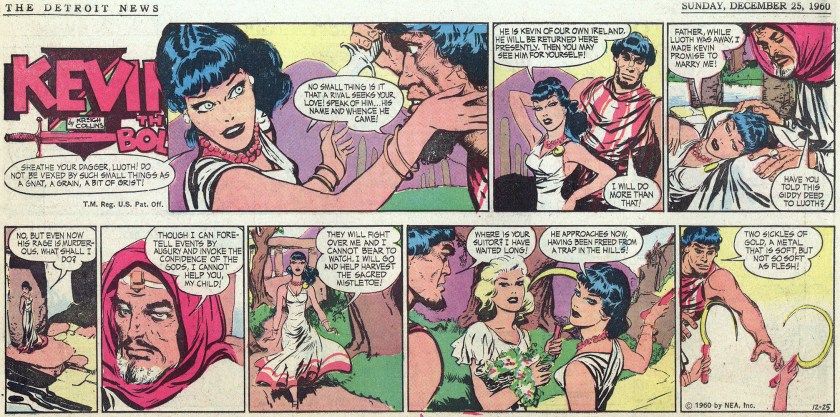
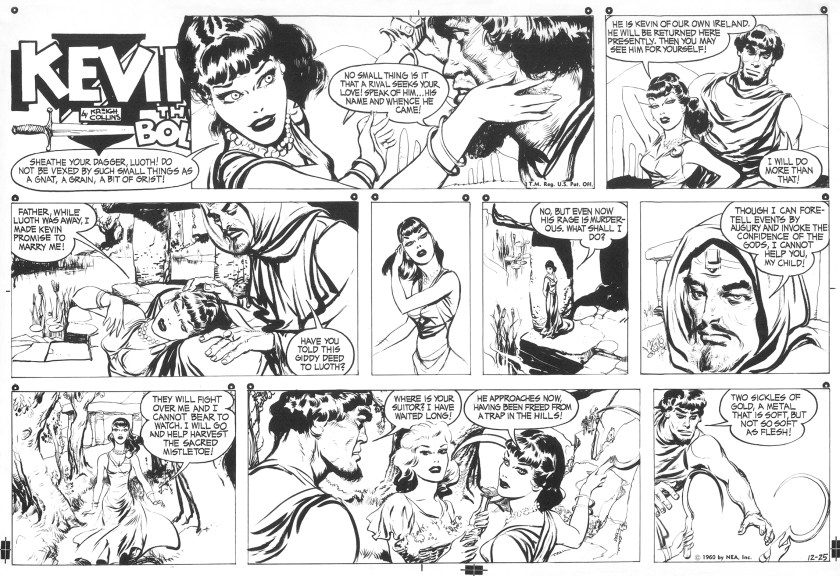
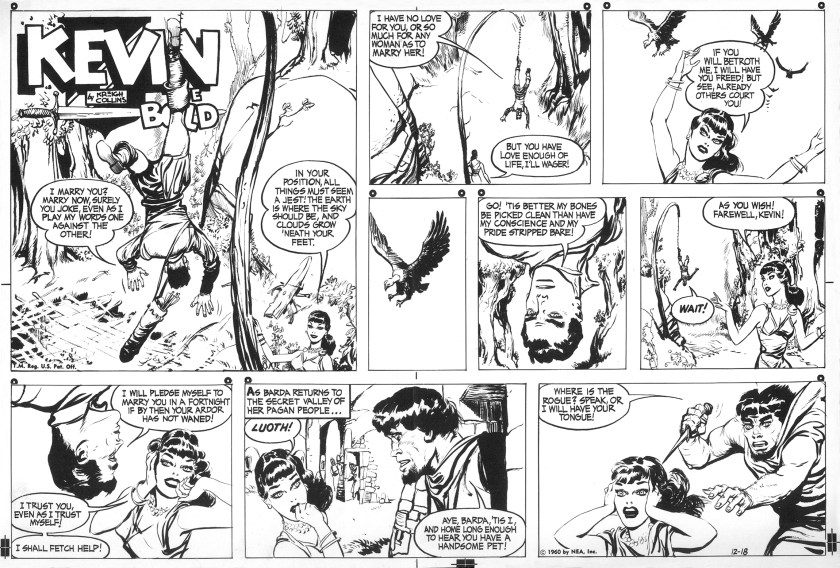
In what could be the worst bachelor party ever, Kevin and Luoth spend the eve of the wedding working hard on a risky and dangerous task.
Following his night of hard labor, Kevin is spent. The panels in the middle tier of the episode above are hysterical—with the first two contrasting the eager bride and the reluctant groom, and the third panel existing somewhere between the screwball and the absurd (and practically begging to be taken out of context). Meanwhile, Kevin faces his moment of truth.
Mascarading as Hercules, Kevin passes one test, but unexpectedly faces another.
Luoth understands that if Barda breaks the engagement, it is mutually beneficial to Kevin and himself. Luoth is willing to take a great risk in order to restore his standing with Barda. Finally, a sudden thunderstorm and some quick thinking allows Kevin to escape his fate as a married man.
For more information on the career of Kreigh Collins, visit his page on Facebook.
I wish I had some color half-pages from this sequence to intersperse with the black and white art, but the printer proofs really accentuate Collins’ wonderful line work. And As you can see, the third-page versions that ran in many newspapers during this era of Kevin left much to be desired. With these shrunken comics, each panel was cropped, and the lovely “throwaway” was eliminated.
For the time being, Barda is able to calm her erstwhile boyfriend’s anger, but her situation proves too sticky for any further help from her father. Though Kevin will have his hands full dealing with the jealous, jilted Luoth, he is as calm and confident as ever.
Someone please hide those scissors!
Quick thinking and a sudden, unlikely alliance buys Kevin time as he tries to dig his way out of trouble.
For more information on the career of Kreigh Collins, visit his page on Facebook.
Barda has a new muse, and she gives her new toy both freedom and fair warning.
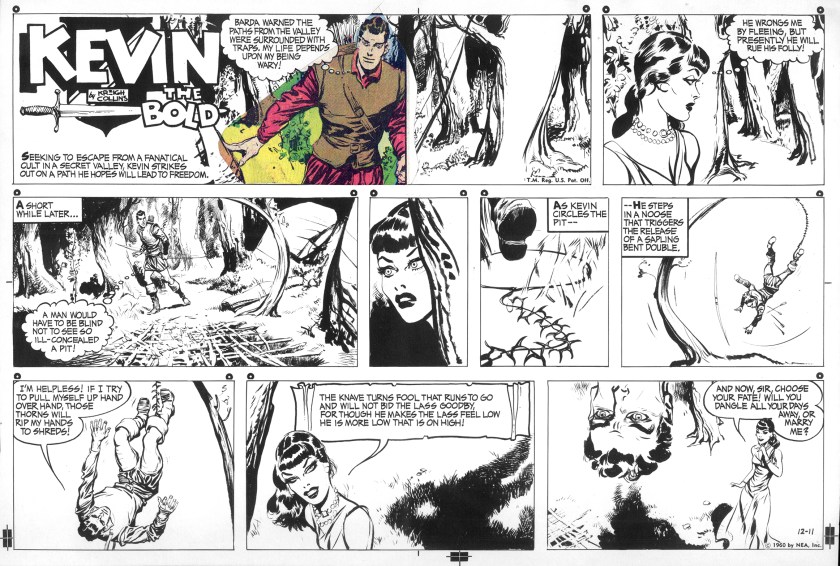
Determined not to make the same mistake twice, Kevin is cautious.
The comic used to patch the hole in this proof reveals the main problem with one-third-page versions—a significant chunk of the opening panel (to the right of Kevin) has been cropped out.
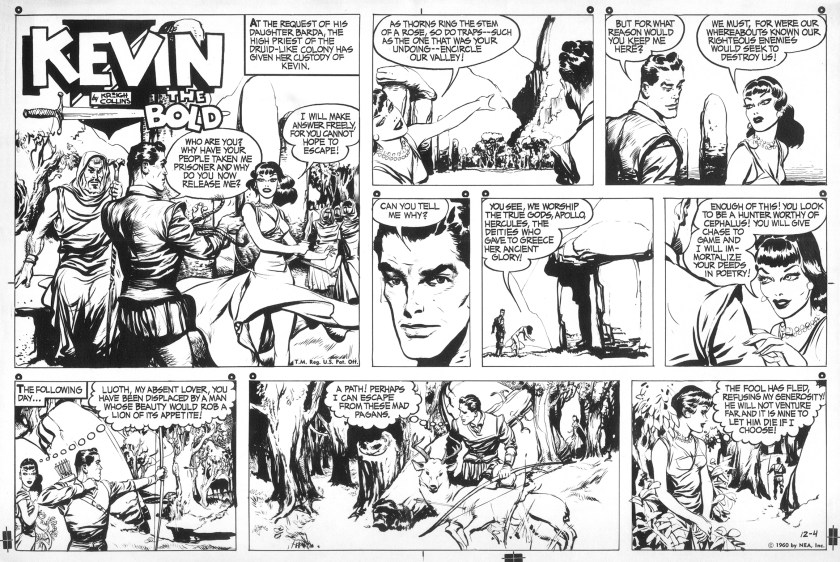
The names of Kreigh Collins’ ancillary characters were generally symbolic. As the child of a druid-inspired cult’s spiritual leader, Barda (“daughter of the earth”) is an appropriate name for a young poetess. Although she seems to relish dominating her love interests, she is not to be confused with Big Barta (a DC comics character with similar proclivities that debuted a decade later).
In the December 11 episode, our poetess riffs on a scene from King Lear (“The knave turns fool that runs…”). Of note, five years down the road Shakespeare would figure even more prominently as inspiration for a “Kevin the Bold” sequence.
Having made Kevin an offer he could not refuse, Barda finds trouble of her own.
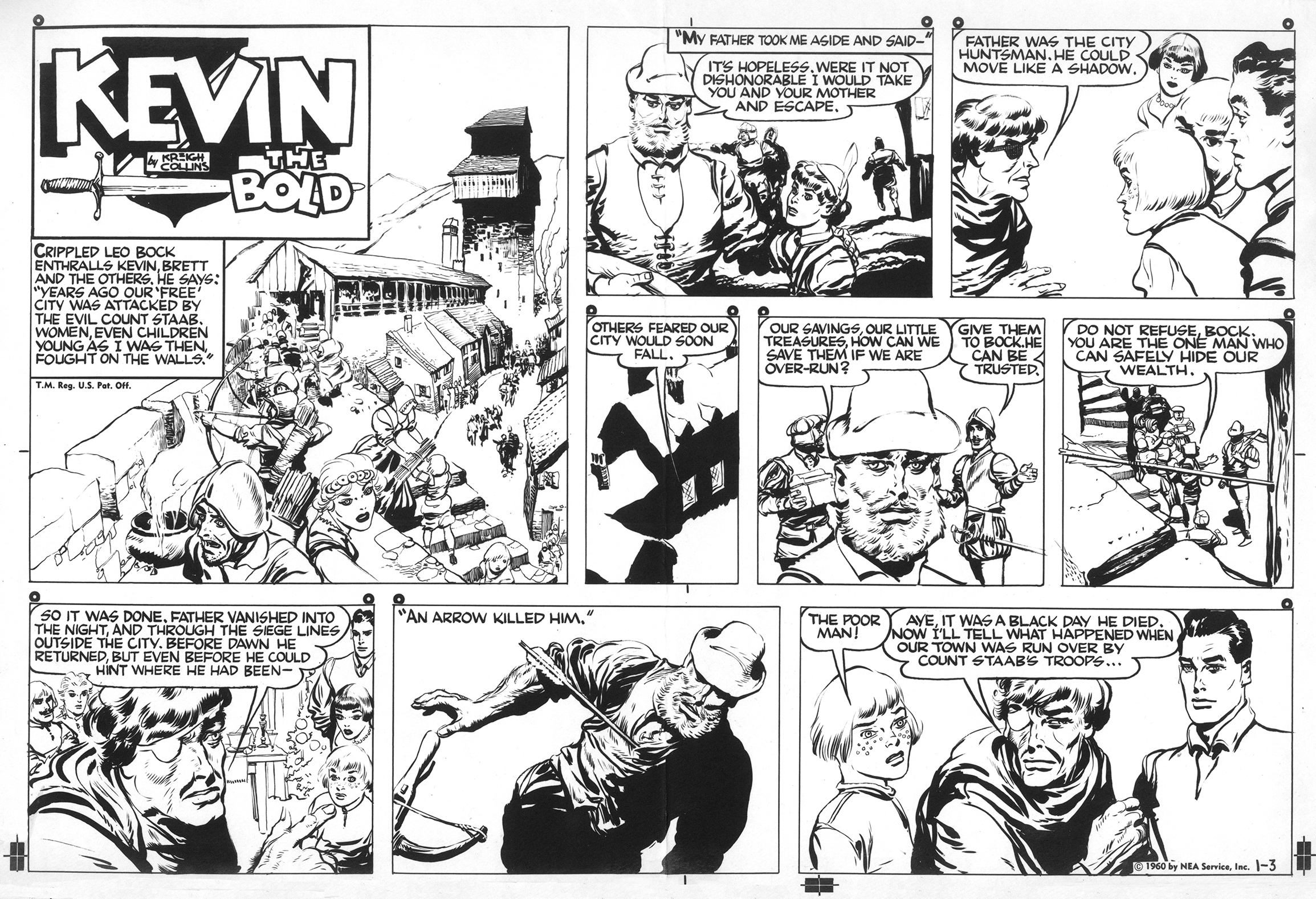
The peak years for “Kevin the Bold” were the 1950s, but by mid-1957, the Chicago Tribune, an early champion of the comic, was running inferior one-third page versions of the strip. While other papers continued running the strip as a half-page, like the Detroit News, many soon followed suit with the dreaded one-thirds.
Finding half-page examples of the comic from the late-50s can be difficult, so I am lucky to have numerous syndicate proofs in my collection. These proofs (veloxes?), show the entire half-page comic, and are printed on a nice heavy stock. Kreigh Collins used these to provide color guides to the NEA. He would paint them with watercolors, and these would be used by the NEA as guides while colorizing the comics. Extra copies of the proofs were kept in Collins’ studio, and sometimes these ended up being used like coloring books by either his youngest sons or his grandchildren. In retrospect, it’s a real shame, but at the time it probably seemed like a “grand” idea (to use a word that reminds me of Gramma Collins). While some of these proofs were colored or painted on, others suffered a worse fate, as the aspiring artists attempted collages, apparently, cutting holes in the proofs with scissors.
The following sequence, which ran from November of 1960 to January of ’61, has 11 episodes. I have cleaned up one that was painted on (our young artist hadn’t gotten very far with the November 27 episode—for once a short attention span proved beneficial), and I used some one-third page comics to patch up two others.
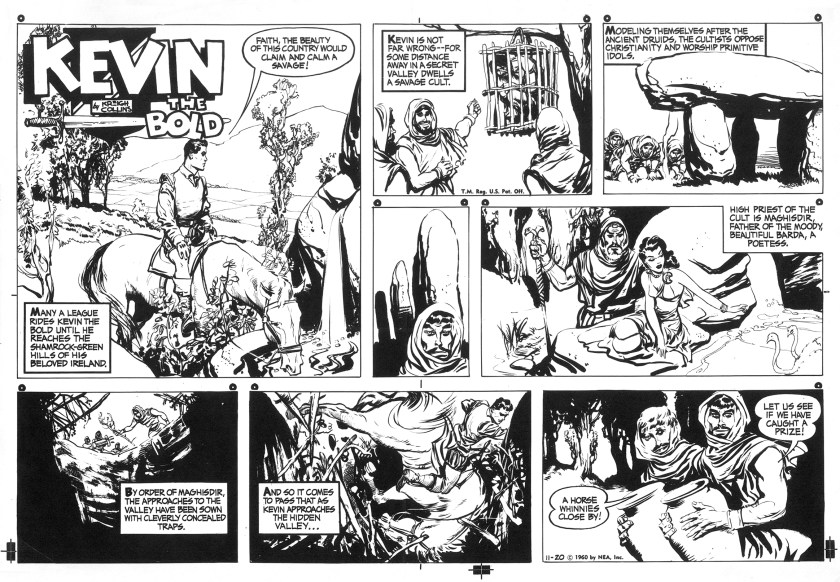
Despite these flaws, the sequence itself is wonderful. It contains all of the strip’s classic elements: beautiful scenery, a gorgeous young woman (smitten with Kevin, naturally), mystery, and action, plus a nice feat of engineering. It begins with Kevin taking a needed break from his adventures; he has returned alone to Ireland.
After falling into the trap, Kevin’s captors comment on his size and strength, comparing him to one of the ancient gods they worship. Despite his appearance, a perplexed Kevin is released to Barda, the daughter of the cult’s leader.
For more information on the career of Kreigh Collins, visit his page on Facebook.
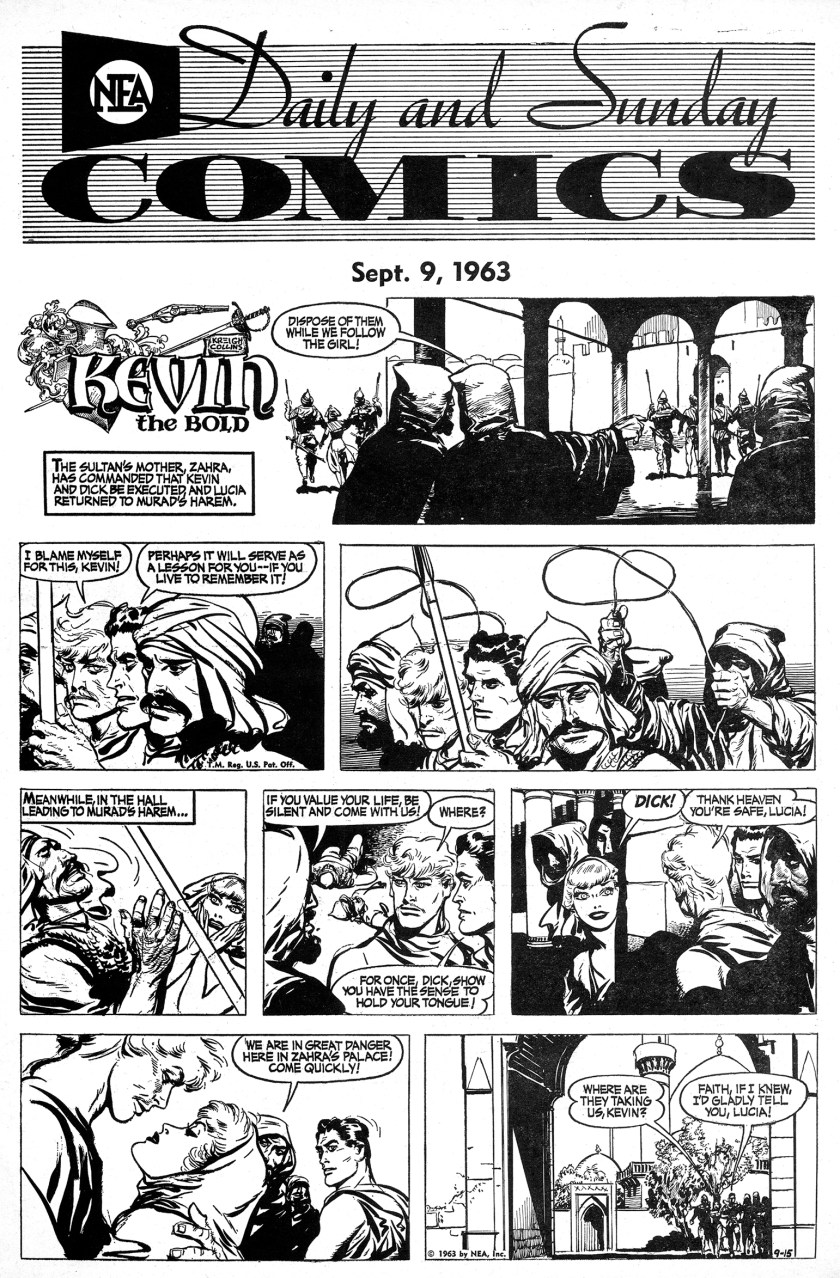
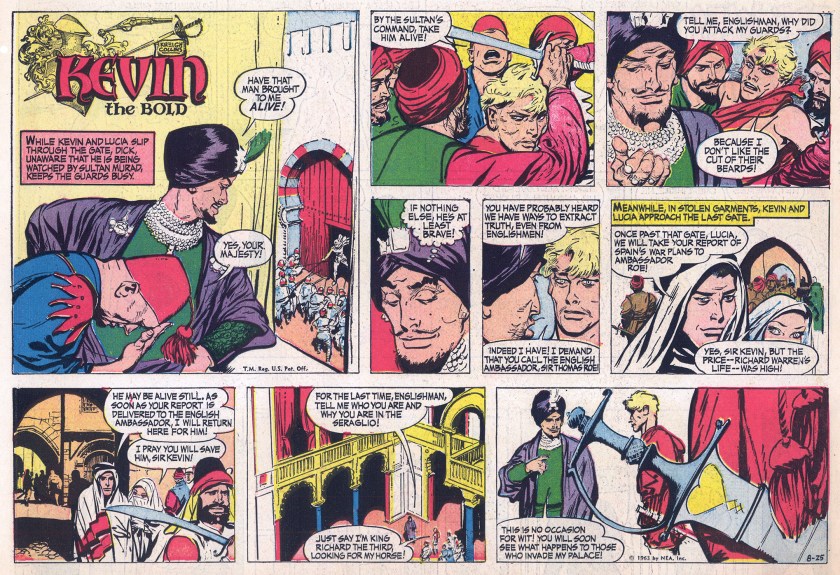
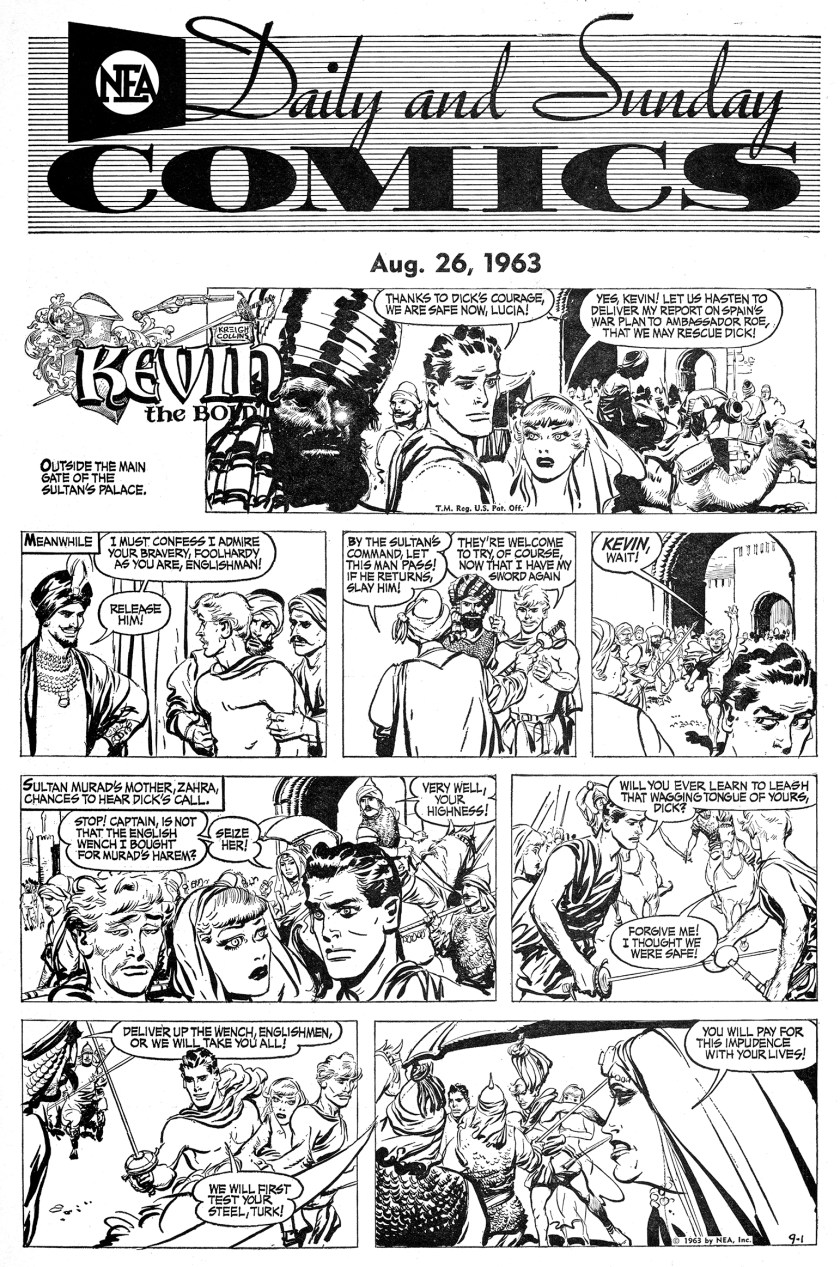
After experiencing Sir Richard’s foolhardiness first hand, Kevin witnesses it again. This time it seem certain that it will cost Sir Richard his life.
In a shocking turn of events, Sultan Murad releases Richard. And sure enough, the foolish Englishman puts them all in harm’s way again. How many times can Kevin overcome Richard’s ineptitude?
For more information on the career of Kreigh Collins, visit his page on Facebook.
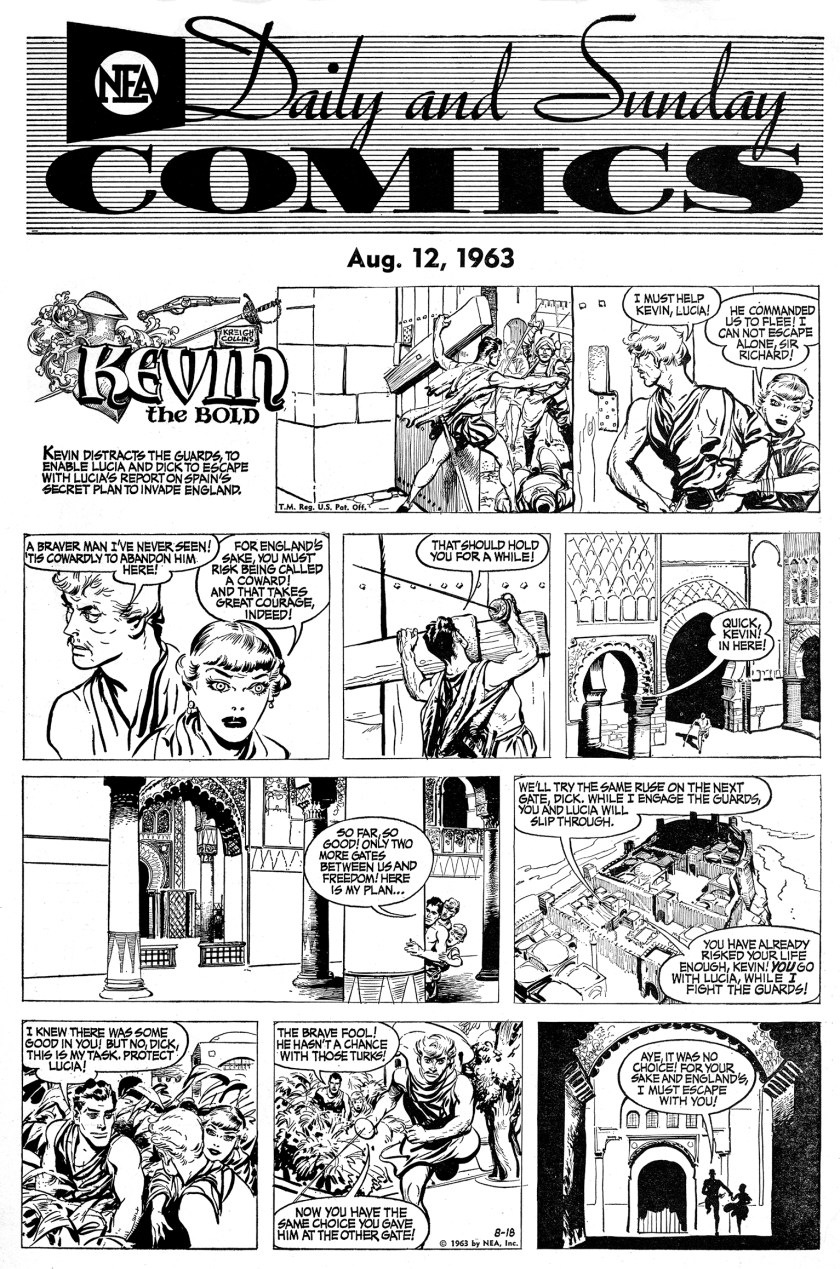
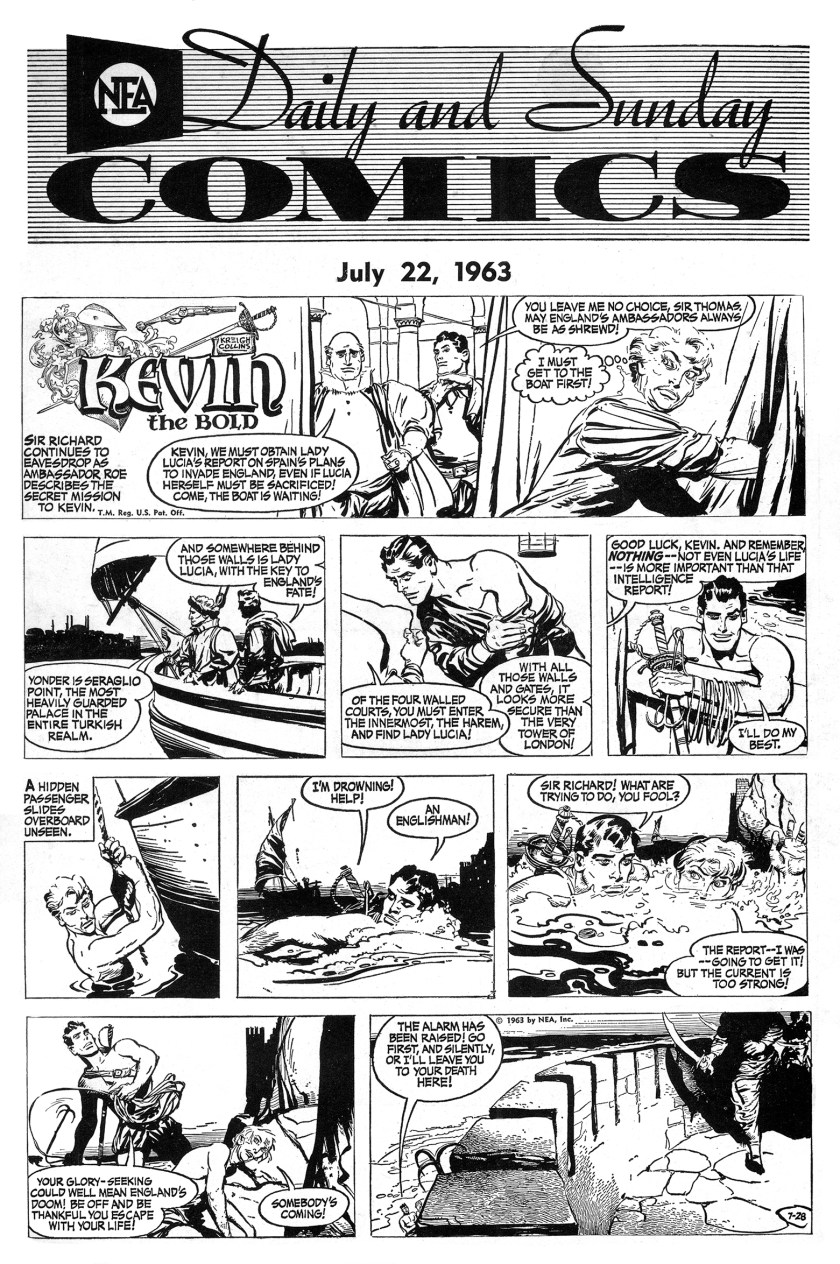
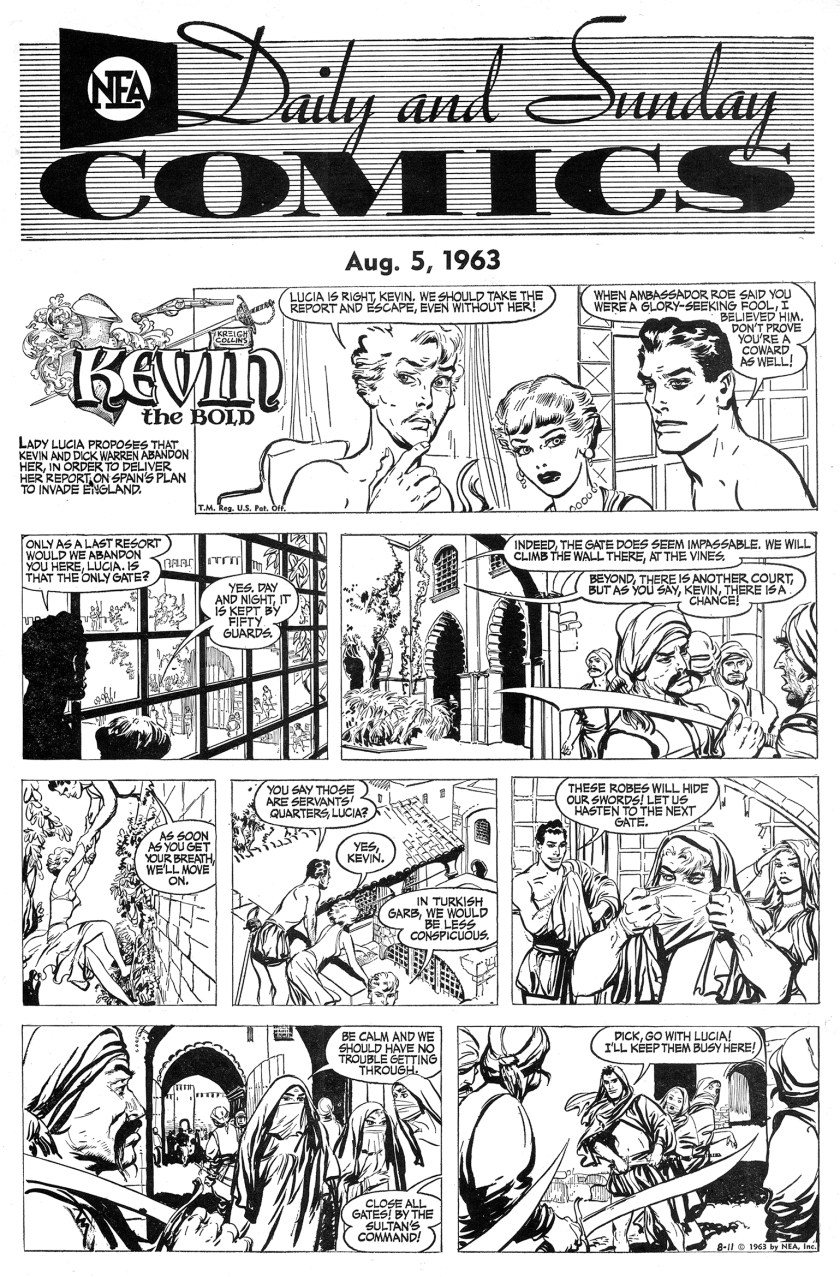
As this new adventure begins, Kevin is aboard a sailboat near Istanbul, a seemingly unusual place to secure intel on Spain’s plans to invade England.
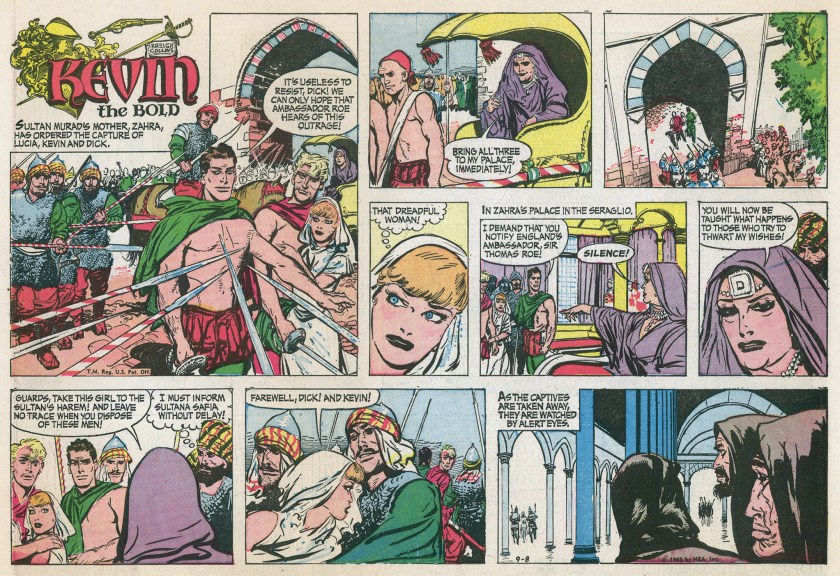
Due to the reference to Sultan Murad (III), the events depicted would be occurring c. 1580, the height of the Ottoman Empire. Kevin and tagalong Sir Richard are set to rescue the fetching English spy, Lucia.
The August 11 episode is a marvel, and Collins’ beautiful line work is fully on display in the NEA Daily. Despite Sir Richard’s timely suggestion to change into less conspicuous clothing, their daring escape is noticed.
For more information on the career of Kreigh Collins, visit his page on Facebook.
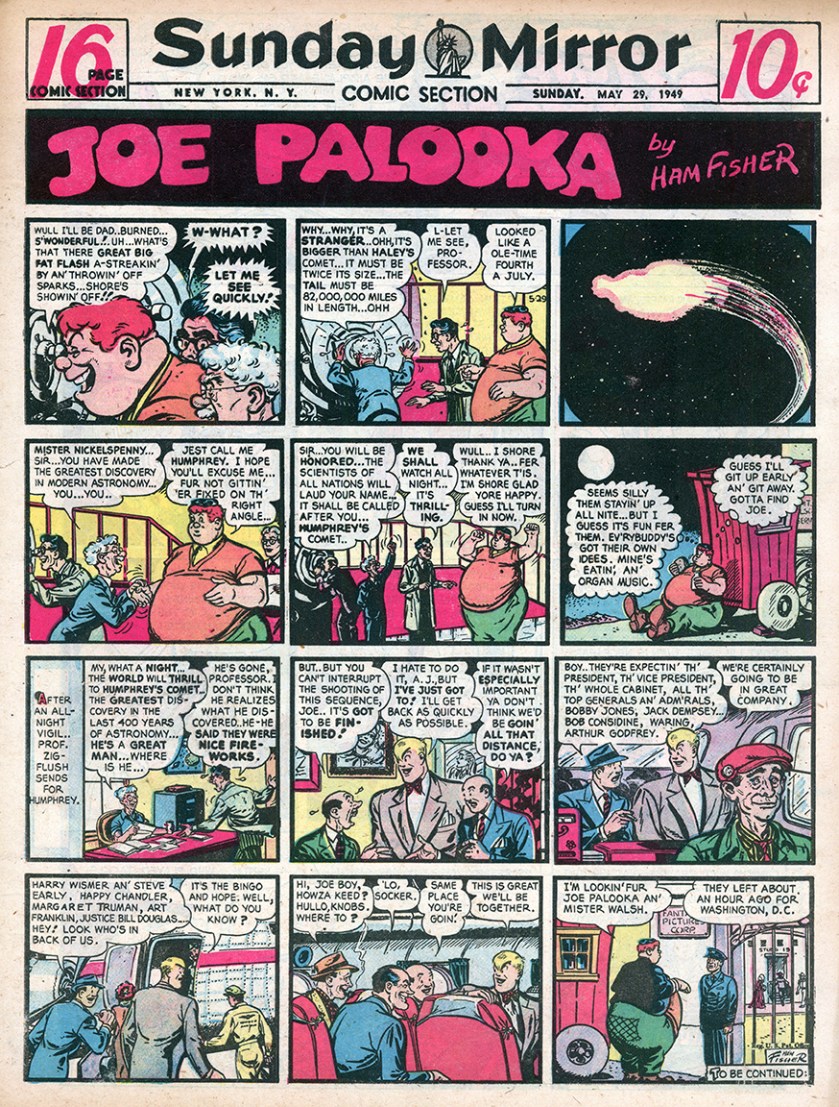
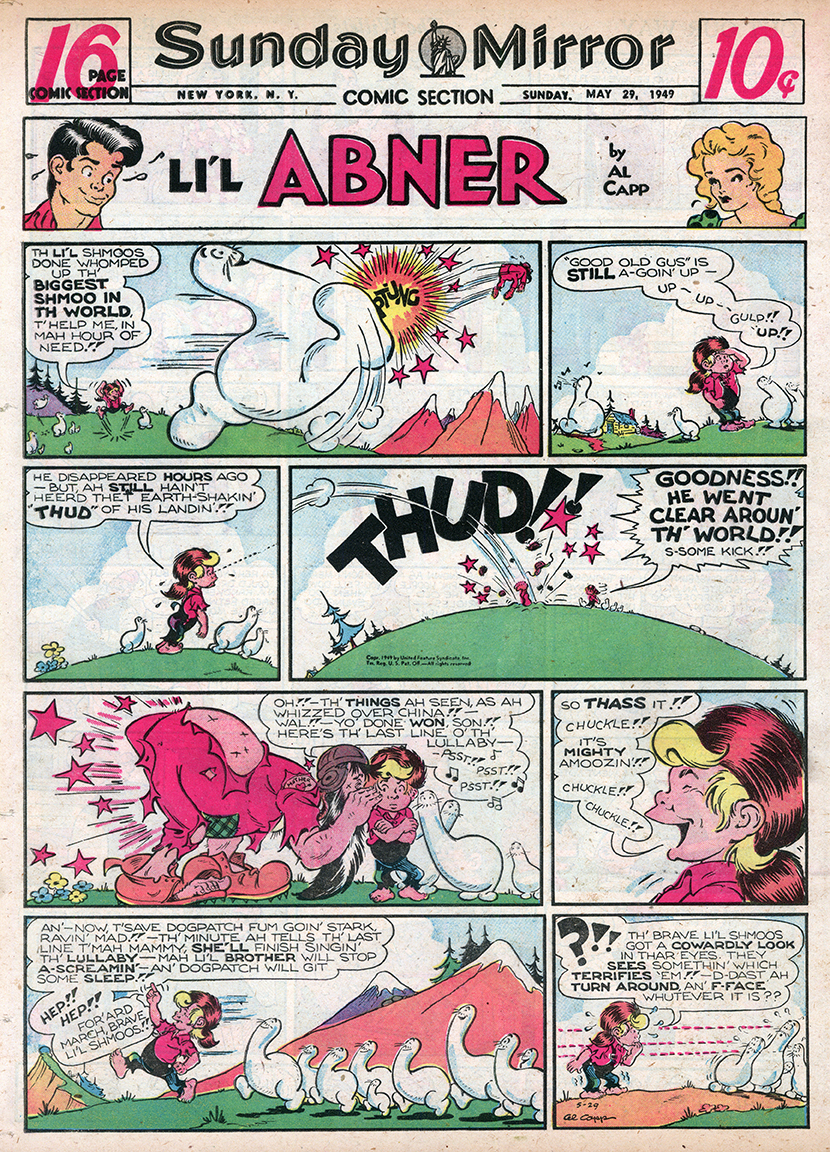
When I was putting together The Lost Art of Kreigh Collins, Vol. 1, The Complete Mitzi McCoy, a late stumbling block was finding replacement comics for the episodes I only had third-page examples of. Ironically, after searching far and wide for several years, I located them in a comic book shop about a dozen miles from my home. The catch was that I had to purchase them as part of complete comic sections. I left the shop with six 16-page New York Sunday Mirror Sunday comic sections and while I spent far more than I hoped, my quest was over. The Mirror carried MITZI for the duration of its run—usually in a half-tabloid format, but occasionally as a full tabloid page. Flipping through it reveals both big name features and comics now forgotten.
As usual, Ham Fisher’s JOE PALOOKA ran on the front page, followed by Milton Caniff’s STEVE CANYON and MICKEY FINN by Lank Leonard. Next up are HENRY by Carl Anderson, KERRY DRAKE, and SUPERMAN (neither credited, but by Alfred Andriola/Allen Saunders and Stan Kaye/Wayne Boring respectively). Then it was THE FLOP FAMILY by Swan, an advertisement for Philip Morris tobacco, and Frank Miller’s BARNEY BAXTER IN THE AIR.
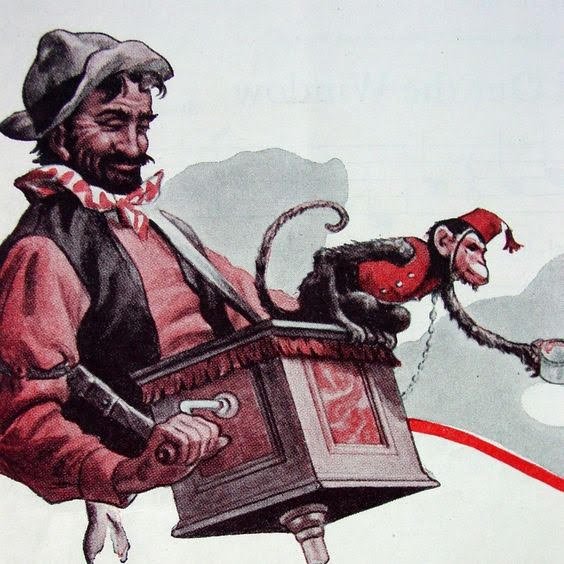
The Philip Morris ad is interesting, it promotes both cigarettes and pipe tobacco. In the cigarette portion of the ad, Dick is behaving like a dick—due to a sore throat (caused by some other brand of smokes). He is given advice by a character dressed in a bizarre uniform who seems to be a golf course clubhouse attendant (was the illustrator’s reference an organ grinder monkey?), and appears to be about nine years old. Astonishingly, the dapper dandy offers Dick a Philip Morris cigarette, and ultimately, Dick’s love life is back on track. (Perhaps the attendant is an adult but his cigarette habit stunted his growth?)
The pipe tobacco portion of the ad, masquerading as a topper strip, has a character mentioning that he was from the class of ’89. With this newspaper edition dating to 1949, that means the gent was class of 1889 (!). Another character claims she loves the clean, fresh smell of her husband’s pipe. (Could it be that tobacco companies lied to consumers? Egad).
For me, the funny pages’ highlight probably falls into a category I mentioned earlier, “comics now forgotten.” This episode, MITZI McCOY’s 30th, is from the middle of the strip’s fourth story arc, and appears in the half-tabloid format. Half-tabs have small dimensions, but they include the throwaway panel, which full-page tabloid versions do not. It’s a sweet episode where a runaway child is discovered, and is notable for not showing the strip’s titular character. Of personal interest to me is the appearance of the child, Dick. Like many artists, Kreigh Collins used his family as models; for Dick, the model was my father, Erik—Kreigh’s oldest son. Dad was 10 years old when this episode was drawn. Sharing a page with MITZI is an advertisement for Pepsi, a rather saccharine affair with another kid saving the protagonist’s love life.
Next up were Harry Hanan’s silent comic LOUIE and an ad for Kellogg’s Corn Flakes (completely devoid of relationship advice from youngsters—how refreshing!). A page with Roy Crane’s CAPTAIN EASY, drawn here by Walt Scott, and V.T. Hamlin’s ALLEY OOP FOLLOWS; opposite these two strips is an ad for Fab detergent. The ad features a cartoonish family looking suspiciously similar to the family from the Corn Flakes ad, and hypes a pretty cool giveaway—a free house!—valued at $18,000 (things have certainly changed in the last 74 years!). then it’s Frank Godwin’s RUSTY RILEY, REX MORGAN, MD by Bradley and Edgington, BOOTS by Martin, and Merrill Blossar’s FRECKLES AND HIS FRIENDS (plus the topper strip HECTOR).
The last full spread in the section features OUT OUR WAY by J.R. Williams, PLUS OUR BOARDING HOUSE.
Taking its usual spot on the back cover is LIL’ ABNER by Al Capp.
Want to See More of Mitzi?
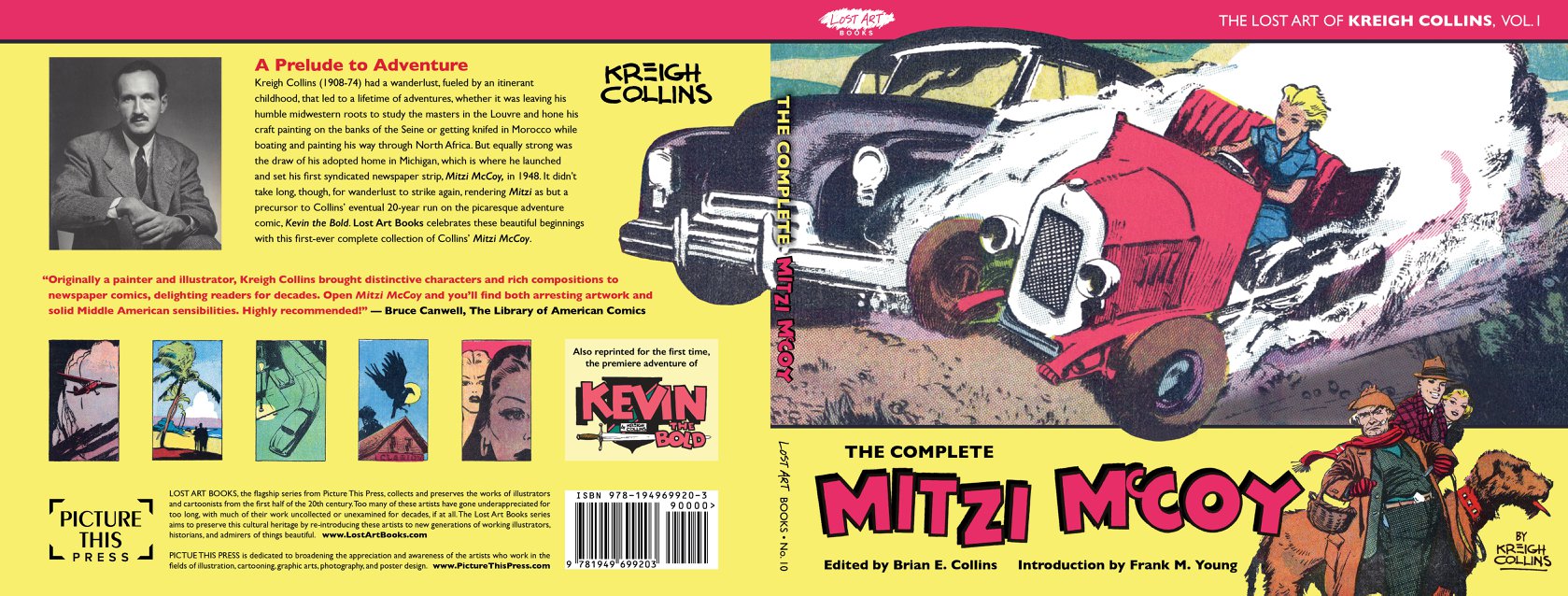
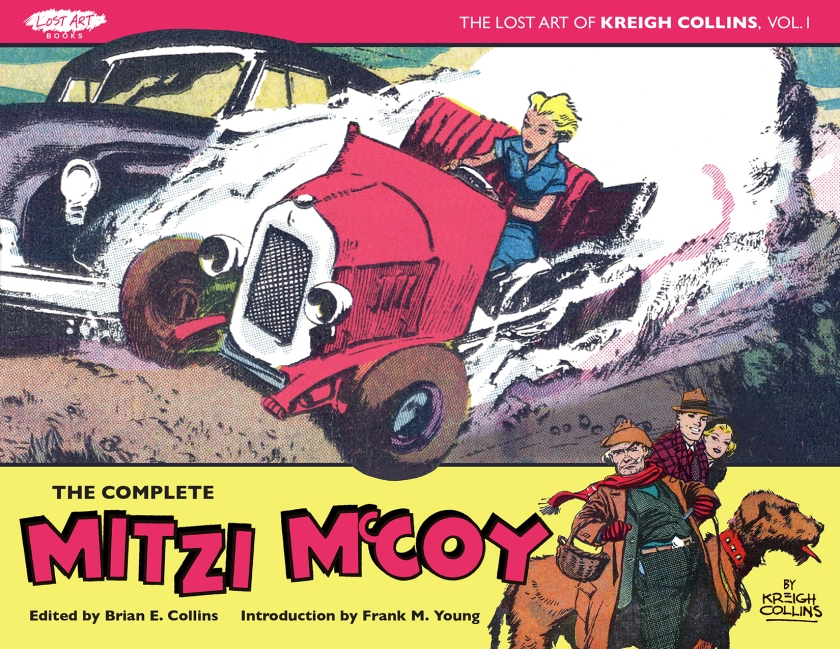
“The Lost Art of Kreigh Collins, the Complete Mitzi McCoy” features the entire run of Kreigh Collins’ first NEA feature.
MITZI McCOY ran from 1948 to 1950 and showcased Kreigh Collins’ skill as an illustrator and storyteller. His picturesque landscapes, lovely character designs, and thrilling action sequences brimmed with detail and charm, and the strip’s ensemble cast rotated in and out of the spotlight taking turns as protagonists in the dozen story arcs collected in this volume. The last story collected in “The Complete Mitzi McCoy” is the narrative bridge that set Collins and his characters off on a new journey, beautifully told for the next couple of decades in the much-lauded adventure strip Kevin the Bold.
The collection includes an introduction by Eisner Award-winning author Frank M. Young, an Afterward by Ithaca College’s Ed Catto, and previously unpublished artwork and photos. Longtime comics artist Butch Guice also provides a new pin-up of the character Mitzi McCoy.
The book is available for $30. For domestic shipping, add $4; for international orders, please add $25 to cover first class shipping. To place an order, leave a comment below or email me at BrianEdwardCollins1[at]gmail.com, and I will give you PayPal or Venmo information. Thank you!
For more information on the career of Kreigh Collins, visit his page on Facebook.
Whenever this blog’s anniversary rolls around, I try to come up with something interesting and comprehensive. This year, I decided to create an outline of all the chapters of my grandfather’s Sunday comics.
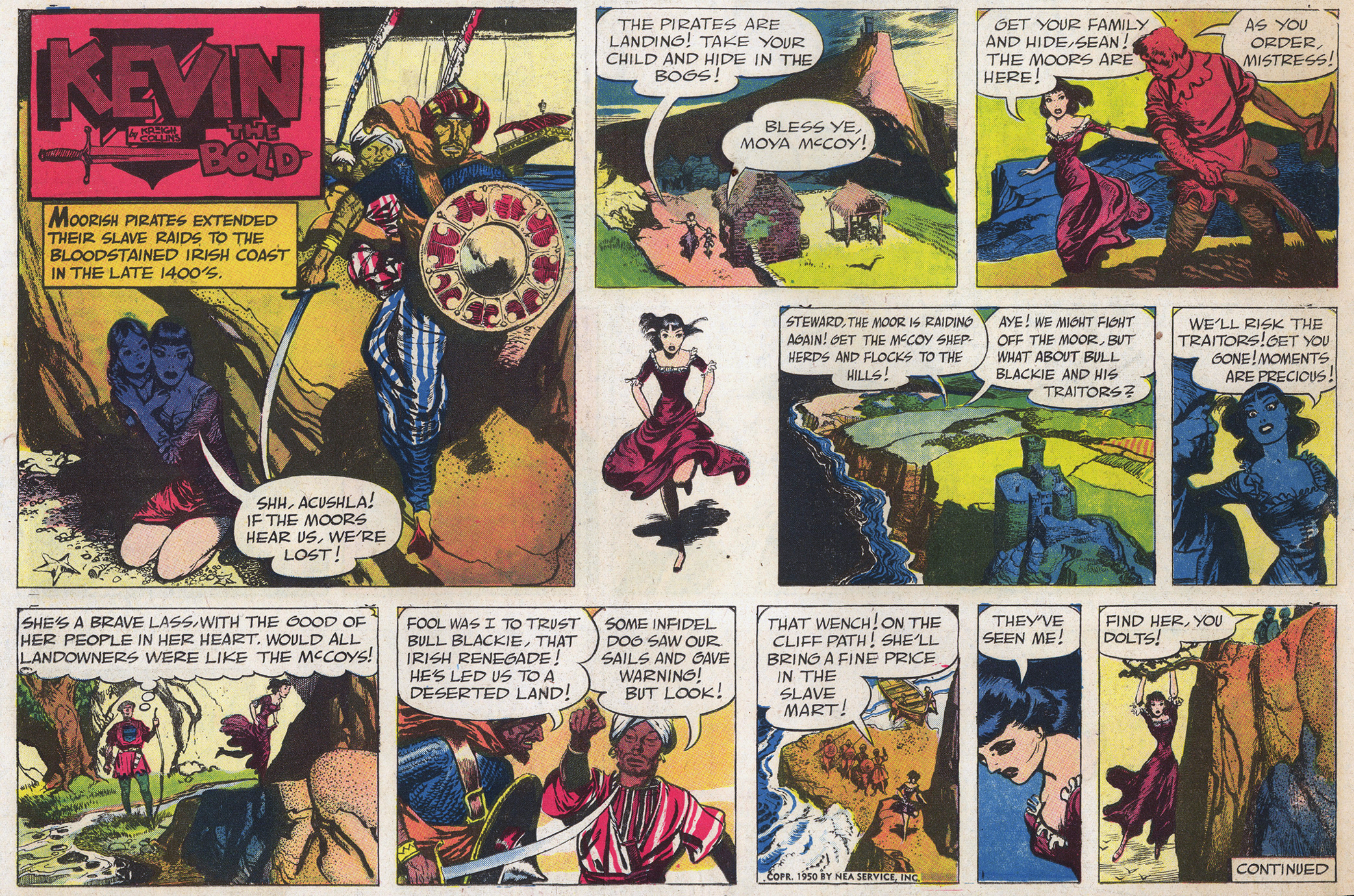
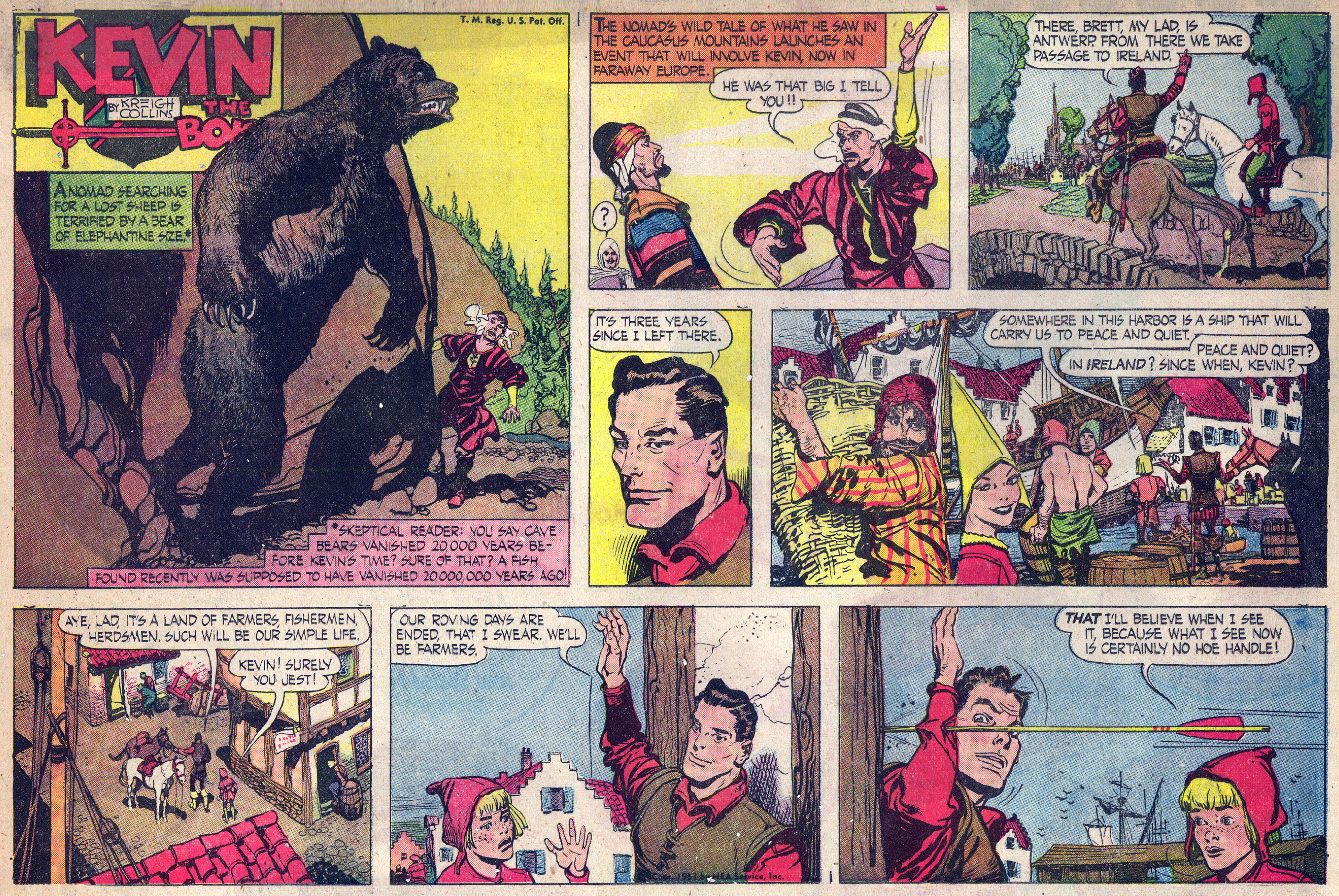
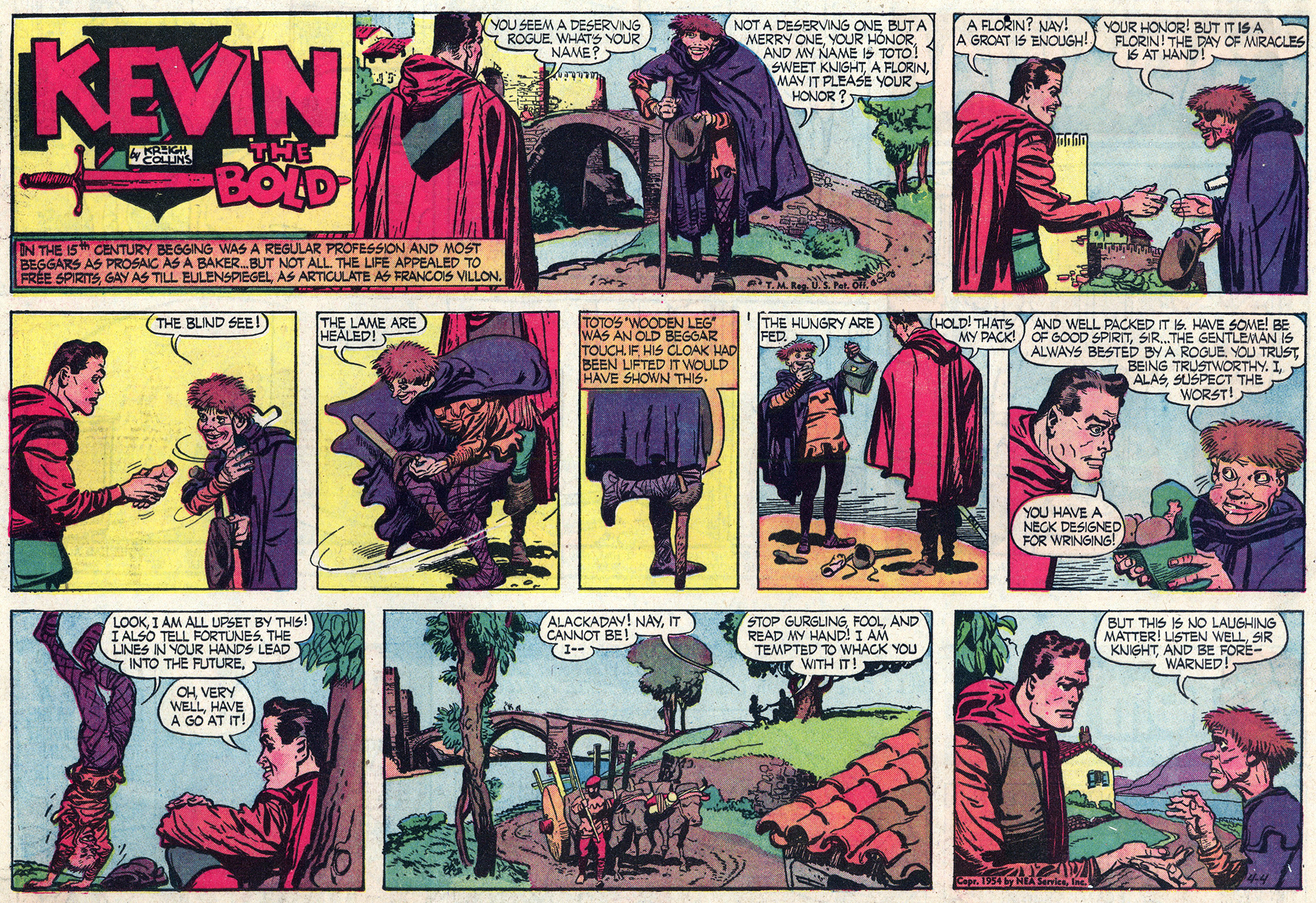
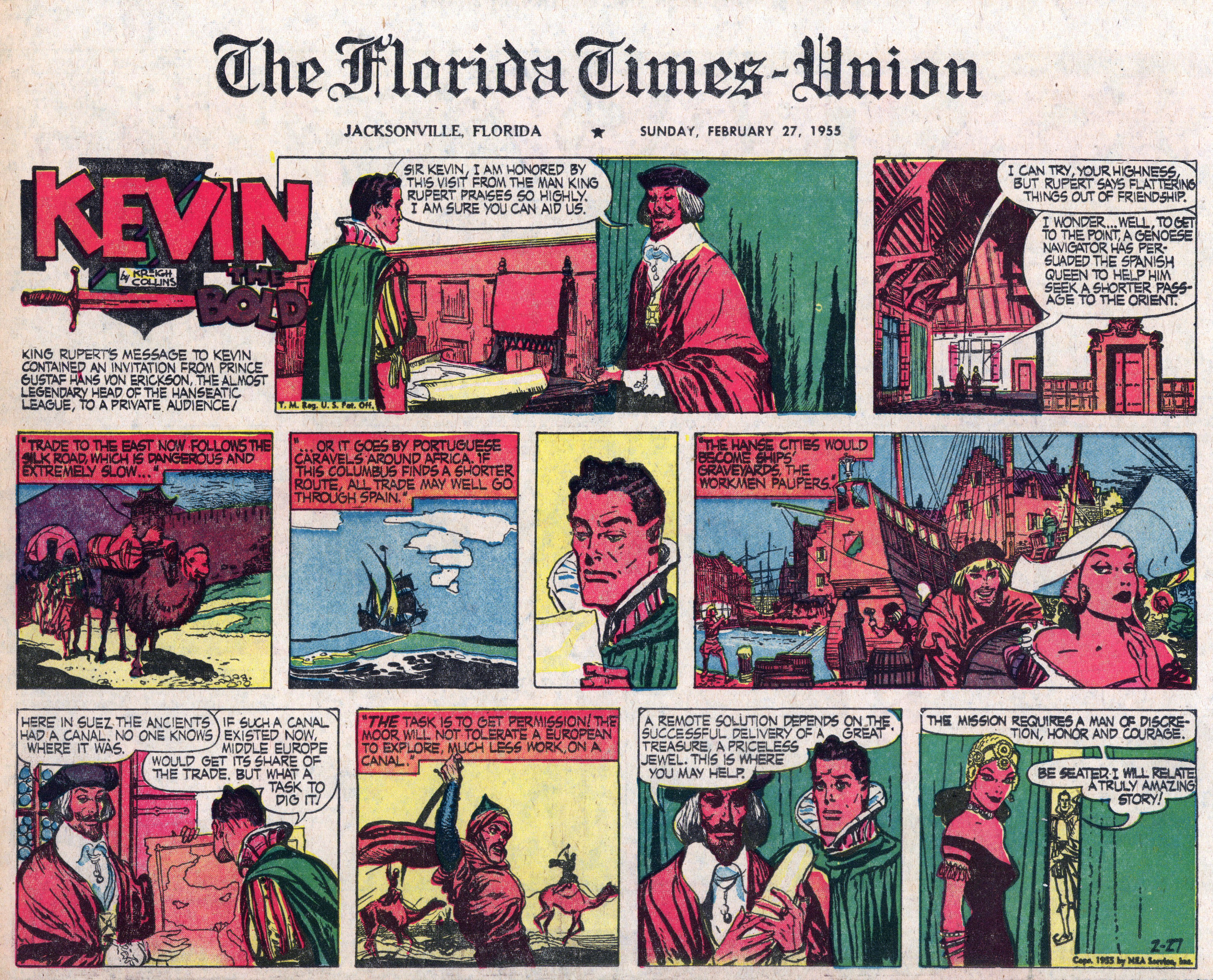
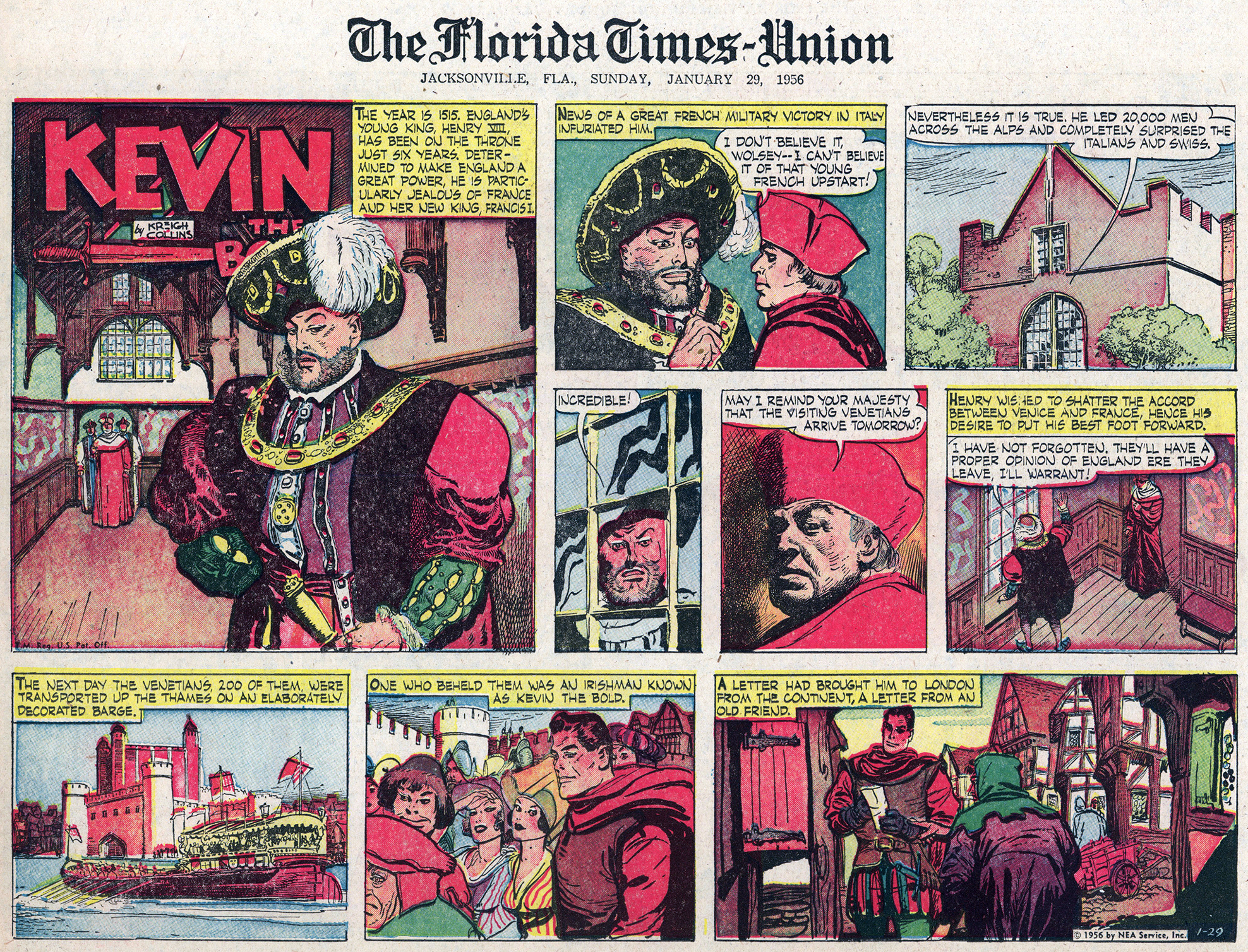
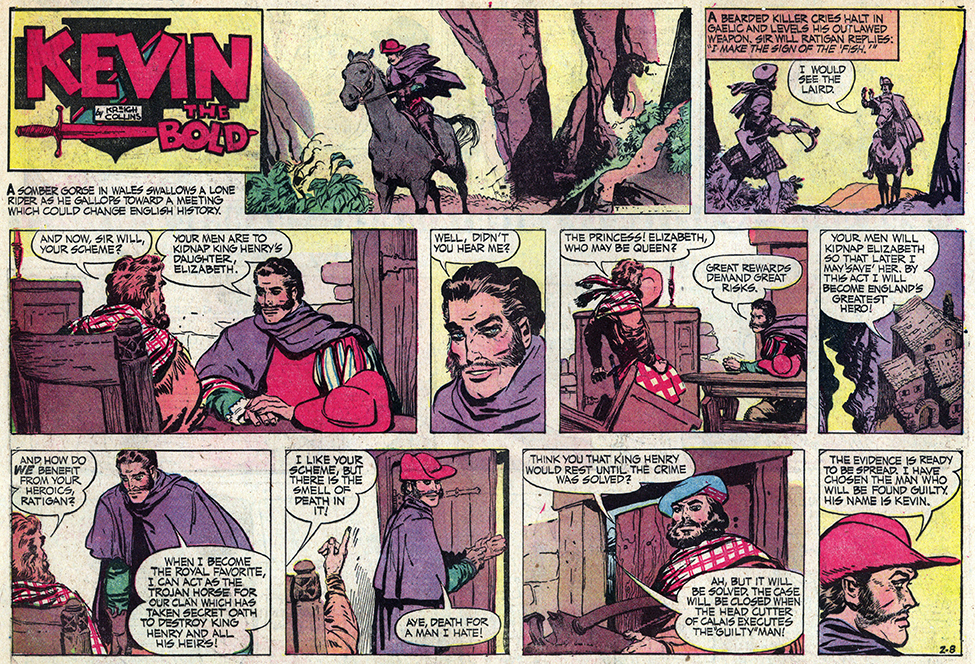
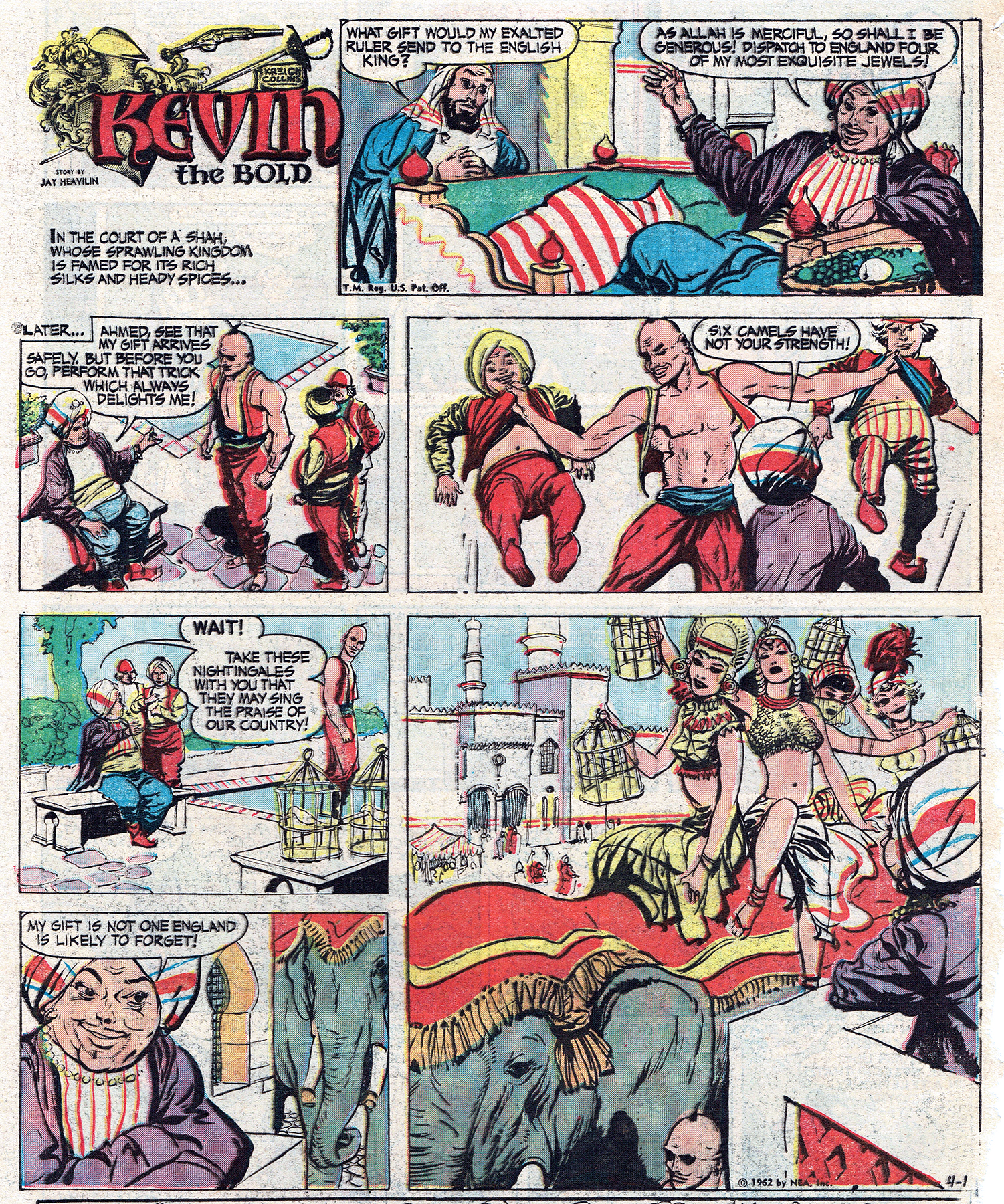
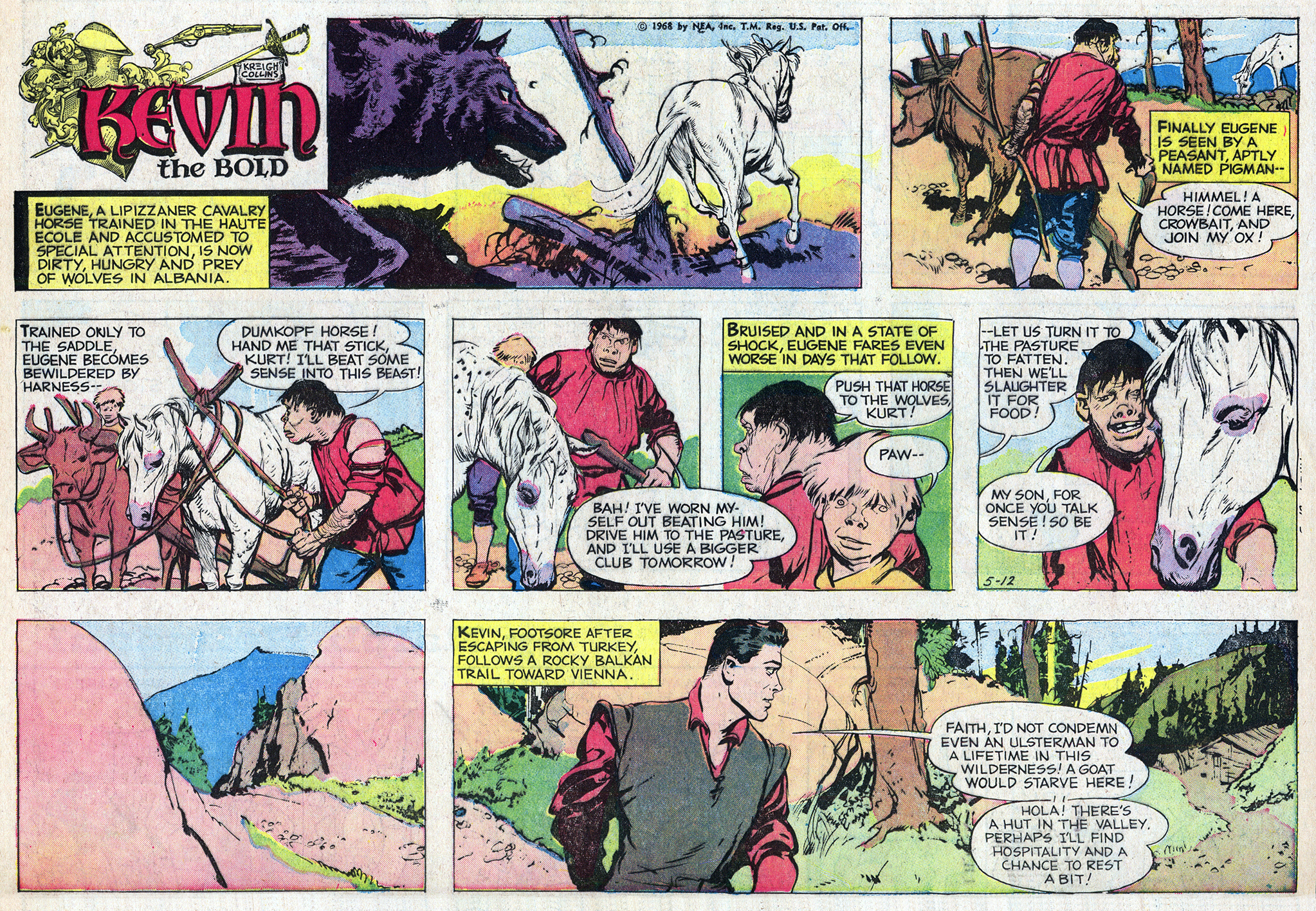
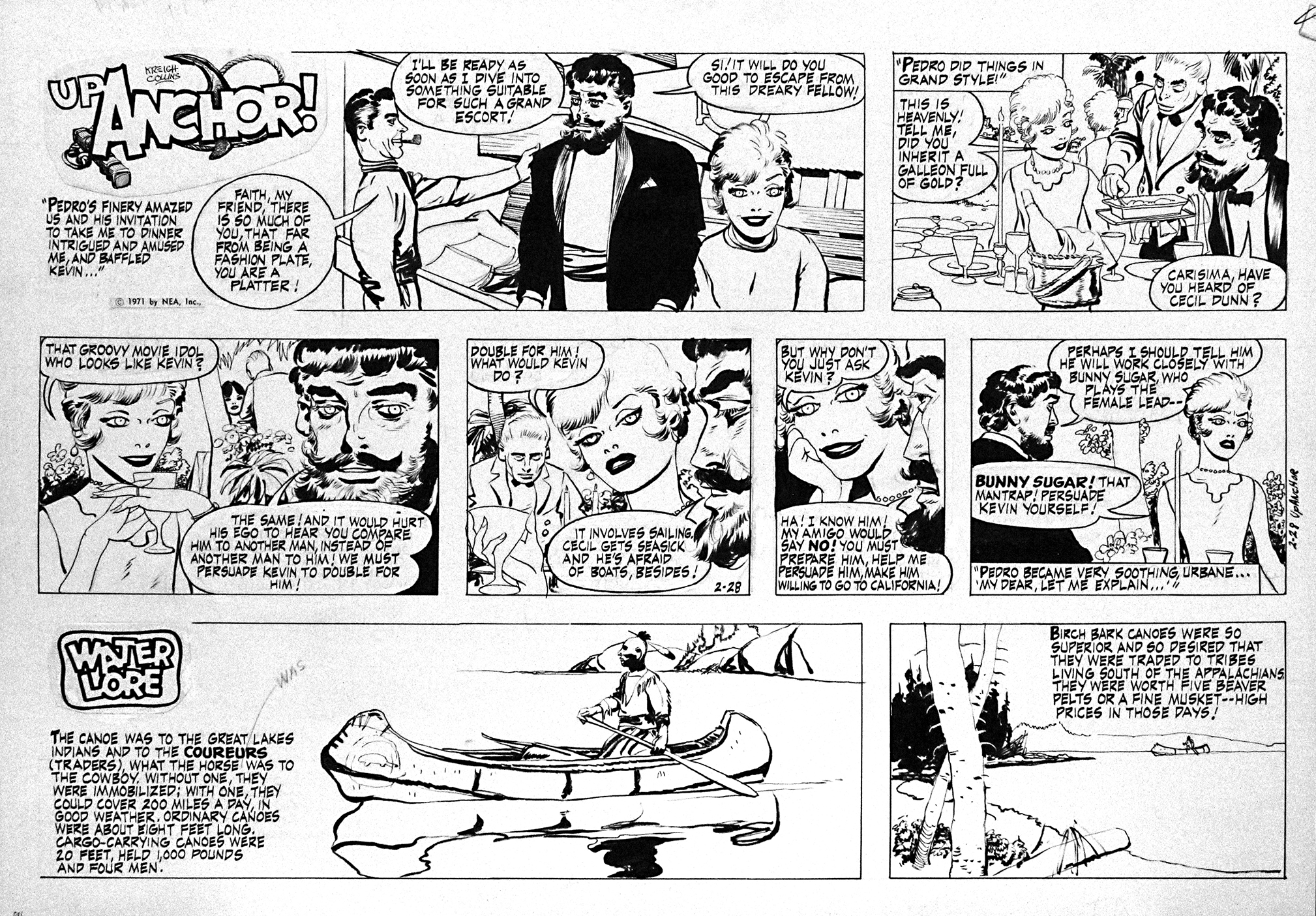
Kreigh Colins’ career as an NEA-syndicated cartoonist lasted for over 23 years. MITZI McCOY debuted in 1948 and ran for a couple years before it morphed into KEVIN THE BOLD in 1950. In 1968 it morphed again into UP ANCHOR! In all, they added up to 1,221 Sunday episodes spread across 105 chapters.
Here is the list, with links to the corresponding blog posts where applicable. (Apologies in advance for any linking errors! If you find one, please let me know). The chapter titles listed below aren’t official, they’re just things I came up with, often based on the villain or where the action takes place.
1966 78. Kevin the Warlock (from Dutch comic book) 79. The Search for the Northwest Passage 80. Sir Frances Drake 81. Stormy 82. The Story of the Norman Conquest (English and Serbian versions)
1967 83. Sir John Drayke Returns from Hispanola 84. Tankard the Bold 85. The True Story of Captain John Smith 86. Leonardo DaVinci Redux 87. Buried Treasure
“The Lost Art of Kreigh Collins, the Complete Mitzi McCoy” features the entire run of Kreigh Collins’ first NEA feature.
MITZI McCOY ran from 1948 to 1950 and showcased Kreigh Collins’ skill as an illustrator and storyteller. His picturesque landscapes, lovely character designs, and thrilling action sequences brimmed with detail and charm, and the strip’s ensemble cast rotated in and out of the spotlight taking turns as protagonists in the dozen story arcs collected in this volume. The last story collected in “The Complete Mitzi McCoy” is the narrative bridge that set Collins and his characters off on a new journey, beautifully told for the next couple of decades in the much-lauded adventure strip Kevin the Bold.
The collection includes an introduction by Eisner Award-winning author Frank M. Young, an Afterward by Ithaca College’s Ed Catto, and previously unpublished artwork and photos. Longtime comics artist Butch Guice also provides a new pin-up of the character Mitzi McCoy.
The book is available for $30. For domestic shipping, add $4; for international orders, please add $25 to cover first class shipping. To place an order, leave a comment below or email me at BrianEdwardCollins1[at]gmail.com, and I will give you PayPal or Venmo information. Thank you!
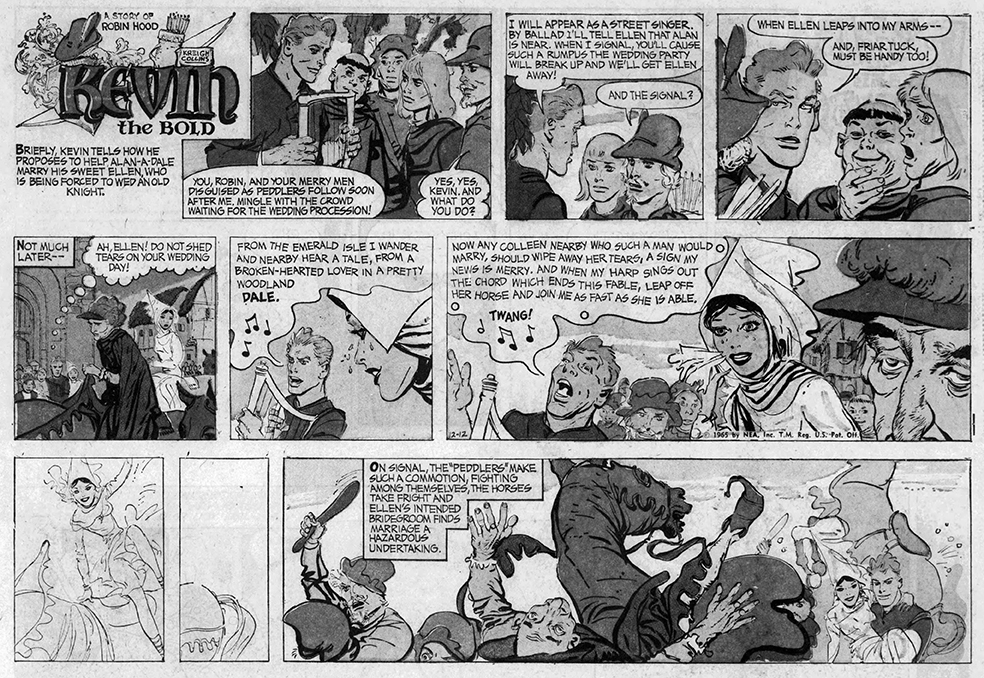
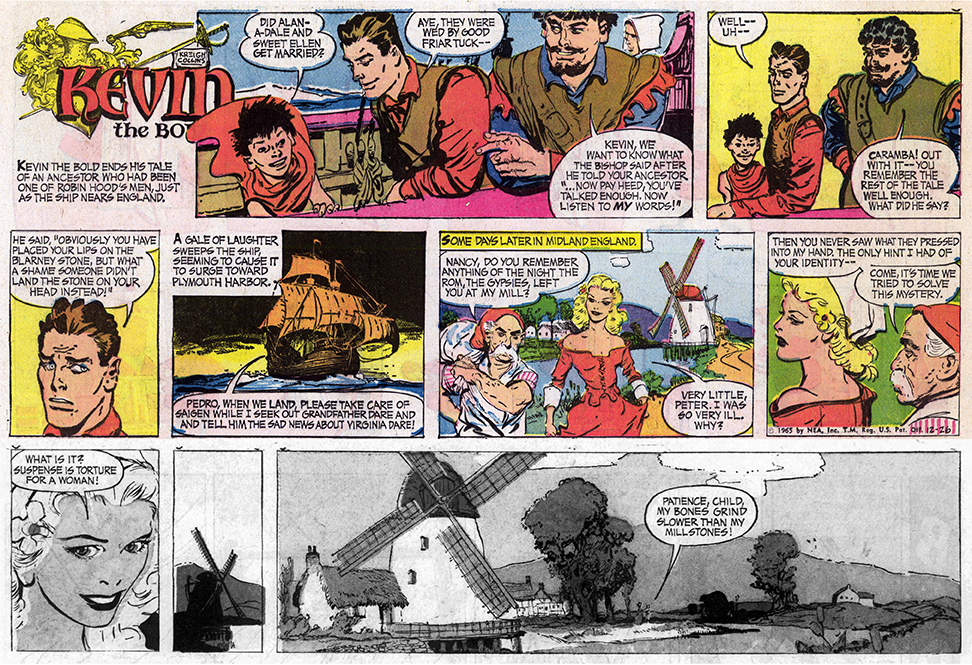
Among the more than 900 episodes that appeared over 18 years, the December 12, 1965 installment is one of a handful of KEVIN THE BOLD pages missing from my collection. Until I discovered Newspapers.com, I was unsure how Kevin was able to broker the union between Ellen and Alan-a-Dale.
Kevin’s plan begins smoothly, but an obstacle is found in the form of the Bishop who intends to marry Ellen to Sir Guy.
The story within a story ends, as Kevin’s tale of Robin Hood reaches its conclusion (recall how Kevin’s narrative came at the end of the “Lost Colony or Roanoke” story arc). Young Saigen was satisfied with the tale, but one thing still puzzled Pedro.
Next week is Christmas, and if you celebrate the holiday, I hope you are fortunate enough to receive a gift as wonderful as one that was recently delivered to me.


























 Kreigh’s Comics