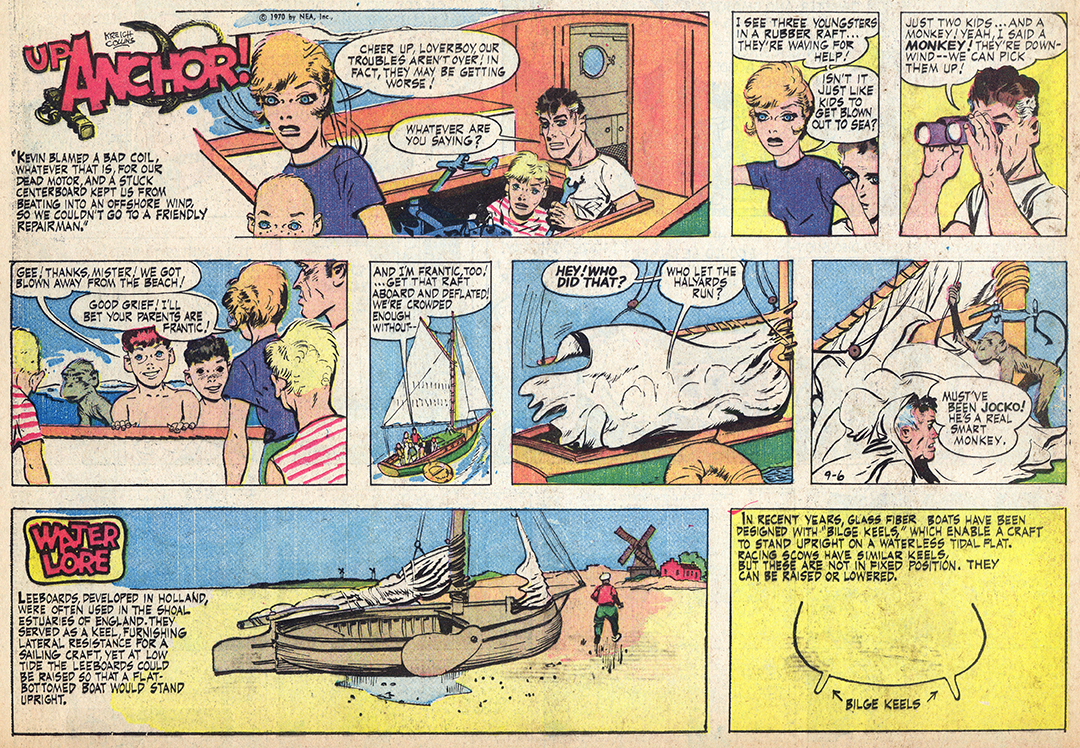
Since rescuing two kids and their monkey from a drifting rubber raft, everything that could go wrong did go wrong. However, Heather’s crew is pretty good at problem solving.
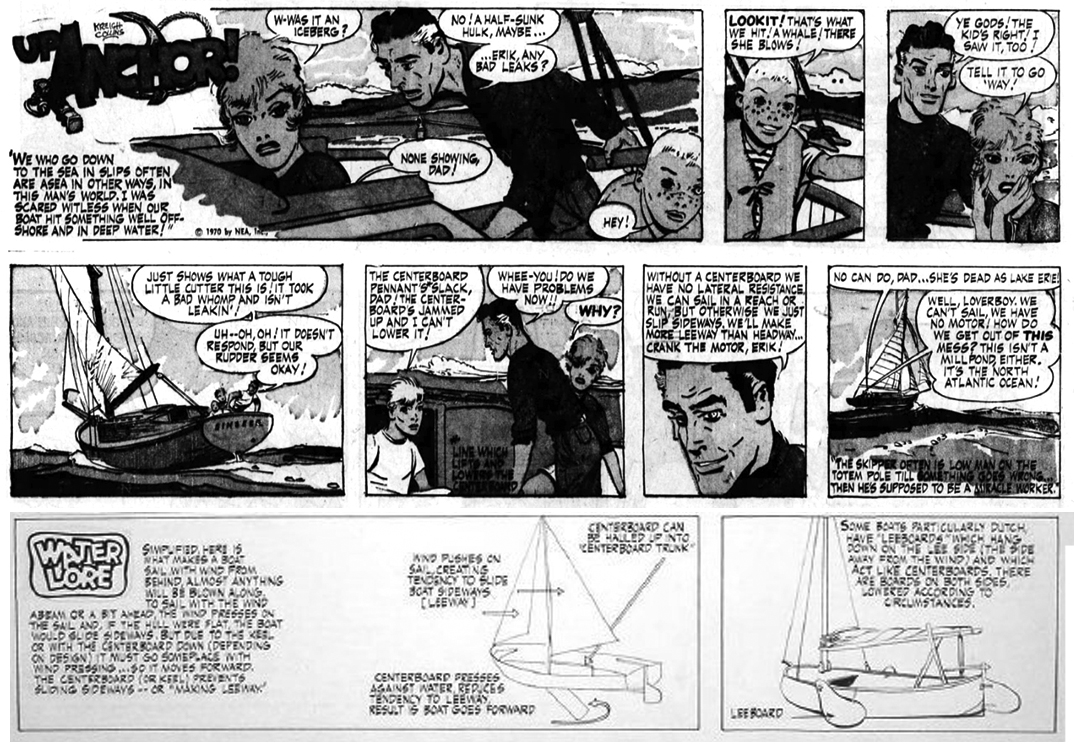
A leeboard was improvised, and worked pretty well until the monkey dropped anchor.
Luckily, tying up the loose ends wasn’t too challenging.
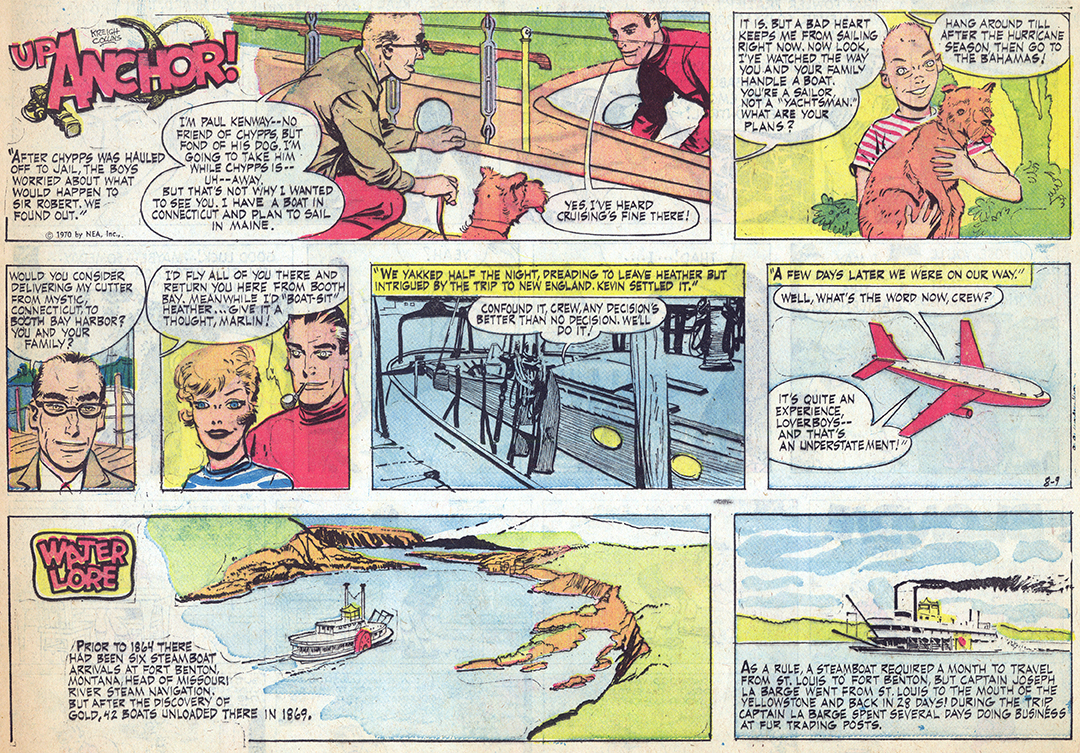
Unfortunately, the chapter concludes with an episode I don’t have. And Murphy’s Law dictates that the original artwork isn’t among the 75 examples found in Collection 56 at the Grand Rapids Public Library, either. (All told, there are 174 episodes of UP ANCHOR!).
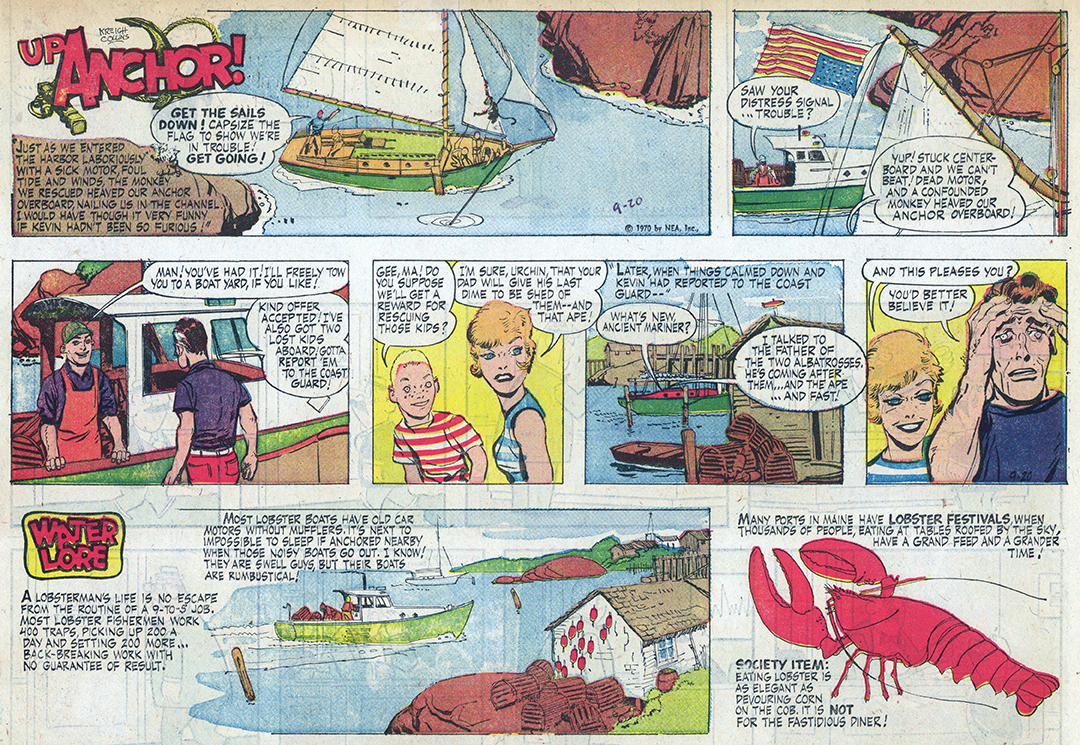
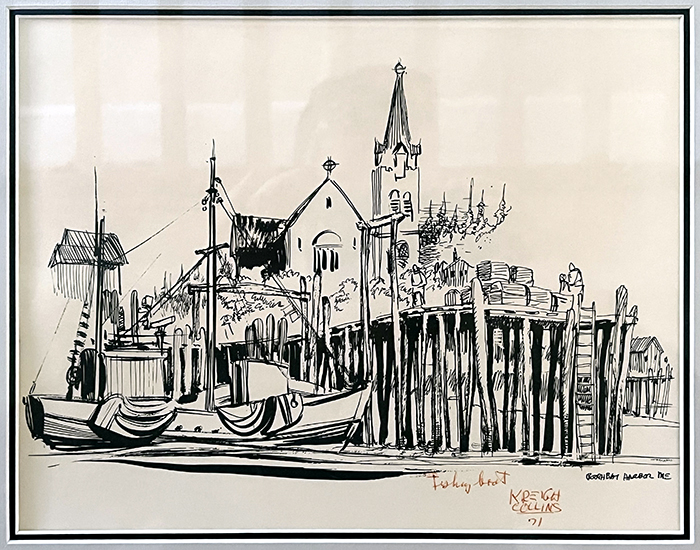
Nonetheless, it shows the family sailing into Boothbay Harbor, Maine, aboard the cutter they were delivering.
This ending was inspired by Collins and his family reaching Boothbay Harbor, Maine, aboard their schooner Heather in the summer of 1965. After a year of sailing, Boothbay Harbor was the furthest point east that they reached—over 1,000 miles from Lake Macatawa.
After wintering in Maine, Heather would start her return trip to west Michigan in the spring. By August she would be home.
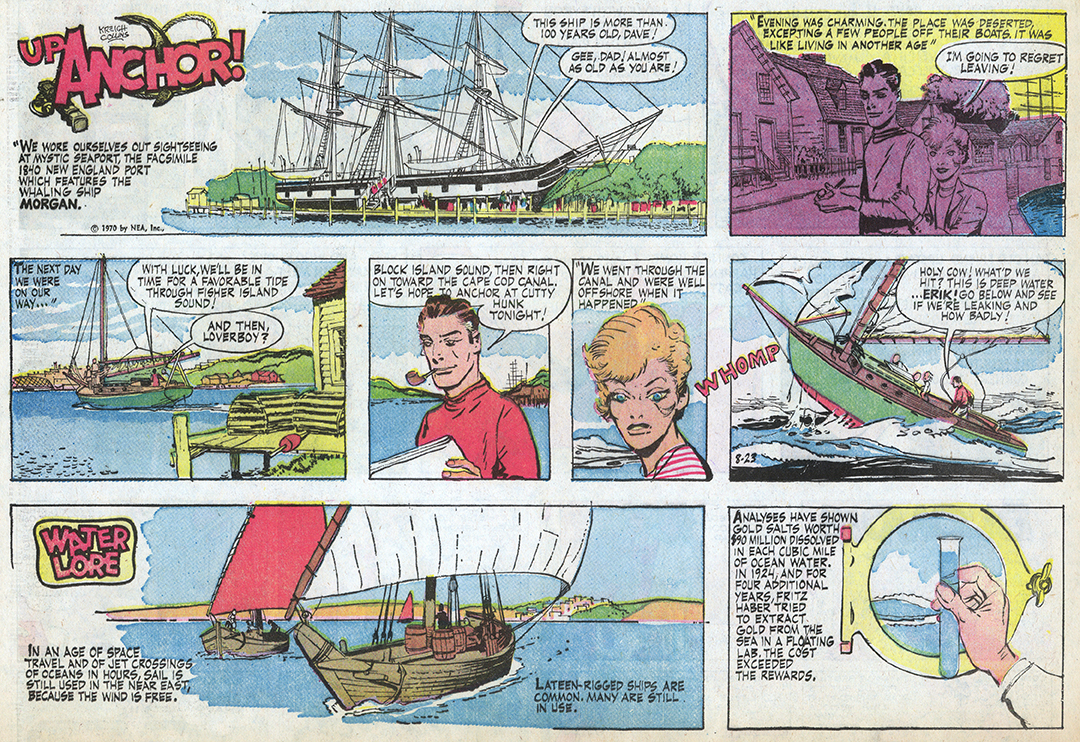
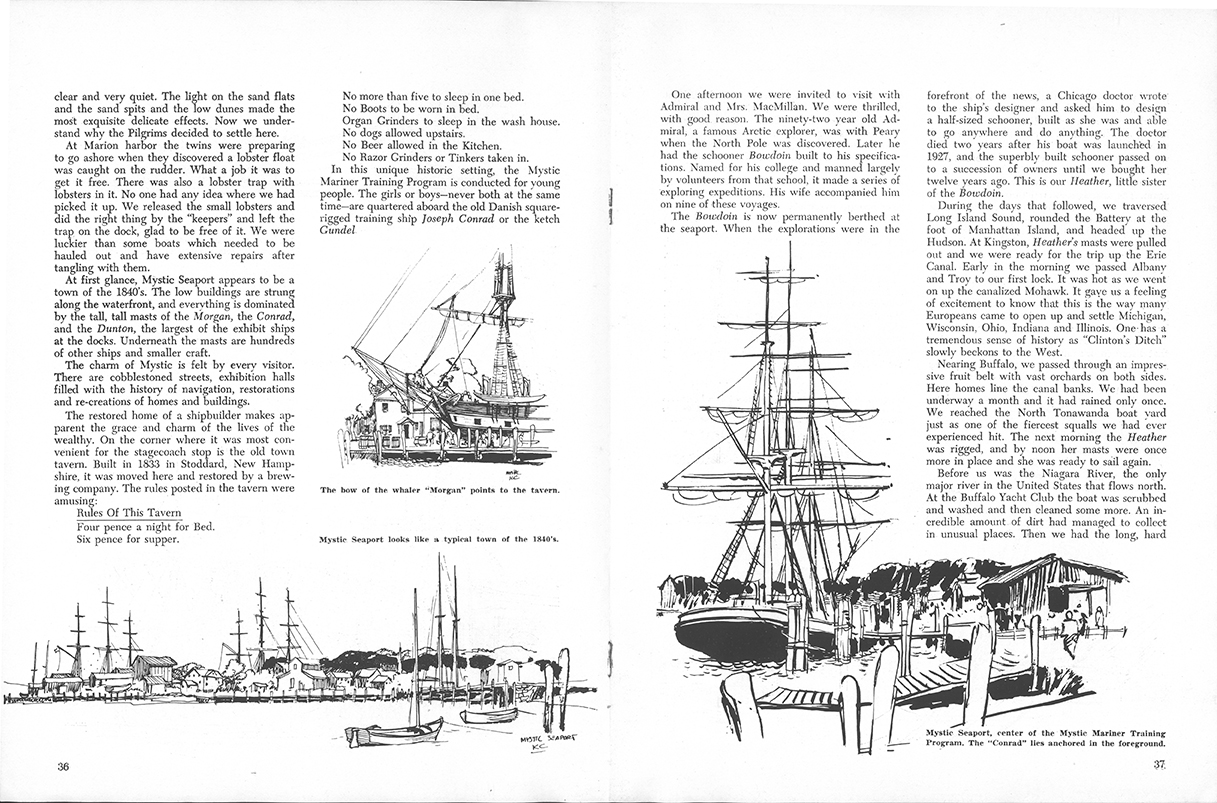
Heather and her crew spend a short time in Mystic, then continue their journey eastward. An interesting parallel is found to a three-week sailing trip I took with my Brother aboard his Gulfstar 43.
In the spring of 1989, we sailed from South Amboy, New Jersey and made some of the same stops as UP ANCHOR’s Marlin family. After sailing through Long Island Sound, we visited Block Island (and hit Mystic on the return trip). We also spent a night at Cuttyhunk Island, but from there our courses diverged. Where Heather headed northeast toward the Cape Cod Canal (and Down East), Brett and I sailed east to Martha’s Vineyard and Nantucket. Also, we didn’t hit any whales. The only bit of trouble we ran into was getting pulled over by a Coat Guard Cutter in Buzzard’s Bay… but that’s another story.
The damage is assessed and while it could have been worse—losing the engine and centerboard is not good!
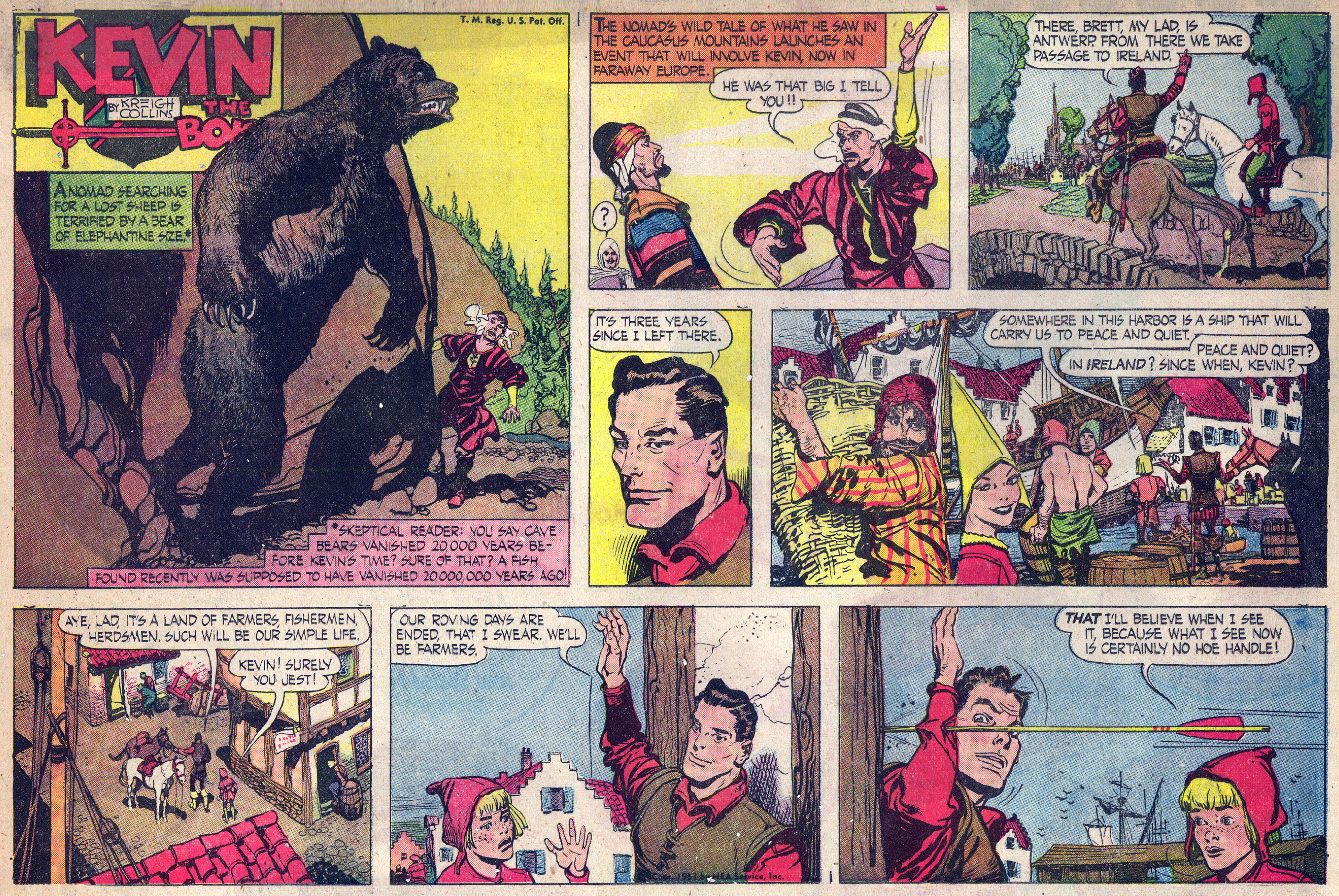
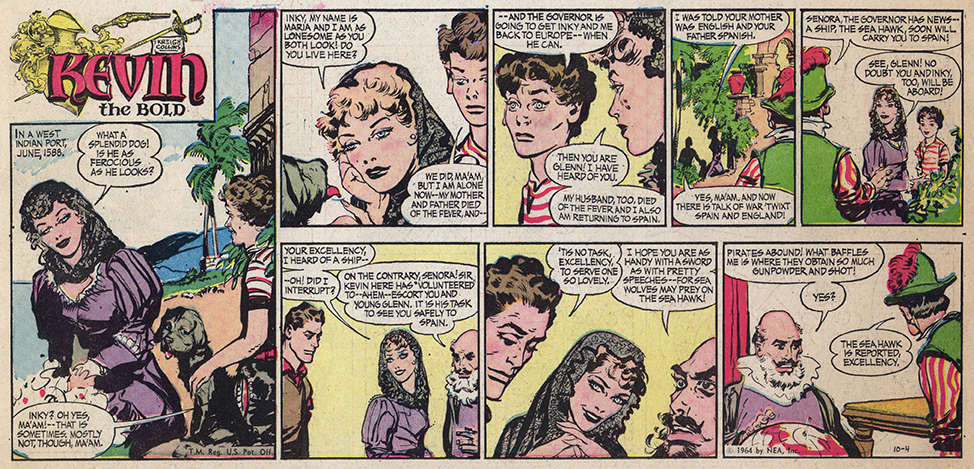
Introducing a monkey might seem like a bit of a stretch, but it is a nice call back to a KEVIN THE BOLD episode from a couple decades back.
A recently-acquired batch of UP ANCHOR! half pages included most of the episodes of a story arc which ran 53 years ago, in the summer of 1970. The action begins in Florida, but the Marlin family soon land in New England, in order to handle the delivery of a sailboat.
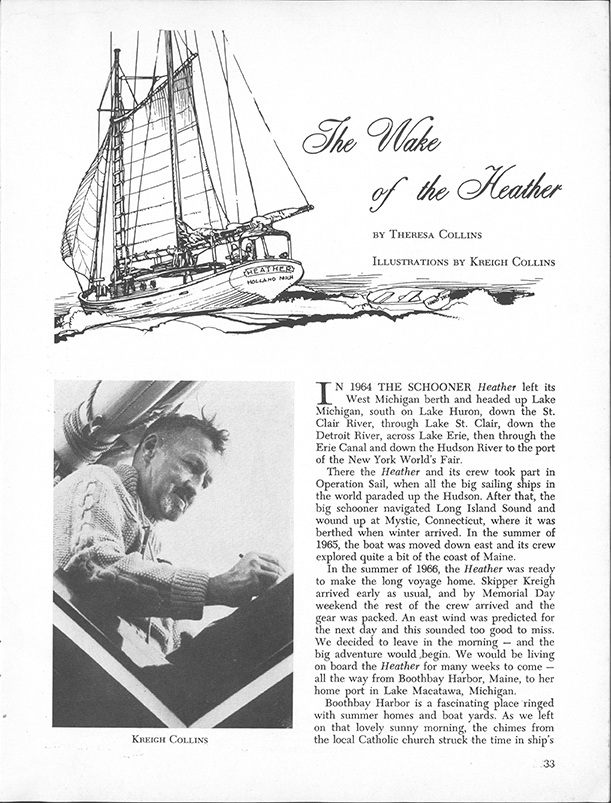
UP ANCHOR! was based on the Collins’s experiences cruising and living aboard their boat. In May, 1964, Kreigh, Theresa, and 13-year-old twins Kevin and Glen left West Michigan and journeyed to New York City to take part in the first Operation Sail, which was a tie-in to the 1964 New York World’s Fair.
Coinciding with this trip was the imminent birth Of Kreigh and Teddy’s second grandchild (Ahoy! That’s me!). In order to simplify things for my parents (Judy and Erik), the decision was made for my older brother Brett (not quite three years old), to accompany his grandparents and the “Uncle Boys” on the first leg of Heather’s trip. My family was living in Ann Arbor, Michigan at the time, so my dad drove Brett to Ada, dropped him off, with plans to pick him up in the Detroit area, after Heather had made the trip up and around Michigan’s “mitten.” (It must have made an impression on Brett, who has owned numerous sailboats during his adult life). In a letter, Kreigh described his youngest crew member as “not too much trouble,” which I always thought was pretty funny.
After dropping Brett off, the journey continued down the Detroit River, through Lake Erie and the Erie Barge Canal, and down the Hudson River. From there they sailed through Long Island Sound and made port at Mystic, Connecticut.
Theresa kept as diary during the voyage, and much of the material was eventually used as raw material for UP ANCHOR! Before turning into the comic strip’s storylines, it was edited, illustrated by Kreigh, and published as “In the Wake of the Heather.”
Whenever this blog’s anniversary rolls around, I try to come up with something interesting and comprehensive. This year, I decided to create an outline of all the chapters of my grandfather’s Sunday comics.
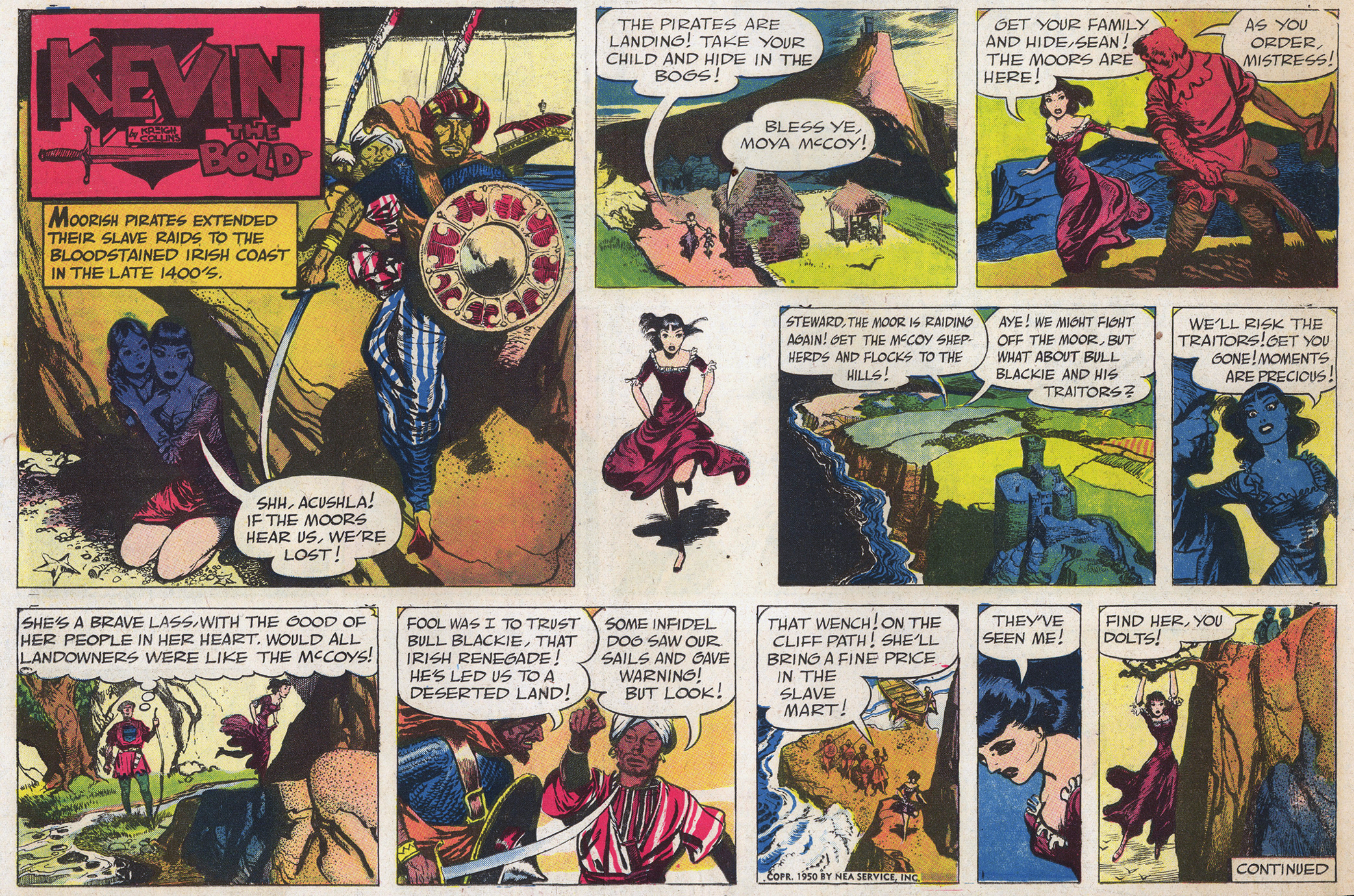
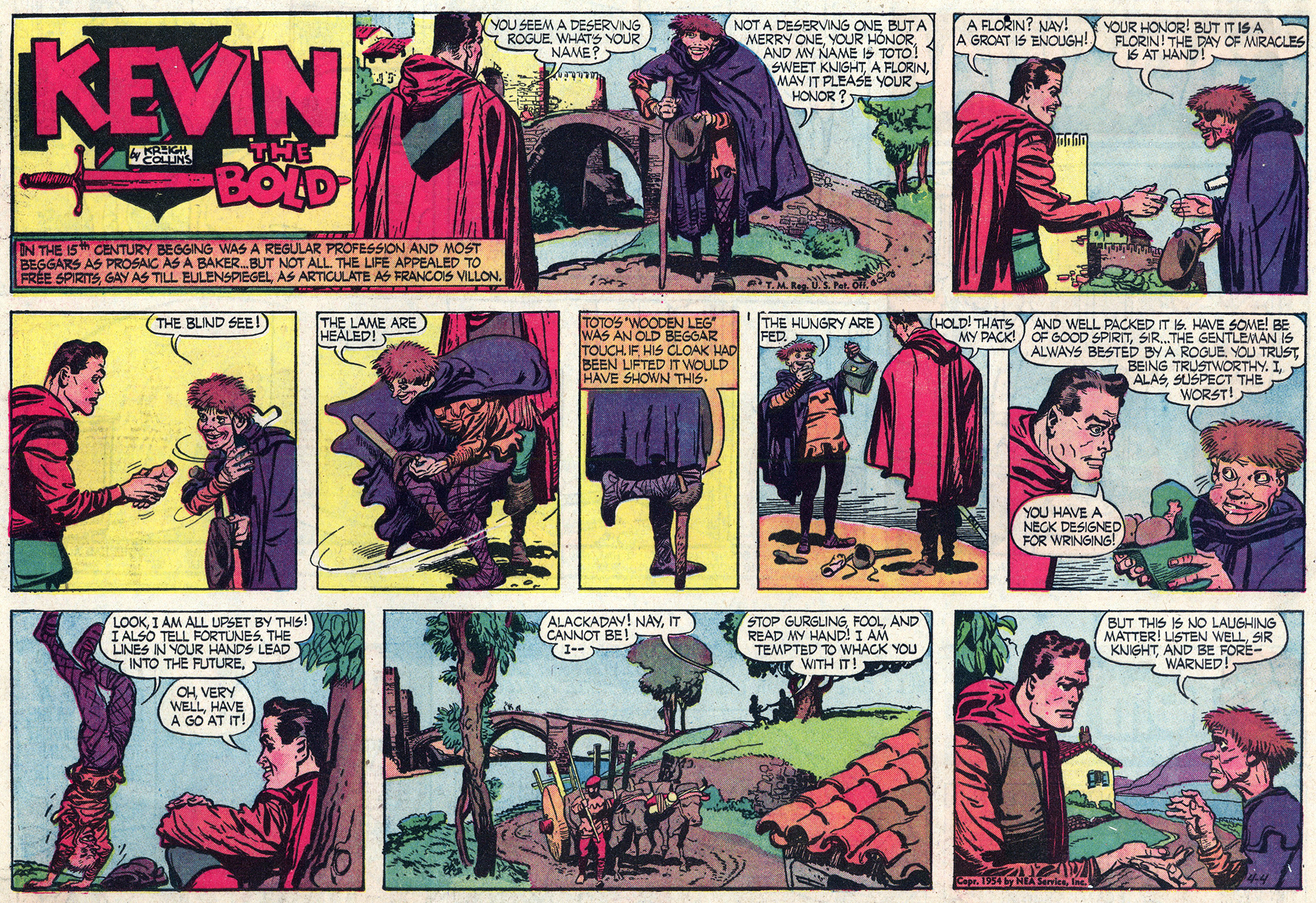
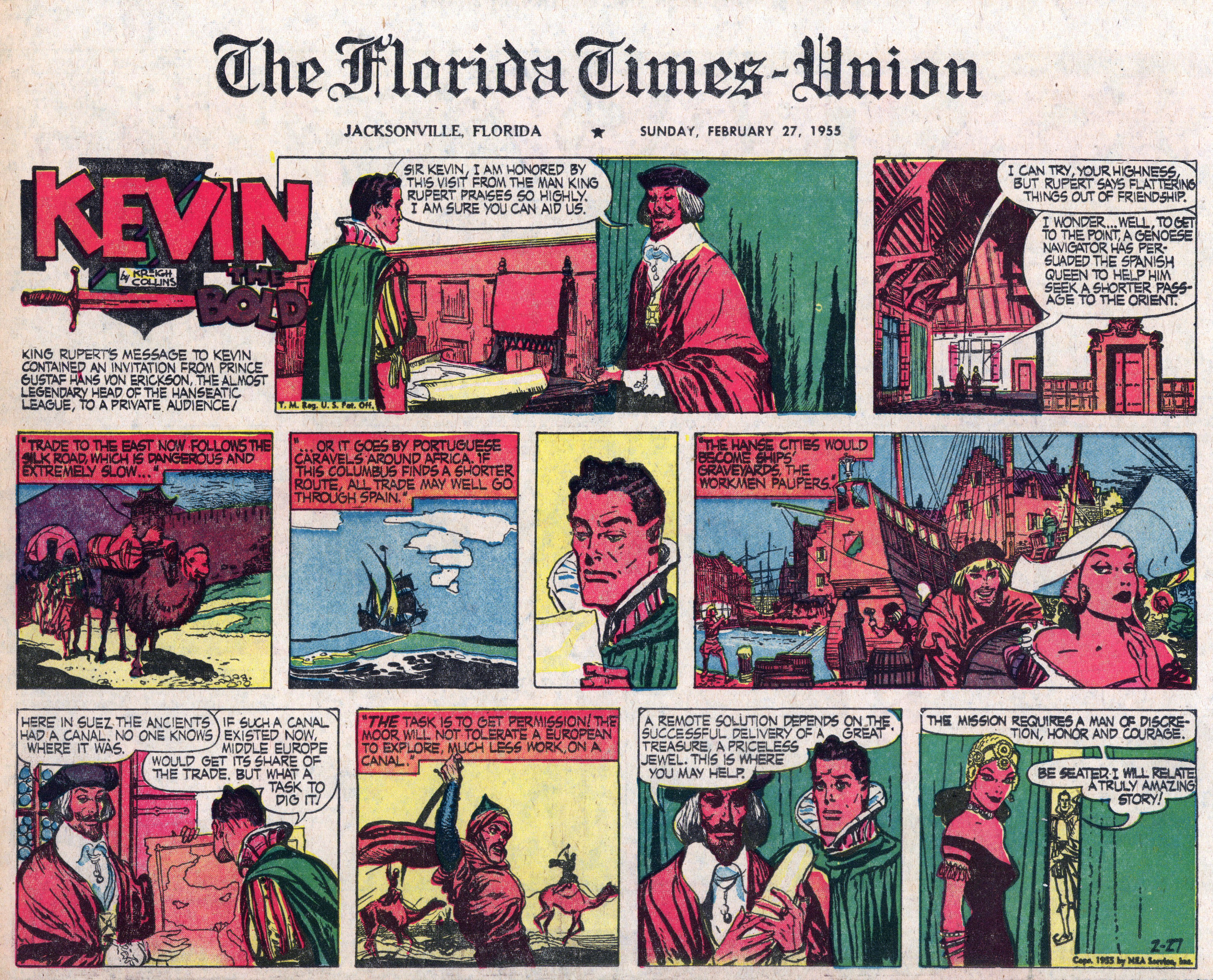
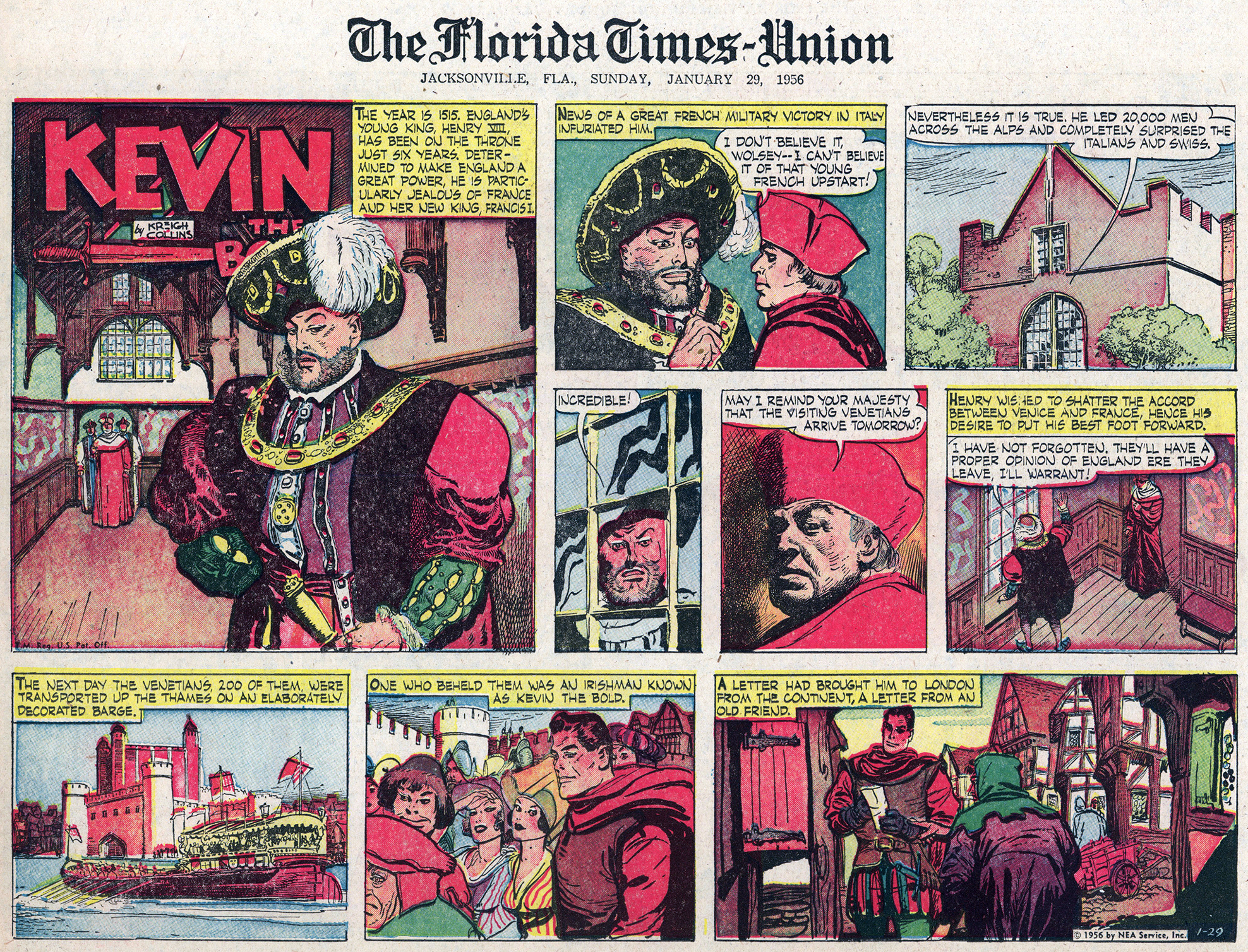
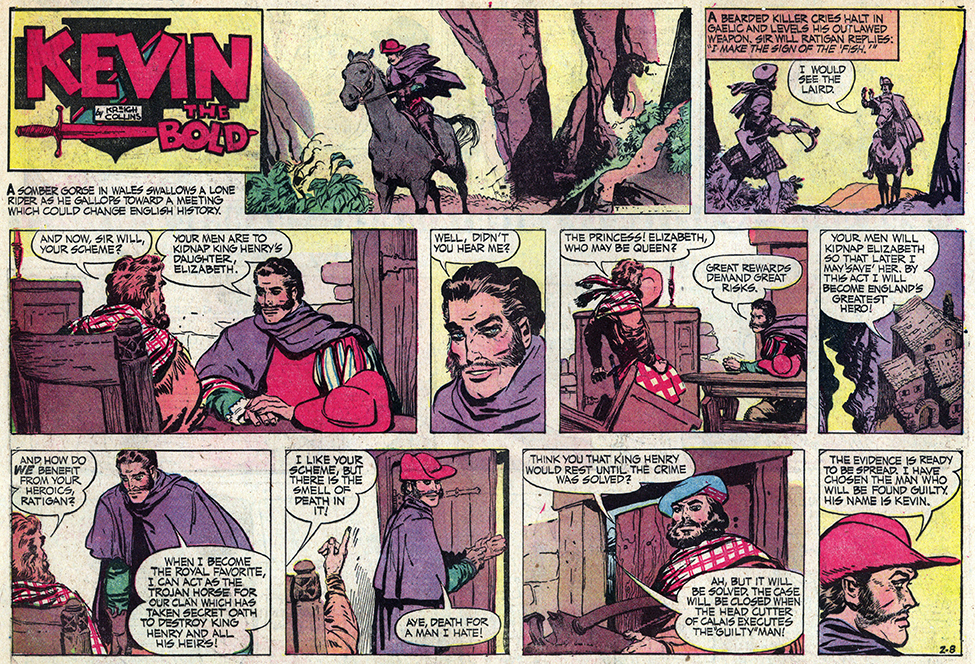
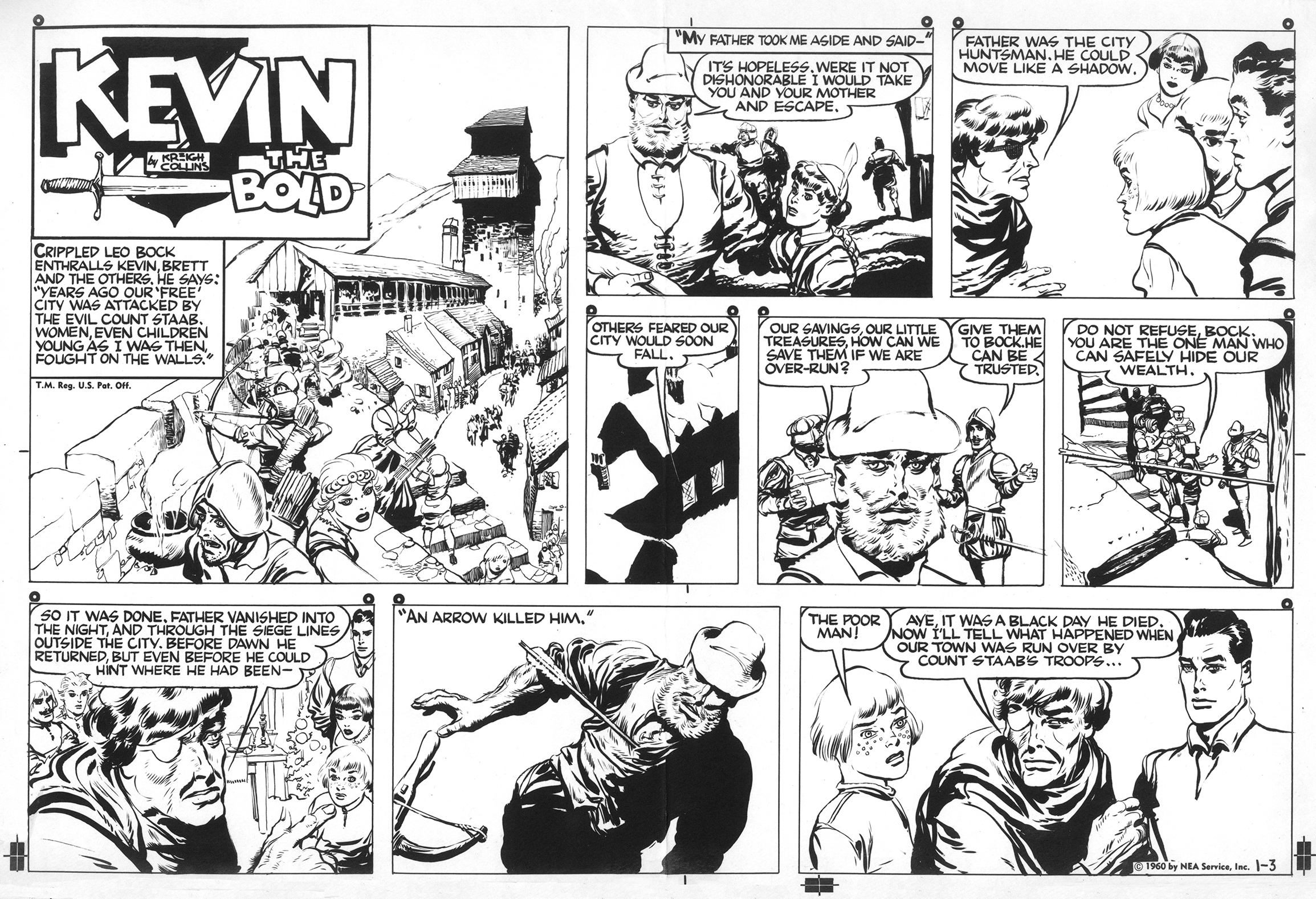
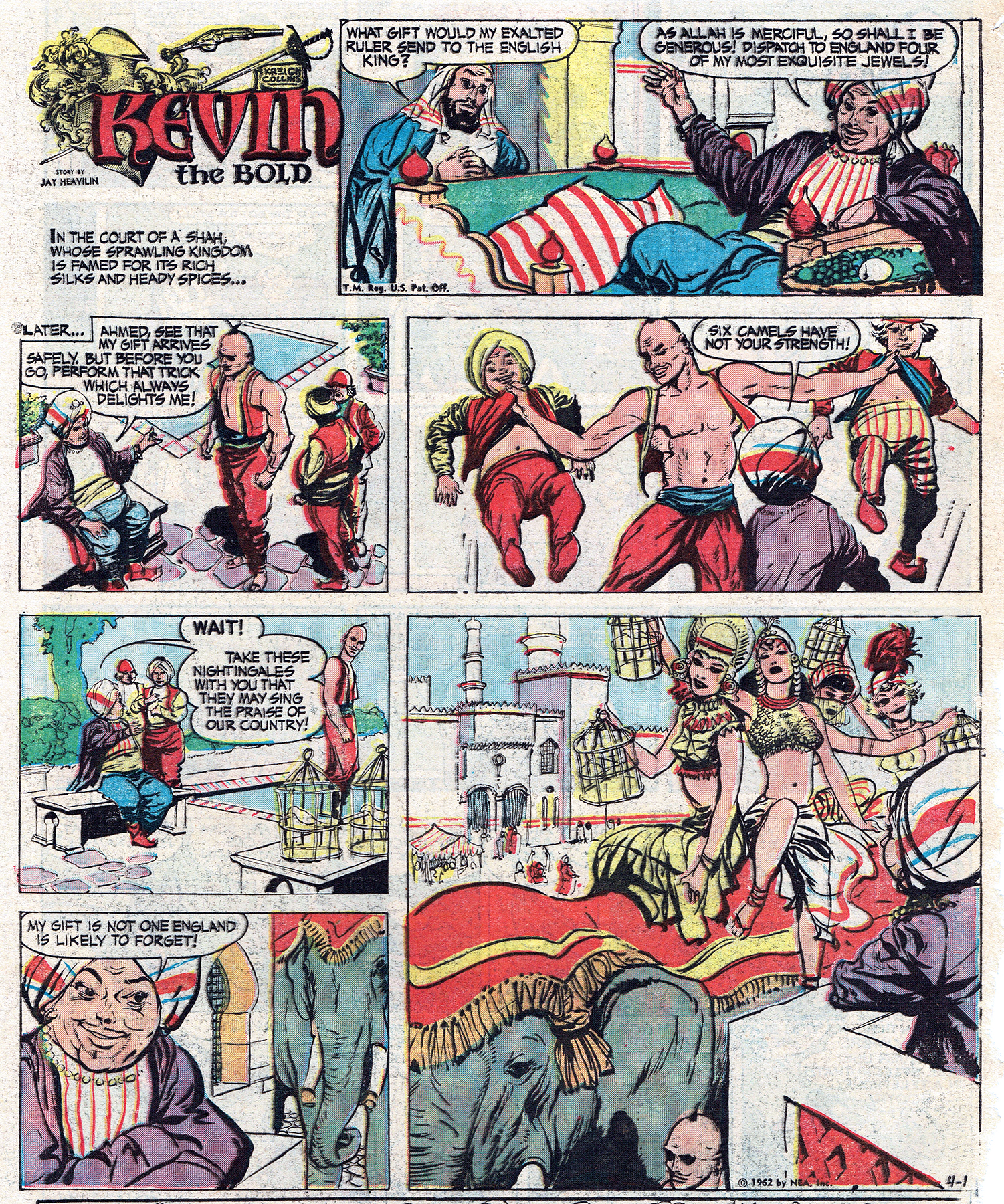
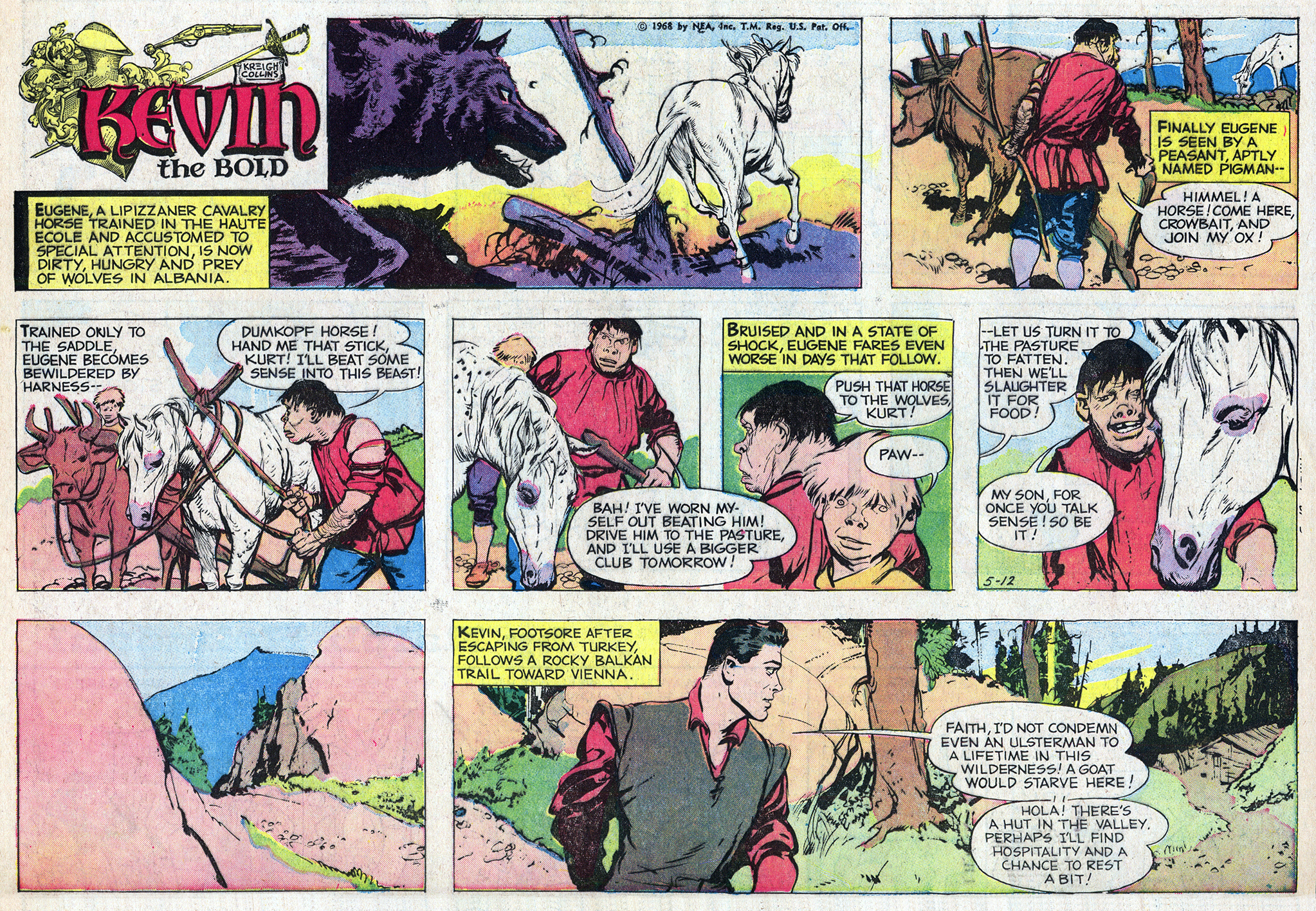
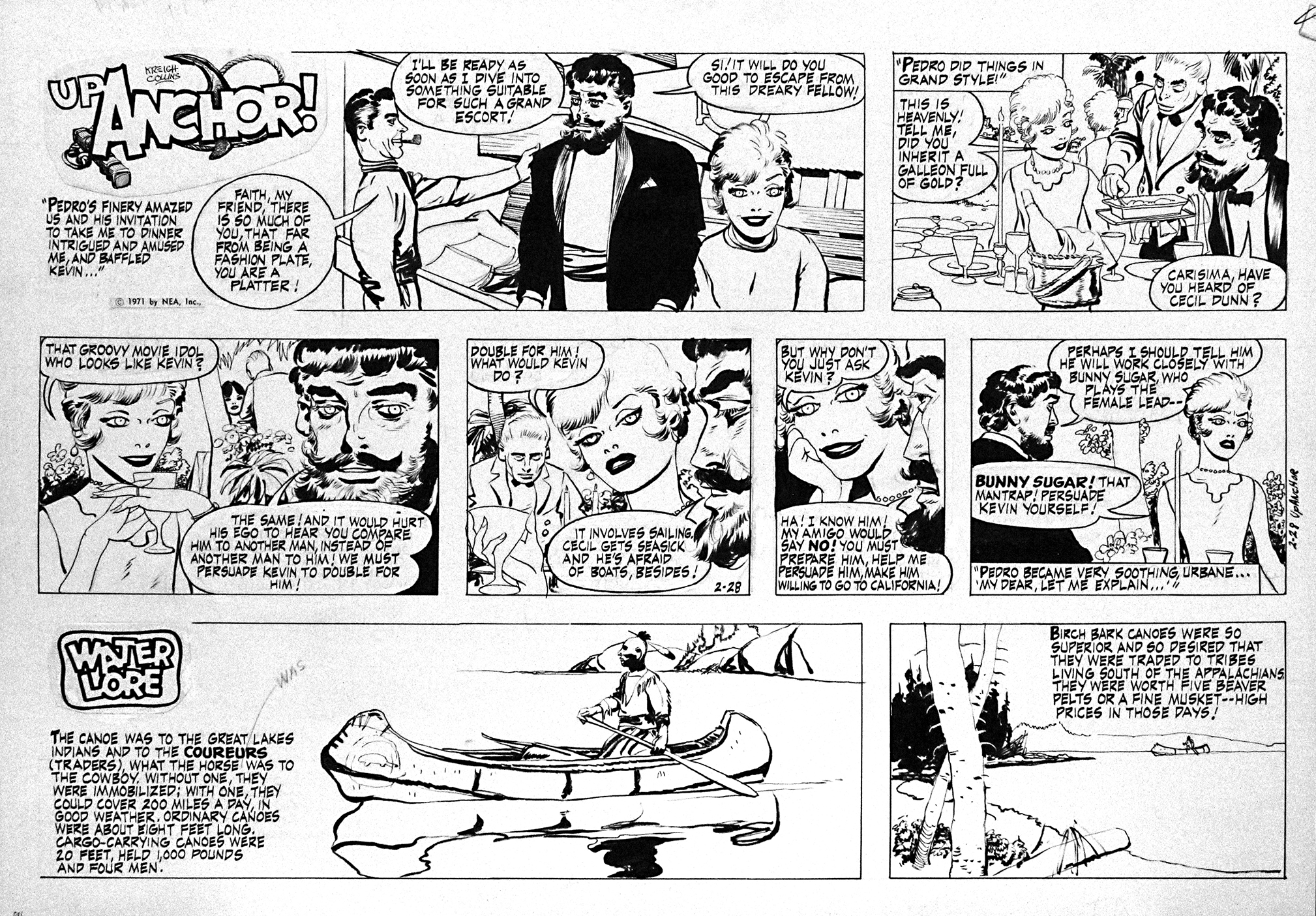
Kreigh Colins’ career as an NEA-syndicated cartoonist lasted for over 23 years. MITZI McCOY debuted in 1948 and ran for a couple years before it morphed into KEVIN THE BOLD in 1950. In 1968 it morphed again into UP ANCHOR! In all, they added up to 1,221 Sunday episodes spread across 105 chapters.
Here is the list, with links to the corresponding blog posts where applicable. (Apologies in advance for any linking errors! If you find one, please let me know). The chapter titles listed below aren’t official, they’re just things I came up with, often based on the villain or where the action takes place.
1966 78. Kevin the Warlock (from Dutch comic book) 79. The Search for the Northwest Passage 80. Sir Frances Drake 81. Stormy 82. The Story of the Norman Conquest (English and Serbian versions)
1967 83. Sir John Drayke Returns from Hispanola 84. Tankard the Bold 85. The True Story of Captain John Smith 86. Leonardo DaVinci Redux 87. Buried Treasure
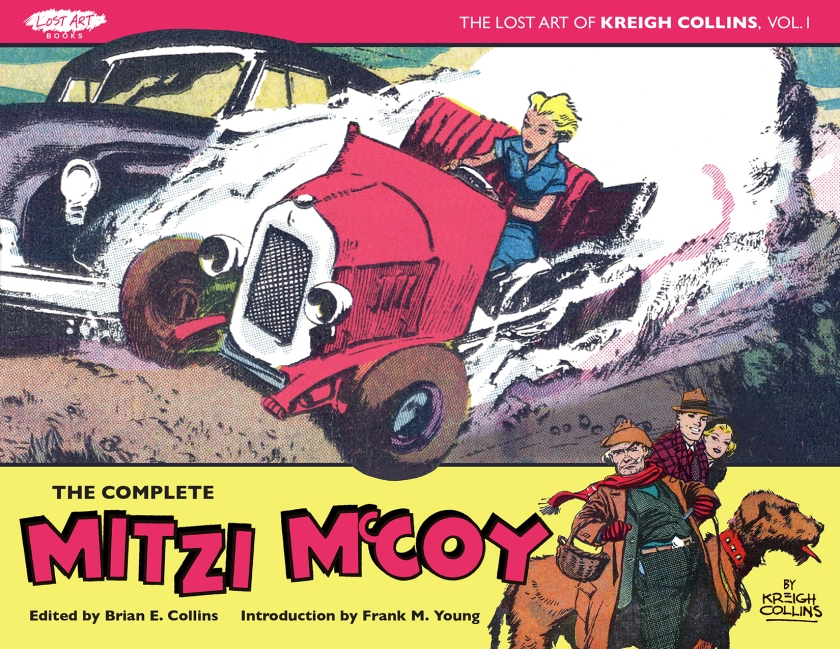
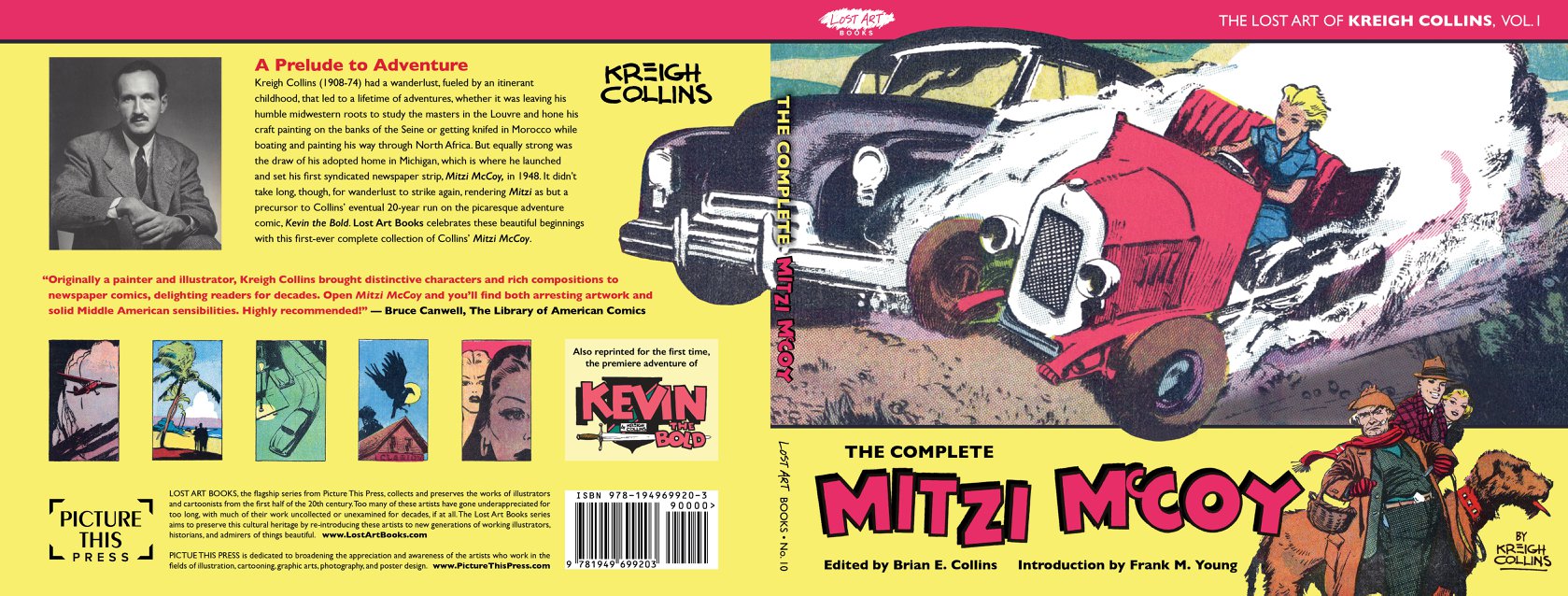
“The Lost Art of Kreigh Collins, the Complete Mitzi McCoy” features the entire run of Kreigh Collins’ first NEA feature.
MITZI McCOY ran from 1948 to 1950 and showcased Kreigh Collins’ skill as an illustrator and storyteller. His picturesque landscapes, lovely character designs, and thrilling action sequences brimmed with detail and charm, and the strip’s ensemble cast rotated in and out of the spotlight taking turns as protagonists in the dozen story arcs collected in this volume. The last story collected in “The Complete Mitzi McCoy” is the narrative bridge that set Collins and his characters off on a new journey, beautifully told for the next couple of decades in the much-lauded adventure strip Kevin the Bold.
The collection includes an introduction by Eisner Award-winning author Frank M. Young, an Afterward by Ithaca College’s Ed Catto, and previously unpublished artwork and photos. Longtime comics artist Butch Guice also provides a new pin-up of the character Mitzi McCoy.
The book is available for $30. For domestic shipping, add $4; for international orders, please add $25 to cover first class shipping. To place an order, leave a comment below or email me at BrianEdwardCollins1[at]gmail.com, and I will give you PayPal or Venmo information. Thank you!
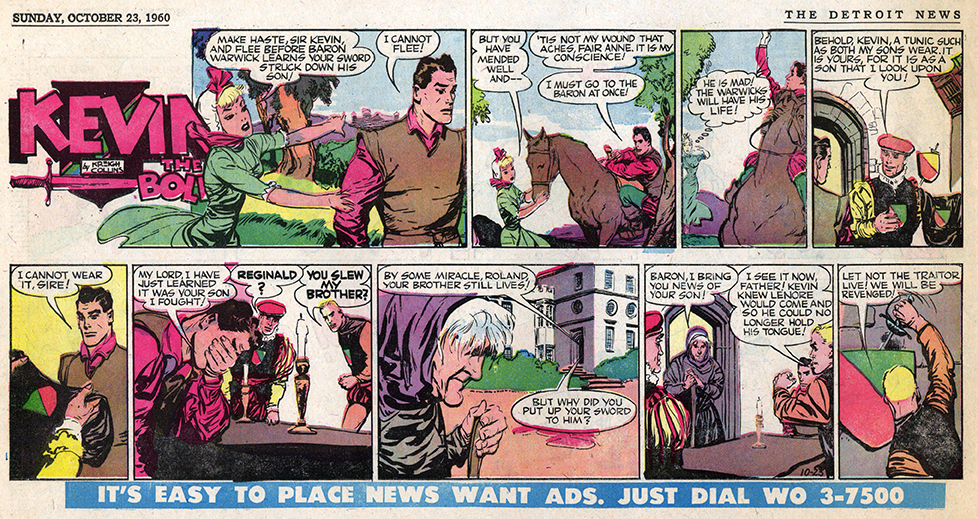
Kevin heads back, bearing terrible news for Baron Warwick.
Despite his contempt for his brother Reggie, Roland is enraged, and Lenore’s appearance spells more trouble for Kevin.
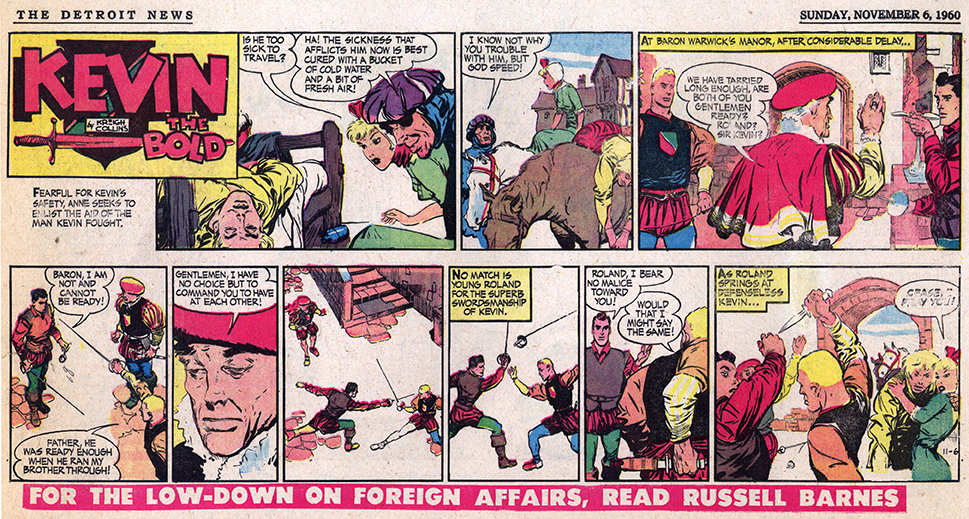
The Baron urges patience but refuses to stop Roland. Meanwhile, Reggie has found his usual form.
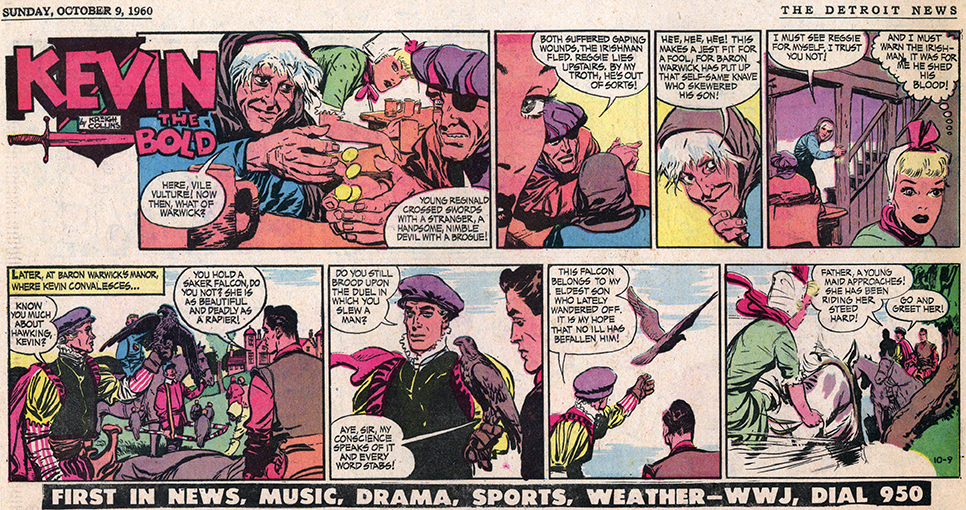
Despite his failings, Reggie is much the superior swordsman to Roland, and Kevin easily disarms his opponent, using a favorite trick. My Detroit News third page is lacking in quality; in the final panel, Anne shouts, “Cease it, I pray you!”
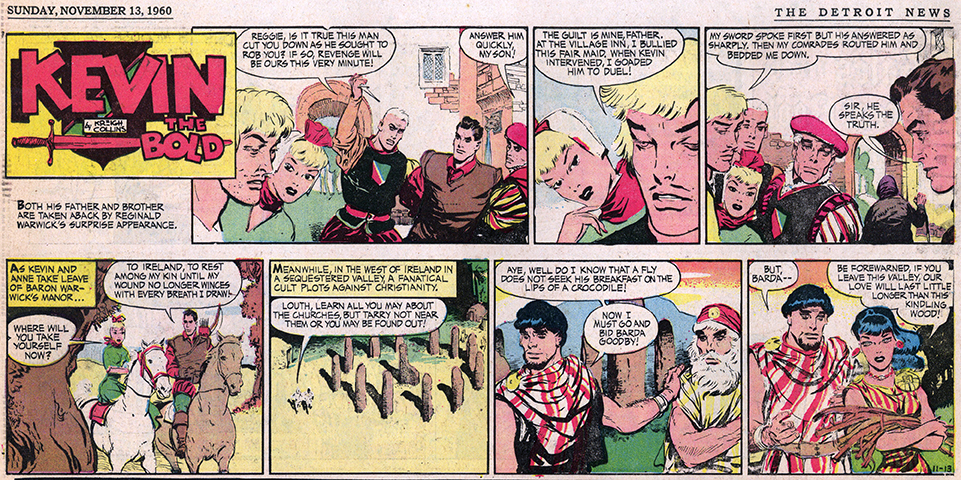
In a shocking turn of events, Reggie admits the truth. The chapter ends quickly and the action transitions to Ireland, and a group of pagans. (It’s a beautifully-illustrated chapter that begins here).
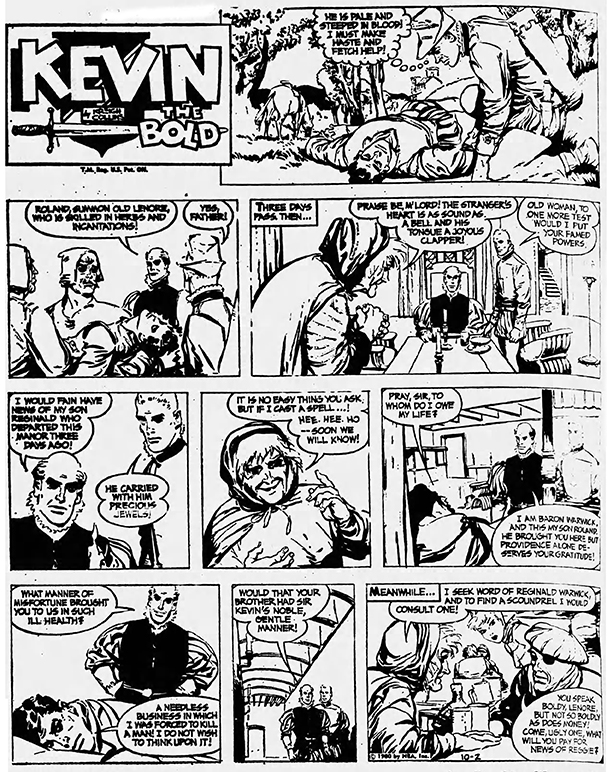
Five episodes into the chapter, we finally learn the name of Reggie’s more responsible brother, Roland, when Baron Warwick instructs him to go and fetch Lenore. In KEVIN THE BOLD, generally the villains are men—but not always. Enter the medicine woman—or is she more of a witch?
Lenore’s medicine has helped Kevin, who is convalescing at Baron Warwick’s home.
As the news gets out about what happened at the tavern, Kevin eventually finds out too.
The following article appeared in an in-house NEA publication, and also ran in various newspapers that had picked it up from NEA. Written by Jay Heavilin, it picks up the story about Heather and her crew’s Great Loop journey as the schooner neared home. Since the NEA offices were located in Cleveland, Kreigh Collins and crew would be sailing directly past NEA HQ as they neared the western end of Lake Erie on their way to Heather’s home port on Lake Macatawa. They still needed to nearly circumnavigate the lower peninsula of Michigan—nearly 500 miles through lakes St. Clair, Huron, and Michigan—but with 5,000 miles already logged, they were on the homestretch.
The final installment of this story arc includes two new additions to my collection—the two color third pages shown below. These episodes (and three dozen others) came from my new friend Dave, a vendor from New Jersey. This spring, I paid him a visit, intending to purchase the episodes, but he insisted on giving them to me. Thank you, Dave!
The black and white portions of final three episodes come from photographs I took of the originals, which are located in one of the Grand Rapids Public Library’s special collections. (If I remember correctly, they are found on the fourth floor. Highly recommended!)
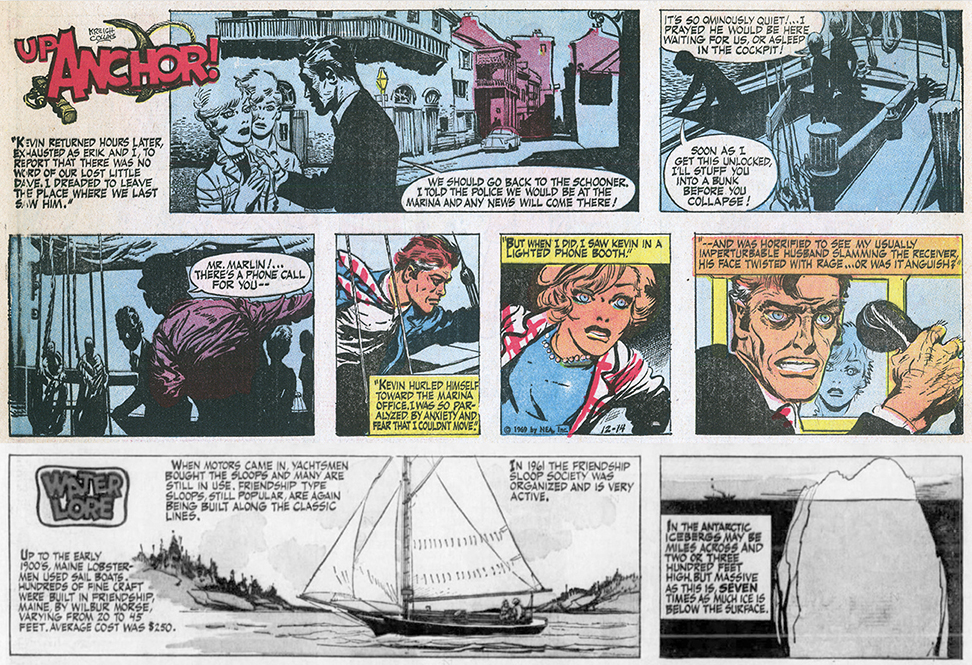
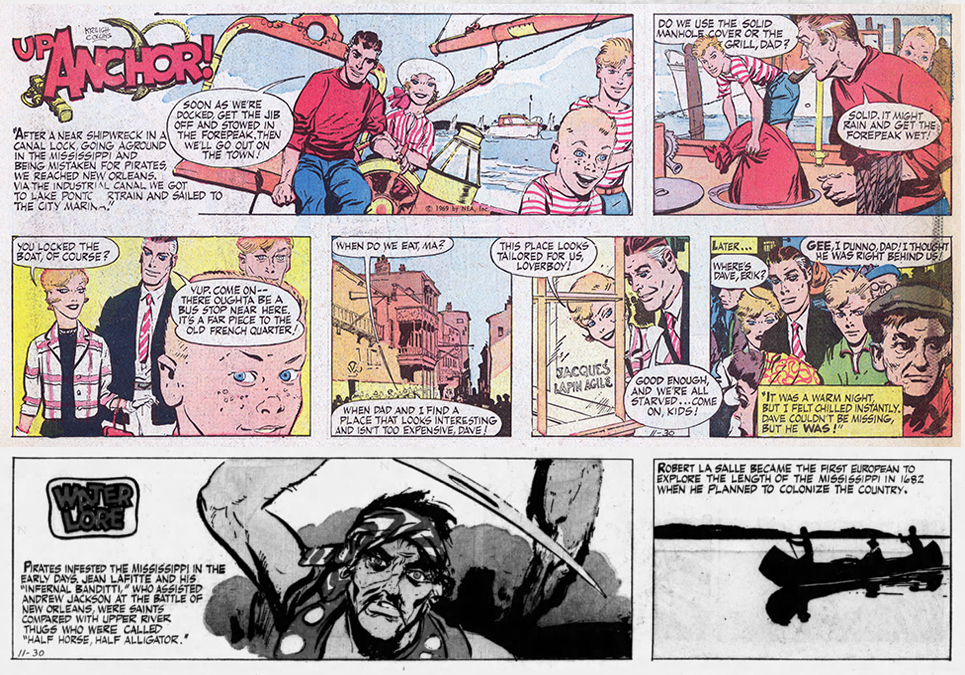
Meanwhile, back in New Orleans, the situation is frantic.
And when things couldn’t get worse…
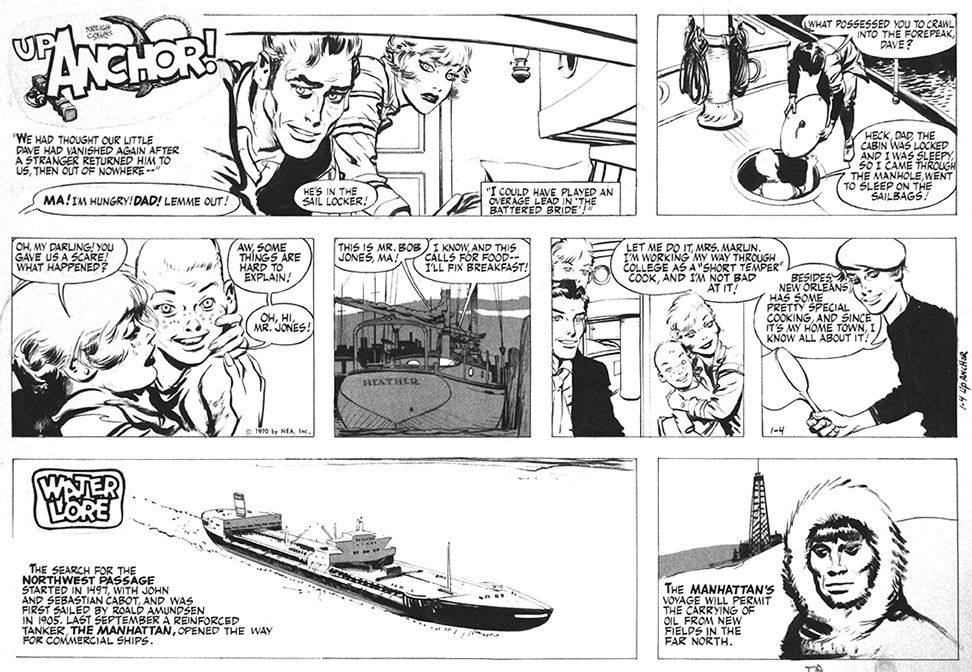
Oh, what a relief!
In the third frame of the final episode of the chapter, young Dave utters what seems to have become something of a catchphrase, “Some things are hard to explain.” I haven’t kept track of all the instances, but I recall Pedro uttering the line in a mid-1960s episode of KEVIN THE BOLD.
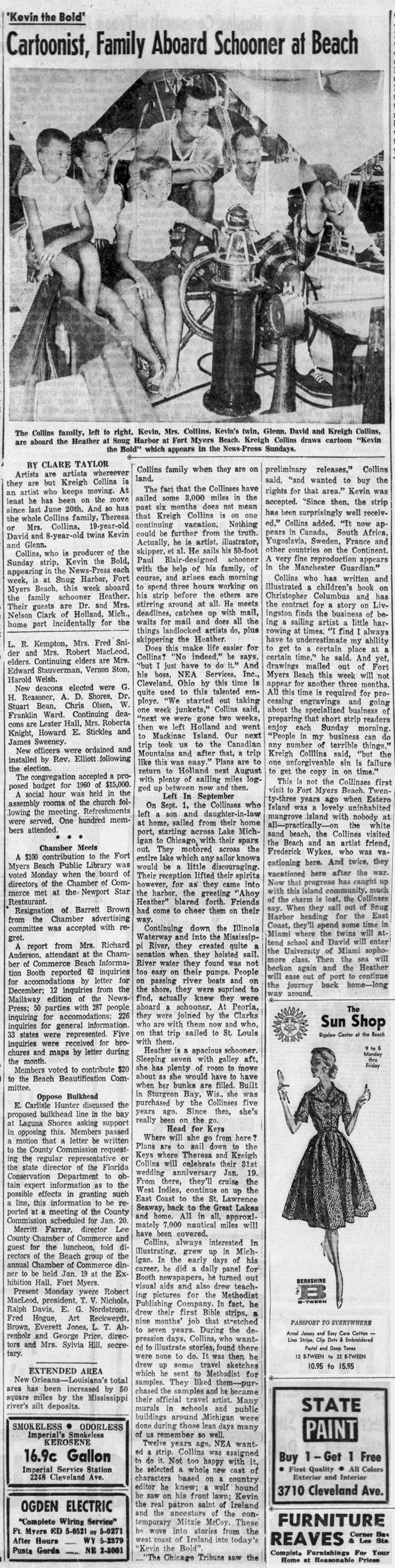
On this journey south, articles often appeared in the newspapers of the towns Heather and her crew visited. I don’t know if my grandfather acted as his own publicist, or if the mere sight of his boat drew reporters looking for some interesting local news (47-foot schooners were a rarity on the Mississippi). It certainly helped if the newspaper featured KEVIN THE BOLD in their comic sections. However they came about, the articles sometimes provided some interesting information, such as this one, from the January 13, 1960 Fort Meyers News-Press.
Over the years, as my comics collection has grown, the thing that surprised me most was the number of countries in which Kreigh’s comics were published. Aside from a single Swedish Tom Mix comic book and a tear sheet from a Cuban newspaper, my research had yielded no acknowledgement of his work appearing in markets outside the US and Canada—and I always wondered if Collins was aware of (and compensated for) these additional NEA revenue streams.
Finally, that question was answered—check the top of the article’s third column. Speaking of KEVIN THE BOLD, Collins is quoted as saying, “…the strip has been surprisingly well received. It now appears in Canada, South Africa, Yugoslavia, Sweden, France and other countries on the Continent. A very fine reproduction appears in the Manchester (England) Guardian.”
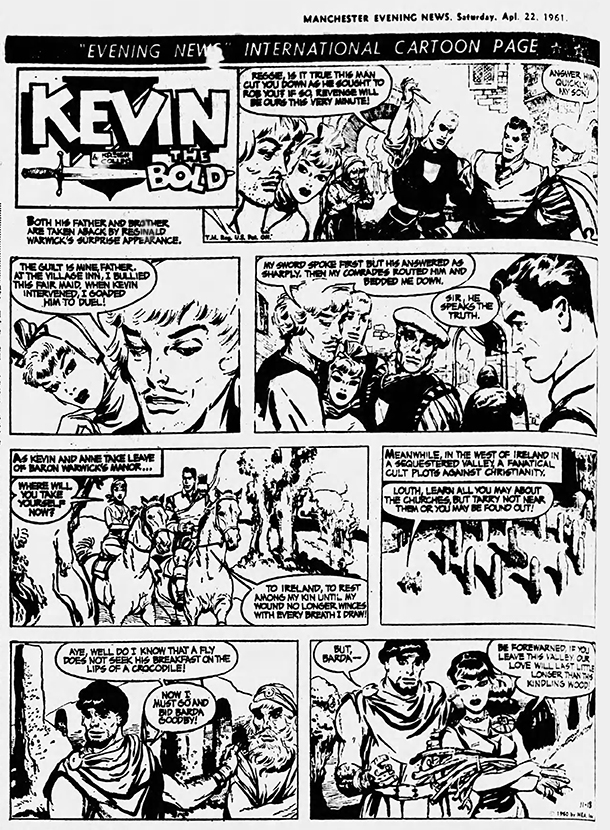
This example from the Manchester Guardian ran December 31, 1960, five an a half months after its original publication date (July 10, 1960)
I hadn’t been aware of any British papers carrying his work—it’s wonderful to learn something new after all these years of research!
Meanwhile, back to the funny pages’ version of Heather…
More obstacles—and more helpful strangers. By the time they reached New Orleans, Kevin Marlin and his crew had to be feeling pretty good about their state of affairs.
Like sailing weather, things can change change quickly, and not always for the better. Where’s David?!
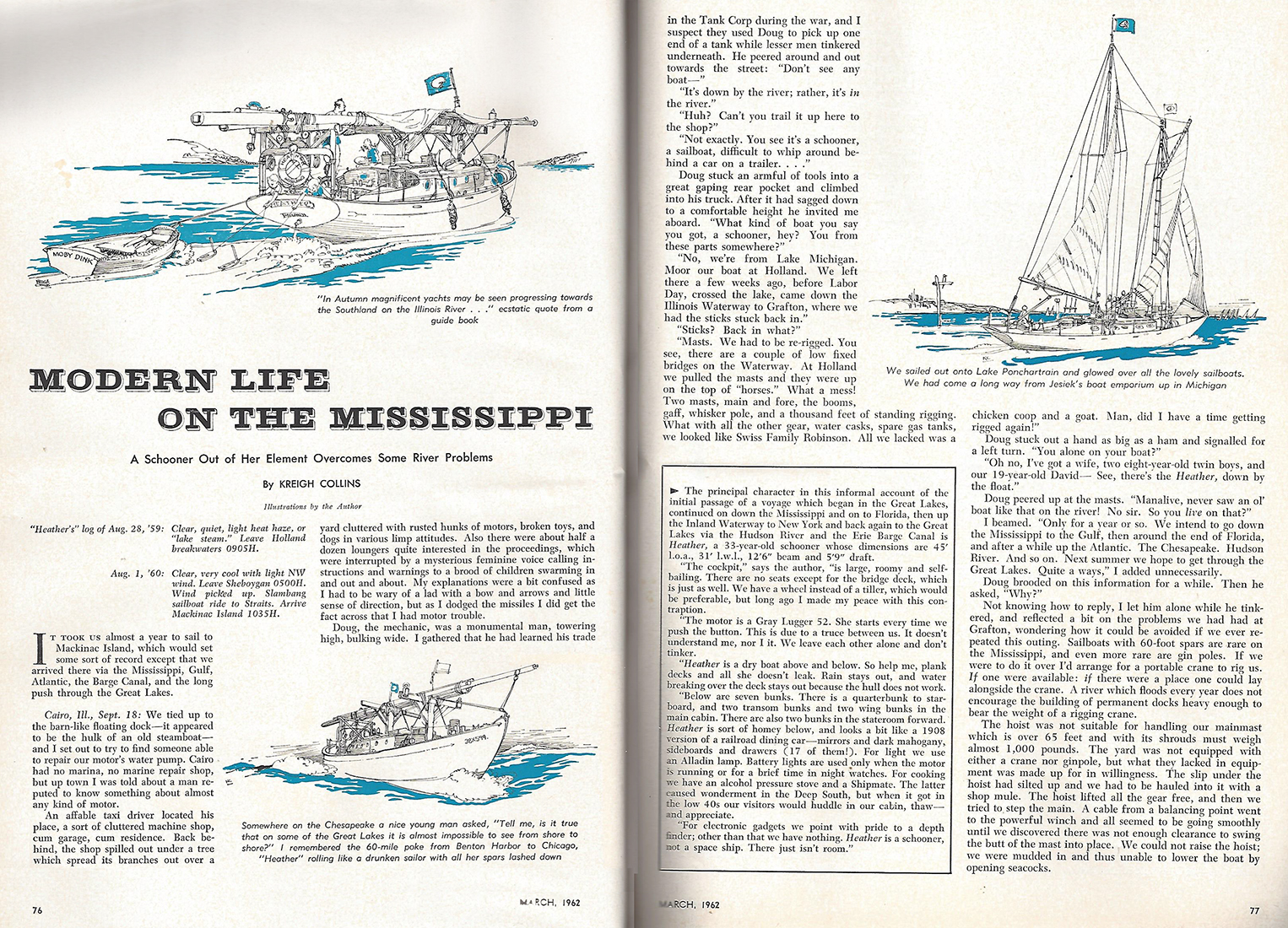
Yachting is a monthly magazine first published in 1907; it’s still on newsstands today. I’m most familiar with issues from the 1960s–80s, because my father had stacks of them piled in his library. Little did I know then, but on at least two occasions my grandfather wrote and illustrated features for Yachting. The first that I’m aware of was included in the March, 1962 issue.
Due to the times, these articles occasionally contained language now considered politically incorrect. Otherwise they are well-written, informative, and very funny. The March, 1962 article described the trip down the Mississippi that became the inspiration for this blog’s current story arc.
A cute detail are the two toy boats trailing behind Heather, in addition to the dighy, Mobe Dink.
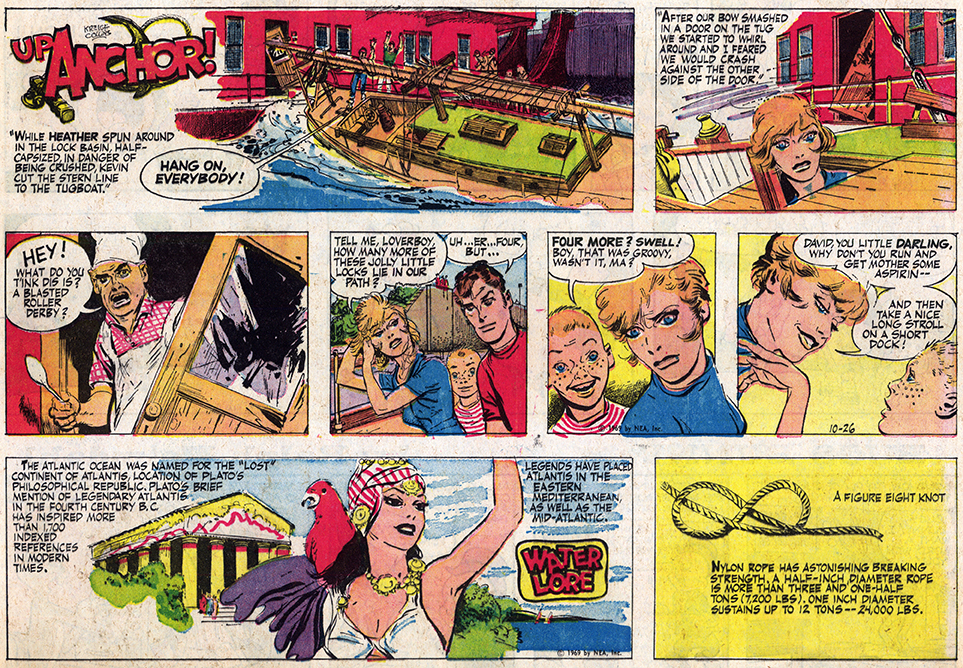
While the opening spread relates some of Heather‘s mechanical troubles, the following page describes the incident later featured in the October 26, 1969 episode.
No doubt some liberties were taken in both versions of the story, and it’s not surprising that in the comic strip version, the smashed window was placed in the galley (kitchen), not the head (bathroom).
The article jumps to the back of the magazine, and continues for three more pages. (If you’re interested in the complete article, copies are usually available on ebay).
Heather and her crew survived this first drama, but surely there would be more to come.
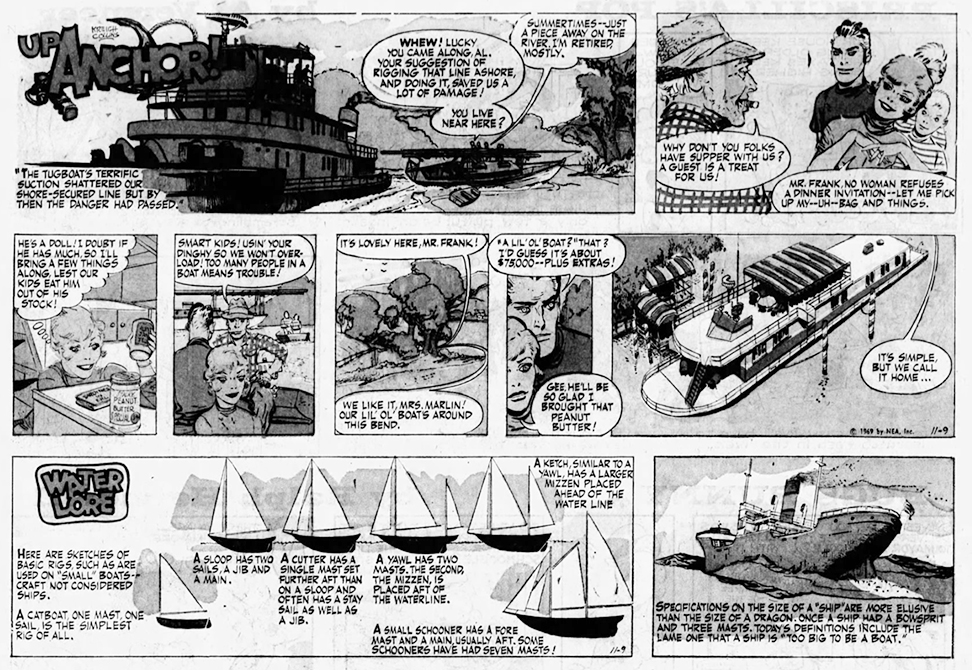
The Marlin family’s new friend had some good advice, but it was to no avail. Making sure not to judge a book by its cover, they graciously accept Al’s generous offer. (Of note, the November 2 WATER LORE episode consists of three panels, not two—the only such instance I can recall).
More surprises awaited—thankfully, this one was pleasant.
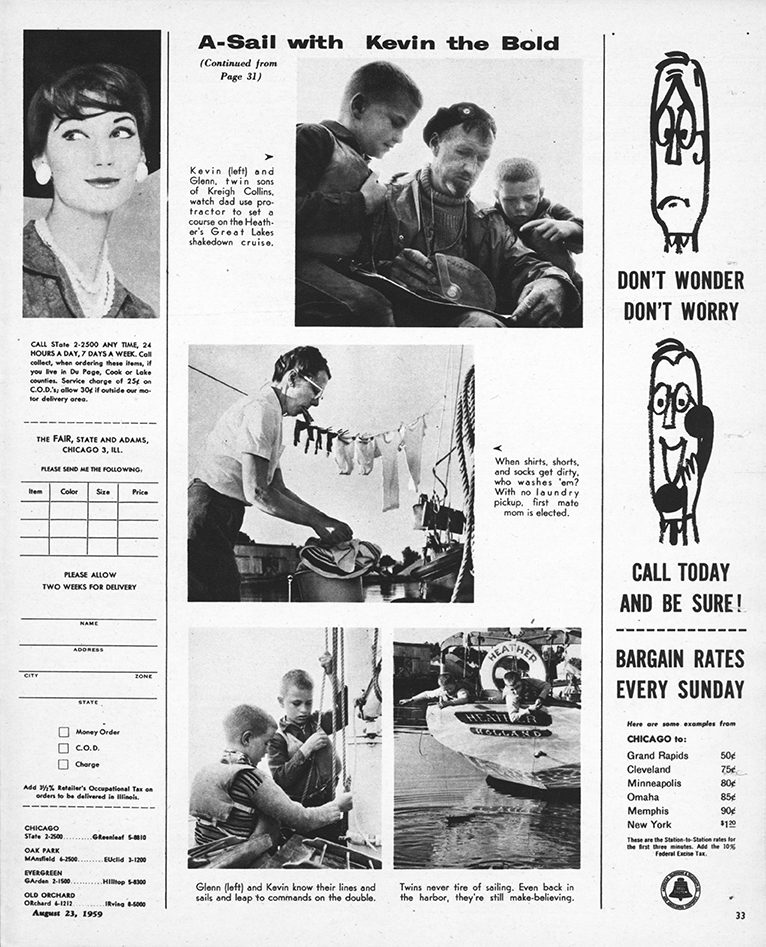
On August 23, 1959, a short photo-essay appeared in the Chicago Sunday Tribune Magazine. It described life aboard Heather for the Collins family as they prepared for their journey south. The short profile was a nice promotional piece for the artist, whose work appeared every Sunday in the Trib’s funny pages. (Sadly, it is likely the last promo the Tribune ran for Collins—four months later, after a nine-year run, KEVIN THE BOLD was discontinued.)
Now back to the story that resulted from the trip south.
Say… that dog and little boy in WATER LORE… they sure look familiar.
Ah yes, it’s Inky—a dog that, in real life, belonged to one of the Collins’ neighbors. But I digress. Heather has arrived for her overnight stay in Chicago, with an early morning departure and a date with its first lock.
It was smooth sailing through the lock, so much that Jane Marlin thoughts turn to Robert Burns’ Duncan Gray.




































 Kreigh’s Comics
#/media/File:USCG_Seneca.jpg)
