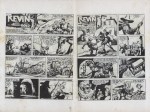
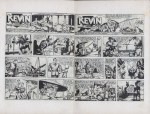
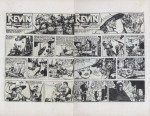
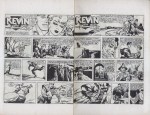
Glenn the Loyal

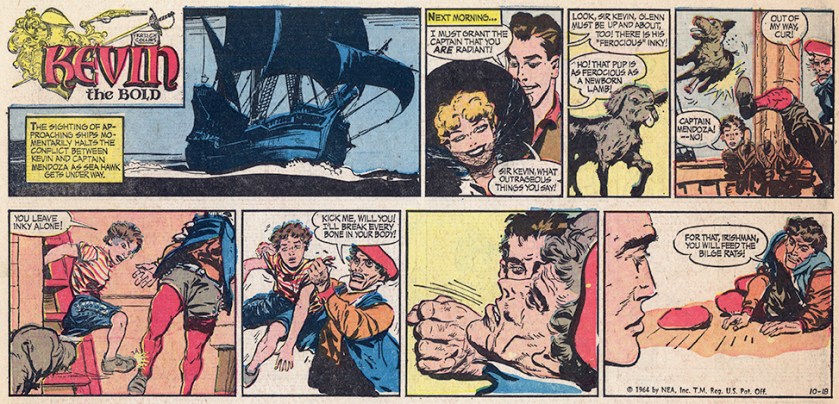
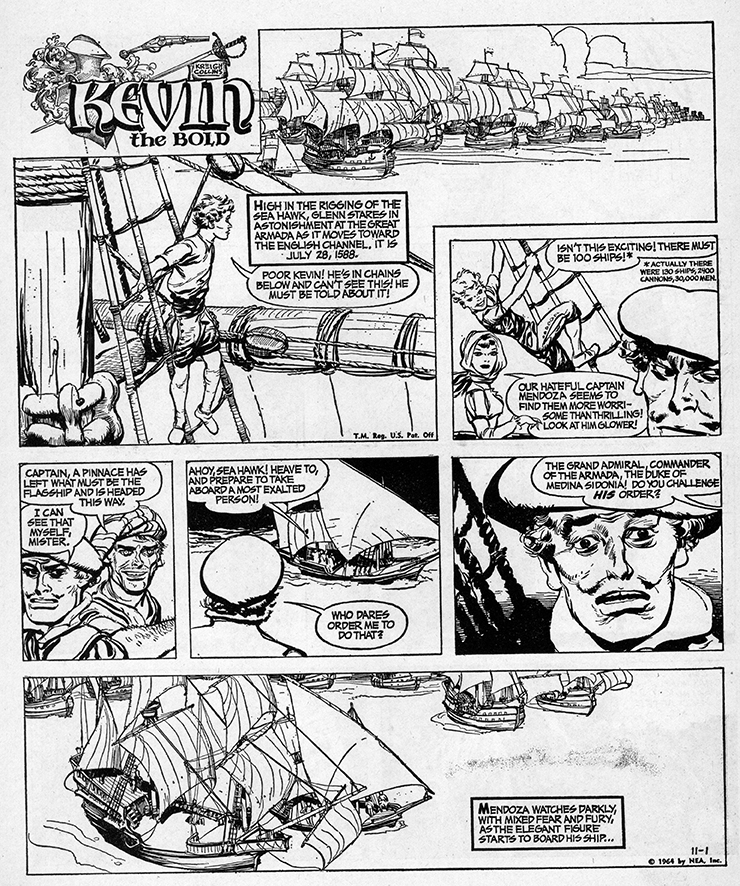
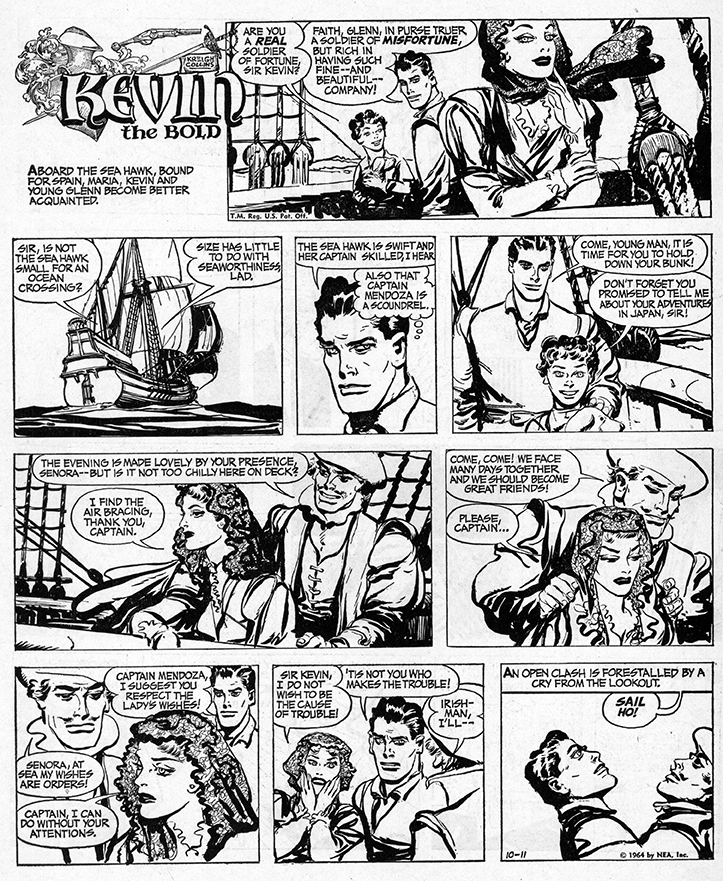
The orphan Glenn, his dog Inky and lovely Maria are bound for Spain. They sail aboard the Sea Hawk, with Kevin acting as their escort. Glenn fiercely defends his dog after witnessing some ill treatment by Captain Mendoza. In defending Glenn, Kevin nearly comes to blows with Mendoza. The captain’s reputation as a scoundrel has proven to be accurate. In the October 18 comic, tempers flare again.

KTB 101864 BWP 72 QCC

KTB 101864 TH 72 qccKTB 101864 TH Fr 72 qcc

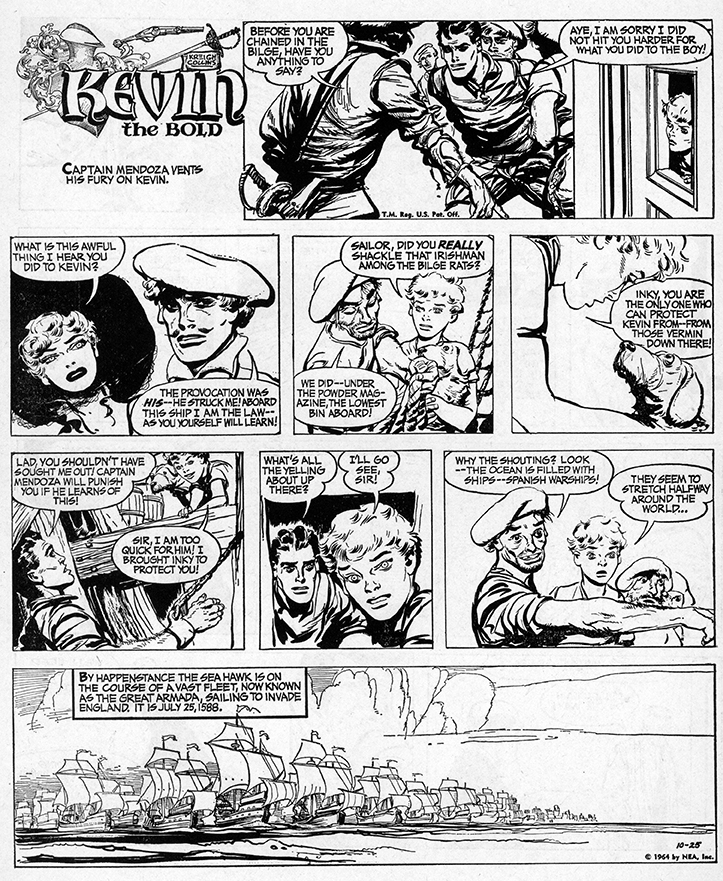
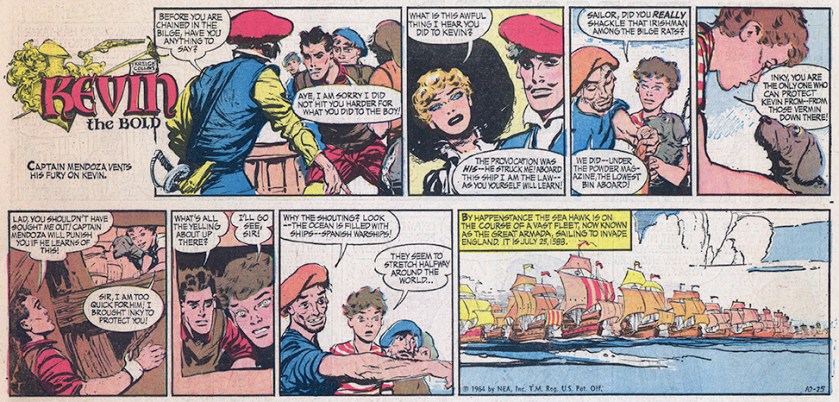
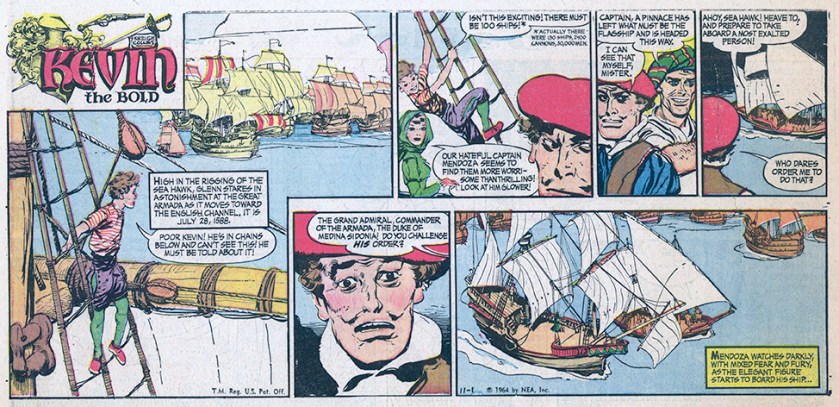
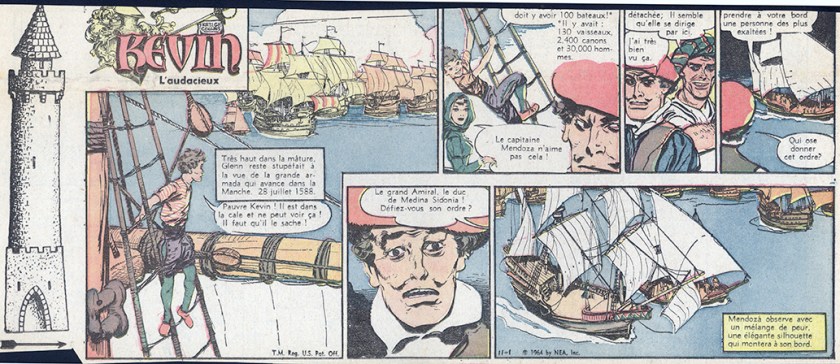
The sails of an enormous fleet have been spotted on the horizon. As was his style, Collins has woven history into his narrative — “Kevin the Bold” often reads like an illustrated  historical novel.

KTB 102564 BT 72 QCC

KTB 102564 TH 72 qcc

KTB 102564 TH BW Fr 72 qcc

Finalement! Une bande dessinée intacte. Mais il est noir at blanc! Merde!!

Kreigh Collins had four sons. Like-named characters based on the older two were featured in “Up Anchor.” The younger boys were twins, and one was named Kevin. I’m not sure exactly which was named for whom, but the comic debuted five months before my uncle. Fourteen years later, a character named Glenn appeared — perhaps my other twin uncle thought this was just a bit overdue. Another common name between the comic strip and the artist’s family was Brett, Kevin’s ward and the name of Kreigh’s first grandchild. Again, the character preceded the person (this time by nine and a half years). Glenn’s dog Inky was modelled on not one of the family’s cocker spaniels, but on a neighbor’s dog (also named Inky) who spent a lot of time at the family house in Ada.

KTB 110164 BT 72 QCC

KTB 110164 TH 72 qccKTB 110164 TH Fr 72 qcc

Kevin the Audacious

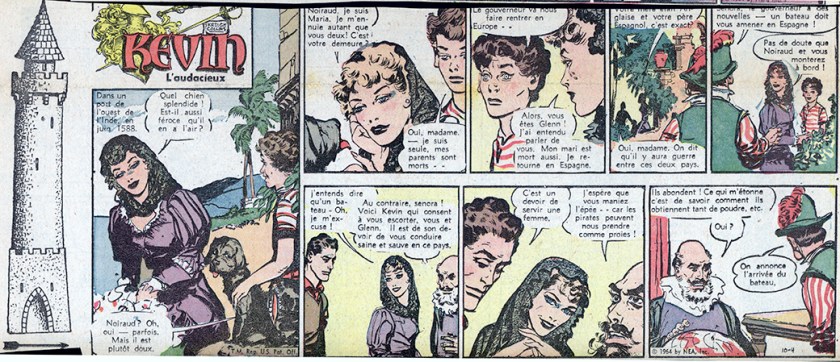
The action in the following sequence begins on October 4, 1964. Kevin has sailed to the West Indies, and three new characters are introduced. It is June, 1588.

KTB 100464 BT 72 QCC

This first comic came from a tabloid the NEA published featuring its stable of comics. These were dated six days before they appeared in the Sunday funnies.

When I first began collecting “Kevin,” I was frustrated by its lack of availability. Auctions on eBay weren’t showing up very often, and when they did, the prices tended to go beyond my budget. I had complete runs of a few different years, but my goal was to collect the entire 19-year run. I was starting to get impatient.

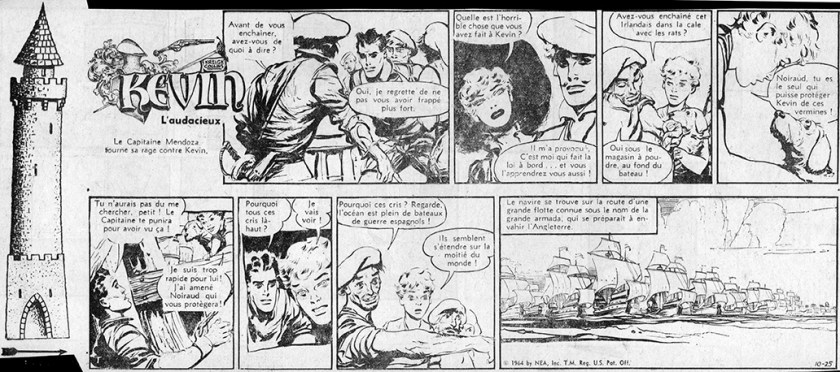
While searching for books illustrated by my Grandpa Collins on a used book site (in this case, abebooks.com), I came across a couple of listings of “Kevin l’audacieux” — French-language versions for newspapers in Québec. For cheap! I bit on one, thinking I could translate the dialog, and… well, it seemed like a good idea at the time.KTB 100464 TH 72 qccKTB 100464 TH Fr 72 qcc

I soon realized that translating them would take an enormous amount of time. Also, they were very poorly trimmed. Mon dieu! They worked out to 46¢ apiece, and I guess I got what I paid for. However, since I did make the initial investment, and especially since I took the time to scan them, let’s follow the action bi-lingually. (Qui sait, peut-être que je vais gagner quelques abonnés français!) The one-third pagers will at least add some color.

KTB 101164 BT 72 QCC

KTB 101164 TH 72 qccKTB 101164 TH Fr 72 qcc

On the Hard

Plenty of action and adventure lay behind; a proposed ocean crossing promised further excitement ahead. Once home, the Marlins reunited with their old friend Pedro, who almost seems to have anticipated Heather’s upcoming journey. These comics ran November 14, 21 and 28, 1971. With only 13 more “Up Anchor” comics to come before Kreigh Collins retired, it seems doubtful that Heather ever made it to Europe.

UA 111471 OA

UA 112171 Th 300 qcc

UA 112871 Th 300 qcc

Pedro is a character with a familiar face. As with other characters Kreigh illustrated, his doppelgänger was a friend of Kevin Marlin in his earlier incarnation as Kevin the Bold. Whereas Kevin has aged from one comic strip to the next, Pedro has not. Maybe Pedro’s secret is the Italian beautician’s powder.

KTB 122858 TH 300 QCC

(KTB from December 28, 1958)

Kevin the Scandinavian

SeriemagasinetSolohaefte_1975_23  KTC Tom Mix Comicbook cvr.jpg

At some point in the 1970s, “Kevin the Bold” was published for a market in Norway. I have no information about the comic book shown (above, left) other than his new sobriquet translates as “fearless.”

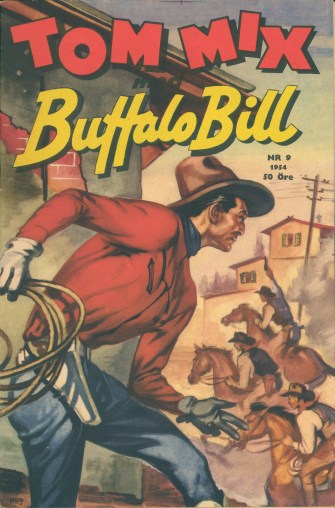
Another European market for American golden- and silver-age comics was Sweden. The wild west was a uniquely American subject that appealed enough for a comic to be assembled from various western-themed sources. Dating from 1953, the comics inside the beautifully-printed “Tom Mix with Buffalo Bill” ranged from classics (“Tom Mix,” “Frisco Kid,” “Buffalo Bill,” and “Lash LaRue”), to dense one-pagers (“De Dog Med Stövlarna På” [translation: They Died with their Boots On] and “Slaget vid [Battle of] Little Big Horn”) to the forgettable (“Ugh,” a silent comic featuring a native American girl). Also included, rather inexplicably, was “Kevin the Bold.” Maybe the comic’s connecting theme wasn’t the wild west — perhaps it was horses. At any rate, “Kevin” was the only American comic renamed in Swedish (here called “Roland den Djärve” — which indeed translates to “bold”.

KTC CB p02-03

The “Kevin” sequence covers three and a half comics that ran at the tail end of 1951 — a memorable sequence where Kevin fights Baron von Blunt to the death. Interestingly, the comics aren’t simply reprints of tabloid pages. The artwork has been edited quite a bit. Throwaways aren’t the only panels that disappear, and a few other panels are expanded with line work that isn’t a very convincing imitation of Kreigh’s. The comic ends abruptly — in fact, the next one in the sequence (January 6, 1952) is a cliff-hanger (literally!).


Australian Editions, Part 2

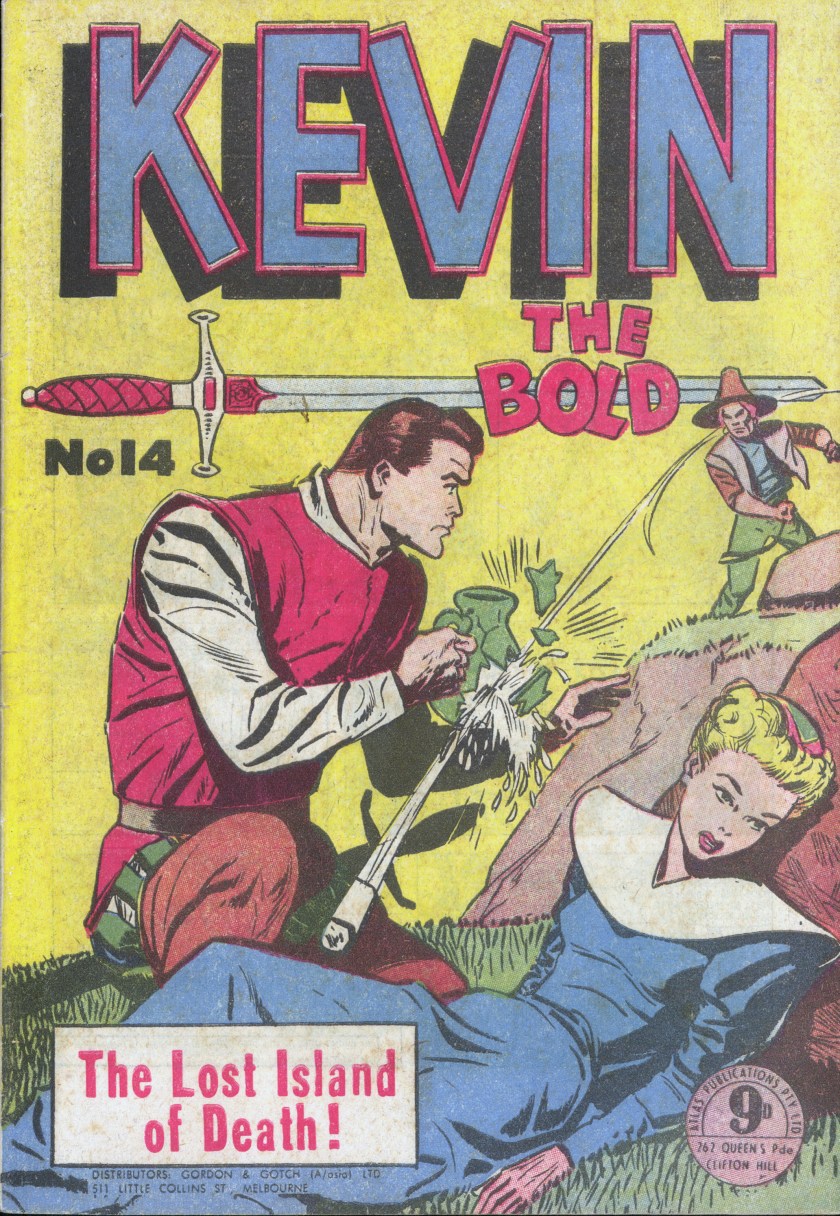
A third publisher of “Australian Edition” comic books was Atlas. The comics Atlas published came out later than those put out by Tip-Top and Thriller, and they seem to be better organized — the comics run in sequence without the randomness that occurred in some Tip-Top titles.

KTBCB 13 01 cover

The comics may run in sequence but the material in No. 13 (April 11–August 22, 1954) is older than that which is found in No. 14 (November 8, 1953–March 28, 1954). I found these titles on an eBay and was fortunate to win the lot of them for less than $20.00. They were listed by a seller in Australia, and don’t turn up very often — maybe once a year.

KTBCB 14 01 cover


Australian Editions, Part 1

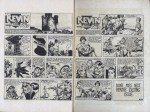
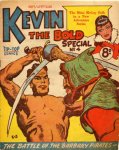
Many U.S. Golden Age comics were printed and distributed in Australia throughout the 1930s, 40s, and 50s. Tip-Top and Thriller were two publishers that first brought Kreigh Collins’s comics down under. Tip-Top No. 3 features later “Mitzi McCoy” comics, and No. 4 covers the opening sequence of “Kevin the Bold.” I’m not sure which comics are found inside the pages of No. 5; No. 6 has a hodge-podge of “Mitzi” (from 1949–50) and “Kevin” (1952) with no logical sequencing. Apparently the target demographic wasn’t overly concerned with continuity. The 24-page books would typically feature 20 Sundays’ worth of tabloid versions of the comics, plus the cover and a couple pages of ads.

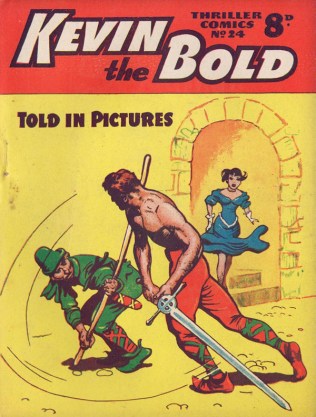
These “Australian Editions” are highly sought after due to their affordable prices and unique covers. The covers repurposed dramatic panels from the comics with backgrounds and dialogue eliminated (as shown in Thriller No. 24, which uses the opening panel from the December 24, 2950 “Kevin”).

KTB Comicbook 24LgKTB 122450 HA 72 P1

Foreign Tongues

When it was launched in 1948, “Mitzi McCoy” appeared in about three dozen newspapers. Nearly all were located in the United States, but two were from Canada — the Farmer from Winnipeg, Manitoba and Montreal’s La Patrie. Being situated in Quebec, “Mitzi” was translated into French and ran as the more Gallic-sounding “Mitzi Morot.” When the strip rebooted as “Kevin the Bold,” it continued to run in a translated form in the pages of La Patrie.

As the popularity of “Kevin” grew, its reach spread further and it was translated into other languages. Often, the comics ran after their original publishing dates, as was the case when “Kevin el Denodado” appeared in Argentina in a magazine called Tit-Bits. (Though it sounds like a girlie mag, it was actually the Argentinian version of an eponymous British weekly first published in 1881).

“Kevin” eventually made his way to South Africa and was translated into Afrikaans, as shown in this comic from 1965.

KTB 1965 09.12 afrikaans

The comic was also repackaged into comic books for overseas markets, and besides the relatively common examples from Australia, it was translated into Norwegian and Swedish for Scandinavian readers. (More on the comic books later).

[French “Mitzi Morot” and “Kevin the Bold” images at top of post courtesy of Encyclopédie de la Bande Dessinée de Journal au  Québec 1918-1988]

New Year/Old Gear

After acquiring my first comics — a two-year run of “Kevin the Bold” — I decided I should publish a book somehow. First, I needed to figure out the best way to get images of them, and since they were too large for my present scanner, I thought of using a camera stand. I had a vague notion of what one would look like, so I jury-rigged one out of some dowels and thin pieces of pine. 

Camera Stand

It held my camera, a Canon PowerShot A40. The camera wasn’t very sleek, but a grip that bumped out on its side helped secure it onto the camera stand. It was March, 2004, so shooting indoors made sense.

A40

Being a bit of a packrat, I still had some old light scoops and 3200K bulbs that dated back to college. I plugged them in by my camera stand and my ersatz photo studio seemed set. However, the resulting photos left much to be desired — my lighting was terrible!
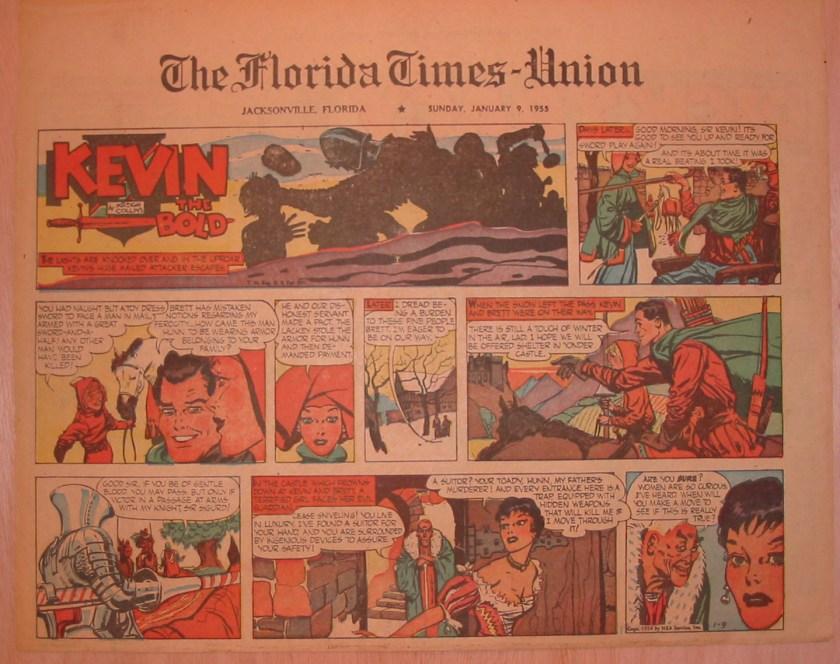
KTB 010955 inside photo

I decided to try shooting outside; I figured the natural light would be perfect. It was now May, so going outside wasn’t out of the question. The light was ideal, but even a light breeze complicated everything.
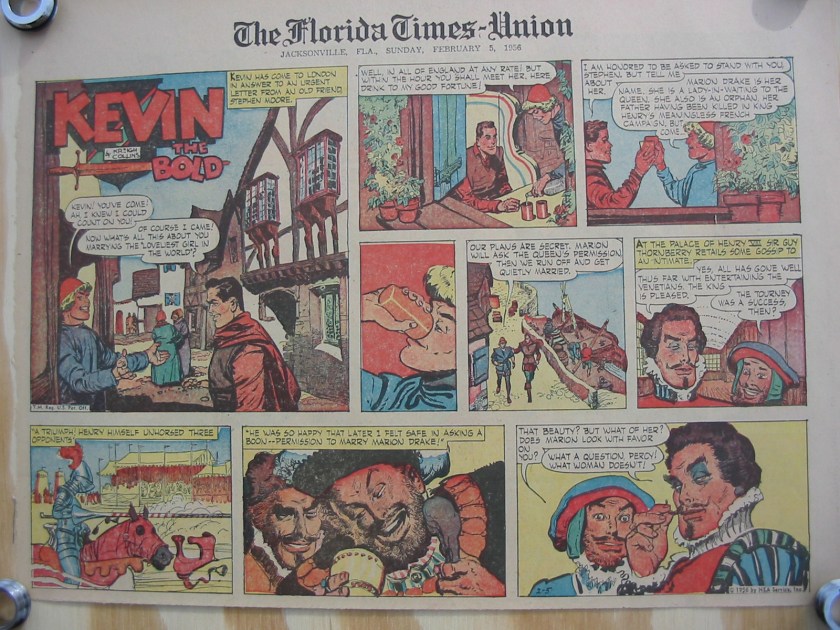
KTB 020556 outside photo

Needless to say, I didn’t have a photo assistant. I could use weights to hold the comics in place, but having to deal with all these moving parts for each shot was less than ideal. It was a very slow, nerve-racking process — one gust and everything would be all over the back yard. Eventually I decided that shooting indoors on a sunny day near large windows was the most workable solution.

One way to say it would be that I didn’t know what I was doing; I prefer to think I was making it up as I went along. Regardless, it’s not the most confident way to start an endeavor, but I thought the most important thing was to just get started. I settled on using three 75-watt bulbs, my camera’s flash and the necessary color corrections in PhotoShop.

I shot my 105 comics, and proceeded to photograph new additions the same way, using a SanDisk card reader to  upload the images to my iMac. My collection grew slowly, which was just as well, since the process was so time-consuming. I recalled vaguely that higher-end cameras had lenses with optics that produced images whose edges were square but the A40 was obviously not in that category. So I also used PhotoShop to square up the images. But again, what a slow process.

Card Reader

A guy who worked at a place where I freelanced knew how to use the company’s tabloid-sized  photocopier as a scanner, and this seemed promising, but I wasn’t able to get permission to take advantage of this piece of equipment. As my comics collection grew, I become familiar with eBay, and I started looking into inexpensive tabloid scanners. Eventually I won an auction for a Microtek ScanMaker 9800XL. It makes nice square scans and easily accommodates half-page comics on its 12″ x 17″ bed. Lighting and wind are no longer problems. Even with its ultra-slow scanning speed, the $200 investment was well worth it. And it’s much more civilized than the old camera-stand process. The scanner is probably 15 years old but it still works fine (though I’ve had to purchase third-party software drivers to keep it functioning with the ever-changing Mac operating systems. I recommend VueScan from Hamrick software).
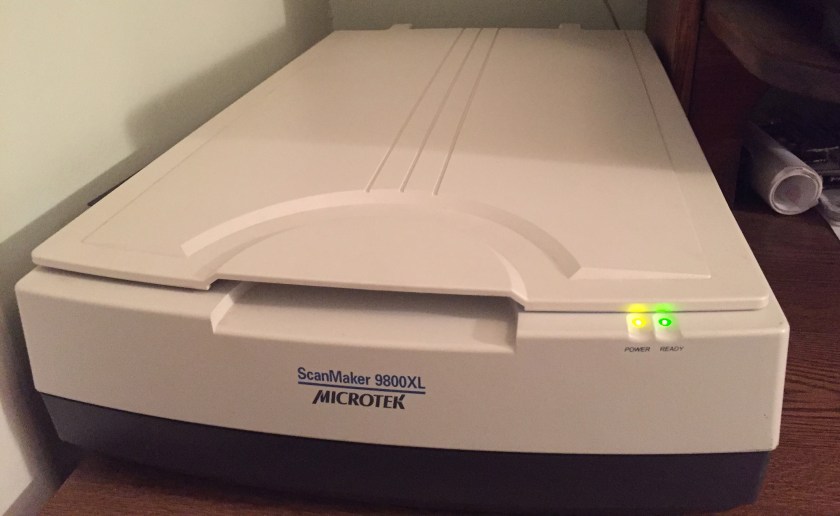
9800XL

At this point, I have most of my comics scanned (duplicating my attempts with the camera stand). Color-correction lags way behind, though I have nearly worked my way through the 100 “Mitzi McCoys” extant. And with any luck, a Mitzi McCoy book will be published in 2016.

Happy New Year!

Merry Christmas and a Good 1969

KTC xmas 68 200

1968 was filled with change. After appearing for 19 years, “Kevin the Bold” ended its run. At the age of 61, Kreigh Collins launched his third comic strip, “Up Anchor.” This fresh start was the big news in the holiday letter Kreigh and Teddy sent out that December. There were also family updates , typical New Year’s optimism, and a dose of Kreigh’s wit.

“Up Anchor” ran until early 1972, and after its 174 episodes, Collins retired. All told, Kreigh’s comics appeared for 25 years, spanning four decades — over 1,200 Sundays.

UA envelope 72

Metamorphosis 2 — More Time Travel

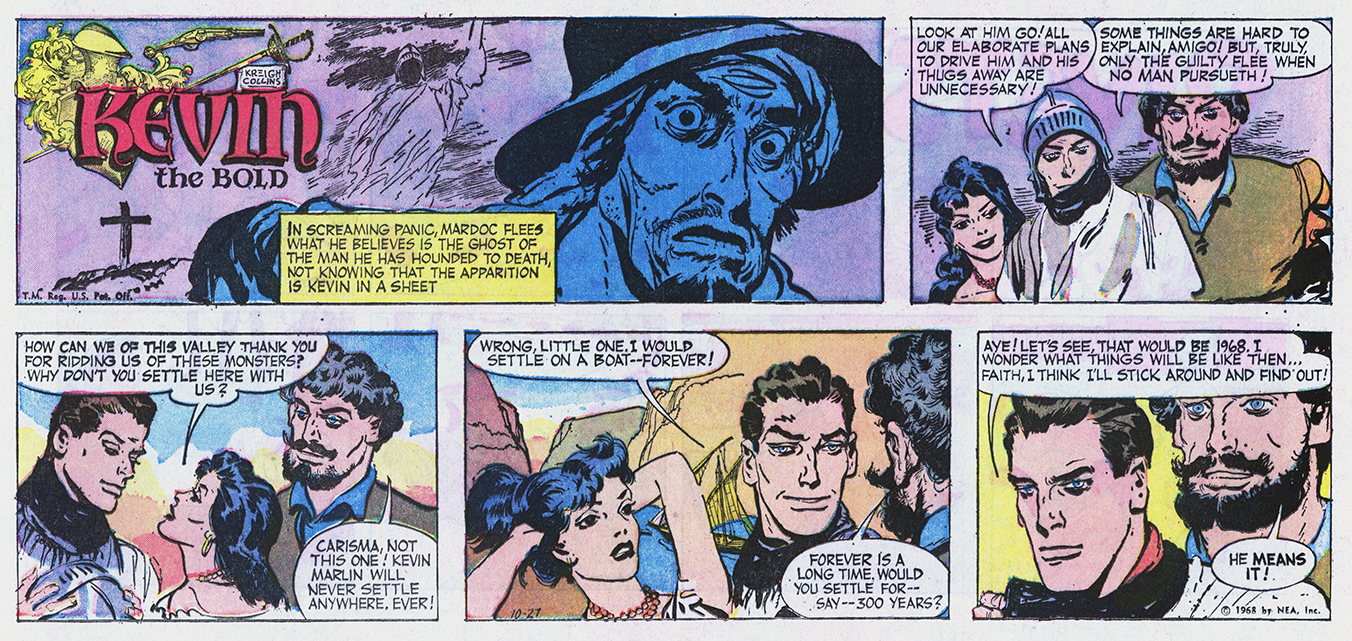
In the final episode of “Kevin the Bold,” after saving yet another damsel in distress (and of course, an entire village), our hero is begged by a lovely señorita to settle down and stay in her now-peaceful valley. Kevin, whose last name (Marlin) has been revealed in a recent, prior episode, declines the offer from the Spanish beauty but admits he could imagine himself settling down on a boat in say, 300 years.

KTB 102768 Th 100 qcc

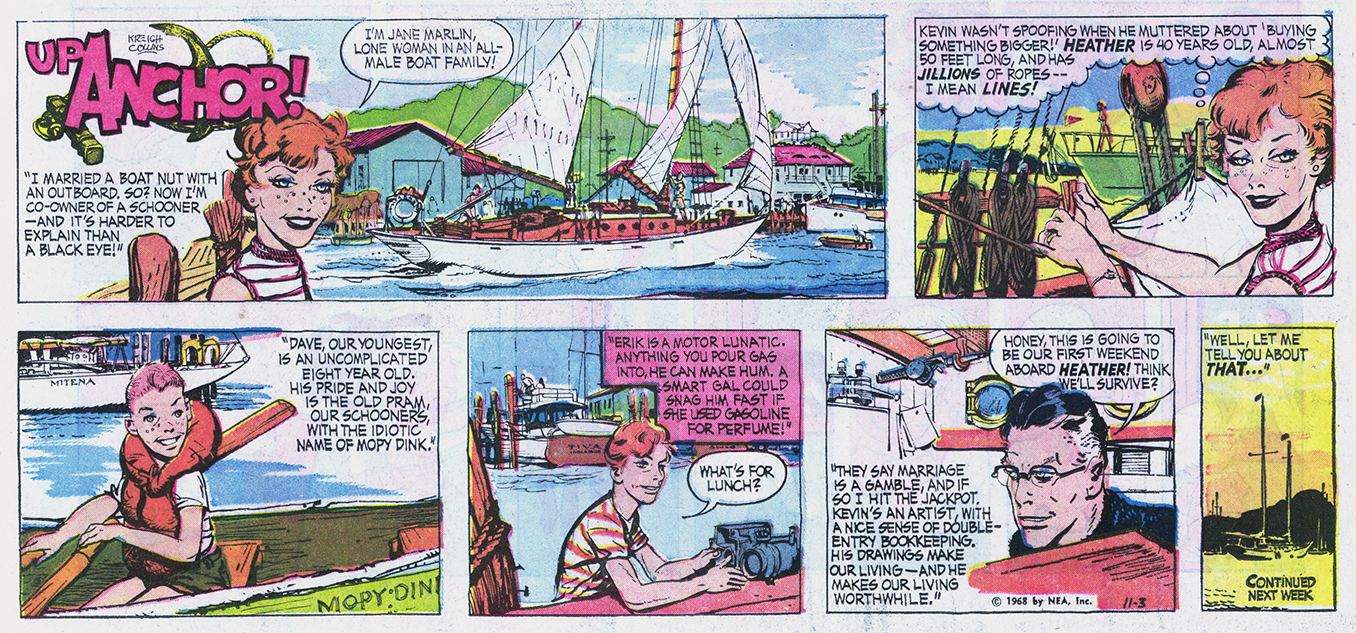
Abruptly, “Up Anchor” was launched a week later (November 3, 1968). As the NEA’s promotional literature put it, “Kreigh Collins’ credentials to create and draw ‘Up Anchor,’ America’s first color comic strip devoted to boating, are as bona fide as the burr on a thistle.” Narrated by first mate Jane Marlin, “Up Anchor” was based on experiences Collins had with his family cruising on his own sailboat. Aboard Heather with Jane were her husband (Kevin Marlin, remember him?), and sons Erik and Dave. The scripts were developed in partnership with Collins’ wife Theresa (“Teddy”), who had previously chronicled the family’s round-trip journey from their home port on Lake Michigan to Maine (Teddy’s “The Wake of the Heather” was published in 1967) .

UA 110368 Th 100 qcc