The outline ends. As before, it accurately describes the final episode of the chapter—another graphically-appealing example of Collins’ work. The example I have, like many of the MITZIs in my collection, is a half-page from The Pittsburgh Press. For nearly its entire run, MITZI McCOY was the Press‘ lead comic feature (though as you may have noticed, my examples from this sequence also included tabloids, half-tabloids, a third-page, an NEA promotional slick, and a photo of one of the original pieces of artwork).
This final episode includes several interesting panels. One is an interior of the Freedom Clarion’s work space (note the metal type being composed on the make-ready table, and the first and last panels of the second row both show exterior scenes of the little town of Freedom that very closely resemble those shown in the proto-episode Collins created for NEA that became MITZI. These exterior scenes were modeled after Fishtown, the commercial lakefront district of Leland, Michigan, where Collins spent much time in his career, both at leisure and painting.
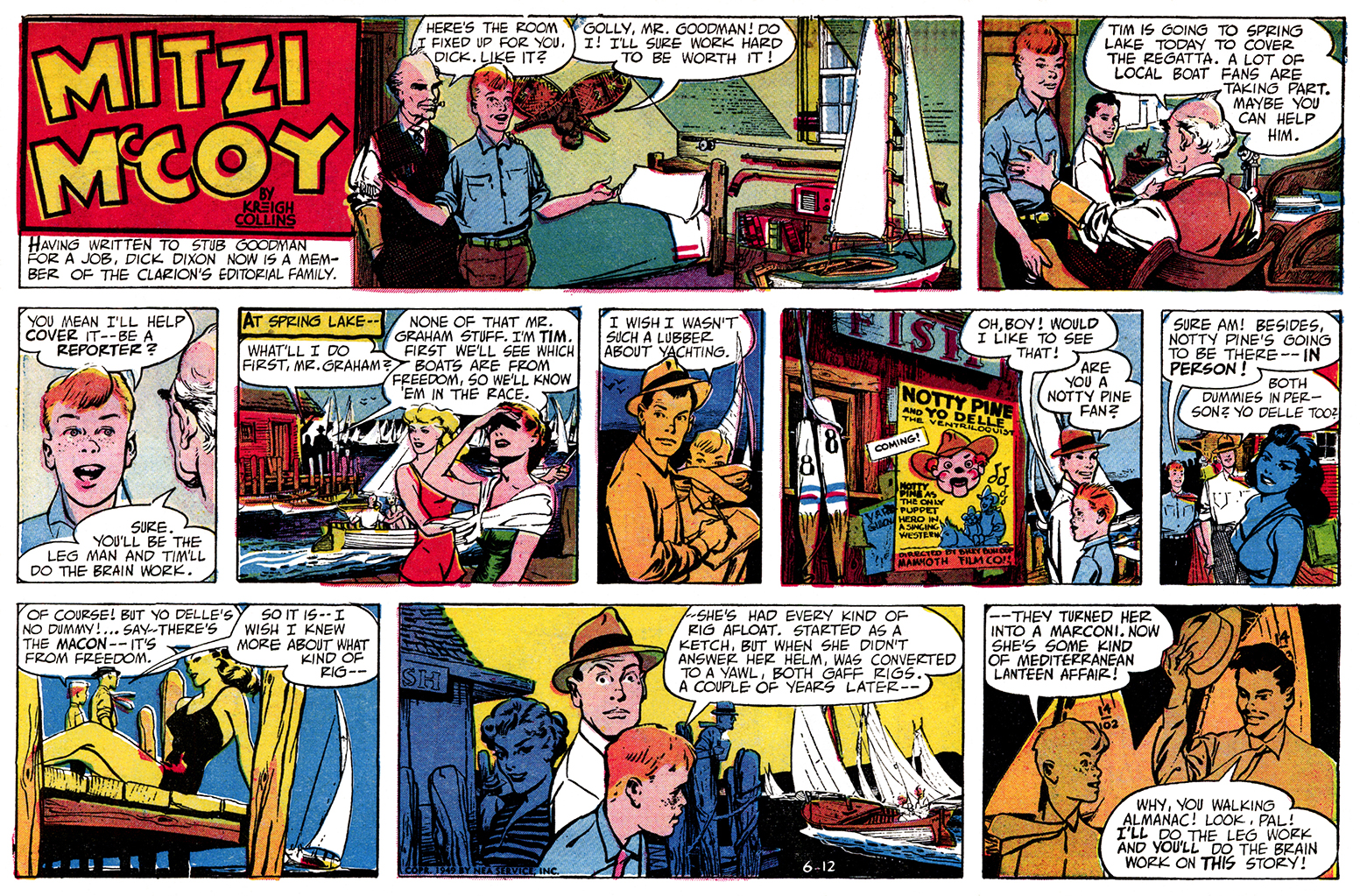
As the outline came together in March-April, 1949, Collins was able to sneak in a teaser reference to the upcoming chapter in the one he was currently inking. In the June 12, 1949 episode, from the prior sequence that introduced Dick Dixon, the boy notices a poster for the Notty Pine show that was central to the chapter just featured. (Incidentally, this one is one of my favorite MITZI episodes—along with the Notty Pine reference, DIck stuns Tim Graham with his knowledge of various sailboats’ histories, and there are several beautiful examples of good-girl art—typical hallmarks of Collins’ work.
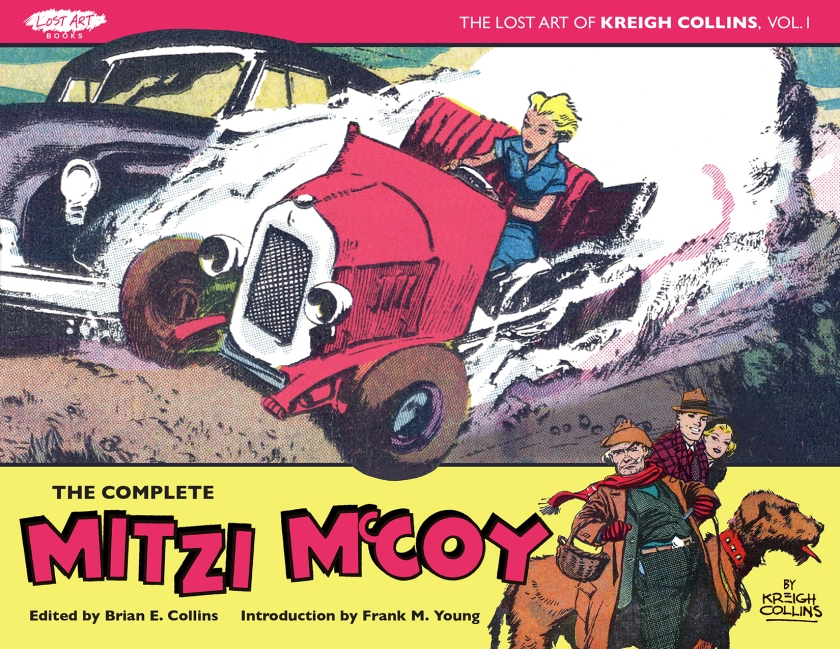
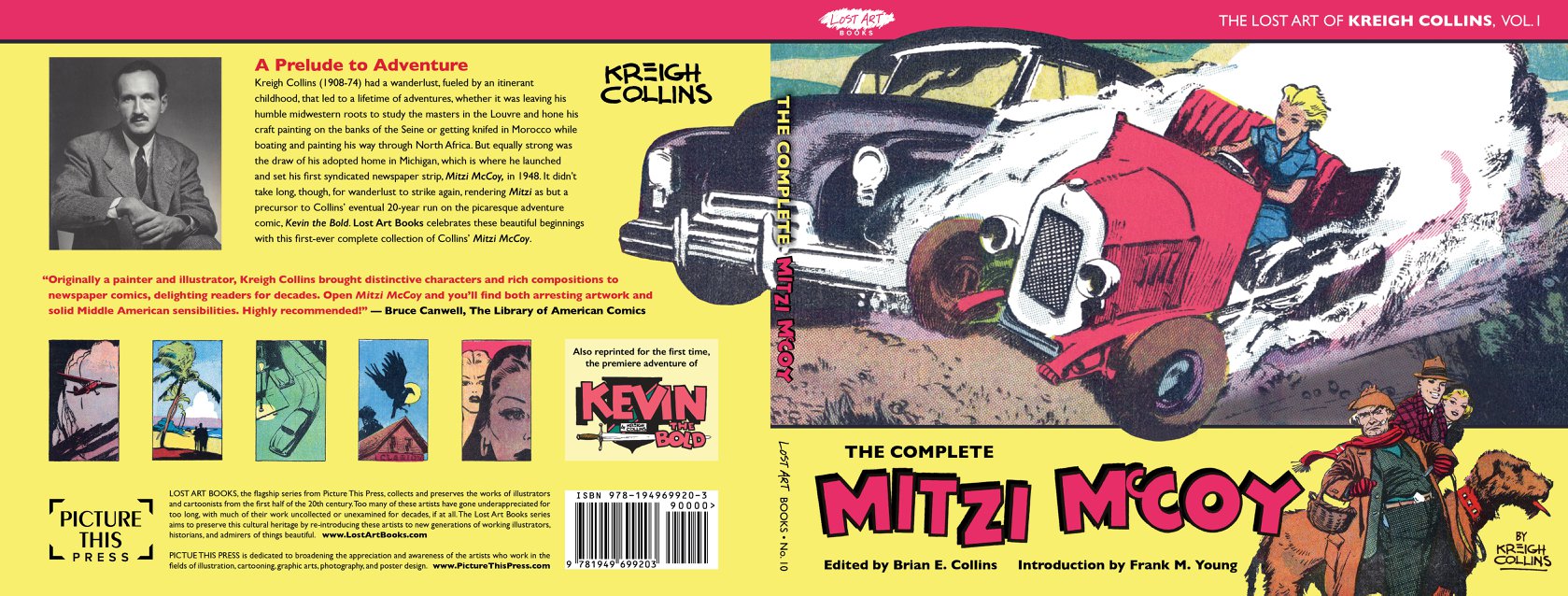
“The Lost Art of Kreigh Collins, the Complete Mitzi McCoy,” is available for a limited time at a reduced price; it features the entire run of Kreigh Collins’ first NEA feature.
MITZI McCOY ran from 1948 to 1950 and showcased Kreigh Collins’ skill as an illustrator and storyteller. His picturesque landscapes, lovely character designs, and thrilling action sequences brimmed with detail and charm, and the strip’s ensemble cast rotated in and out of the spotlight taking turns as protagonists in the dozen story arcs collected in this volume. The last story collected in “The Complete Mitzi McCoy” is the narrative bridge that set Collins and his characters off on a new journey, beautifully told for the next couple of decades in the much-lauded adventure strip Kevin the Bold.
The collection includes an introduction by Eisner Award-winning author Frank M. Young, an Afterward by Ithaca College’s Ed Catto, and previously unpublished artwork and photos. Longtime comics artist Butch Guice also provides a new pin-up of the character Mitzi McCoy.
The book costs $30ONLY $20! For domestic shipping, add $4; for international orders, add $25 for first class shipping. To place an order, leave a comment below or email me at BrianEdwardCollins1[at]gmail.com, and I will give you PayPal information.
An aspect that was simplified was the omission of Billy telling Stub his troubles, and Billy’s plan to leave the cave and spread the word about Dick being safe.
Also, no reason was given in the finished episode for Tiny jumping overboard, but otherwise, the episodes neatly match the outline.
This MITZI McCOY chapter will wrap next week with the final episode in the sequence.
The outline continues with some more description of the cave Yo Delle’s manager Billy Buildup found for them to hide out. It also establishes that Billy has a more blue collar existence than many of MITZI McCOY’s other characters, who are busy with leisure activities in the next couple of episodes.
The outline was clearly written by someone familiar with sailing small boats, and the final product shows he had a facility with drawing sailcraft. No doubt the final dialogue was all written by Collins too.
At this time, Kreigh Collins owned a small pram, Stub, similar to a Snipe—the main difference being its lack of a jib. In a year or two, Collins would upgrade to a larger daysailer, a 19-foot Lightning (shown being sailed by his sons Eric and David).
A nice tabloid example of the July 24, 1949 episode shows the footer common to NEA features, with Mitzi fifth from left.
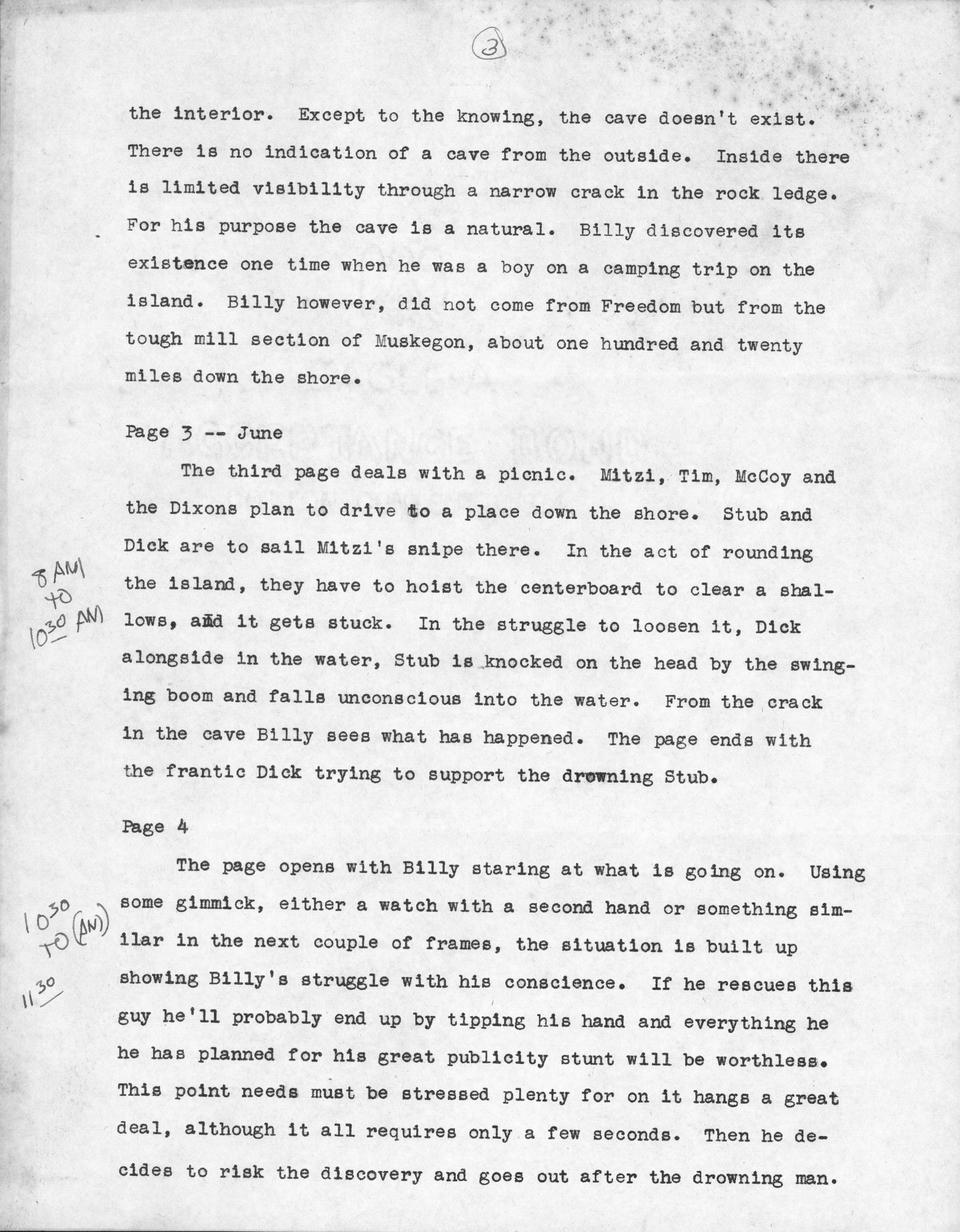
That’s a pretty brave stunt young Dick is pulling, trying to free the Snipe’s centerboard while under sail—all without wearing a life vest. But it’s Stub who needs to be careful. When Stub moves over to the high side to keep an eye on Dick, he causes the boat to jibe. A opposed to tacking into the wind, an uncontrolled jib can be very dangerous, and Stub illustrates this by getting clocked by the boom as it swing quickly across the cockpit. Meanwhile, DIck shows impressive life saving technique as he struggles to get Stub to shore.
The “gimmick” proposed by Collins in his original outline (either a watch with a second hand or something similar) was scrapped and replaced with standard captions, but he revisited the idea nearly a decade later, in a 1957 episode of KEVIN THE BOLD.
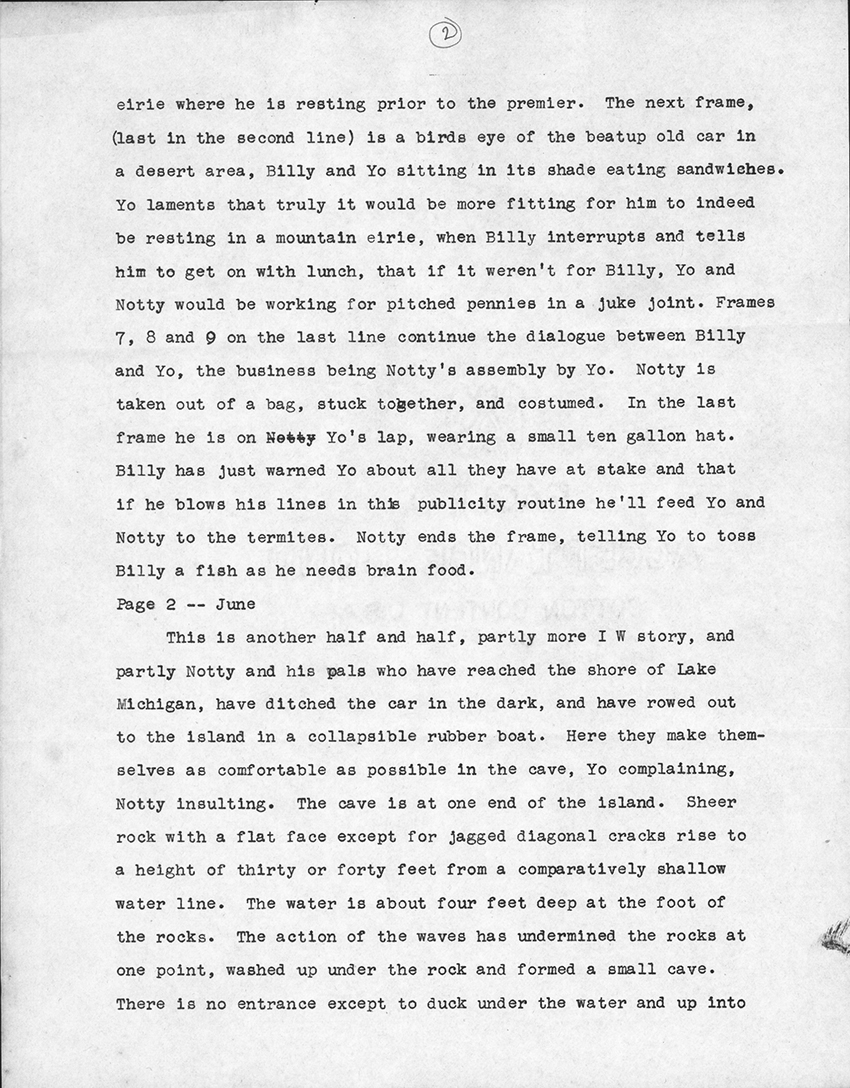
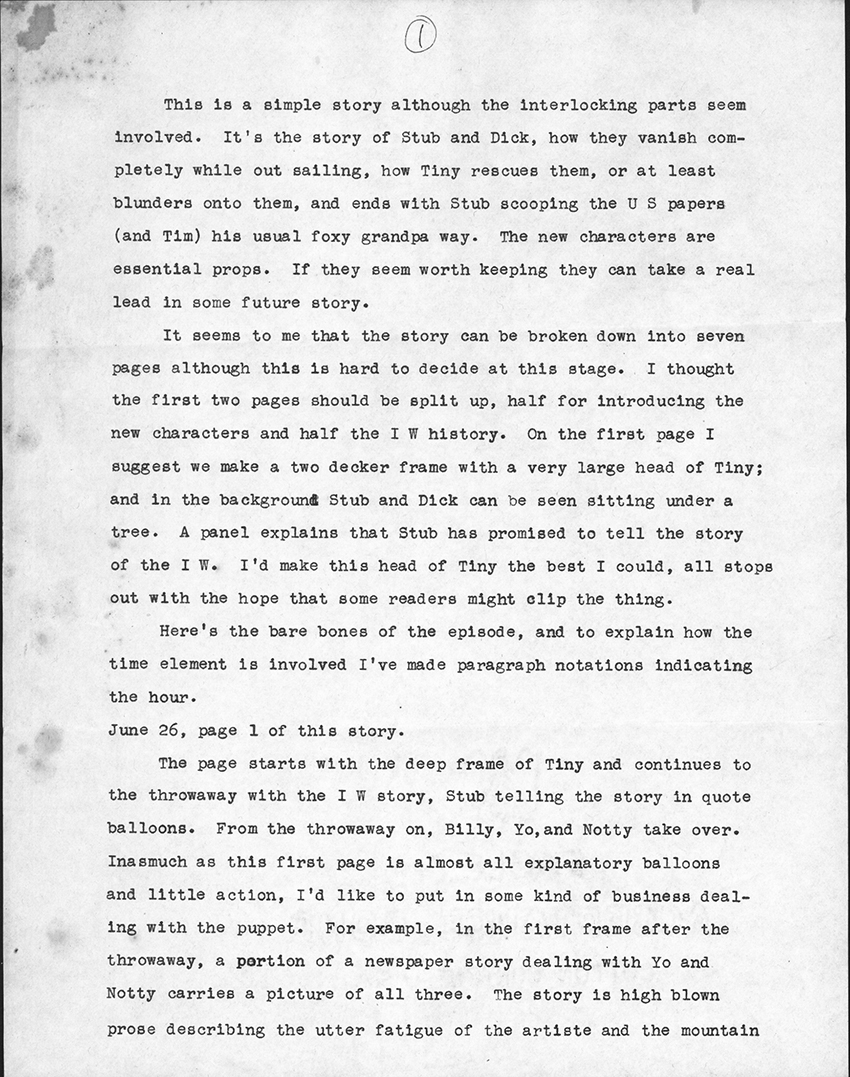
The outline continues. Here is the beginning of the sentence from page 1: The story is high blown prose describing the utter fatigue of the artiste and the mountain…
The first paragraph is a pretty accurate description of the July 10 episode, taken from a photograph of the original artwork, which is found in a collection at the Grand Rapids Public Library..
It is a delight, both in its overall appearance and in some of the details hidden within. In the first panel showing Yo Delle and his manager, Notty Pine is shown to be bald—something fans of the “cowboy ventriloquist” wouldn’t notice, since the dummy’s costume included a cowboy hat. In the following panel, the crew stops at a roadside diner called Tomain Tommy’s, a play on a (now obsolete) term describing food poisoning, “ptomaine”). The final panel has an eerie quality, with manager Billy Buildup looking over his shoulder—he apparently has the car in reverse—and taken out of context, Notty Pine’s crack seems strangely contemporary.
From the outline, “Page 2 — June” (i.e., the July 17 episode) turned out not to be a “half and half” with more Irish wolfhound backstory, but a simplified version showing the new characters getting established on shore, identified as Manitou Island. In reality, Manitou is actually two islands, North and Sound Manitou, and they are located to the west of Michigan’s “pinkie,” about a dozen miles away from the town of Leland. Leland is the town in which Collins situated the prototype episode he created for NEA, “Tom Match and Stub;” here is evidence that MITZI McCOY was also set in Leland (an area that Collins spent a couple summers early in his career, when his focus was landscape painting).
The outline is quite specific in its description of the island—I would posit that Collins had read about such geographical features somewhere along the way.
About ten years ago, when I started collecting my grandfather’s comics in earnest, I received a large package from my Uncle Kevin. It contained hundreds of KEVIN THE BOLD and MITZI McCOY episodes (including the entire run of MITZI). Because I had talked with (Uncle) Kevin about putting together a book featuring his namesake, I was less interested in the MITZIs. Later, when the idea of publishing a compilation of a comic feature that ran for nearly two decades became too daunting, I recalculated and set my sites on Kreigh Collins’ first NEA feature. Around this time, my uncle sent me another massive shipment—many more Sunday strips, but also some odds and ends.
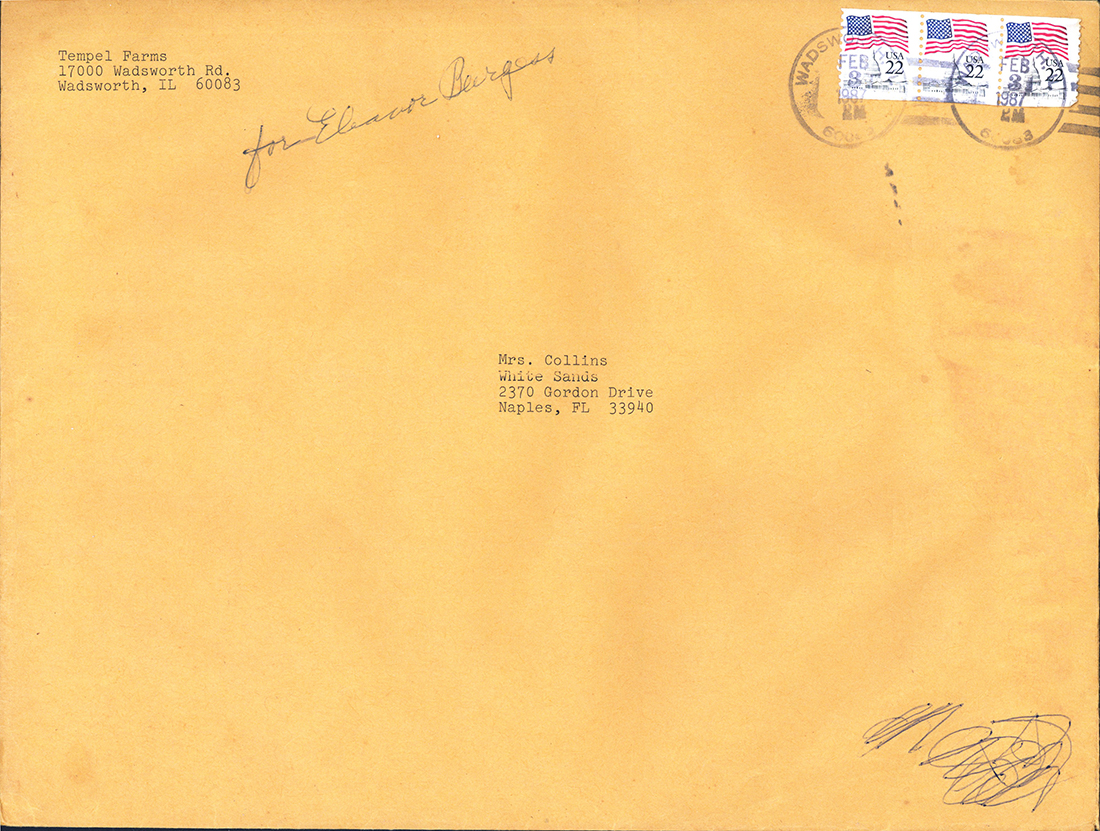
Among the miscellanea was the envelope shown above, postmarked February 1987, from Wadsworth, Illinois. Tempel Farms was the home of Aunt Esther, my grandmother’s sister. Because the husbands of both Theresa and Esther had passed, the two women spent much time together, including at Aunt Esther’s winter home in Naples (where the letter was delivered). My grandmother’s handwriting indicates the envelope was for Eleanor Burgess, with whom I am not familiar. The contents all related to my grandfather’s comics career, but by the time I opened it, it seems the envelope had become a sort of catchall, a little time capsule, circa 1949. There was a letter typed by Kreigh (the numerous typos were a dead giveaway)—it mentioned the possibility of starting a second comic strip. Also included was a plot outline for one of the chapters of MITZI McCOY, and about a half dozen MITZI episodes, half-tabloids likely from the New York Sunday Mirror—but not the episodes covered in the plot outline. Unable to make sense of the package, I put it aside and got busy scanning and cataloguing all my new comics.
Later, after having done research for my MITZI collection, the contents of the envelope started to make more sense, and as this blog celebrates its sixth anniversary, now seems like a good time to delve further into this enigma. The second strip referred to brief discussions Collins had about creating one with a religious theme (like his earlier BiblePictureStories), and whether he would be bound to his current employer (NEA), or if he could negotiate with another syndicate, such as King Features.
Revisiting the plot outline, and now more familiar with MITZI McCOY, I was surprised to see how closely the finished episodes hewed to Collins’ original plan. His boss, Ernest “East” Lynn, was a heavy-handed editor inclined to nitpick and tinker, and prior to the publication of my MITZI collection (ahem, The Lost Art of Kreigh Collins, The Complete Mitzi McCoy), much of the information I read online gave others credit for the storylines my grandfather illustrated (such as this well-written blog post by my future collaborator, Frank M. Young).
Because of the long advance time needed to create a weekly Sunday comics feature, the outline for these episodes would have been written 3–4 months before the corresponding strips were published. In this instance, that would mean roughly March, 1949. In the late 1940s, Kreigh Collins and his family wintered on Anna Maria Island, a barrier island located at the southern tip of the mouth of Tampa Bay. For two or three months, the family would escape the snowy West Michigan winters and stay in a rented cottage, with sons Eric and David temporarily enrolled in a local elementary school. Later in his career, Collins and his family would spend even longer periods away from home, plying the Great Lakes and beyond in a sailboat.
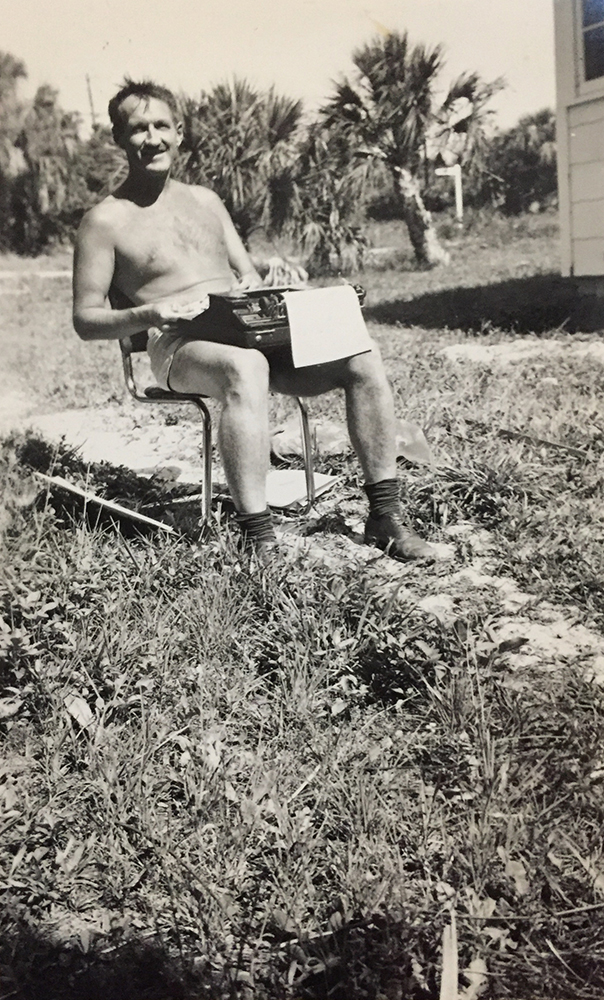
Anna Maria Island, Florida, 1949. Kreigh was an early adaptor of the remote working concept.
The story outline is for what became MITZI’s fifth chapter. In my MITZI McCOY collection, I titled it “The History of the Irish Wolfhound,” but it’s really more about Stub Goodman, the editor of a smalltown newspaper, and Dick Dixon, an erstwhile runaway who ends up working for Stub at the Freedom Clarion. Tiny, Stub’s Irish Wolfhound, also plays a major role. By design, any of MITZI’s primary characters could take the lead in a given sequence—this time, Mitzi herself doesn’t show up until the third episode, and then only in a supporting role.
I can’t guarantee Collins banged this out while basking in the Florida sun, but I’d like to imagine that’s exactly how it happened.
The first paragraph mentions some new characters, and although Collins was open to having them return at some point in the future, they never did. One minor change is that the action occurred over eight episodes, not seven, but beyond that, it’s an accurate prediction of the final product. Six months into the strip’s run, Tiny had already become a reader’s favorite, and to capitalize on this, Collins suggested a splash panel with an eye-catching closeup of the dog. Lynn and the suits at the NEA were pleased with the results, and printed promotional slicks to woo potential clients.
In the outline, June 26 was the target date for the first episode of the story; this episode was actually split across two weeks. This sort of recalibration was not unusual—apparently an episode from an earlier sequence was also spread out over two weeks, as the chapter debuted a week later, on July 3, 1949.
Notably, this chapter was one of the most influential of MITZI’s short run—the device of having Stub narrate a story to a youngster would recur in Collins’ future work, and the throwback visuals shown here foretell what was to come 15 months later when MITZI morphed into KEVIN THE BOLD.
“The History of the Irish Wolfhound,” and its outline, continues next week.
“The Lost Art of Kreigh Collins, the Complete Mitzi McCoy,” is available for a limited time at a reduced price; it features the entire run of Kreigh Collins’ first NEA feature.
MITZI McCOY ran from 1948 to 1950 and showcased Kreigh Collins’ skill as an illustrator and storyteller. His picturesque landscapes, lovely character designs, and thrilling action sequences brimmed with detail and charm, and the strip’s ensemble cast rotated in and out of the spotlight taking turns as protagonists in the dozen story arcs collected in this volume. The last story collected in “The Complete Mitzi McCoy” is the narrative bridge that set Collins and his characters off on a new journey, beautifully told for the next couple of decades in the much-lauded adventure strip Kevin the Bold.
The collection includes an introduction by Eisner Award-winning author Frank M. Young, an Afterward by Ithaca College’s Ed Catto, and previously unpublished artwork and photos. Longtime comics artist Butch Guice also provides a new pin-up of the character Mitzi McCoy.
The book costs $30ONLY $20! For domestic shipping, add $4; for international orders, add $25 for first class shipping. To place an order, leave a comment below or email me at BrianEdwardCollins1[at]gmail.com, and I will give you PayPal information.
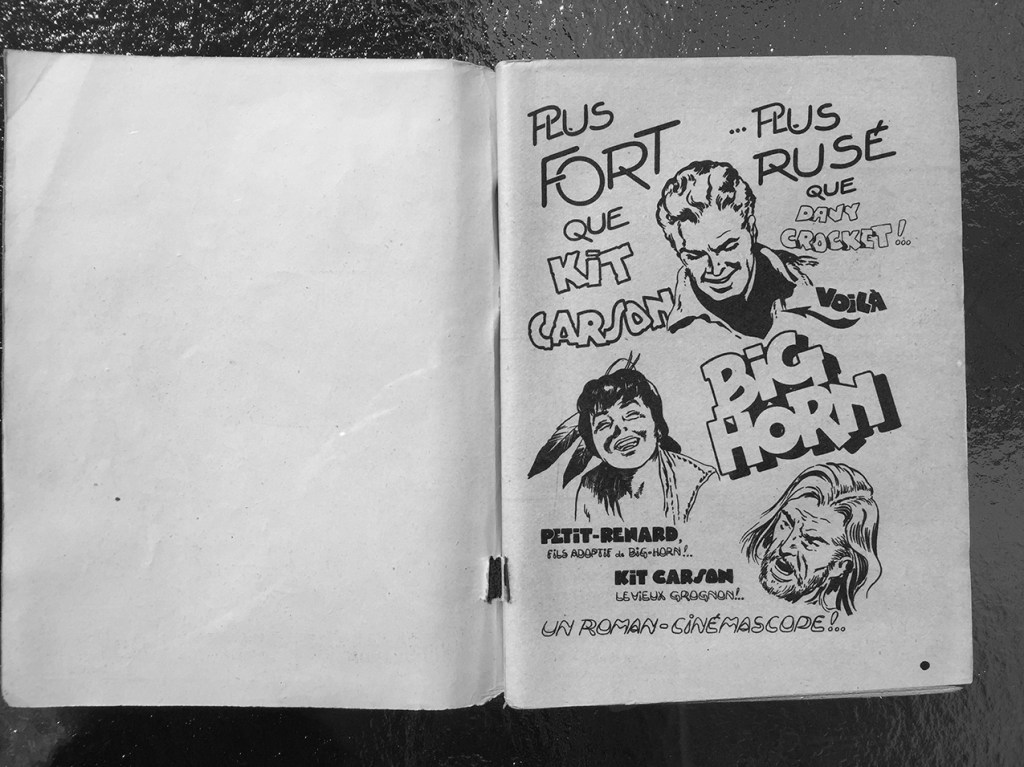
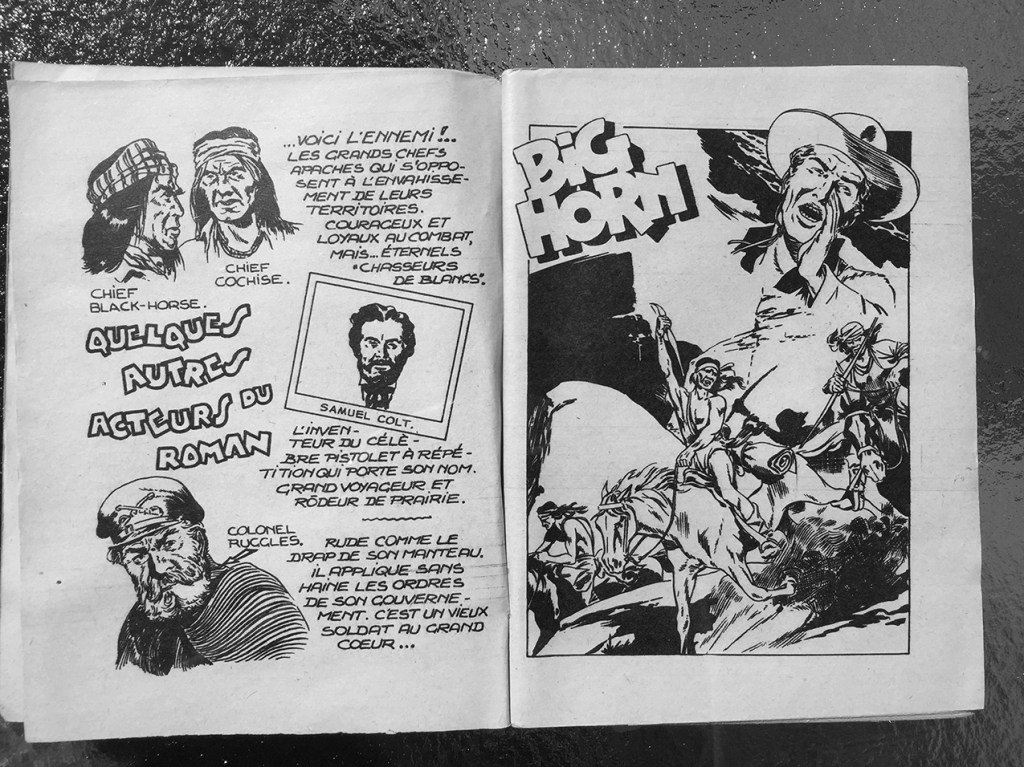
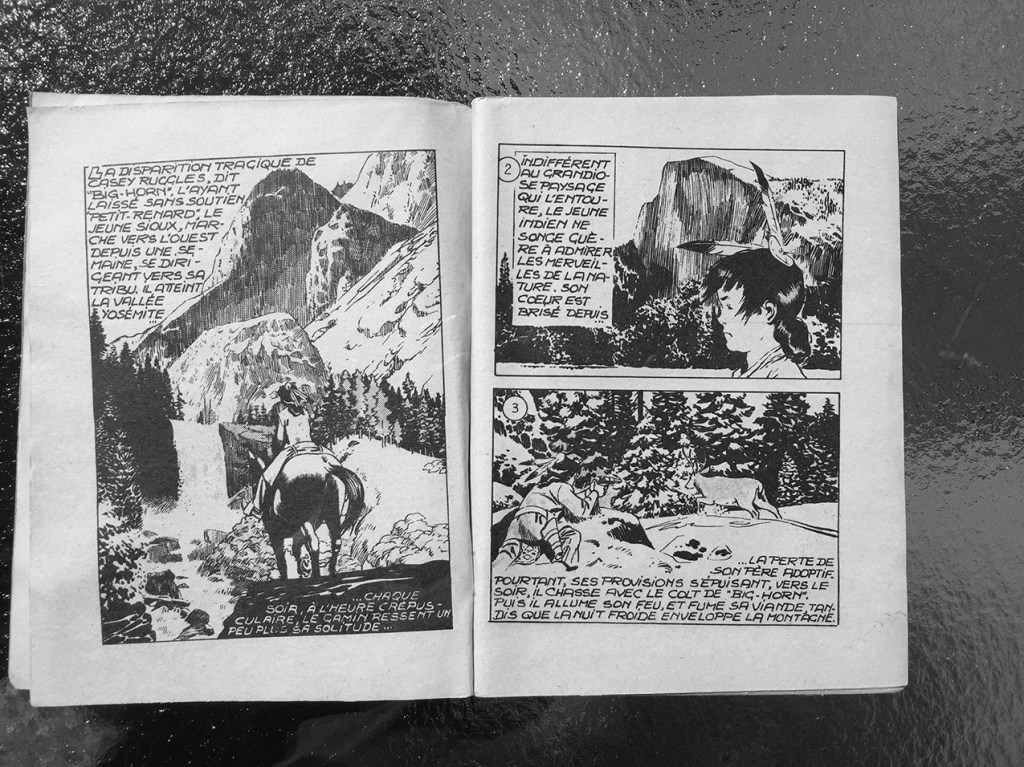
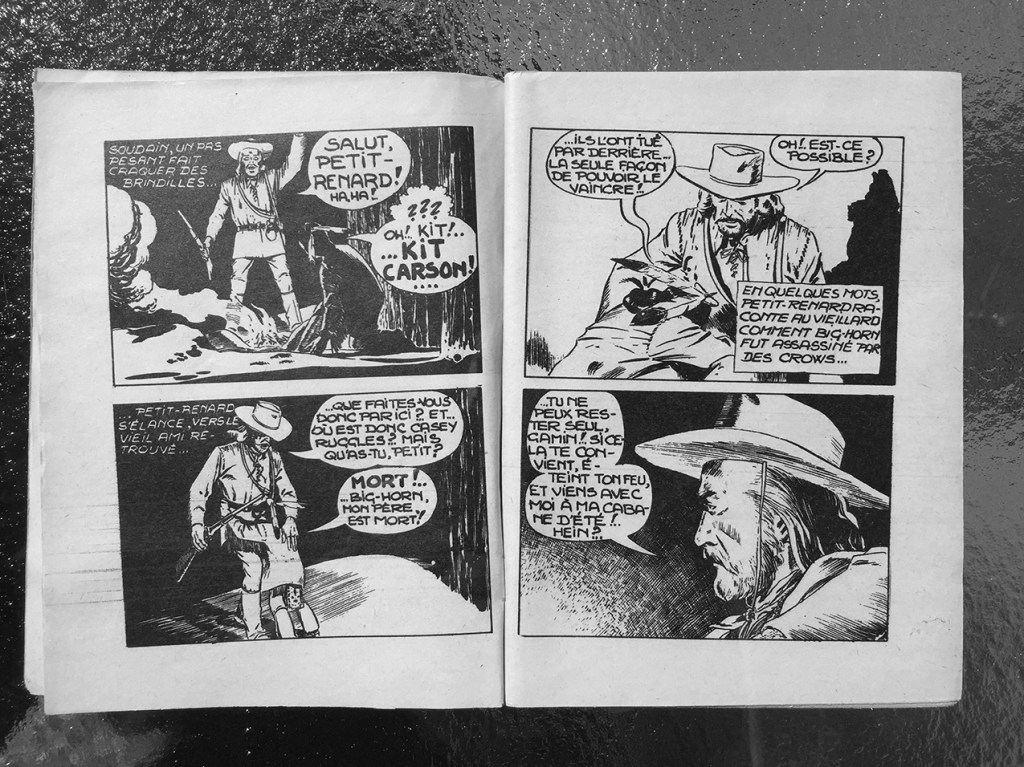
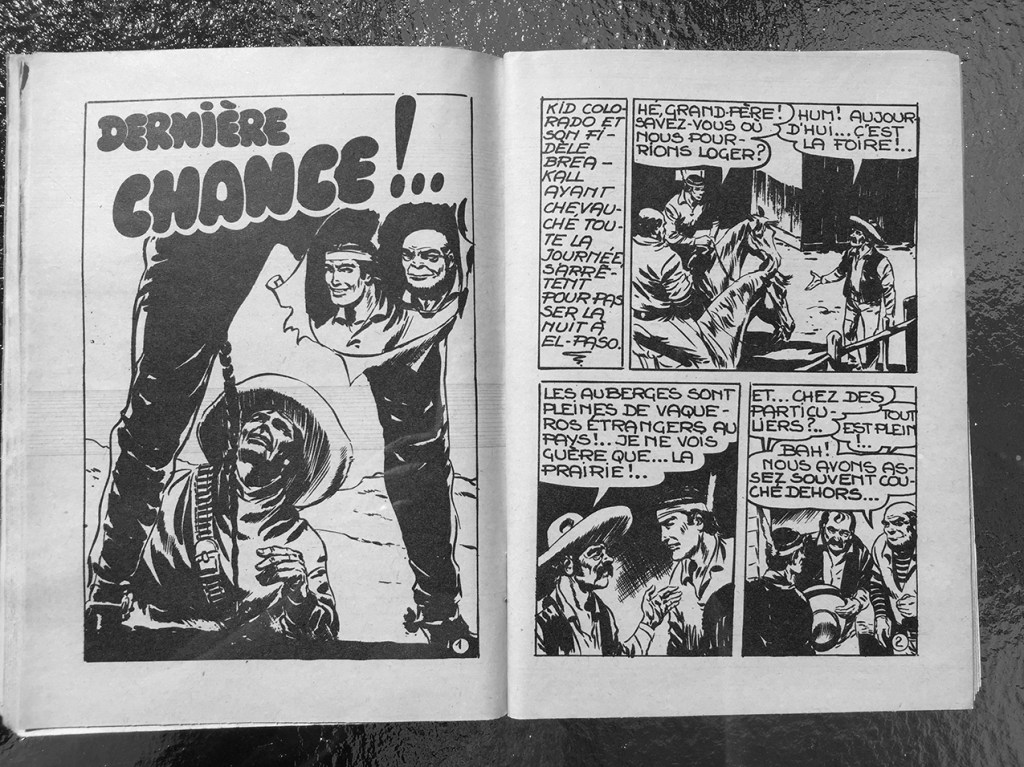
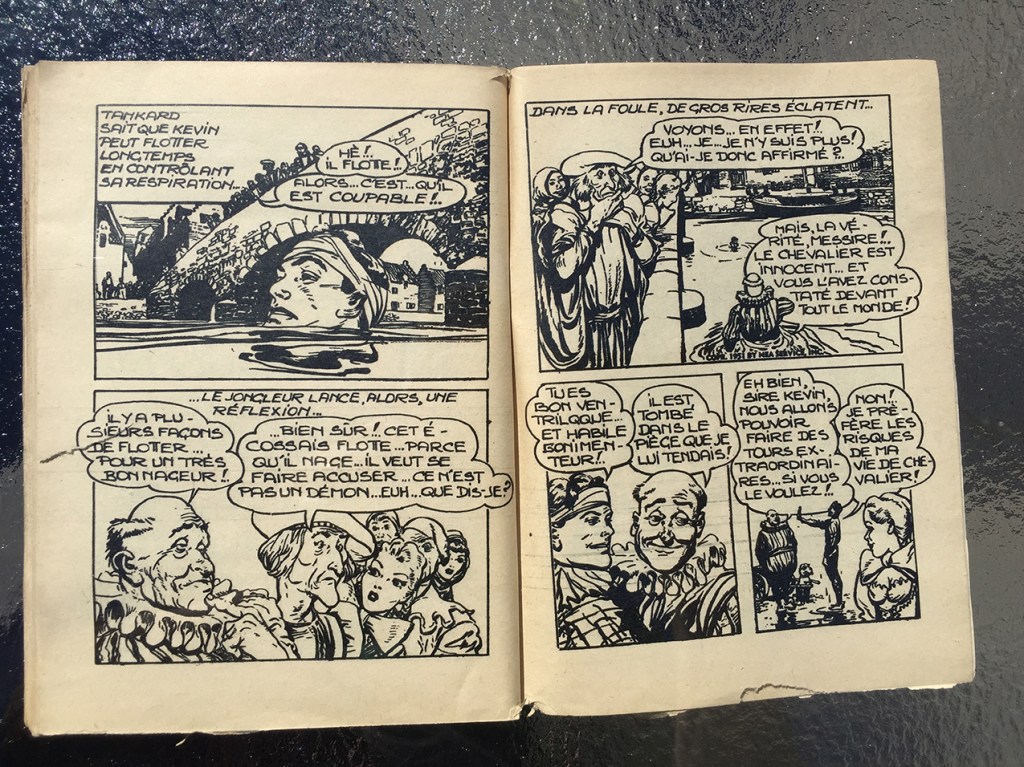
“Kevin le Hardi” was included as part of five French “Big Horn” comic books, which were published beginning in October, 1957. The comic books, though small in trim size (about 5-3/8″ x 7-1/8″), were quite lengthy, 128 black and white pages plus color covers. On the cover, Kevin received third billing, and Kreigh Collins’ creation ran on the 31 pages at the back of the book.
Warren Tufts’ title comic occupied the first 32 pages, and it was followed by “Kid Colorado,” by John Wheeler. Each of the comics have nice, custom introductory pages (three pages for “Big Horn.”)
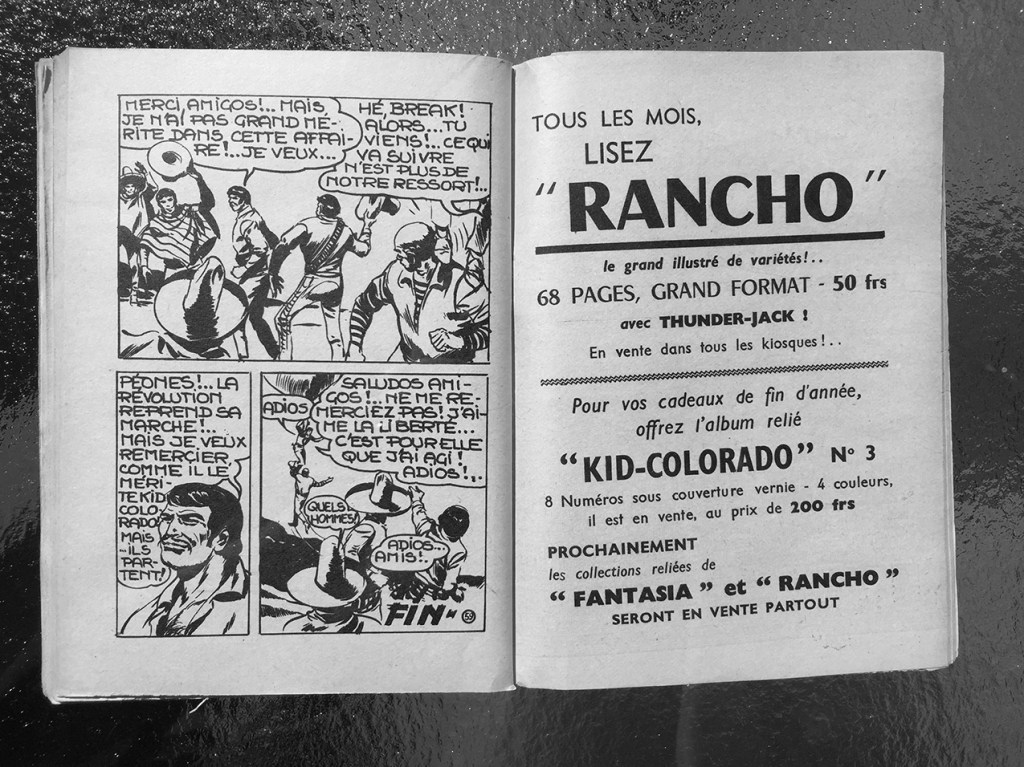
At the conclusion of the “Big Horn” adventure is an ad for “Fantasia.” Next up is a sizable chunk of “Kid Colorado.” I wasn’t able to find out much about it, other than it was the work of a British artist, John Wheeler. Here, it runs for nearly 60 pages—about half the comic book’s pages—and is followed by an ad for “Rancho.”
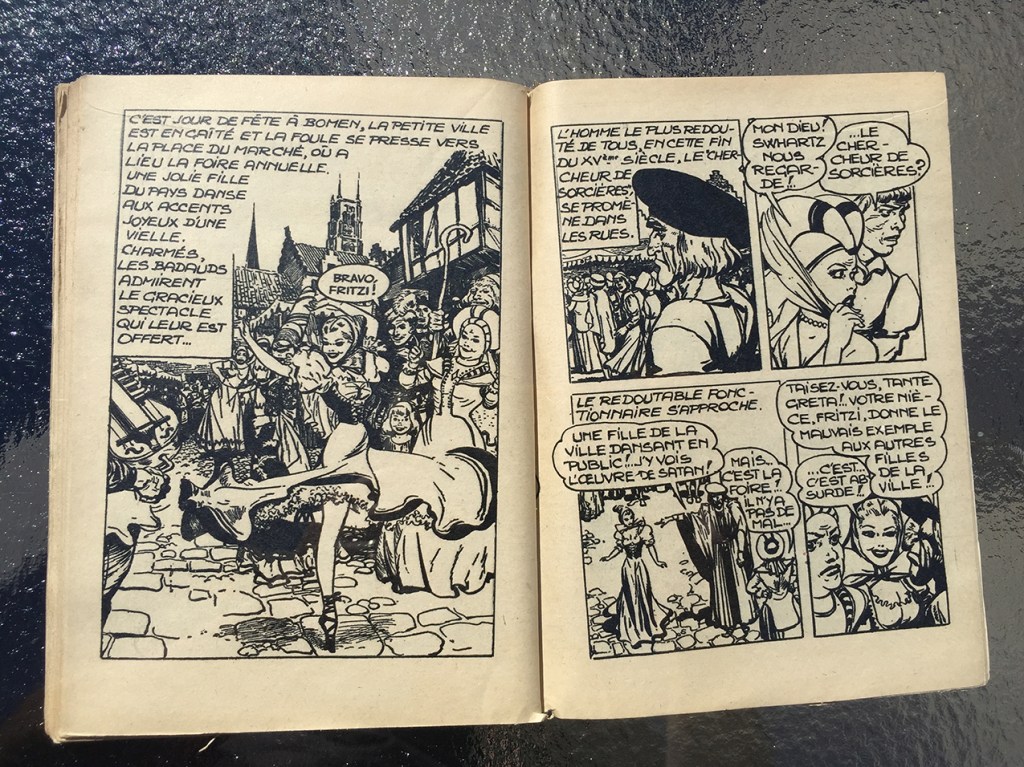
Now, allow me a “Wizard of Oz”-like transition (RGB files for the good stuff!). Here’s the star of our show, Kevin le Hardi. I know just enough French to make some foolish assumptions about what I’m reading, so it looks like the charming introductory page presents Kevin, his enemy Von Blunt (en français, Von Blut), and his loyal, um, squire (I had to look that one up), MacGrégor (Stub).
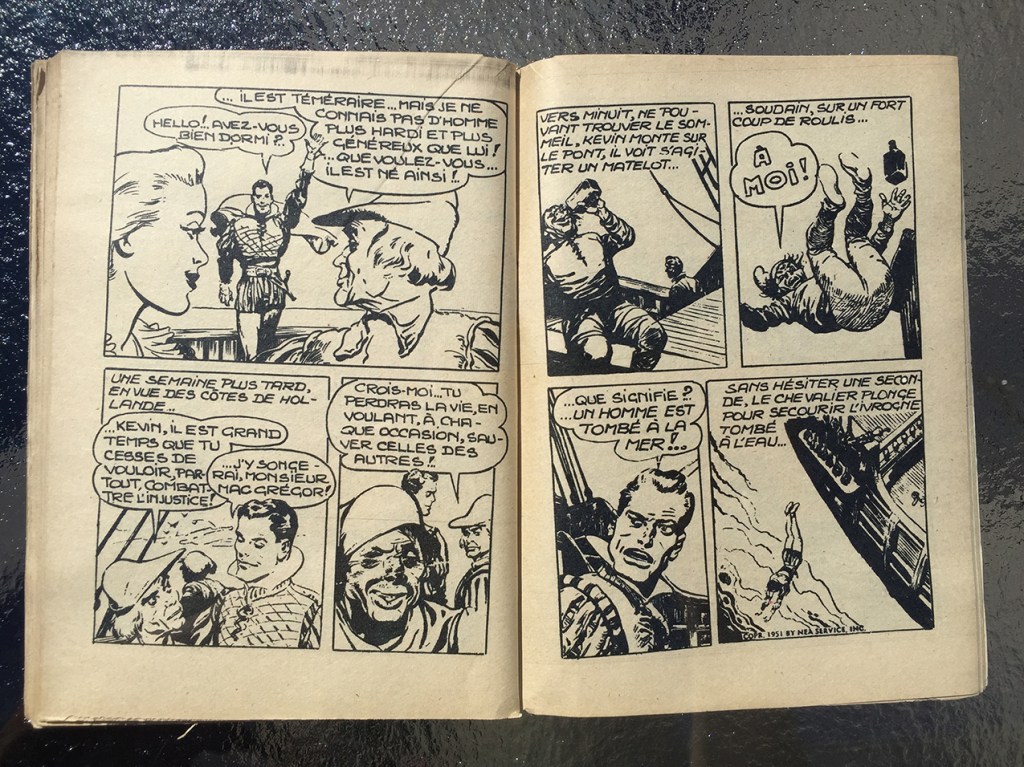
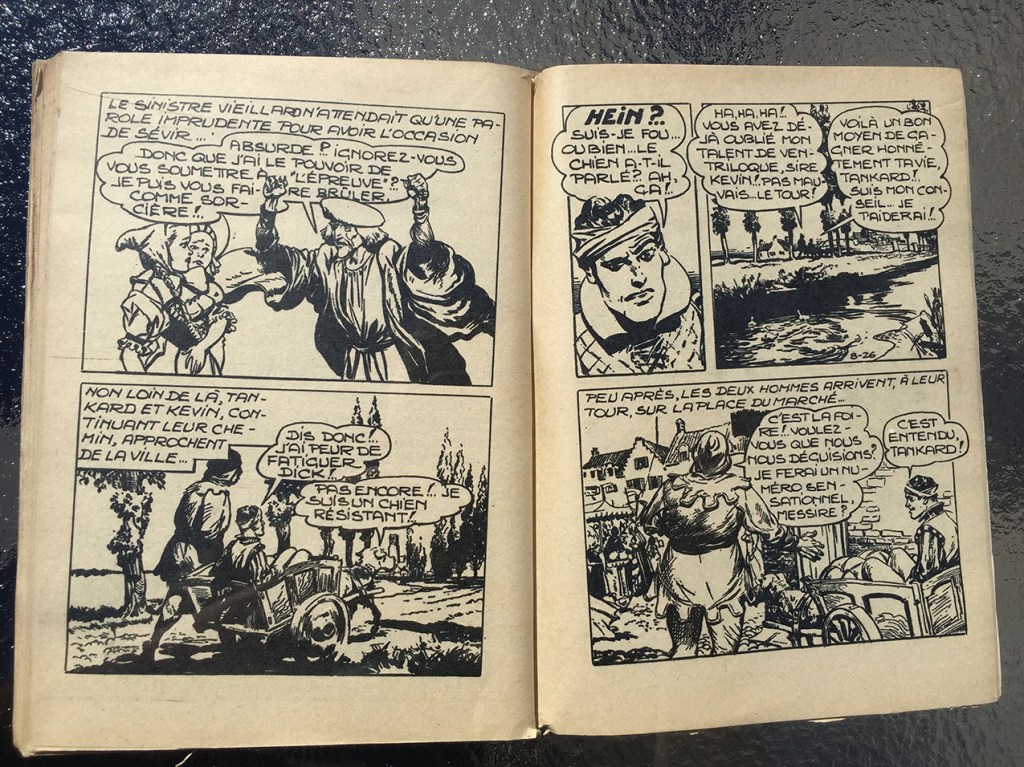
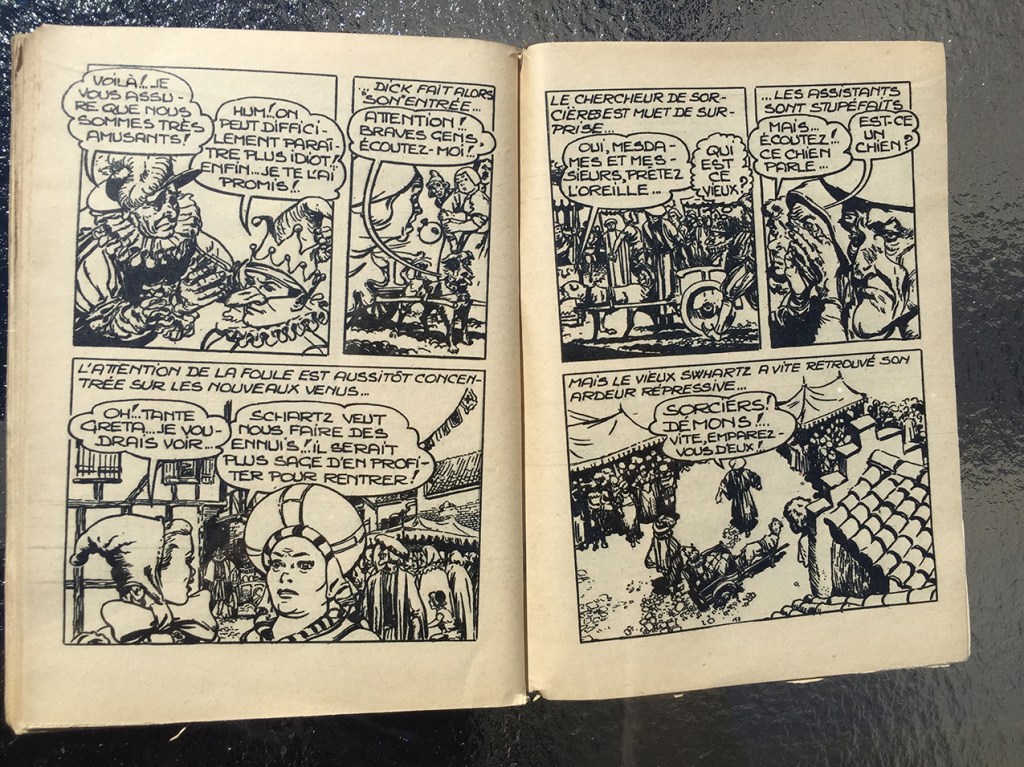
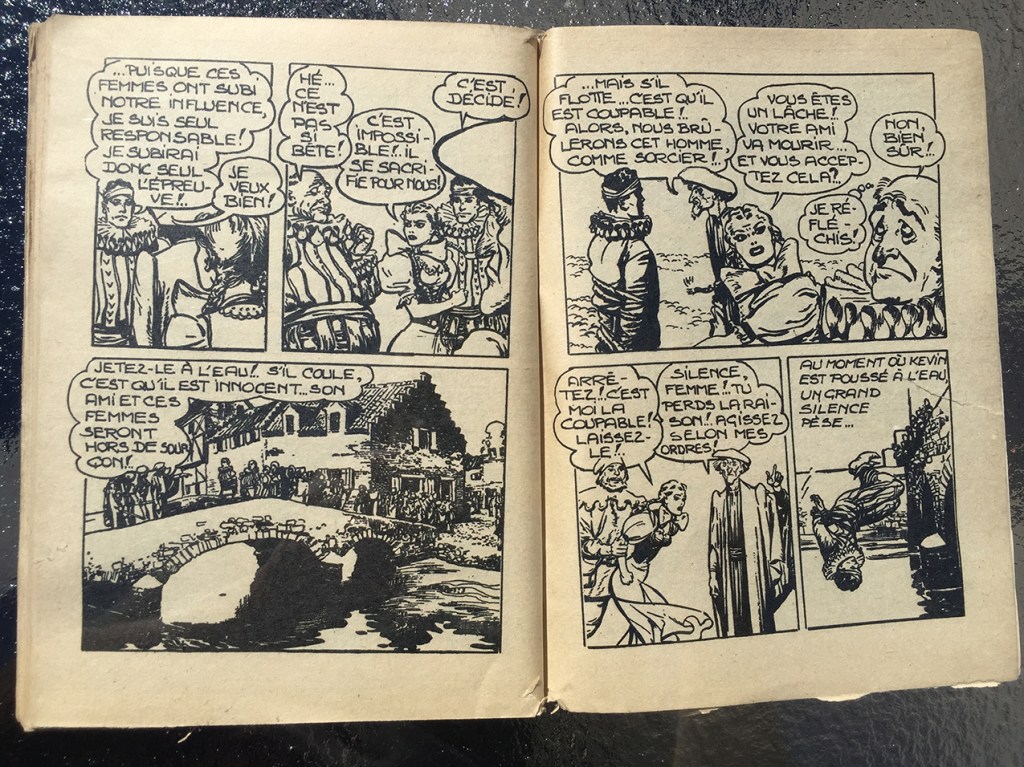
“Big Horn No. 1″ features the fourth chapter in the “Kevin the Bold” saga, “The Witch Hunt.” The action picks up with the episode that ran in Sunday comic sections on August 5, 1951.
Ici, a single Sunday episode typically runs three and a half pages (sans throwaway panels).
Au dessous, the September 2, 1951 episode starts at the end of the left-hand spread, and in the center spread, a couple of panels are reversed in order. Otherwise, the panels follow unimpeded for the remainder of the chapter.
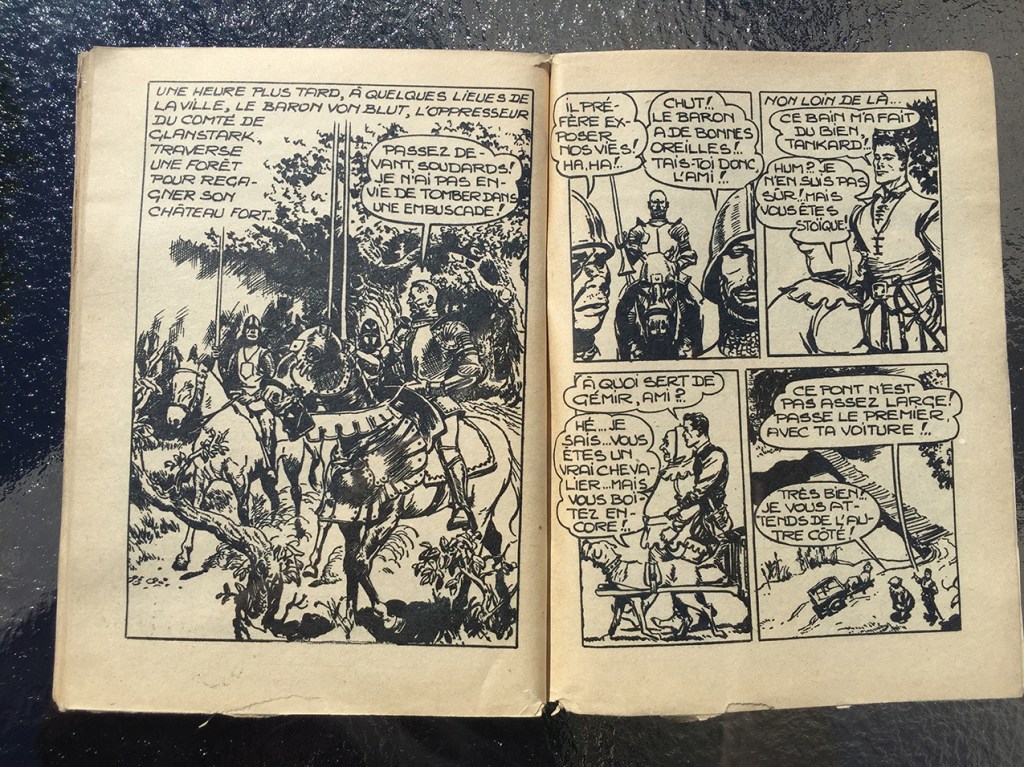
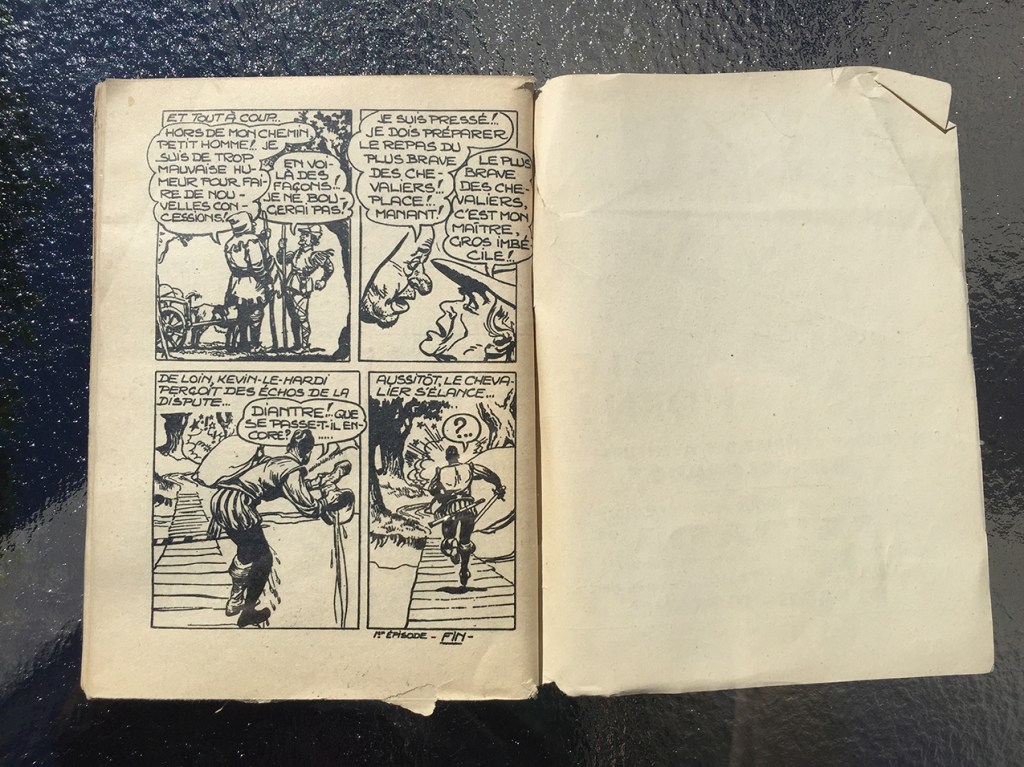
Près de the very end of “Big Horn No. 1″ (page 124), the fifth “Kevin the Bold” chapter begins. It features the foe shown on Kevin’s introductory page, Von Blut. The second-to-last page has another example of panel re-sequencing—Von Blut’s mug originally ran on September 23 but it is plopped right in the middle of the September 30, 1951 episode. It works just fine.
Sous the final panel, it curiously states “end of the first episode,” but it’s not even the end of the September 30, 1951 episode! Not to worry, the action continues in “Big Horn No. 2.”
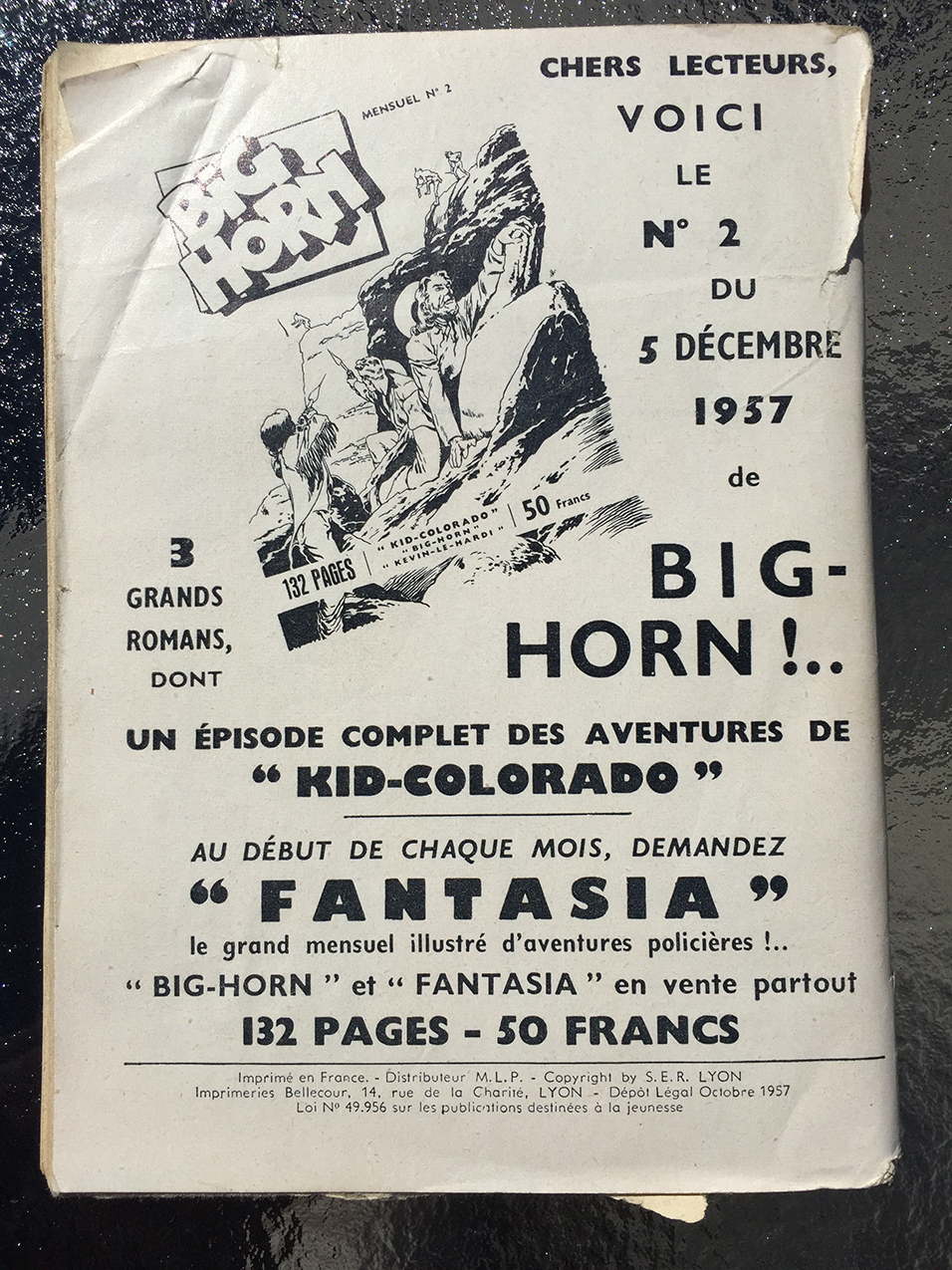
Malheureusement, the back cover highlights everyone but Kevin le Hardi.
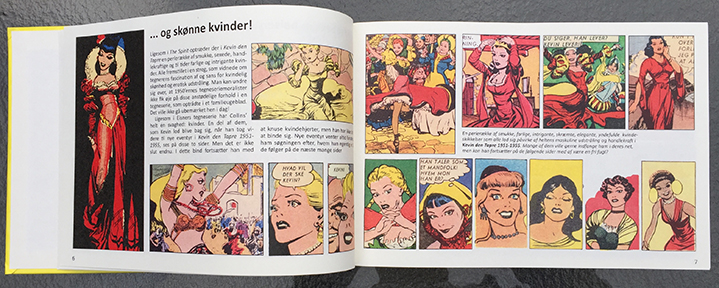
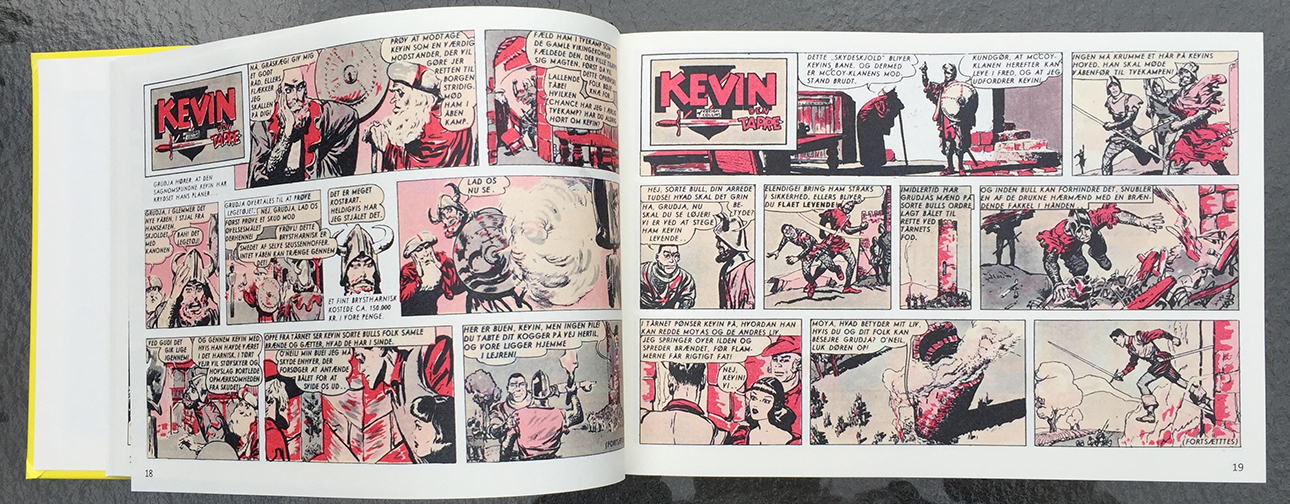
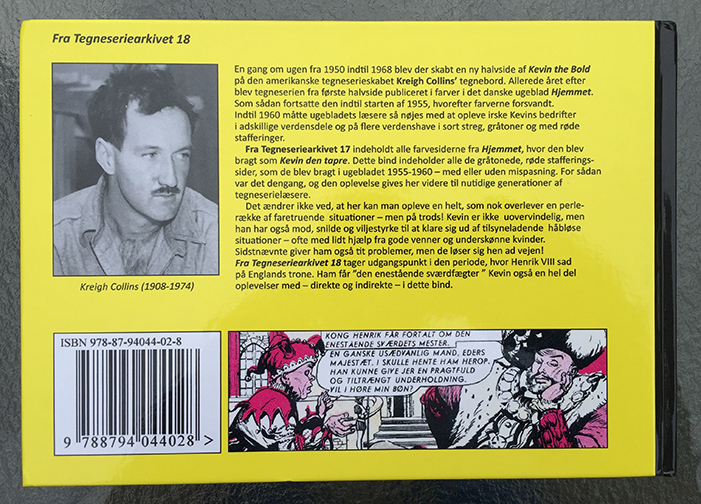
The most recent addition to my comics compilation library is the massive, second volume of “Kevin den Tapre,” from publisher Anders Hjorth-Jørgensen and his company, Forlaget desAHJn. Like its companion volume, the comics were sourced from the Danish weekly magazine Hjemmet. From 1955-1960, Hjemmet ran the episodes in an interesting three-color scheme; the collection is available here.
The book has an impressive front matter section highlighting various aspects of Kreigh Collins’ heroic protagonist.
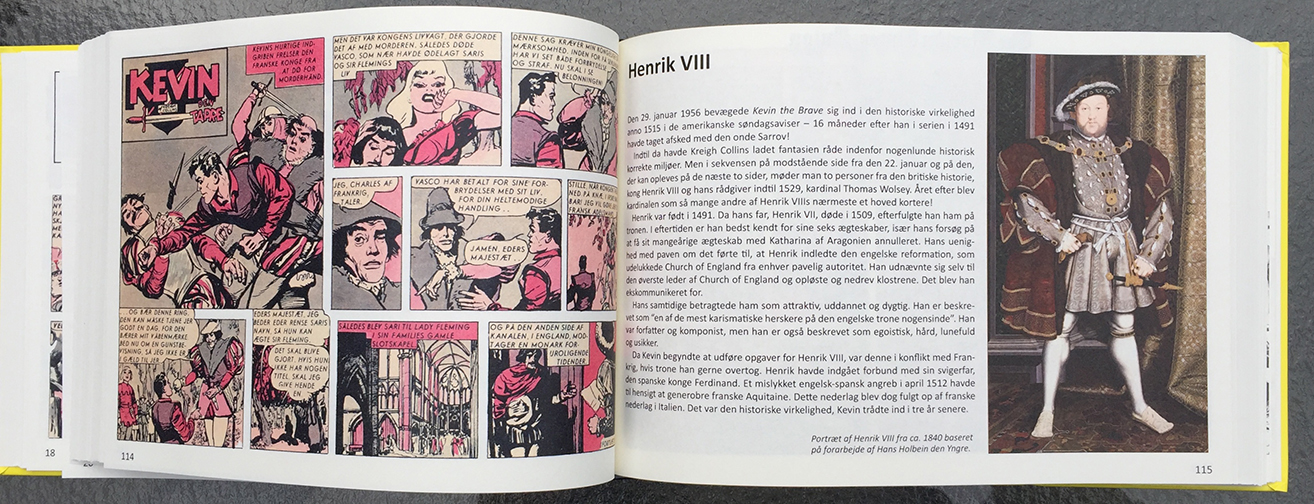
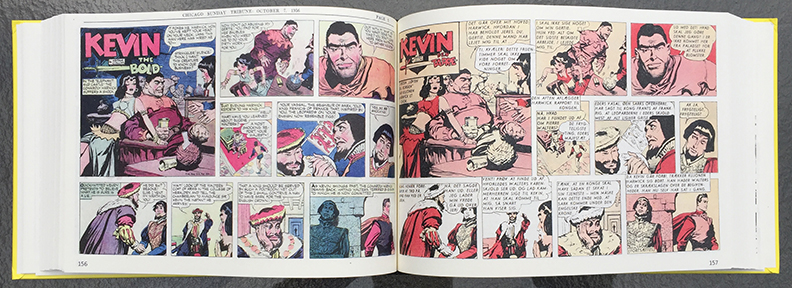
In many instances, the original, full-color episodes precede their corresponding three-color Danish versions for easy comparison. When King Henry VIII enters Kevin’s world, a full-page sidebar offers some background of the English monarch. Considering the book’s 218 Danish episodes, plus all the extras, it results in a rather hefty volume—364 pages in all.
The spread on pages 156-157 shows a prime example of one of the lovely ladies my grandfather featured—Gertie reproduces nicely in any number of colors! And speaking of lovely ladies, if your preference runs toward more wholesome lasses, pages 300-301 and beyond feature Becky Makepeace, whose story just ran on this blog. (Speaking of which, this is post No. 300! Woo-hoo!).
Following the complete run of three-color Hjemmet episodes, there is a lengthy section of back matter. It touches on some of Kevin’s later adventures, including the transition to “Up Anchor!” and how “Kevin” was repackaged into comic books for numerous foreign markets.
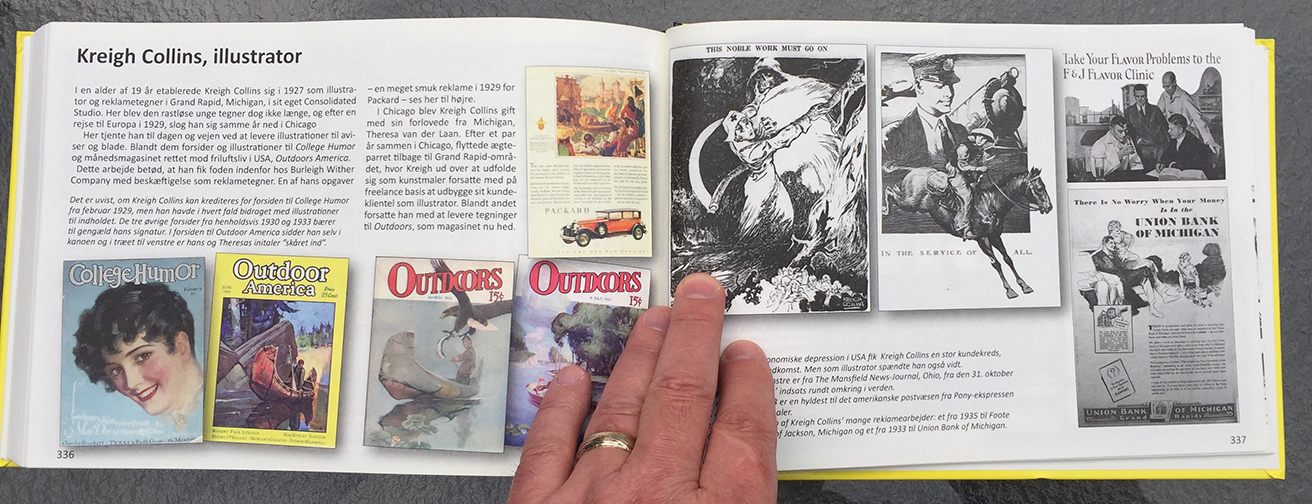
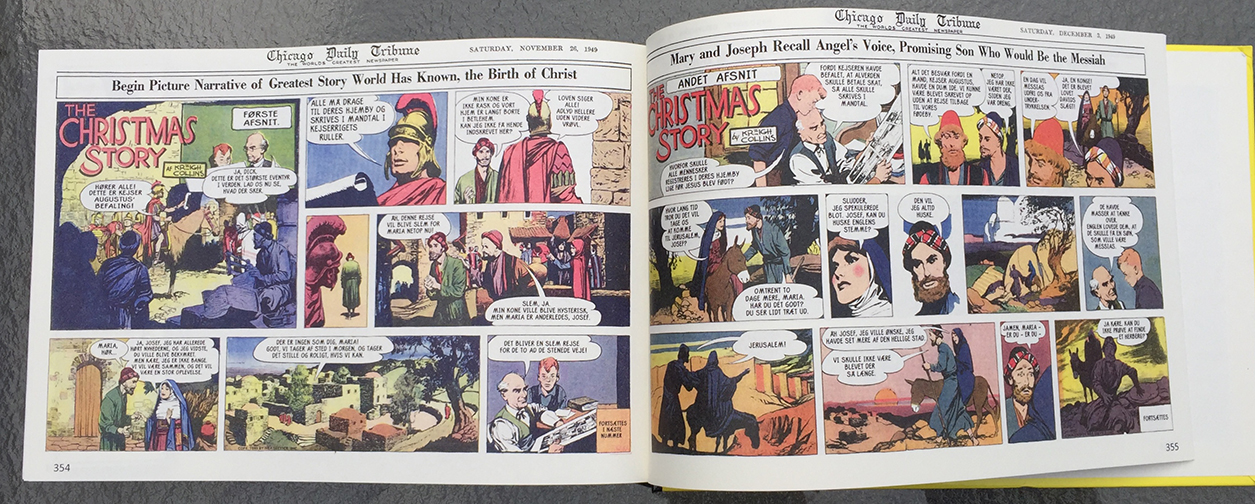
Further spreads highlight Collins’ pre-comics work as an illustrator, the start of his NEA comics career, and the Bible Stories Pictures he created in the mid-1940s for the Methodist Publishing House (among other subjects). The book is very thorough.
While reviewing the book gave my translation app quite a workout, certain words required no explanation, such as “Research,” a bibliography. I will vouch for the source material!
Danish Originals
While researching Kevin’s Danish incarnation, I came across an auction site with 30+ episodes of “Kevin den Tapre” listed, check it out! (Though I’m not sure if they do international shipping). These are the same episodes appearing in the Danish collections. All but one of the listings are for the full-color examples that appeared in Volume 1.
Attention Bibliophiles
“The Lost Art of Kreigh Collins, the Complete Mitzi McCoy,” is available for immediate delivery at a reduced price; it features the entire run of Kreigh Collins’ first NEA feature.
MITZI McCOY ran from 1948 to 1950 and showcased Kreigh Collins’ skill as an illustrator and storyteller. His picturesque landscapes, lovely character designs, and thrilling action sequences brimmed with detail and charm, and the strip’s ensemble cast rotated in and out of the spotlight taking turns as protagonists in the dozen story arcs collected in this volume. The last story collected in “The Complete Mitzi McCoy” is the narrative bridge that set Collins and his characters off on a new journey, beautifully told for the next couple of decades in the much-lauded adventure strip Kevin the Bold.
The collection includes an introduction by Eisner Award-winning author Frank M. Young, an Afterward by Ithaca College’s Ed Catto, and previously unpublished artwork and photos. Longtime comics artist Butch Guice also provides a new pin-up of the character Mitzi McCoy.
The book costs $30ONLY $20! For domestic shipping, add $4; for international orders, add $25 for first class shipping. To place an order, leave a comment below or email me at BrianEdwardCollins1[at]gmail.com, and I will give you PayPal information.
For more information on the career of Kreigh Collins, visit his page on Facebook.
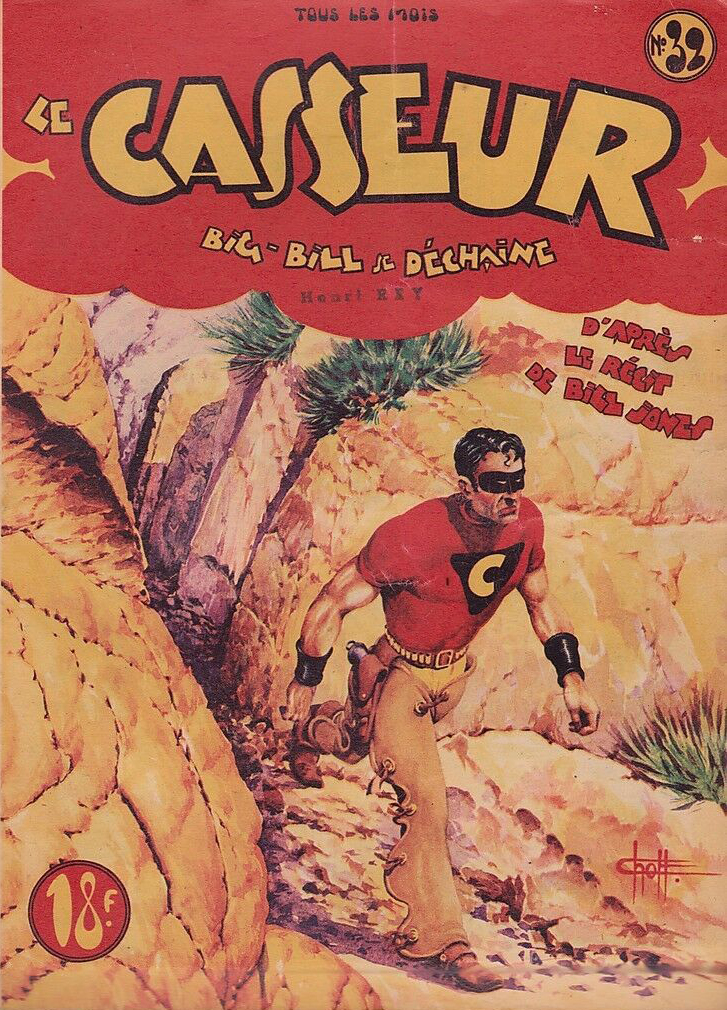
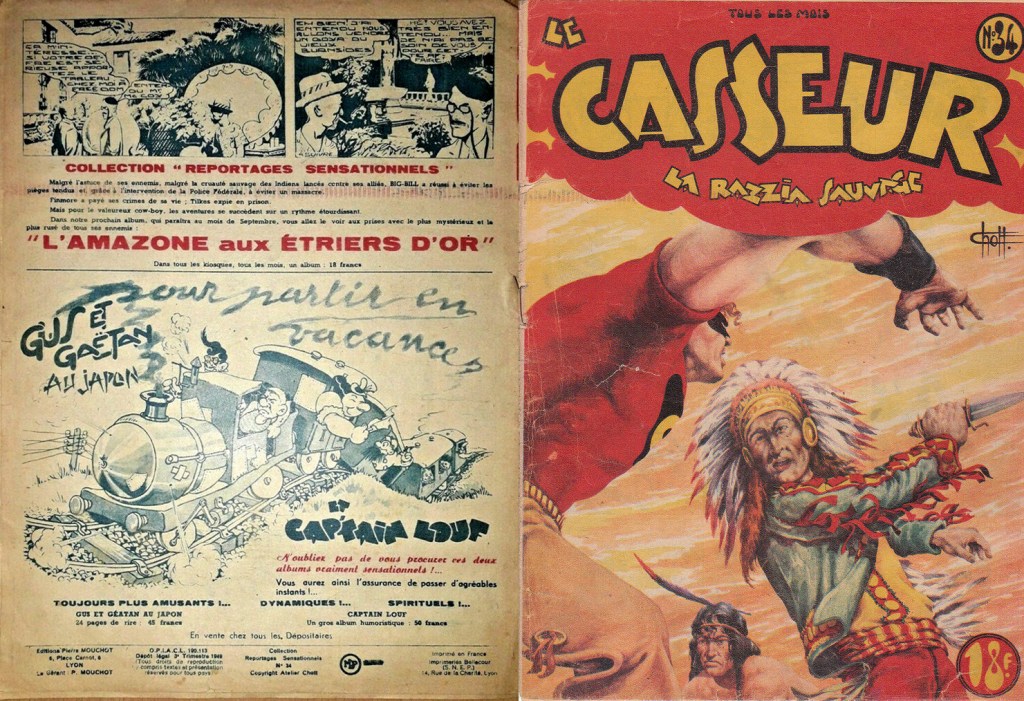
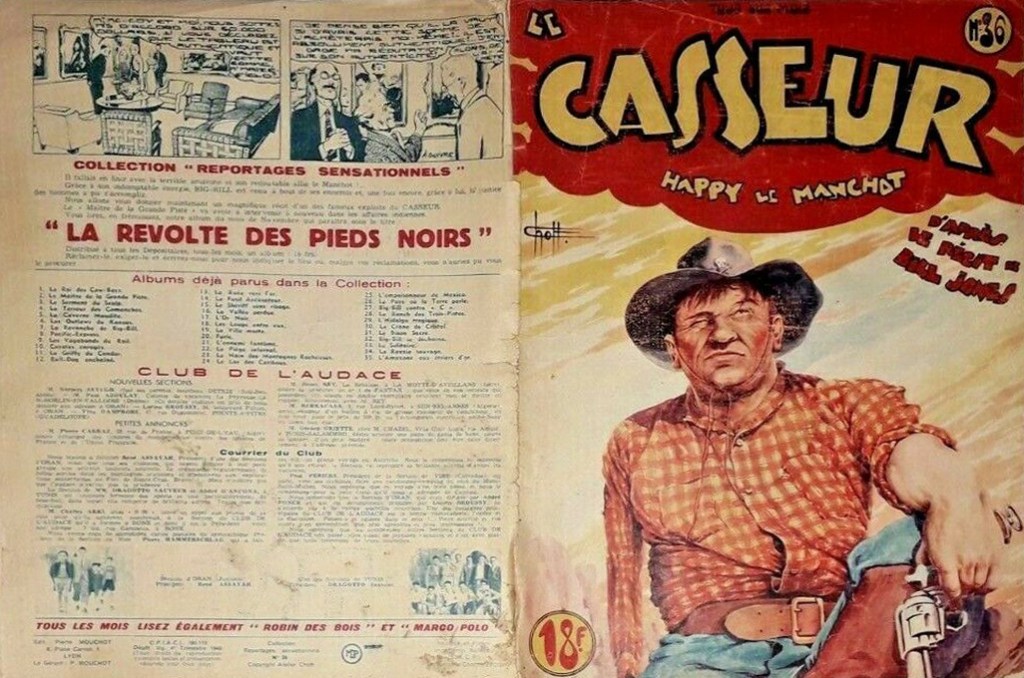
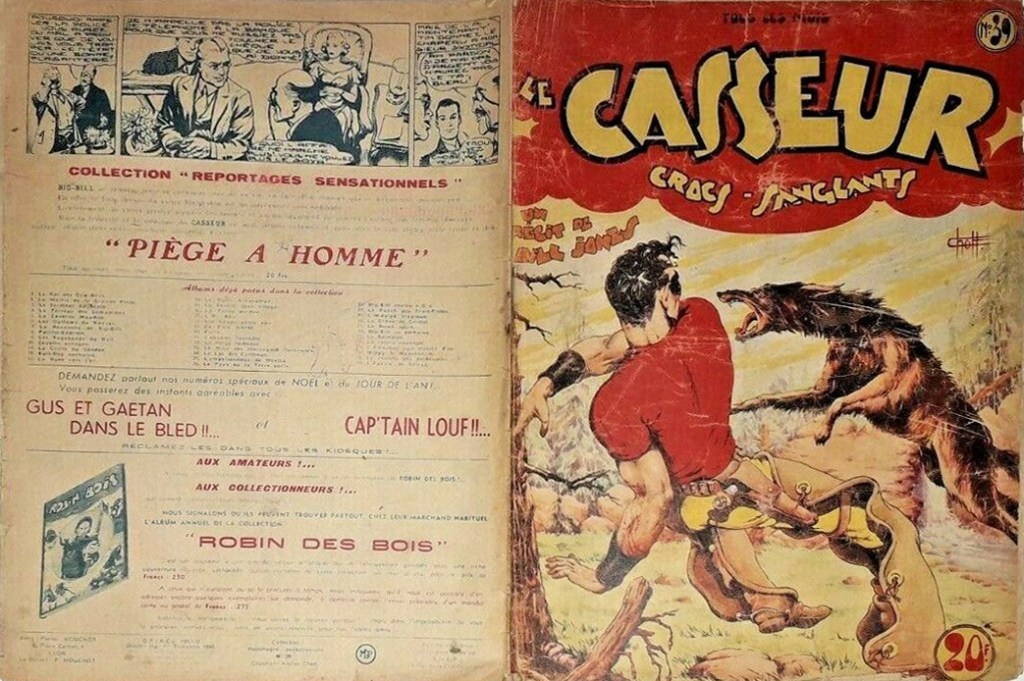
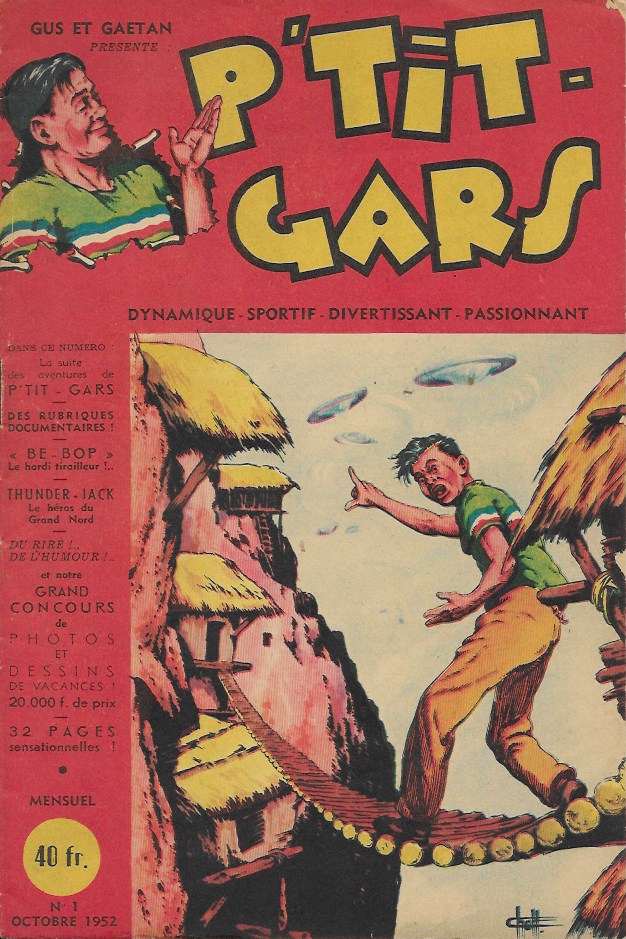
“Mitzi McCoy” was featured in several of Pierre Mouchot‘s French comic book titles—first in Fantax, then in Robin des Bois, Le Casseur, and P’tit Gars. In all, about ⅔ of Mitzi’’s episodes appeared in Mouchot’s titles. Le Caseur, featuring Big Bill, had the longest run of the four, with Mitzi appearing in 20 issues (Nos. 32–51). As with the case of most (all?) of the others, an episode (or more) started inside and concluded on the back cover. I haven’t seen interiors of Le Casseur, but I was able to track down a bunch of the covers (with guidance from my friend Gérard).
The examples above show episodes that came from the third and fourth chapters of “Mitzi McCoy.”
If you’re curious how these look in English (and in full color!), see below for information on how to order “The Lost Art of Kreigh Collins, the Complete Mitzi McCoy.”
In 1956, NEA offered an illustration for subscribing newspapers to run on Easter Sunday (or in the case of the reproduction shown here, for the Grand junction, Colorado Daily Sentinel, on Saturday, March 31). Kreigh Collins’ illustration ran in full color, which was a rare occasion (outside of the papers’ Sunday comics). My apologies that I don’t have a color example to show.
“The Lost Art of Kreigh Collins, the Complete Mitzi McCoy,” is available for immediate delivery at a reduced price; it features the entire run of Kreigh Collins’ first NEA feature.
MITZI McCOY ran from 1948 to 1950 and showcased Kreigh Collins’ skill as an illustrator and storyteller. His picturesque landscapes, lovely character designs, and thrilling action sequences brimmed with detail and charm, and the strip’s ensemble cast rotated in and out of the spotlight taking turns as protagonists in the dozen story arcs collected in this volume. The last story collected in “The Complete Mitzi McCoy” is the narrative bridge that set Collins and his characters off on a new journey, beautifully told for the next couple of decades in the much-lauded adventure strip Kevin the Bold.
The collection includes an introduction by Eisner Award-winning author Frank M. Young, an Afterward by Ithaca College’s Ed Catto, and previously unpublished artwork and photos. Longtime comics artist Butch Guice also provides a new pin-up of the character Mitzi McCoy.
The book costs $30only $20! For domestic shipping, add $4; for international orders, add $25 for first class shipping. To place an order, leave a comment below or email me at BrianEdwardCollins1[at]gmail.com, and I will give you PayPal information.
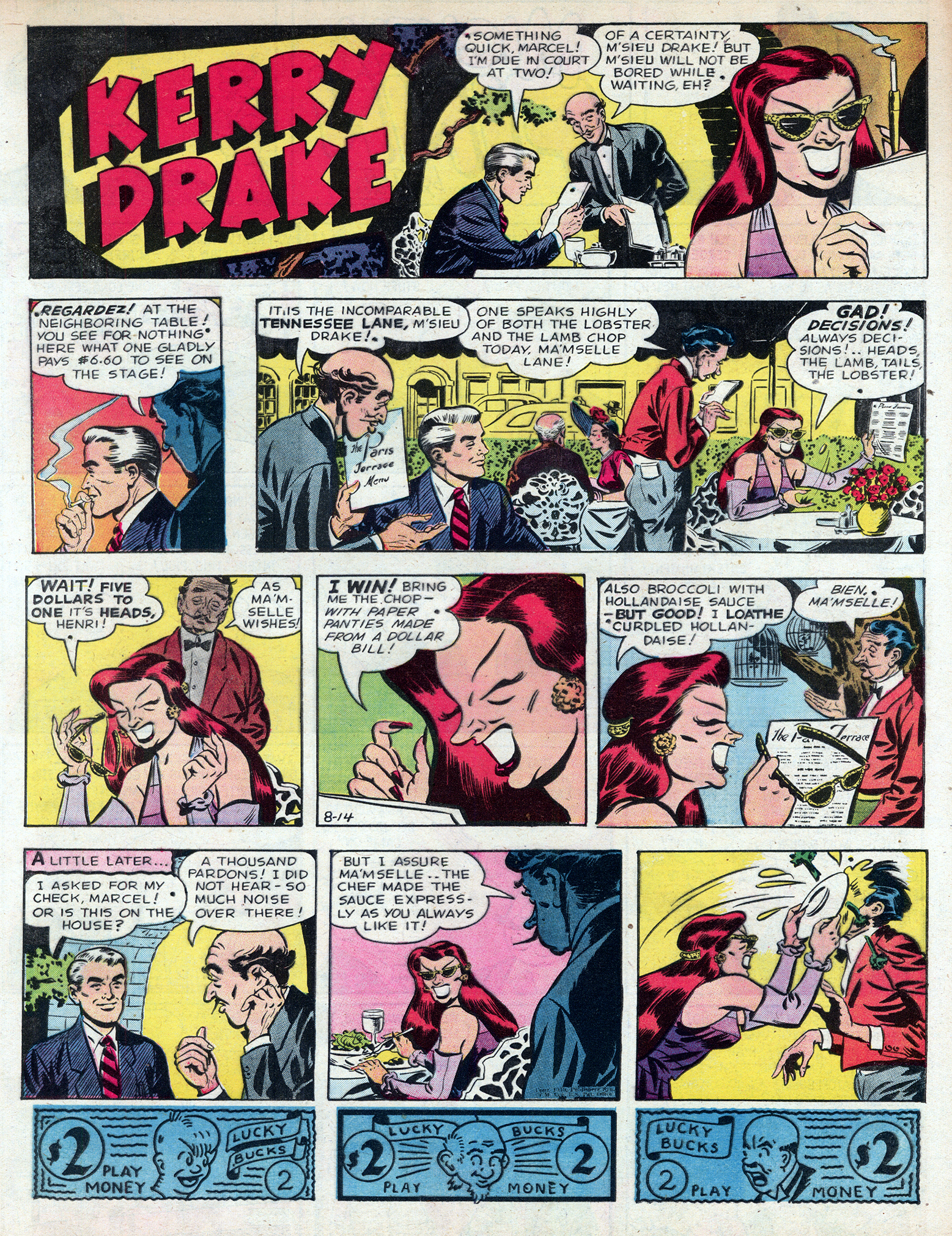
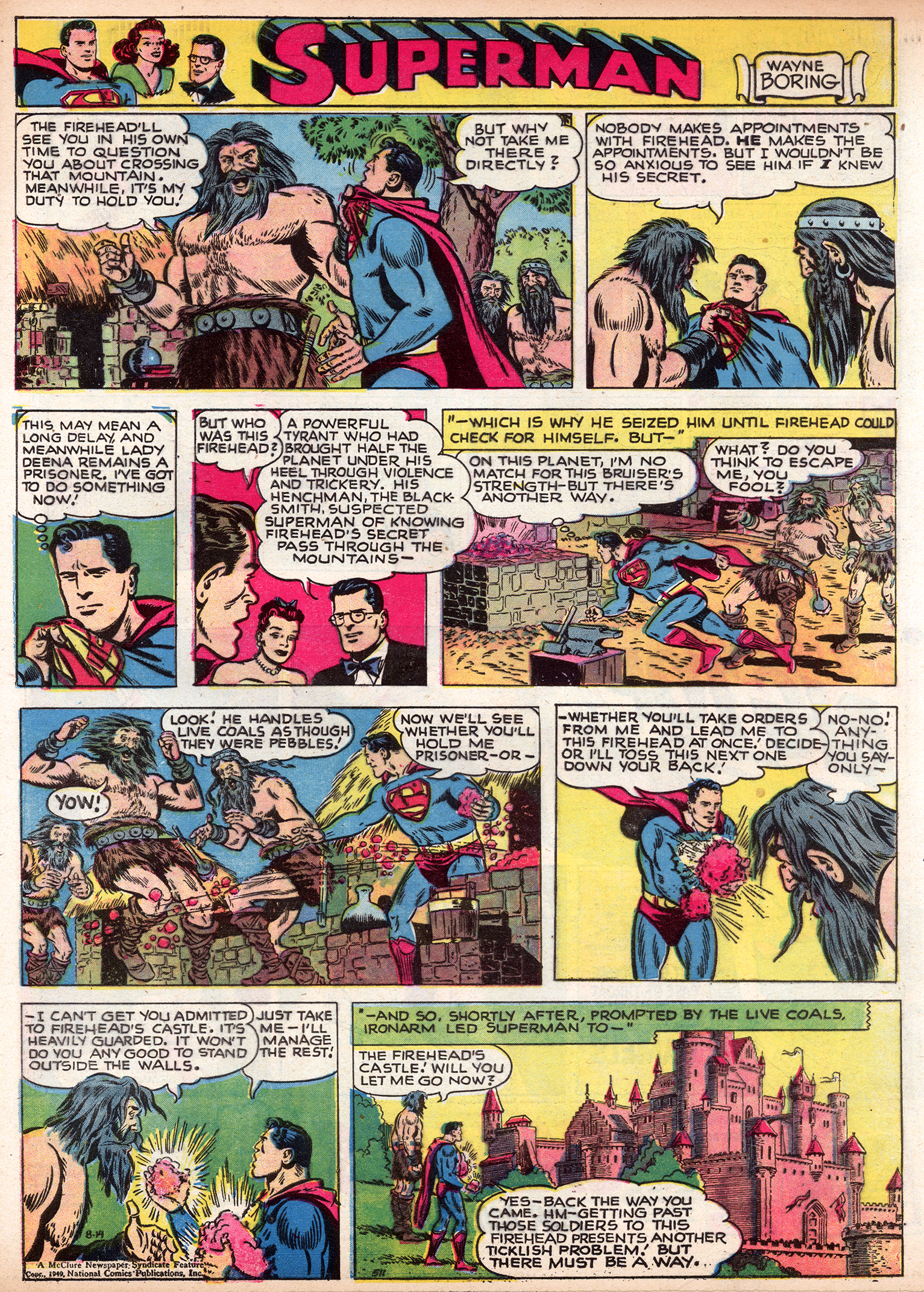
Here is another Sunday Times Mirror section I acquired while putting together The Complete Mitzi McCoy. There are fewer ads than usual—if the Mirror’s ad sales department was slacking off, that just meant more full-page episodes and fewer half-tabloids. As usual, Ham Fisher’s “Joe Palooka” leads off, followed by Milt Caniff’s “Steve Canyon” and “Mickey Finn,” by Lank Leonard. Next up is “Kerry Drake,” by Alfred Andriola/Allen Saunders and Frank Miller’s “Barney Baxter in the Air,” with each page filled out with a few $2 bills of play money. Harry Hanand’s silent comic “Louie,” and “Superman” by Wayne Boring (and likely Stan Kaye) follow.
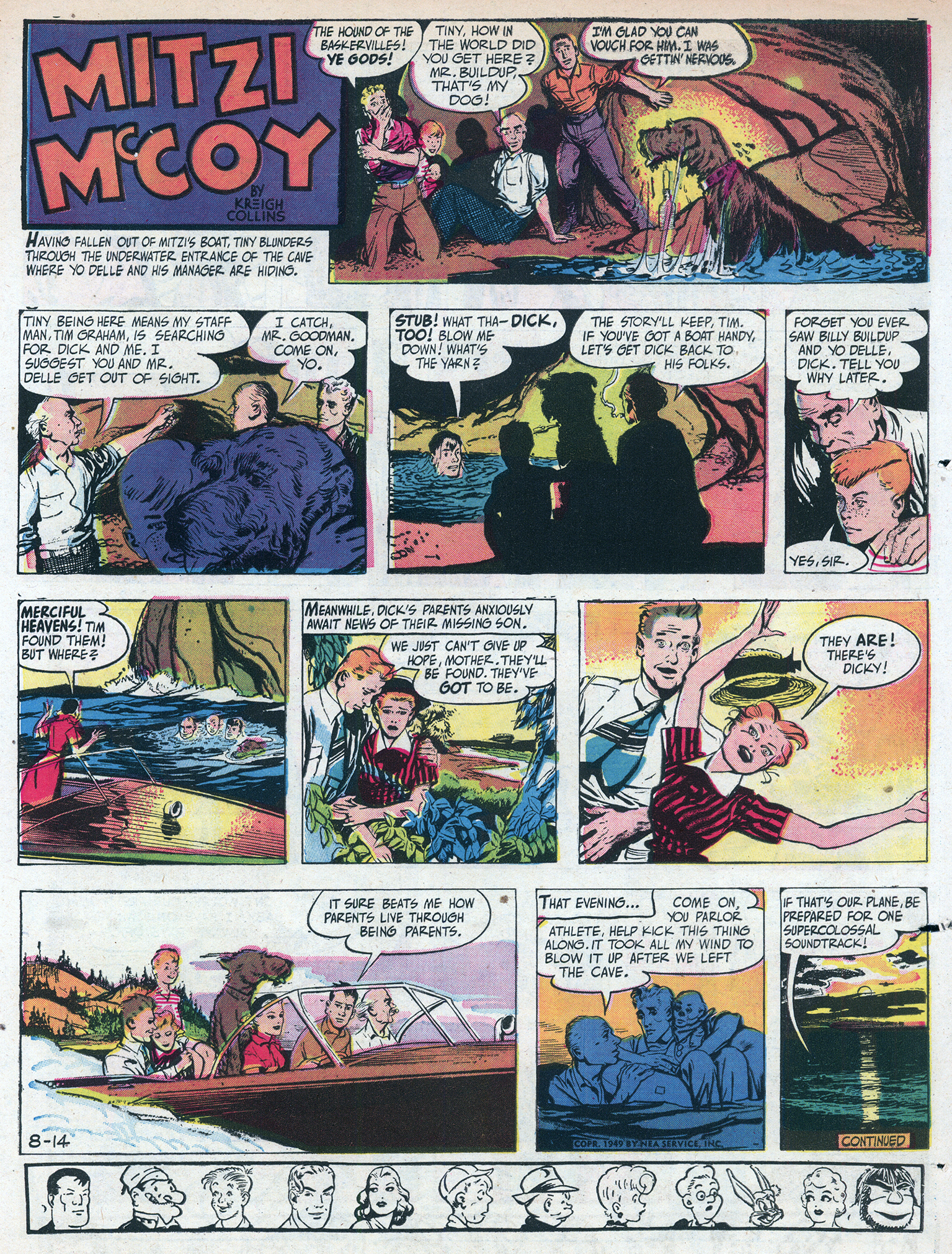
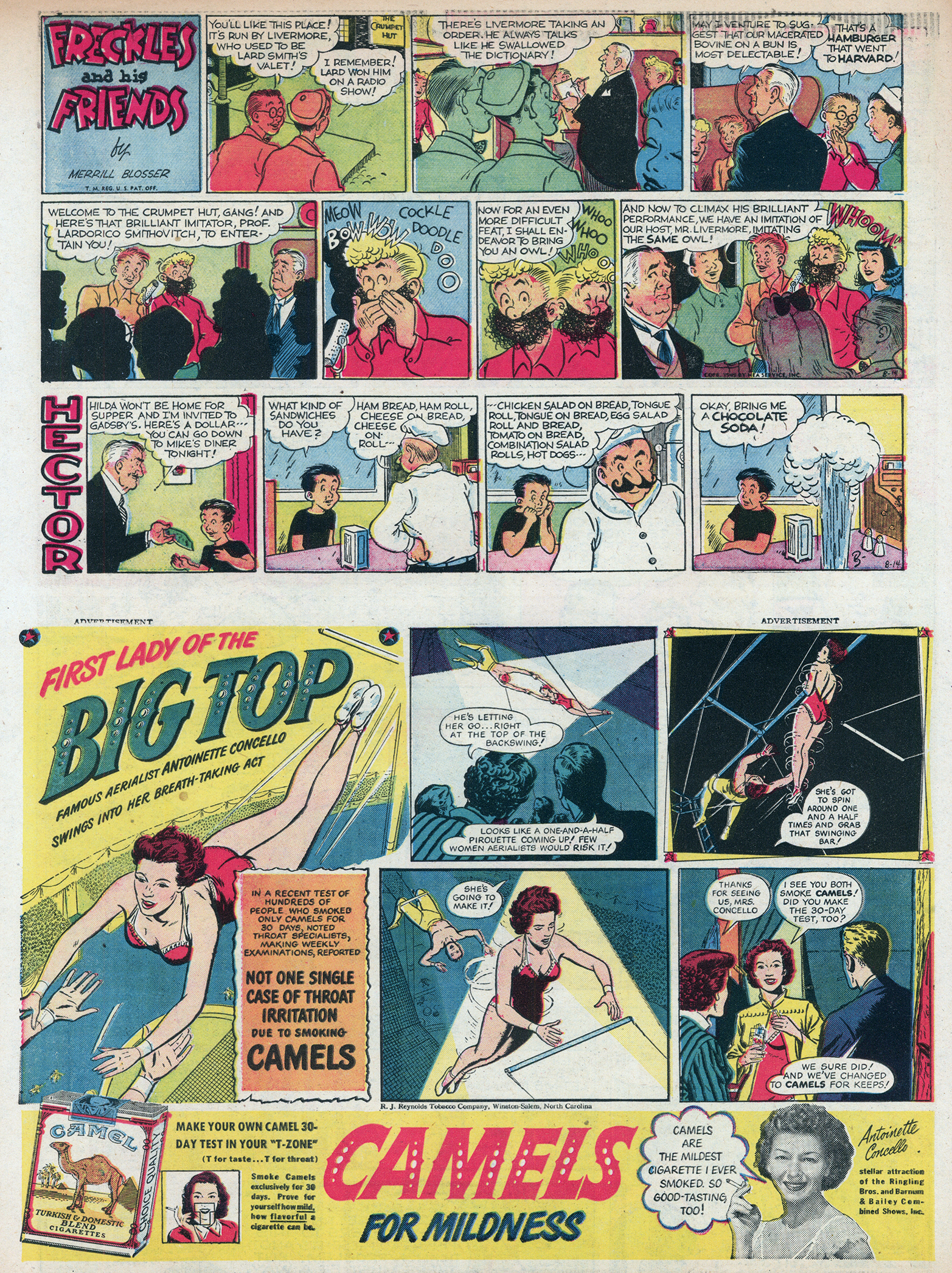
Next, Merrill Blossar’s “Freckles and His Friends” shares a page with an ad for Camel filtered cigarettes—the ad features the then-famous aerialist Antoinette Concello. Ms. Concello offers a testimonial to the mild, good-tasting cancer sticks, but I think she likes them because they soothe her nerves. (I don’t care if she performed over a net, I’d need something at least as strong to calm down after running through that routine!). The facing page features the comic strip that inspired me to plunk down my money for this section—a full page “Mitzi McCoy” episode (a nice change from the usual half-tabloids that ran in the Mirror). This August 14 episode is the penultimate installment of the fifth chapter of “Mitzi” and features the NEA’s typical footer—mugshots of the syndicate’s lead characters.
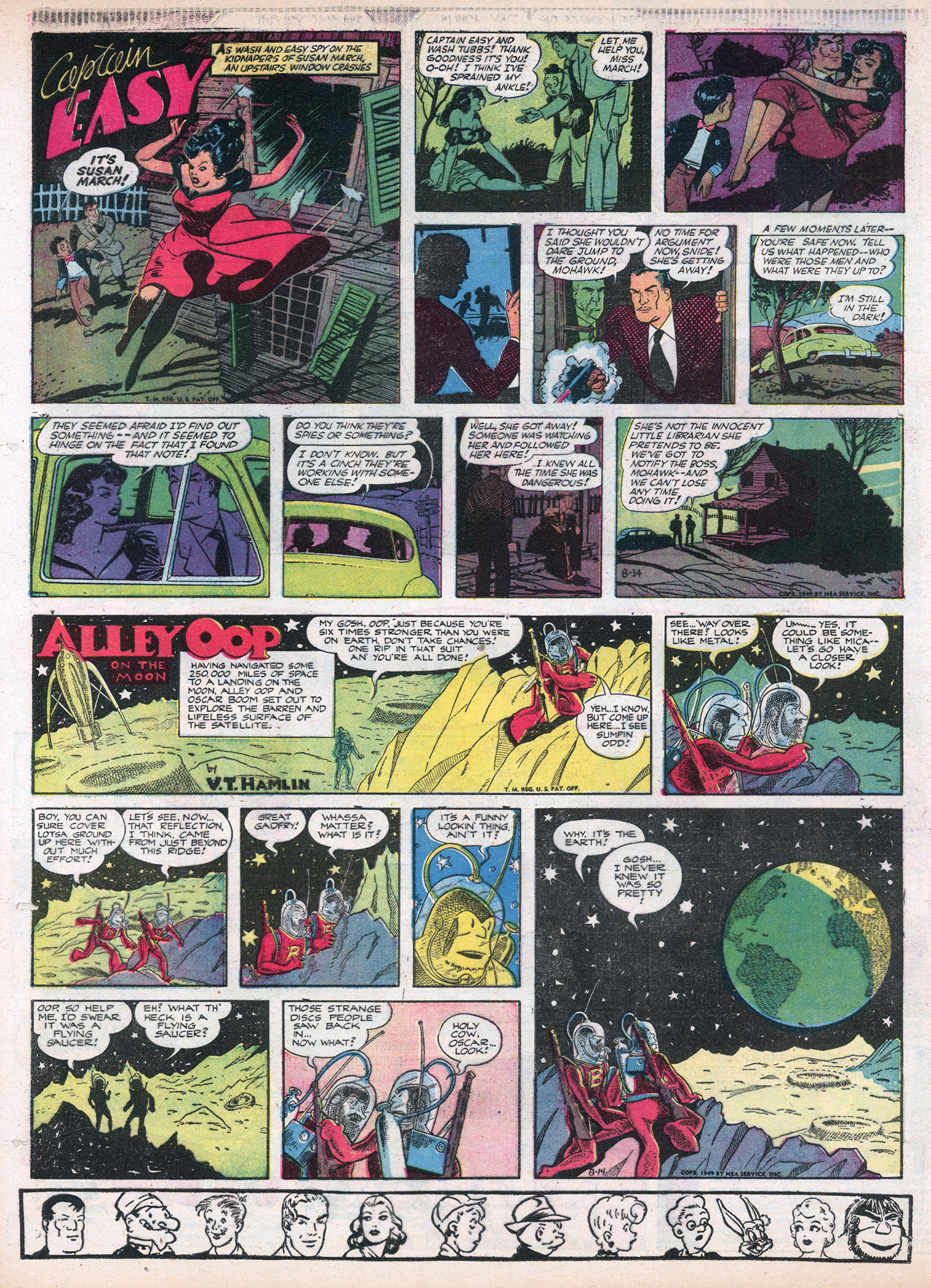
Next up, “Rex Morgan, MD” by Bradley and Edgington (with a nice, custom footer), and “Boots” by Martin, sharing the page with an ad for Colgate Dental Cream. Sometimes the ads in these old sections are charming, but this one is pretty obnoxious (and typical of the era). Roy Crane’s “Captain Easy” (drawn here by Walt Scott?) and V.T. Hamlin’s “Alley Oop” share the next page, followed by “Henry” by Carl Anderson. While “Captain Easy” and “Alley Oop” get the NEA footer, “Henry” features more play money, this time it’s big money—sawbucks! (I wonder if any kids ever cut these out? If so, then “Mickey Finn,” “Louie,” and “Bobby Sox” paid the price by being on the flip side). Two more split pages follow, “The Flop Family” by Swan with “Bobby Sox” by Marty Links, and “Out Our Way featuring the Willets,” by J.R. Williams, and “Our Boarding House.”
Taking its usual spot on the back cover is “Lil’ Abner” by Al Capp.
“The Lost Art of Kreigh Collins, the Complete Mitzi McCoy,” is available for immediate delivery at a reduced price; it features the entire run of Kreigh Collins’ first NEA feature .
MITZI McCOY ran from 1948 to 1950 and showcased Kreigh Collins’ skill as an illustrator and storyteller. His picturesque landscapes, lovely character designs, and thrilling action sequences brimmed with detail and charm, and the strip’s ensemble cast rotated in and out of the spotlight taking turns as protagonists in the dozen story arcs collected in this volume. The last story collected in “The Complete Mitzi McCoy” is the narrative bridge that set Collins and his characters off on a new journey, beautifully told for the next couple of decades in the much-lauded adventure strip Kevin the Bold.
The collection includes an introduction by Eisner Award-winning author Frank M. Young, an Afterward by Ithaca College’s Ed Catto, and previously unpublished artwork and photos. Longtime comics artist Butch Guice also provides a new pin-up of the character Mitzi McCoy.
The book costs $30only $20! For domestic shipping, add $4; for international orders, add $25 for first class shipping. To place an order, email me at BrianEdwardCollins1[at]gmail.com, and I will give you PayPal or Venmo information.
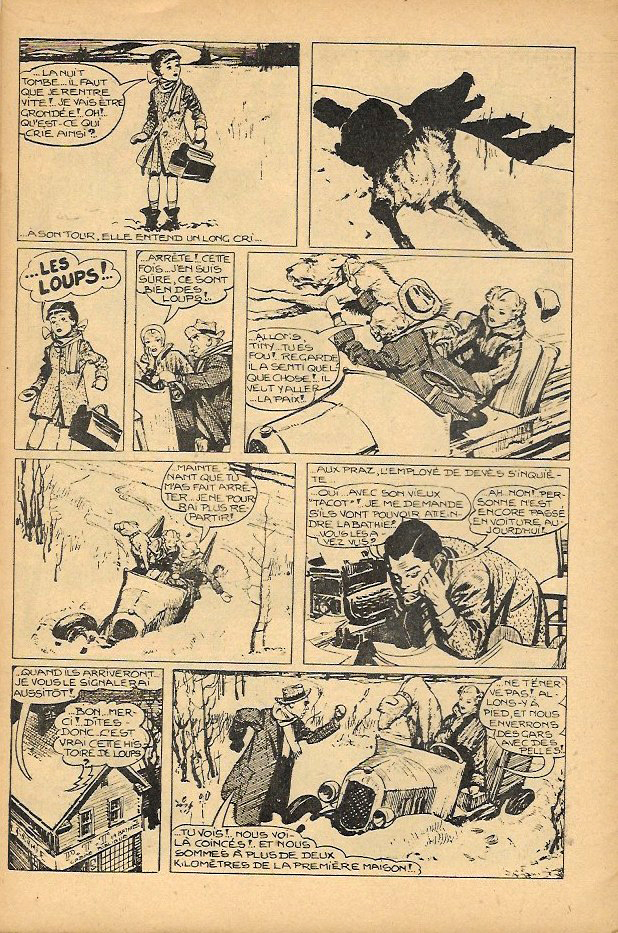
“Mitzi McCoy” was featured in several of Pierre Mouchot‘s French comic book titles, and P’tit Gars No. 1 was her swan song. This issue featured the eighth chapter in Mitzi’s saga, titled “L’exploit de Tiny” (or “Tiny’s feat”).
Because the artwork came from eight original “Mitzi McCoy” episodes, the editors had to take some liberties in presenting the story, which was spread across seven pages in the comic book. Some panels were resequenced and others were eliminated to allow the story to be told more concisely in the smaller format. A nice bonus is that several of the pages were printed in color. These French comic book scans were sent to me by mon ami, Gérard. Merci!
Savez-vous lire le français? I can read French un petit peu, but have learned to rely on online translators, for better or worse.
The first page of the story came from the January 1, 1950 episode, except for the opening panel (January 15, 1950).
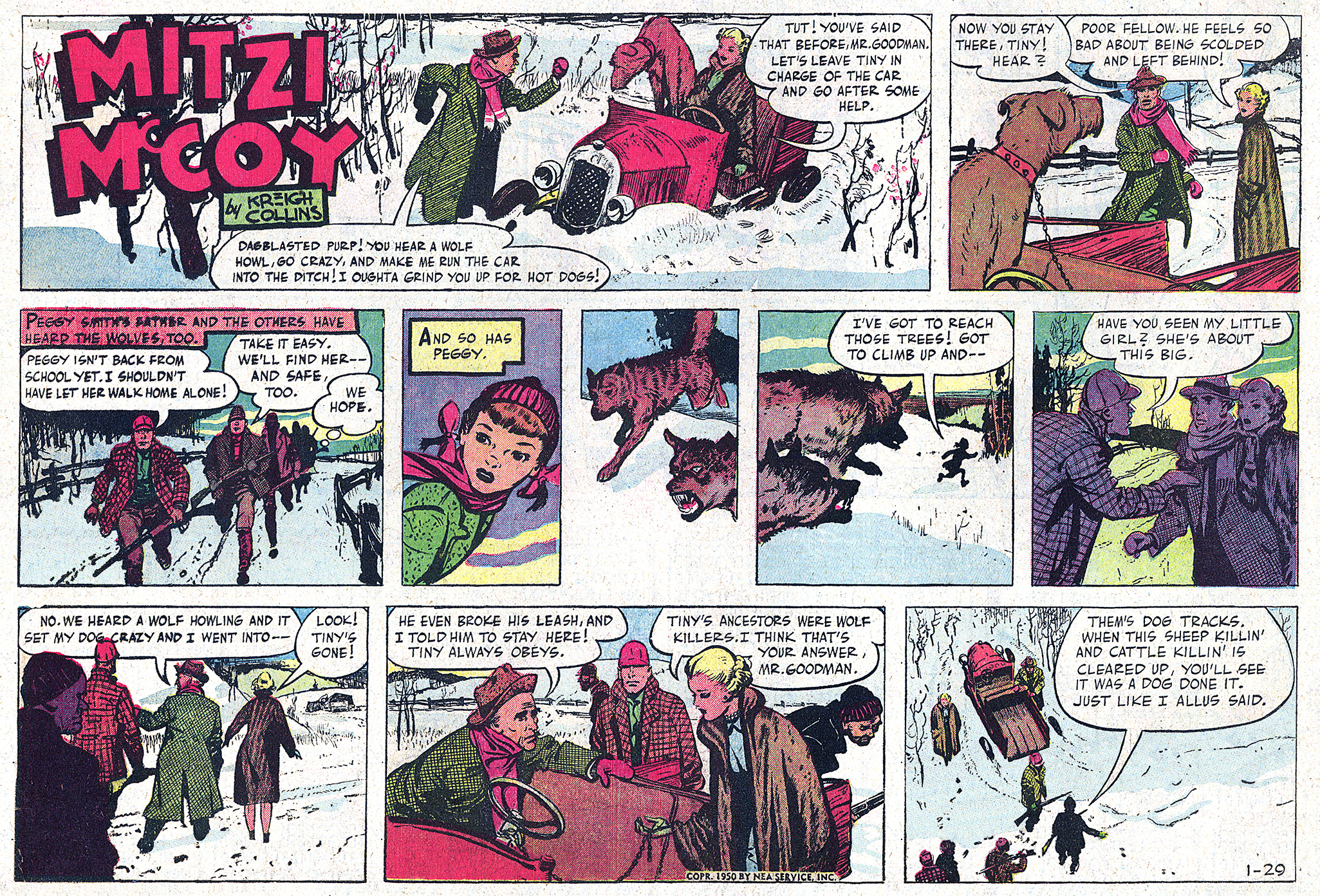
The artwork for the second page came from three episodes: January 1, 1950 (panels 1, 3), January 8, 1950 (panels 2, 4–7, 9–10), January 29, 1950 )panel 8).
The third page also sourced artwork from three episodes: January 8, 1950 (panels 1–3), January 1, 1950 (panel 4), and January 15, 1950 (panels5–9).
Only two episodes provided the artwork for the fourth page: January 15, 1950 (panels 1–4) and January 22, 1950 (panels 5–8).
The fifth page again used three different episodes: January 22, 1950 (panels 1–6), February 19, 1950 (panels 7–8), and January 29, 1950 (panel 9).
I cannot figure out where the artwork of Tiny in the first panel originated, but the remaining panels all come from the February 12, 1950 episode).
The artwork for the final page of the story comes from at least two episodes: February 12, 1950 (panels 1–2) and February 19, 1950 (panels 4–6). The third panel is another that I could not find in the original artwork).
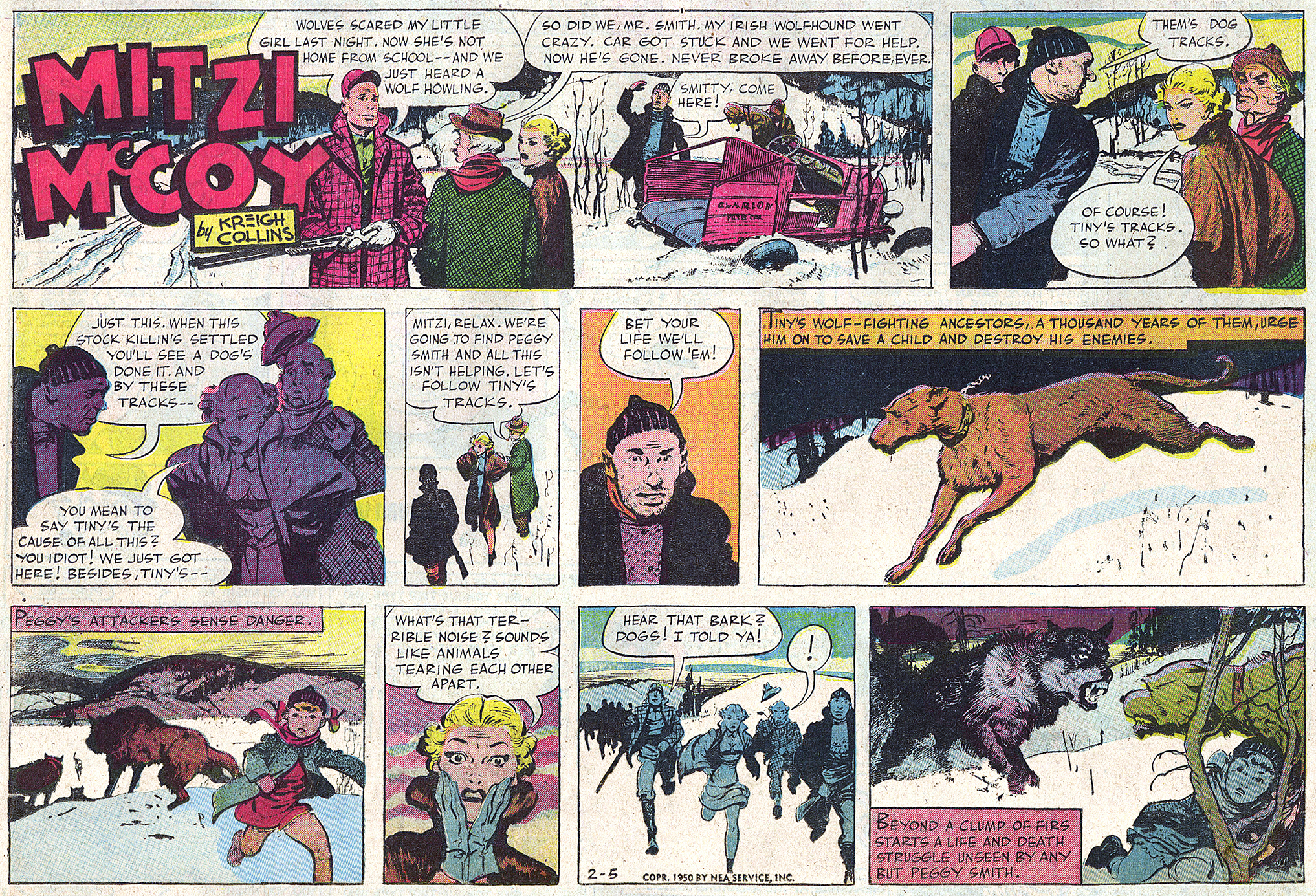
In trying to figure out which panels came from what original episodes, I noticed that two of the episodes in this sequence were essentially omitted. The January 29 was used for two panels (out of nine), and the February 5, 1950 episode was omitted entirely in the French retelling of the story. This action would have fallen near the end of the story—just after Stub puts his car in the ditch. For the completists out there, I will append those two original episodes (in English).
Only the first and fourth panels were taken from this episode.
Now if you’re a truly a completist, no doubt you have a hankering to read the entire collection of “Mitzi McCoy” episodes, so…
“The Lost Art of Kreigh Collins, the Complete Mitzi McCoy,” features the entire run of Kreigh Collins’ first NEA feature, and is available for immediate delivery. Order today to ensure that the collection arrives in time for the holidays.
MITZI McCOY ran from 1948 to 1950 and showcased Kreigh Collins’ skill as an illustrator and storyteller. His picturesque landscapes, lovely character designs, and thrilling action sequences brimmed with detail and charm, and the strip’s ensemble cast rotated in and out of the spotlight taking turns as protagonists in the dozen story arcs collected in this volume. The last story collected in “The Lost Art of Kreigh Collins, the Complete Mitzi McCoy” is the narrative bridge that set Collins and his characters off on a new journey, beautifully told for the next couple of decades in the much-lauded adventure strip Kevin the Bold.
The collection includes an introduction by Eisner Award-winning author Frank M. Young, an Afterward by Ithaca College’s Ed Catto, and previously unpublished artwork and photos. Longtime comics artist Butch Guice also provides a new pin-up of the character Mitzi McCoy.
The book costs $30. For domestic shipping, add $4; for international orders, add $25 for first class shipping. To place an order, email me at BrianEdwardCollins1[at]gmail.com, and I will give you PayPal or Venmo information.







































 Kreigh’s Comics