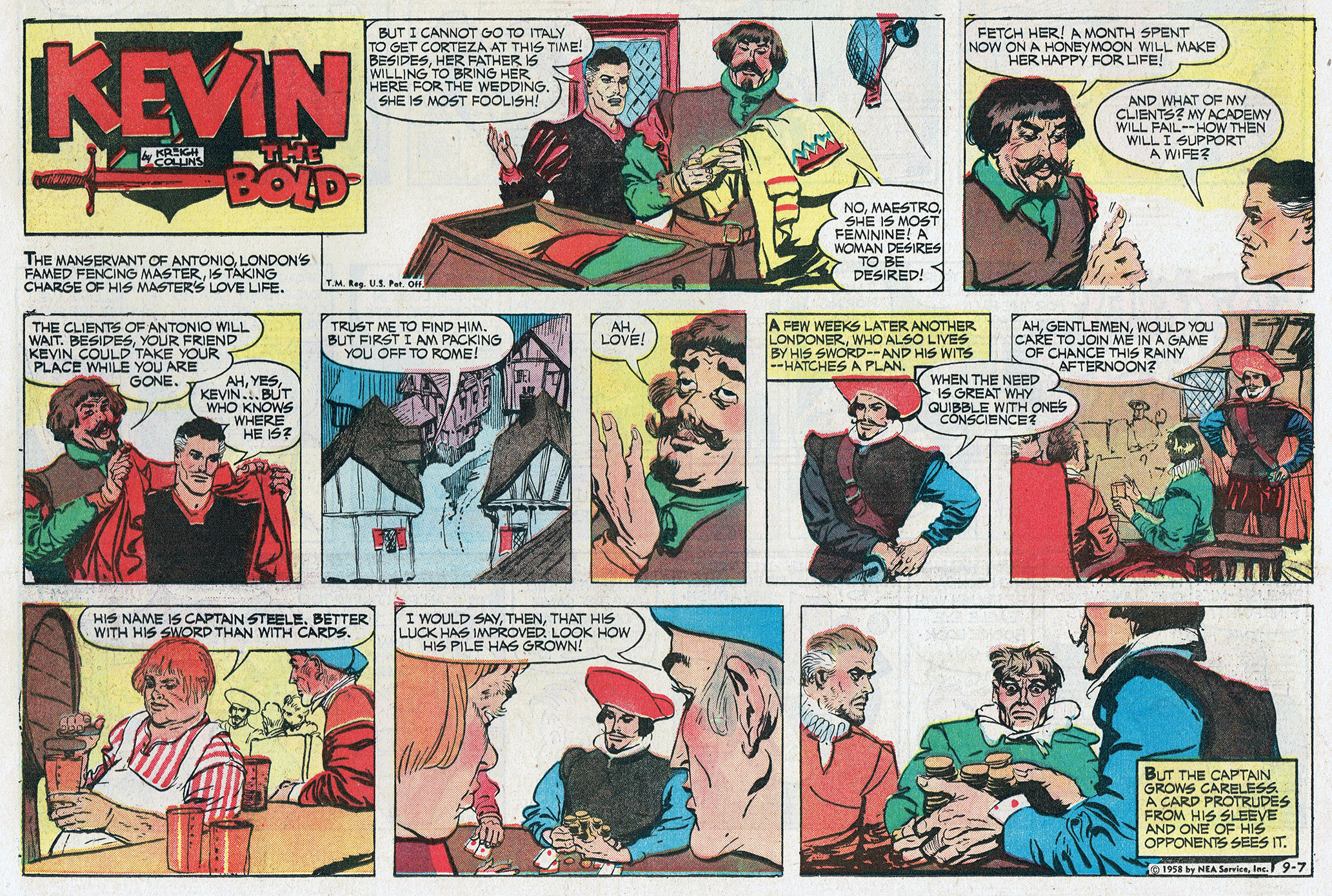
As a mid-1958 storyline transitions to a new chapter, a new, recurring character is introduced.
A mountain of a man, Pedro would continue to play a large roll in Kevin’s adventures over the final decade of the comic strip’s run. Pedro even made the jump when “Kevin” morphed into “Up Anchor!,” continuing his supporting roll during the 3.5-year run of Collins’ final NEA feature. Friends like that are hard to find, and I would like to thank my friend Arnaud for providing most of these scans from Pedro’s introductory sequence.
As the story unfolds, some new characters are introduced—the first is swordsman/card cheat Captain Steele—I’m thinking he’s going to be the villain…
…Call me Kreskin! Another new face is that of little Glenn. In real life, Glen is one of Kreigh Collins’ four sons, the oldest of twins born when Kreigh and wife Theresa were in their mid-40s. (Glen’s twin is named Kevin). Glenn is a handsome little fella, as is his namesake—though Uncle Glen now more closely resembles Pedro in size. Here Glenn and Kevin meet cute as Captain Steele flees the scene of a crime.
Although this is Pedro’s first appearance in the comic strip, he and Kevin are well acquainted previously, and their story continues next week…
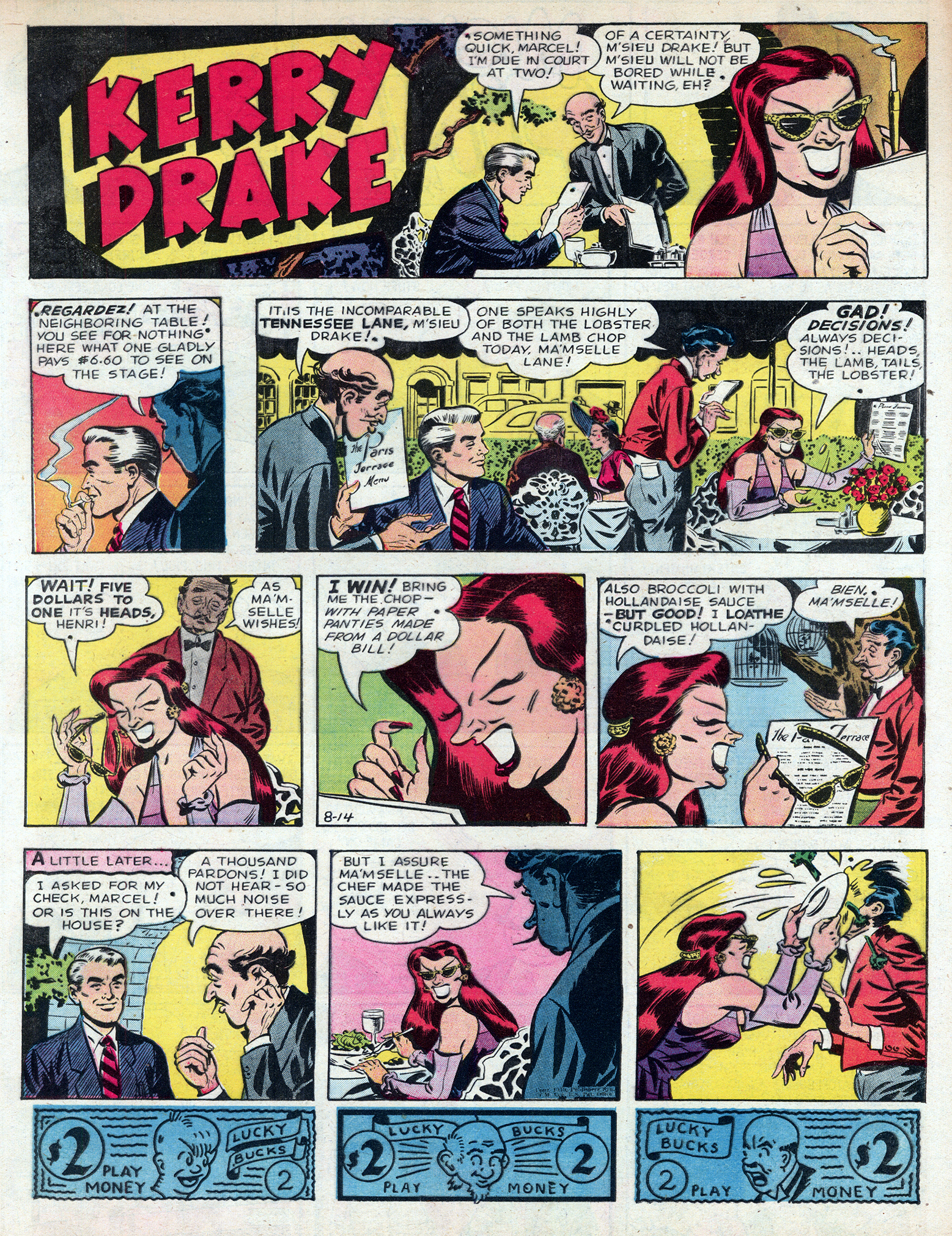
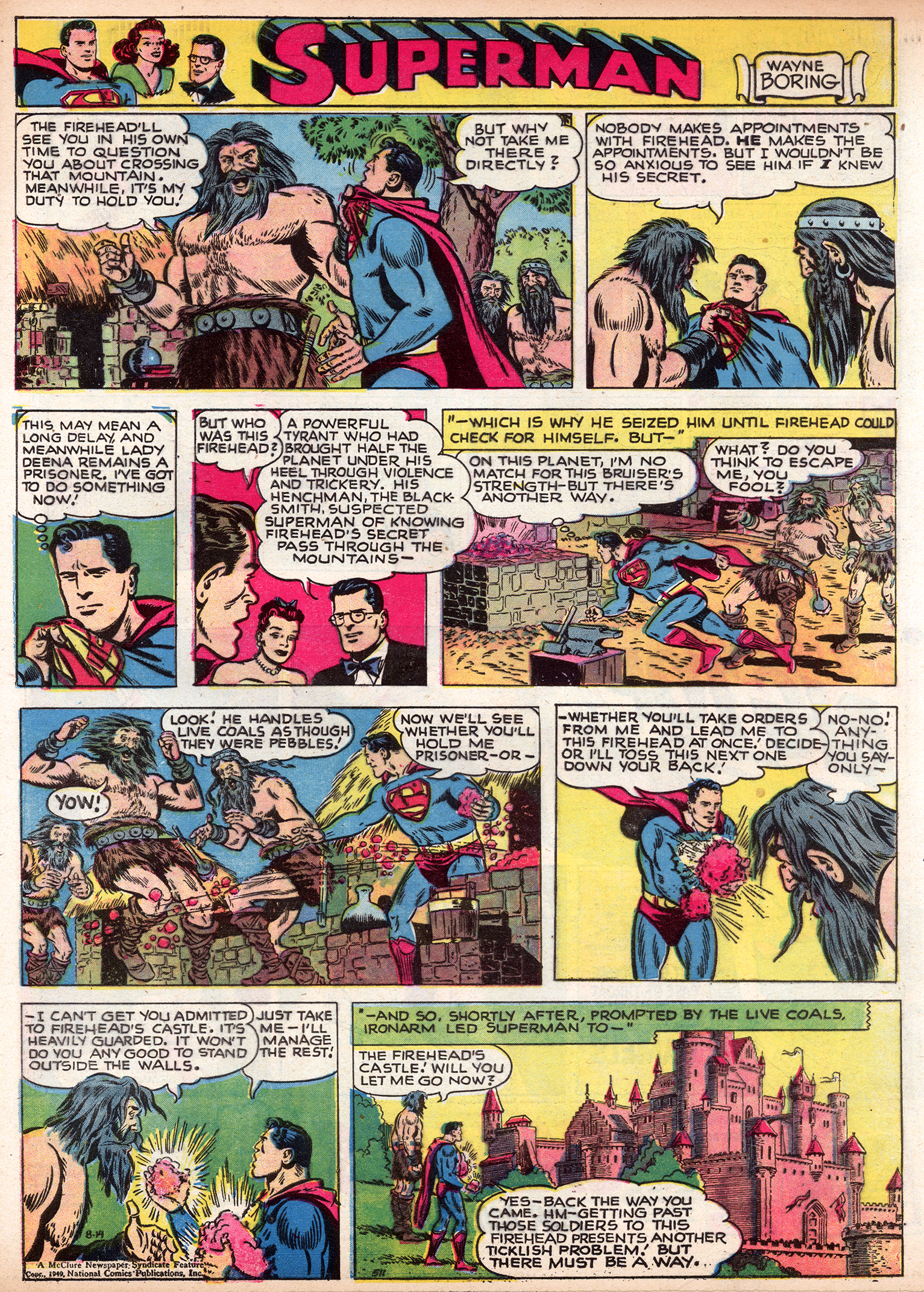
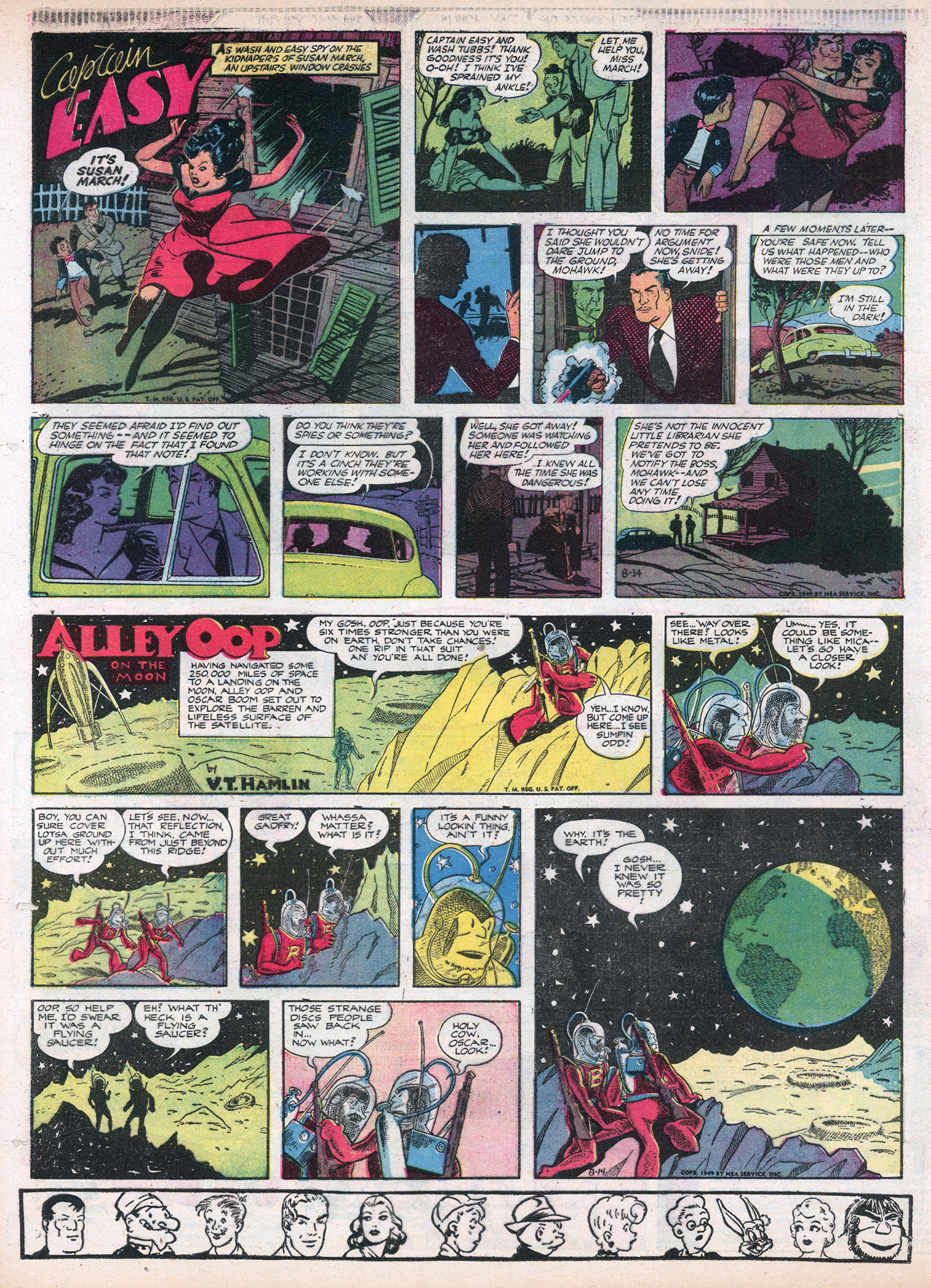
Here is another Sunday Times Mirror section I acquired while putting together The Complete Mitzi McCoy. There are fewer ads than usual—if the Mirror’s ad sales department was slacking off, that just meant more full-page episodes and fewer half-tabloids. As usual, Ham Fisher’s “Joe Palooka” leads off, followed by Milt Caniff’s “Steve Canyon” and “Mickey Finn,” by Lank Leonard. Next up is “Kerry Drake,” by Alfred Andriola/Allen Saunders and Frank Miller’s “Barney Baxter in the Air,” with each page filled out with a few $2 bills of play money. Harry Hanand’s silent comic “Louie,” and “Superman” by Wayne Boring (and likely Stan Kaye) follow.
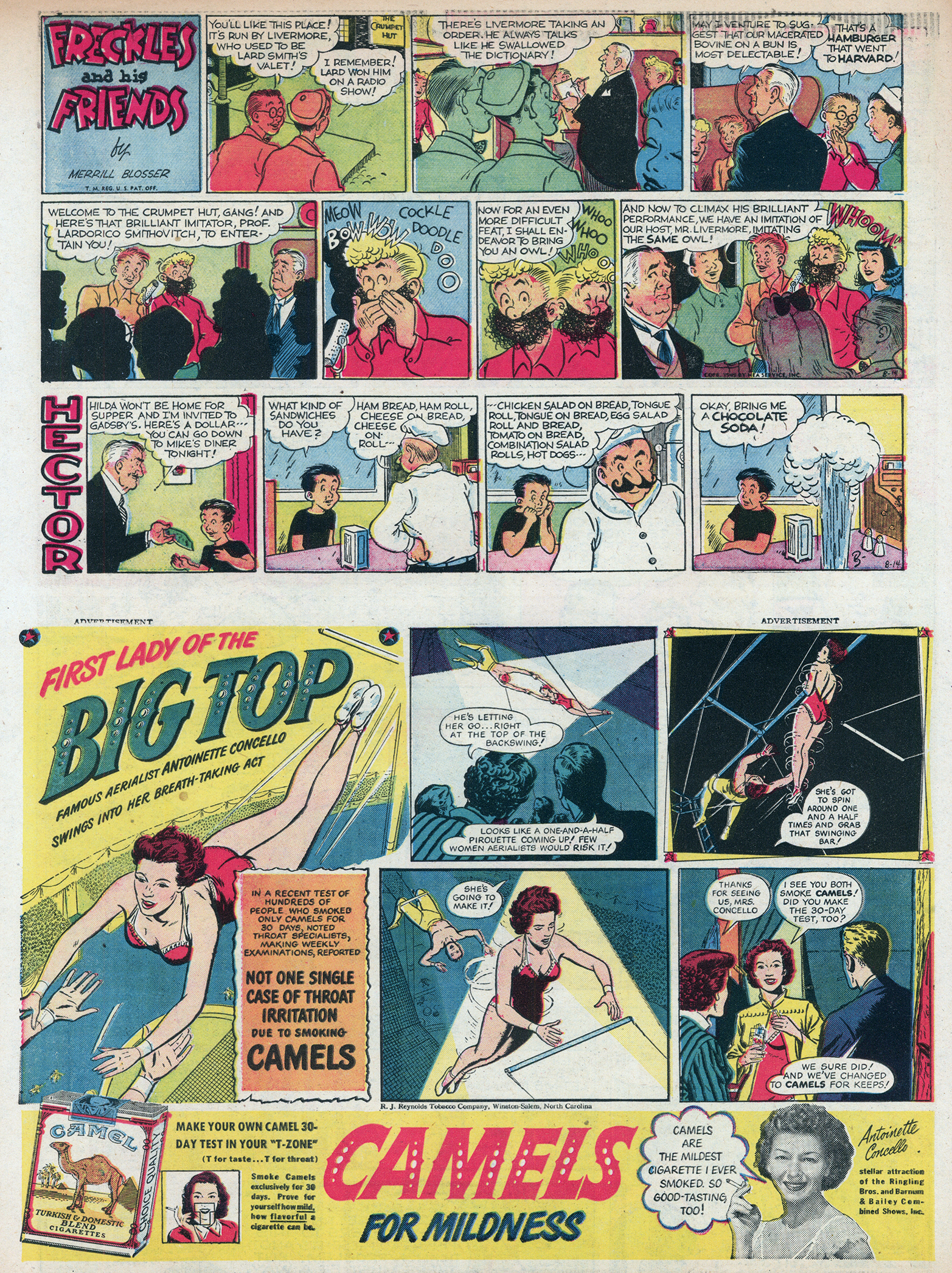
Next, Merrill Blossar’s “Freckles and His Friends” shares a page with an ad for Camel filtered cigarettes—the ad features the then-famous aerialist Antoinette Concello. Ms. Concello offers a testimonial to the mild, good-tasting cancer sticks, but I think she likes them because they soothe her nerves. (I don’t care if she performed over a net, I’d need something at least as strong to calm down after running through that routine!). The facing page features the comic strip that inspired me to plunk down my money for this section—a full page “Mitzi McCoy” episode (a nice change from the usual half-tabloids that ran in the Mirror). This August 14 episode is the penultimate installment of the fifth chapter of “Mitzi” and features the NEA’s typical footer—mugshots of the syndicate’s lead characters.
Next up, “Rex Morgan, MD” by Bradley and Edgington (with a nice, custom footer), and “Boots” by Martin, sharing the page with an ad for Colgate Dental Cream. Sometimes the ads in these old sections are charming, but this one is pretty obnoxious (and typical of the era). Roy Crane’s “Captain Easy” (drawn here by Walt Scott?) and V.T. Hamlin’s “Alley Oop” share the next page, followed by “Henry” by Carl Anderson. While “Captain Easy” and “Alley Oop” get the NEA footer, “Henry” features more play money, this time it’s big money—sawbucks! (I wonder if any kids ever cut these out? If so, then “Mickey Finn,” “Louie,” and “Bobby Sox” paid the price by being on the flip side). Two more split pages follow, “The Flop Family” by Swan with “Bobby Sox” by Marty Links, and “Out Our Way featuring the Willets,” by J.R. Williams, and “Our Boarding House.”
Taking its usual spot on the back cover is “Lil’ Abner” by Al Capp.
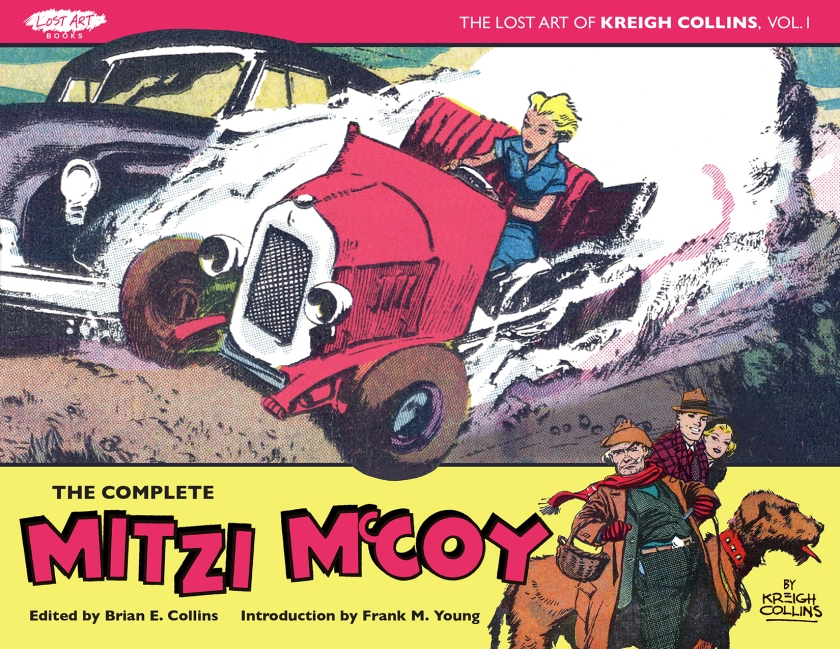
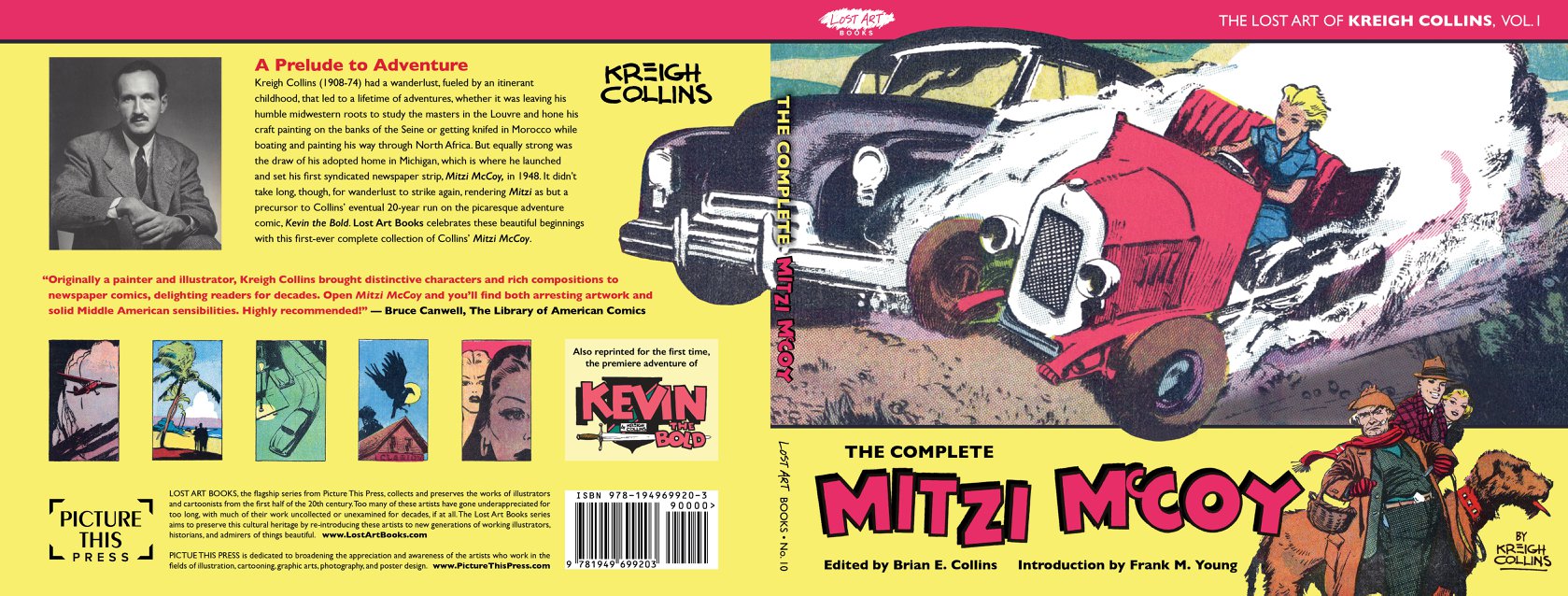
“The Lost Art of Kreigh Collins, the Complete Mitzi McCoy,” is available for immediate delivery at a reduced price; it features the entire run of Kreigh Collins’ first NEA feature .
MITZI McCOY ran from 1948 to 1950 and showcased Kreigh Collins’ skill as an illustrator and storyteller. His picturesque landscapes, lovely character designs, and thrilling action sequences brimmed with detail and charm, and the strip’s ensemble cast rotated in and out of the spotlight taking turns as protagonists in the dozen story arcs collected in this volume. The last story collected in “The Complete Mitzi McCoy” is the narrative bridge that set Collins and his characters off on a new journey, beautifully told for the next couple of decades in the much-lauded adventure strip Kevin the Bold.
The collection includes an introduction by Eisner Award-winning author Frank M. Young, an Afterward by Ithaca College’s Ed Catto, and previously unpublished artwork and photos. Longtime comics artist Butch Guice also provides a new pin-up of the character Mitzi McCoy.
The book costs $30only $20! For domestic shipping, add $4; for international orders, add $25 for first class shipping. To place an order, email me at BrianEdwardCollins1[at]gmail.com, and I will give you PayPal or Venmo information.
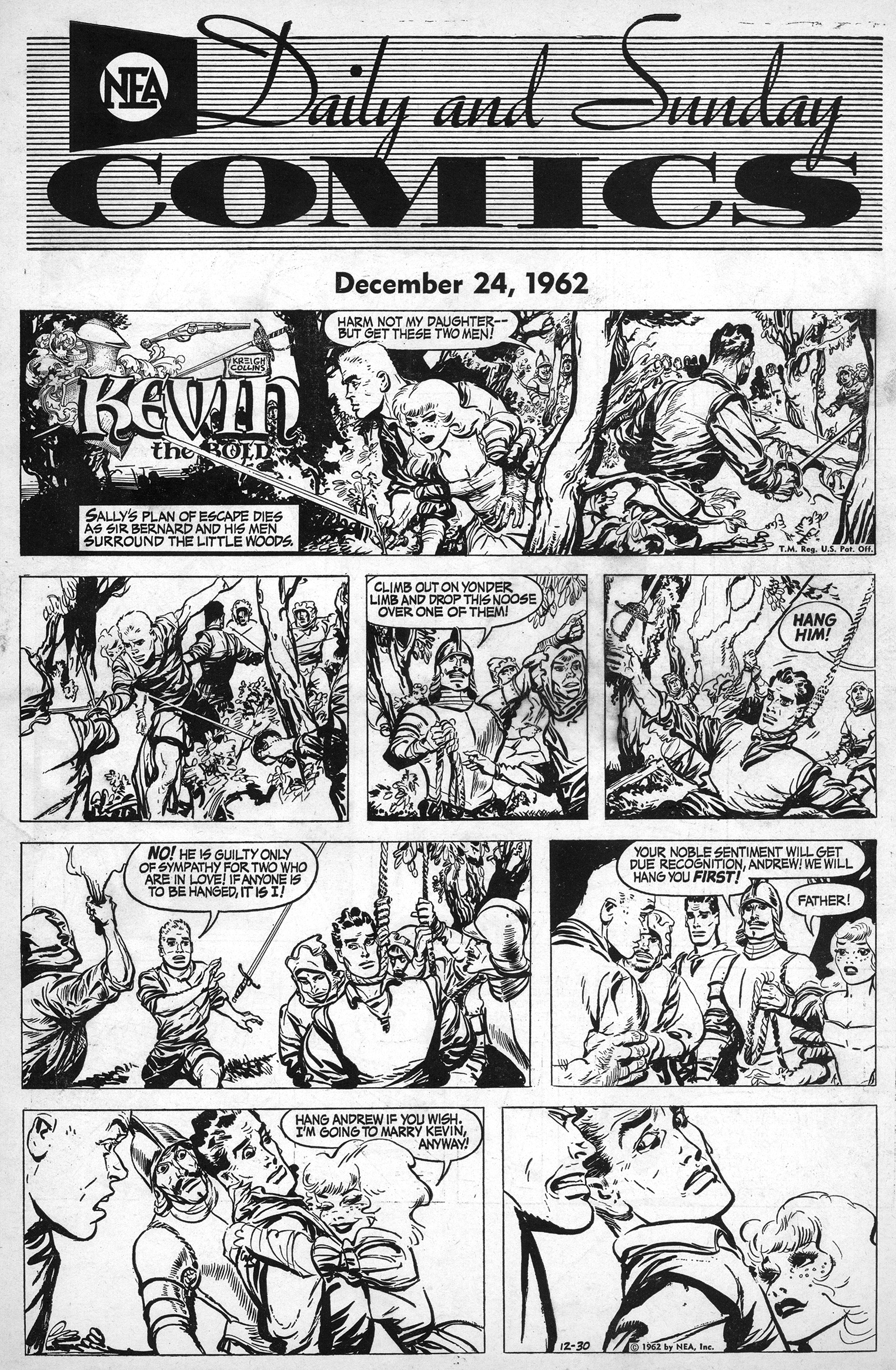
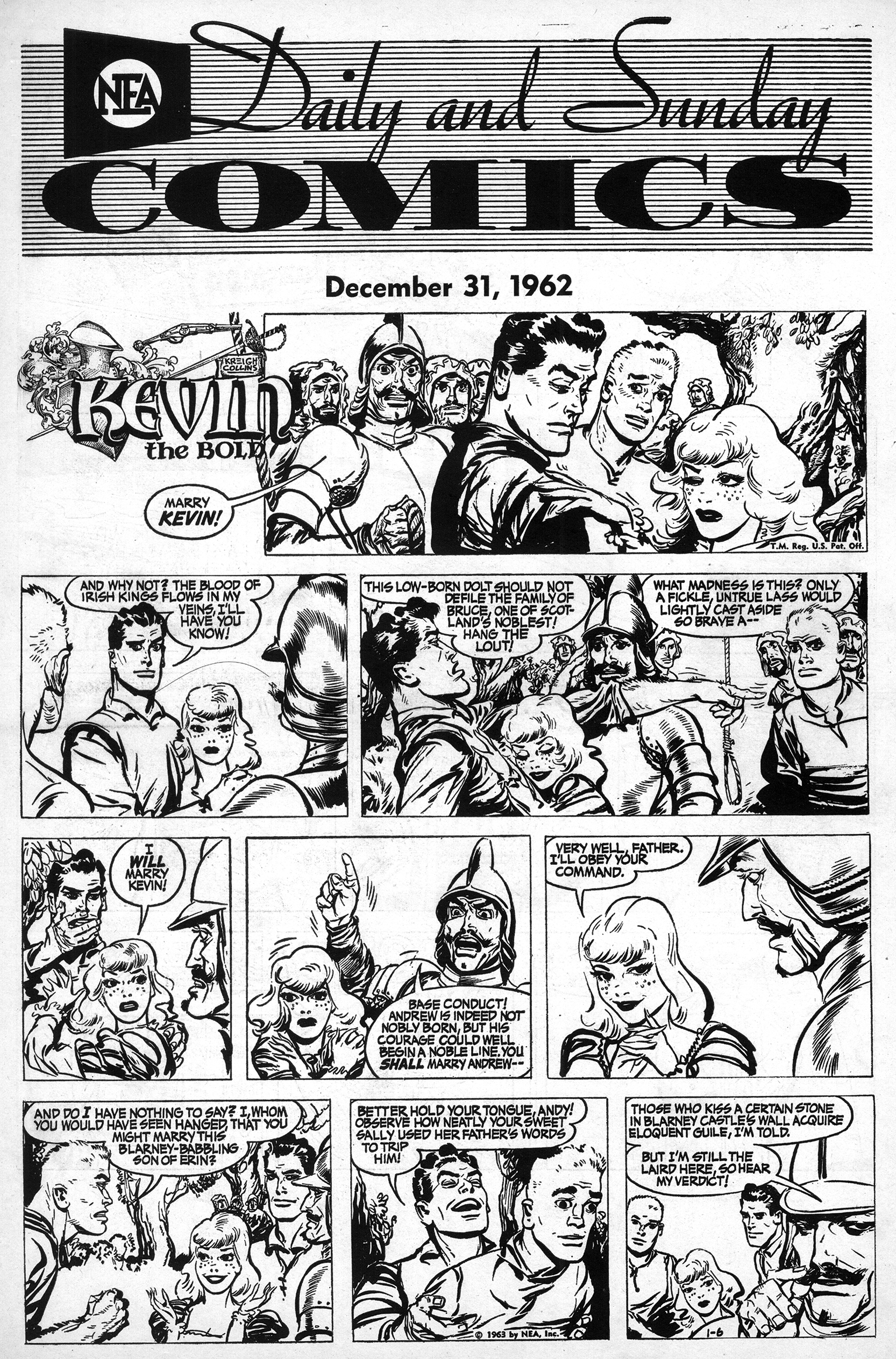
Sally’s plan is foiled and Kevin and Andrew are outnumbered.
Kevin has been snared in a noose, yet it’s Sally who sets a trap for her father. Kevin quickly follows her lead.
Andrew is the last one to realize what has played out, but they’re not out of the woods yet. (Literally! Recall they are trapped in a small thicket).
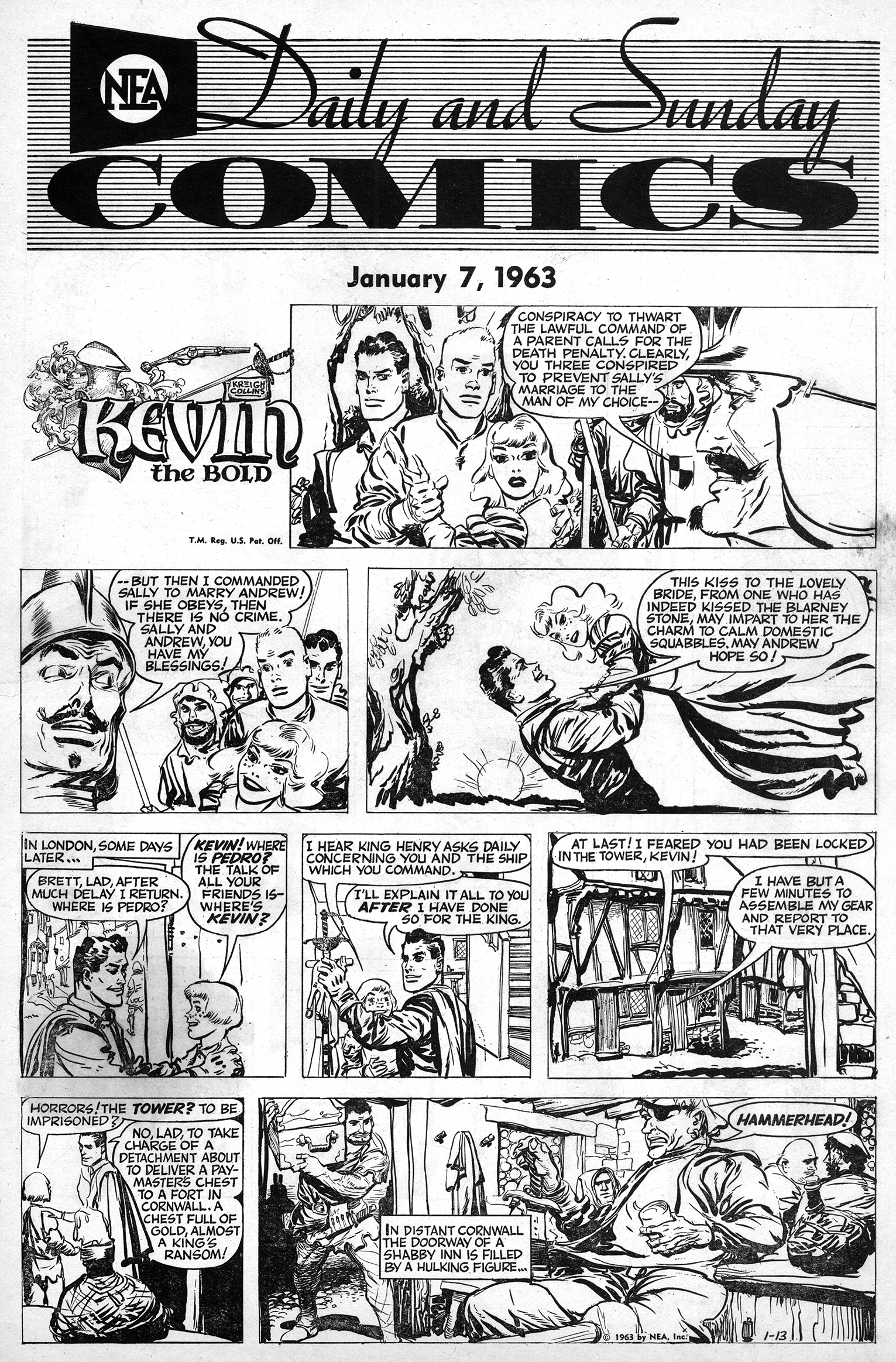
After a dramatic pause, Sir Bernard (Sally’s father) caves in to his daughter, giving the lovebirds permission to marry, and the strip transitions to the next storyline. One minor note is the use of photostats to illustrate Kevin’s rapier in the fourth panel of the December 30, 1962 episode, and in the fifth panel of January 13, 1963. This time-saver became a somewhat frequent tool for Collins in episodes after the comic strip’s logo was updated on April 30, 1961. (The photostats are the same size as the logo’s rapier).
Dressed in the clothes of the henchmen hired by Sally’s father, Kevin goes about his plan.
The plan goes off, but with a hitch—Sally has been identified. Plus, they have bigger a problem.
Not only has Sally packed a beautiful wedding gown, but plenty of confidence as well. It will be needed, in the face of this adversity! Here are black-and-white versions of the original half-page episodes.
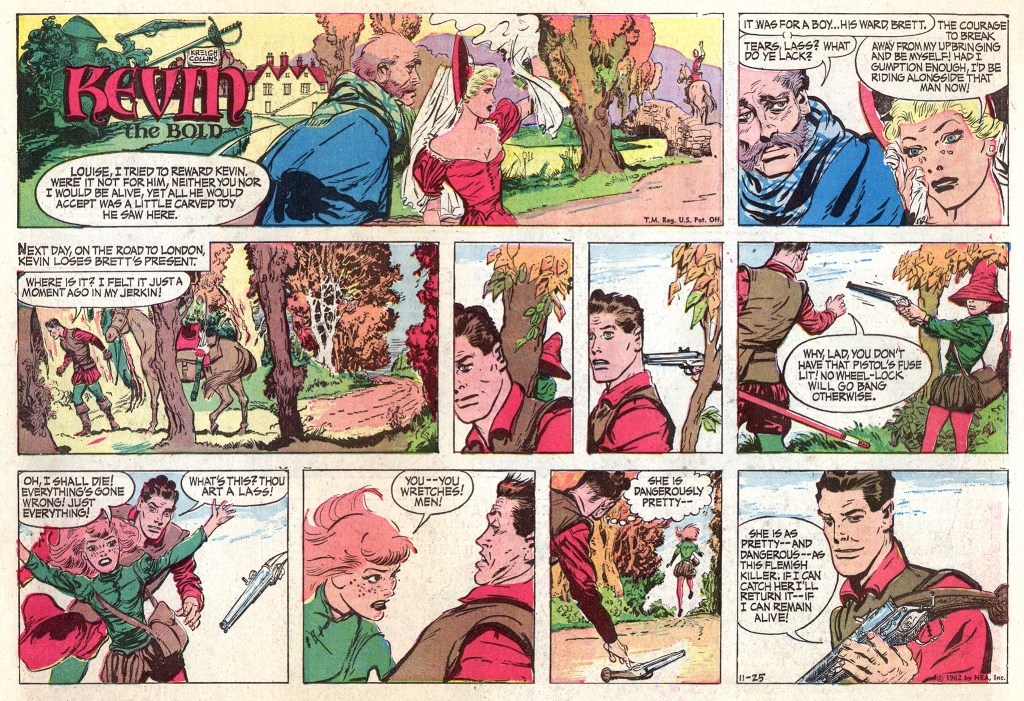
Today marks the start of a sequence from late 1962. It features some beautiful illustrations, and its theme of young love seems appropriate as Valentine’s Day nears. The November 25 episode is the transition from yet another chapter with a lovely young lady bidding Kevin a tearful farewell.
Most of the remaining episodes are taken from issues of the NEA Daily and Sunday Comics, with a couple of third-page examples too. So who is this mystery girl?
Sally has certainly settled down, and Kevin learns that her histrionics are over a young man.
After the ever-popular costume change plot point, Kevin unveils his plan.
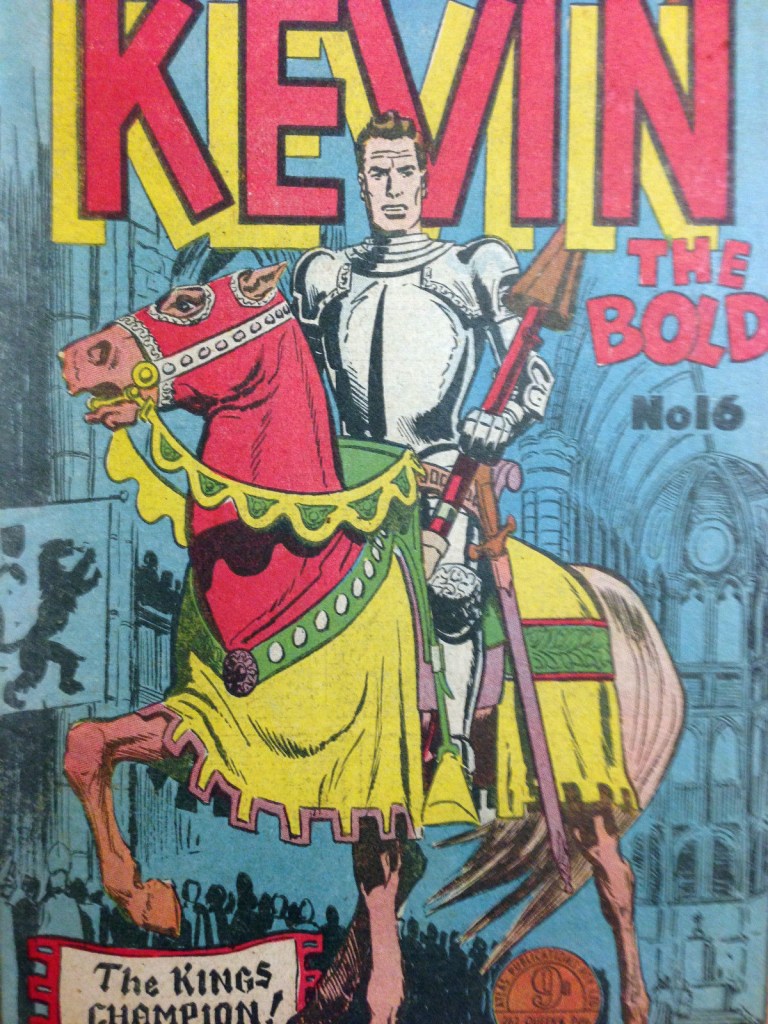
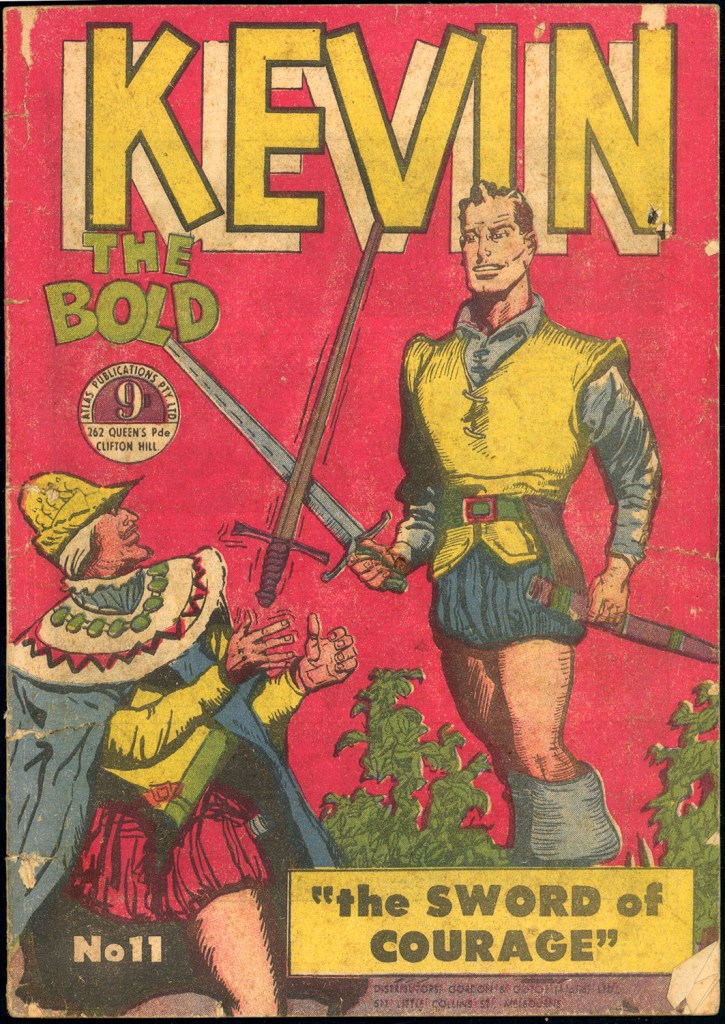
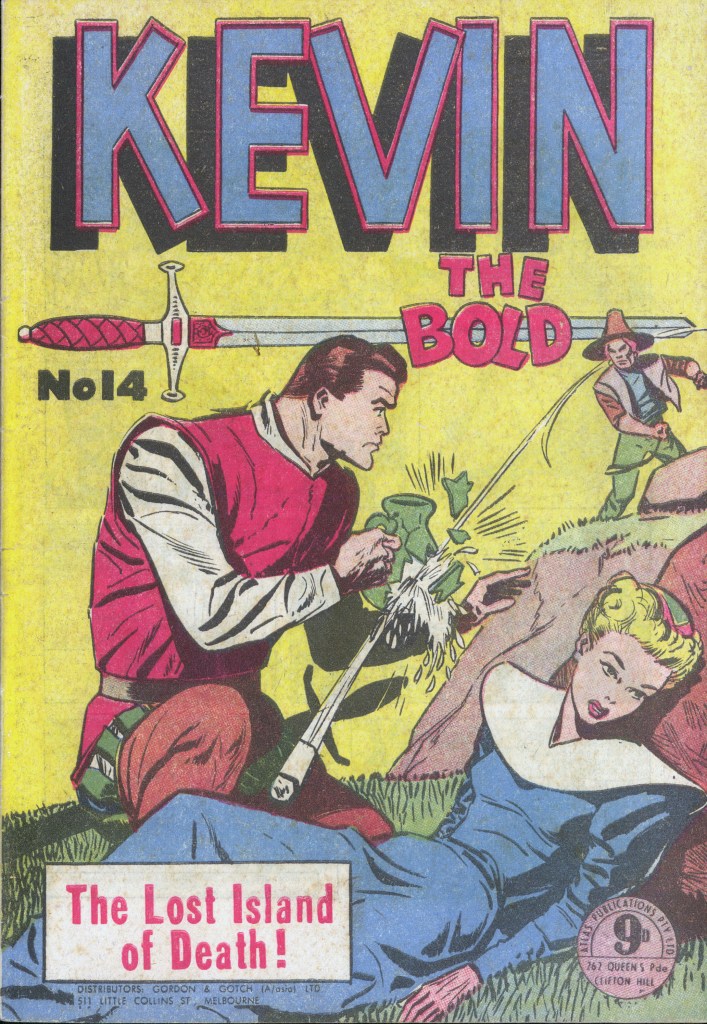
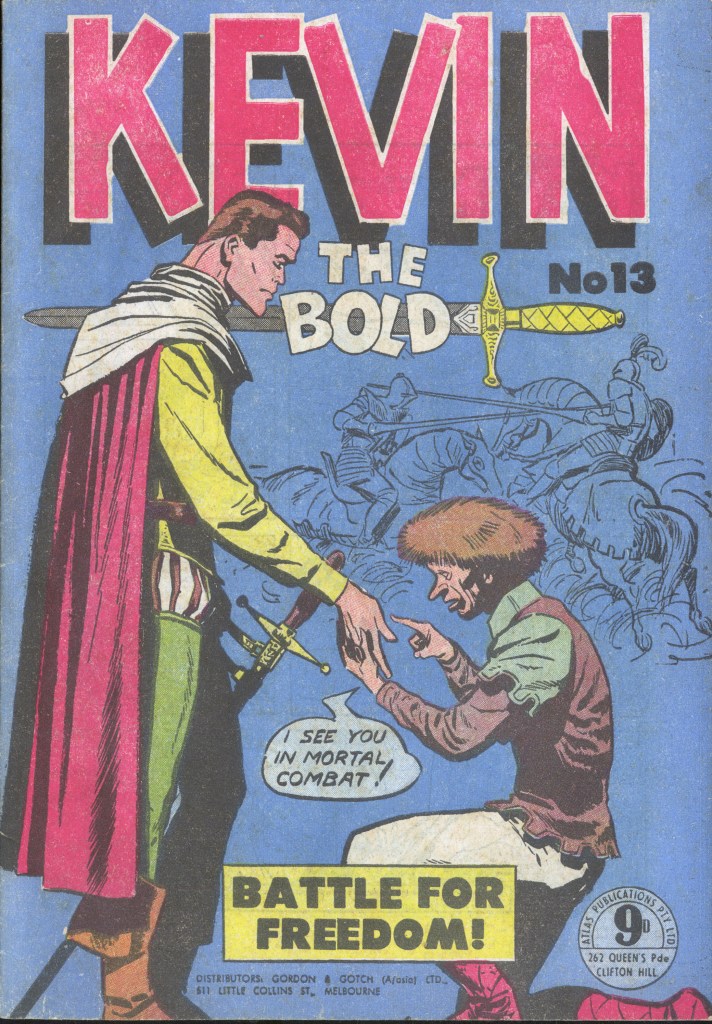
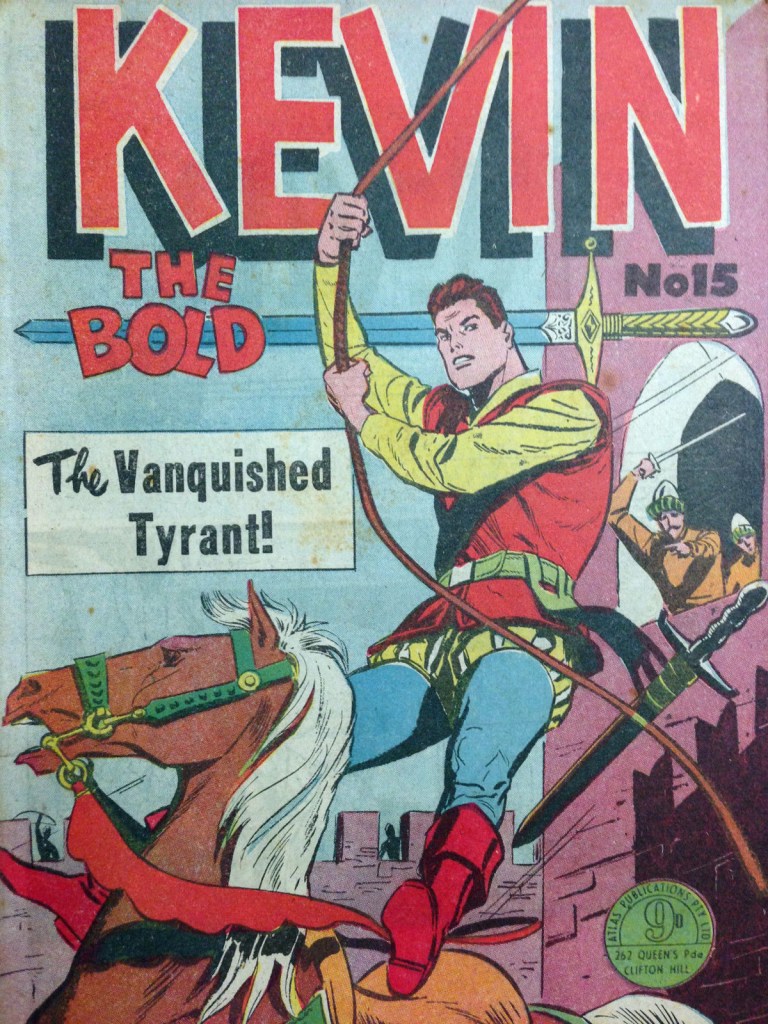
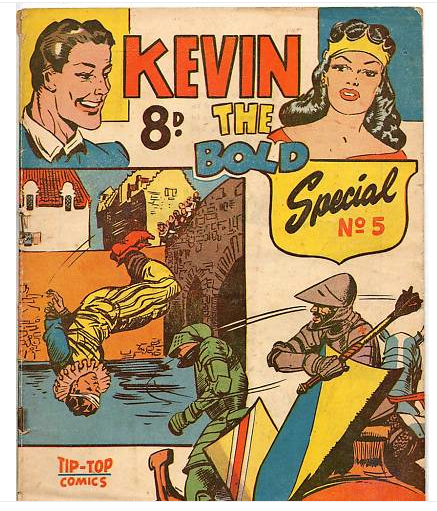
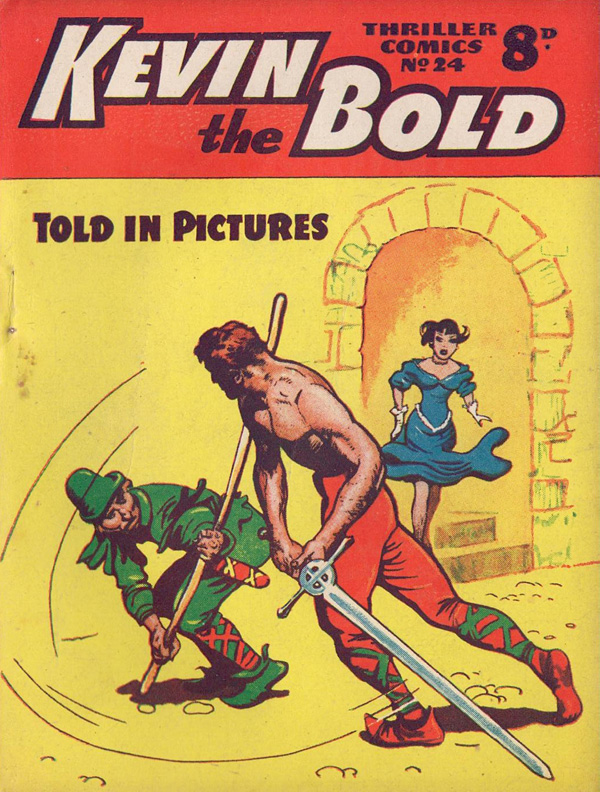
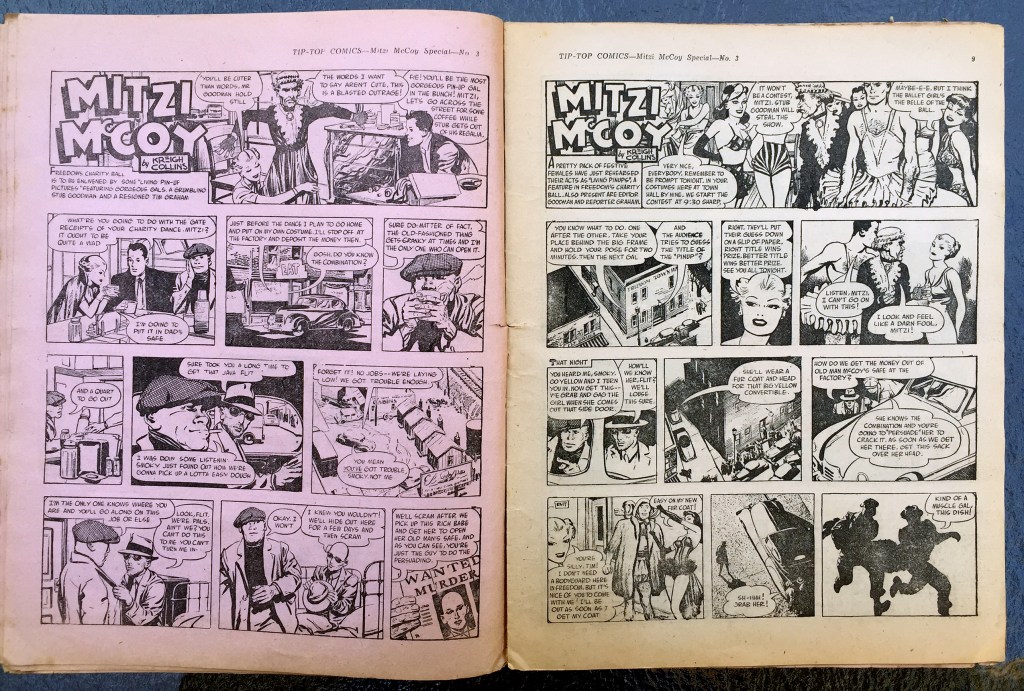
When I started collecting my grandfather’s Sunday comics, I had no idea they had been repackaged as comic books. I soon learned differently, seeing occasional listings of “Australian edition” comics on eBay, usually featuring KEVIN THE BOLD. Atlas Publications seemed to have the longest run, and other titles were published by both Tip-Top Comics and Thriller Comics.
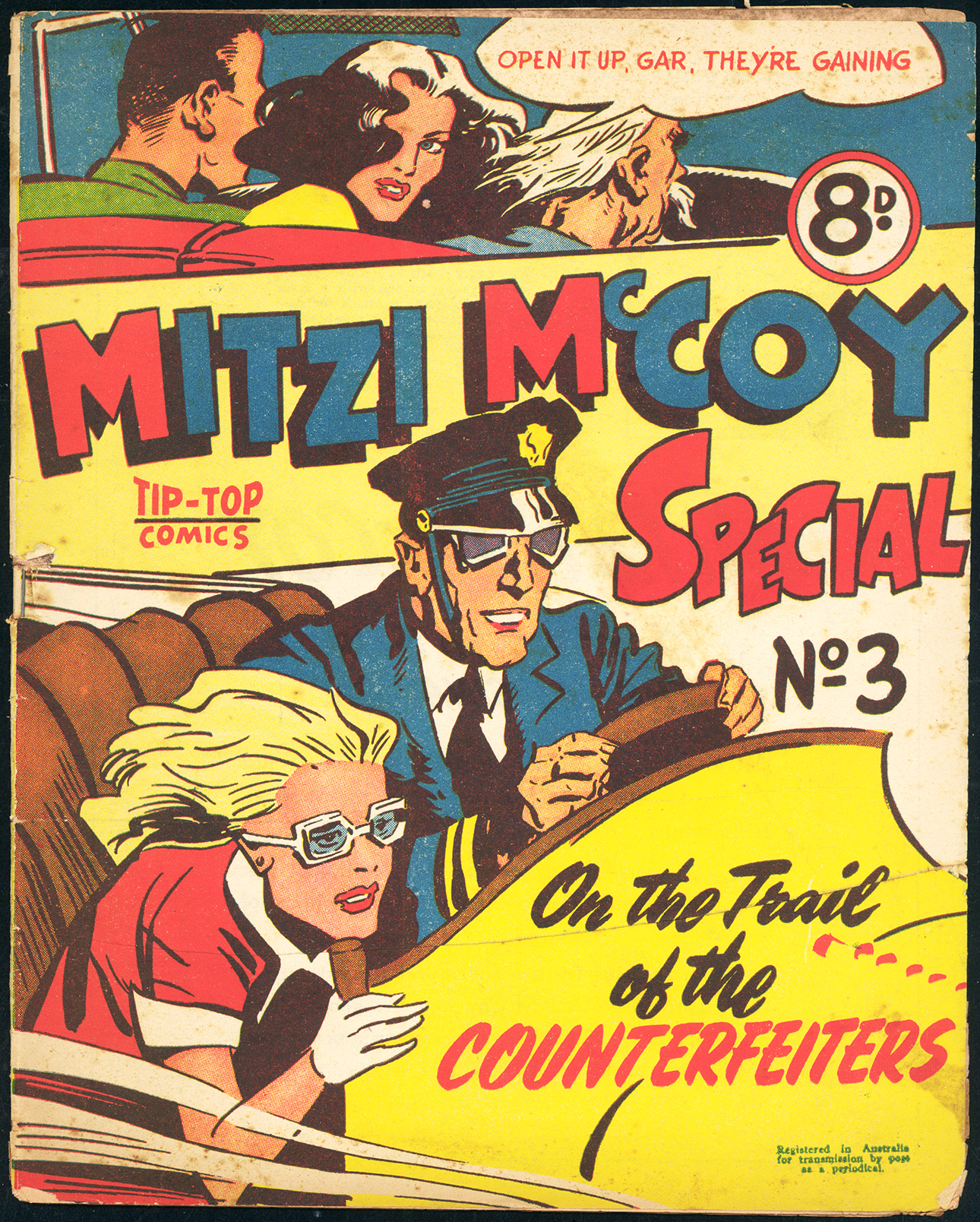
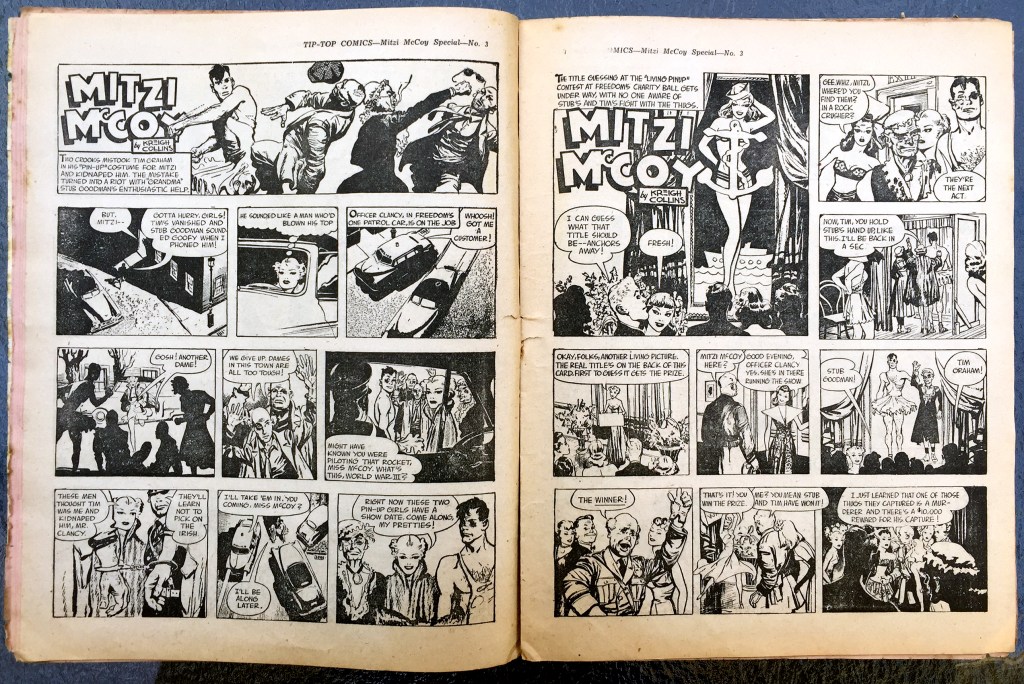
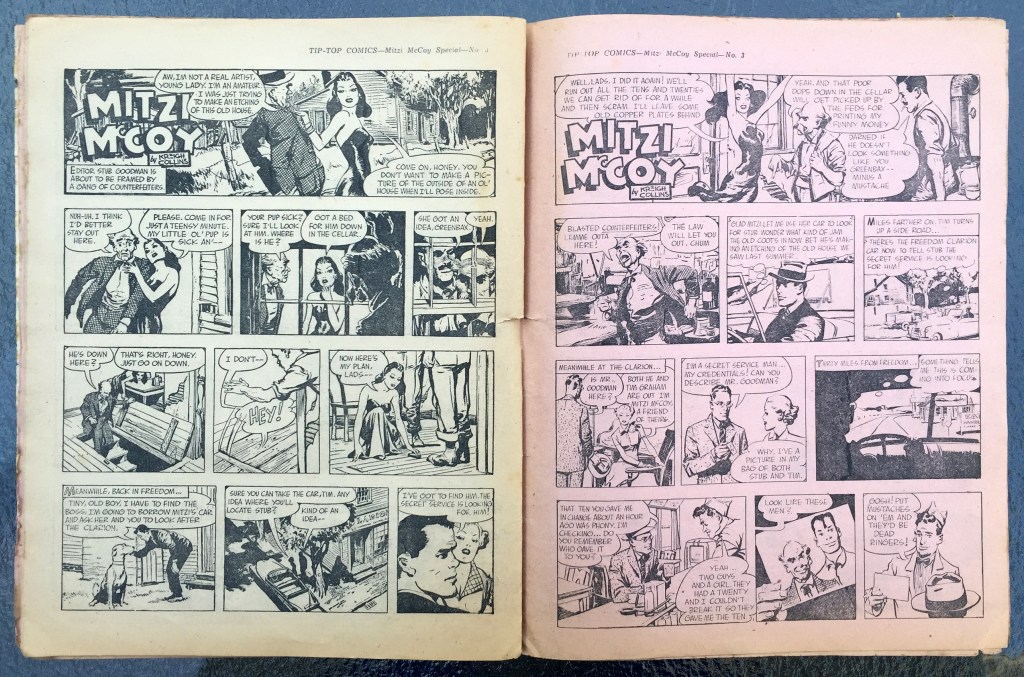
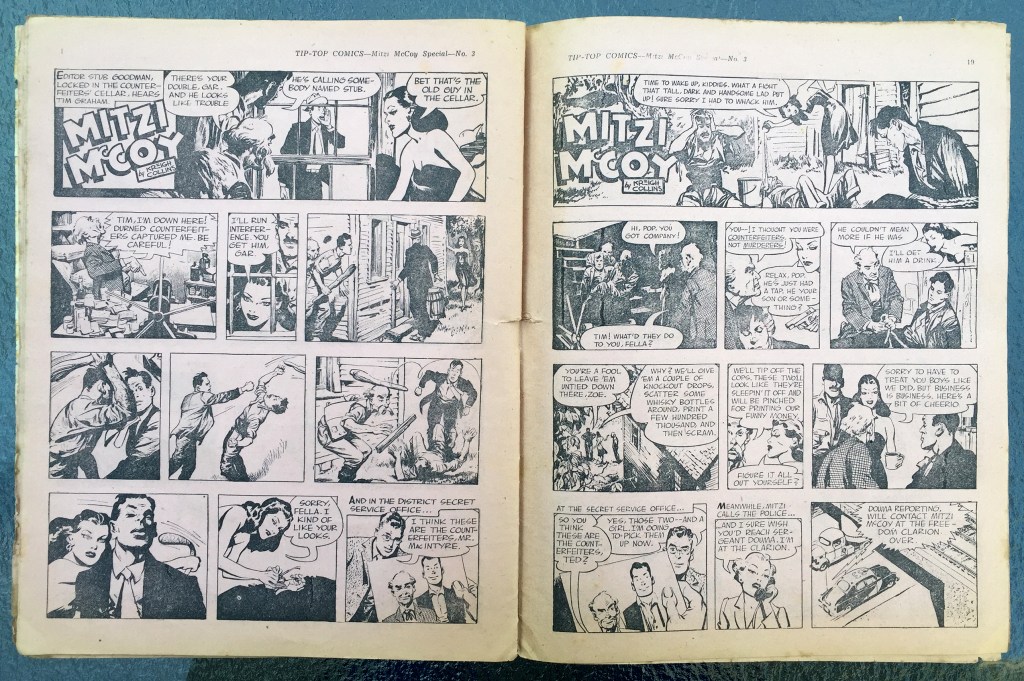
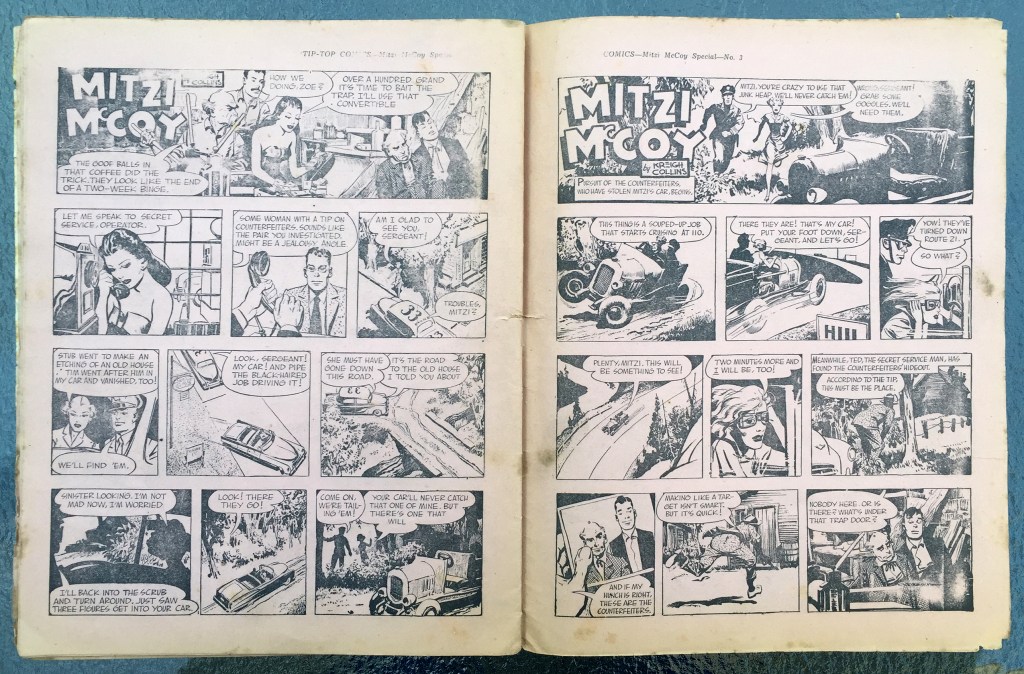
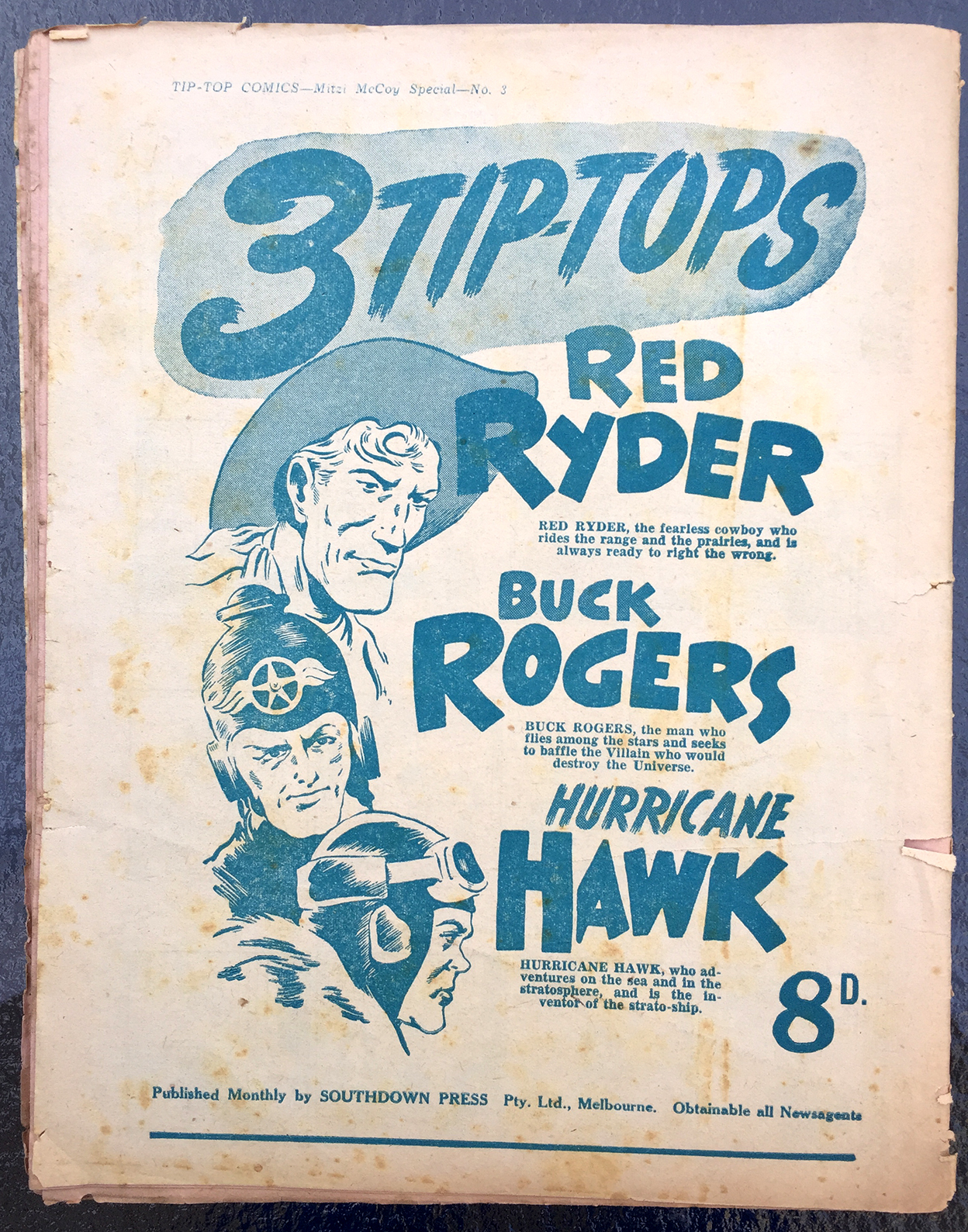
Because I was working on my Mitzi McCoy collection, the comic book that really caught my eye was Tip-Top’s “Special No. 3,” published by Southdown Press of Melbourne, Australia. Until recently, I never saw it listed for sale, only in google image search results.
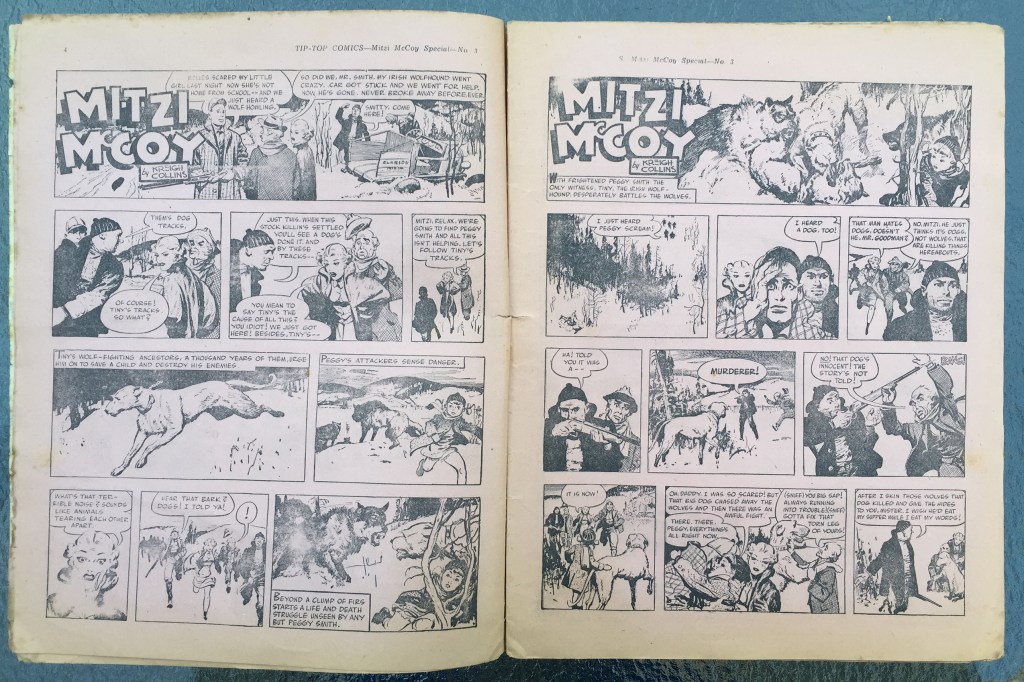
The copy I snagged isn’t in very good condition, but I couldn’t resist. I wonder what these comics looked like when they were new, because after laying around for 70 years or so, the ones I have managed to collect are a bit beat up. My copy of “Special No. 3” has some other minor problems—the cover has a crease running horizontally near the bottom, and the pages are torn slightly where they were stapled—but otherwise, it’s intact. It runs 24 pages plus cover, and seems to be printed on both pink and white paper stock (the middle eight pages being white).
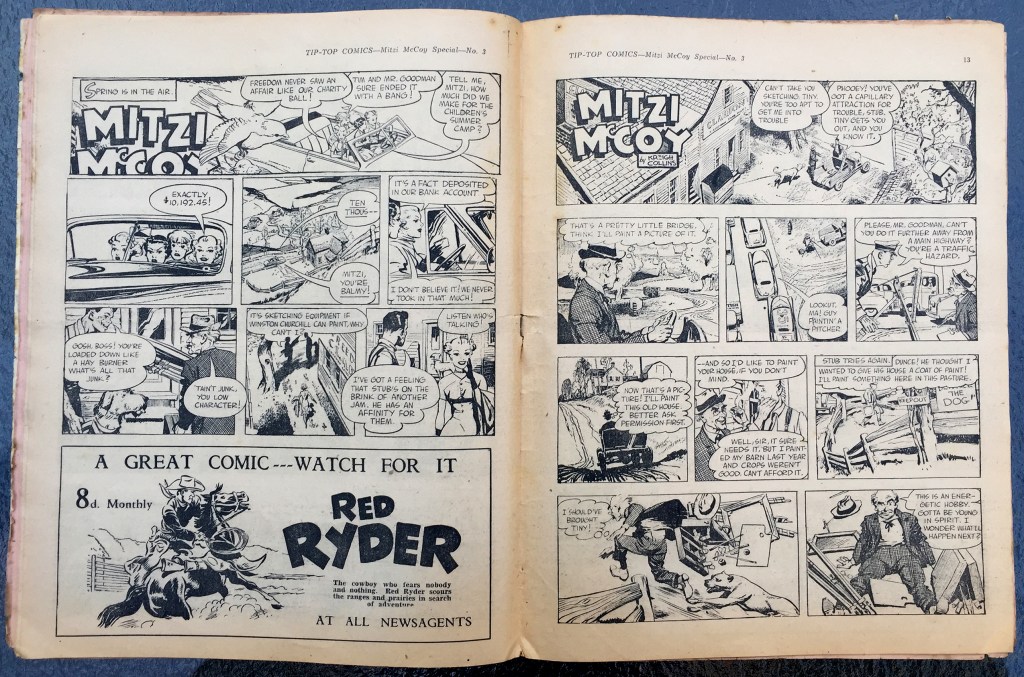
Inside, it features three of MITZI’s 12 story arcs; they come near the end of the strip’s run, and include a couple of my favorites. They inside front cover has a brief description of Kreigh Collins’ creation; it includes an error which I find amusing. Introducing the comic strip’s characters, it mentions that the dog is “part wolf.” Tiny is, in fact, an Irish wolfhound—a breed specializing in protection against and for the hunting of wolves. “Special No. 3” kicks off with a story where Tiny, a readers’ favorite, plays a major part. It starts with the sequence’s third episode, and while some of the preamble is lost, the story is still coherent. It begins with the episode that originally appeared on January 15, 1950. (This sequence was also featured in the French comic book P’tit Gars No. 1).
Next up is “Living Pinups,” packed with action. Interestingly, one of the original episodes is omitted (for those keeping score at home, its date is March 19, 1950), and another episode appears minus an entire page-wide panel—most unfortunately. In place of this wonderful example of good girl art is a small fractional ad for RED RYDER (another Tip-Top title). To see both the missing episode and the excised panel, please consider purchasing a copy of my book “The Complete Mitzi McCoy,” details at bottom.
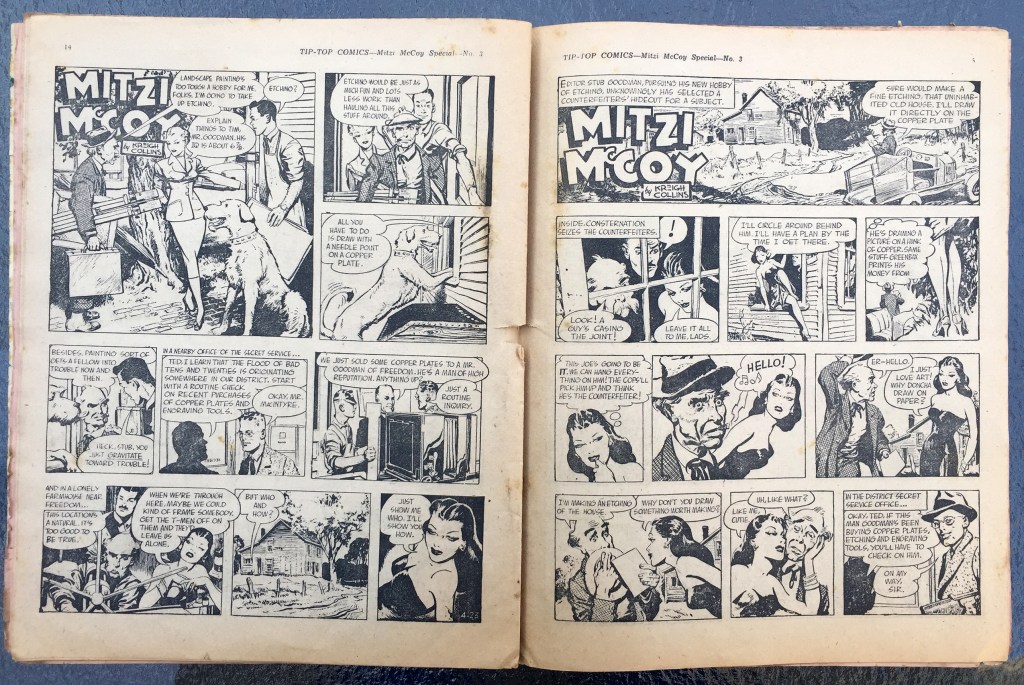
The third and final story arc appearing in “Special No. 3” is “The Counterfeiters,” another great sequence that has more of a noir-ish feel to it than any other found in MITZI McCOY. The comic book’s cover art features redrawn art from the story’s penultimate episode (and the final episode contains the panel I used for the cover of my MITZI book). On the inside back cover are four dailies of a comic called VIRGIL, by Len Kleis.
Strangely, the first episode runs without several panels (and crops and scrunches those that remain) in order to squeeze in the same RED RYDER that appeared a few pages back.
The back cover has an ad for three of the titles on Tip-Top’s roster, RED RYDER, BUCK ROGERS, and HURRICANE HAWK. It makes me wonder if MITZI was a part of the gang on the ads that ran on those comic’s back covers—I can dream!
“The Lost Art of Kreigh Collins, the Complete Mitzi McCoy,” features the entire run of Kreigh Collins’ first NEA feature, and is available for immediate delivery.
MITZI McCOY ran from 1948 to 1950 and showcased Kreigh Collins’ skill as an illustrator and storyteller. His picturesque landscapes, lovely character designs, and thrilling action sequences brimmed with detail and charm, and the strip’s ensemble cast rotated in and out of the spotlight taking turns as protagonists in the dozen story arcs collected in this volume. The last story collected in “The Complete Mitzi McCoy” is the narrative bridge that set Collins and his characters off on a new journey, beautifully told for the next couple of decades in the much-lauded adventure strip Kevin the Bold.
The collection includes an introduction by Eisner Award-winning author Frank M. Young, an Afterward by Ithaca College’s Ed Catto, and previously unpublished artwork and photos. Longtime comics artist Butch Guice also provides a new pin-up of the character Mitzi McCoy.
The book costs $30. For domestic shipping, add $4; for international orders, add $25 for first class shipping. To place an order, email me at BrianEdwardCollins1[at]gmail.com, and I will give you PayPal or Venmo information.
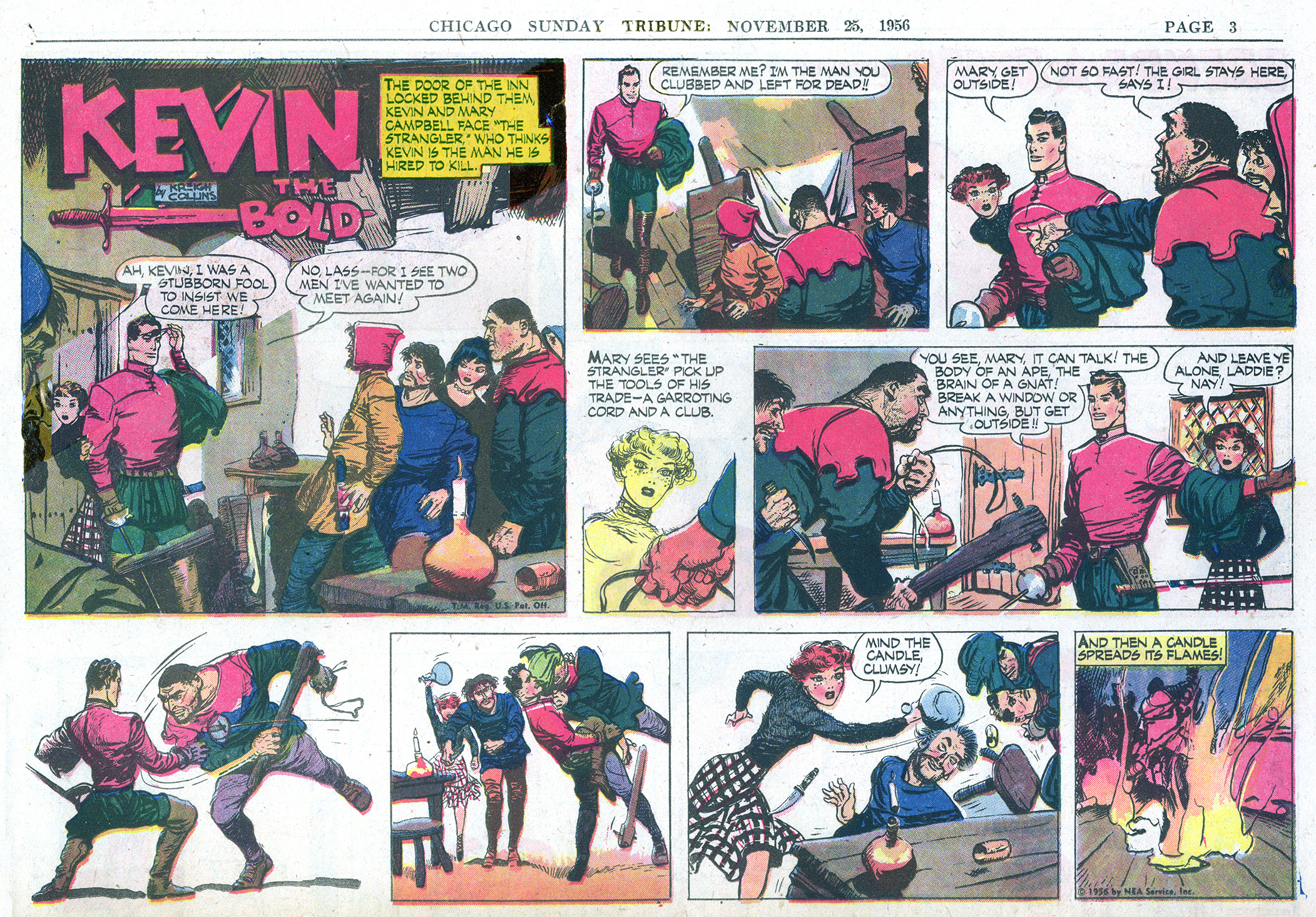
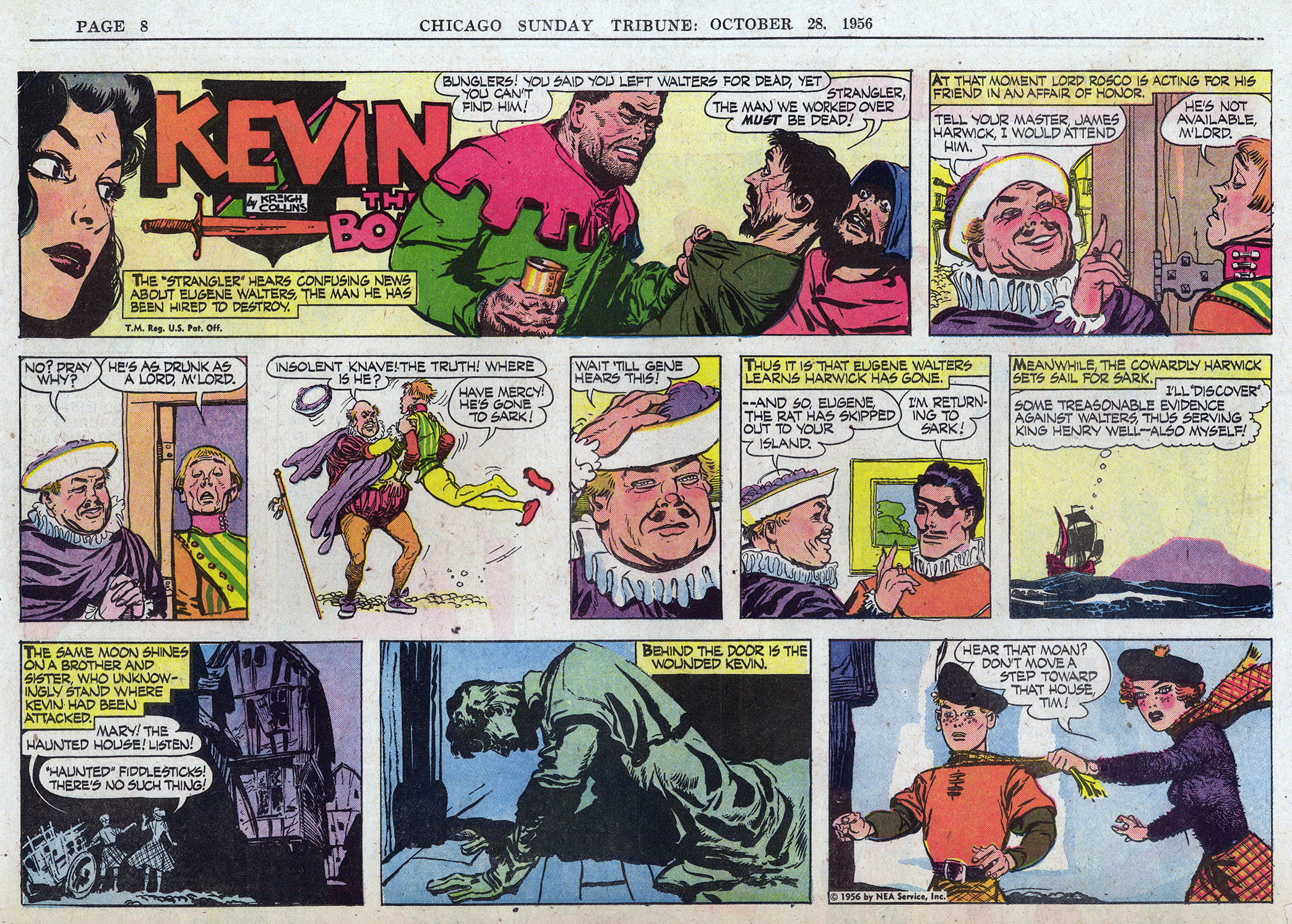
Chicago Tribune episodes are preferable to those found in other newspapers—except in cases where they are damaged. My copy from November 25, 1956 had gotten torn long ago, and the remedy my grandfather used was cellophane tape. 64 years later, it left quite a nasty yellow diagonal scar. I often complain about third-page examples, but in this case one from the Detroit News helped save the day. (The tear ran from Mary Campbell’s “hard scotch skull” in the splash panel all the way to the word “Tribune” in the running head). Now, back to the action.
While Mary immediately regrets their decision, Kevin relishes the opportunity to settle an old score. As the ensuing melee devolves into hand-to-hand combat, even Mary gets in on the action.
Things look especially grim for Kevin as Mary manages to escape.
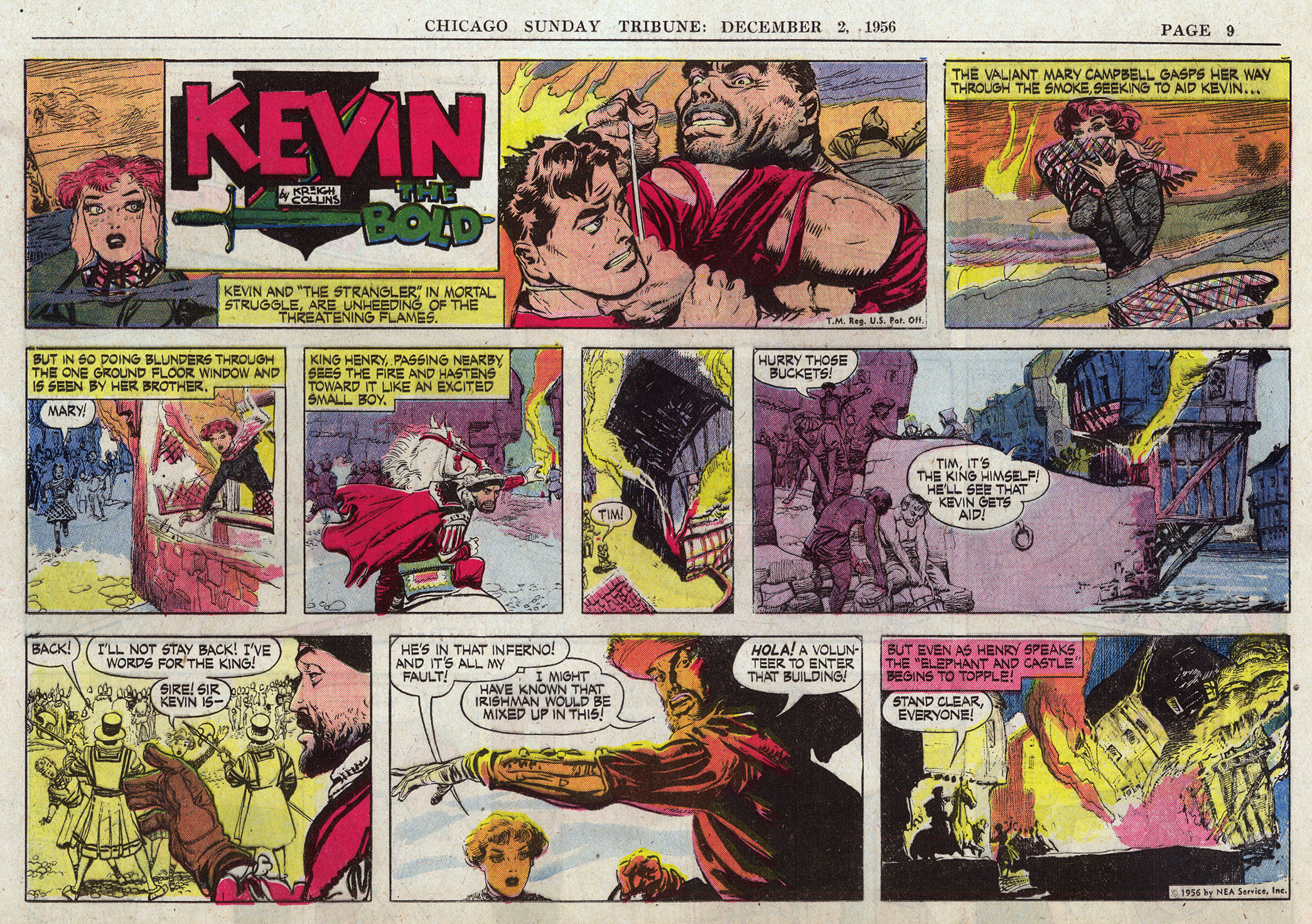
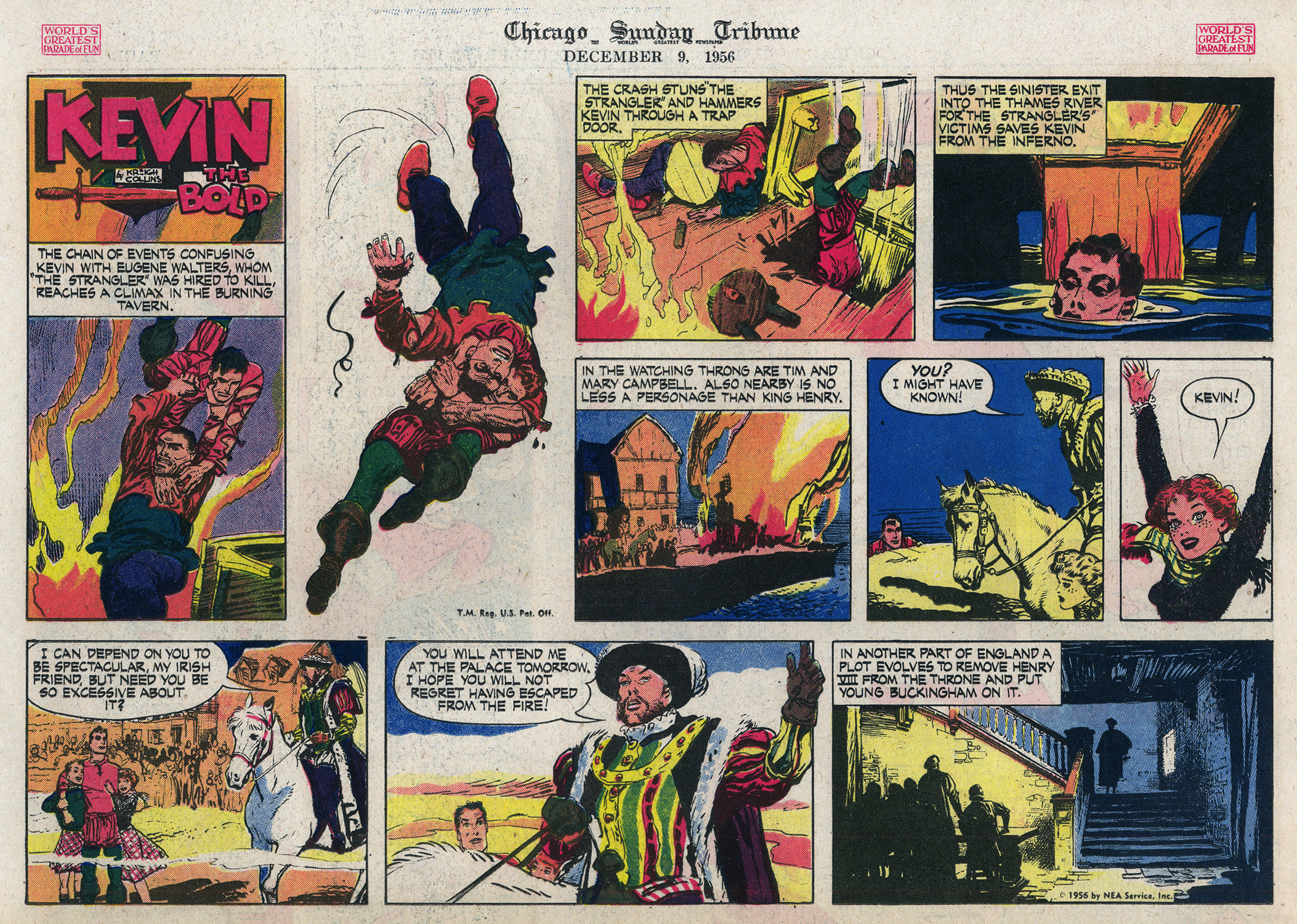
The sequence ends dramatically—and with a unique layout. Instead of a single, double-decked splash panel, Collins includes two, the second being a silhouette. Having King Henry arrive on the scene of the conflagration at the moment of climax is a bit contrived, but there is no time to be wasted as he introduces Kevin’s next adventure.
Much happens in the following three episodes—I’ll let the action speak for itself.
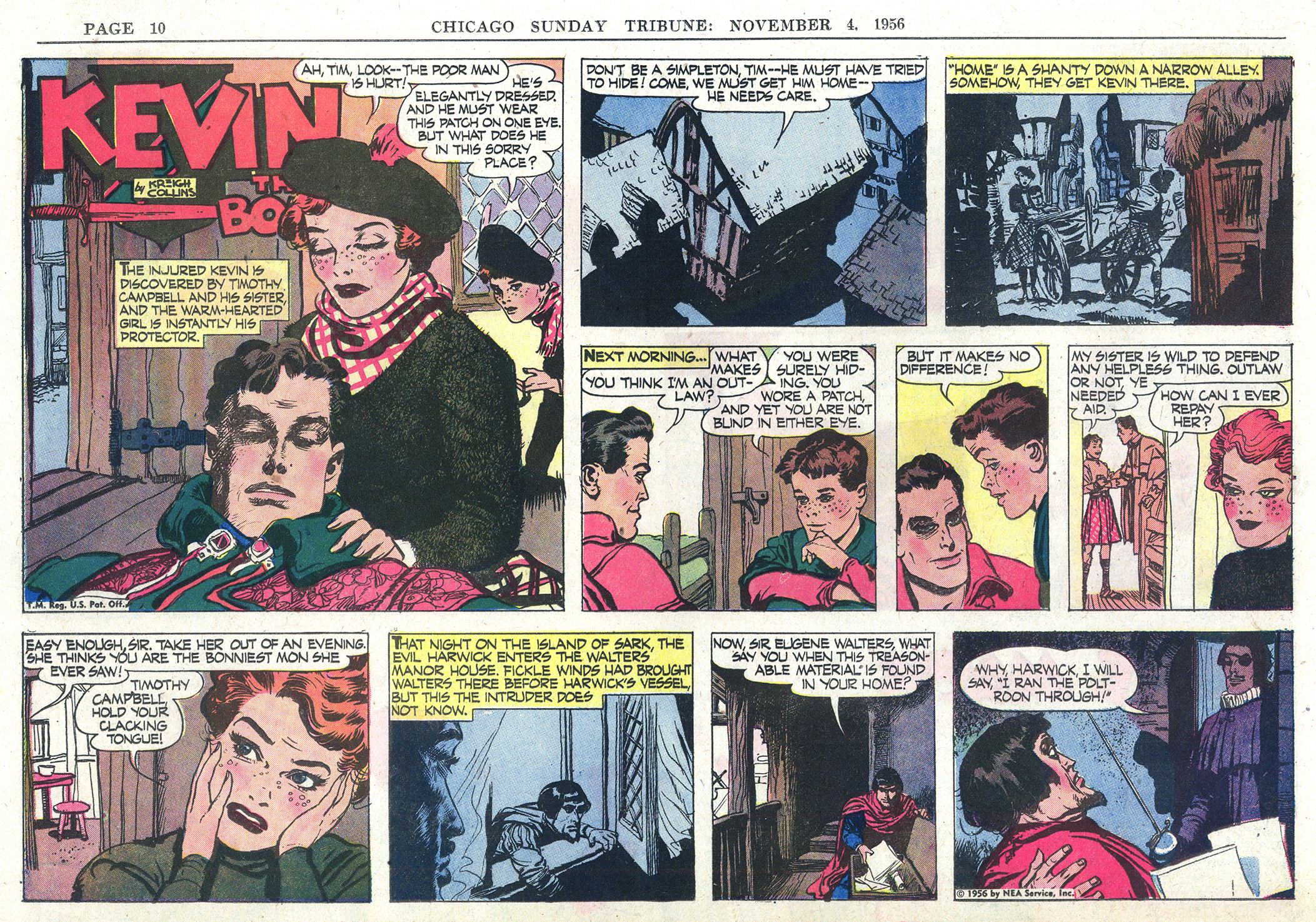
If “autodefenestration” wasn’t a word, it is one now! As is typical of the strip, Harwick’s death comes not as a result of his leap, but due to off-stage misadventure.
Kevin tries to put his foot down, but Mary convinces him otherwise—and who could resist a lass such as shown in the throwaway panel?
Little does Kevin know that his unexplained black eye will lead to worse circumstances.
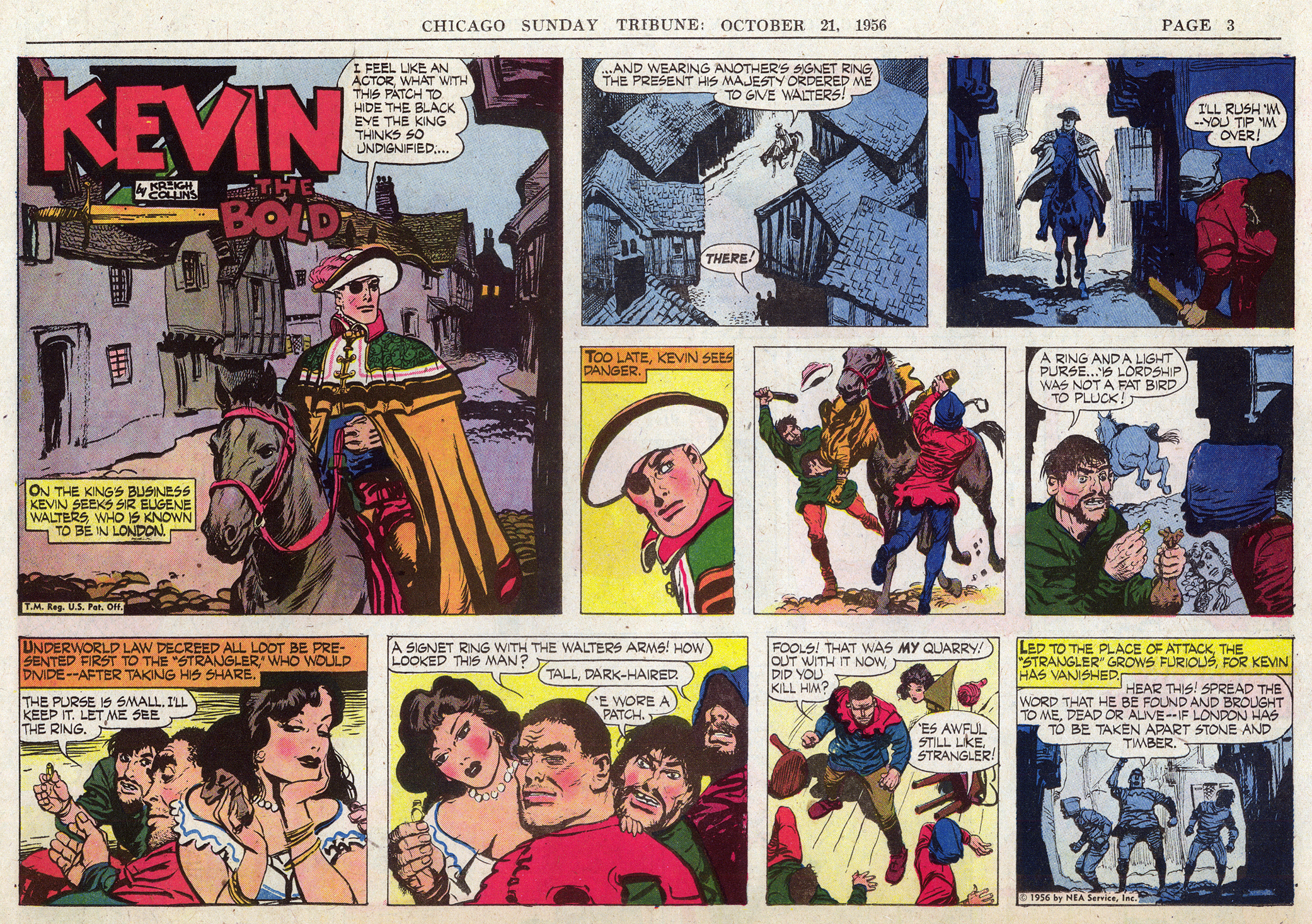
As far as this particular story arc goes, one definite bonus is the fact that I have Chicago Tribune examples of each episode. While the paper was long past its heyday of incredible color separations and reproduction—some “Kevin the Bold” episodes from the early 1950s are simply stunning—the paper still created its own printing plates, which led to higher-quality final results.
Comparing an episode from the Trib with one from the Florida Times-Union could be seen as comparing apples to oranges, with the latter’s output often being rather magenta-saturated, a close comparison between the two shows that the Tribune did indeed use different printing plates than those offered by NEA Services to its regular subscribing newspapers. In some panels it is hard to determine if the difference was simply due to the flood of magenta ink and indifferent press operators, but in the Trib‘s splash panel, the lower portion of Kevin’s cloak clearly shows shades of both orange and red, while in the Times-Union version it’s all reddish orange.
It’s a shame that raven-haired Gertie has gotten mixed up with the Strangler, she’s generally my favorite part of any episode in which she appears!
Happy New Year! January 1 also marks Kreigh Collins’ birthday; he would have been 48 years old when the following story arc appeared. The first two episodes are beautifully illustrated, and show Kevin sailing past the Isle of Sark. As is the case with many of the plot lines in “Kevin,” I was inspired to look up where exactly this little island was located—and I became intrigued by the local talent at the Elephant and Castle.
The previous episode’s splash panel is lovely, but it is no match for the one that followed. The third panel is also masterfully executed—the Strangler is a menacing villain straight from central casting.



























 Kreigh’s Comics