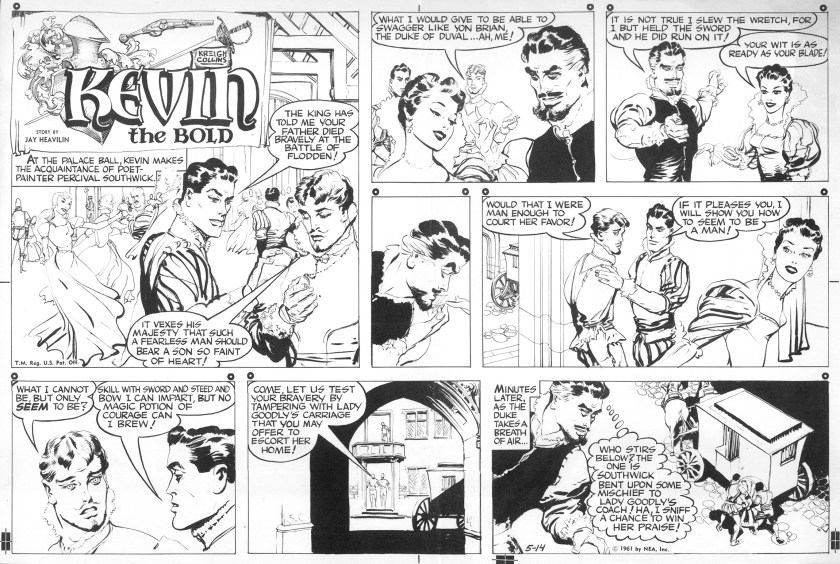
With his vast experience dealing with both dastards and the downtrodden, Kevin is a quick judge of character. Upon meeting meek Percival Southwick, he must have sensed something in him—and he must have seen something in the character of the Duke of Duval, as well. Kevin decides to make a man of Percival, which he’d done before—a decade earlier with Prince Rupert. Therein lies my beef with new writer Jay Heavilin—in his first credited story, he’s already rehashing old plot devices…
…Kevin is also back to playing matchmaker, but his clever plot is uncovered.
Kevin’s first lesson on manliness is interrupted, and things escalate quickly.
Here are the three episodes in color, as third-pages.
For more information on the career of Kreigh Collins, visit his page on Facebook.
As the battle intensifies and the zaniness builds, the story arc reaches its conclusion. Here, “having sport with cheeses” means knocking the fire brigade from the rigging.
The only way this could be better was if it was flaming cheese (a Detroit favorite).
An interesting detail in the April 23, 1961 episode above is how the strip’s logo is partially obscured by Grommet’s monstrous ship. By the next Sunday’s comic, the old logo will have disappeared, replaced by a new one, and accompanied by the byline, “Story by Jay Heavilin.” While this new chapter carries over a couple of characters from the one that preceded it, the tone of the comic strip’s narrative changes.
After begging her father to accompany Kevin to England, Elsa and her mother set off on the journey across the North Sea with him. Allowing his wife and daughter to make the crossing in Kevin’s small boat—Kevin obviously made quite an impression Mr. Van Loo.
Meanwhile, in London, King Henry meets young Percival Southwick, and quickly sizes him up.
The new logo was enlarged slightly for the May 7, 1961 episode, below, and looks great—its proportions work quite nicely with the amount of vertical space provided by a single tier of panels. A taller logo meant it took up more real estate horizontally, and apparently Collins didn’t like the tradeoff. As far as I can tell, the logo would always appear at the smaller size going forward.
Here are the three episodes in color, as third-pages.
For more information on the career of Kreigh Collins, visit his page on Facebook.
While the next two story arcs contain overlapping characters, there is a pretty significant difference between them. The first sequence has only Kreigh Collins’ byline, whereas the one that follows is the first to carry the additional credit, “Story by Jay Heavilin.”
Sadly, I do not have color half pages for any of the comics, third-page versions seem most common for “Kevin the Bold” at this point in its run. Instead, I will post black and white half-page versions (usually syndicate proofs, with occasional BW downloads from newspapers.com), and supplement them with color third-page versions at the end.
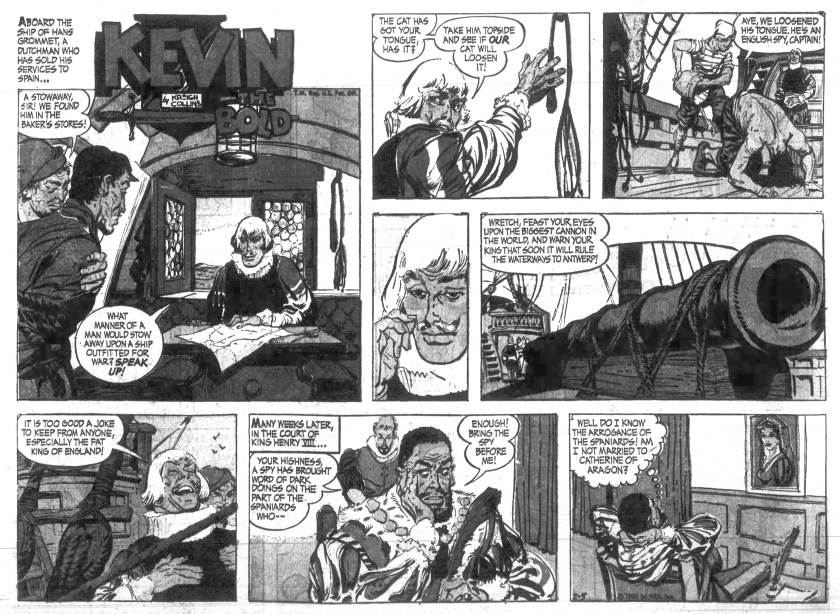
The January 29, 1961 episode, below, is the transitionary episode at the end of one of my favorite sequences, featuring “Hercules.” That story arc ran previously. This sequence references the then-current competition between Spain and England for trade—here, a fearsome weapon is being imported from Constantinople by a traitorous Dutch mercenary, which the Spaniards hope will give them the upper hand.
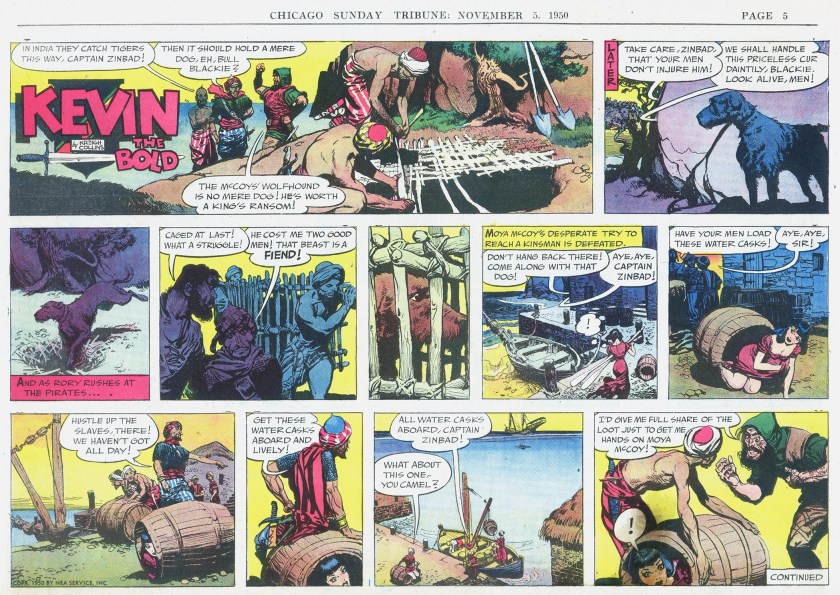
The English spy has stowed away by climbing into an empty barrel, a plot device Collins used by Moya McCoy in his strip’s opening sequence.
The next two episodes are ones for which I don’t have great examples. (And that hiding in the barrel ploy never seems to work).
Hans Grommet is certainly arrogant, and his cockiness is decidedly a flaw. As the action shifts to the Netherlands, new characters are introduced.
That’s a fine spy glass!
I don’t know who added the color—likely one of Kreigh’s grandchildren. I have vague memories of hanging out in my grandfather’s studio, after he had died, reading through stacks of printed comics, but what I remember are the NEA Daily and Sunday Comics publications, not proofs like the one festooned with watercolors above. At this point, my family lived in western New York state, and our trips to Ada, Michigan were sporadic. So I’m guessing either of my cousins Josh or Karen were serving as colorist. No matter, I’ve heard these adornments lend the episodes a certain charm.
Here are the three episodes in color, as third-pages.
For more information on the career of Kreigh Collins, visit his page on Facebook.
This 60-year-old comic section was a souvenir from my grandparents’ southern journey aboard their schooner, Heather. In late 1959, they left their west Michigan home port on Lake Macatawa and set sail for Chicago. The Illinois River led to the Mississippi, and eventually to Florida’s west coast—a favorite wintertime destination (In the ’40s, the Collins clan often rented on Anna Maria Island). Besides his wife, Teddy, Kreigh’s only crew was his eight-year old twins, Kevin and Glen. Heather and her crew wouldn’t return to Michigan until August, 1960.
The Fort Meyers News-Press‘ Sunday edition included an eight-page comic section, led off by Milt Caniff’s popular strip Terry and the Pirates, handled since 1946 by George Wunder. Joining Terry on page one was Mary Worth, written by Allen Saunders and illustrated by Ken Ernst.
Scanning the outside pages of an old comic section is relatively easy with a tabloid scanner, but getting the inside pages presents more of a challenge. Despite having already shrunk from their enormous dimensions from earlier in the 20th century, these pages still measure 29″ x 21.5″ when unfolded. Pages 2-3 feature largely feature run-of-the-mill NEA titles: Boots, by Edgar Martin; Dick Turner’s Carnival; Roy Crane’s Captain Easy (handled on Sundays by Leslie Turner); Vic Flint (written by Jay Heavilin and drawn by Dean Miller); and Our Boarding House, likely illustrated by Bill Freyse. The only non-NEA comic on this first inside spread was Warner Bros.’ Bugs Bunny.
From my perspective, things improve on page 4. There are two contrasting half-page features, Chris Welkin, Planeteer, by Art Sansom and Russ Winterbotham, and Kreigh Collins’ Kevin the Bold. (This episode is one midway through a tale of buried treasure and tyranny, with the villain being Count Stabb). Page 5 has two King Features Syndicate titles (Chic Young’s Blondie and Mort Walker’s Beetle Bailey) and another by McNaught (JoePalooka, likely handled at this point by Tony DiPreta and Morris Weiss).
The final inside spread has a raft of third-page NEA comics, (Pricilla’s Pop by Al Vermeer, Tom Trick by Dale, Out Our Way by J.R. Williams, Rolfe’s Brenda Breeze, Merrill Blossar’s Freckles and His Friends and Walt Scott’s The Little People.
The back page of the comic section had two more McNaught titles (Lank Leonard’s Mickey Finn and McEvoy and Stribel’s Dixie Dugan), as well as the the NEA’s popular feature Alley Oop, by V.T. Hamlin.
By far, most of my comics are single sheets cut from sections, but I’m glad that my grandparents kept this section intact. (Maybe they forgot to bring scissors when they went south).
Happy New Year! (January 1 was Kreigh Collins’ 112th birthday).
For more information on the career of Kreigh Collins, visit his page on Facebook.
As they sailed away from the New World, Kevin began telling Saigen the story of Robin Hood. While having an adult narrate a story to a youth was a familiar trope for Collins, what was different was the appearance of the comic strip’s logo. A longbow and a quiver of arrows replaced the usual rapier and pistol, Robin Hood’s hat rested on the suit of armor’s helmet, and a chapter heading of sorts, “A Story of Robin Hood” was inscribed at the top.
The October 17, 1965 episode serves as an introduction for the chapter’s new characters.
The only previous time the comic strip’s logo changed was on April 23, 1961. Ten years into its run, the familiar blocky KEVIN logo adorned with a claymore and shield was replaced by a more elegant version featuring new weapons and an uncial-style font more appropriate for an Irishman. In fact, in its final appearance in print, the old logo is half-obscured by an enormous Spanish galleon, a portent of its imminent departure. The new logo coincided with the onset of Jay Heavilin‘s 13-month stint as writer for the comic strip.
Yes, those are balls of cheese being used for ammunition!
A year later, the logo was modified again, this time just by adding the new chapter’s title, “Story of the Norman Conquest.” While the historical timeline in “Kevin the Bold” can be a bit difficult to follow—the first episode takes place at the end of the 15th century while the final one is dated 1668, about 175 years later—setting the action during the Norman Invasion of Ireland (c. 1170) required a different approach. Here Kevin’s ancestor (also named Kevin) is featured. Making this flashback less confusing to casual readers, the two Kevins appear identical, except for the ancestor being blond.
Another point of departure is the ancestor’s willingness to chase after women, something later-day Kevin eschews. However, the episode that ran two weeks later portrays the two Kevins as essentially the same character.
The final time the comic strip’s logo was altered was for one its last sequences, “A True Story of Captain John Smith.” Following this chapter, only four more appeared before the comic strip morphed into Kreigh Collins’ final NEA feature, “Up Anchor!”
Oddly, the July 16 episode introducing the sequence is not labelled as “A True Story of Captain John Smith,” but the 14 comics that follow are. Perhaps adding the title was a late decision made by the NEA, and the fact that it is typeset, rather than hand-lettered, lends credence to the theory.
Another familiar trope is the damselle in distress! Not that I’m complaining, mind you.
Nearly all the original art for the final three years of KEVIN THE BOLD is found in a collection at Syracuse University. The July 23 episode is an exception. (I found this image online).
How Many Different Logos Were Featured in MITZI McCOY?
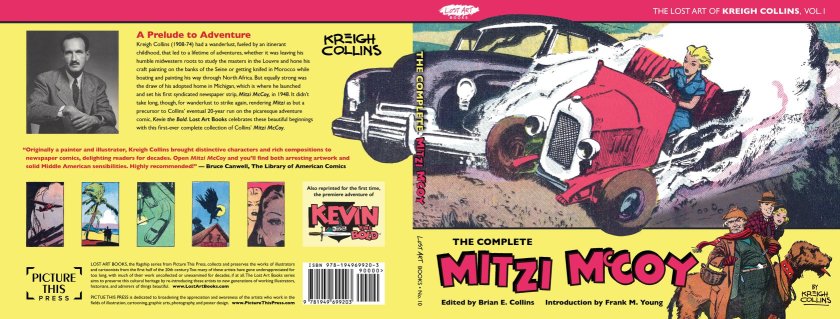
That question and more can be answered by picking up a copy of “The Lost Art of Kreigh Collins, Vol. 1: The Complete Mitzi McCoy.” It features a wonderful introductory essay by Eisner Award-winner Frank M. Young and is available here.
For more information on the career of Kreigh Collins, visit his page on Facebook.
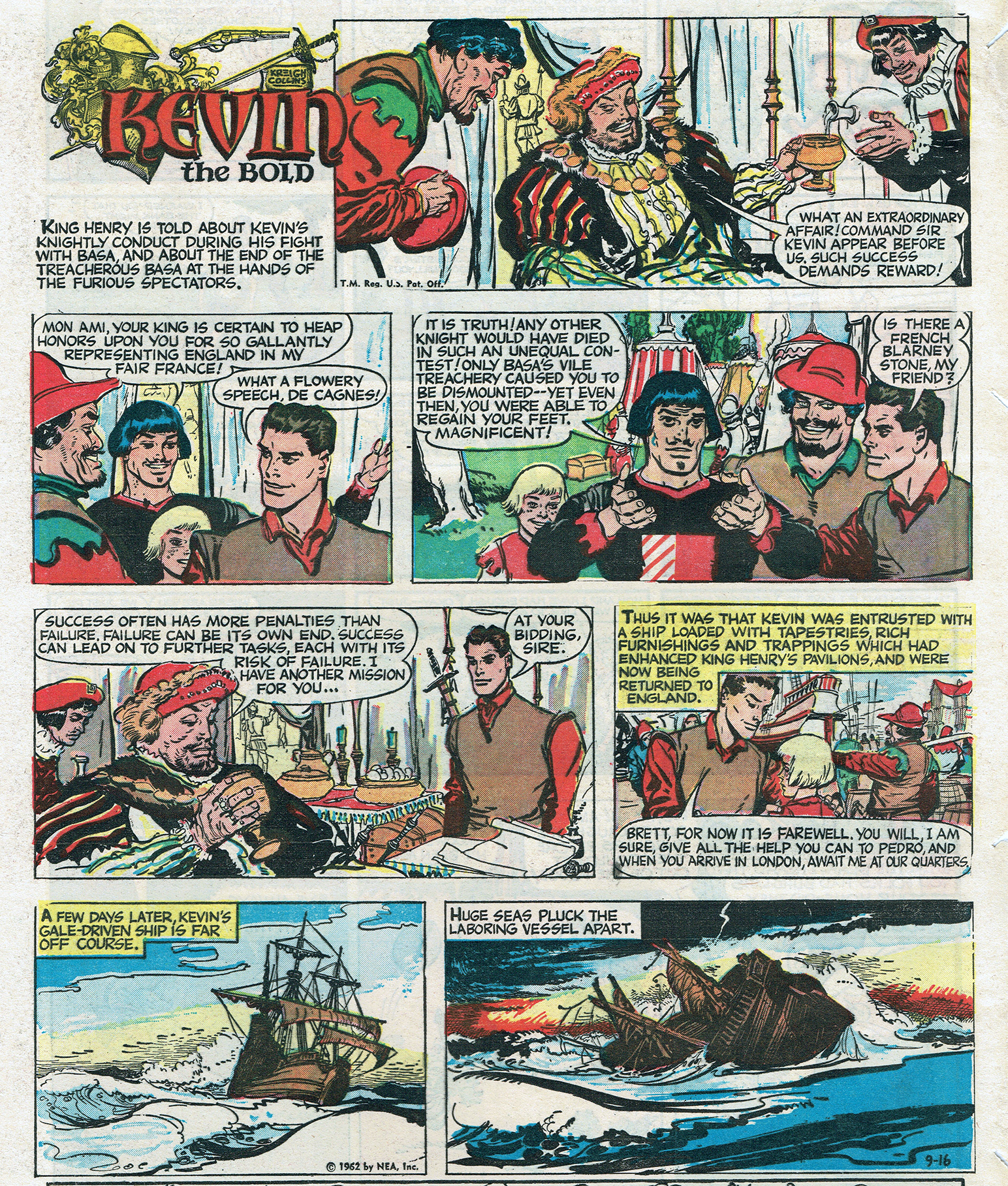
Kevin’s tournament skills paid off in the first round of the joust, but by taking the high moral ground he is setting himself up for possible failure.
Kevin’s virtue is matched by Basa’s treachery, but while Kevin is saved by Hugo’s unexpected confession, Basa meets his end at the hands of the angry mob.
As the story of the Field of the Cloth of Gold ends, another adventure begins.
The Complete Mitzi McCoy
To read the complete run of “Mitzi McCoy” comics, The Lost Art of Kreigh Collins, Vol. 1: The Complete Mitzi McCoy can be found here; it’s still available at its pre-order price of $24.95.
For more information on the career of Kreigh Collins, visit his page on Facebook.
The past six weeks’ Sunday comics set the scene in a historical context, taking place during the Field of the Cloth of Gold, and now the action settles into a more local, intimate setting.
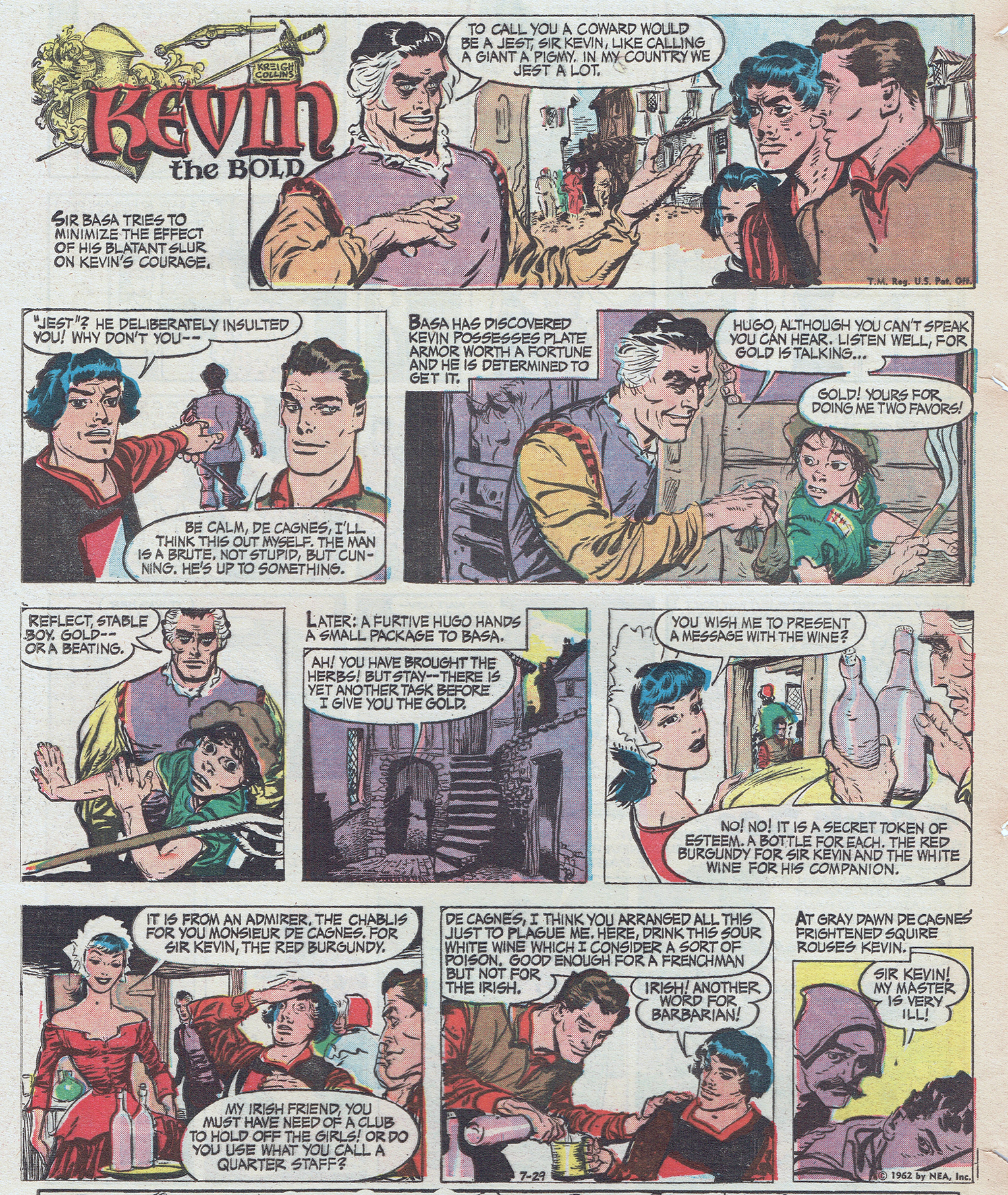
Surely there could be no harm in offering to stage a joust for an enthusiastic, convalescent child.
Having demonstrated his brute strength, Basa also shows he is a louse, and worse.
The Complete Mitzi McCoy
To read the complete run of “Mitzi McCoy” comics, The Lost Art of Kreigh Collins, Vol. 1: The Complete Mitzi McCoy can be found here; it’s still available at its pre-order price of $24.95.
For more information on the career of Kreigh Collins, visit his page on Facebook.
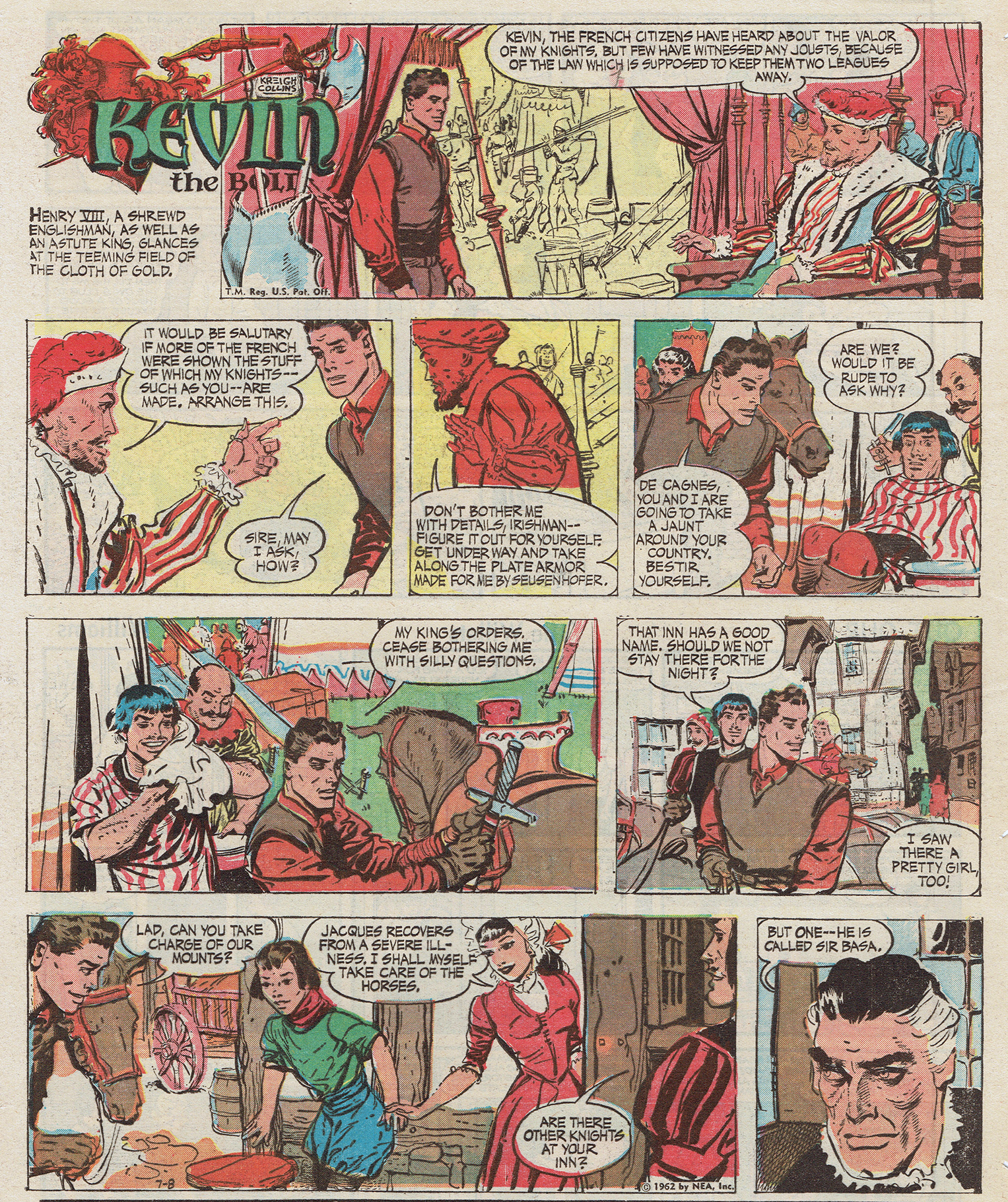
At the summit arranged by Cardinal Thomas Wolsey, King Francis I of France and King Henry VIII of England tried to outshine the other, with dazzling tents and clothes, huge feasts, music, jousting and games. The days were taken up with tournaments, in which both kings took part.
After the joust, Kevin was gracious in victory over his friend De Cagnes — but not everyone was so pleased, as the sourpuss Sir Basa is introduced.
“The Field of the Cloth of Gold” was the first sequence written by Kreigh Collins after a 13-month stretch of episodes written by Jay Heavilin. In fact, the episode above contains a line (paraphrased) that originally appeared in “Kevin the Bold” a decade earlier.
Returning to our current sequence, Kevin has the misfortune of staying at the same inn as his detractor, and he also meets a mute stableboy.
For more information on the career of Kreigh Collins, visit his page on Facebook.
Once I started collecting my grandfather’s comics, I came up with two goals: publish a book and collect them all.
Kreighs’ comics appeared in newspapers every Sunday from November 7, 1948 until February 27, 1972, about three and a half decades. Adding it all up—the 23 complete years, the two partial years, and the four times leap years resulted in a year having 53 Sundays (1950, 1956, 1961, 1967)—amounts to 1,217 individual episodes. (Or is it 1,218? Can someone check my math?) However many there are, it’s easy to see why I chose to publish a book first.
Admittedly, I had a great head start with so many of the episodes having been given to me by my uncle. But while my grandfather saved a lot of stuff, I do not have examples of all of his individual comic strips. Since I have all 99 “Mitzi McCoy” episodes and less than half of the “Up Anchor!” comics, what I’m focusing on primarily are the missing “Kevin the Bold” episodes.
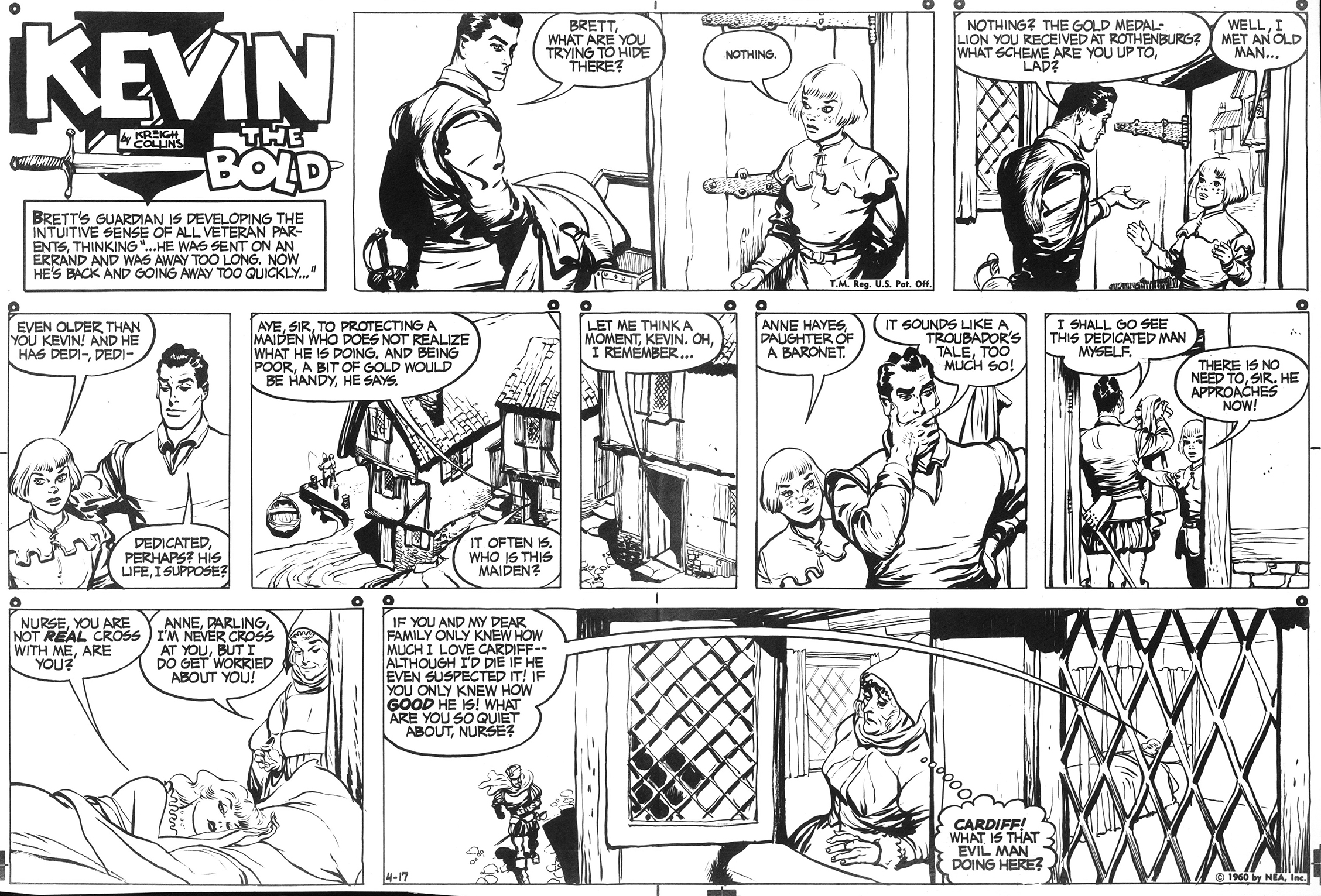
Of the 945 or so examples of “Kevin,” there are 45 which I’ve never seen in any form. The first hole in my collection appears about a decade into its run: April 24, 1960.
What happens next? I’d love to know!
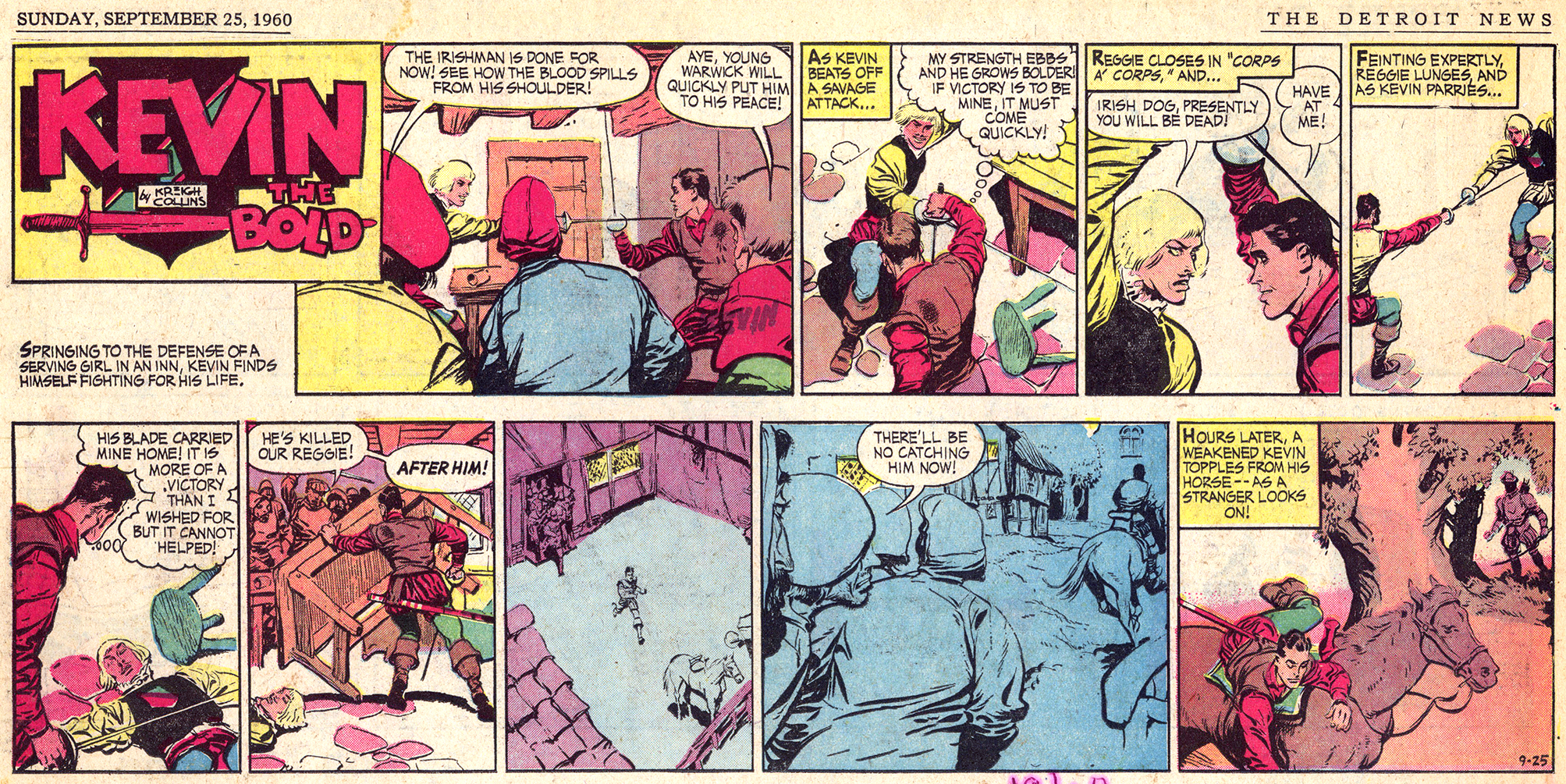
A few months later, the October 2, 1960 episode draws a blank. It follows the one shown below, in a tale of two sons—one good and the other bad. Through 1958, I have full-sized (half-page or tabloid) versions of just about every comic, but by 1960, many of my comics are one-third page versions (sigh). But at least these allow the narrative to continue.
Oh no, Kevin appears mortally wounded! Will he survive?
The next gap in the chronology is found in the first Jay Heavilin-penned sequence (June 25, 1961).
Lady Goodly? Lady Godiva could be featured on June 25 for all I know.
You know what’s worse than a missing episode? Two consecutive missing episodes! (September 10 and 17, 1961).
At least the September 3 episode introduced me to the word, “Taradiddle.” I can only imagine the vocabulary featured over the next two weeks.
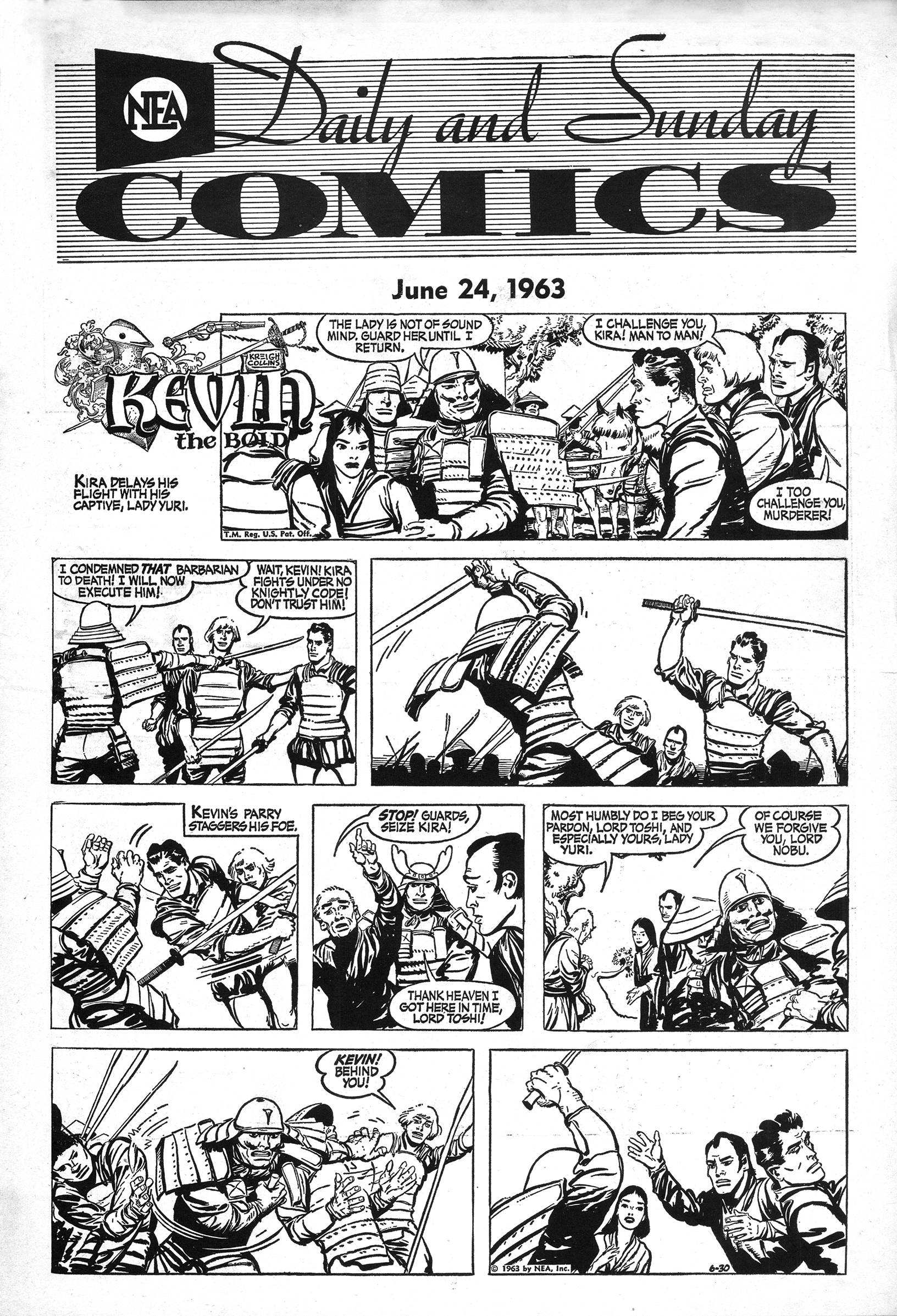
Perhaps even more interesting to me are a couple elusive mid-1963 episodes—June 23, 1963 and July 7, 1963. Kevin has made it all the way to Japan. I wish I had the entire sequence of comics to share that adventure with you. Here is part of it—the two comics that precede the two missing ones.
I’m going to see if I can verify that translation in the throwaway panel.
Here are the dates of the comics listed above: April 24, 1960 October 2, 1960 June 25, 1961 September 10, 1951 September 17, 1961 June 23, 1963 July 7, 1963
For the last three years of “Kevin the Bold,” I need quite a few: January 2 & 16, 1966 May 29, 1966 June 26, 1966 July 10, 17 & 24, 1966 August 21 & 28, 1966 September 4 & 11, 1966 October 2 & 9, 1966 December 25, 1966
January 29, 1967 February 5, 12 & 19, 1967 March 5, 12, 19 & 26, 1967 April 9, 23 & 30, 1967 May 21 & 28, 2967 June 11, 1967 August 27, 2967 October 22, 1967 November 12 & 19, 1967
April 7, 14, 21 & 18, 1968 May 5, 1968 September 15, 1968
Do you have any of these in your collection? I’m more than willing to trade scans. Please leave a message on my blog or contact me directly at brianedwardcollins1(at)gmail.com
Thank you very much.
The Complete Mitzi McCoy
To read the complete run of “Mitzi McCoy” comics, The Lost Art of Kreigh Collins, Vol. 1: The Complete Mitzi McCoy can be found here; it’s still available at its pre-order price of $24.95.
For more information on the career of Kreigh Collins, visit his page on Facebook.
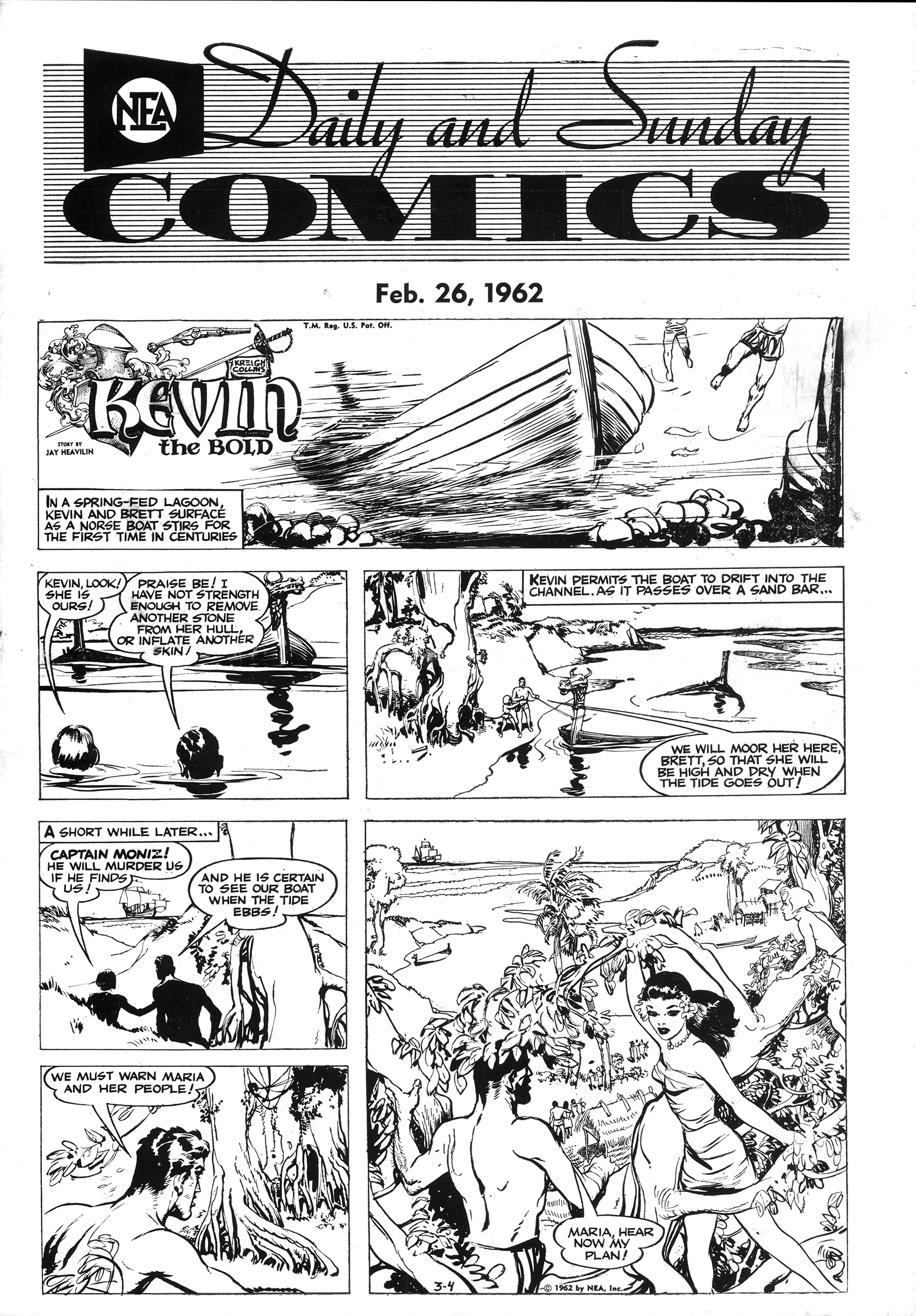
A nice feat of engineering reveals what Kevin and Brett hope will be their ticket off the island.
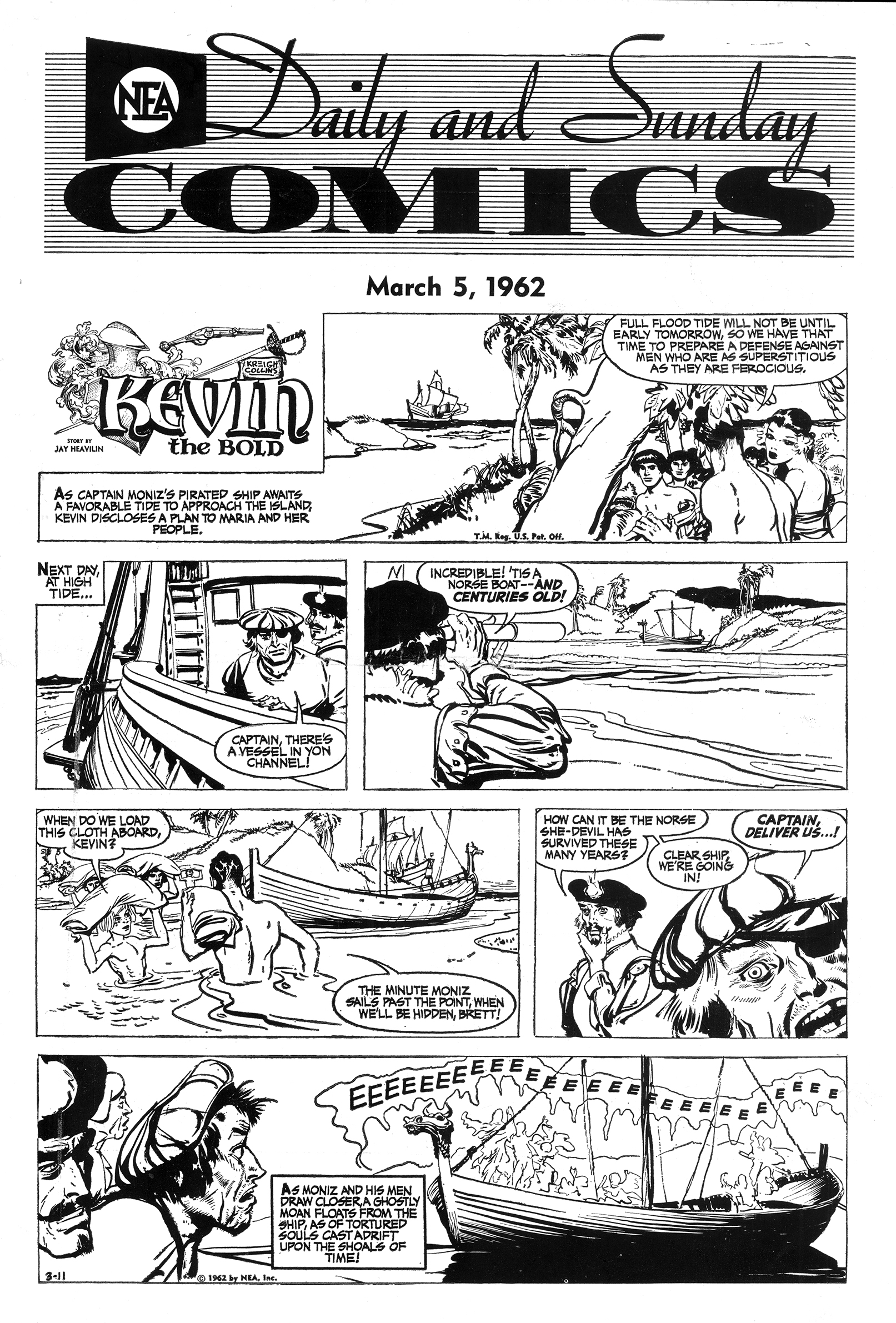
Luckily for Kevin and Brett, the islanders had a nice supply of white cloth for their ruse.
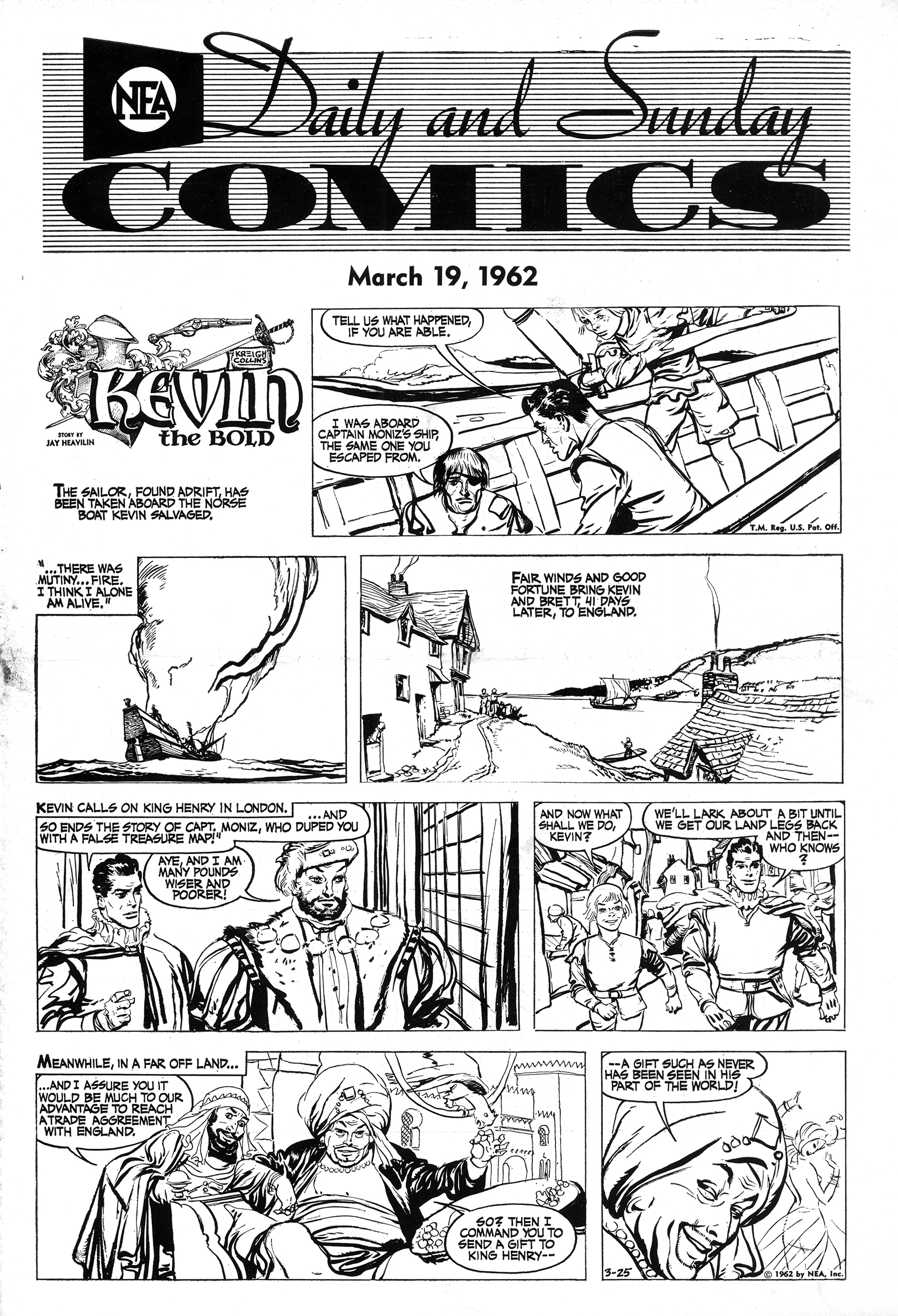
Most gratefully, Maria offers Kevin a kiss in lieu of marriage. Perhaps more than one, as Kevin and Brett don’t disembark until several days later.
Finding a drowning sailor provides an interesting denouement as the sequence transitions swiftly.
Perhaps the reason for the abrupt change is that the next sequence would be Jay Heavilin’s last — his 13-month run as the writer for “Kevin the Bold” was ending.
I’m not sure how long delivery takes, but pre-sale orders of the book The Lost Art of Kreigh Collins, Vol. 1: The Complete Mitzi McCoy have started to be shipped. Apologies for the delay. Presently, I am trying to find out what arrangements can be made for the publisher to fulfill overseas orders. The book is available at the publisher’s website.
For more information on the career of Kreigh Collins, visit his page on Facebook.

















 Kreigh’s Comics