As more is revealed about the counterfeiter gang—Zoe, Gar, and Greenbax—the darker the chapter becomes.
Despite his strong reaction to being blindsided by the thuggish Gar—including a two-fer knockout punch—Tim Graham gets blindsided a second time by the blackjack-wielding Zoe.
Clearly the brains behind their operation, Zoe is also the gang’s secret weapon, with her arresting appearance. The cold-hearted Jezebel does show a bit of a conscience in a beautiful throwaway panel, but she immediately reverts to form, dosing Tim and Stub with barbiturates.
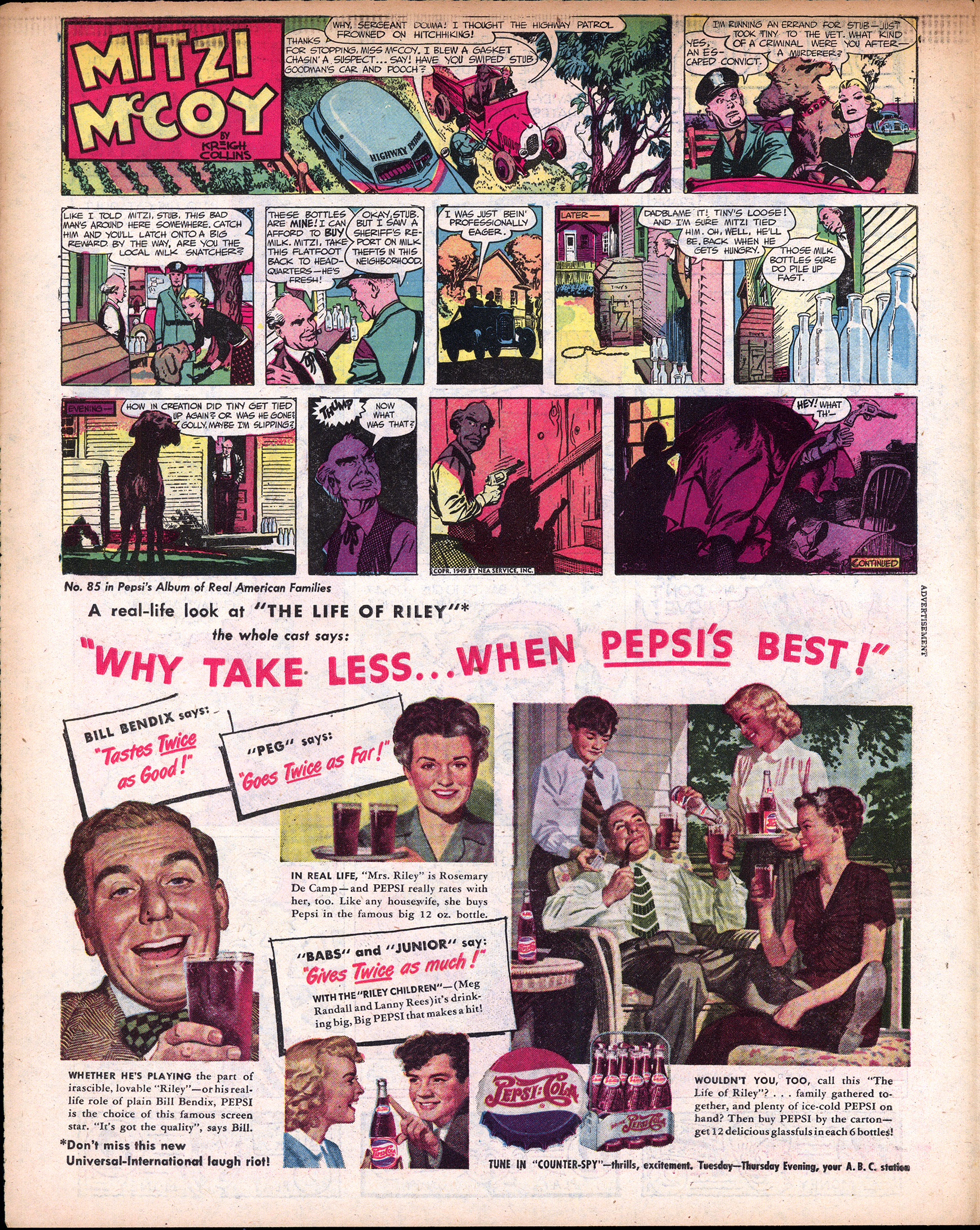
Sgt. Douma was a recurring character. His previous appearance was about a year earlier—shown in this half-tabloid from the New York Sunday Mirror. (I love those old advertisements!)
Knowing her car’s capabilities, Mitzi convinces the skeptical Sgt. Douma to take the wheel of Stub’s hotrod.
MITZI McCOY existed for less than two years, only enough time for 11 distinct chapters. The following story arc was the second-to-last chapter, and is one of my favorites.
All of the following episodes are taken from the Pittsburgh Press, which featured MITZI as the lead comic in its collection of Sunday funnies.
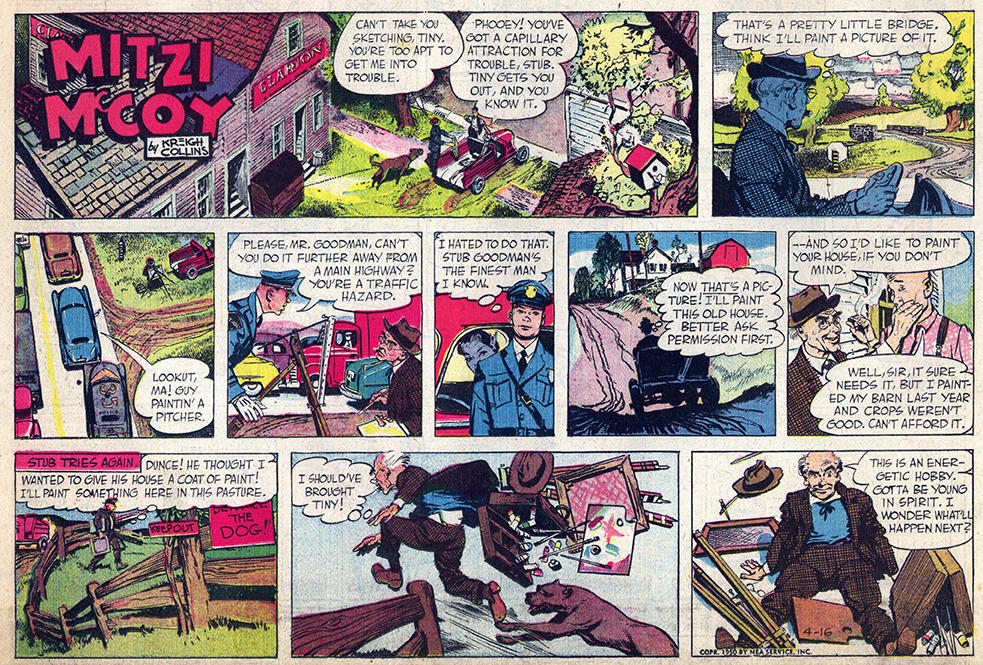
It’s a light-hearted affair, wrapping up the previous chapter. It features some slang I had to look up (“hay burner” = horse), and references the Winston Churchill’s painting hobby (a contemporary development; this episode appeared less than five years after the end of WWII).
Stub soon learns that landscape painting is a young man’s game—something that Kreigh Collins had discovered himself. He was 42 years old at this point, and had been working professionally for over 20 years. During the first fifteen years of hios career, he worked primarily as a painter. He started with landscapes, learning from the esteemed Michigan painter Matthias Alten. Later, in the Depression years, he produced numerous large murals as well as portraits, but his painting career was cut short by a shoulder injury suffered in the mid-1930s. His recovery led to his new focus on pen and ink illustration, which eventually led to his gig as a syndicated Sunday comic strip artist.
I haven’t seen any evidence of my grandfather having ever taken up etching, but for the purpose of the storyline, it makes sense for Stub to take up something “easier” than landscape painting.
While doing research for my MITZI McCOY book, I learned that Collins based Mitzi’s appearance on Rita Hayworth… I wonder who his inspiration was for his new femme fatale (whose name, Zoe, would be revealed in a later episode).
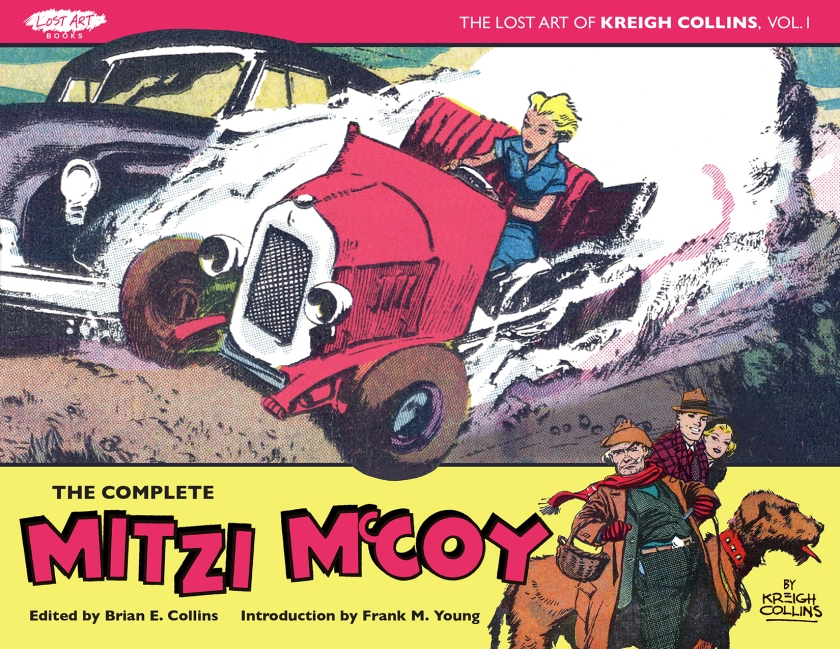
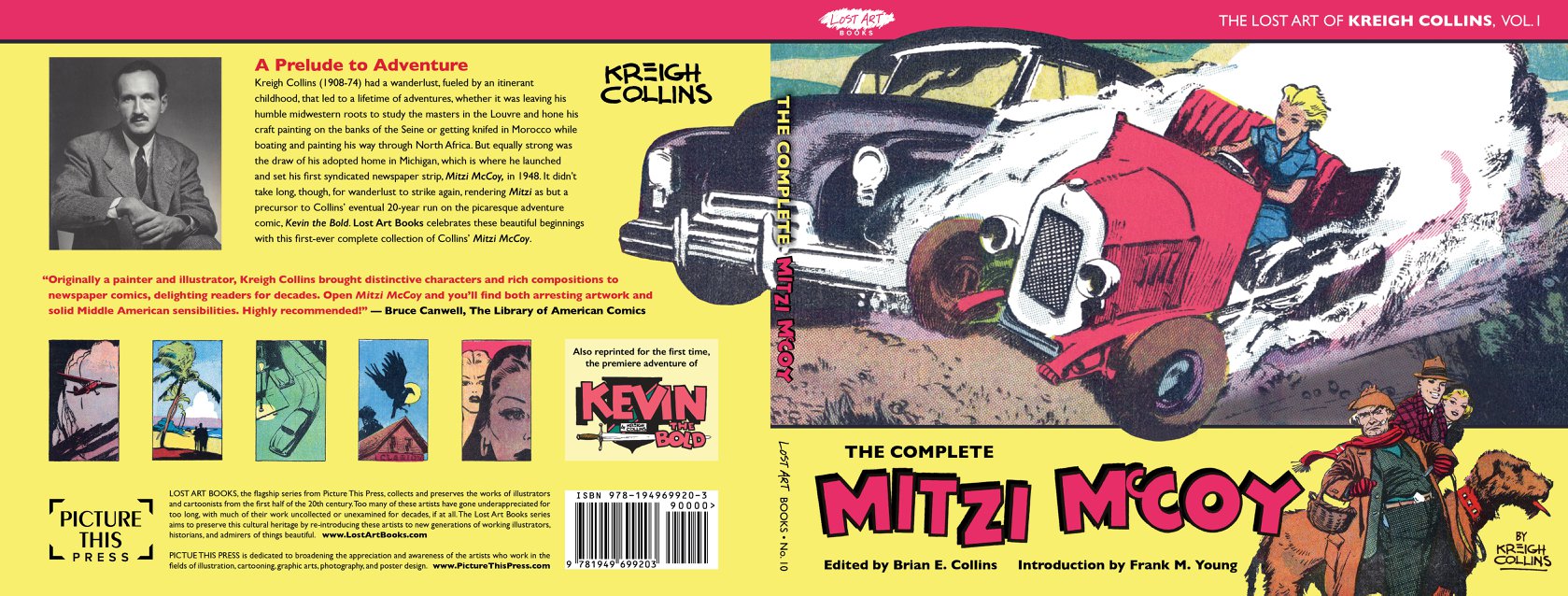
“The Lost Art of Kreigh Collins, the Complete Mitzi McCoy” features the entire run of Kreigh Collins’ first NEA feature.
MITZI McCOY ran from 1948 to 1950 and showcased Kreigh Collins’ skill as an illustrator and storyteller. His picturesque landscapes, lovely character designs, and thrilling action sequences brimmed with detail and charm, and the strip’s ensemble cast rotated in and out of the spotlight taking turns as protagonists in the dozen story arcs collected in this volume. The last story collected in “The Complete Mitzi McCoy” is the narrative bridge that set Collins and his characters off on a new journey, beautifully told for the next couple of decades in the much-lauded adventure strip Kevin the Bold.
The collection includes an introduction by Eisner Award-winning author Frank M. Young, an Afterward by Ithaca College’s Ed Catto, and previously unpublished artwork and photos. Longtime comics artist Butch Guice also provides a new pin-up of the character Mitzi McCoy.
The book is available for $30. For domestic shipping, add $4; for international orders, please add $25 to cover first class shipping. To place an order, leave a comment below or email me at BrianEdwardCollins1[at]gmail.com, and I will give you PayPal or Venmo information. Thank you!
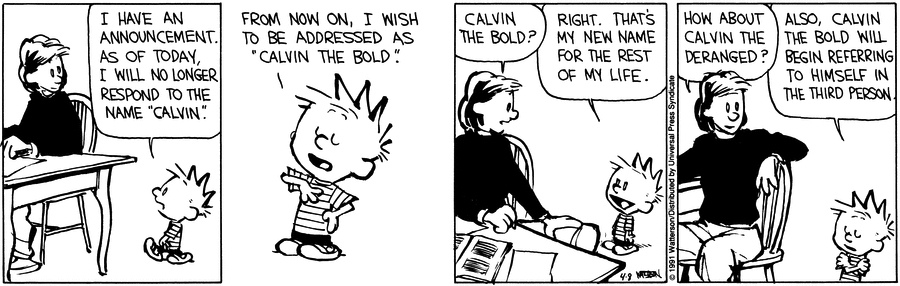
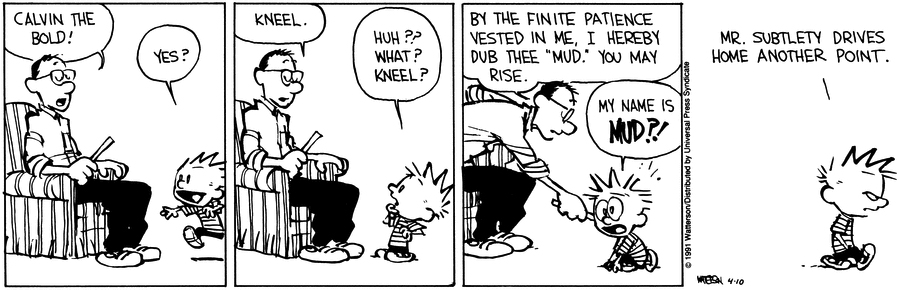
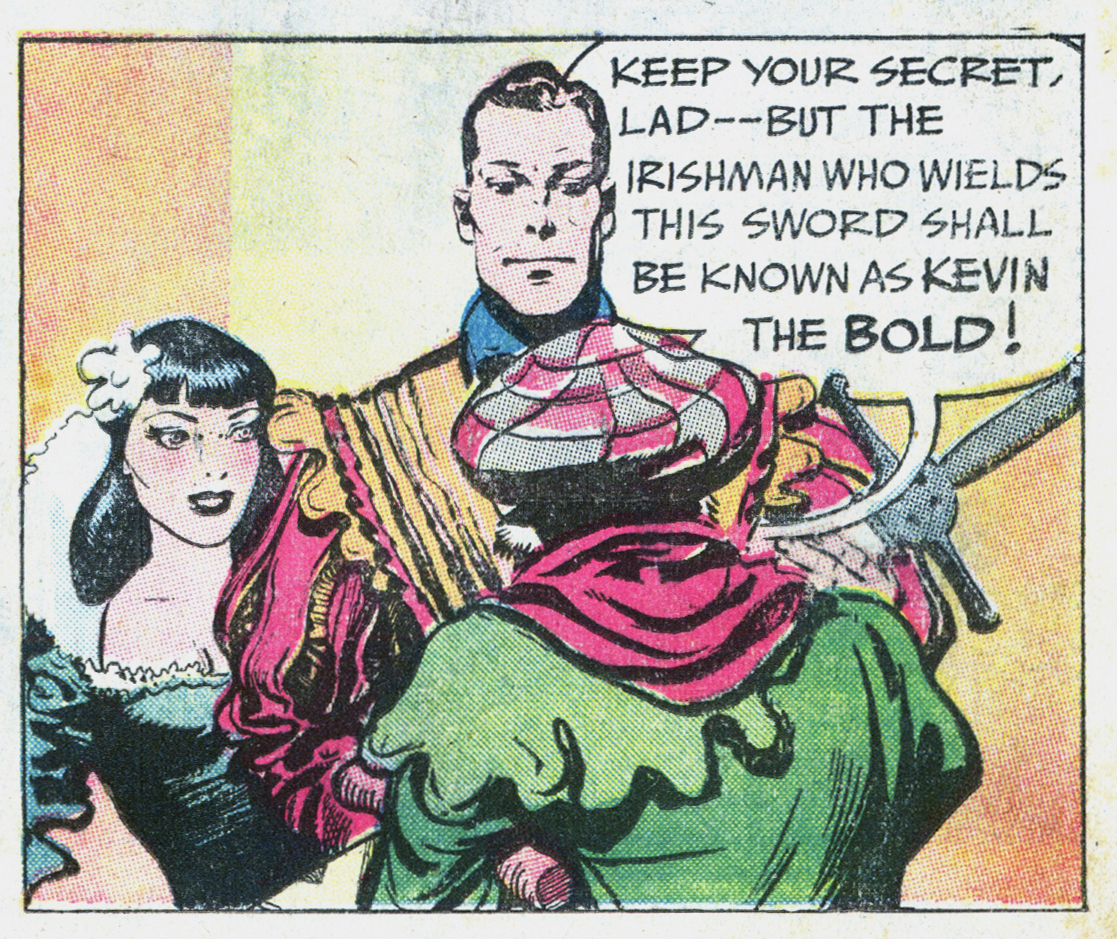
I think pretty much everyone is a fan of CALVIN AND HOBBES. Even folks who don’t like comics probably like Bill Watterson‘s amazing creation. But is it possible that Watterson was a fan of KEVIN THE BOLD?
In the spring of 1991, Calvin assumed a new identity.
Calvin the Bold! Though it caused befuddlement in Calvin’s universe, the name sure rings a bell for me!
CALVIN AND HOBBES ran in 2,000 newspapers. To have been the (likely) inspiration for Watterson is quite an honor. KEVIN THE BOLD had been out of print for decades.
Would his new identity last? That would be so cool.
Well, yes, but for only three days (April 8–10, 1991). Besides, it’s bad form to give yourself a nickname. In polite society, sobriquets should be bestowed by others.
This final installment of this story arc with Leonardo Davinci’s return features another tabloid I received from my late friend Thomas.
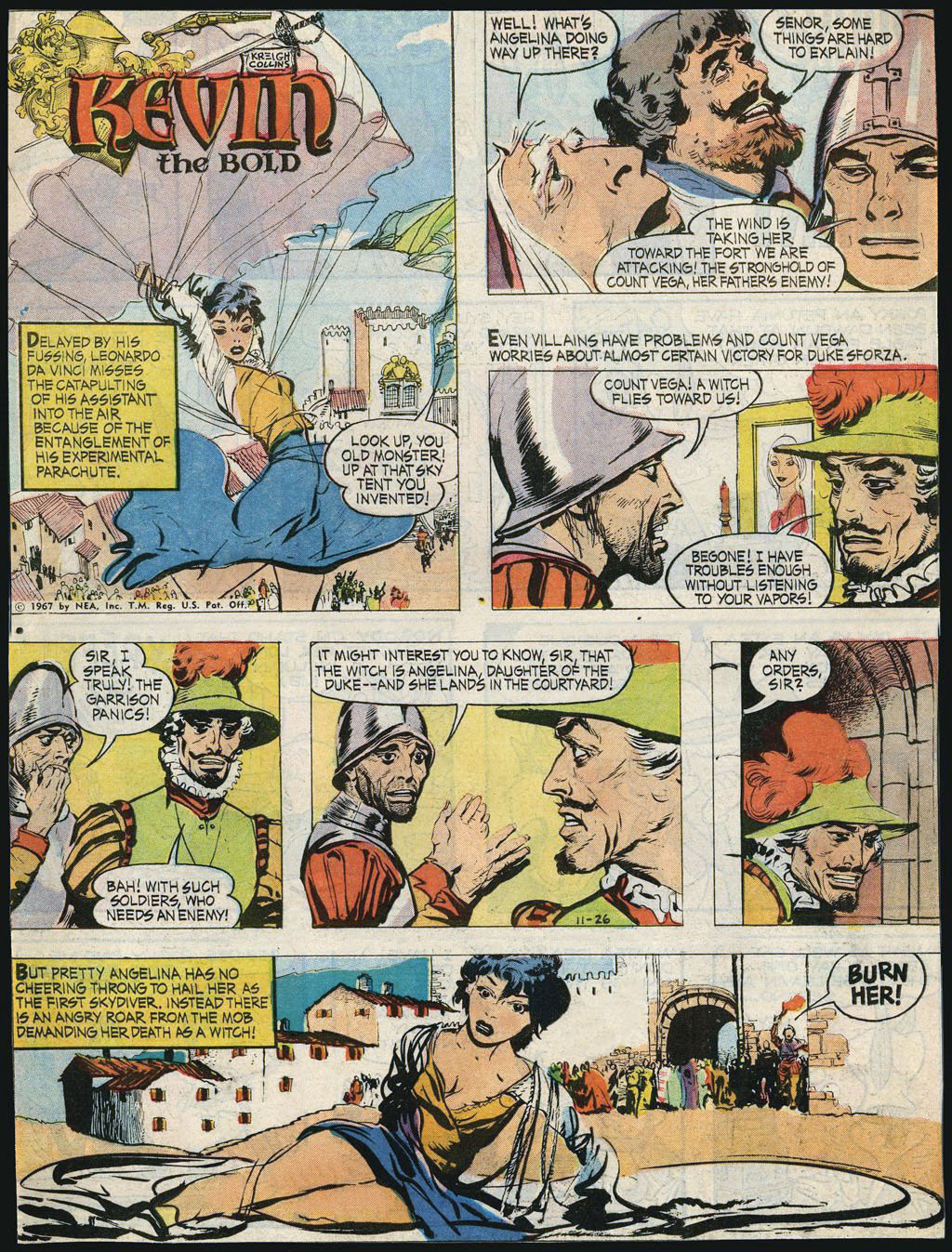
Seeing a tabloid example of a late-period KEVIN THE BOLD, remember that when the episode is run as a third-page, the entire fourth tier is deleted—such a giant throwaway panel which eliminated the need for Collins’ original artwork to be severely cropped (as shown in the final episode at bottom).
Leonardo’s “moveable house of armor” goes into action in an episode pieced together from a third-page and a black and white half-page. Reading it closely, I wish that this had been timed to coincide with Major League Baseball’s (semi-) recent Opening Day (it was four weeks ago). Why?
Realizing that love is in the air, Count Vega’s demeanor suddenly changes. In the second panel, he quotes the Song of Soloman (which I hadn’t realized was considered an erotic poem until now—talk about missing the message!) I just knew it as the Biblical passage that former Detroit Tigers announcer (and Hall of Famer) Ernie Harwell would quote each year on Opening Day (“The Voice of the Turtle“). Go Tigers!
The action transitions to the South Sea Islands—a story of buried treasure. Only two more chapters of Kevin’s saga would follow!
The action continues with a couple black and white half pages. It’s too bad, because this chapter is pretty inspired, from start to finish.
I sense some foreshadowing… what could possibly be in store?
Following the two black and white episodes, a nice color tabloid example is just what the doctor ordered. It’s beautifully illustrated and the witty scripting was likely done by Collins, the Da Vinci enthusiast.
After discovering his blog, I was befriended by a prominent illustrator from Denver. In the post I came across, Thomas Haller Buchanan had featured a late period KEVIN THE BOLD episode that he’d clipped and saved as a teenager. After an email exchange in which I told him my plans to publish my grandfather’s work, Thomas mailed three tabloid episodes to me. He was the first long-distance comics friend I made as I began researching my grandfather; sadly, he passed away this past September. I am most grateful for his kindness and encouragement—and I can certainly understand the appeal these tabloids had to a fifteen-year-old art buff!
In the ninth chapter of “KEVIN THE BOLD,” Kreigh Collins introduced a character from the pages of history, Leonardo Da VInci. (Other real-life characters occasionally appeared in the comic strip—most notably, King Henry). Fifteen years later, in KEVIN’s 75th chapter, Leonardo reappeared.
Leonardo must have been a favorite of Collins. Only three more chapters would run before the strip morphed into UP ANCHOR!, and injecting Da Vinci into the continuation required a bit of flexibility in the timeline. (The previous chapter was about Captain John Smith, dating the action around 1604, while Leonardo Da Vinci died in 1519). So be it.
Kevin learns that that the Italian inventor is an Artist, Sculptor, Mechanic, and Naturalist—no wonder Collins squeezed Leonardo into the action once more.
Da VInci is shown as an elderly man—he died aged 67 in Amboise, France—despite the glitch in the timeline, Collins had obviously done his research.
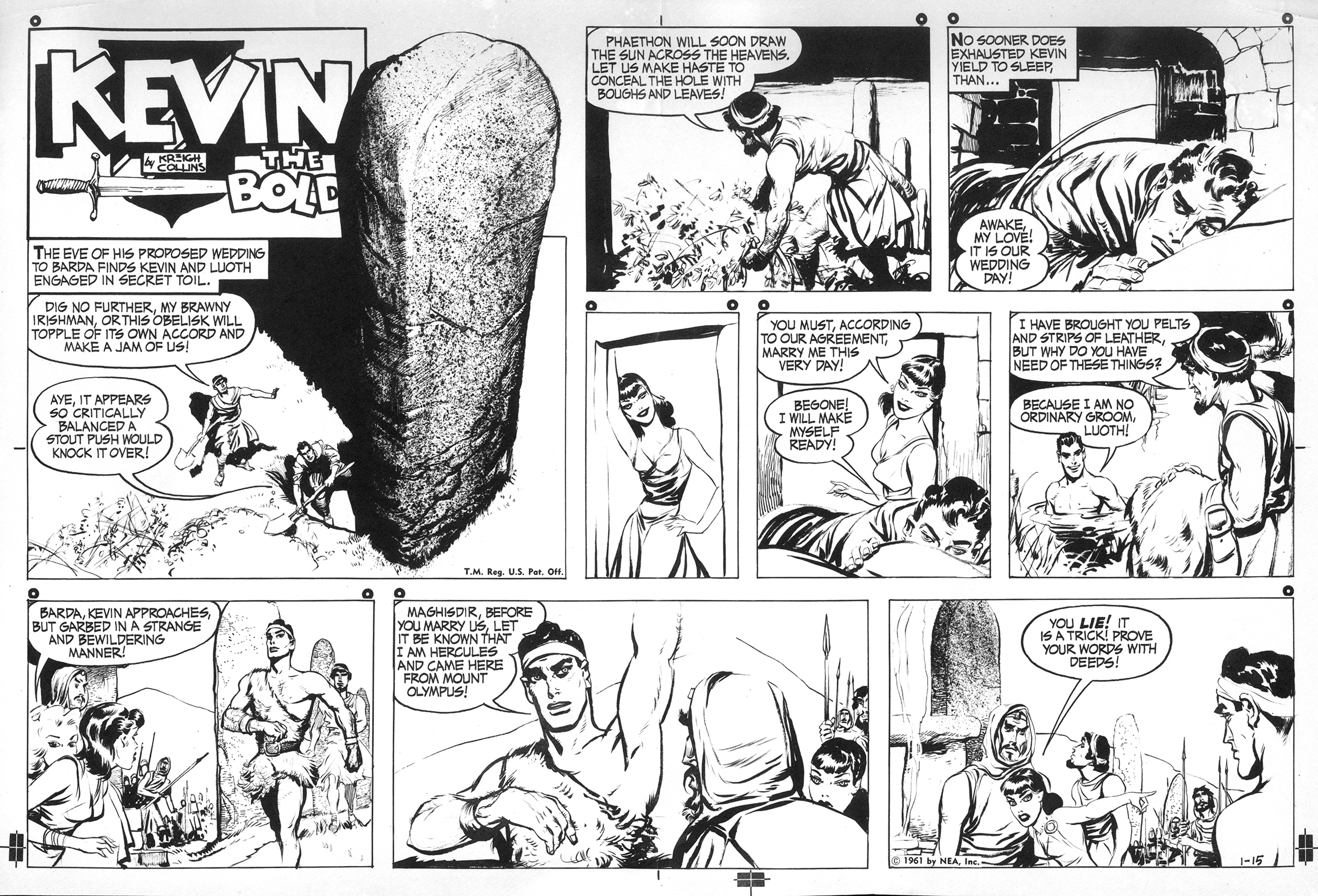
In what could be the worst bachelor party ever, Kevin and Luoth spend the eve of the wedding working hard on a risky and dangerous task.
Following his night of hard labor, Kevin is spent. The panels in the middle tier of the episode above are hysterical—with the first two contrasting the eager bride and the reluctant groom, and the third panel existing somewhere between the screwball and the absurd (and practically begging to be taken out of context). Meanwhile, Kevin faces his moment of truth.
Mascarading as Hercules, Kevin passes one test, but unexpectedly faces another.
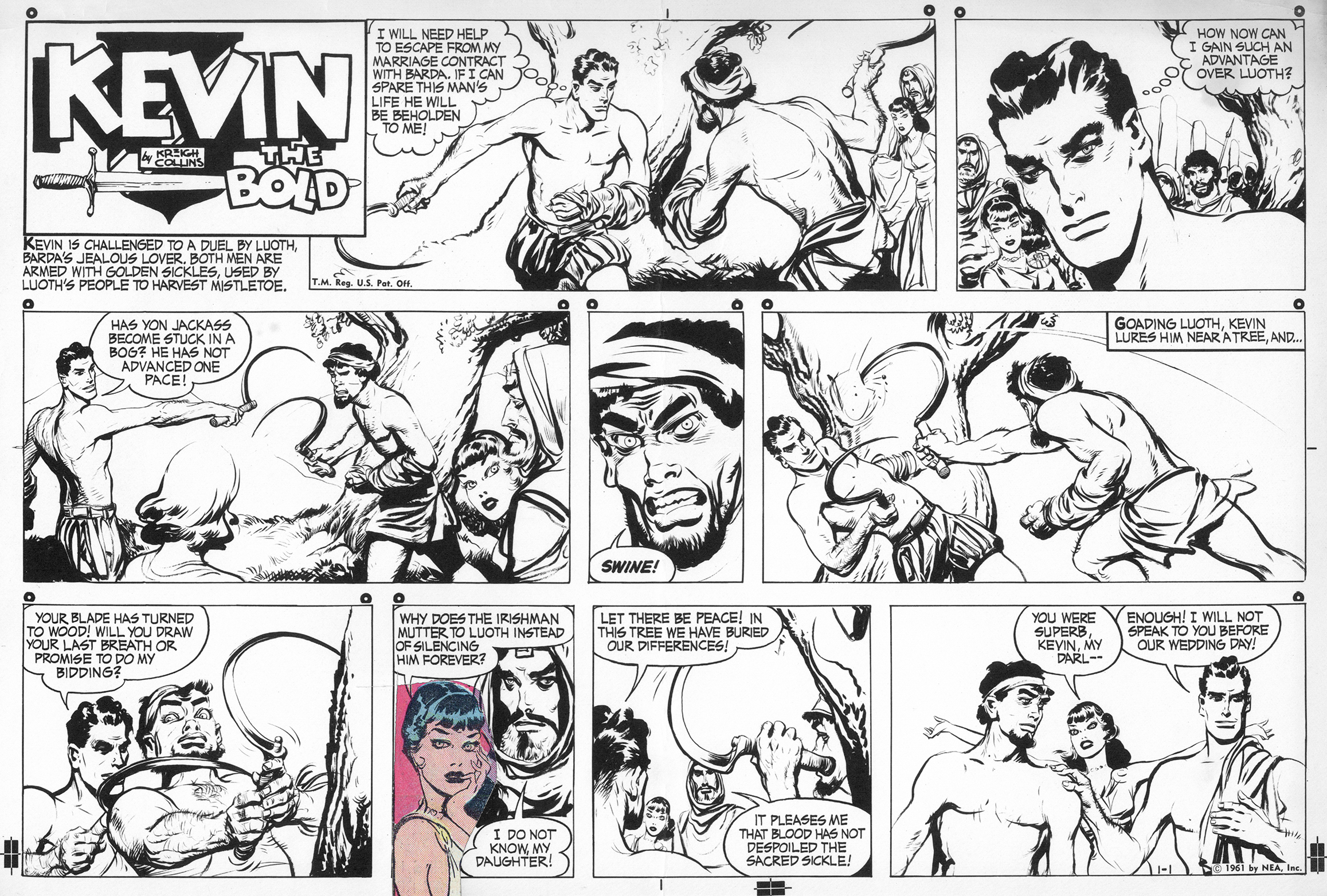
Luoth understands that if Barda breaks the engagement, it is mutually beneficial to Kevin and himself. Luoth is willing to take a great risk in order to restore his standing with Barda. Finally, a sudden thunderstorm and some quick thinking allows Kevin to escape his fate as a married man.
For more information on the career of Kreigh Collins, visit his page on Facebook.
I wish I had some color half-pages from this sequence to intersperse with the black and white art, but the printer proofs really accentuate Collins’ wonderful line work. And As you can see, the third-page versions that ran in many newspapers during this era of Kevin left much to be desired. With these shrunken comics, each panel was cropped, and the lovely “throwaway” was eliminated.
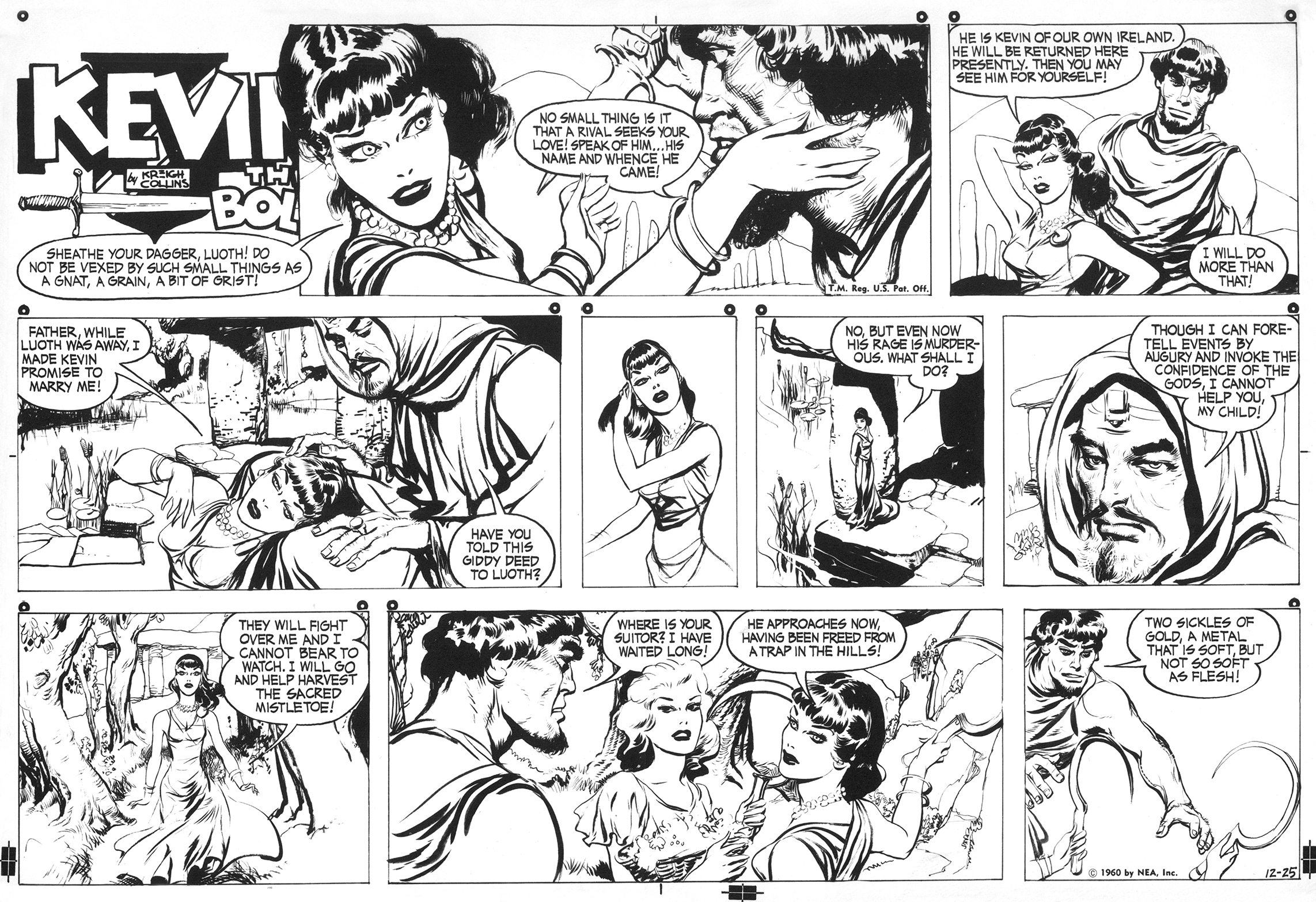
For the time being, Barda is able to calm her erstwhile boyfriend’s anger, but her situation proves too sticky for any further help from her father. Though Kevin will have his hands full dealing with the jealous, jilted Luoth, he is as calm and confident as ever.
Someone please hide those scissors!
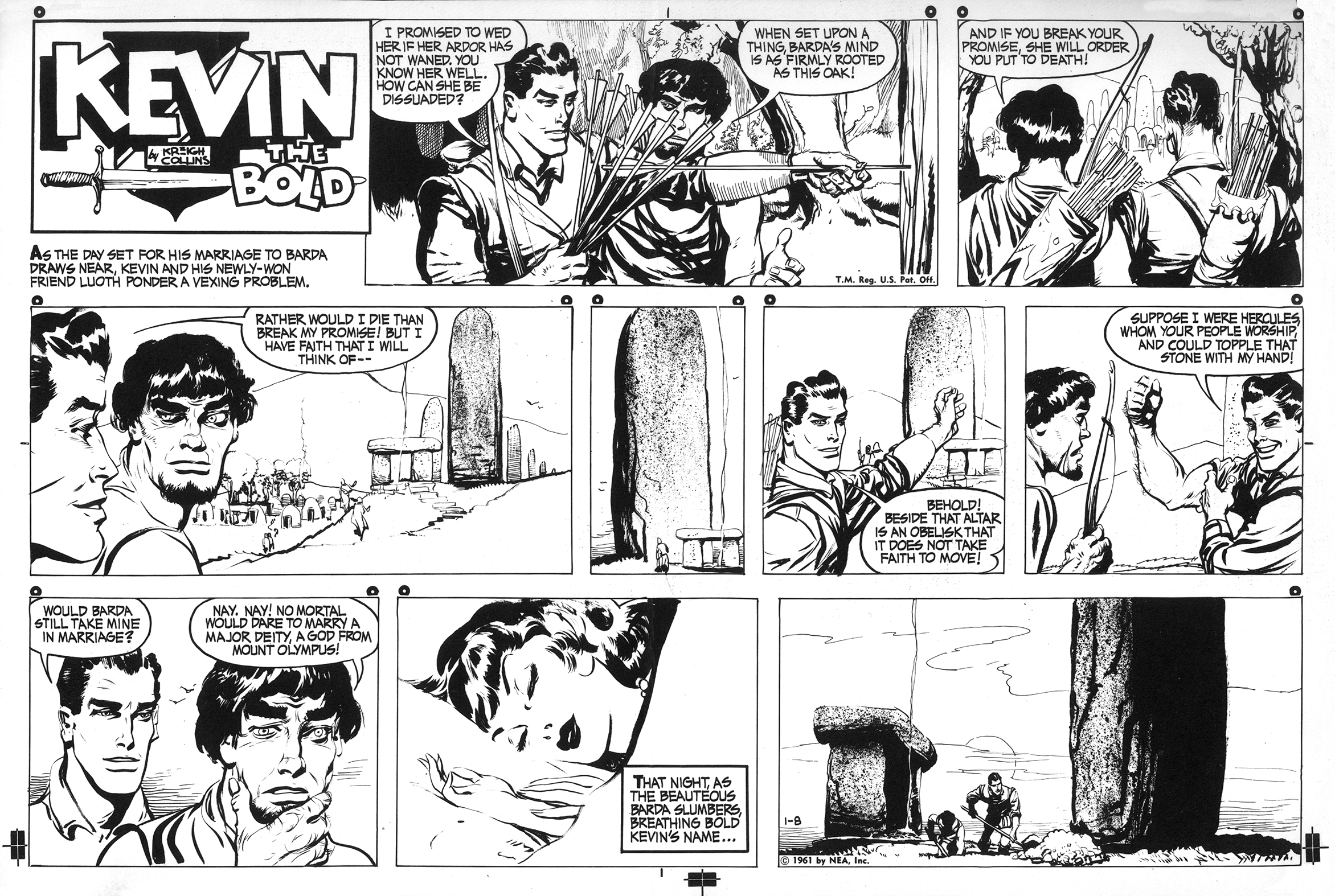
Quick thinking and a sudden, unlikely alliance buys Kevin time as he tries to dig his way out of trouble.
For more information on the career of Kreigh Collins, visit his page on Facebook.
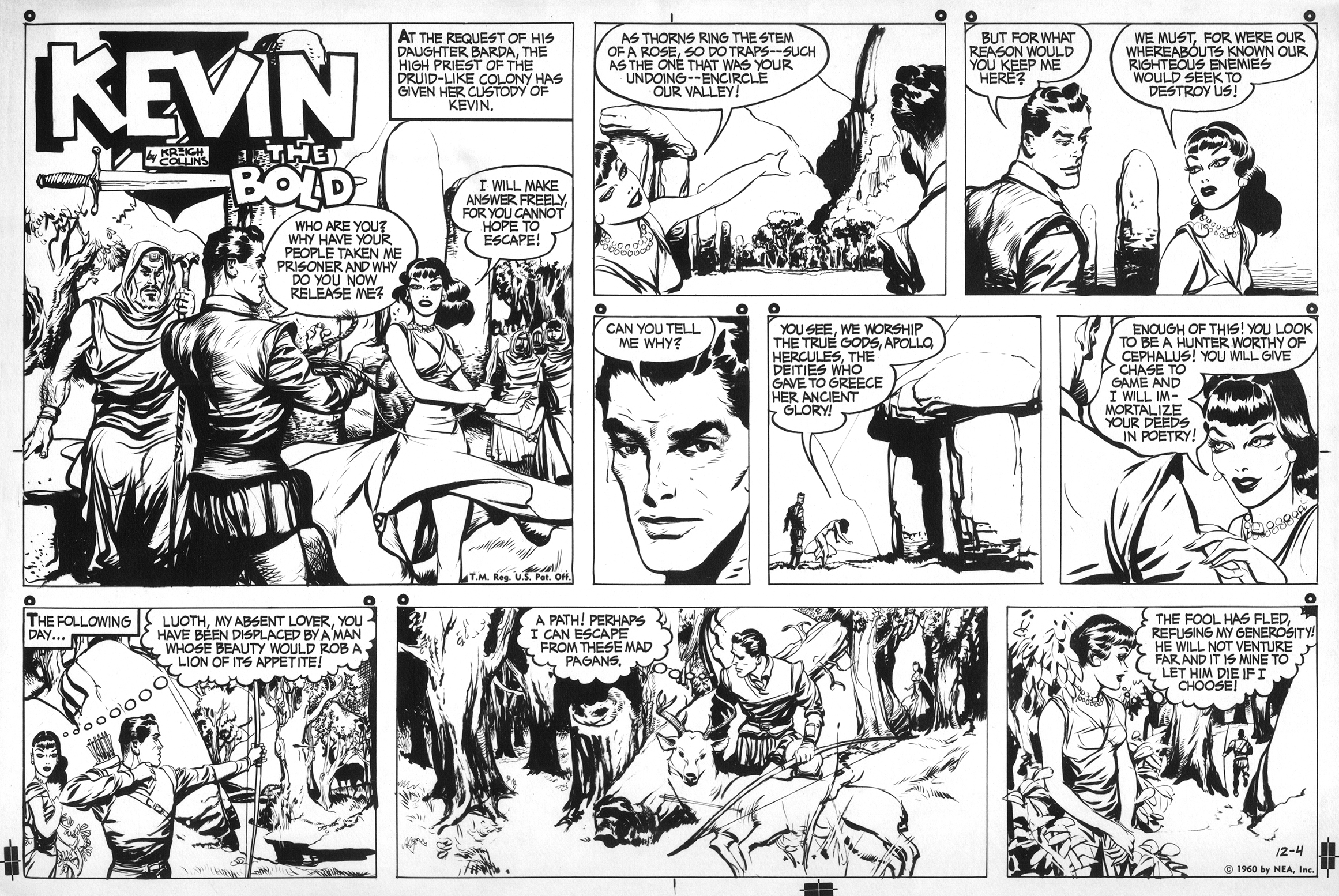
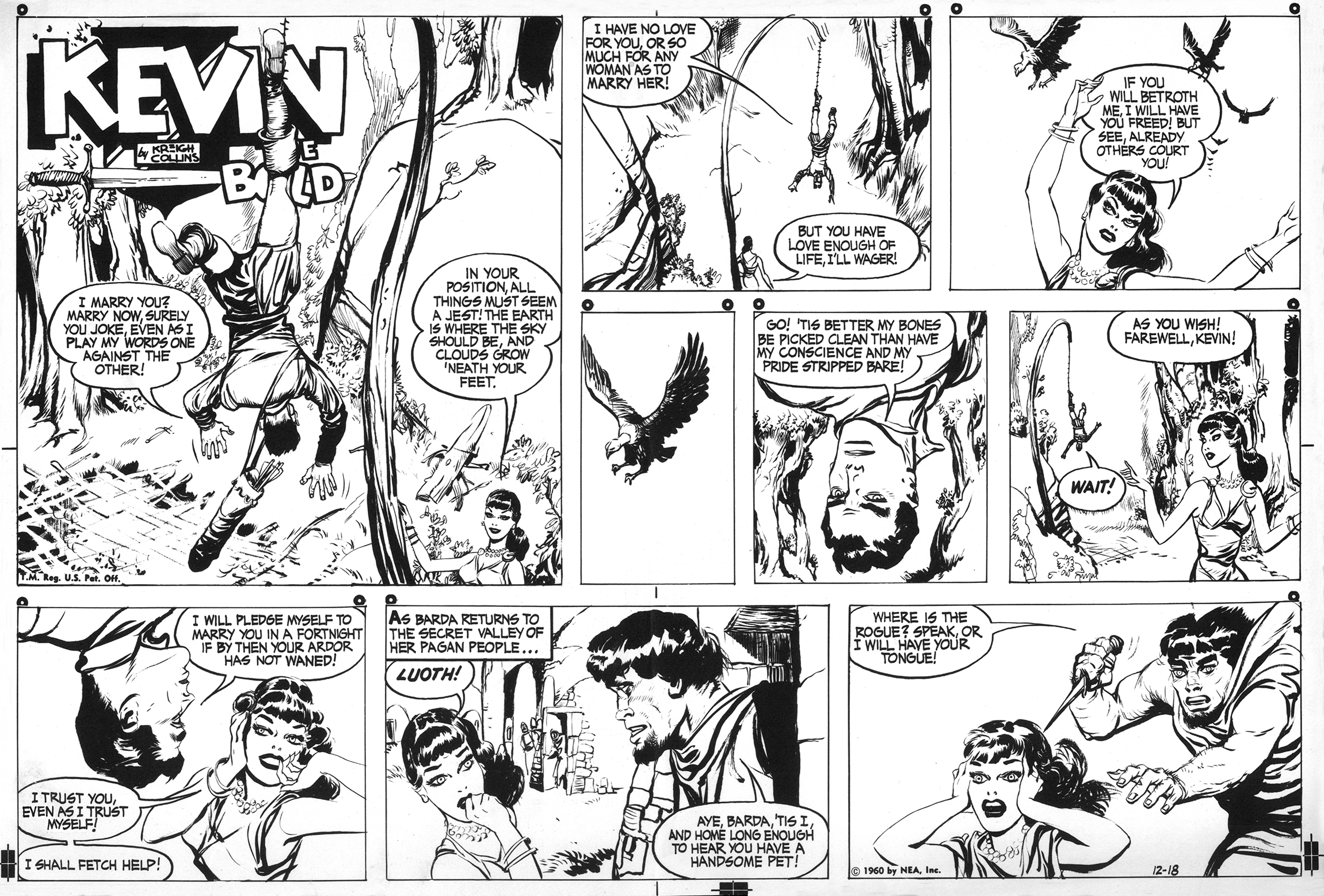
Barda has a new muse, and she gives her new toy both freedom and fair warning.
Determined not to make the same mistake twice, Kevin is cautious.
The comic used to patch the hole in this proof reveals the main problem with one-third-page versions—a significant chunk of the opening panel (to the right of Kevin) has been cropped out.
The names of Kreigh Collins’ ancillary characters were generally symbolic. As the child of a druid-inspired cult’s spiritual leader, Barda (“daughter of the earth”) is an appropriate name for a young poetess. Although she seems to relish dominating her love interests, she is not to be confused with Big Barta (a DC comics character with similar proclivities that debuted a decade later).
In the December 11 episode, our poetess riffs on a scene from King Lear (“The knave turns fool that runs…”). Of note, five years down the road Shakespeare would figure even more prominently as inspiration for a “Kevin the Bold” sequence.
Having made Kevin an offer he could not refuse, Barda finds trouble of her own.













 Kreigh’s Comics
