The Secret Valley

The peak years for “Kevin the Bold” were the 1950s, but by mid-1957, the Chicago Tribune, an early champion of the comic, was running inferior one-third page versions of the strip. While other papers continued running the strip as a half-page, like the Detroit News, many soon followed suit with the dreaded one-thirds.

Finding half-page examples of the comic from the late-50s can be difficult, so I am lucky to have numerous syndicate proofs in my collection. These proofs (veloxes?), show the entire half-page comic, and are printed on a nice heavy stock. Kreigh Collins used these to provide color guides to the NEA. He would paint them with watercolors, and these would be used by the NEA as guides while colorizing the comics. Extra copies of the proofs were kept in Collins’ studio, and sometimes these ended up being used like coloring books by either his youngest sons or his grandchildren. In retrospect, it’s a real shame, but at the time it probably seemed like a “grand” idea (to use a word that reminds me of Gramma Collins). While some of these proofs were colored or painted on, others suffered a worse fate, as the aspiring artists attempted collages, apparently, cutting holes in the proofs with scissors.

The following sequence, which ran from November of 1960 to January of ’61, has 11 episodes. I have cleaned up one that was painted on (our young artist hadn’t gotten very far with the November 27 episode—for once a short attention span proved beneficial), and I used some one-third page comics to patch up two others.

Despite these flaws, the sequence itself is wonderful. It contains all of the strip’s classic elements: beautiful scenery, a gorgeous young woman (smitten with Kevin, naturally), mystery, and action, plus a nice feat of engineering. It begins with Kevin taking a needed break from his adventures; he has returned alone to Ireland.
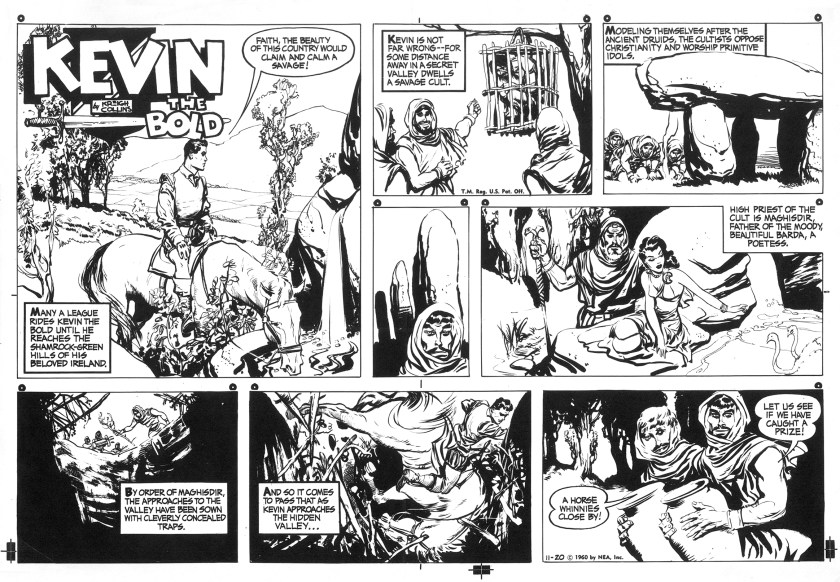
KTB 112060 BWP 150 cc

KTB 112760 BWP 150 BW cc

After falling into the trap, Kevin’s captors comment on his size and strength, comparing him to one of the ancient gods they worship. Despite his appearance, a perplexed Kevin is released to Barda, the daughter of the cult’s leader.


For more information on the career of Kreigh Collins, visit his page on Facebook.

NEA Daily and Sunday Comics

NEA Booklet 01 100

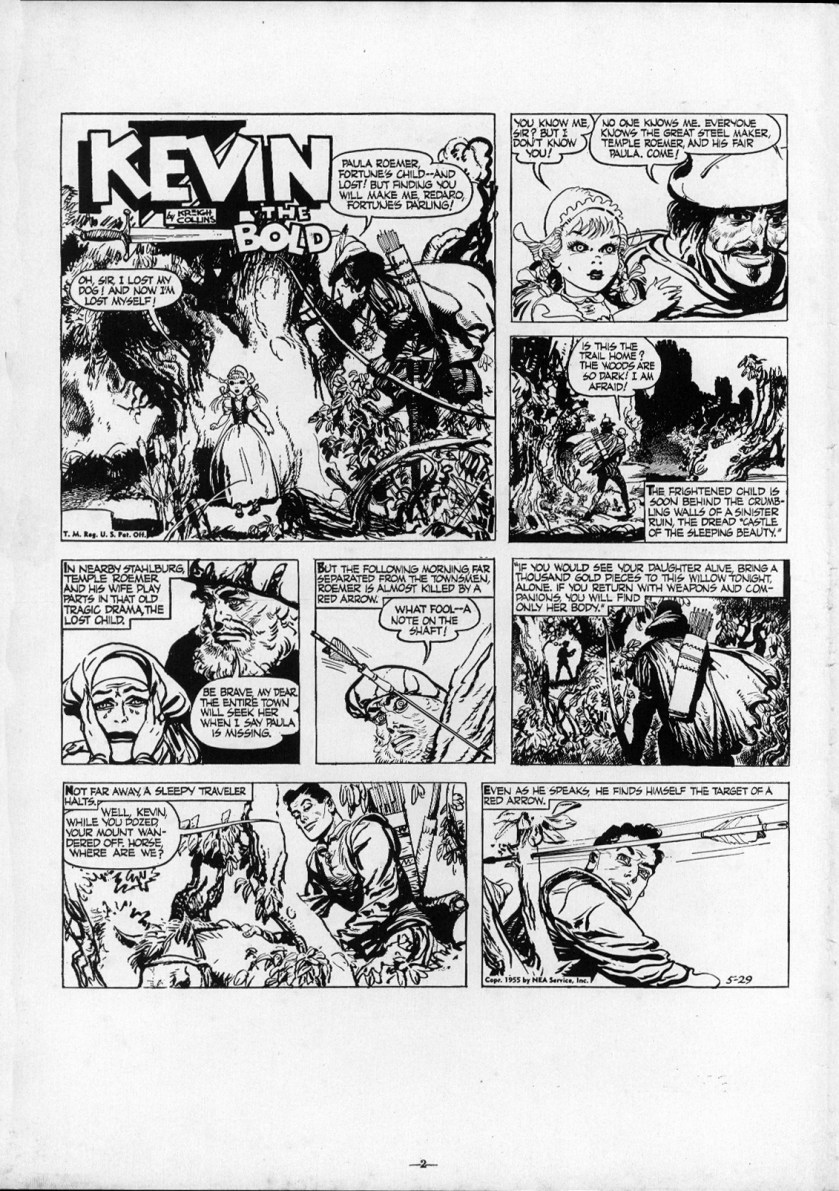
Among my collection of Kreigh Collins’s comics is a sampler of NEA comics from mid-1955. It looks likel the entire NEA comic package for the week of May 23–29, 1955 — but I’m not sure because it’s the only one of its kind I’ve ever seen.

It’s a 32-page, self cover, black and white tabloid, printed on a coated stock. Curiously, it isn’t bound in any way, so the eight individual sheets that it consists of can be pulled apart and put back together with ease. Because of its lack of staples, nice reproduction quality, and decent paper stock, I wonder if it wasn’t intended for newspapers to use for printing their comic sections.

If not, it apparently made for a nice keepsake for the NEA artists whose work was contained inside. As a young boy, I remember stacks of these things piled in Grandpa Collins’ studio. And of course I noticed the comic that appeared inside the front cover!

NEA Booklet 02 100

Beyond that, I’m not sure how far I read. I might’ve skipped the Sunday and daily Boots and Her Buddies comics (by Edgar Martin), but who could resist V.T. Hamlin’s Alley Oop?

It’s interesting to see which strips had daily versions, and which were Sunday-only. Although the topic of Kevin the Bold becoming a daily came up between Collins and his NEA boss, Ernest Lynn, it never happened.

I’m not too well-acquainted with many of the other comics that follow, but I am familiar with others (mostly due to seeing them on the backs of my Kevins). I recognize the name Walt Scott, since he drew the charming illustration that the NEA staff gave my grandfather on the occasion of his twin sons’ birth (in February, 1951).

Besides Walt Scott (whose The Little People, below, ran on page 7), I’m familiar with Red Braucher (quite a character himself), Herbert W. Walker (Newspaper Enterprise Association president), Dean Miller (he illustrated the Vic Flint Sunday on page 15), and… that’s about it.

from NEA

Here’s Walt Scott’s take on Kreigh Collins serenading his newborn baby sons Kevin and Glen (while older sons David and Eric crack wise).

Next up in the NEA tabloid are a Sunday and dailies for Freckles and His Friends (Merrill Blosser), Walt Scott’s The Little People (accompanied by its topper strip, Huckleberry Hollow), and seven days of Captain Easy, by Lesley Turner.

Then, Sundays and dailies for Out Our Way with “The Willets” (J.R. Williams) and Pricilla’s Pop (Al Vermeer).

Continuing to show the variety the NEA package offered, Sundays and dailies for Vic Flint (Dean Miller/Jay Heavilin) and Bugs Bunny (uncredited) follow.

Next up: Chris Welkin Planeteer (Russ Winterbotham), a “fun page” with several small strips including Tom Trick Fun Detective (credited simply to Dale), and seven days of Our Boarding House with Major Hoople (six daily one-panels and a Sunday tabloid).

The single-panel comics Side Glances (by Galbraith), and Carnival (by Dick Turner) follow.

Bringing up the rear are several comics featuring women (Brenda Breeze by Rolfe) or drawn by them (Sweetie Pie by Nadine Seltzer). Continuing in a domestic vein, there is Hershberger’s Funny Business, and apparently to fill extremely tiny spaces, Little Liz, a tiny daily single-panel, that is essentially an illustrated fortune cookie message.

Finally, it’s The Story of Martha Wayne by Wilson Scruggs.

If anyone has further information about any of these comics or the NEA, I’d love to hear from you in the comments section, below.


For more information on the career of Kreigh Collins, visit his page on Facebook.
Turnabout

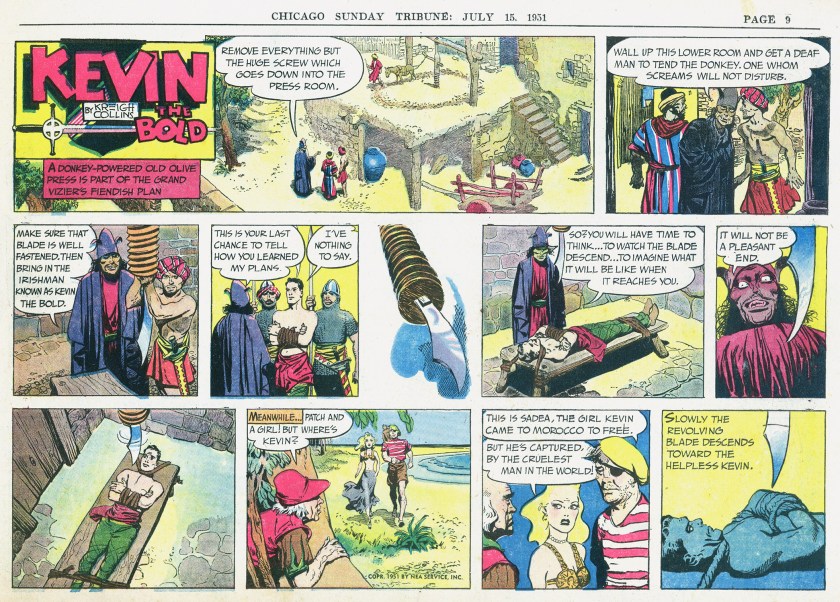
Unfortunately for Kevin, the Grand Vizier is not only cruel, but also creative. As Kevin faces an excruciating painful death, he still refuses to talk.

KTB 071551 HA 150 qcc

Early-1950s examples of Kevin the Bold episodes from the Chicago Tribune have wonderful color reproduction and especially vivid colors, and make for fantastic-looking comics. However, there seems to be another factor influencing the appearance of these beauties, which is only readily apparent upon seeing the original comic artwork.

The Grand Rapids Public Library has a substantial number of Collins’ original comics illustrations, but there are relatively few examples of Kevin in their collection. They have about 41 of the 99 original Mitzi McCoy comics, at least 73 of 174 Up Anchor! comics, but only about 19 of the approximately 944 Kevin the Bold originals. However, one of the episodes that is there is the July 15, 1951 episode, shown above (and below).

070851 OA Photo BW crop 200 IMG_8305

Looking at the original artwork, notice that some of the lines were drawn in a lighter color—I’d guess Collins watered down his India ink slightly. This causes the illustrations to have a softer appearance, and gives them a quality of atmospheric perspective (most notable in the first panel). The Grand Rapids Public Library’s collection of Kreigh Collins’ works is accessible to the public. If you’re in West Michigan, I strongly recommend a visit to the Library’s Local History Department.

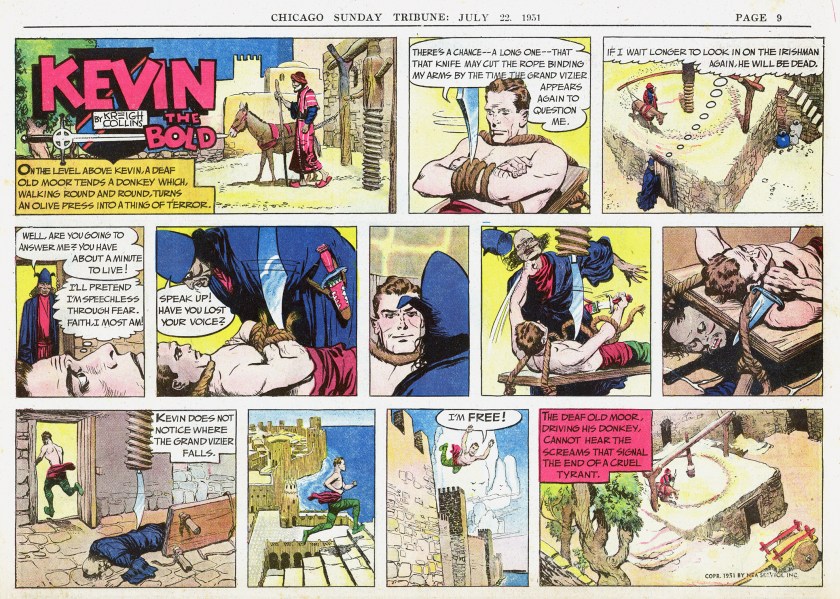
KTB 072251 HA 150 qcc.jpg

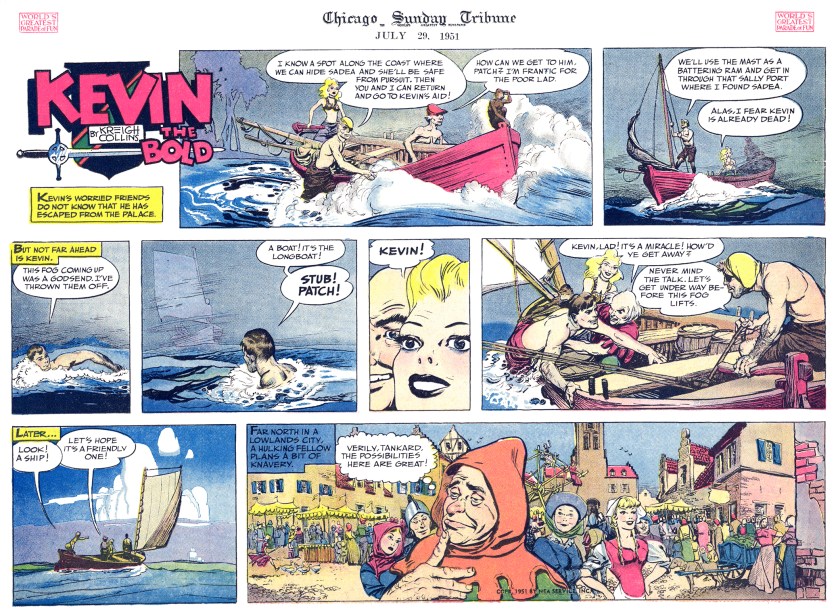
While things looked especially grim for Kevin, the Grand Vizier made the classic bad guy mistake of planning an overly elaborate and exotic death for his nemesis. As Kevin bolts and leaps to his freedom, the region is freed of a sadistic tyrant.

KTB 072951 150 cc wbg

As Stub and Patch devise a way to return and save Kevin, the sequence ends with a chance encounter off the coast of Morocco—another beautiful, cinematic episode.


For more information on the career of Kreigh Collins, visit his page on Facebook.

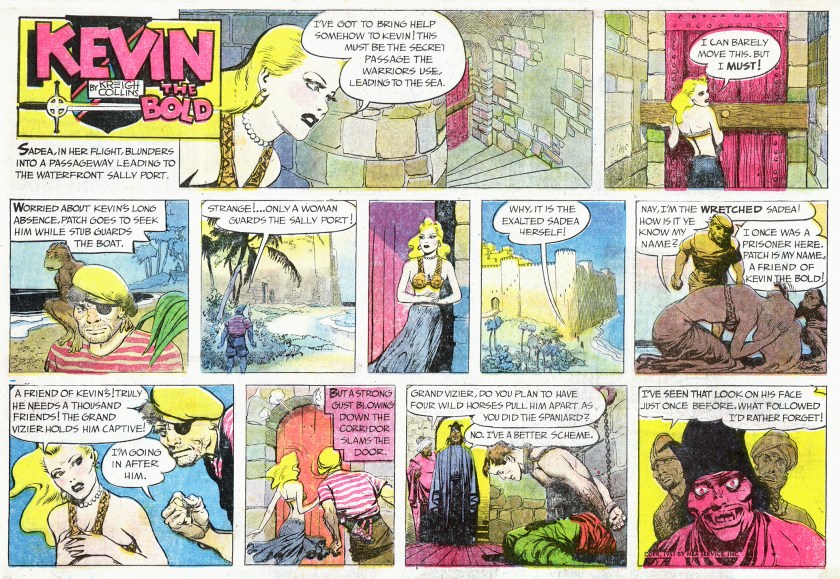
Run Sadea! Run!

Kevin seems to have met his match as far as loyalty is concerned, as he and Sadea formulate an escape plan. One can imagine the pangs of jealousy Moya McCoy would feel if she could only see Kevin now.

KTB 062451 HF 150 QCC.jpg

My collection of comics grew incrementally, over a period of years. The following comic was an early acquisition; at the time, it was the only one from this sequence that I owned. It was very compelling, yet mysterious. Its tenth panel contained a 1951 NEA copyright, but it lacked an inked-in date anywhere else. This was common for “Kevin the Bold” episodes of the era, but unlike most Chicago Tribune examples, this one wasn’t situated at the top of the comics page. This meant there was no typeset date to prevent any confusion (and there were no clues on the reverse side, either). It wasn’t until years later when I obtained the other comics from the sequence that and I was able to place it in time.

KTB 070151 HA 150 qcc

KTB 070851 HA 150

As the plot twists, and the momentum shifts, Kevin’s prospects fade. Despite the reliable Patch joining forces with Sadea, things look grim.


For more information on the career of Kreigh Collins, visit his page on Facebook.

Acts of Valor

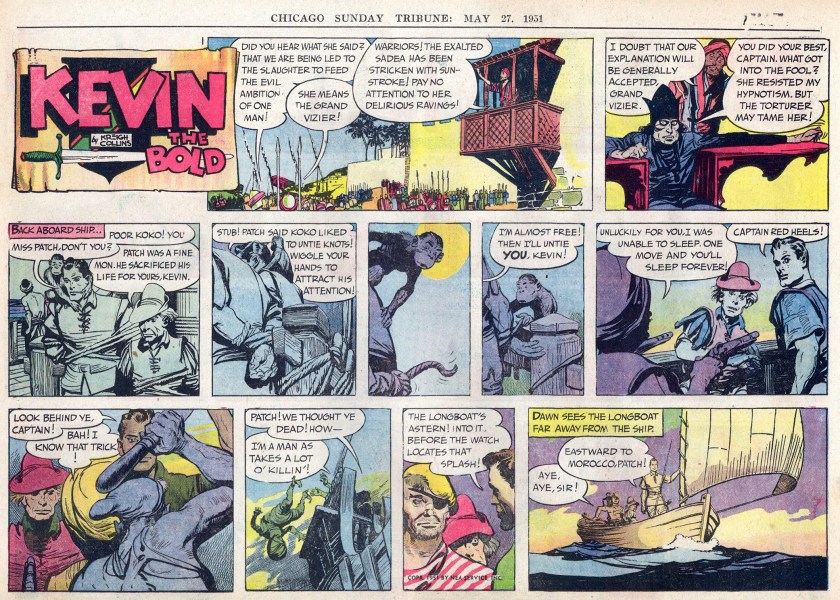
At the palace, Sadea awaits her fate, while Kevin and Stub sweat their own, aboard the commandeered caravel.

KTB 052751 HF 150 QCC

Once again, the timing of Patch’s heroism is perfect. But how had he survived?

KTB 060351 HF 150 QCC

After a full day’s sail, Kevin, Stub, and Patch reach Morocco. While Sadea shows her determination against the Grand Vizier, Kevin shows his own, as he sets off. After all, he had promised the Count de Falcon that he would rescue Sadea, his missing sister.

KTB 061051 HF 150 QCC

Splendor, action, humor, and terror—the June 10, 1951 comic is another showstopper. Each panel is absolutely wondrous.

KTB 061751 HF 150 QCC

With a birds-eye view of the courtyard (reminiscent of an old “Mitzi McCoy” setup), Kevin’s quick thinking allows him to subdue two palace assassins, and he introduces himself to the lovely Sadea. So far, so good, but the two are not yet out of the woods.


For more information on the career of Kreigh Collins, visit his page on Facebook.

Villainy

As a villain, Red Heels has the usual traits—he is coldhearted and ruthless. Like the baddies in Kevin’s inaugural sequence, he is another bloodthirsty Arab pirate. But he’s no stereotype. What makes Red Heels stand out is his effeminacy. Small in stature (in panel 1, he seems to be wearing heels), he also sports oversized headwear which has the dual purpose of making him appear larger and supplying shock value. Despite these illusions, he comes up short compared to other villains…

KTB 050651 150 qcc

The outstretched hand of the drowning man (fourth panel) was a device that Collins had used before. It appeared in throwaway panels in Kevin’s earlier encounter with the Arab pirates and in another sequence from 1952. Nonetheless, its poignancy remained as shorthand for a gruesome death. All of the men injured in the battle—on both sides—were destined to suffer the same fate, including Koko’s master, Patch.


Back in Morocco, things take a turn for Sadea.

KTB 051351 HF 150 QCC

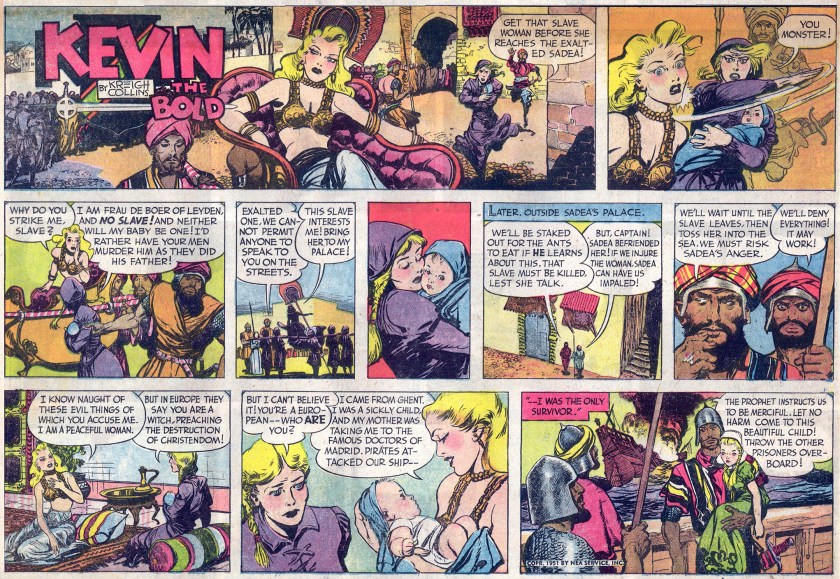
Learning of Frau de Boer’s life, Sadea begins to reveal her own story. No doubt many readers approved of her costuming and poses.

KTB 052051 HF 150 QCC

The embodiment of evil with a countenance to match, the Grand Vizier beseeches Sadea to do his bidding once again. Emboldened by Frau de Boer’s tale, she successfully resists his attempt at hypnosis, imperiling her own future.


For more information on the career of Kreigh Collins, visit his page on Facebook.

La Ragazza Stregata

The story continues with an amazing mélange of sensuality, occult, horror, and humor — despite the terrifying spectacle of the Moorish pirates. Aboard the caravel, Koko and Kevin both tease poor Stub, but it’s all in good fun, as the crew bonds tightly.

KTB 041551 150 qcc

Kreigh Collins’ dialog is hysterical, and the episode is packed with nautical terminology likely not seen in any other comic. With a reference to the galley “sweeping” toward the Genoese ship, a casual reader would generally understand what was happening, but would lose the nuance of the phrase. Unlike a traditional rowboat, which a single person moves by “sculling” with two oars, the pirates’ galley is propelled by numerous oarsmen, each pulling a single oar, or “sweeping” (like eight-man racing boats seen competing in regattas).

sweeping IMG_7639

These guys “swept” past virtually all of their competition last year. (Don’t tell my son, the oarsman at the far left, that I used a picture of his crew on my blog!)

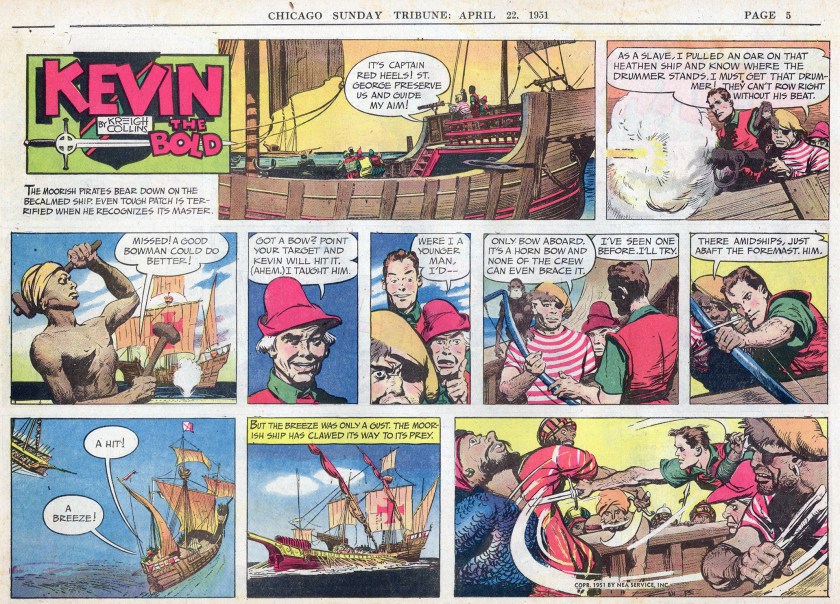
Crews that sweep have a coxswain — they are in charge of the boat, and determine its stroke rate (the cox is seated at the back of the boat, above). Similarly, the Sea Hawk utilized a drummer to pound out a beat for its rowers to follow. Like a cox for a crew shell, the drummer was critical to keeping the Sea Hawk’s rowers in sync, and thus moving most quickly. Knowing this, and being an archery master, Kevin takes aim.

KTB 042251 150 qcc

Patch is all too familiar with the Sea Hawk, and its captain, Red Heels. Despite Kevin’s incredible shot, and a timely gust of wind, the pirates board the caravel and a fierce battle ensues.

KTB 042951 150 qcc

While Patch gallantly saves Kevin, and Koko rescues Stub, it should come as no surprise that it is Kevin who proves to be bravest of all.


For more information on the career of Kreigh Collins, visit his page on Facebook.

Bewitched

KTB 031851 HA 150 qccThe March 18, 1951“Kevin the Bold” comic is packed with backstory. Kreigh Collins was known to haunt libraries while researching his subjects, but in this case, much of the context was observed firsthand. As a young man, Collins had spent time drawing and painting in northwest Africa. In the spring of 1928, he had crossed the Atlantic aboard a freighter with an early mentor, noted painter Mathias Alten. The first stop was Morocco; their departure for France was a couple weeks off. No doubt this experience came in handy when Collins scripted and drew the episodes for the next eighteen weeks.

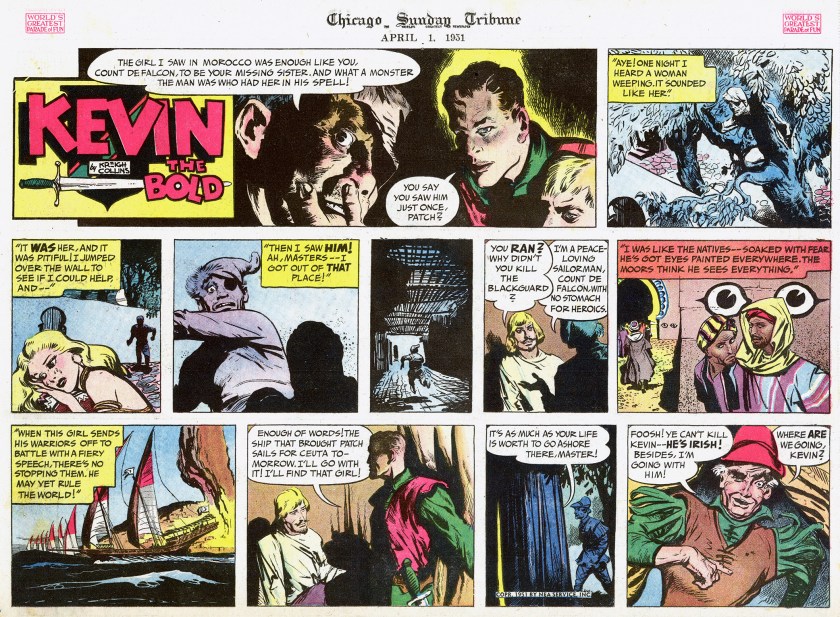
Kevin hears the strange tale told by an English sailor, Patch, about an entranced blonde woman who whips Moorish pirates into a frenzy with her words and antics. Also introduced is Koko, Patch’s adorable and mischievous simian companion.

Thinking the strange enchantress could be the woman DeFalcon seeks, Kevin introduces Patch to the convalescing Count.

KTB 032551 HA CST 150 qcc.jpgSkeptical DeFalcon doesn’t understand, but Kevin wants to hear more. He does, as the April 1 comic’s events are as vivid as its Chicago Sunday Tribune printing.

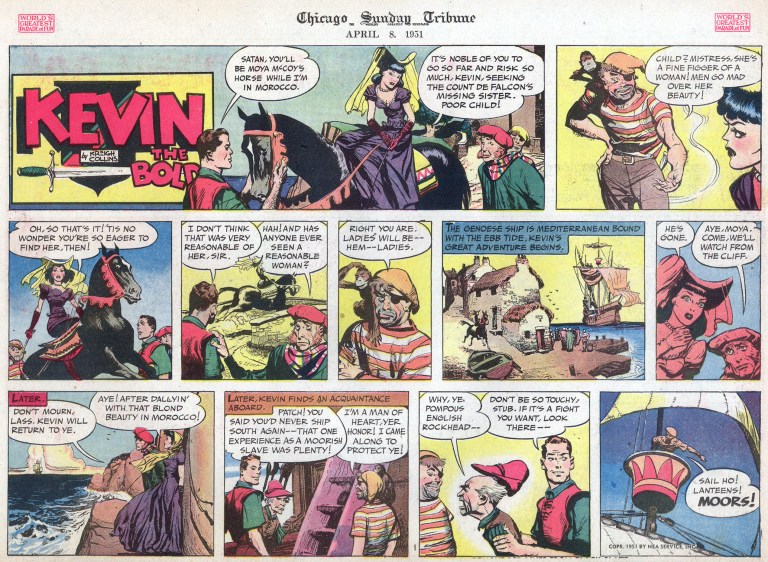
KTB 040151 HA 150 qcc.jpgAs Kevin prepares to set off on his next fantastic adventure, he witnesses another fierce scene — a piqued Moya McCoy, jealously storming off astride his own horse. Despite the embarrassment he felt over her scene, Lord McCoy comforts his distraught daughter, Moya. As Kevin and Stub recognize one of their ship’s crewmates, danger is sighted ahead.

KTB 040851 HA 150 qcc.jpg


For more information on the career of Kreigh Collins, visit his page on Facebook.

The Search for Sadea

Not long after launching “Mitzi McCoy,” Kreigh Collins began to tire of the strip’s setup, a contemporary comic with a female lead. With his background in historical subjects and costume illustration, he longed to do a “cloak and sword” feature more in line with his interests. So when “Mitzi” abruptly morphed into “Kevin the Bold,” Collins was more than ready with ideas for Kevin’s initial adventures. The following sequence, Kevin’s third, is absolutely loaded: beautiful illustrations, fascinating characters, stunning locations, and action. There is drama, humor, and blossoming romance. It also defines Kevin’s raison d’être.

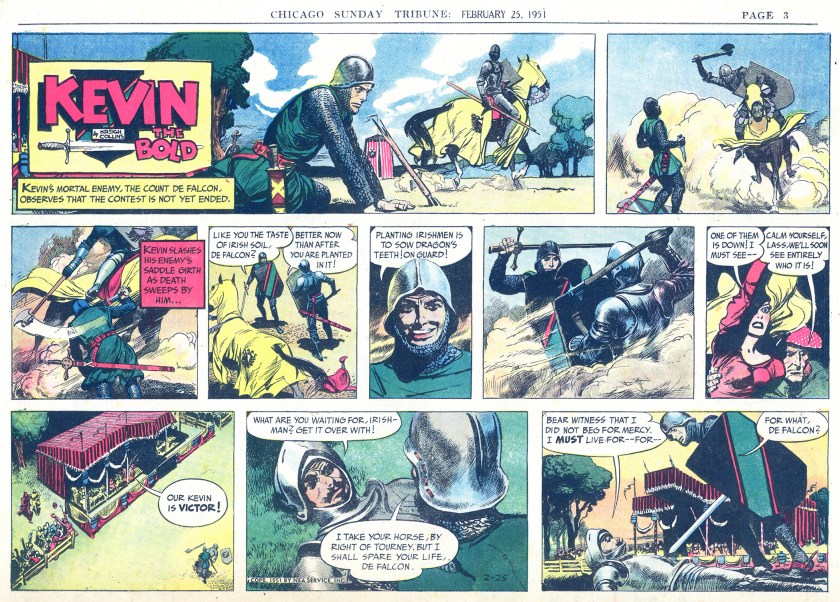
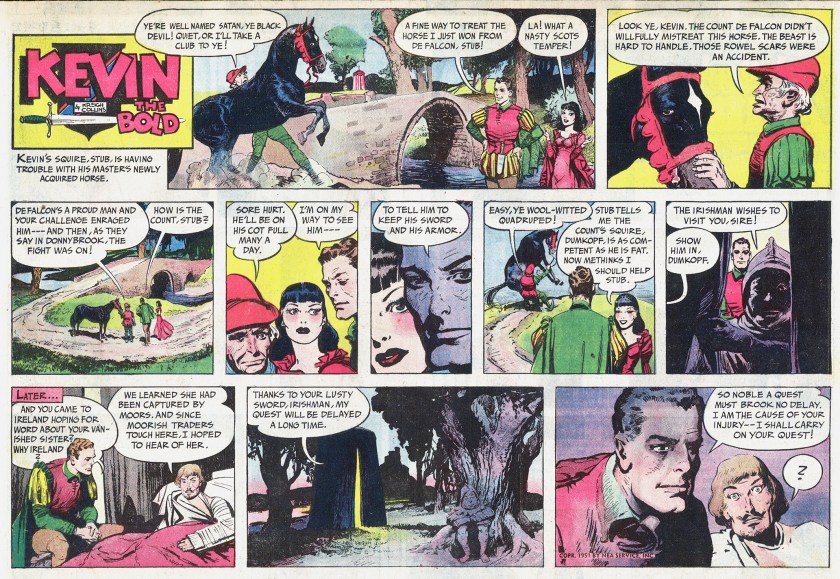
In the climax of the previous sequence, Kevin faced (and defeated) the formidable Count De Falcon — in mortal combat. By tournament rules, Kevin won the Count’s horse, sword, and armor. Revealing his character, Kevin spared his opponent’s life, and let him keep his sword and armor. And not only that…

KTB 022551 HA 150 qcc

KTB 030451 HA 150 qcc.jpg

Kevin’s beef with De Falcon arose from the belief that the Count had mistreated his horse. After discovering this to be untrue, and learning what brought De Falcon to Ireland in the first place, Kevin discovers his next challenge.

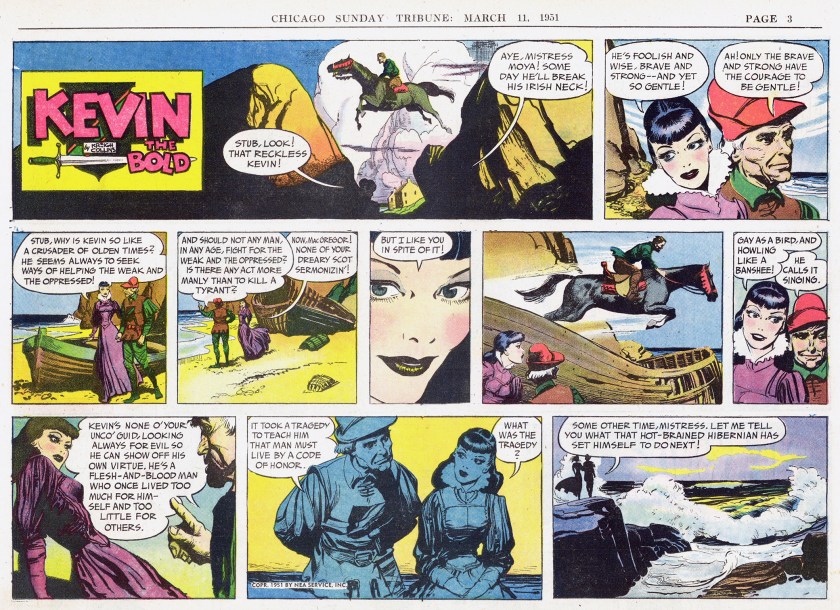
KTB 031151 HA 150 qcc

After learning more about the mysterious, brave man who had first saved her family, and then treated his vanquished foe so kindly, Moya begins to fall for Kevin. Because of his credo, she learns that she must wait. Surely she won’t mind that the woman Kevin is determined to rescue is a beautiful blonde…


For more information on the career of Kreigh Collins, visit his page on Facebook.

Anno III, N. 1

Nerbiniano 03 01 C1 150.jpg

My other recently-acquired copy of Il Nerbiniano is an older one: year III, number 1, published in January, 1975. While Kevin shared the cover with a strip called “Cino e Franco,” one of Kreigh Collins’ most arresting panels was repurposed for the cover. Notably, the comic in which it originated (October 28, 1951) does not appear inside.

Anno III, N. 1 used heavier cover stock than my other copy. This one was bound in a landscape format, and all of the material inside is formatted that way too. Overall, this earlier copy is of a higher quality than Anno VIII, N. 1. The inside covers were printed in two colors, black and cyan, and the interior text pages appeared in alternating 4-C and black-and-white signatures, each four pages long. The inside front cover lists an editor-in-chief, six staffers and a cover artist, and includes an editor’s letter (La Poltrona del Direttore, or, The Director’s Chair). The table of contents nicely features a piece of Collins’ artwork as a spot illustration.


Having started this blog as a tribute to my grandfather, perhaps the most fascinating aspect is how much I learn about ancillary material while doing necessary research. While I know quite a bit about my grandfather’s comics, I am by no means a comics historian. I learned that the comic featured in the opening section, “Jungle Jim,” was created as a topper by Alex Raymond for his comic “Flash Gordon.” The comics reprinted here are lovely, dating to 1939.

“Kevin the Bold” appears on page 5, and two tabloid comics are split across four pages as in my other copy of Il Nerbiniano, but with no need to rotate the book while reading. The interior text pages’ stock is heavier than in my other copy, and instead of a coated paper with what almost appears to be xerographic printing, this issue uses a nice uncoated stock. The reproduction quality is excellent.
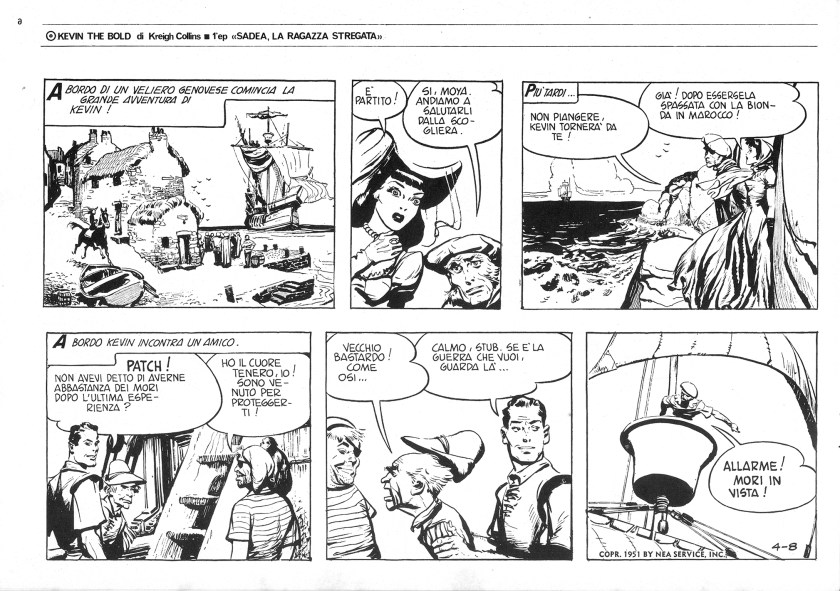
Nerbiniano 03 01 05 150Nerbiniano 03 01 06 150

This time, the comics’ original publication dates (and NEA copyright credit) remain in the artwork. While I always thought of this sequence as “The Search for Sadea,” I now prefer the Italian title, “Sadea, la Ragazza Stregata” (“Sadea, the Bewitched Girl”).

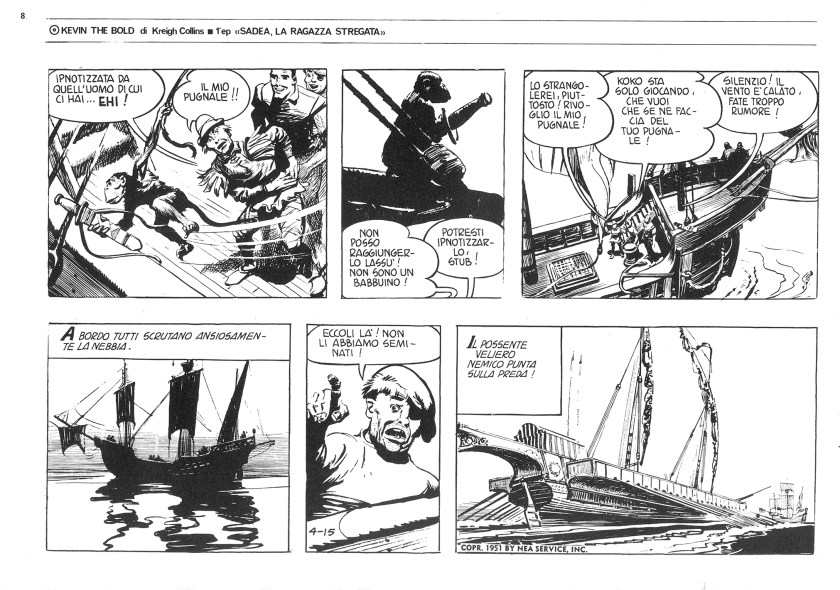
In all of my grandfather’s comics, the Sadea sequence is perhaps my favorite. It features thrilling action, a hauntingly beautiful (kidnapped) young woman, magnificent ships, horses and battle scenes. Not to mention Koko, the mischievous sea monkey (not that kind!), and frightening villains, all beautifully illustrated and with a captivating plot line.

Nerbiniano 03 01 07 150Nerbiniano 03 01 08 150

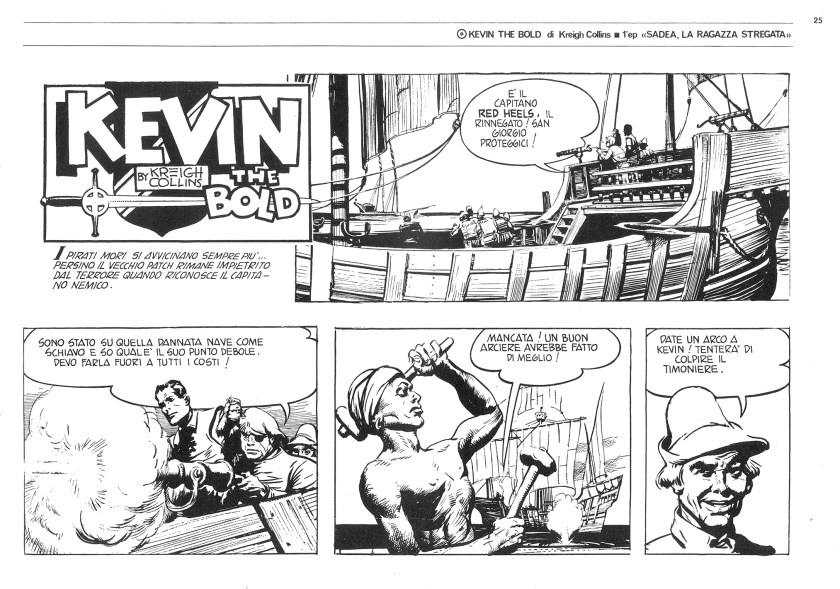
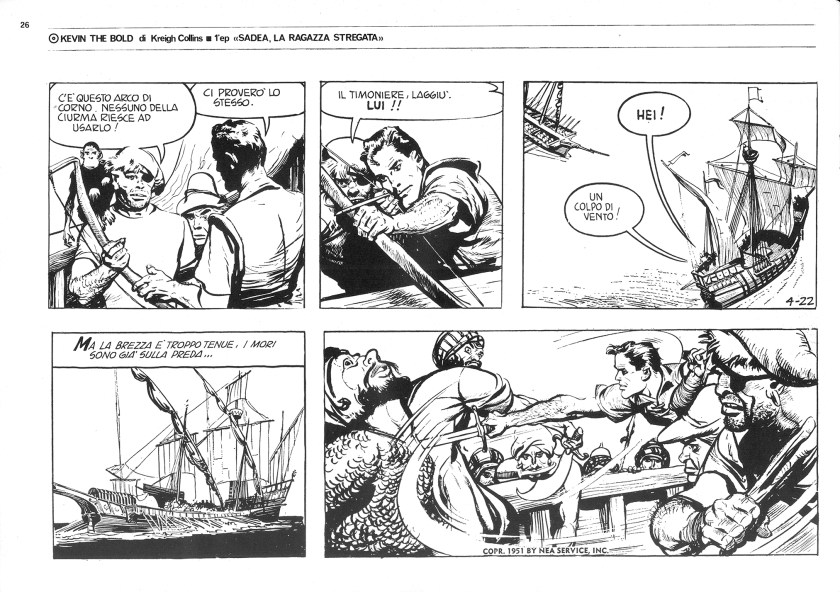
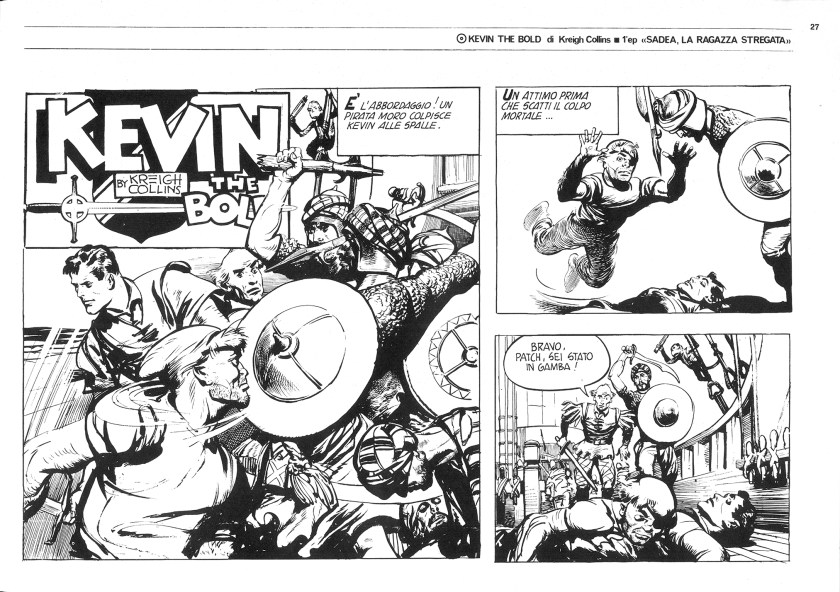
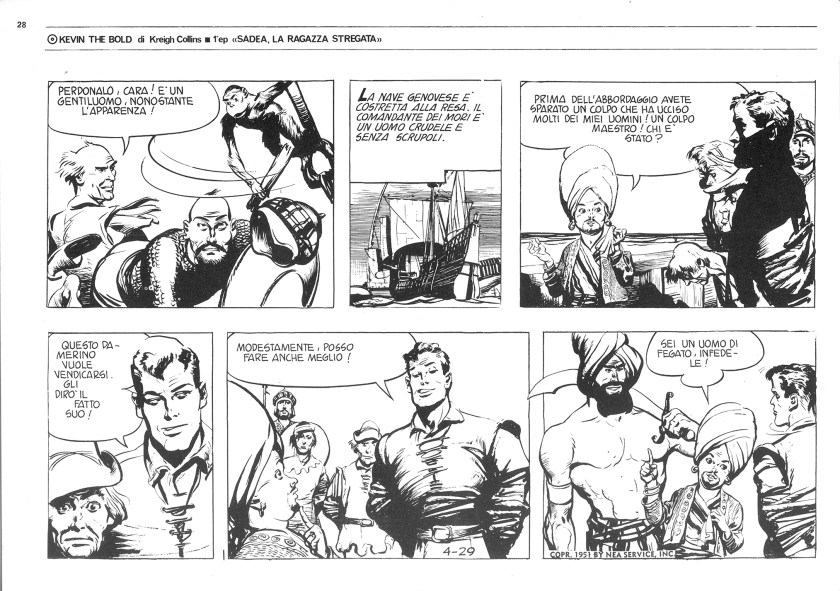
After four stunning pages, Il Nerbiniano continues with more four-color “Cino e Franco” comics. After further research, I learned that this comic is the Italian version of Lyman Young’s long-running “Tim Tyler’s Luck.” (I also learned that Lyman’s younger brother Chic Young was the man who created “Blondie”). This is followed by eight black and white pages of a comic called “Nell Impero Degli Incas” (“In the Empire of the Incas”), and four more color pages of “Cino e Franco.” Then, four more exquisitely-reproduced “Kevin the Bold” pages — the comics from April 22 & 29, 1951.

Nerbiniano 03 01 25 150Nerbiniano 03 01 26 150

Nerbiniano 03 01 27 150Nerbiniano 03 01 28 150

Because this sequence has had no exposure for the past 67 years (in color, anyway), next week I will begin featuring it on this blog it in its entirety. But first, one last look at Il Nerbiniano — what a charming back cover!

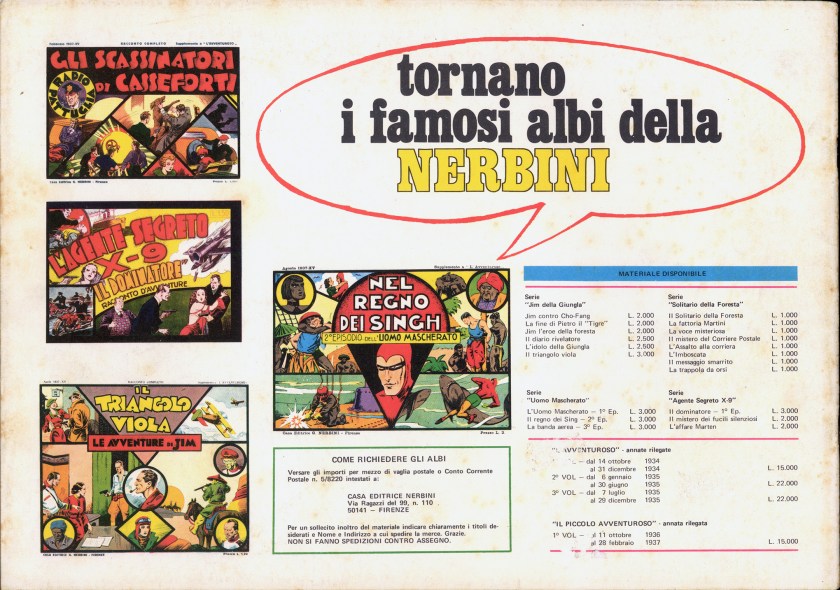
Nerbiniano 03 01 C4 150.jpg


For more information on the career of Kreigh Collins, visit his page on Facebook.