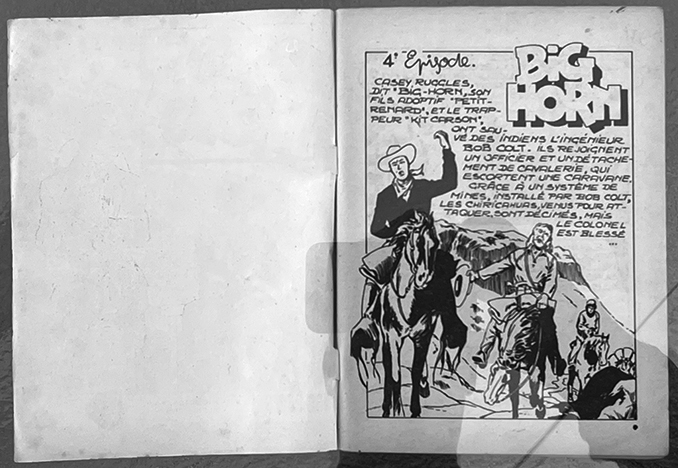
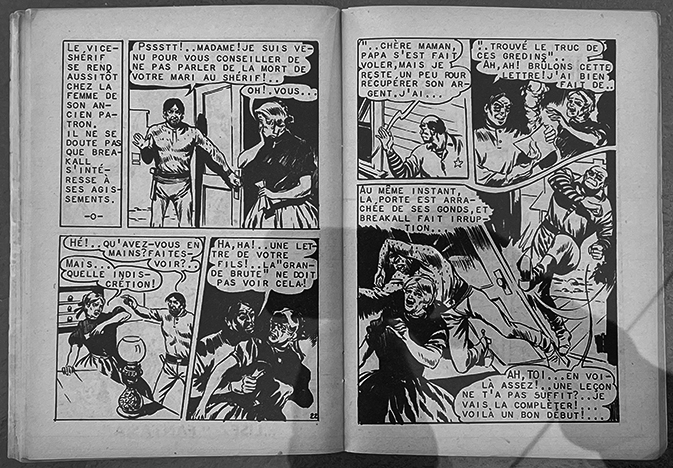
Published in late 1957, issue No. 4 of the French comic book Big Horn follows the same format as its three predecessors. In addition to Warren Tufts’ title comic, it also features John Wheeler’s KID COLORADO, a short story, and Kreigh Collins’ KEVIN LE HARDI (“Kevin the Bold”).
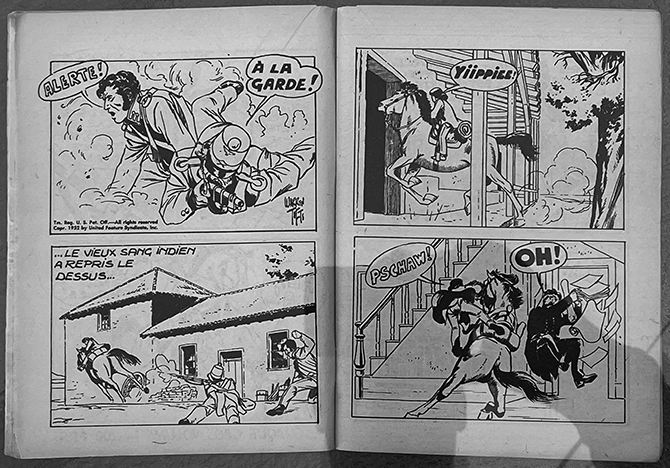
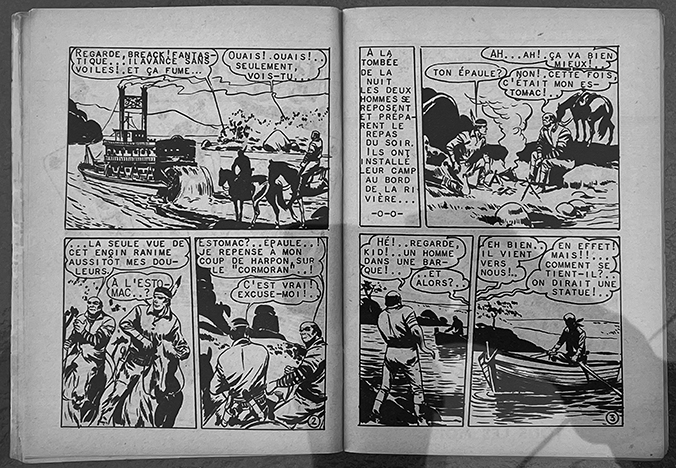
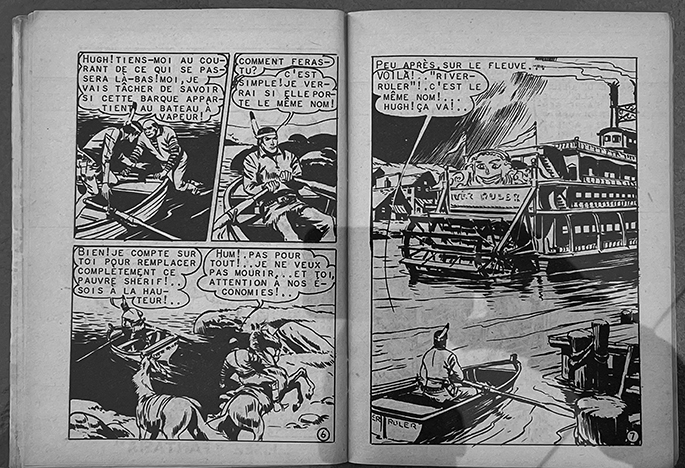
Because the smallish (5-1/4″ x 7-1/8″) BIG HORN comic books are so thick (132 pages), they don’t scan very well. These images are photos I took outside with the comic book spread flat beneath a piece of plexiglass. My apologies for the glare and shadows. First up is BIG HORN, which runs for 35 pages.
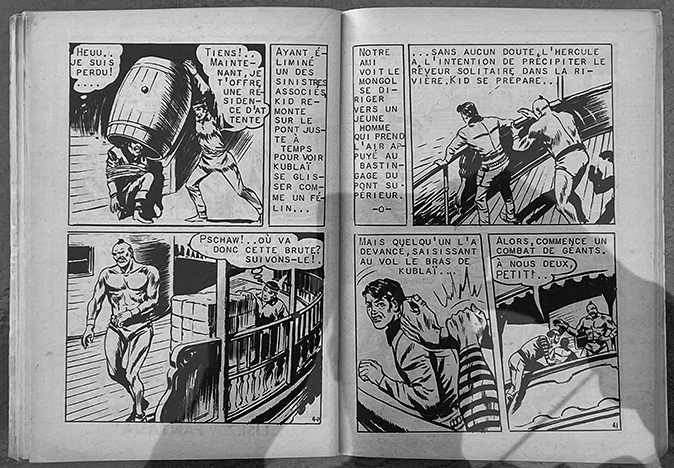
BIG HORN is followed by 62 pages of KID COLORADO. I love the introductory pages found in these comic books!
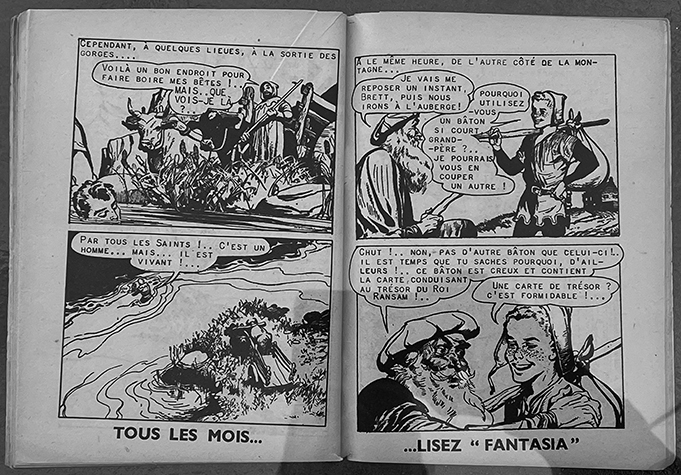
A space-filling three-page short story (“Smoke Signals”), buttresses the comic book’s non-titular features.
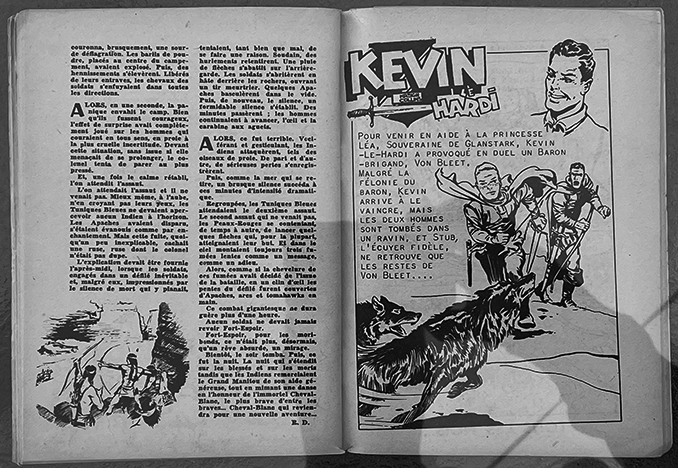
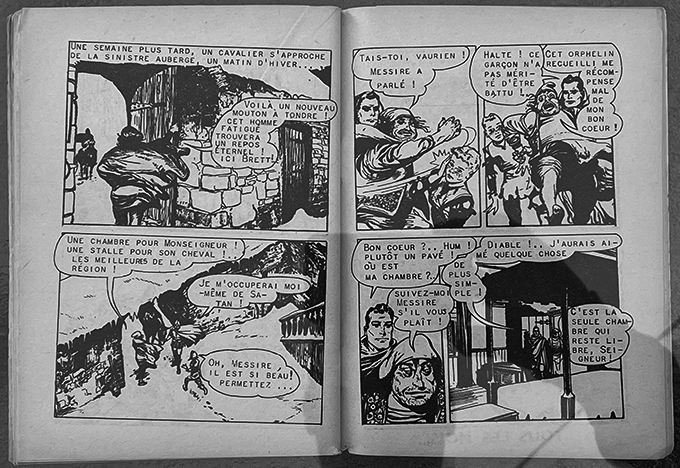
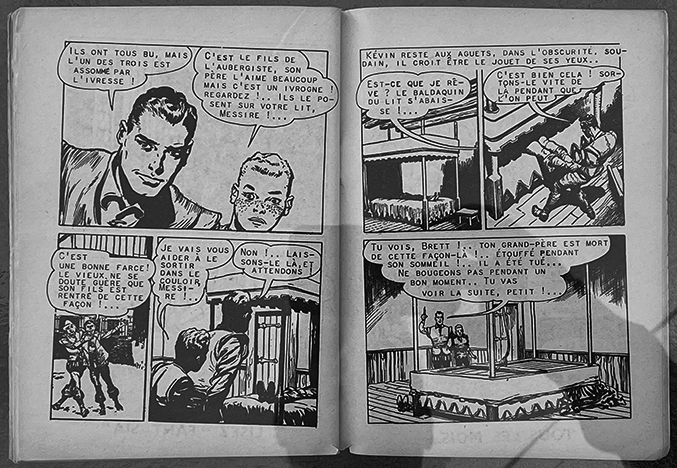
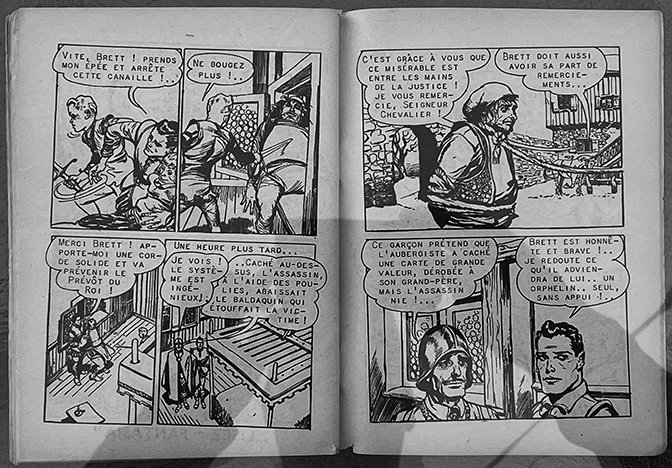
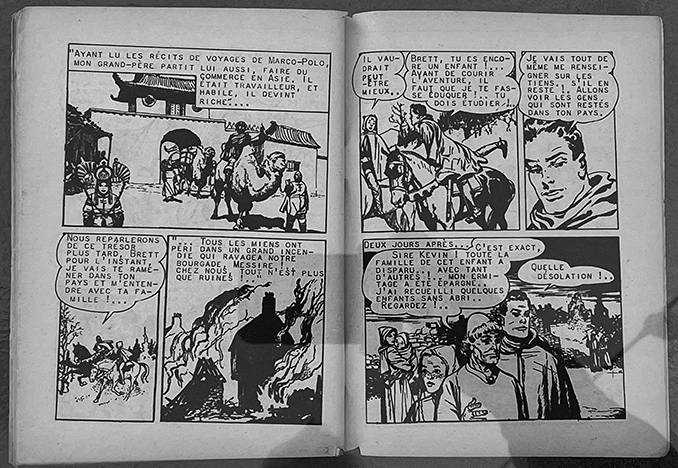
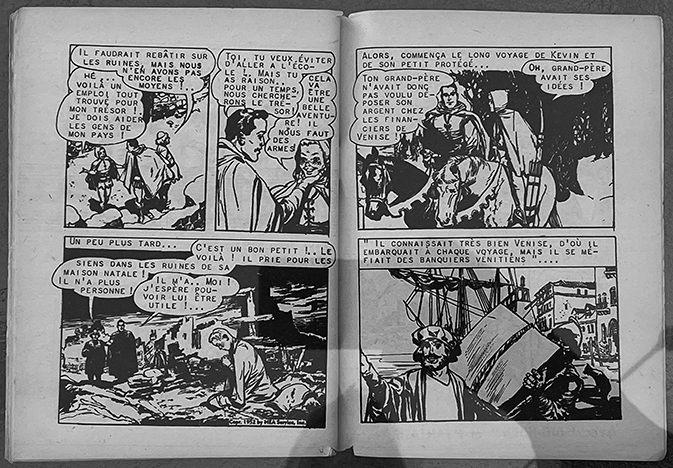
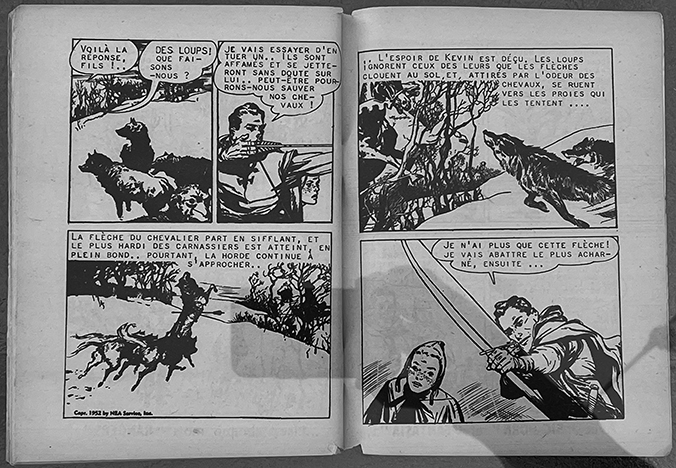
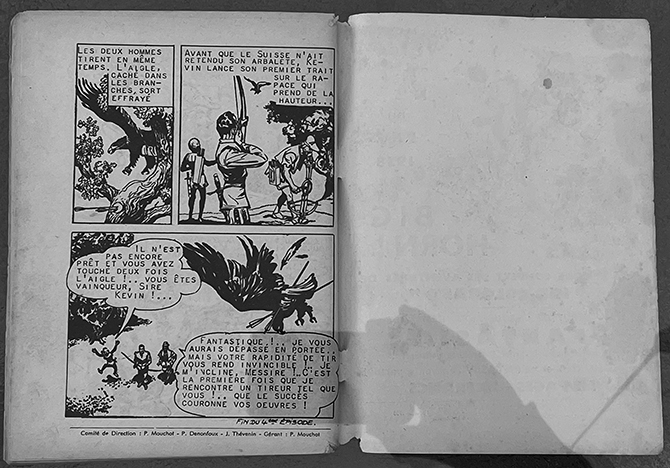
KEVIN LE HARDI brings up the rear of the book with the action picking up where it left off in BIG HORN No. 3. Originally published on January 13, 1952, the black and white comic book version pales in comparison to the beautiful Chicago Tribune color reproductions of the early 1950s.
Kevin le Hardi’s introductory page gives some back story (“To come to the aid of Princess Léa, sovereign of Glanstark, Kevin the Bold challenged a robber baron, Von Bleet, to a duel. Despite the Baron’s treachery, Kevin manages to defeat him, but the two men have fallen into a ravine, and Stub, the faithful squire, only finds the remains of von Bleet.”)
The comic book’s next 32 pages contain the conclusion of Kevin’s fifth chapter (Baron Von Blunt/Bleet), an entire (short) chapter, “The Deathtrap,” and the beginning of chapter seven, “The Treasure Hunt.” Although the episodes are edited and rearranged to some degree, the comic book covers 10 original Sunday episodes from January 13, 1952 to March 16, 1952.
As usual, a black and white ad promoting the next issue of BIG HORN is found on the back cover. No. 5 also features Kevin le Hardi.
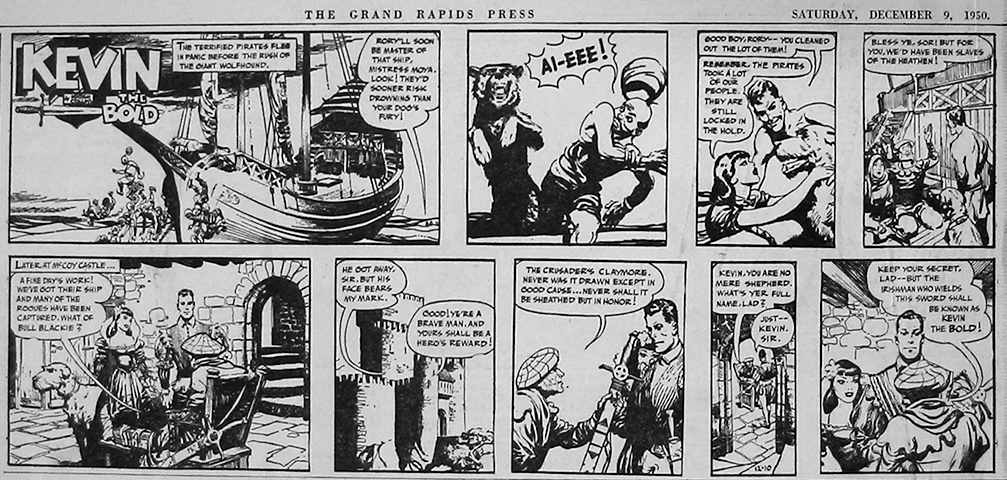
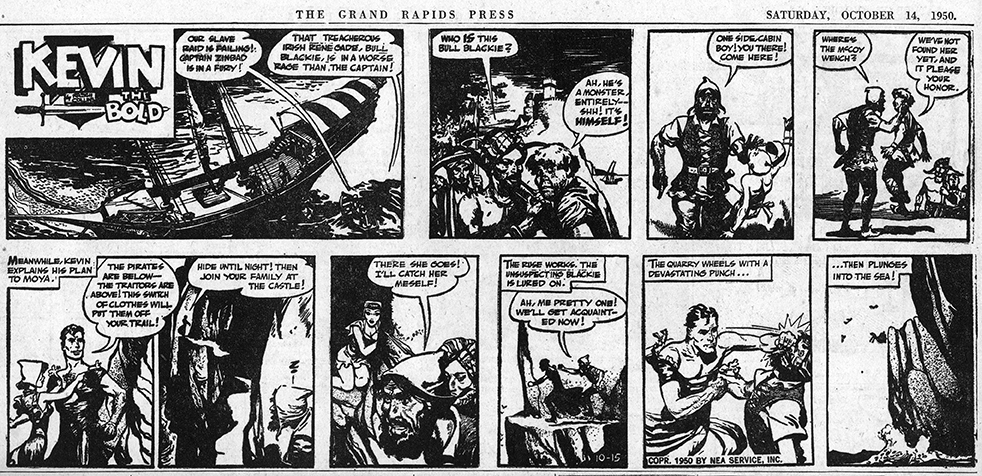
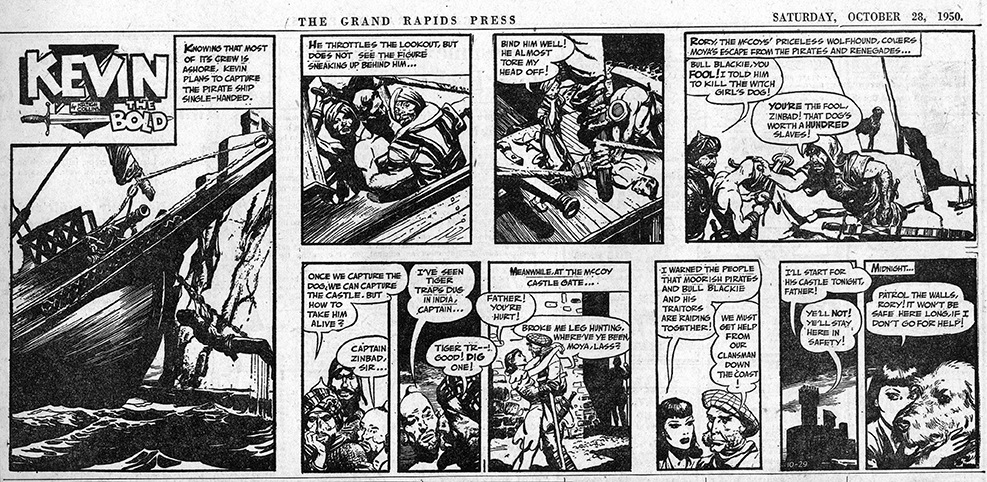
Captain Zinbad has decided to kidnap not only Moya and her family, but also Rory, their imposing Irish wolfhound.
In 1969, my family moved from Ann Arbor, Michigan to Fredonia, New York, when my father took a teaching job at SUNY-Fredonia. Along the trails in the woods behind our house, I remember digging tiger traps with my brother—knowledge passed down from my grandfather to my father to us. (We caught neither tigers nor wolfhounds).
Traitorous Bull Blackie has bad intentions with Moya, but the “witch girl” isn’t going down without a fight!
With Moya and Rory now also held captive, Kevin quickly devises a plan to set them all free.
Before diving overboard, Kevin uses his cutlass to scar Bull Blackie’s face. His Zorro-like swordplay and dialog was recycled from a story Collins had written and illustrated approximately fifteen years earlier. (I think his short story was titled “T Stands for Traitor”—alas, I cannot find the original. But trust me, it’s somewhere in the Grand Rapids Public Library’s Special Collection #56, a must-see for fans).
The introductory chapter ends with Kevin being knighted by the Moya’s father, Lord McCoy. While these roughly-assembled black and white third-page versions are interesting to see, the color half-page versions are quite an improvement—and they are included as the final chapter of The Lost Art of Kreigh Collins: The Complete Mitzi McCoy.
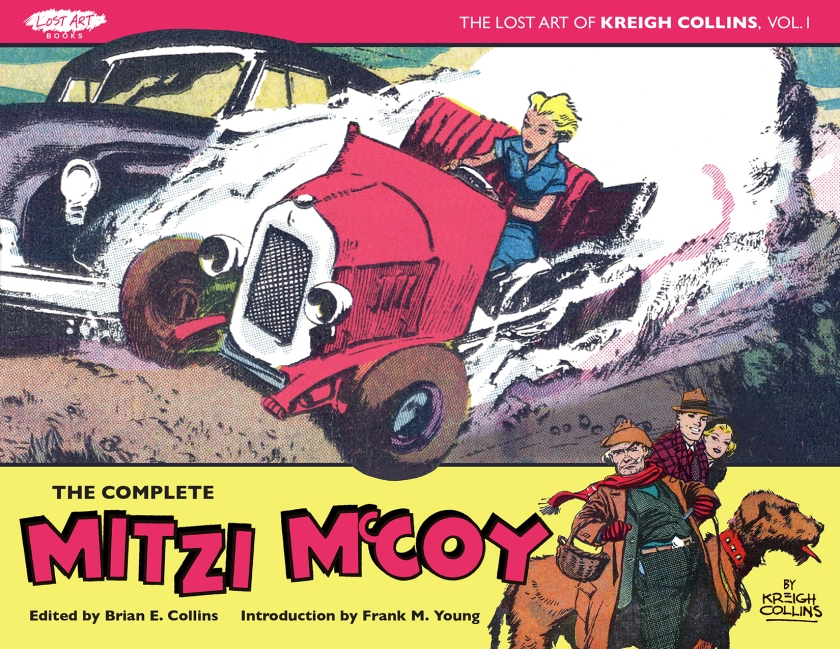
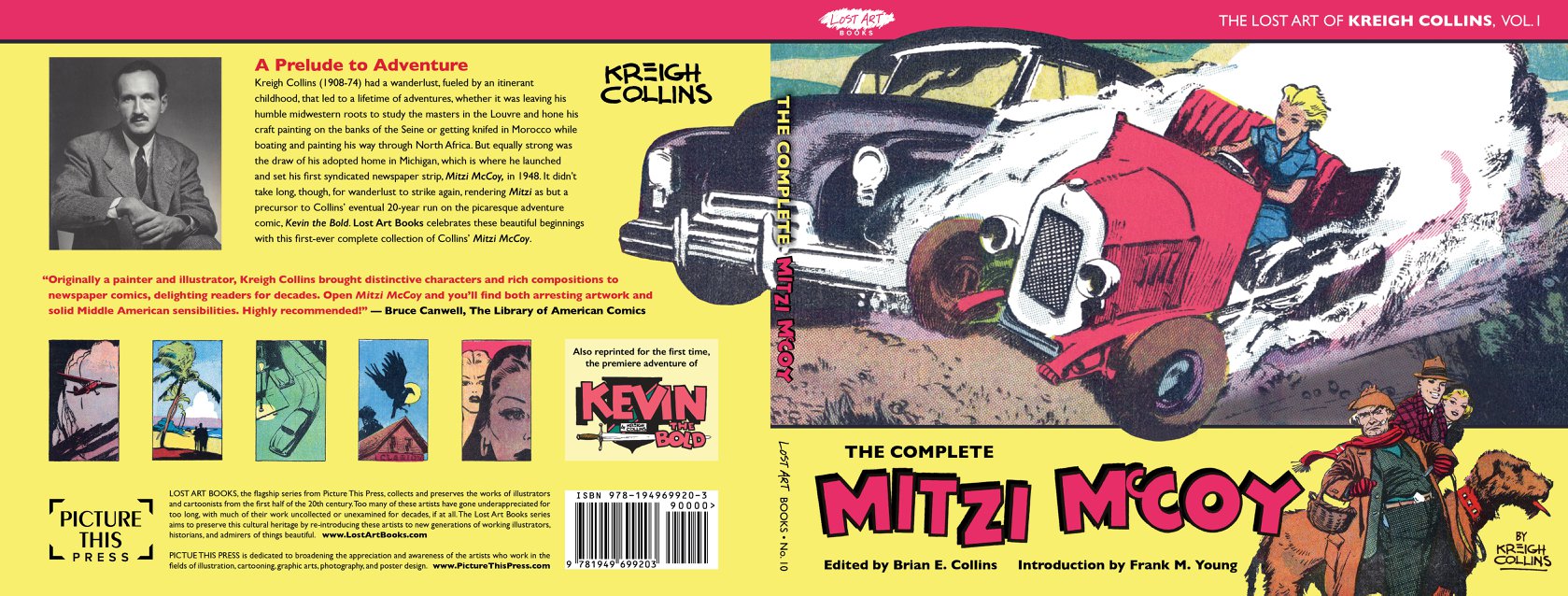
“The Lost Art of Kreigh Collins, the Complete Mitzi McCoy” features the entire run of Kreigh Collins’ first NEA feature, as well as the transitional story arc in which the strip morphs into KEVIN THE BOLD.
MITZI McCOY ran from 1948 to 1950 and showcased Kreigh Collins’ skill as an illustrator and storyteller. His picturesque landscapes, lovely character designs, and thrilling action sequences brimmed with detail and charm, and the strip’s ensemble cast rotated in and out of the spotlight taking turns as protagonists in the dozen story arcs collected in this volume. The last story collected in “The Complete Mitzi McCoy” is the narrative bridge that set Collins and his characters off on a new journey, beautifully told for the next couple of decades in the much-lauded adventure strip Kevin the Bold.
The collection includes an introduction by Eisner Award-winning author Frank M. Young, an Afterward by Ithaca College’s Ed Catto, and previously unpublished artwork and photos. Longtime comics artist Butch Guice also provides a new pin-up of the character Mitzi McCoy.
The book is available for $30. For domestic shipping, add $4; for international orders, please add $25 to cover first class shipping. To place an order, leave a comment below or email me at BrianEdwardCollins1[at]gmail.com, and I will give you PayPal or Venmo information. Thank you!
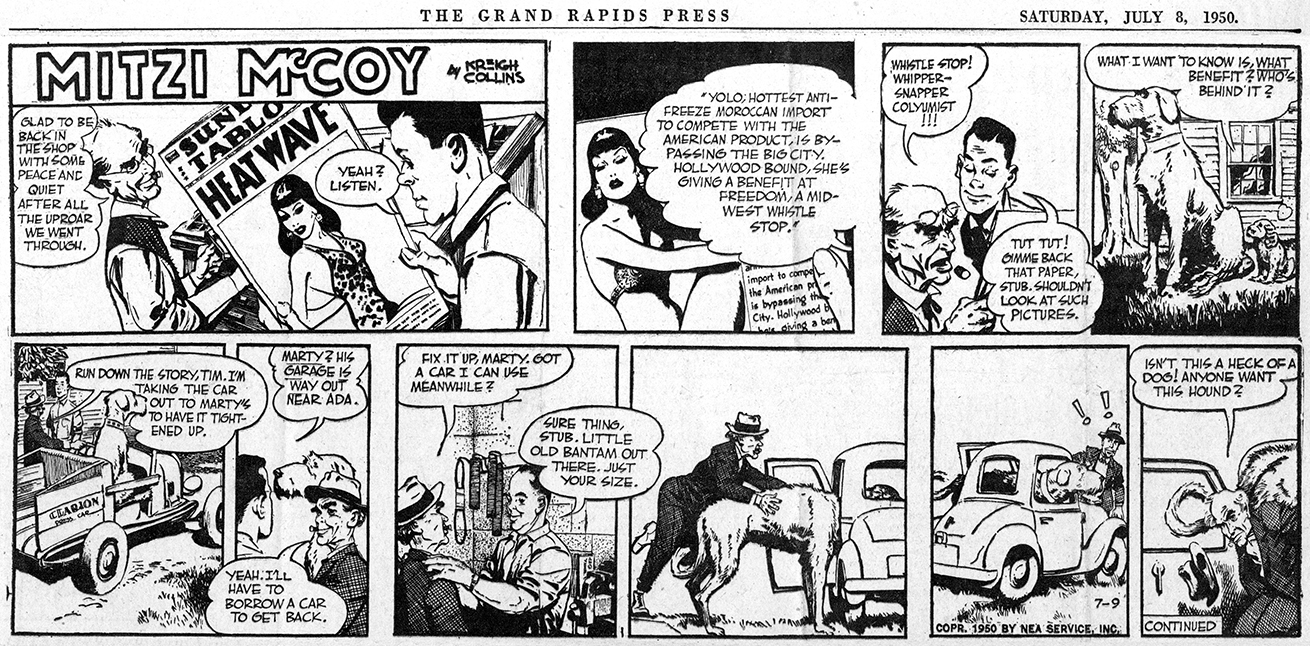
In the summer of 1950, MITZI McCOY started running in the Grand Rapids Press, which was not just Collins’ hometown newspaper, but a client. He had been doing illustrations for them since the beginning of his career, which began about 20 years earlier. (Collins also did work for another local daily, the Grand Rapids Herald).
The first print example is dated July 8, 1950, and it’s the leadoff episode in MITZI’s penultimate chapter, about an exotic woman named Yolo. (That story arc appeared on this blog previously).
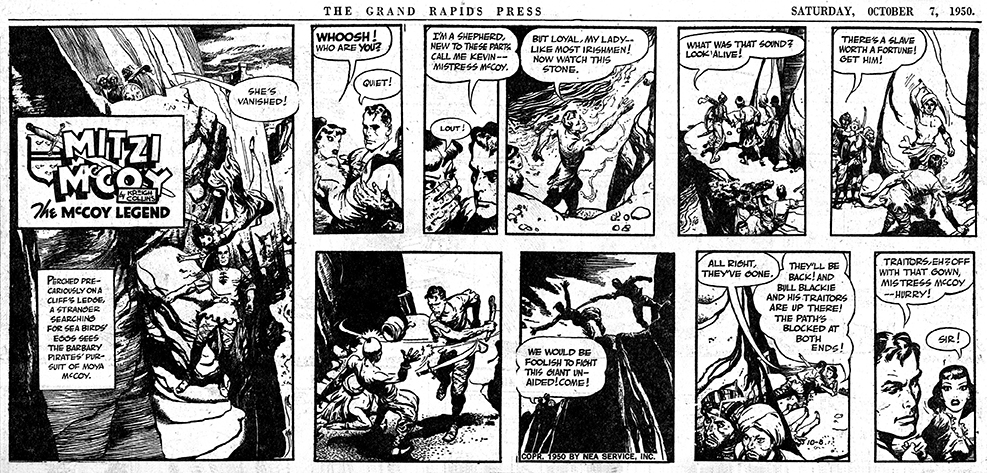
The chapter that followed Yolo will be featured over the next two weeks. “The McCoy Legend,” served as the transition point between MITZI and KEVIN THE BOLD. The big change in direction started innocuously enough, with Stub Goodman’s friend, Dick Dixon paying him a visit on a rainy day.
Stub loves to tell stories, and the one he relates to young Mr. Dixon is legendary—so much so that it uses a modified MITZI McCOY logo. For newspapers that had been running MITZI, this logo helped the reader navigate the change in the comic strip’s direction, whereas newspapers that were picking up Collins’ strip with KEVIN’s debut (like the Chicago Sunday Tribune) used an episode with the new KEVIN THE BOLD logo.
At any rate, readers of the Grand Rapids Press were the first to meet Kevin, as these episodes printed in the Saturday edition, scooping other Sunday readers. In it, Moorish pirates were raiding the Irish coast, looking for slaves.
Moya McCoy, Mitzi’s ancestress, has a sudden meeting with Kevin, and this overqualified shepherd soon comes to her aid. After two episodes, the “McCoy Legend” logo was replaced, and the metamorphosis was complete.
This opening chapter was an action-packed classic, and introduced a character who became a fan favorite—Rory the Irish wolfhound.
Having leaped from the cliff into the sea, Kevin makes his way to the pirates’ ship, which he hopes to capture single-handedly.
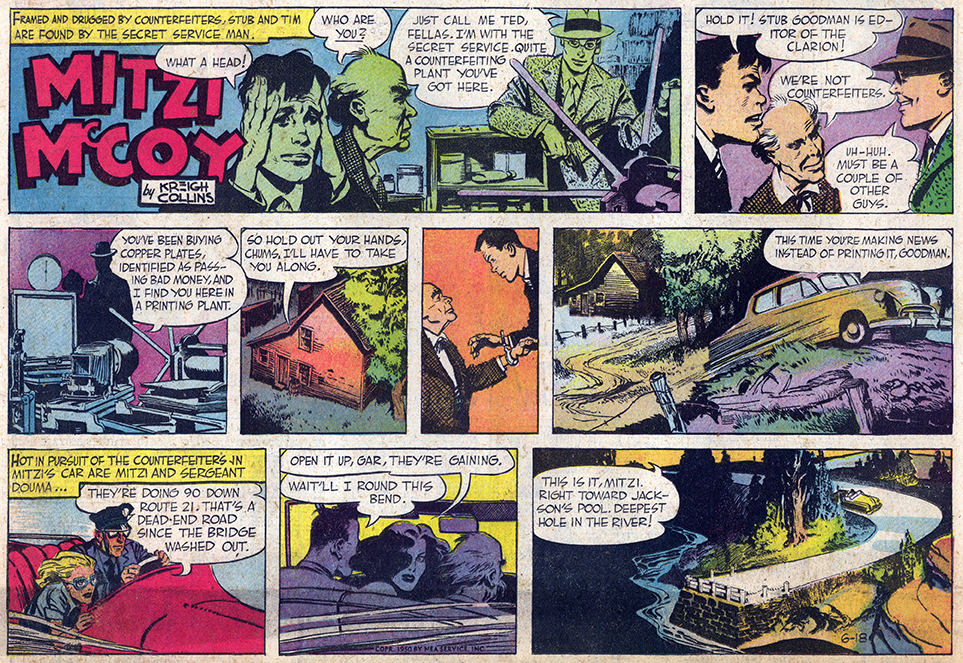
Stub and Tim awaken from their stupor to in front of a very interested government agent. Meanwhilke, Mitzi and Sgt. Douma are in hot pursuit of Zoe and her gang.
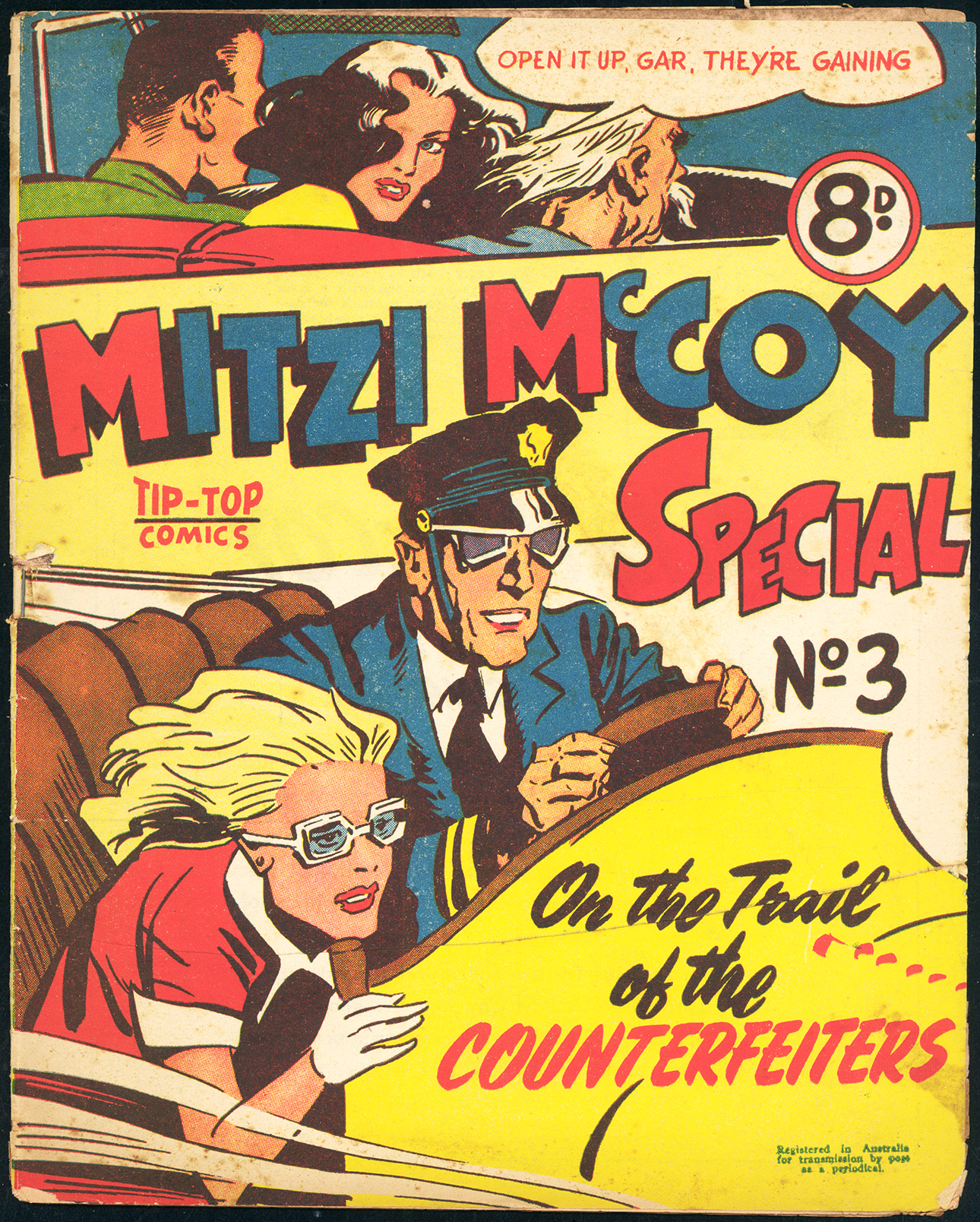
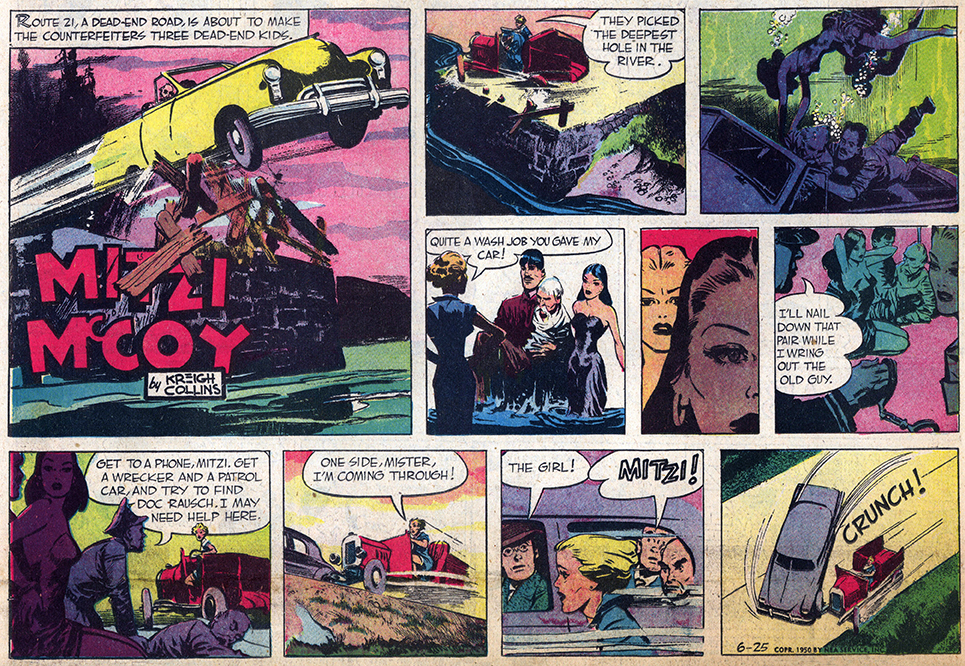
The June 18, 1950 episode inspired the cover of an Australian comic book—Tip-Top Special No. 3. In addition to this story arc about the Counterfeiters, Special No. 3 also includes MITZI McCOY’s two previous chapters, “Tiny to the Rescue” and “The Living Pinups.”
In an extremely dramatic episode, the surprise to me was finding out how much Mitzi prized her car! The spirited lass was certainly one of the Sunday funnies’ stereotype breakers.
In choosing the cover artwork for the MITZI McCOY collection I assembled, a solid option would be the splash panel from the August 28, 1949 episode.
However, the chapter with the counterfeiter gang was always my preference. The previous episode’s splash panel was exciting, but Mitzi wasn’t in it. I went with the chapter’s final episode. The episode itself is wonderful, and is a star performance from the comic strip’s titular character.
What MITZI McCOY artwork do you think would have best suit the cover of the book? Please let me know by commenting below or sending an email to brianedwardcollins1[at]gmail.com.
“The Lost Art of Kreigh Collins, the Complete Mitzi McCoy” features the entire run of Kreigh Collins’ first NEA feature.
MITZI McCOY ran from 1948 to 1950 and showcased Kreigh Collins’ skill as an illustrator and storyteller. His picturesque landscapes, lovely character designs, and thrilling action sequences brimmed with detail and charm, and the strip’s ensemble cast rotated in and out of the spotlight taking turns as protagonists in the dozen story arcs collected in this volume. The last story collected in “The Complete Mitzi McCoy” is the narrative bridge that set Collins and his characters off on a new journey, beautifully told for the next couple of decades in the much-lauded adventure strip Kevin the Bold.
The collection includes an introduction by Eisner Award-winning author Frank M. Young, an Afterward by Ithaca College’s Ed Catto, and previously unpublished artwork and photos. Longtime comics artist Butch Guice also provides a new pin-up of the character Mitzi McCoy.
The book is available for $30. For domestic shipping, add $4; for international orders, please add $25 to cover first class shipping. To place an order, leave a comment below or email me at BrianEdwardCollins1[at]gmail.com, and I will give you PayPal or Venmo information. Thank you!
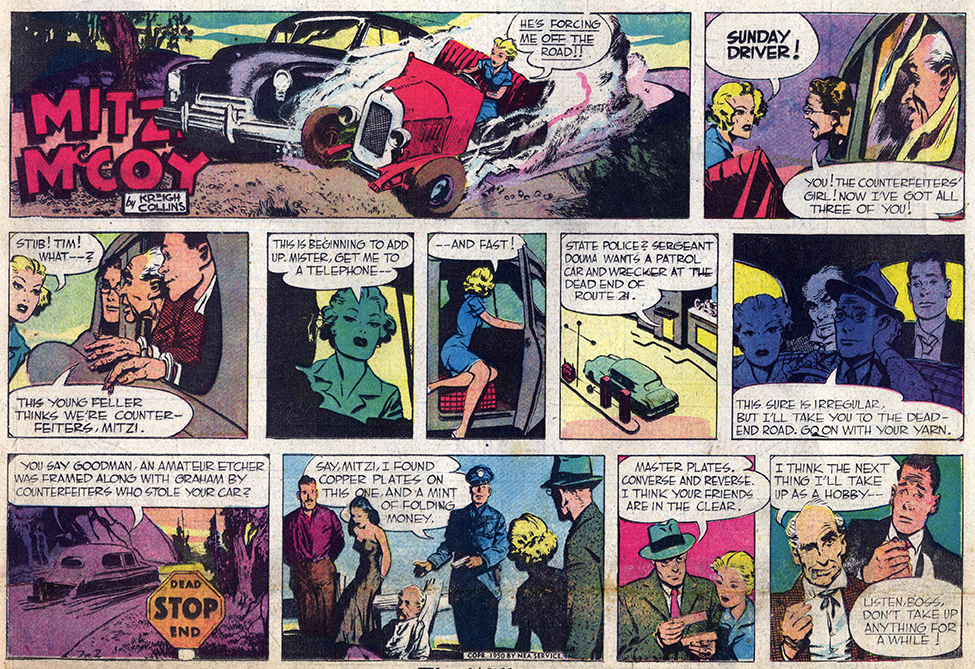
As more is revealed about the counterfeiter gang—Zoe, Gar, and Greenbax—the darker the chapter becomes.
Despite his strong reaction to being blindsided by the thuggish Gar—including a two-fer knockout punch—Tim Graham gets blindsided a second time by the blackjack-wielding Zoe.
Clearly the brains behind their operation, Zoe is also the gang’s secret weapon, with her arresting appearance. The cold-hearted Jezebel does show a bit of a conscience in a beautiful throwaway panel, but she immediately reverts to form, dosing Tim and Stub with barbiturates.
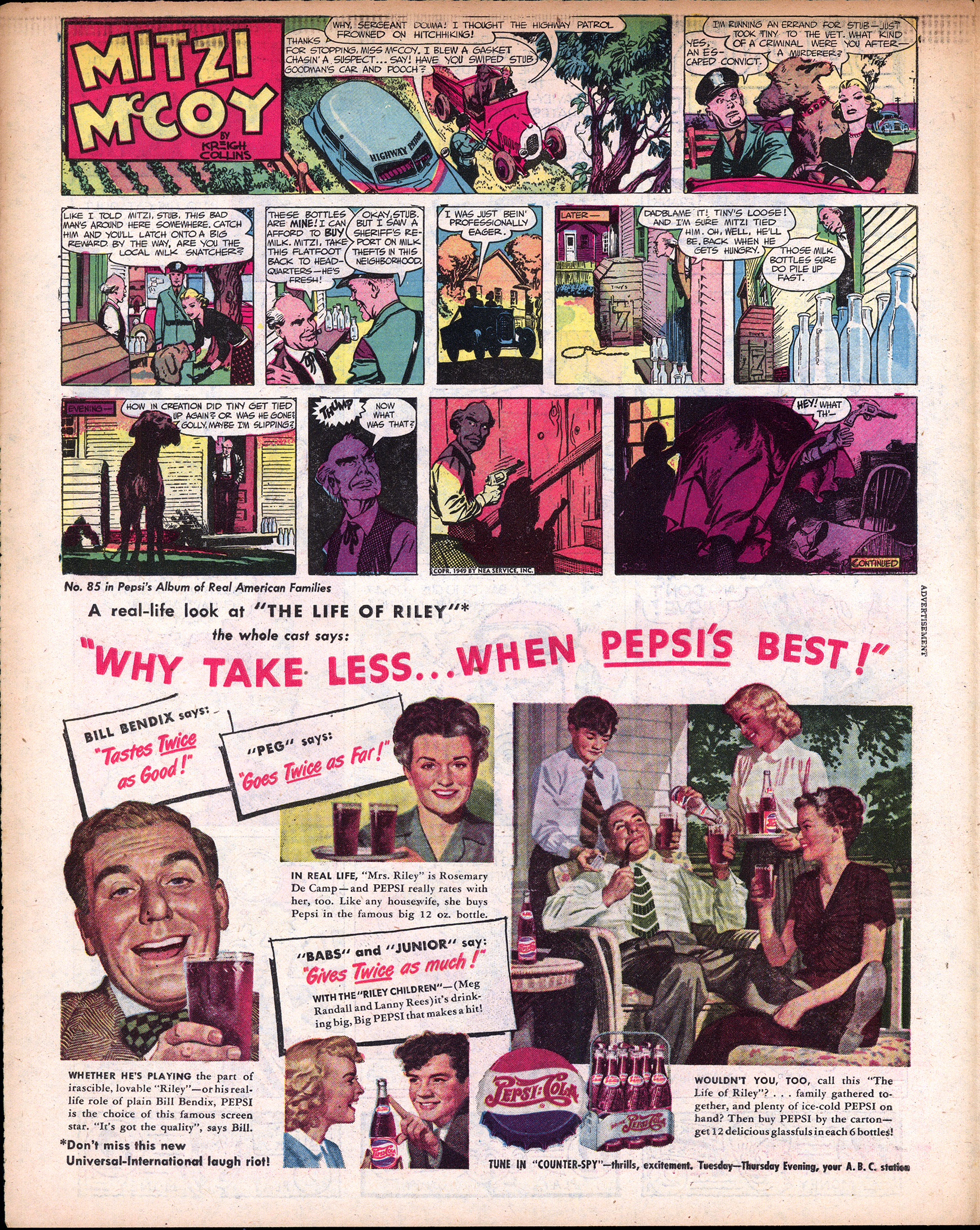
Sgt. Douma was a recurring character. His previous appearance was about a year earlier—shown in this half-tabloid from the New York Sunday Mirror. (I love those old advertisements!)
Knowing her car’s capabilities, Mitzi convinces the skeptical Sgt. Douma to take the wheel of Stub’s hotrod.
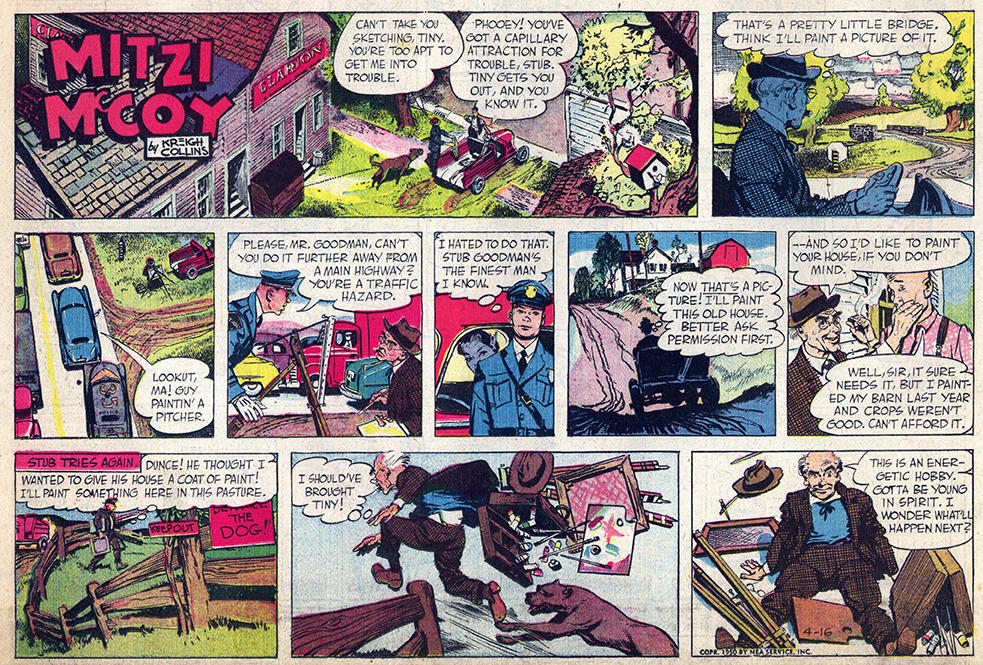
MITZI McCOY existed for less than two years, only enough time for 11 distinct chapters. The following story arc was the second-to-last chapter, and is one of my favorites.
All of the following episodes are taken from the Pittsburgh Press, which featured MITZI as the lead comic in its collection of Sunday funnies.
It’s a light-hearted affair, wrapping up the previous chapter. It features some slang I had to look up (“hay burner” = horse), and references the Winston Churchill’s painting hobby (a contemporary development; this episode appeared less than five years after the end of WWII).
Stub soon learns that landscape painting is a young man’s game—something that Kreigh Collins had discovered himself. He was 42 years old at this point, and had been working professionally for over 20 years. During the first fifteen years of hios career, he worked primarily as a painter. He started with landscapes, learning from the esteemed Michigan painter Matthias Alten. Later, in the Depression years, he produced numerous large murals as well as portraits, but his painting career was cut short by a shoulder injury suffered in the mid-1930s. His recovery led to his new focus on pen and ink illustration, which eventually led to his gig as a syndicated Sunday comic strip artist.
I haven’t seen any evidence of my grandfather having ever taken up etching, but for the purpose of the storyline, it makes sense for Stub to take up something “easier” than landscape painting.
While doing research for my MITZI McCOY book, I learned that Collins based Mitzi’s appearance on Rita Hayworth… I wonder who his inspiration was for his new femme fatale (whose name, Zoe, would be revealed in a later episode).
“The Lost Art of Kreigh Collins, the Complete Mitzi McCoy” features the entire run of Kreigh Collins’ first NEA feature.
MITZI McCOY ran from 1948 to 1950 and showcased Kreigh Collins’ skill as an illustrator and storyteller. His picturesque landscapes, lovely character designs, and thrilling action sequences brimmed with detail and charm, and the strip’s ensemble cast rotated in and out of the spotlight taking turns as protagonists in the dozen story arcs collected in this volume. The last story collected in “The Complete Mitzi McCoy” is the narrative bridge that set Collins and his characters off on a new journey, beautifully told for the next couple of decades in the much-lauded adventure strip Kevin the Bold.
The collection includes an introduction by Eisner Award-winning author Frank M. Young, an Afterward by Ithaca College’s Ed Catto, and previously unpublished artwork and photos. Longtime comics artist Butch Guice also provides a new pin-up of the character Mitzi McCoy.
The book is available for $30. For domestic shipping, add $4; for international orders, please add $25 to cover first class shipping. To place an order, leave a comment below or email me at BrianEdwardCollins1[at]gmail.com, and I will give you PayPal or Venmo information. Thank you!
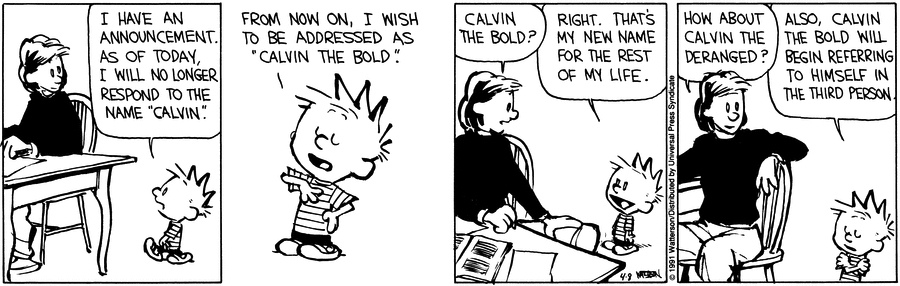
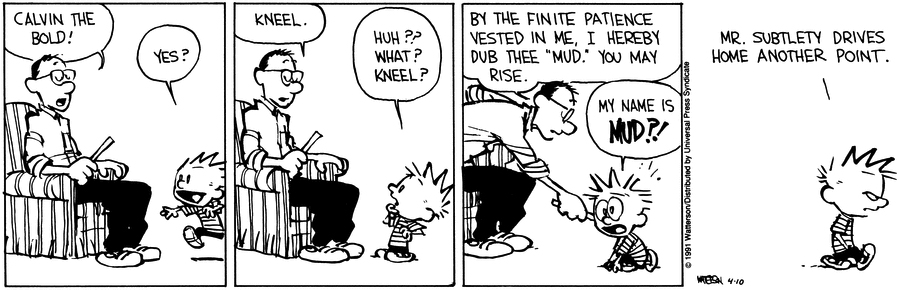
I think pretty much everyone is a fan of CALVIN AND HOBBES. Even folks who don’t like comics probably like Bill Watterson‘s amazing creation. But is it possible that Watterson was a fan of KEVIN THE BOLD?
In the spring of 1991, Calvin assumed a new identity.
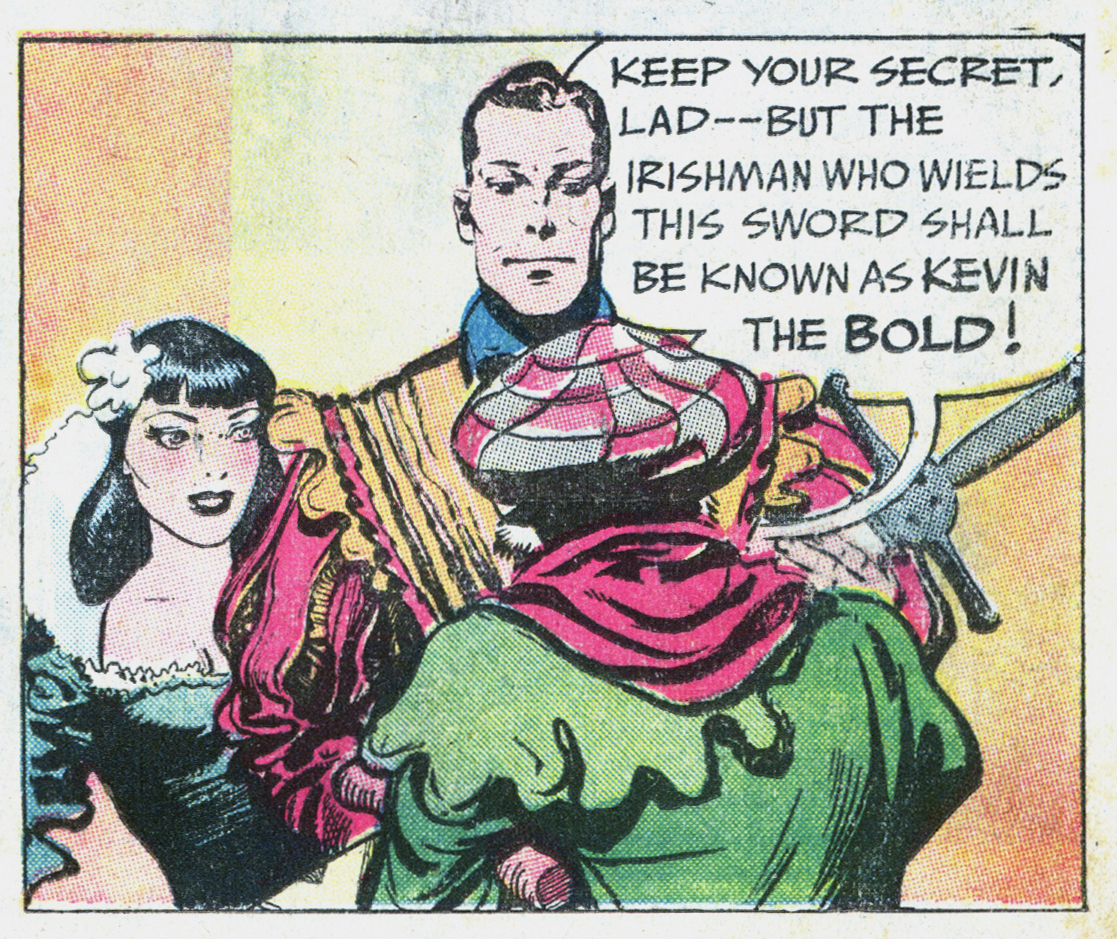
Calvin the Bold! Though it caused befuddlement in Calvin’s universe, the name sure rings a bell for me!
CALVIN AND HOBBES ran in 2,000 newspapers. To have been the (likely) inspiration for Watterson is quite an honor. KEVIN THE BOLD had been out of print for decades.
Would his new identity last? That would be so cool.
Well, yes, but for only three days (April 8–10, 1991). Besides, it’s bad form to give yourself a nickname. In polite society, sobriquets should be bestowed by others.
Over the course of his 24-year career illustrating comics for NEA, Kreigh Collins received quite a bit of fan mail. No doubt it was flattering for Collins to read, but the real benefit was more tangible. Fan mail indicated engaged readers, and led to better treatment from the newspapers running the comics—more desirable placement in the comics section, and less chance of running in the unflattering one-third page version. When letters arrived at the NEA offices, staffers wrote back, thanking them, but suggesting they send praise directly to their local paper.
During the “Mitzi McCoy” era, Stub Goodman’s dog Tiny was the inspiration for much of the positive reader response. Tiny was an enormous Irish Wolfhound, and became the favorite of many, especially members of the Irish Wolfhound Club of America. Initially, these letters were encouraged—Lynn thought he could mobilize an enthusiastic base in a letter-writing campaign to help boost “Mitzi” ’s profile. Soon, however, it was decided the amount of energy spent catering to the wolfhound aficionados outweighed any benefit they provided.
After the successful debut of “Kevin the Bold,” one letter writer wondered (correctly) if the the comic strip was created by the same Kreigh Collins he had known who did illustration work for Chicago ad agencies in the early 1930s. (After all, my grandfather wasn’t the only one with that unusual name).
What other letters often had in common, besides praise, was a request. Would Mr. Collins please sent an autographed photo? Could he please send a drawing of Tiny/Mitzi/Kevin? Or would he be able to send a piece of original artwork?
Collins was happy to oblige. In his era, original comic art didn’t hold the cachet it does today. By the time his original illustrations were returned to him, those episodes were ancient history, and Collins would be busy refining layouts for upcoming comics and developing scripts for future ones. Besides mailing art to far flung fans, Kreigh also gave them to friends closer to home. Though it isn’t in fantastic condition, my favorite “Kevin the Bold” original is the one my Grandpa Collins gave to my Grandpa Palmer (my mother grew up in Grand Rapids, about ten miles from my father, who hailed from Ada, Michigan).
Personalized by the artist, top left.
Many letters complimenting Collins’ fine illustrations came due to his dogged research efforts, whether of 16th-century Austrian armorer Konrad Seusenhofer (“my family were armorers for generations going back as far as 1250… would you be so kind to give me the source of the information…”), 16th century sailing ships (“Above all I have enjoyed the lavish details that you put into your caravels…”), or period-appropriate clothing (“the thing I am so very fond of are the gorgeous clothes”).
Features Director Ernest Lynn used the fan mail as a sales tool. A letter sent to Miami Herald brass collected several glowing quotes and a referenced the Chicago Tribune’s use of “Kevin the Bold” in an attempt to persuade them to feature the comic.
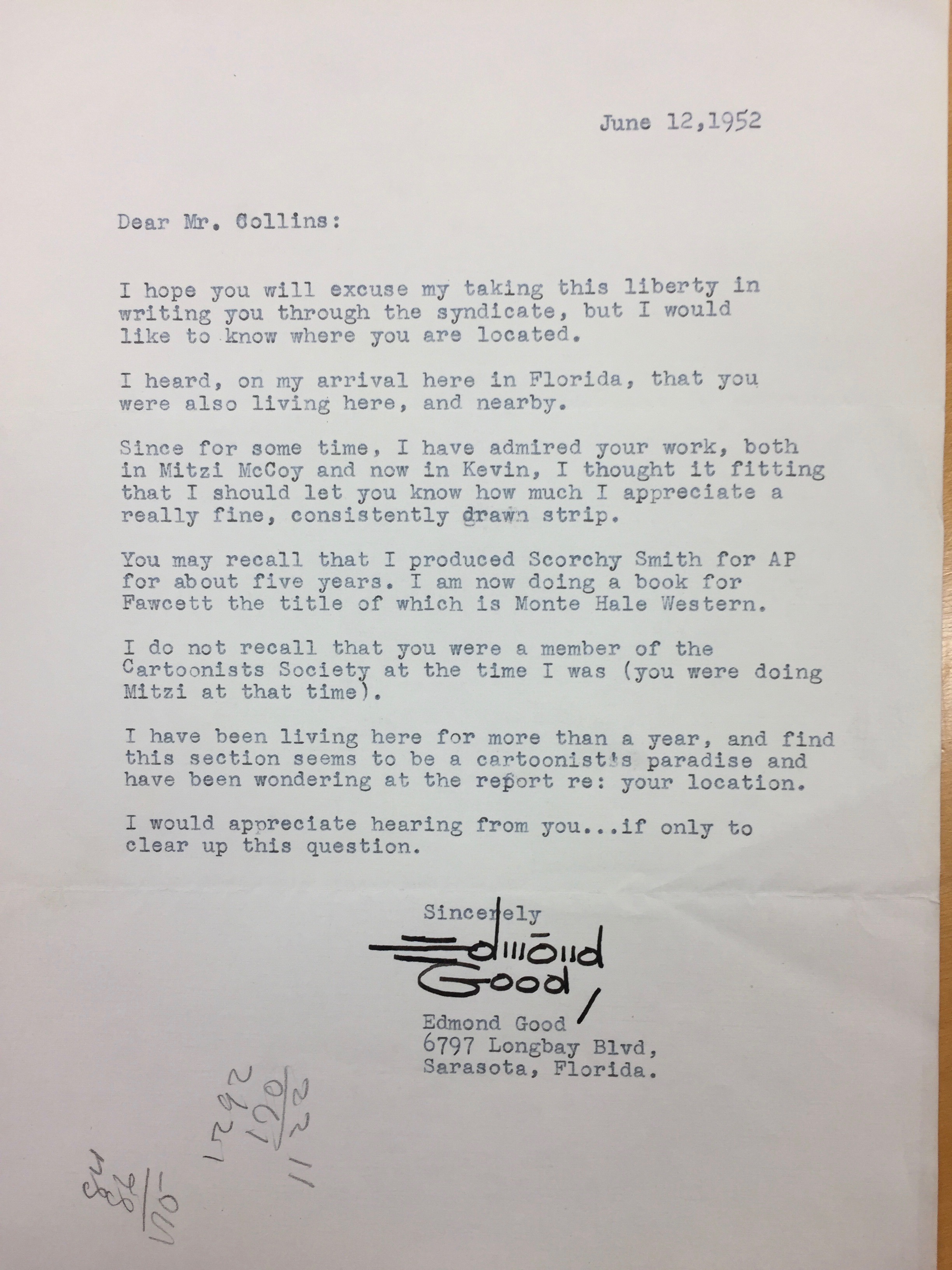
Letters from hobbyists and art students are one thing, but recognition from peers is something else. Another 1952 letter came from comic book artist Edmond Good. I was unfamiliar with his name, but after seeing his telltale signature, I looked him up.
For more information on the career of Kreigh Collins, visit his page on Facebook.
For a while, it seemed like the results of last week’s survey would be unanimous, but a late flurry of vote (singular intended—Ed.) made things interesting. As I was color-correcting the pages of what was Rafa G’s request, TOM MIX Nr. 4, a second vote came in from Alberto, tying the score. With no tie-breaker in place, a New York Mirror Sunday comics section will have to wait until next month.
Although my ruse didn’t produce an overwhelming response, it was nice to hear from a few readers. As for the third request I received (thanks, Roger!), the Treasure Hunt chapter will begin next week.
Like the preceding issues, the cover for TOM MIX Nr. 4 was printed in color on a nice, sturdy cover stock, with black and white inside covers. Released two weeks after its predecessor, the cover seems to feature General George Custer. (I might be missing something, but I didn’t find this character inside the comic book). Besides the cachet of being a nicely printed, 70-year old comic featuring the Swedish version of KEVIN THE BOLD, it features a few other elements that coincidentally align with some of my (other) fondest obsessions—the Buffalo Bills, beer, and Johnny Cash.
As usual, two episodes of UGH appeared on the inside front cover. The main portion of the comic book was kicked off by a mock-up of a newspaper’s front page.
TOM MIX runs across three spreads…
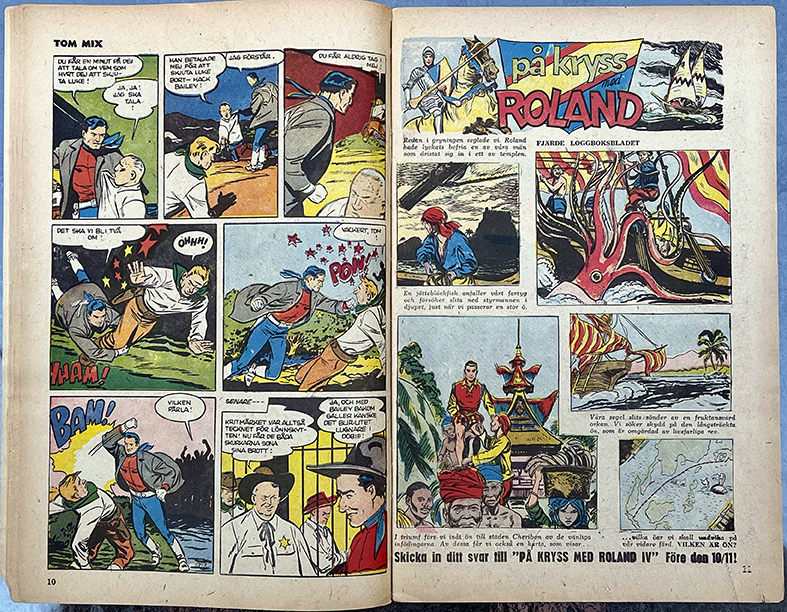
…and concludes on a page facing the recurring På Kryss med Roland contest, notable for its imagined adventures, this time featuring a giant squid on the attack.
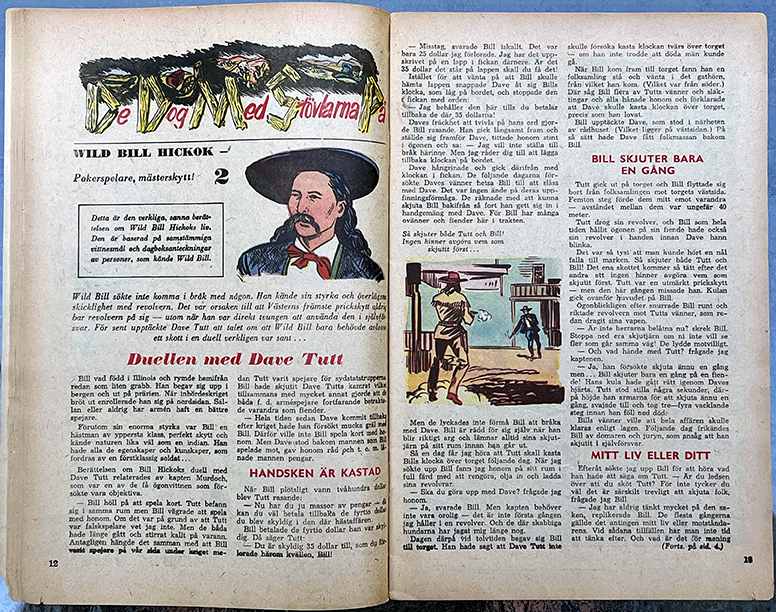
De Dog Med Stövlama På (“They Died with their Boots On”) follows; it profiles “Wild” Bill Hickok, the notorious gun-fighting western figure.
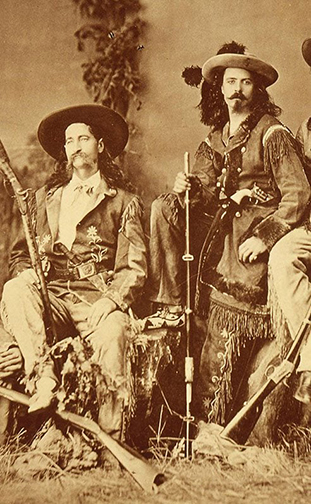
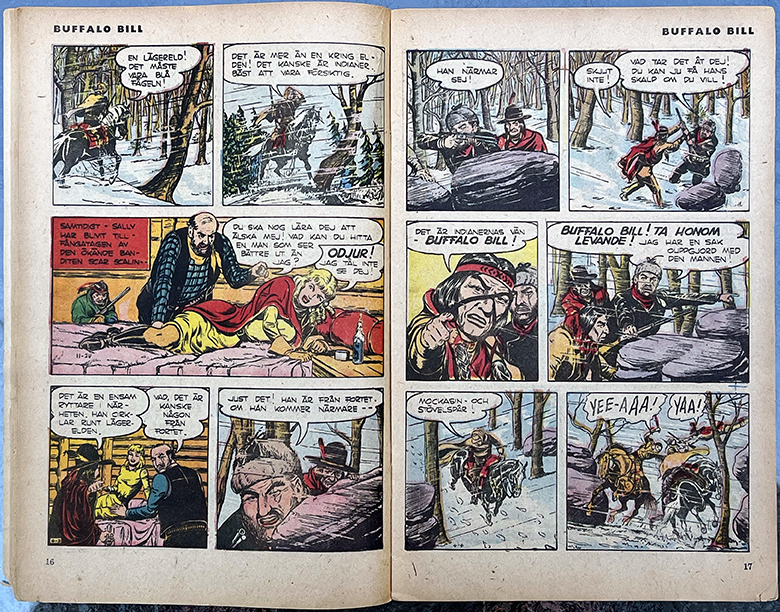
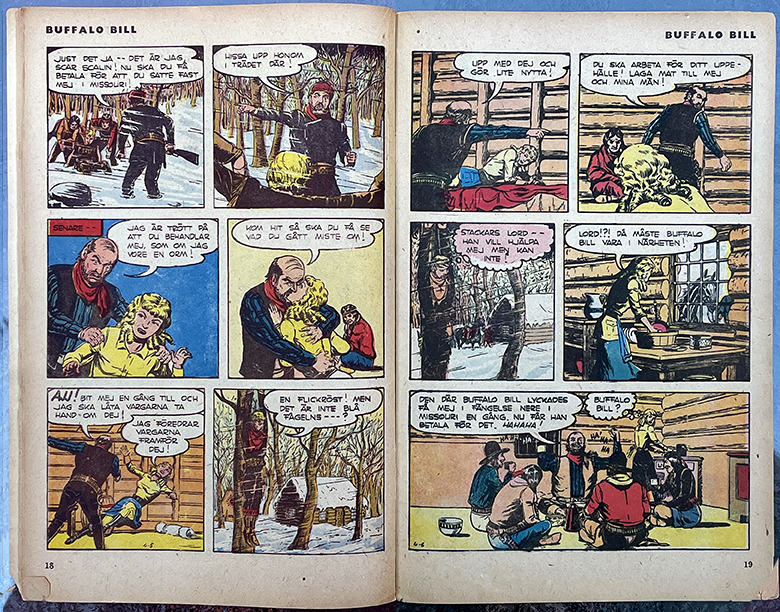
Eight pages of a comic based on the exploits of William F. “Buffalo Bill” Cody followed. Interestingly enough, “Wild” Bill Hickok and Buffalo Bill knew each other—in fact, Hickok became Cody’s mentor.
Two Bills—“WIld” (left) and “Buffalo” (right).
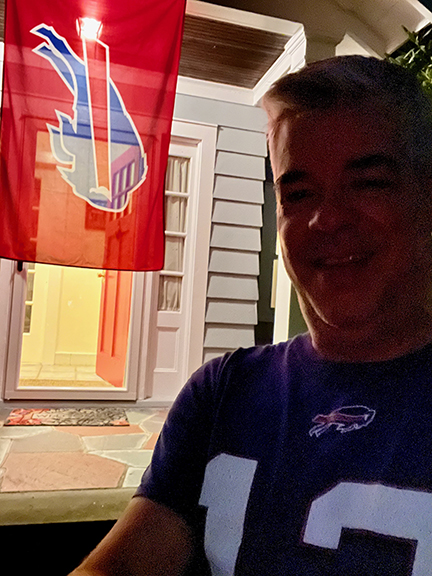
I’m not overly familiar with either of these Bills, but having grown up in western New York State, I’m a big fan of the (American) football team, the Buffalo Bills!
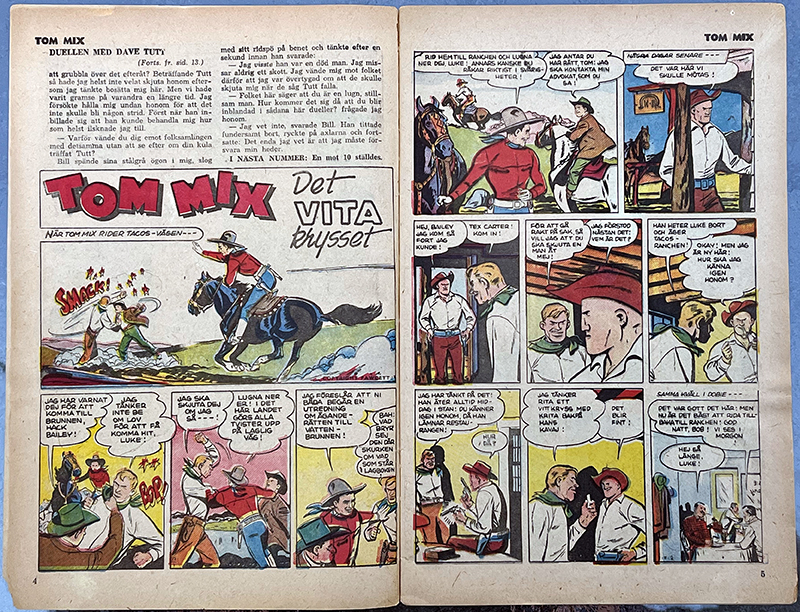
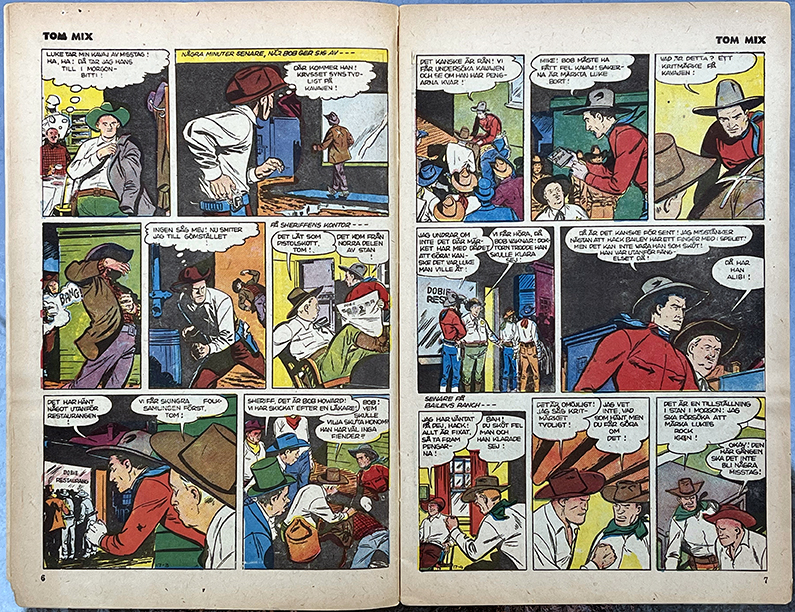
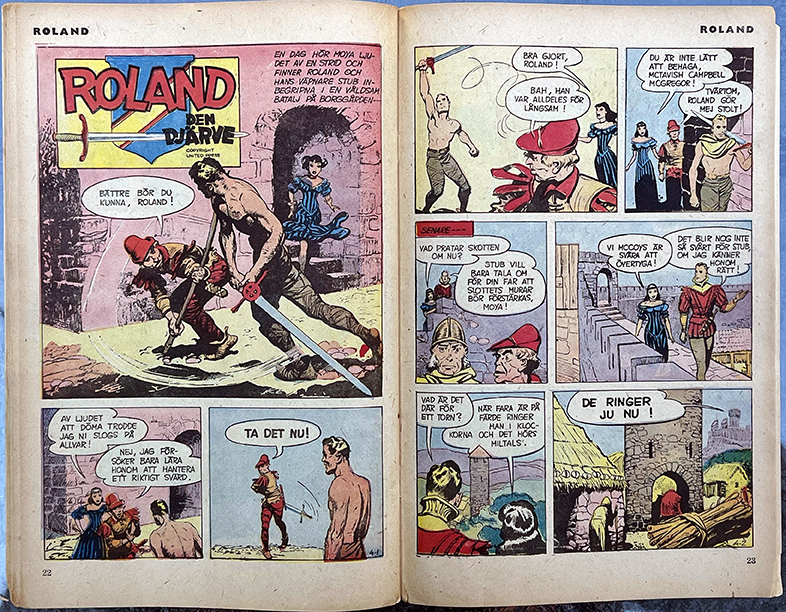
Next up was ROLAND DEN DJÄRVE. The action picks up where it left off in TOM MIX Nr. 3, with the episode originally published on December 24, 1950. The comic book publisher created their own color separations, and an interesting choice was made for the color of Roland’s hair—he’s blond (not the first time Kevin was depicted as a toehead).
To fit in the comic book, the three Sunday half pages were repurposed quite smartly, with each episode being reconfigured into a comic book spread.
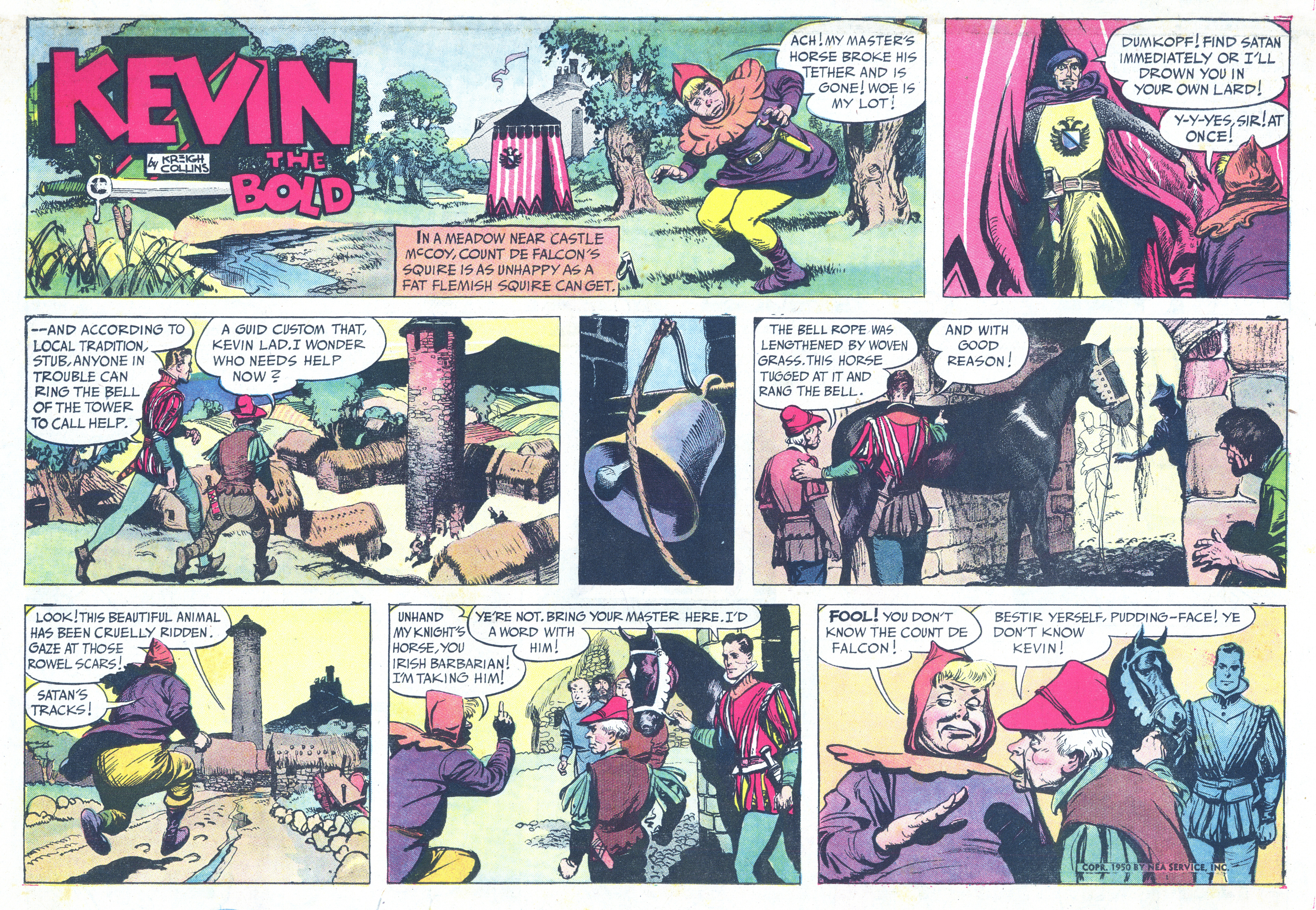
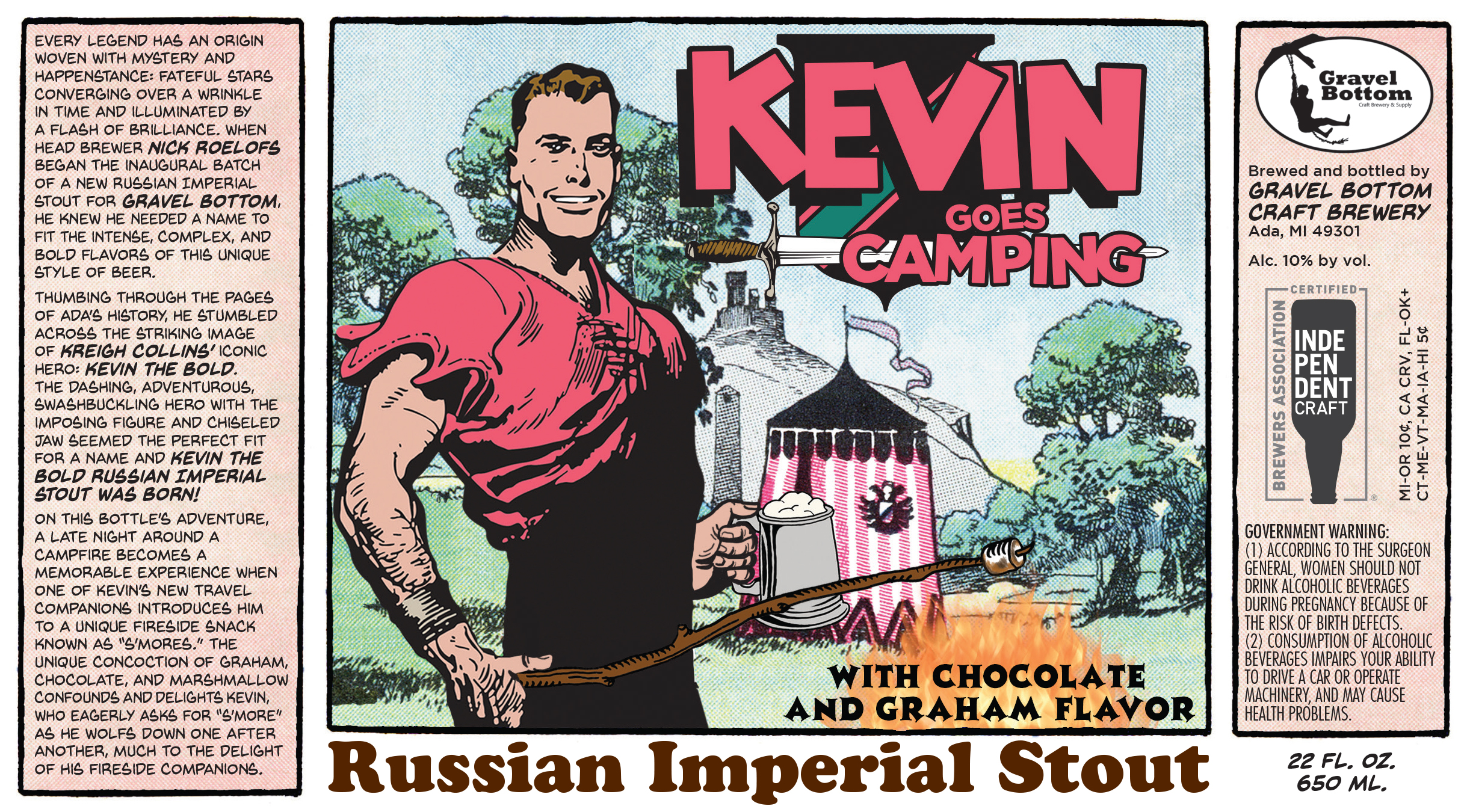
As a Buffalo Bills fan, it might come as no surprise that I’m also a fan of beer; I used the little tent seen in the introductory panel of the December 31 episode as part of a beer label I created for Ada, Michigan’s Gravel Bottom Brewery—Kevin the Bold Imperial Stout.
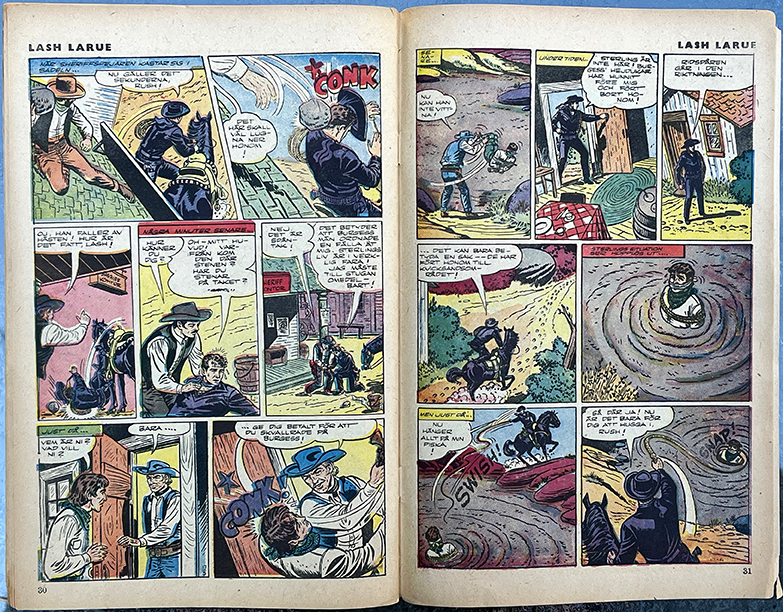
Following Kevin, it’s time for LASH LaRUE.
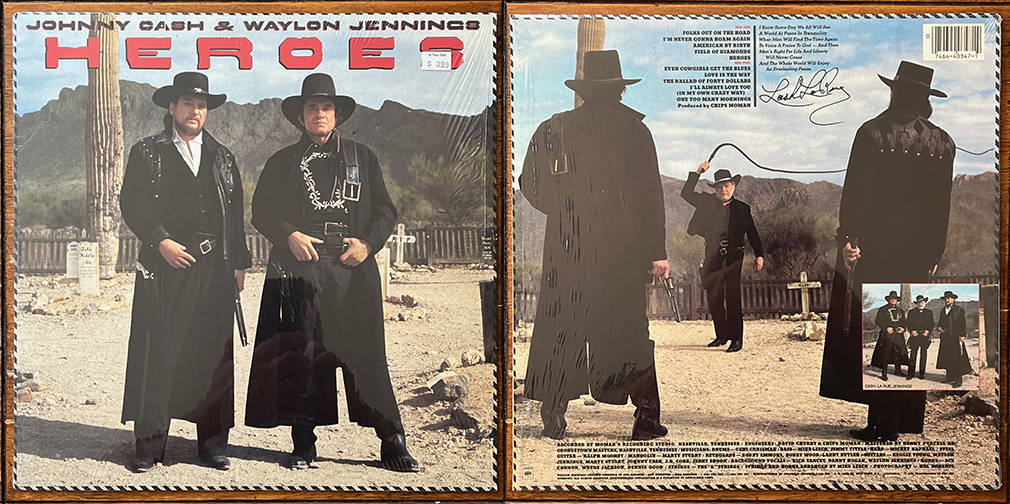
My only familiarity with Lash LaRue is the fact that he appeared on the cover of a mid-1980s album by another of my obsessions, Johnny Cash. (Before I started collecting my grandfather’s comics, I collected Johnny Cash LPs. I don’t have them all, but 94 is a pretty substantial total—even without including CDs and cassette tapes, but I digress). The handsomely-photographed album features an action shot of Mr. LaRue on the back cover. (Sadly, the version of “Heroes” that appears at the end of side one is not a cover of David Bowie’s memorable track).
No offense to Johnny or Waylon, but the cover art is the album’s highlight. Getting back to the realm of comics, it’s interesting to know that Johnny even had his own comic book.
TOM MIX Nr. 4 concludes with a short story running on the inside back cover, Afrikas Vän (“Africa’s Friend”), about David Livingstone.
Despite owning a book on Livingstone written and illustrated by Kreigh Colllins (1961), my knowledge of the famed explorer was quite spotty. (I was happy to learn that he was an abolitionist, and not out to exploit Africa).
Livingstone’s portrait is featured on the back cover of TOM MIX Nr. 4.












































 Kreigh’s Comics

