Bad Hair Day

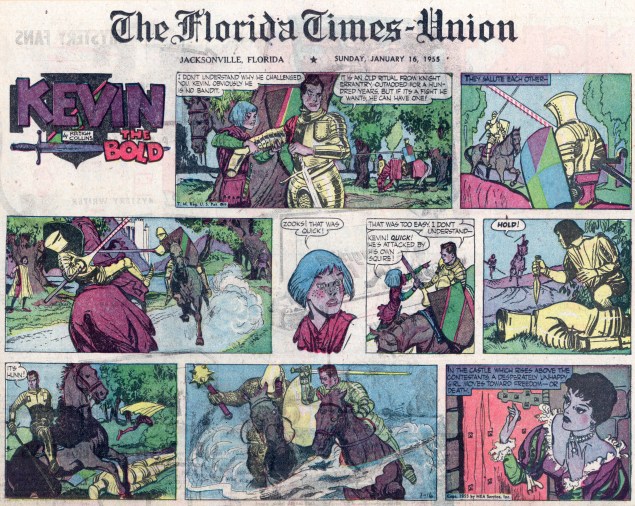
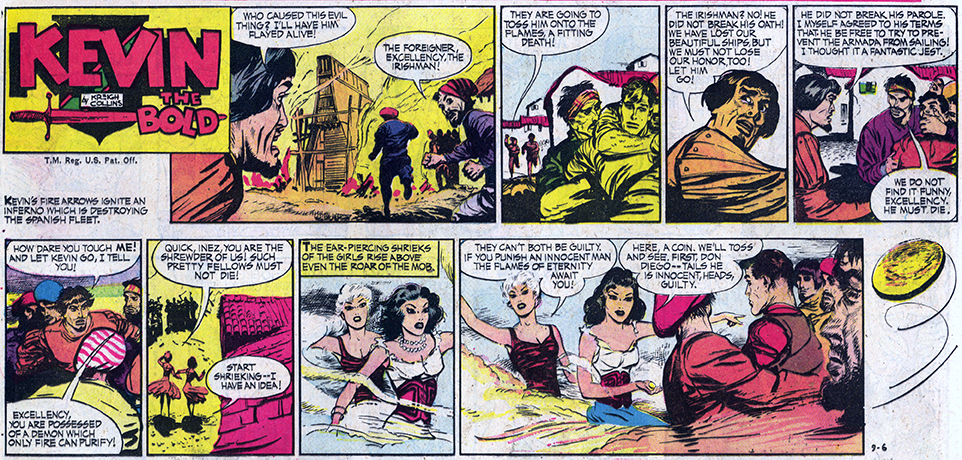
Some Sunday comic sections were known for their high-quality coloring jobs, others less so. But no matter where they appeared, comics were reproduced using the standard four-color process: cyan-magenta-yellow-black. I doubt the Florida Times-Union won many awards for color reproduction, as this comic from early 1955 makes clear. The yellow and cyan plates were switched, resulting in bizarre colors, most notably in Brett’s blond hair — check out the ’do in the throwaway panel! The foliage was relatively unaffected, being comprised up of both cyan and yellow, but anything colored primarily in tints of yellow (hair) or cyan (armor) had a pretty undesirable appearance (not to mention those skin tones).

KTB 011655 HF 300 x QCC

KTB 011655 HF 300 cc

Merry Christmas and a Good 1969

KTC xmas 68 200

1968 was filled with change. After appearing for 19 years, “Kevin the Bold” ended its run. At the age of 61, Kreigh Collins launched his third comic strip, “Up Anchor.” This fresh start was the big news in the holiday letter Kreigh and Teddy sent out that December. There were also family updates , typical New Year’s optimism, and a dose of Kreigh’s wit.

“Up Anchor” ran until early 1972, and after its 174 episodes, Collins retired. All told, Kreigh’s comics appeared for 25 years, spanning four decades — over 1,200 Sundays.

UA envelope 72

Selling Mitzi

MM 122648 Slick Promo 72 cc

As the calendar flipped to 1949, “Mitzi McCoy” began to appear in more and more newspapers. The NEA would use nice, clean reproductions of the comics on glossy paper to try and sway comics editors’ opinions of the appeal of the strip. By February, 35 newspapers across the United States and Canada were running the comic.

However, conservative attitudes held more sway in some cities than others. In one such case, the Sunday Editor at the Boston Post, John H. Griffin, informed the NEA that Mitzi showed more of her female charms than the Post was comfortable  printing.

This was the era when Dr. Fredric Wertham began pushing his ideas on the alleged negative effects of comic books on children. A 1948 interview with Wertham in Collier’s magazine was titled “Horror in the Nursery.”  The reaction to Dr. Wertham’s views was swift. By spring, a story in Time magazine quoted Detroit Police Commissioner Harry S. Toy, who declared all the comic books available in his community were “loaded with communist teachings, sex, and racial discrimination.” Mass burning of comic books began across the country.

Appealing to Collins, his boss, NEA features director Ernest Lynn, emphasized the importance of signing the Post: “keep her as attractive as possible, and snappily dressed, and don’t try to conceal the fact that she is a woman. Just let good taste be our guide always, and when there is a question of doubt, lean over backwards on the side of the Watch and Ward Society.” However, Wertham’s beliefs seem to have prevailed, as “Mitzi McCoy” never ran in the Post’s pages. 

Promoting Mitzi

MM Promo3 cc

The NEA provided promotional materials for newspapers that ran its comics, including Mitzi McCoy. The promos featured nice artwork, some marketing text and instructions for where the newspaper would insert its own name into the copy. They were used to herald the addition of a new strip to the paper’s comic section. In the case of the Grand Rapids Press, the comics ran in black and white on Saturdays.

MM Promo4 cc

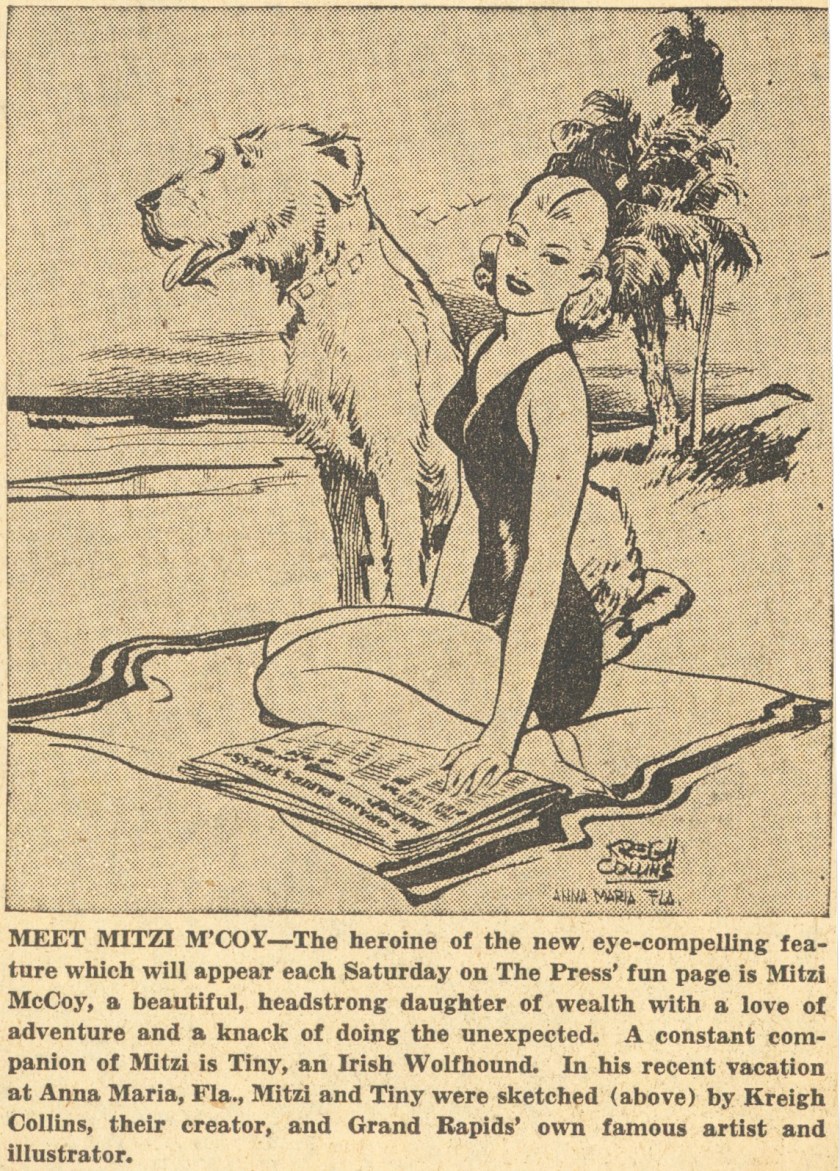
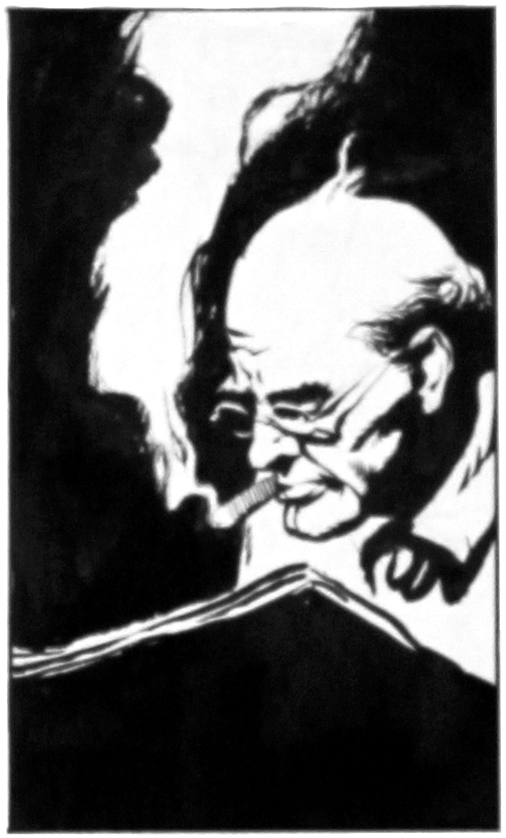
In the case of the Grand Rapids Press, Kreigh got additional promotion, as he fell under the “local boy makes good” news angle. The paper ran a profile of Collins with some interesting pre-1950 biographical information.

MM Promo3B cc

Toppers

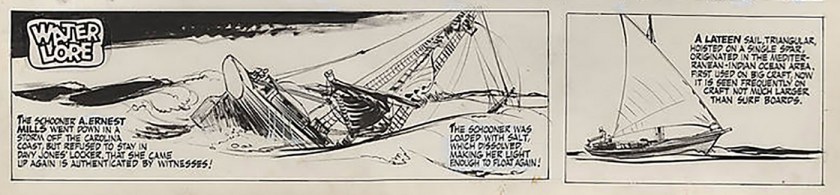
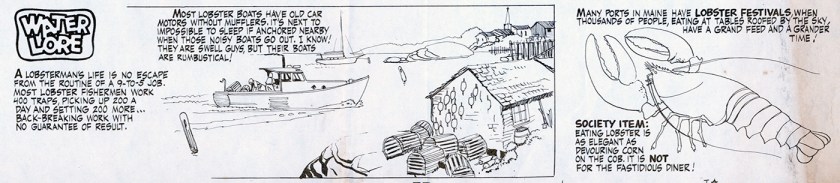
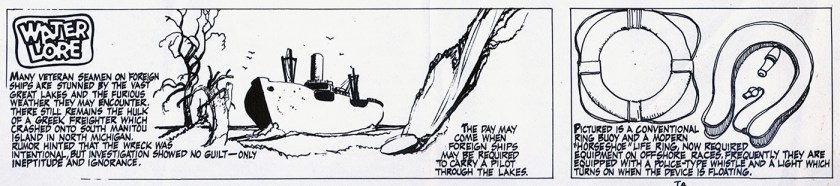
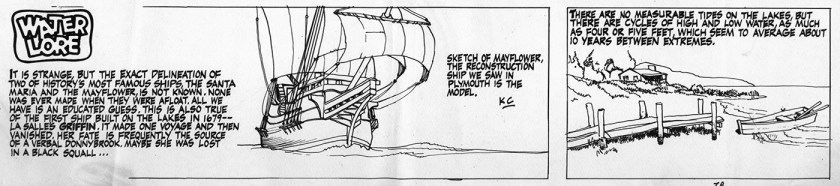
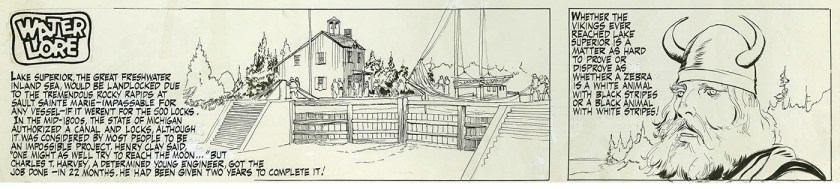
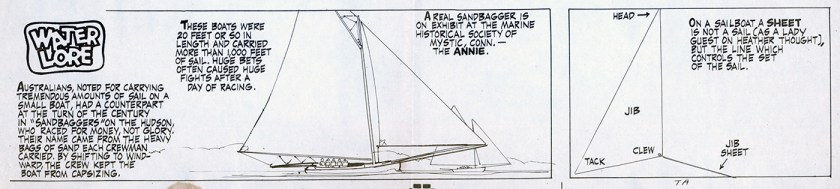
In comic strip parlance, a topper is a small secondary strip seen along with a larger Sunday strip. These strips usually were positioned at the top of the page, but they sometimes ran beneath the main strip, as in “Water Lore,” Kreigh Collins’s topper for his third and final comic, “Up Anchor.”

UA 081069 OA 72

Times were changing in the 1960s — in the comic strip business, they were changing too, as space for comics continued to shrink. Fewer and fewer papers printed half-page comics, and Collins was frustrated by the way his artwork was cropped in order to squeeze into the smaller third-page format. When his new comic launched, he drew it as a one-third pager, and used the topper to fill out the half-page of space. If a paper ran it as a third, the topper was lost. Printed half-page versions of “Up Anchor” are very rare, so these days, the most likely place to see the “Water Lore” topper is on examples of the original artwork. 

UA WL 022270 OA 100February 2, 1970
UA WL 091370 BWS 100 qccSeptember 13, 1970
UA WL 092070 BWS 100 qccSeptember 20, 1970
UA WL 100371 BWS 100October 3, 1971
UA WL 102471 BWS 100October 24, 1971
UA WL 103171 BWS 100 qccOctober 31, 1971
UA WL 110771 BWS 100 qccNovember 7, 1971
UA WL 111471 OA 100November 14, 1971
UA WL 112170 BWS 100 qccNovember 21, 1971
UA WL 121971 OA 100December 19, 1971

Metamorphosis 2 — More Time Travel

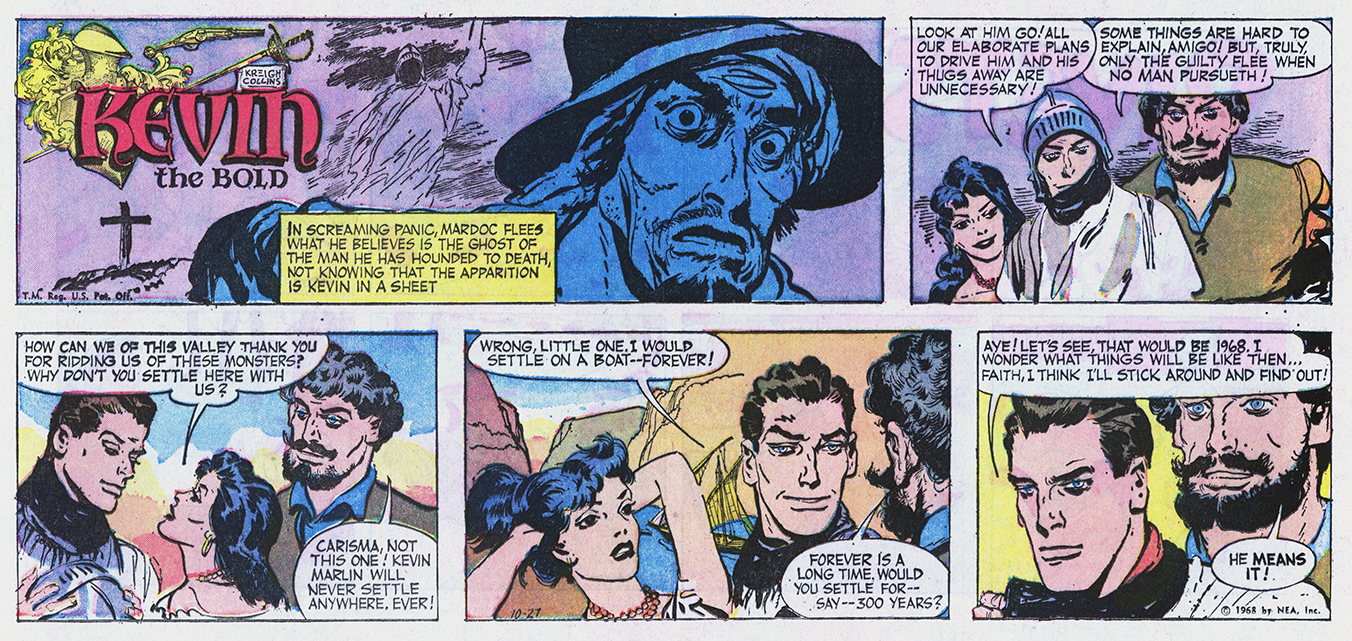
In the final episode of “Kevin the Bold,” after saving yet another damsel in distress (and of course, an entire village), our hero is begged by a lovely señorita to settle down and stay in her now-peaceful valley. Kevin, whose last name (Marlin) has been revealed in a recent, prior episode, declines the offer from the Spanish beauty but admits he could imagine himself settling down on a boat in say, 300 years.

KTB 102768 Th 100 qcc

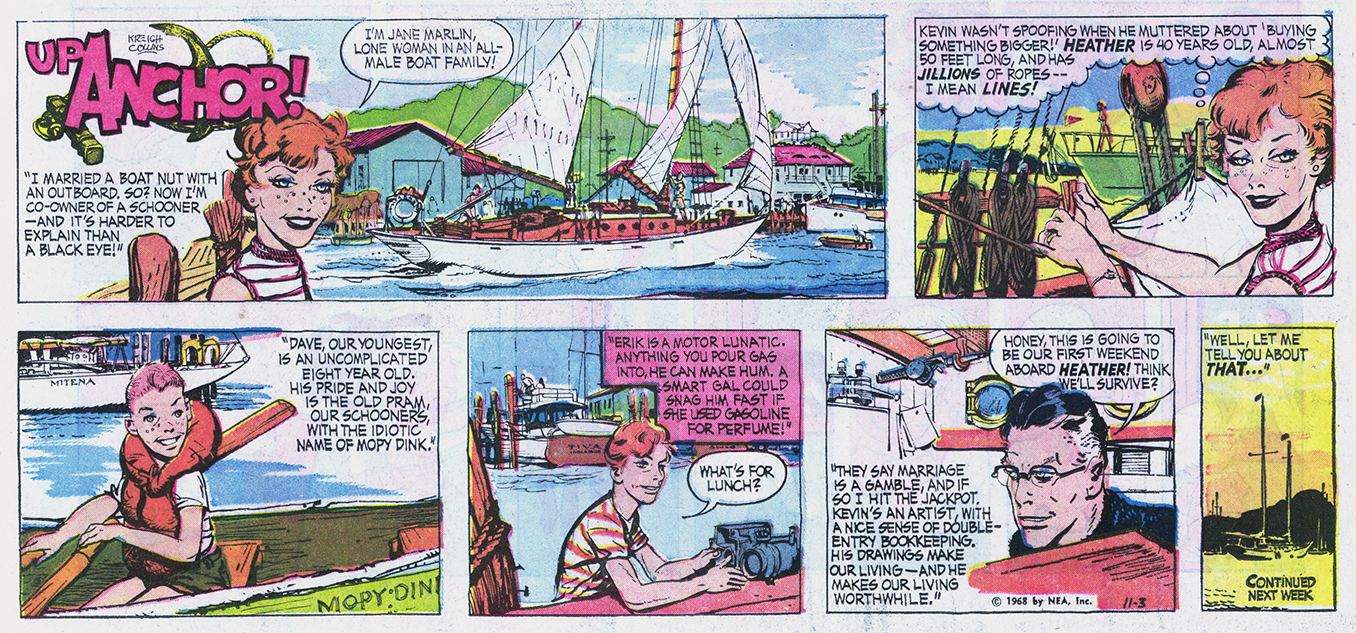
Abruptly, “Up Anchor” was launched a week later (November 3, 1968). As the NEA’s promotional literature put it, “Kreigh Collins’ credentials to create and draw ‘Up Anchor,’ America’s first color comic strip devoted to boating, are as bona fide as the burr on a thistle.” Narrated by first mate Jane Marlin, “Up Anchor” was based on experiences Collins had with his family cruising on his own sailboat. Aboard Heather with Jane were her husband (Kevin Marlin, remember him?), and sons Erik and Dave. The scripts were developed in partnership with Collins’ wife Theresa (“Teddy”), who had previously chronicled the family’s round-trip journey from their home port on Lake Michigan to Maine (Teddy’s “The Wake of the Heather” was published in 1967) .

UA 110368 Th 100 qcc

Metamorphosis 1 — By Popular Demand

Editor & Publisher, a newspaper industry trade magazine, announced in its August 26, 1950 issue that “Mitzi McCoy” was about to be taken over by a new character. According to NEA feature director Ernest “East” Lynn, jumping back nearly five centuries to this new lead character was without precedent in the comic business. With the comic strip’s new setting, Collins returned to the field in which he made an international reputation — the field of costume illustration.

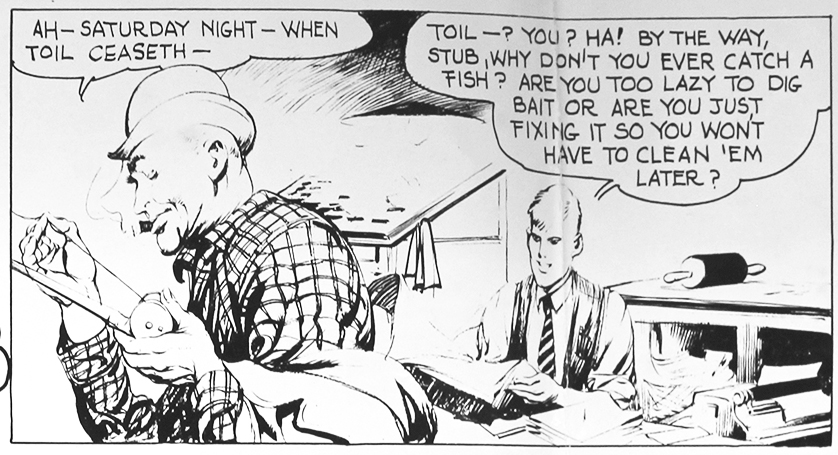
E&P quoted Lynn, “It was the outgrowth of popular approval of two episodes in Mitzi McCoy, each of which gave the artist an opportunity to display his great flair for period art. The first was a story dealing with the history of the Irish wolfhound. The second, ‘The Christmas Story,’ told the story of the birth of Christ. In each instance Mr. Collins used the device of having Stub Goodman, one of the leading characters of Mitzi McCoy, narrate the story to a young boy, Dick Dixon. And in each instance fan mail greatly increased. Several editors urged period illustration on a regular basis.”

A month after the announcement, the final episode of “Mitzi” ran, the tale of the McCoy family legend.

MM 092450 OA 100 cc

The following Sunday (October 1, 1950), the action continued, but under a new shingle. It began with Kevin saving Mitzi’s ancestress, Moya McCoy. However, the focus soon shifted as Kevin left Moya (and Mitzi) behind. As penance for a wild youth, Kevin had pledged a fight against oppression wherever he found it. He waged his battle for the next eighteen years in the funny papers, until another major plot change occurred.

MM 100150 72 cc

Tom Match and Stub

Tom Match and Stub 150

This undated one-off comic, found in the archives of the Grand Rapids Public Library’s local history department, appears to pre-date “Mitzi McCoy.” After taking notice of Kreigh’s “Bible Stories Comics,” the Newspaper Enterprise Association (NEA) began pursuing Collins to develop a comic, and “Tom Match and Stub” is likely an early draft of a proposed strip.

This early comic was set in Fishtown (Collins often spent summers painting in nearby Leland, Mich.); most of the action in “Mitzi” occurred in the fictional “picturesque little town of Freedom,” which was also situated in Michigan. Like “Mitzi,” “Tom Match and Stub” is set in a newsroom, only the roles are reversed — here Stub works for young Tom, whereas Stub is Tim’s boss in the syndicated version. Stub is clearly Stub, Tom resembles Tim, but the Match character doesn’t resemble Mitzi.

 MM Stub Stub TomTimMatchMoya McCoy KrgbHowever, she does bear a resemblance to an ancestor of Mitzi’s, but that’s jumping ahead (or is it jumping back?).

One Man’s Trash

Throway panels 1950s 72 Gals

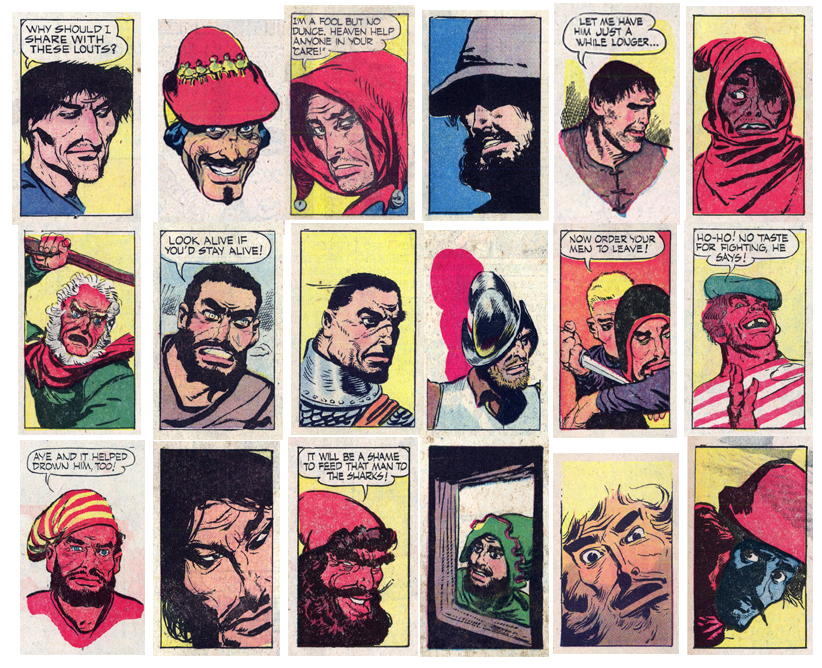
“Throwaway Panels” — such an unfortunate term for these wonderful little illustrations. Deleted in order to squeeze and rearrange a half-page comic into a tabloid format, they were usually somewhat incidental to the action. In “Kevin,” they often showed damsels — in distress, or otherwise.

Other options included villains, exclamations, or random bits of scenery. Kevin himself also made frequent appearances in this panel.

Throway panels 1950s 72 Thugs  Throway panels 1950s 72 exclamations

Throway panels 1950s 72 nice illo

After seeing enough of these, I couldn’t help but be reminded of Lotería, a Mexican game of chance similar to Bingo. With the strip having a presence in Latin America (“Kevin el Denodado”), I think the NEA missed a marketing opportunity!

loteria sets

kevin el denodado 72