Kevin’s tournament skills paid off in the first round of the joust, but by taking the high moral ground he is setting himself up for possible failure.
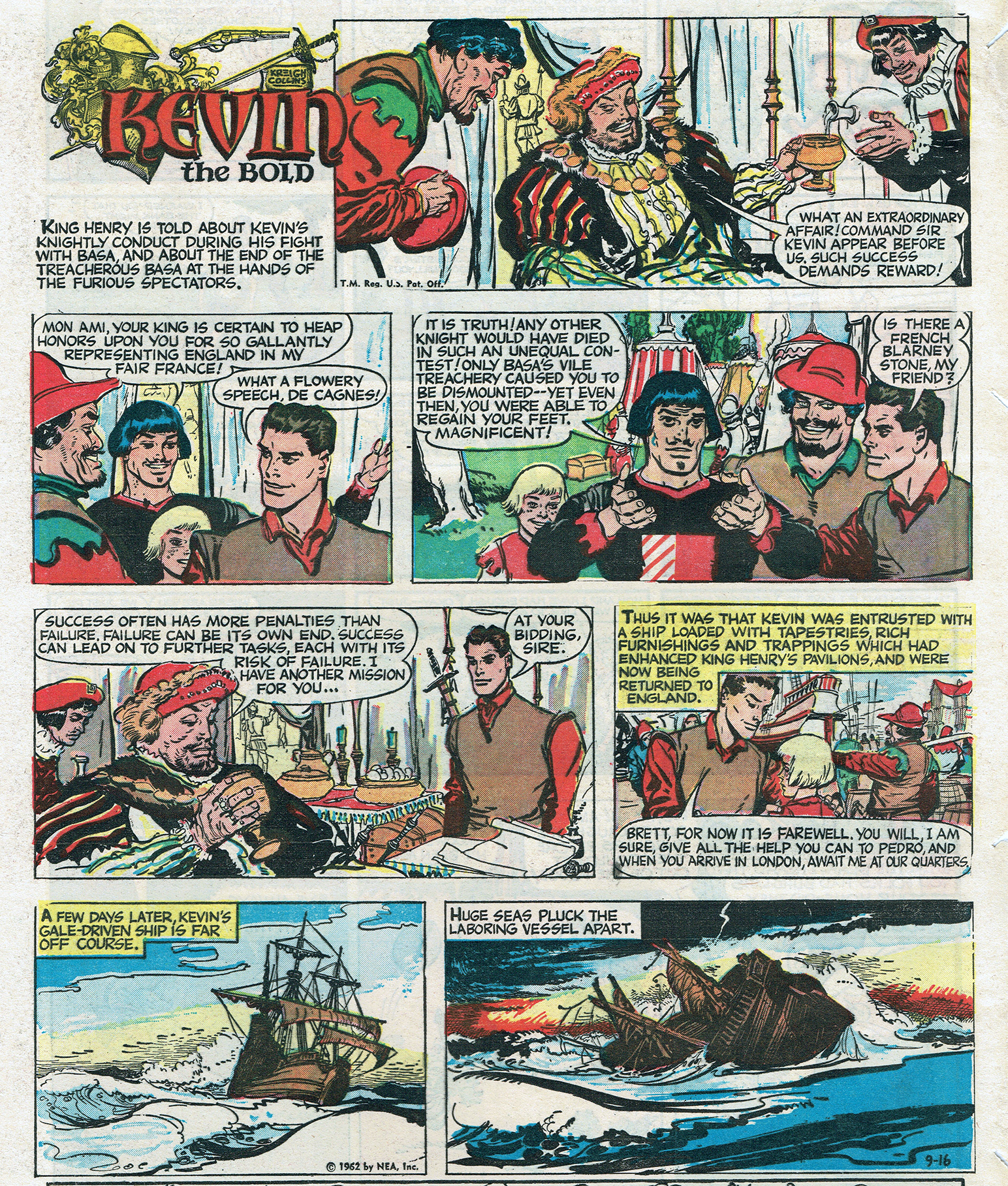
Kevin’s virtue is matched by Basa’s treachery, but while Kevin is saved by Hugo’s unexpected confession, Basa meets his end at the hands of the angry mob.
As the story of the Field of the Cloth of Gold ends, another adventure begins.
For more information on the career of Kreigh Collins, visit his page on Facebook.
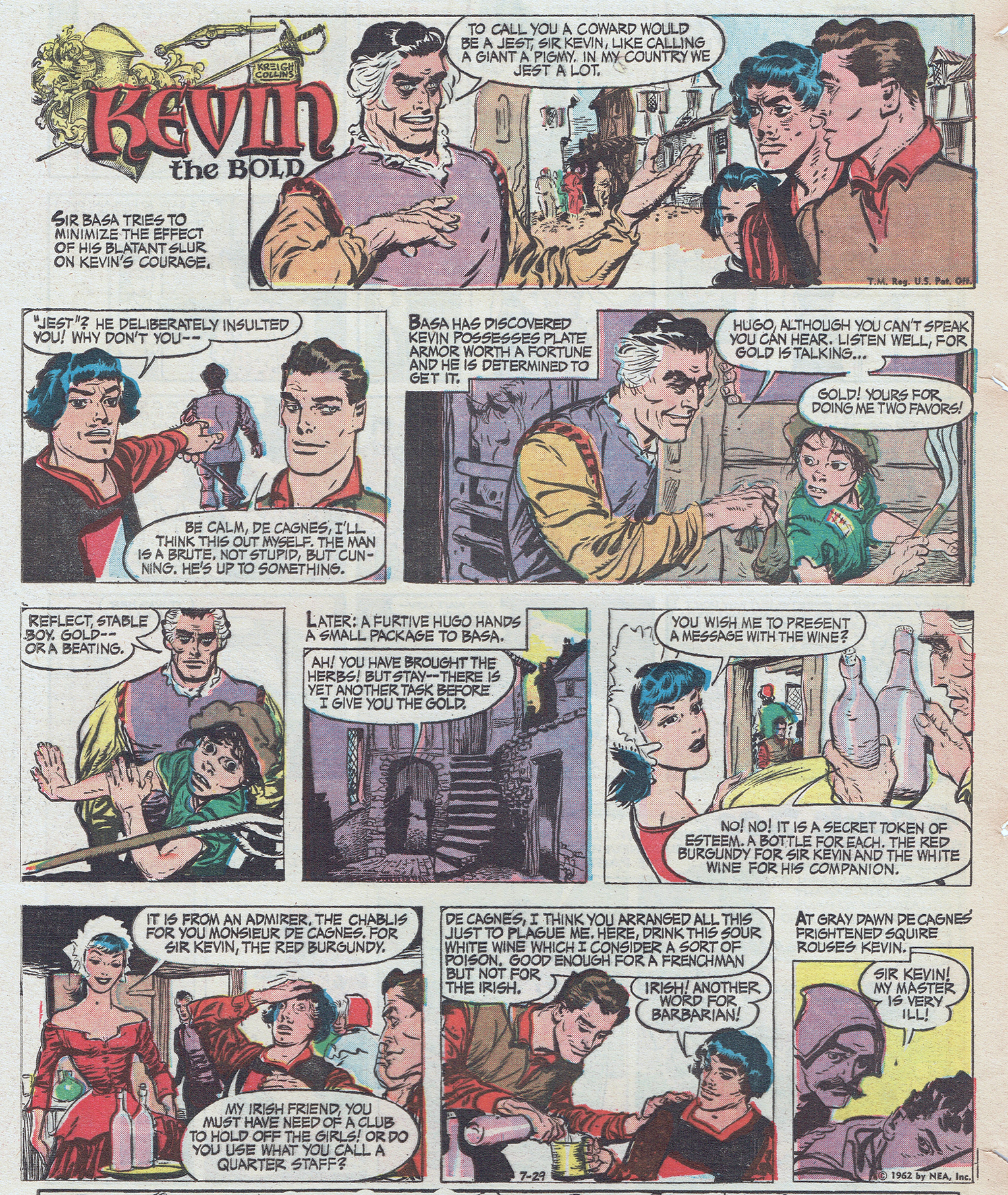
Sir Basa sets his nefarious plan in motion, and De Cagnes smells a rat. As usual, Kevin remains calm.
Evil to the bone, Sir Basa reneges on his promise to pay Hugo—and he confuses the stableboy’s inability to speak with stupidity. Perhaps Hugo isn’t the only one Basa has underestimated.
In the August 26 episode, the “Ancient Code” is spelled out once again. From the beginning of his time with NEA, Collins had been instructed to repeat information critical to a story’s plot so that newspapers could pick up the strip at any time and start running it—and the same was true for readers. If they’d missed a sequence’s earlier episodes, they could be brought up to speed. The repetition might help newcomers, but to those following the action each week, the practice was no doubt a bit tedious.
For more information on the career of Kreigh Collins, visit his page on Facebook.
The past six weeks’ Sunday comics set the scene in a historical context, taking place during the Field of the Cloth of Gold, and now the action settles into a more local, intimate setting.
Surely there could be no harm in offering to stage a joust for an enthusiastic, convalescent child.
Having demonstrated his brute strength, Basa also shows he is a louse, and worse.
For more information on the career of Kreigh Collins, visit his page on Facebook.
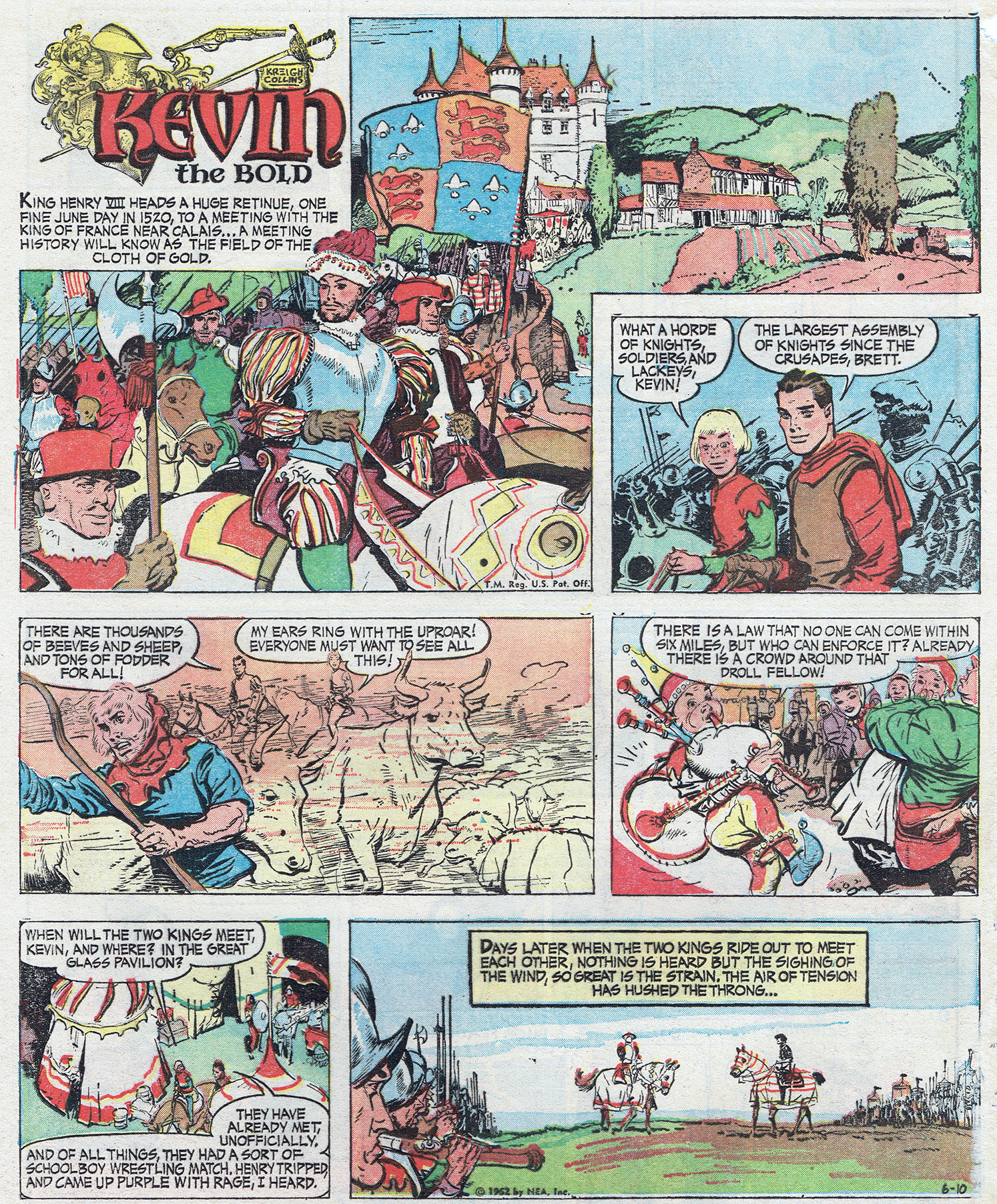
At the summit arranged by Cardinal Thomas Wolsey, King Francis I of France and King Henry VIII of England tried to outshine the other, with dazzling tents and clothes, huge feasts, music, jousting and games. The days were taken up with tournaments, in which both kings took part.
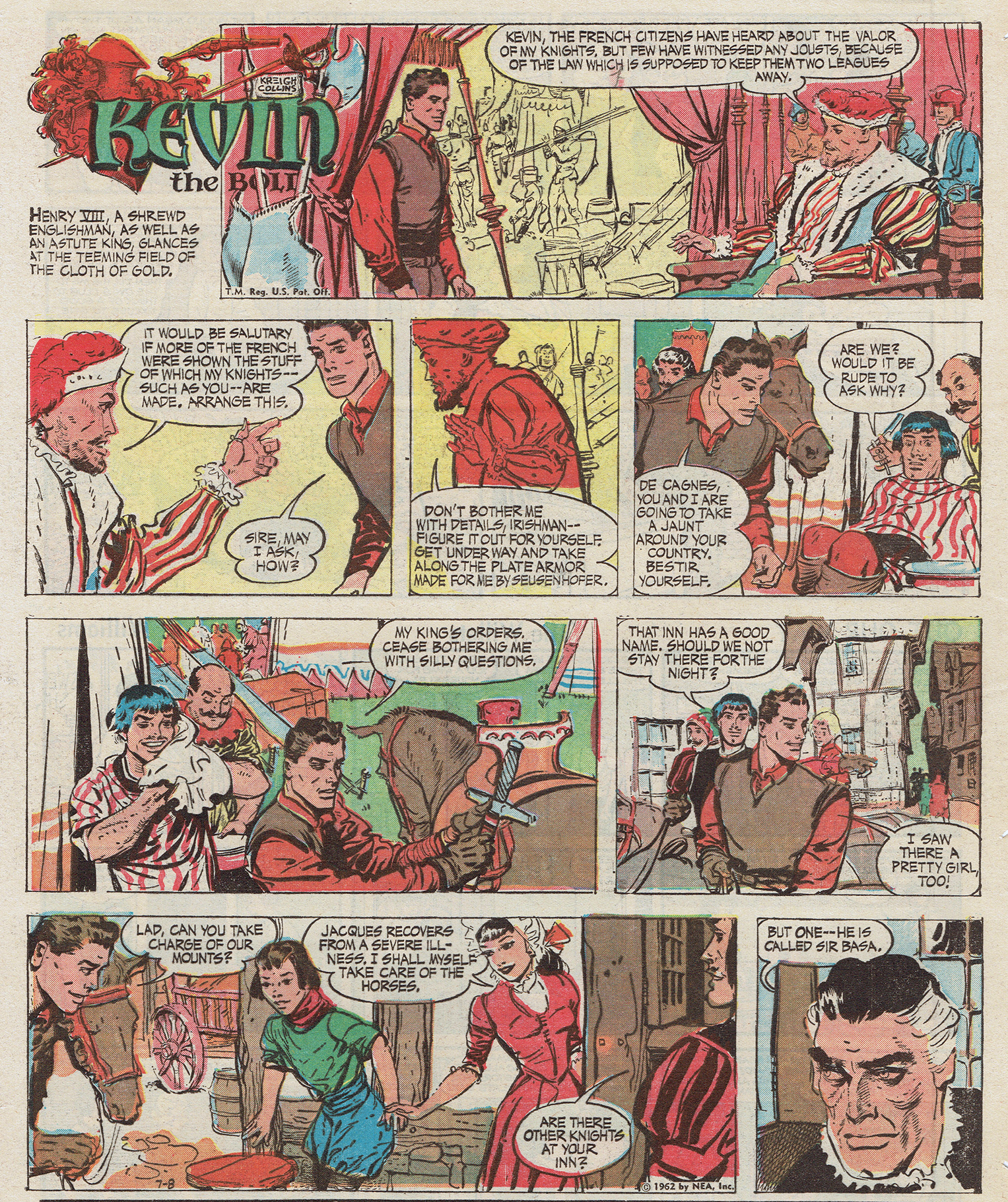
After the joust, Kevin was gracious in victory over his friend De Cagnes — but not everyone was so pleased, as the sourpuss Sir Basa is introduced.
“The Field of the Cloth of Gold” was the first sequence written by Kreigh Collins after a 13-month stretch of episodes written by Jay Heavilin. In fact, the episode above contains a line (paraphrased) that originally appeared in “Kevin the Bold” a decade earlier.
Returning to our current sequence, Kevin has the misfortune of staying at the same inn as his detractor, and he also meets a mute stableboy.
For more information on the career of Kreigh Collins, visit his page on Facebook.
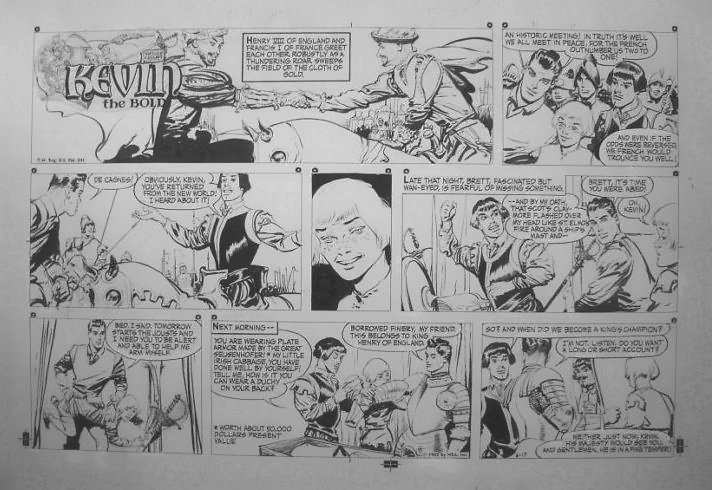
Last week I asked readers if their collections included any “Kevin the Bold” episodes that were missing in mine. This week a sequence starts using comic scans sent to me by my man in Rotterdam, Arnaud, with whom I traded a bunch of other “Kevin” scans (Nogmaals bedankt!). These tabloid comics were originally published starting in June, 1962, and were based on a historical event from 442 years earlier—the June, 1520 summit between England’s King Henry VIII and France’s King Francis I.
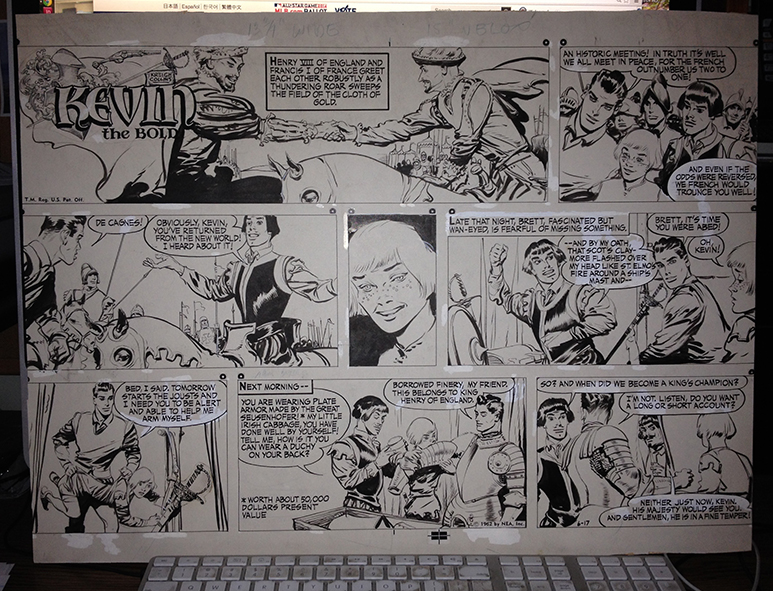
These first few episodes serve as a preamble to the main event, but the June 17 comic shown above is a favorite of mine because I have the original artwork in my collection.
In 2010, when I first found an image of the artwork online, it appeared as shown above. Sadly, by the time I saw it listed for sale four years later, the illustration had been cropped so it would fit in an 18″ x 24″ picture frame (below). It might have been damaged goods, but I bought it anyway (frame not included). One interesting detail is found in the panel in the lower left-hand corner, where Brett is holding Kevin’s sword. The sword is a photostat, pasted onto the original art—apparently as a time saver for the artist.
Another shameless plug!
Featuring the complete run of Kreigh Collins’ first NEA comic, “Mitzi McCoy,” The Lost Art of Kreigh Collins, Vol. 1: The Complete Mitzi McCoy is still available! It can be ordered directly from me for $24.95 plus postage (contact me for shipping details at brianedwardcollins1[at]gmail.com).
For more information on the career of Kreigh Collins, visit his page on Facebook.
Once I started collecting my grandfather’s comics, I came up with two goals: publish a book and collect them all. In 2018, “The Complete Mitzi McCoy” was published, so—halfway there!
Kreighs’ comics appeared in newspapers every Sunday from November 7, 1948 until February 27, 1972, about two and a half decades. Adding it all up—the 23 complete years, the two partial years, and the four times leap years resulted in a year having 53 Sundays (1950, 1956, 1961, 1967)—amounts to 1,217 individual episodes. WIth so many of them, it’s easy to see why I chose to publish a book first.
Admittedly, I had a great head start with so many of the episodes having been given to me by my uncle. But while my grandfather saved a lot of stuff, I do not have examples of all of the individual episodes. With all 99 MITZI McCOY episodes and less than half of the UP ANCHOR! comics, what I had focused on primarily was the missing KEVIN THE BOLD episodes, but I’ve recently been making progress on my collection of UP ANCHOR! episodes too.
At some point, I was clued into the existence of comic sections found online at newspapers.com, so there aren’t any episodes I haven’t seen—but these online versions are of varying quality and are in black and white.
As for the different formats available, my preference for obtaining digital images goes as follows: color half pages, color half tabloids, color tabloids, original artwork, black and white velox proofs, black and white tabloids, color thirds, black and white thirds, etc. Obviously, I prefer to have original hard copies of the episodes, but scans are just as good as far as I’m concerned. Perhaps someone could help me fill some holes in my collection with their scans—I’d be happy to trade.
The first hole in my collection, appears about a decade into KEVIN’s run: April 24, 1960.
A few months later, the October 2, 1960 episode draws a blank.Through 1958, I have full-sized (half-page or tabloid) versions of just about every comic, but by 1960, many of my comics are one-third page versions (sigh).
A previously published version of this post resulted in a reader sending me a bunch of scans to trade (Thanks, Arnaud!), but I’m still looking for a color version of the September 17, 1961 episode—and the one for June 23, 1963.
Here are the dates of the comics listed above: April 24, 1960 October 2, 1960 September 17, 1961 June 23, 1963
Not bad for the first 18 years of my grandfather’s cartooning career—only 18 missing episodes left!
For the last three years of “Kevin the Bold,” I used to need quite a few, but a connection with a collector in New Jersey (Thank you, Dave!) has helped fill in a lot of the blanks. However, these still elude me: January 2 , 1966 June 26, 1966 July 17, 1966 July 24, 1966 January 8, 1967 March 5, 1967 March 26, 1967 April 9, 1967 March 10, 1968 March 17, 1968 April 7, 1968 April 21, 1968 May 5, 1968 September 15, 1968
Dave has also helped me complete my collection of UP ANCHOR! strips, but there are quite a few still missing… January 26, 1969 June 8, 1969 June 15, 1969 June 20, 1969 November 9, 1969 December 7, 1969 December 28, 1969 August 30, 1970 September 27, 1970 October 25, 1970
…especially from 1971 and 1972: January 3–March 21, 1971 (12 episodes) April 4–May 30, 1971 (9 episodes) June 13–September 12, 1971 (14 episodes) September 26, 1971 October 31–November 7, 1971 (2 episodes) December 5–December 19, 1971 (3 episodes) January 2–February 27, 1972 (all 9 episodes)
It looks like I’m missing about 32 episodes of KEVIN THE BOLD and 36 from UP ANCHOR! Do you have any of these in your collection? I’m more than willing to trade scans (or hard copies). If you’re willing to help, please leave a message here on my blog or contact me directly at brianedwardcollins1(at)gmail.com
Thank you! See you in the funny papers!
_________________________________________________________________________________ For more information on the career of Kreigh Collins, visit his page on Facebook.
Compiled by Eisner Award-winning comics historian Frank M. Young, the collection is available online from Amazon (a bargain at $14.99).
As Described on the back cover: Unjustly neglected in newspaper comics histories, Kreigh Collins’ Kevin the Bold is one of the 1950s’ best, with outstanding artwork and witty scripting. Here are close to three years of Kevin (and Collins) at the top of their game, sourced from rare syndicate proofs.
For more information on the career of Kreigh Collins, visit his page on Facebook.
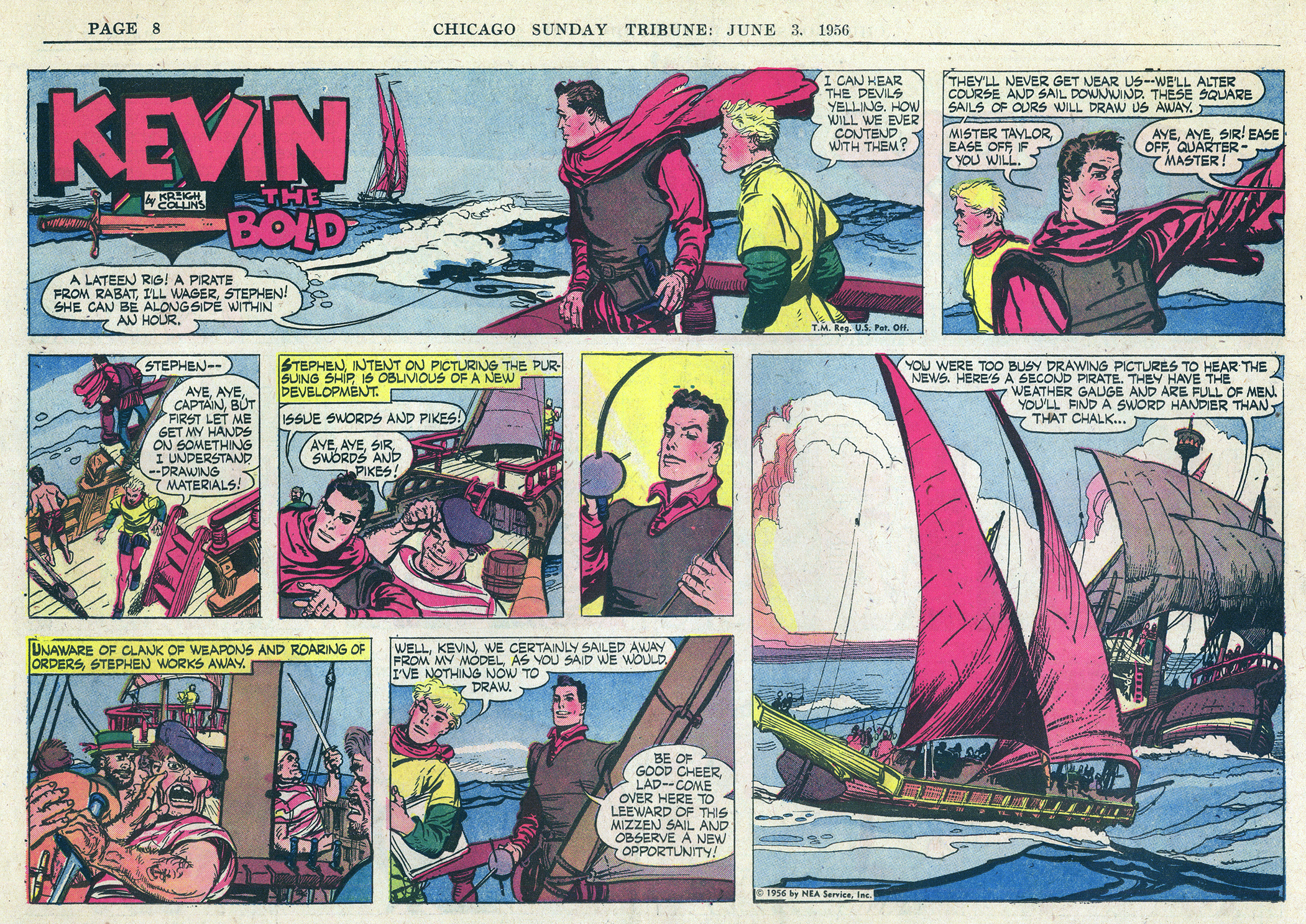
The pirates picked a fight with the wrong crew—even the “gentle” artist Stephen gets into the act. (It’s always interesting to note how Kreigh Collins portrayed artists in his comics).
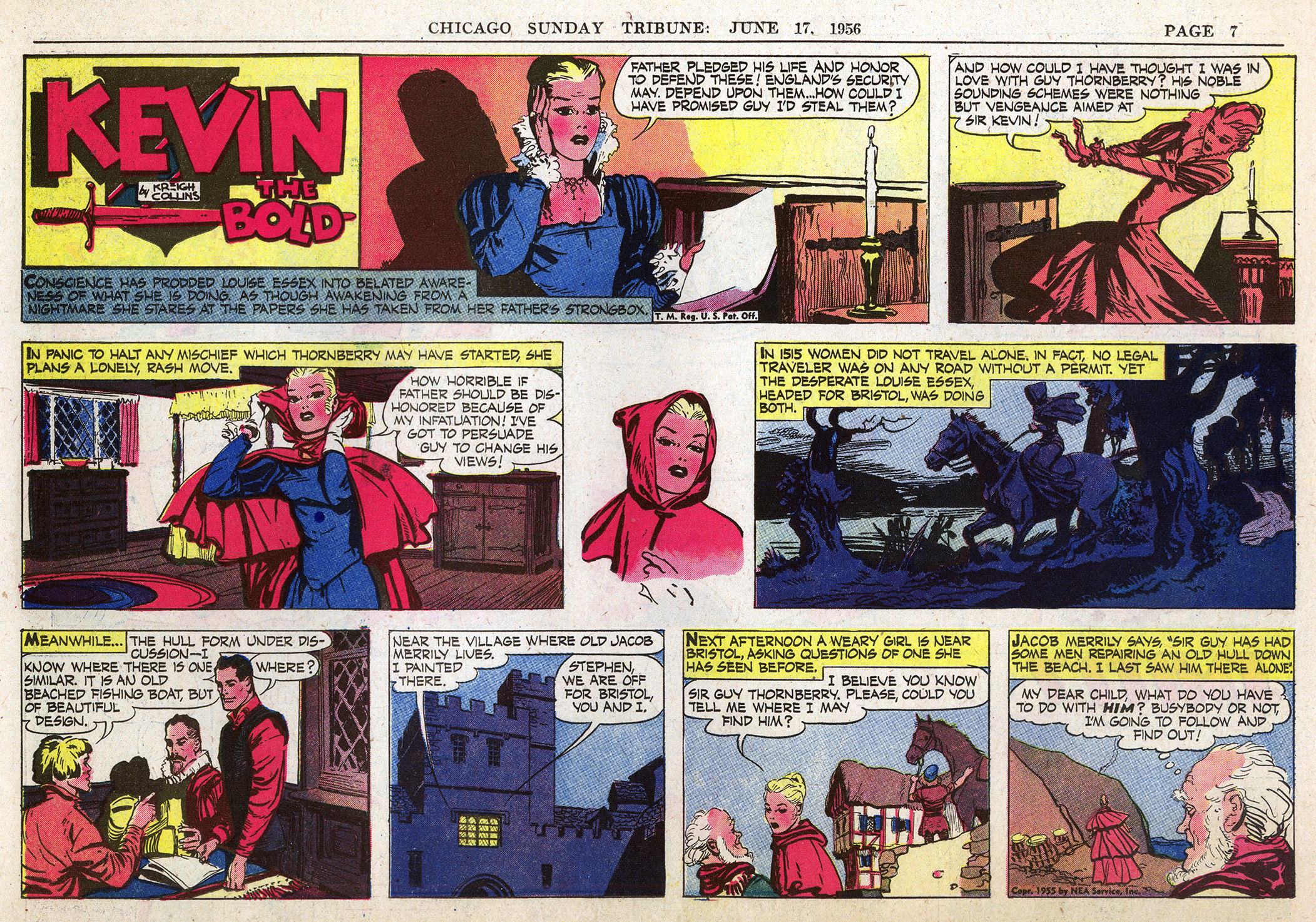
Louise Essex is slowly coming to her senses; unfortunately, she’s still a bit naive.
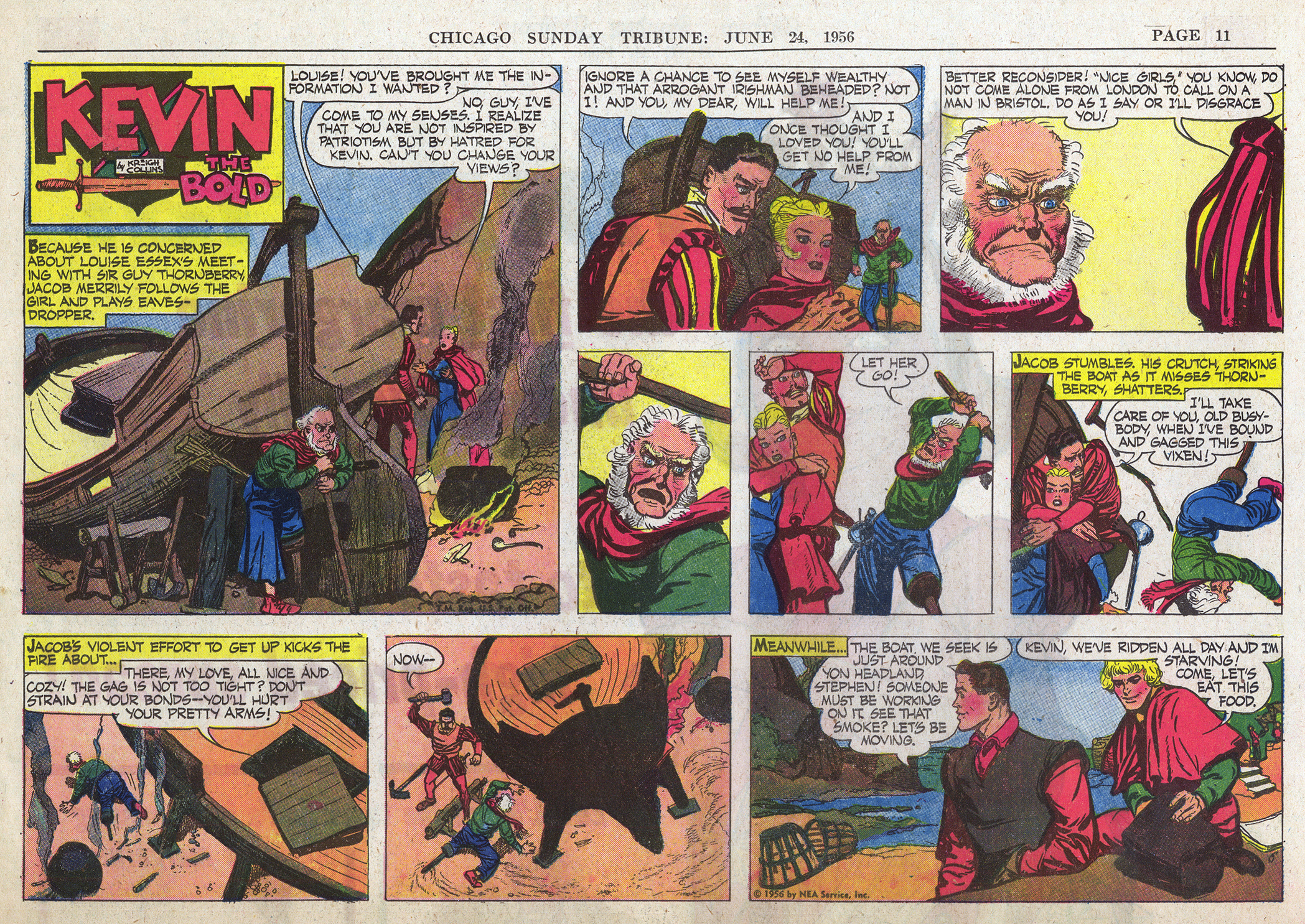
Kind of a funny thing, lovely Louise is running around and can’t seem to make an impression on the men—meanwhile they’re both headed to the shore, to scrutinize the same boat.
Jacob Merrily, an acquaintance of Stephen’s, was introduced during the previous sequence—in the March 4 episode. When Stephen went into hiding, the kindly old sailor gave him shelter; following a chance encounter with Louise, his protective instincts kick in again.
Sadly, things didn’t work out the way Jacob had intended.
Next, will Stephen stop for lunch? Or will Kevin persuade him to investigate the smoke first? Check back next week for this story’s conclusion!
For more information on the career of Kreigh Collins, visit his page on Facebook.
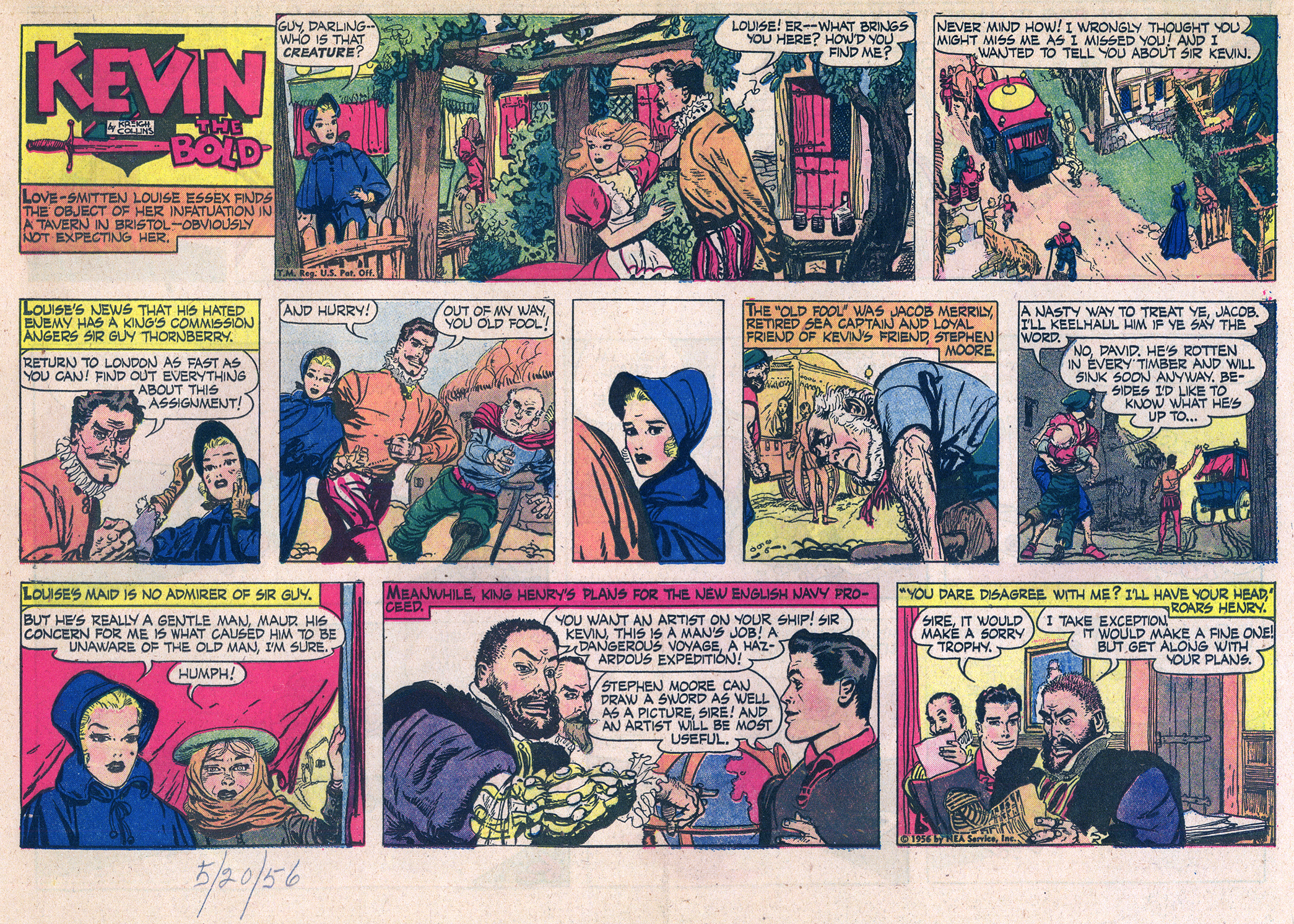
A surprise visit by Louise catches Sir Guy unawares. (It’s hard to imagine what they see in him, but Sir Guy certainly attracts lovely young ladies. Oh—it’s money).
Shoving Jacob Merrily to the ground, Thornberry shows his true colors, and Merrily’s comment proves to be prophetic.
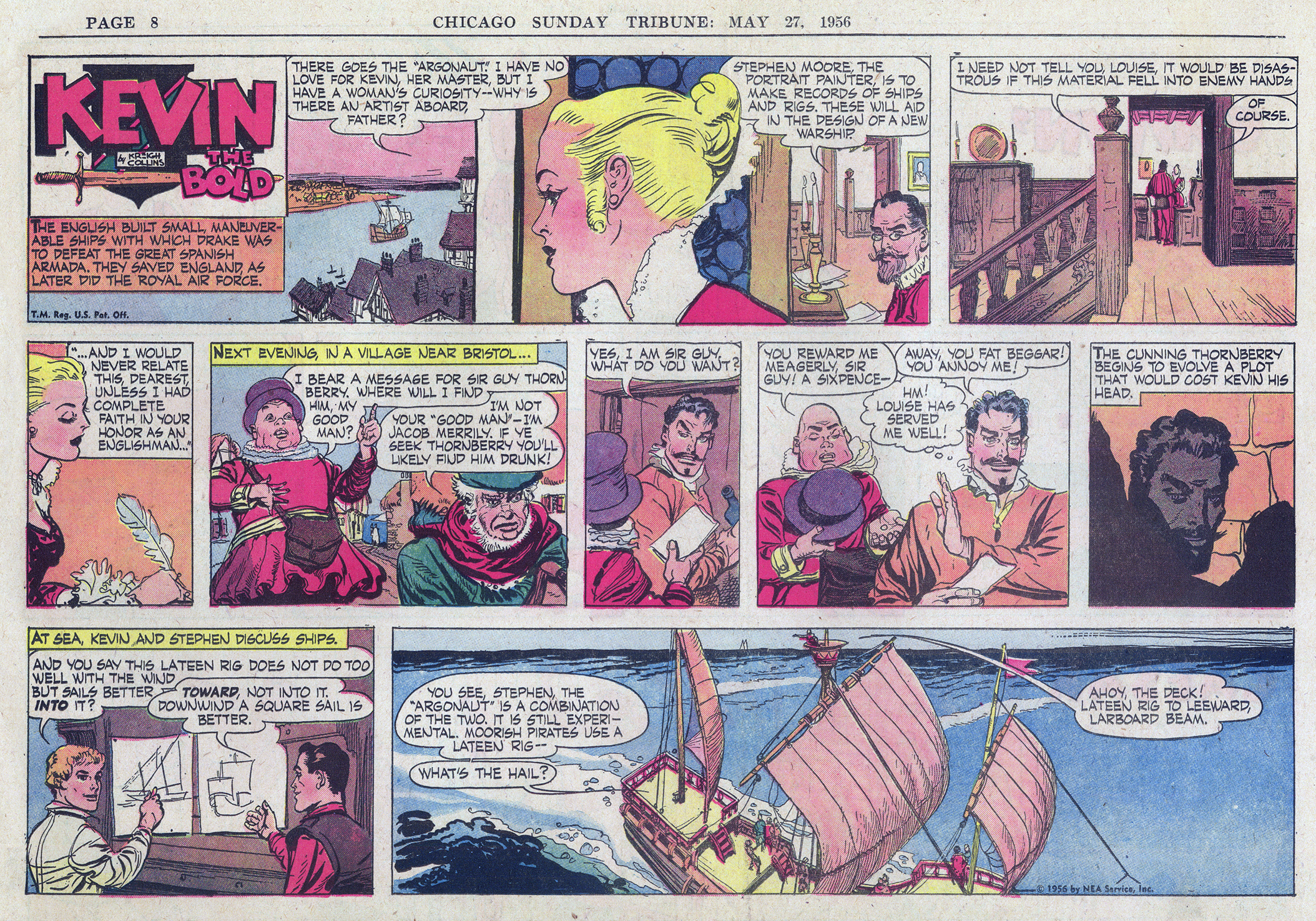
The May 27 episode is a beauty, with especially arresting opening and closing panels. The events are equally portentous with Louise naively sharing sensitive information and Kevin discussing the merits of different sailing rigs. It also includes an interesting sailing term of the day, shouted by the watch. These days, left is referred to as “port” side of a ship, as is “starboard” for the right, but in the 16th century, the left was known as the “larboard” side.
As Stephen Moore sketches, the battle draws nigh.
For more information on the career of Kreigh Collins, visit his page on Facebook.
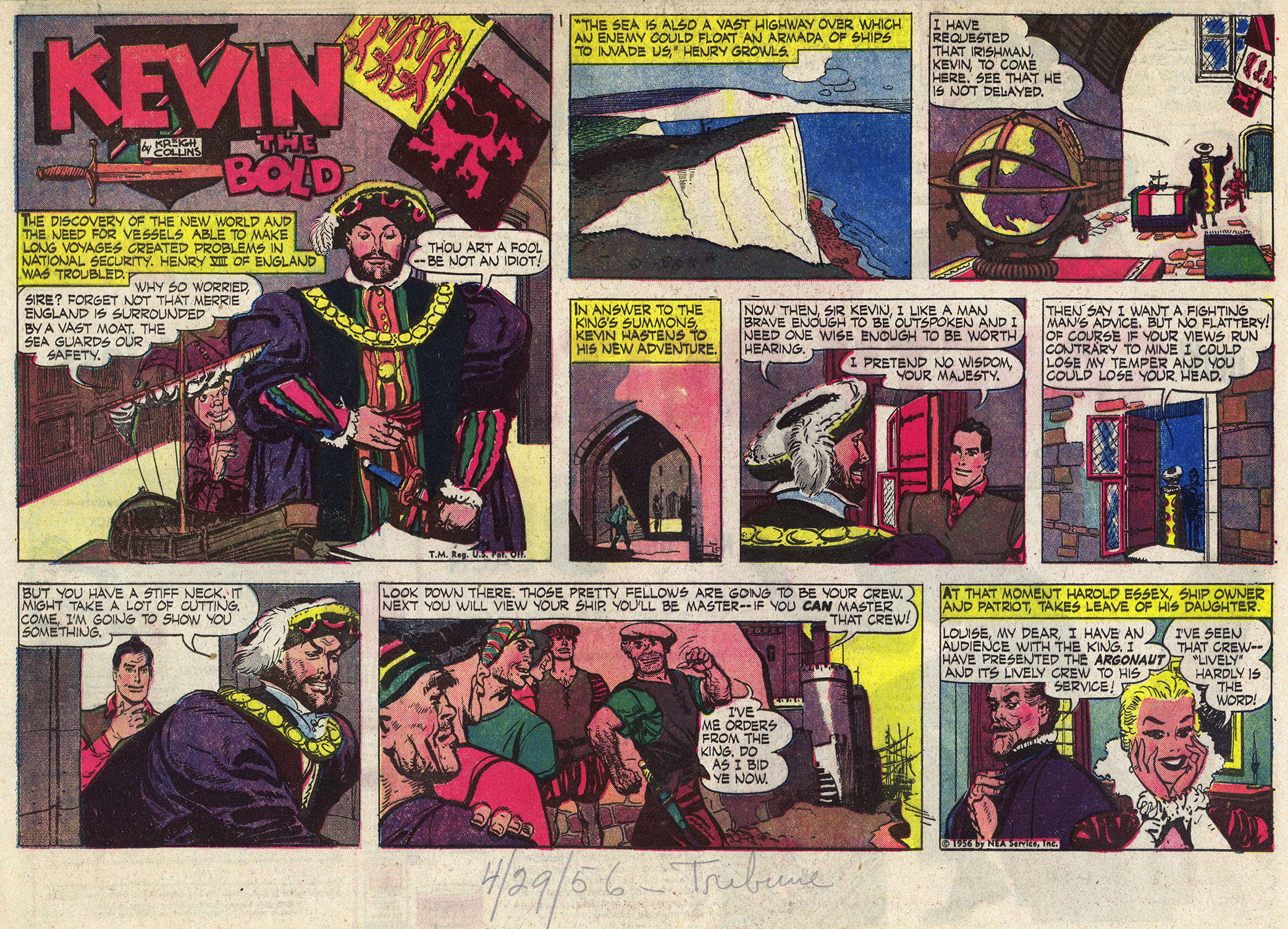
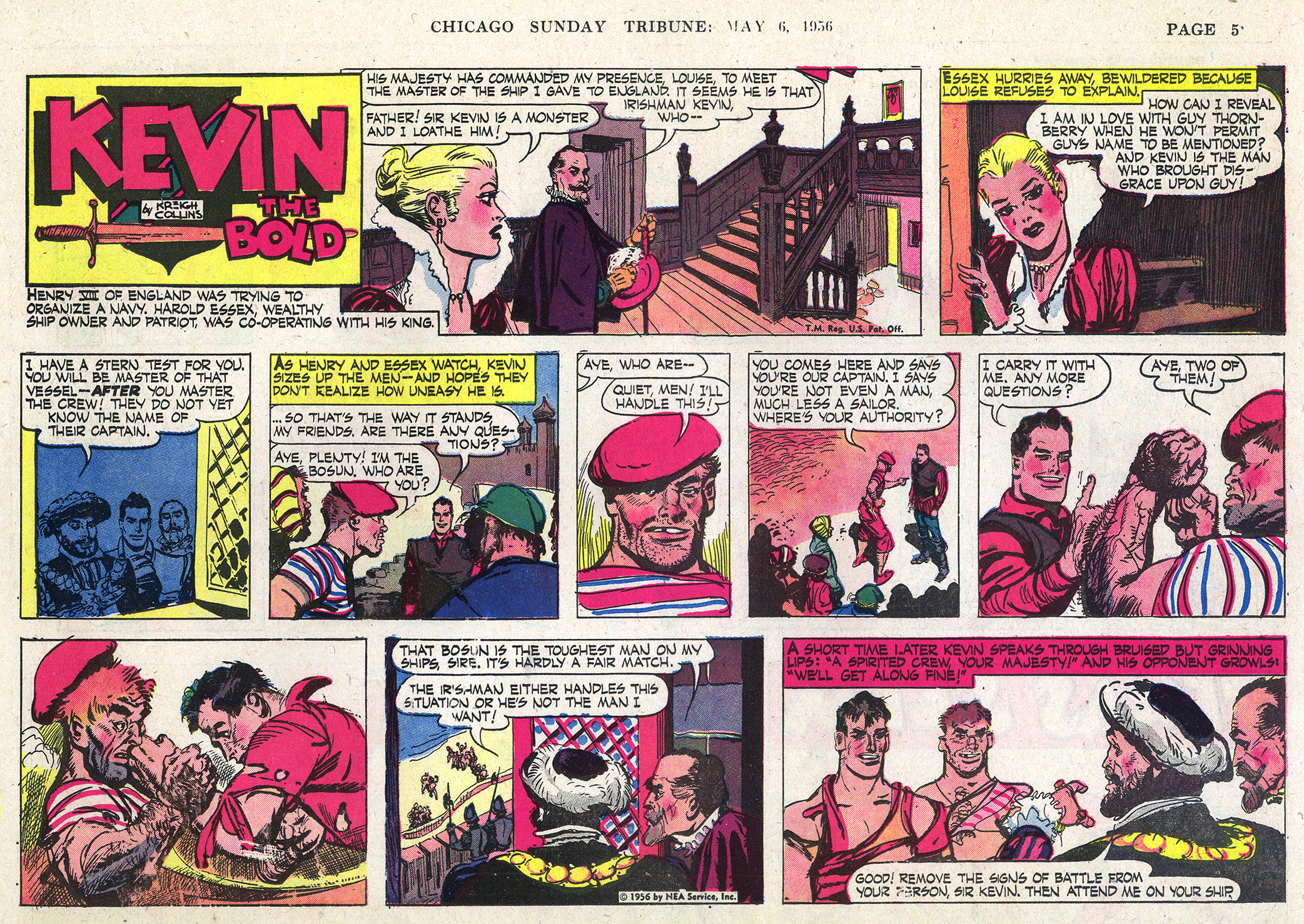
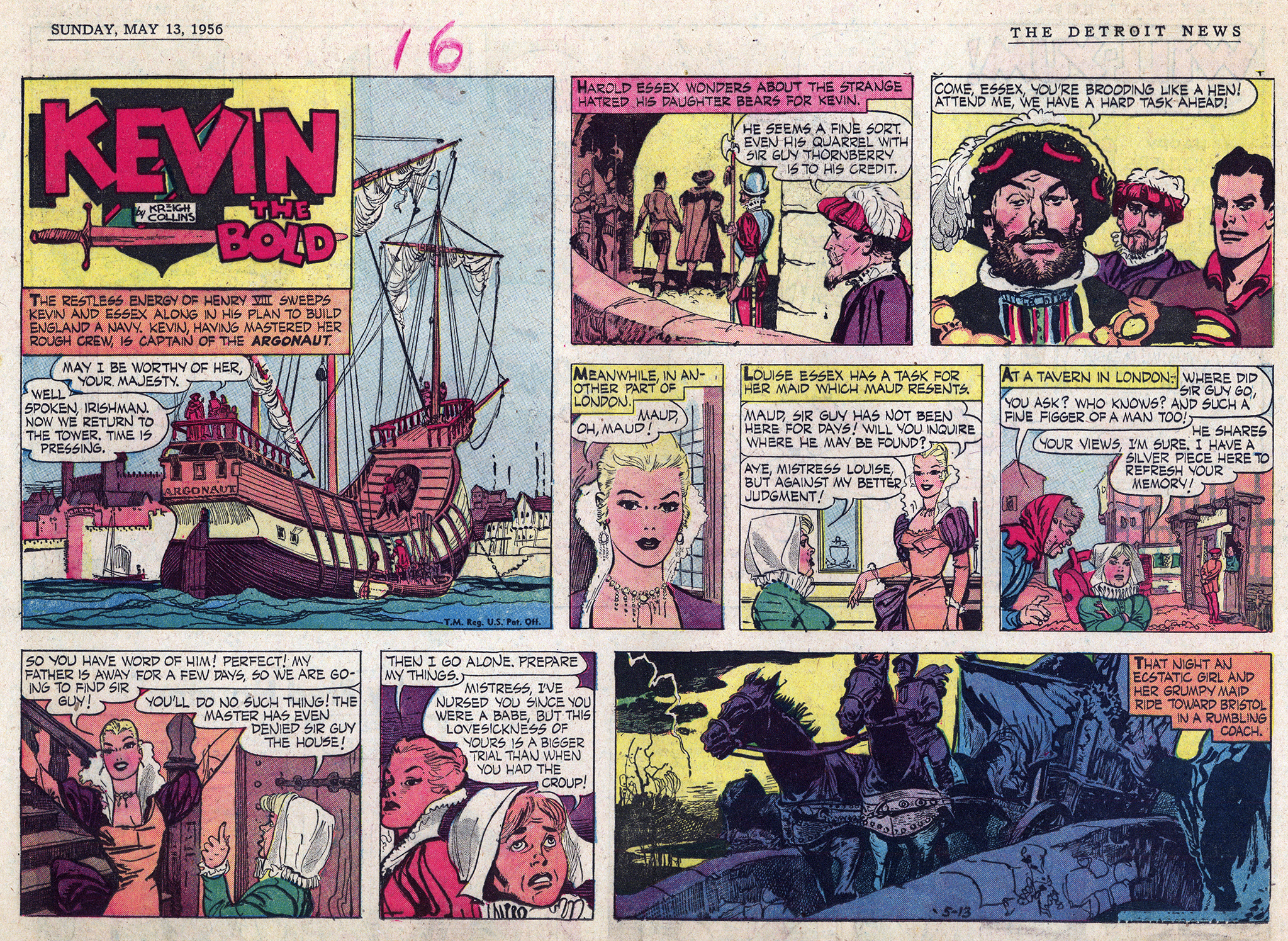
The action from the preceding story arc continues, and with many of the same characters. Sir Guy Thornberry has skulked offstage, but for how long? For reasons unknown, Louise Essex is smitten with the scoundrel. Meanwhile, King Henry has an important job for Kevin—once he overcomes a certain obstacle.
The second panel has a nice rendering of the Cliffs of Dover.
By this point, there wasn’t much difference in the print quality of the comics in the Chicago Sunday Tribune and the Detroit News (as shown below). One detail the Tribune versions lacked was the comic’s date inked into one of the panels (shown in the final panel of the News version). For Trib comics that didn’t appear at the top of a page, with the date typeset directly above, a nice personal detail for me is the date written on them, recognizable to me as done by my grandmother, Theresa. (“Teddy” also frequently modeled poses for her husband and basically served as his secretary).
The colors are a bit richer in the “Tribune” version, but in the third panel there seems to have been some indecision whether to include a yellow background or not.
I think the second and third panels look better with a white background.
Another nice family detail is found in the name of the ship Kevin captains. Argonaut was the name of Kreigh Collins’ own sailboat, a yawl—somewhat smaller than her namesake (I think she was only 25′ long). And while Collins purchased his schooner Heather later this same summer, she too was dwarfed by Kevin’s ship.
Collins and his family sailed aboard “Argonaut” (shown at left in Racine, WI) from 1952–1956, and aboard “Heather” (shown in Annapolis, MD) from 1956–1972.
For more information on the career of Kreigh Collins, visit his page on Facebook.













 Kreigh’s Comics