Hurricane Hole

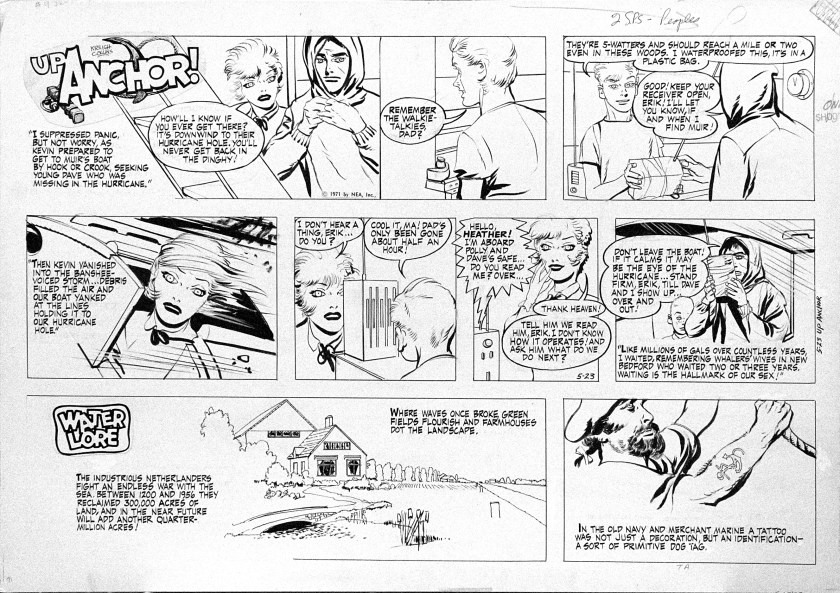
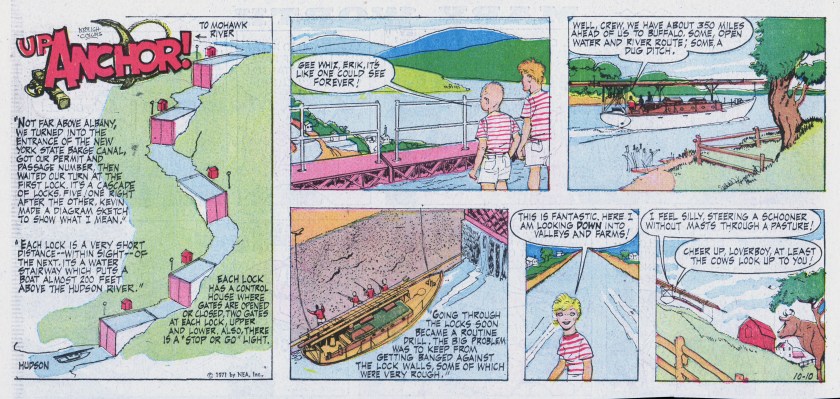
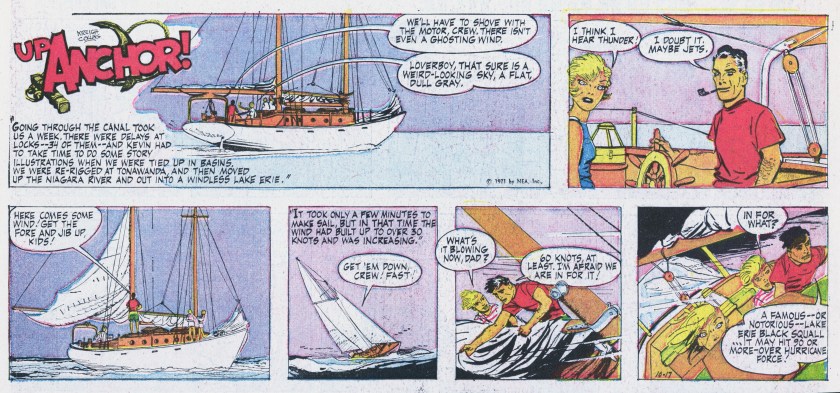
Much of the action in “Up Anchor!” was based on events experienced by Kreigh Collins and his family as they sailed aboard their 45-foot schooner, Heather. Artistic license was exercised — I doubt they encountered any hurricanes sailing north in late-spring of 1960. The following two sequences are based on this voyage.

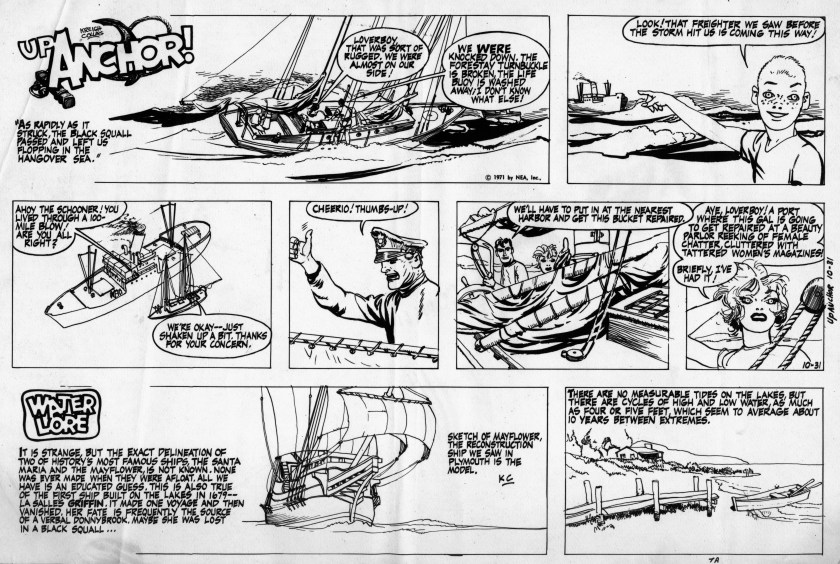
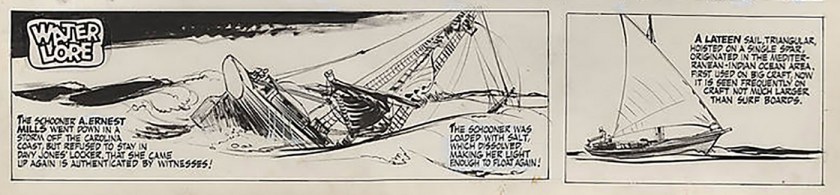
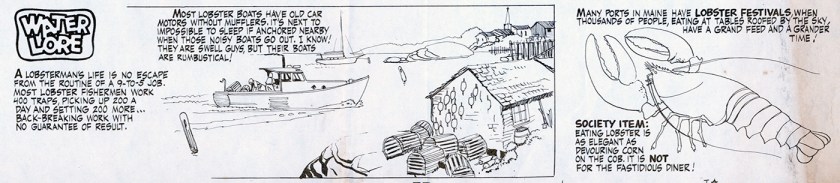
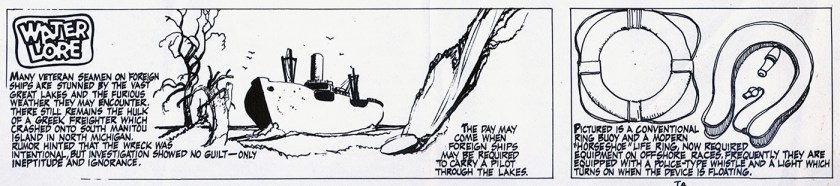
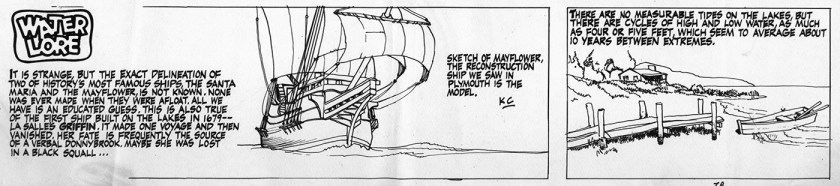
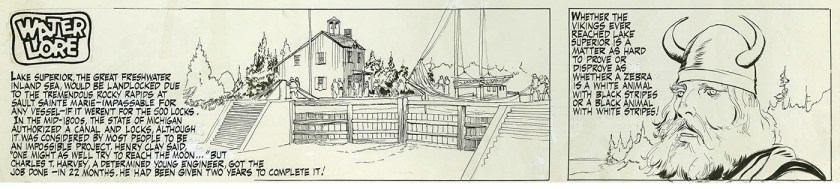
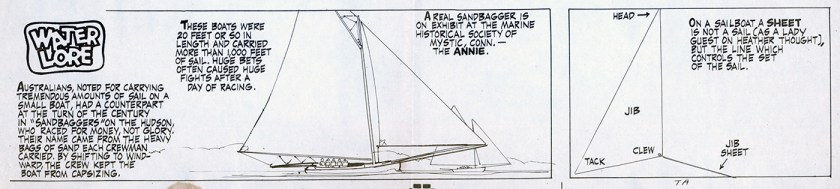
These images come from Kreigh’s original illustrations, many of which are now in the collection of the Grand Rapids Public Library. The originals feature the topper strip “Water Lore,” which would periodically reflect the action in the main strip. When the comic appeared in broadsheet papers, it generally ran as a one-third page, and the topper was omitted. However, in tabloids, the topper would appear (although without its second panel, which served as a throwaway).

ua-050271-r-b-200ua-050971-r-b-200ua-051671-r-b-200

As the storm hits, Kevin and Jane Marlin realize that part of their crew is missing — younger son Dave has disappeared. In real life, Kreigh’s sons Erik and David were only two years apart, but in the comic the age difference is greater. This change helps differentiate them in the strip, and as Kevin heads out in search of the young boy, Erik helps by having already water-proofed a walky-talky. (As Erik’s son, I especially appreciate seeing this character’s smart moves).

ua-052371-r-b-200

Family Characters

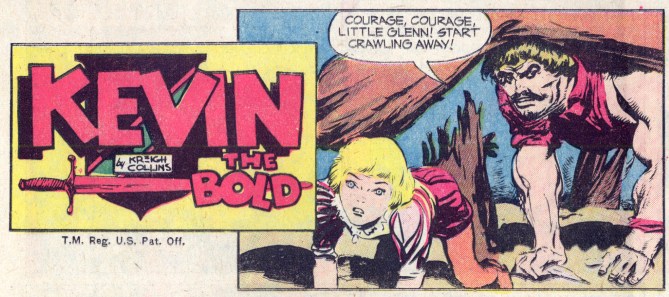
Like most artists, Kreigh Collins looked to his family and surroundings for inspiration. Kreigh’s young twins were named Kevin and Glen. Kevin obviously had a major part in his eponymous cartoon strip, whereas Glen didn’t show up until eight years later.

KTB 121050 Kevin intro

KTB 111658 Glenn panel

If you knew my Uncle Glen, you’d appreciate the irony of Pedro’s comment.

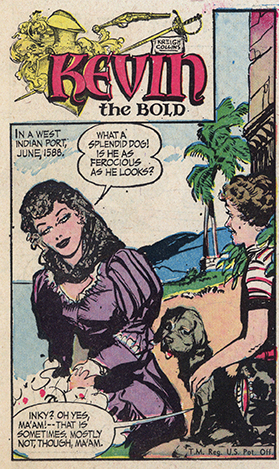
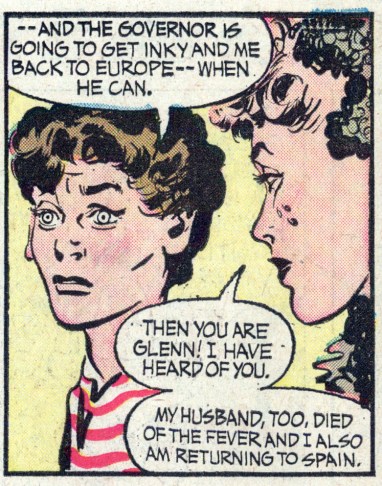
The sequence with “little Glenn” lasted nine weeks. Perhaps seeing the inequality of his twins’ like-named characters, Kreigh introduced another Glen six years later. This time, he was an orphan, stranded in the West Indies.

KTB 100464 Inky ktb-100464-glen-intro

Even Inky appeared. He was the neighbors’ dog.

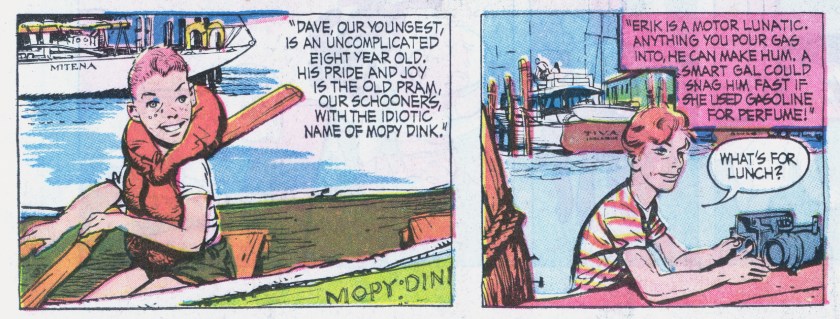
Kreigh’s oldest sons, Erik and David, had namesake characters in Collins’ final comic strip, “Up Anchor!” Like Kreigh’s, the Marlin family sailed aboard a schooner named Heather. (In reality, Erik and David were no longer living at home, and neither were redheads).

UA 110368 Dave Erik Intro

Fifteen months into its nearly two-decade run, “Kevin the Bold” introduced a new character, Brett. My brother Brett was Kreigh’s first grandchild, and as with Kevin, the character appeared in the funnies before the actual person was born (in Brett’s case, nearly ten years earlier).

KTB 011352 Brett Intro

In “Mitzi McCoy” Stub Goodman drove a loaner car that looked a lot like Kreigh’s.

MM 070950 Bantam carCar and Heather

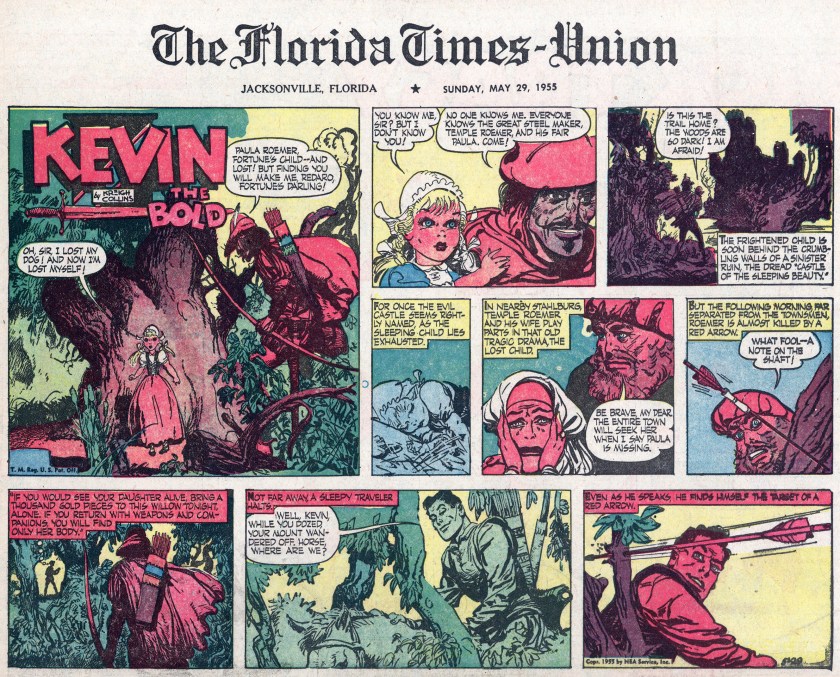
Another character with a name from the artist’s real-life experiences appeared in a mid-1955 sequence, “The Castle of the Sleeping Beauty.” A little girl had gotten lost in the woods, and her father, the “great steel maker Temple Roemer” was distraught. Tempel Smith, Kreigh’s brother-in-law, had started a steel-stamping business ten years earlier, and by this time it had grown into a massive steel company.

KTB 052955 HF 200 QCC.jpg

Recycling

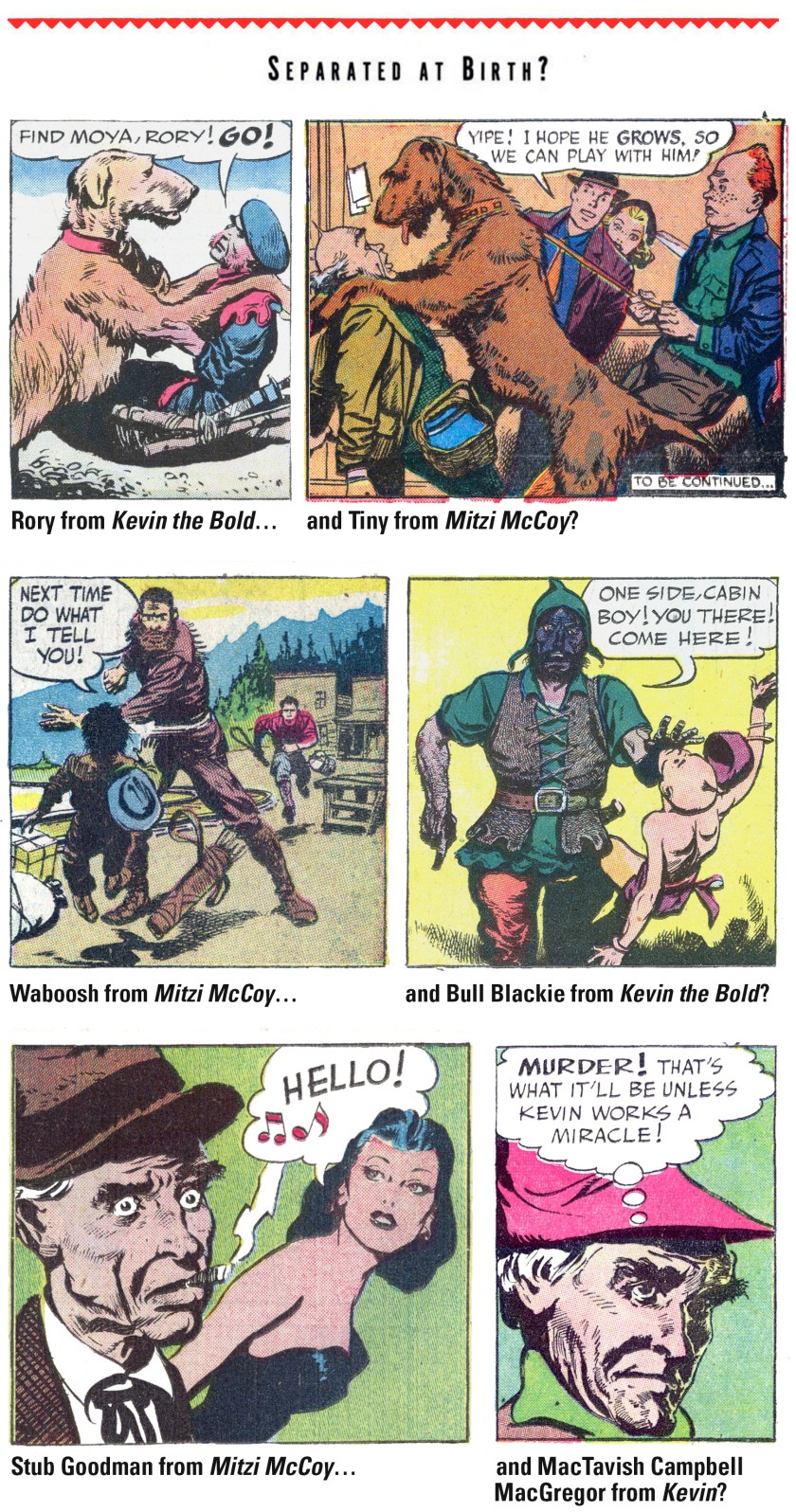
I started my professional career as a graphic designer in 1987. Like a lot of young people in the publishing industry, I was a big fan of Spy magazine. Spy was a satirical monthly that ran from 1986 to the mid-90s and was based in New York City, like me. There were plenty of interesting components of the magazine, among them “Separated at Birth.” It wasn’t a high-brow feature, and no doubt it’s been parodied to death.

Kreigh Collins often had characters that were inspired by ones from his previous comics. Occasionally ideas were recycled too, but these are examples of the former.
Separated 1-3

These examples might not be as elegant as those found in Spy, but they are still pretty interesting. Sometimes it wasn’t so much a recurring character as it was an object.
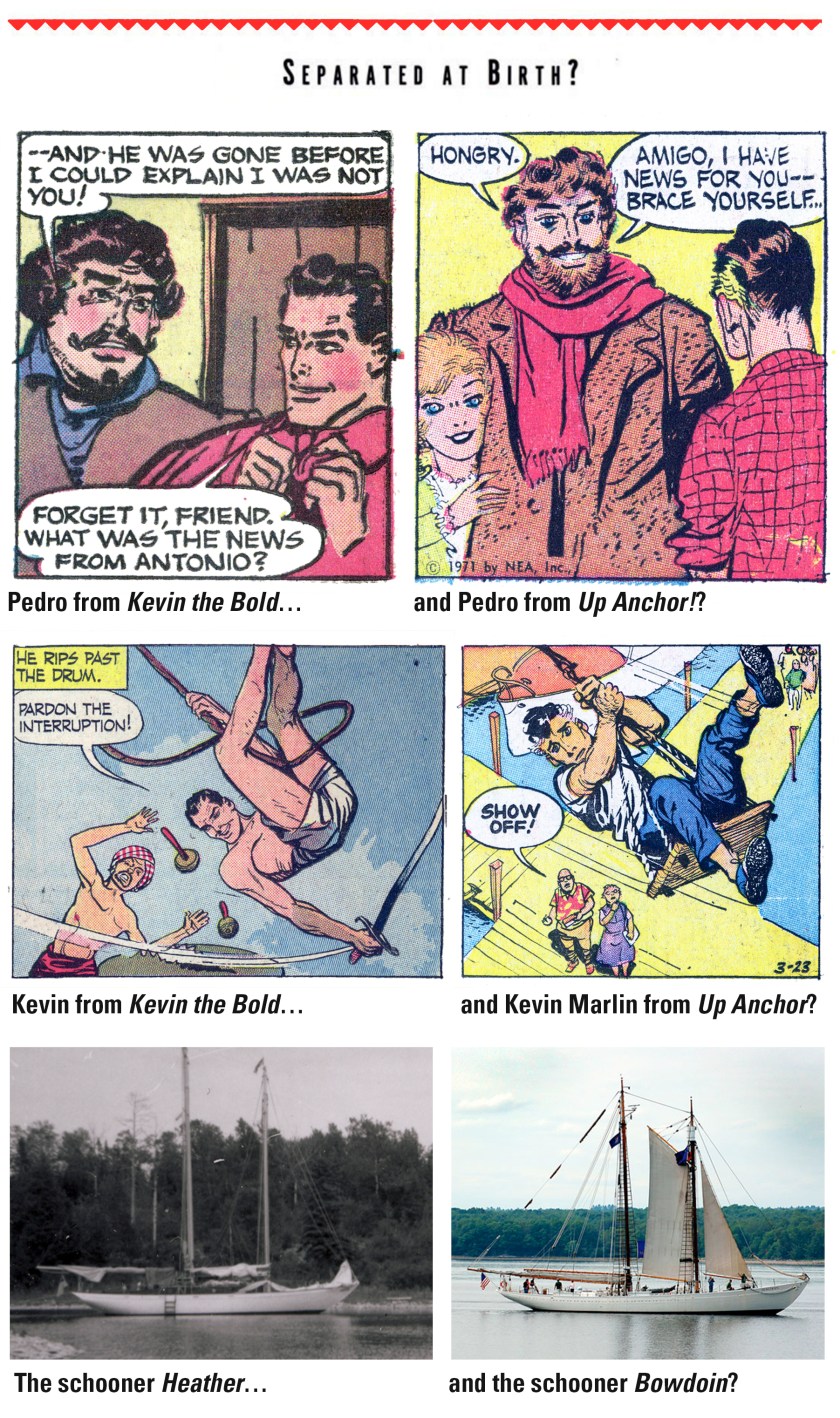
Separated 4-6

“Up Anchor!,” Kreigh’s final comic, was set aboard a representation of his own boat, the 45-foot long Heather. The Bowdoin didn’t feature in any of Kreigh’s comics, but the historic 88-foot long schooner was the design upon which the half-size Heather was based.

Uniquely designed for Arctic exploration, the Bowdoin was launched in 1921.Under the direction of skipper Donald B. MacMillan, it made dozens of trips above the Arctic Circle. Earlier, MacMillan had accompanied Robert Peary on his historic expedition to the North Pole in 1909.

Kreigh’s wife Theresa described how Heather came to be in the article she wrote, and which Kreigh illustrated, “The Wake of the Heather.”

When [Arctic] explorations were in the forefront of the news, a Chicago doctor wrote to the ship’s designer and asked him to design a half-sized schooner, built as she was and able to go anywhere and do anything. The doctor died two years after his boat was launched in 1927, and the superbly built schooner passed on to a succession of owners until we bought her twelve years ago. This is our Heather, little sister of the Bowdoin.

Kreigh and Teddy met MacMillan at Mystic Seaport in the summer of 1966. They had known of Heather’s parentage, and had sought out the Bowdoin. The 92-year-old MacMillan, a rear admiral in the Naval Reserve, invited the couple to dine with him and his wife aboard their boat.

Kreigh and his family sailed Heather for nearly 15 years, and she lived up to her go-anywhere, do-anything billing. Among the places they took her were all of the Great Lakes, the Erie Canal, the Hudson River, New York harbor, Long Island Sound, the Cape Cod Canal, Maine, the Bay of Fundy; and the Inter-coastal Waterway, Florida, the Gulf of Mexico and the Mississippi River. I’m not sure if they ever made it to the Bahamas, as a late-1950s newspaper article mentioned, but they certainly covered a lot of water.

Girl Meets Boy

The first “Kevin the Bold” sequence features all the classic elements for which the strip would become known — dramatic action, monstrous villains, damsels in distress, heroism… and gorgeous artwork.

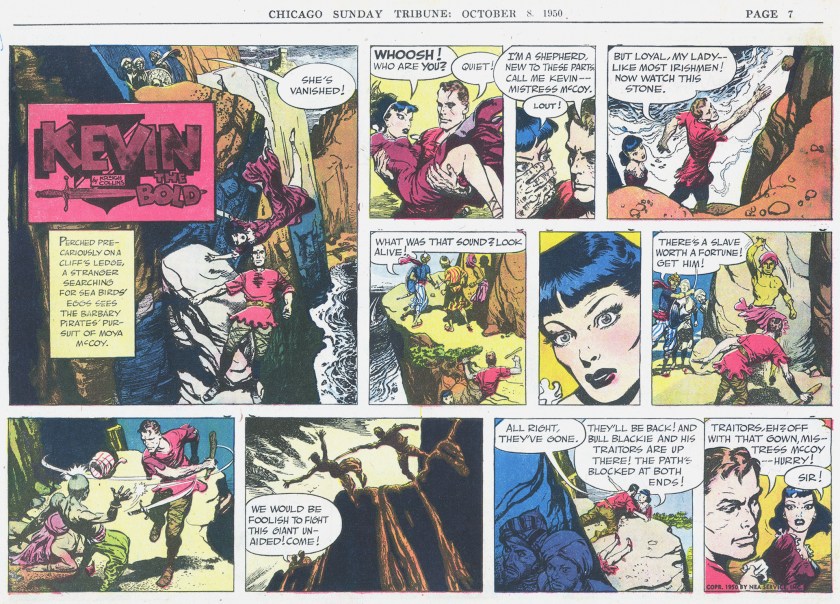
Moya McCoy is the first character introduced; Kevin doesn’t appear until the second episode, when the two abruptly meet (or as it says in the comic, “Whoosh!”).KTB 100150 HF 150 QCC

KTB 100850 HA 150 CC

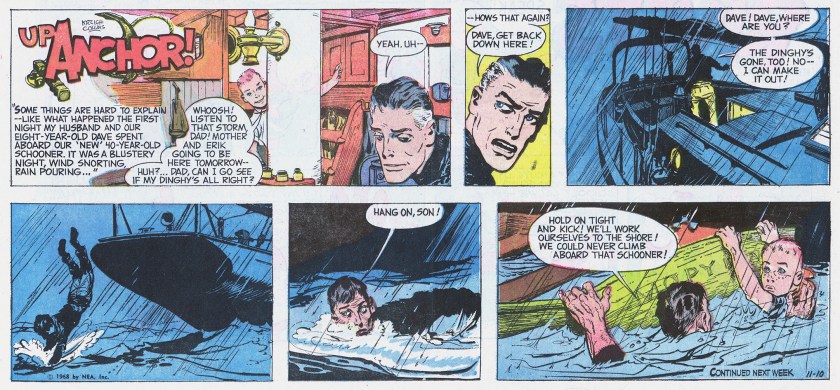
“Whoosh!” is a slang term with which I had been unfamiliar — until I started reading Kreigh’s comics. It must be dialogue suggested by the artist. By coincidence, the word appears in not just the second episode of “Kevin the Bold,” but also in the second episode of “Up Anchor.” Note to conspiracy theorists: it does not appear in the second (or any!) episode of “Mitzi McCoy.”

UA 111068 Th 150 QCC

Note: I stand corrected! See the fourth panel (or “frame,” as Collins called them) of the March 26, 1950 “Mitzi,” below.

MM 032650 150 cc wbg.jpg

On the Hard

Plenty of action and adventure lay behind; a proposed ocean crossing promised further excitement ahead. Once home, the Marlins reunited with their old friend Pedro, who almost seems to have anticipated Heather’s upcoming journey. These comics ran November 14, 21 and 28, 1971. With only 13 more “Up Anchor” comics to come before Kreigh Collins retired, it seems doubtful that Heather ever made it to Europe.

UA 111471 OA

UA 112171 Th 300 qcc

UA 112871 Th 300 qcc

Pedro is a character with a familiar face. As with other characters Kreigh illustrated, his doppelgänger was a friend of Kevin Marlin in his earlier incarnation as Kevin the Bold. Whereas Kevin has aged from one comic strip to the next, Pedro has not. Maybe Pedro’s secret is the Italian beautician’s powder.

KTB 122858 TH 300 QCC

(KTB from December 28, 1958)

Surviving the Squall

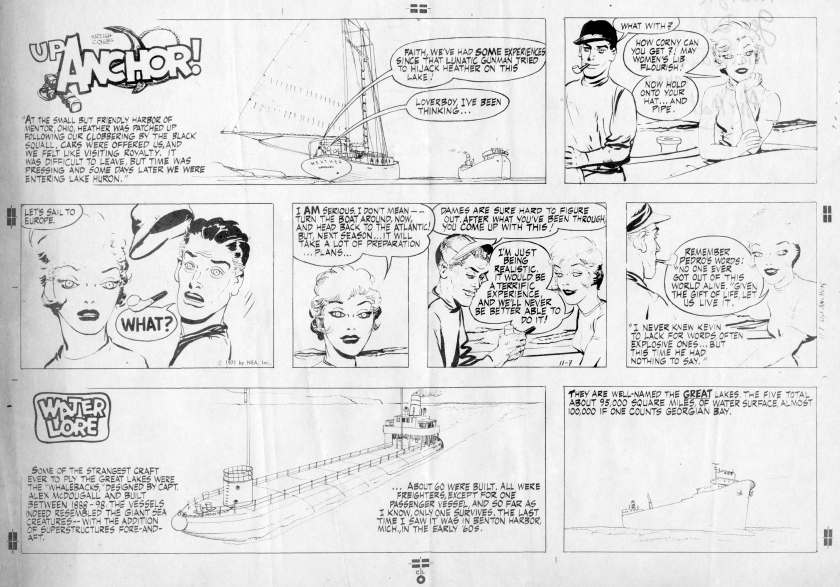
Heather and crew managed to survive “a notorious Lake Erie black squall,” and despite the trauma, Jane Marlin has an idea for Heather’s next journey, which comes as quite a surprise. It seems her trip to the beauty parlor was quite rejuvenating.

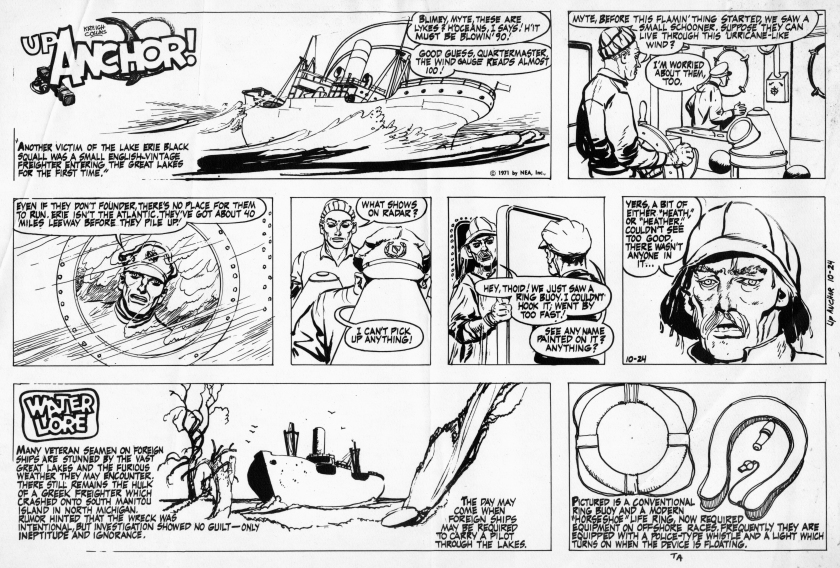
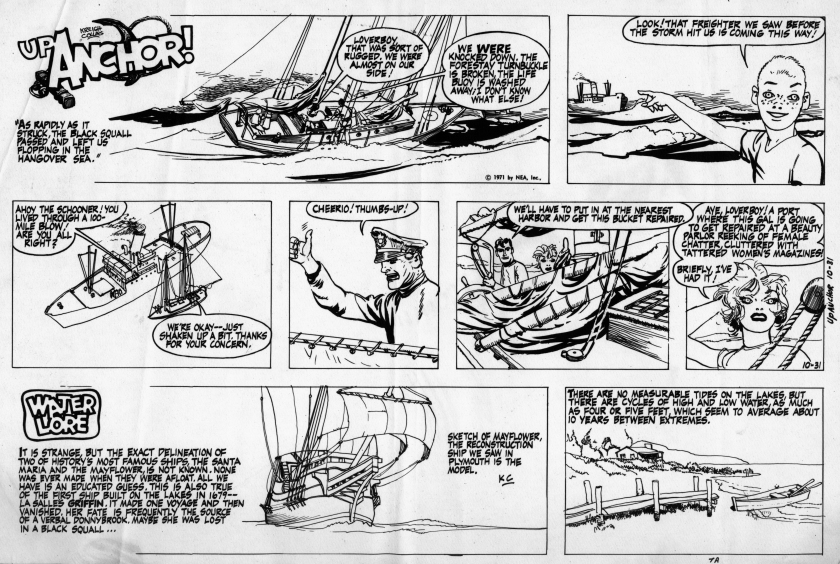
Below are the comics that ran from October 24 until November 7, 1971. They are all silver prints, which Kreigh would receive from the NEA as a last chance for proofing before the comics were published. Some of the proofs he received were of better quality than others, but the nicer ones are almost as crisp as images of the original artwork. When “Up Anchor” appeared in print, it was almost always as a one-third page; the proofs have the bonus of including the topper strip “Water Lore.”

UA 102471 BWS 300 qcc

UA 103171 BWS 300 qcc

UA 110771 BWS 300 qcc

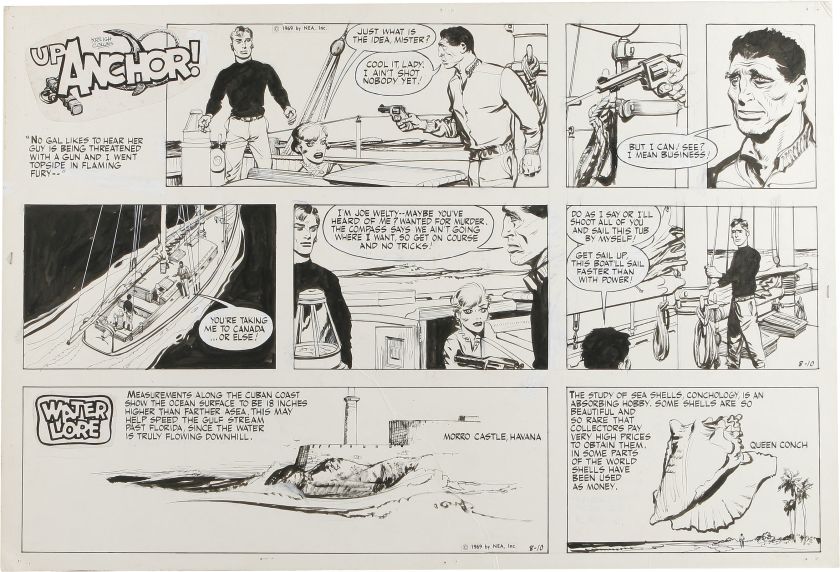
With the storm behind them, skipper Kevin Marlin remembers an incident when a “lunatic gunman” tried to hijack Heather the last time they plied Lake Huron’s waters. That sequence is unfamiliar to me, but while surfing online I did come across the episode (August 10, 1969) from that chapter of “Up Anchor.”

UA 081069

Homeward Bound

When Kreigh Collins scuttled “Kevin the Bold” and launched “Up Anchor,” he had a fresh start with a new theme. After nearly 20 years of Kevin’s 15th-century exploits, the action was now set in the 20th century. Most of it took place aboard Heather, with a fictionalized version of his family serving as crew.

Much of what was depicted in the new comic was inspired by events the Collinses experienced while cruising the Great Lakes and beyond. In 1966, Heather returned to her home port after a nearly two-year absence. Much of the journey was chronicled in a series of ten articles that appeared in the Grand Rapids Press, much the way blog posts are written today. The articles were illustrated by Kreigh and written by wife Theresa. Later, the articles were adapted into a narrative, “The Wake of the Heather,” which appeared in The World of Comic Art, a trade journal. Eventually, the journey became the basis for one of the final sequences in “Up Anchor.”

Surviving newsprint copies of “Up Anchor” are not very common, but I as able to piece together nine consecutive comics from a variety of sources. There are black and white “silver print” proofs, color comics from the newspaper, and photograph of a piece of original art.

The action begins with the comic from October 3, 1971.

UA 101071 Th 300 qcc

UA 101771 Th 300 qcc

UA 103171 BWS 300 qcc

Here is Theresa’s description of the foul weather as it originally appeared in “The Wake of the Heather:”

Nearing Buffalo, we passed through an impressive fruit belt with vast orchards on both sides. Here homes line the canal banks. We had been underway a month and it had rained only once. We reached the North Tonawanda boat yard just as one of the fiercest squalls we had ever experienced hit. The next morning the Heather was rigged, and by noon her masts were once more in place and she was ready to sail again.

Merry Christmas and a Good 1969

KTC xmas 68 200

1968 was filled with change. After appearing for 19 years, “Kevin the Bold” ended its run. At the age of 61, Kreigh Collins launched his third comic strip, “Up Anchor.” This fresh start was the big news in the holiday letter Kreigh and Teddy sent out that December. There were also family updates , typical New Year’s optimism, and a dose of Kreigh’s wit.

“Up Anchor” ran until early 1972, and after its 174 episodes, Collins retired. All told, Kreigh’s comics appeared for 25 years, spanning four decades — over 1,200 Sundays.

UA envelope 72

Toppers

In comic strip parlance, a topper is a small secondary strip seen along with a larger Sunday strip. These strips usually were positioned at the top of the page, but they sometimes ran beneath the main strip, as in “Water Lore,” Kreigh Collins’s topper for his third and final comic, “Up Anchor.”

UA 081069 OA 72

Times were changing in the 1960s — in the comic strip business, they were changing too, as space for comics continued to shrink. Fewer and fewer papers printed half-page comics, and Collins was frustrated by the way his artwork was cropped in order to squeeze into the smaller third-page format. When his new comic launched, he drew it as a one-third pager, and used the topper to fill out the half-page of space. If a paper ran it as a third, the topper was lost. Printed half-page versions of “Up Anchor” are very rare, so these days, the most likely place to see the “Water Lore” topper is on examples of the original artwork. 

UA WL 022270 OA 100February 2, 1970
UA WL 091370 BWS 100 qccSeptember 13, 1970
UA WL 092070 BWS 100 qccSeptember 20, 1970
UA WL 100371 BWS 100October 3, 1971
UA WL 102471 BWS 100October 24, 1971
UA WL 103171 BWS 100 qccOctober 31, 1971
UA WL 110771 BWS 100 qccNovember 7, 1971
UA WL 111471 OA 100November 14, 1971
UA WL 112170 BWS 100 qccNovember 21, 1971
UA WL 121971 OA 100December 19, 1971

Metamorphosis 2 — More Time Travel

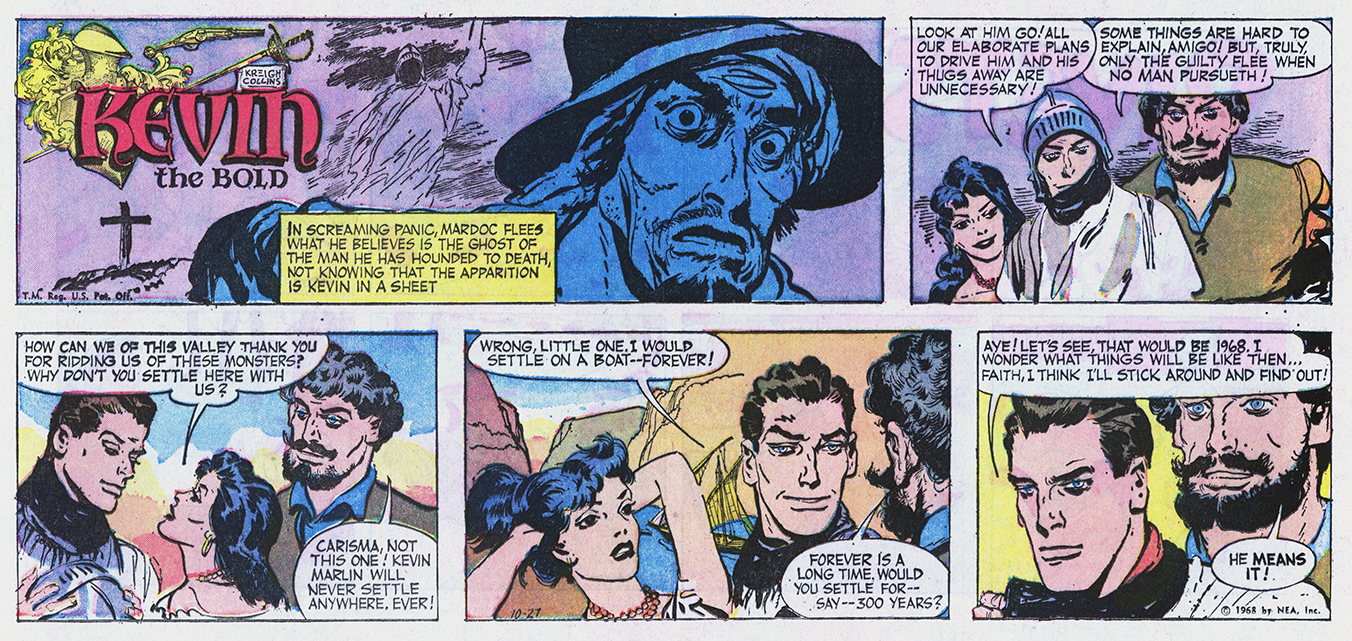
In the final episode of “Kevin the Bold,” after saving yet another damsel in distress (and of course, an entire village), our hero is begged by a lovely señorita to settle down and stay in her now-peaceful valley. Kevin, whose last name (Marlin) has been revealed in a recent, prior episode, declines the offer from the Spanish beauty but admits he could imagine himself settling down on a boat in say, 300 years.

KTB 102768 Th 100 qcc

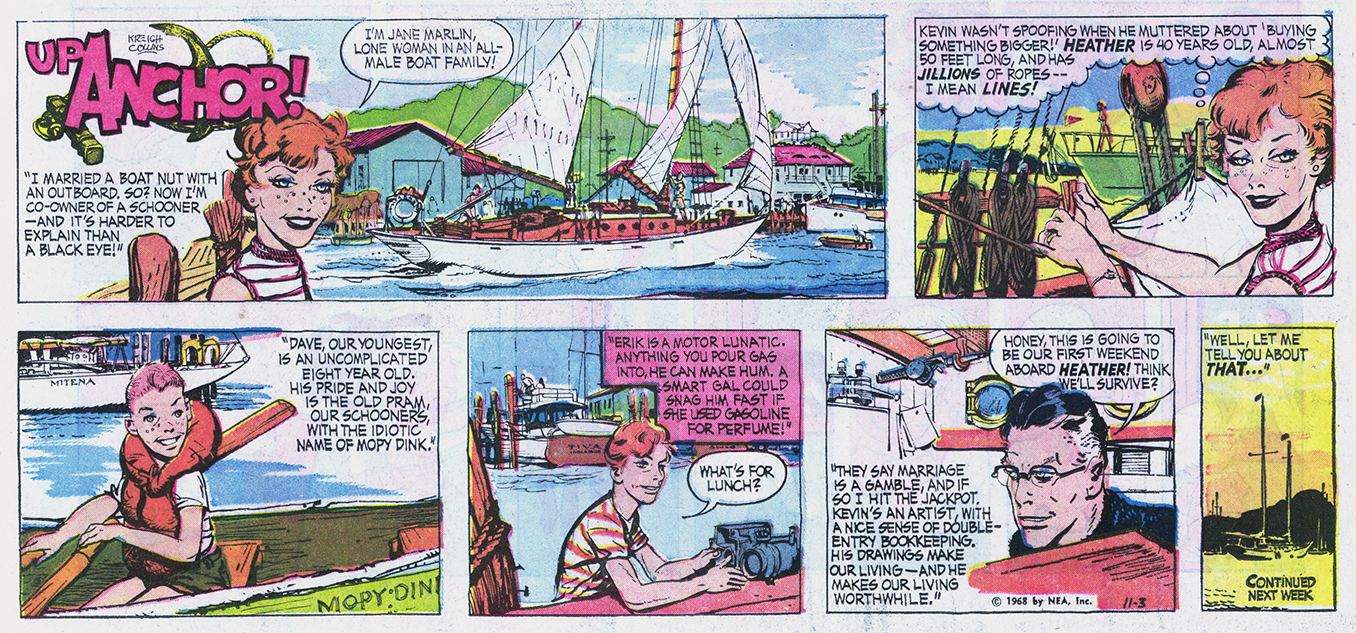
Abruptly, “Up Anchor” was launched a week later (November 3, 1968). As the NEA’s promotional literature put it, “Kreigh Collins’ credentials to create and draw ‘Up Anchor,’ America’s first color comic strip devoted to boating, are as bona fide as the burr on a thistle.” Narrated by first mate Jane Marlin, “Up Anchor” was based on experiences Collins had with his family cruising on his own sailboat. Aboard Heather with Jane were her husband (Kevin Marlin, remember him?), and sons Erik and Dave. The scripts were developed in partnership with Collins’ wife Theresa (“Teddy”), who had previously chronicled the family’s round-trip journey from their home port on Lake Michigan to Maine (Teddy’s “The Wake of the Heather” was published in 1967) .

UA 110368 Th 100 qcc