Training

From its onset, “Kevin the Bold” had much going for it. Kreigh Collins was bursting with enthusiasm for its subject matter, he had the experience and artistic chops to pull of such a period comic, and he had the backing of the Chicago Sunday Tribune to give his work a wider audience. Collins also had a compelling collection of original storylines to illustrate.

The result was some exceptional work. These next three comics neatly distill the essence of the comic strip and its protagonists. Kevin is honorable and humble, yet invincible; MacTavish Campbell MacGregor (“Stub”) is steadfast and loyal; and Moya is cheerful, smart, and beautiful. It’s important to note that as Mitzi McCoy’s ancestor, Moya more closely resembles the heroine of Collins’ earlier comic feature than Kevin and his squire resemble their forebearers, Tim and Stub (despite the older man’s familiar sobriquet). Sadly, Moya does not last long as a prominent character in “Kevin”.

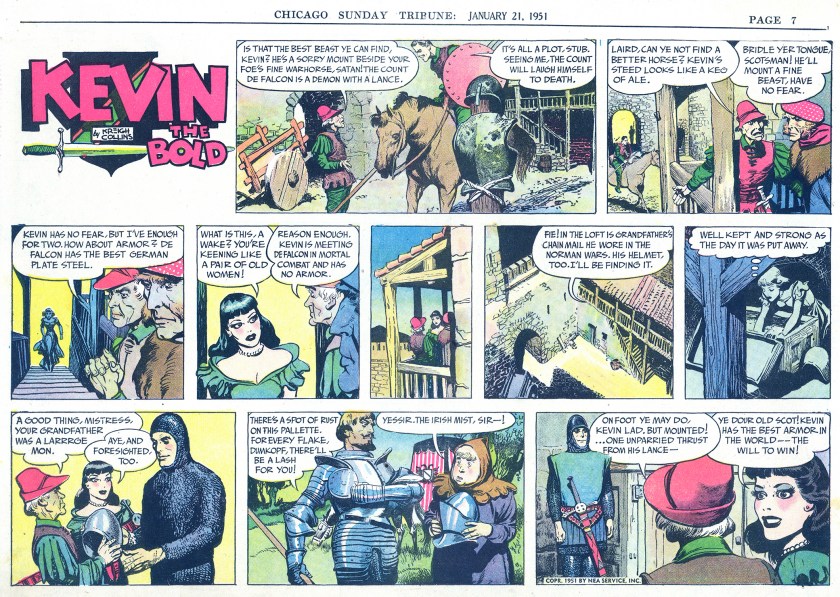
KTB 012151 HA 150 qcc.jpg

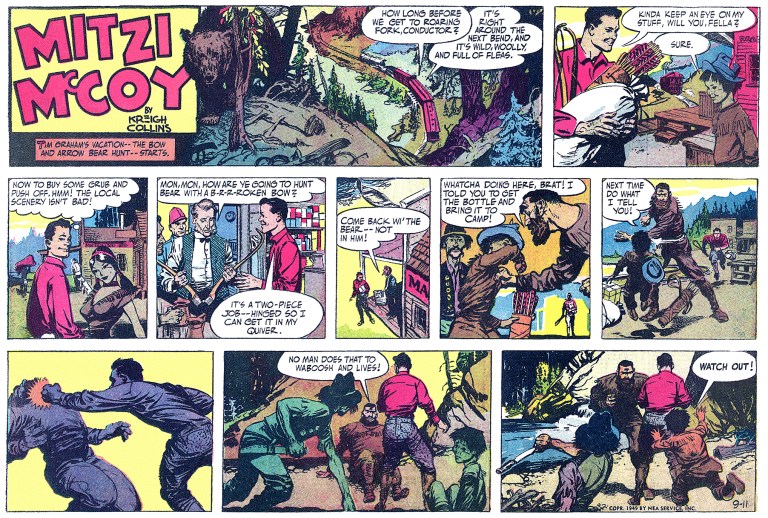
With the date of his fight against De Falcon looming, Kevin starts training, and he also begins to upgrade his gear. In addition to his Claymore, he now has chain mail. With Stub as his tactician, Kevin gets to work.

KTB 012851 HA 150 qcc.jpg

KTB 020451 HA 150 qcc

Acknowledging his past heroism, one of Moya’s father’s subject presents Kevin with a horse more suitable for his tournament date. Appropriately, she is mare, leading to a false sense of confidence in Kevin’s opponent. Like Kevin, she is not to be underestimated, an error made by many of Kevin’s adversaries.

The comics also contrast the two sides in the upcoming battle. Despite the obvious differences, maybe Kevin and the Baron have more in common than they realize.

First Impressions

Following the abrupt transformation of the comic strip “Mitzi McCoy” into “Kevin the Bold,” Kreigh Collins was ready with several dynamic storylines for his new hero, and his artwork was equally up to the task.

At the end of the new comic strip’s first chapter, Kevin defeated the Moorish pirates and saved the locals from enslavement. As a reward, Moya McCoy’s father presented Kevin with a historically significant claymore, as well as his distinguished title.

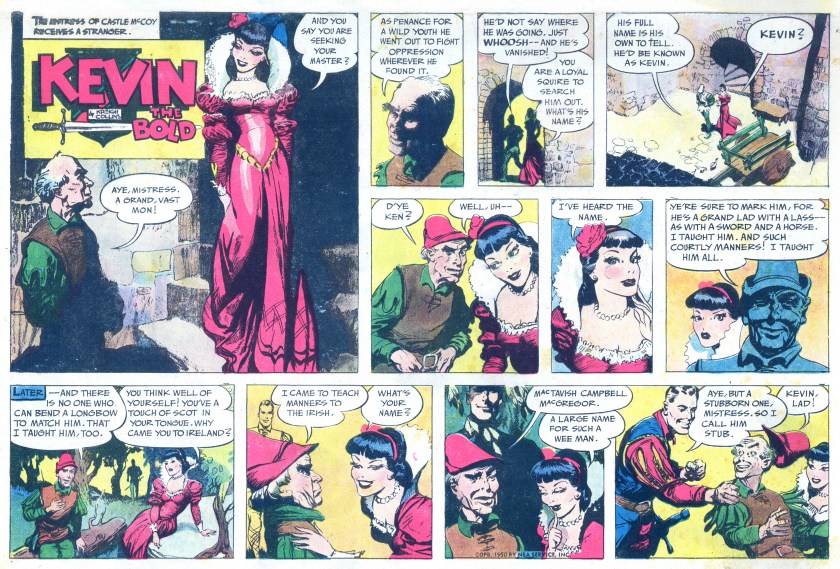
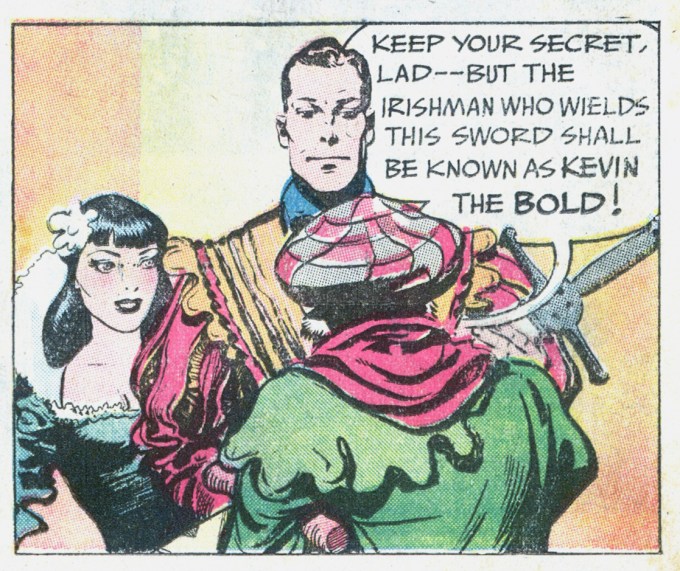
The second chapter of “Kevin the Bold” begins with a marvelous comic. Its splash panel shows a beautifully garbed Moya, as MacTavish Campbell MacGregor is introduced. Upon meeting Moya, “Stub” announces Kevin’s simple credo. Moya instantly takes to the prickly Scotsman and fires a snappy line at her new friend.

KTB 121750 HA 300 qcc.jpg

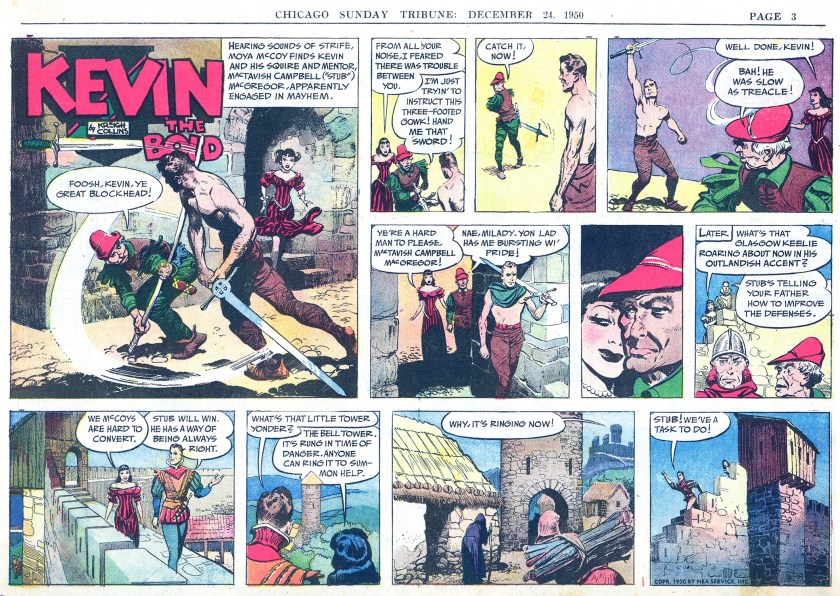
As is often the case, the transitional comics between the main sequences are lighthearted, but action comes to the fore in the next comic, with another exciting splash panel. Stub has resumed Kevin’s training, with our protagonist getting acquainted with his fearsome new weapon. No doubt this training will come in handy at a later time.

The comic also shows the amazing reproductive abilities of Collins’ newest champion, the Chicago Tribune. The Trib typically ran its new feature near the front of its comic section, and the newspaper was able to showcase the Kreigh’s skills with its own superb coloring, including a very nice example of aerial perspective in the ninth panel.

KTB 122450 HA 150 qcc.jpg

Significantly, this panel shows a distant bell tower, which calls Kevin to action.


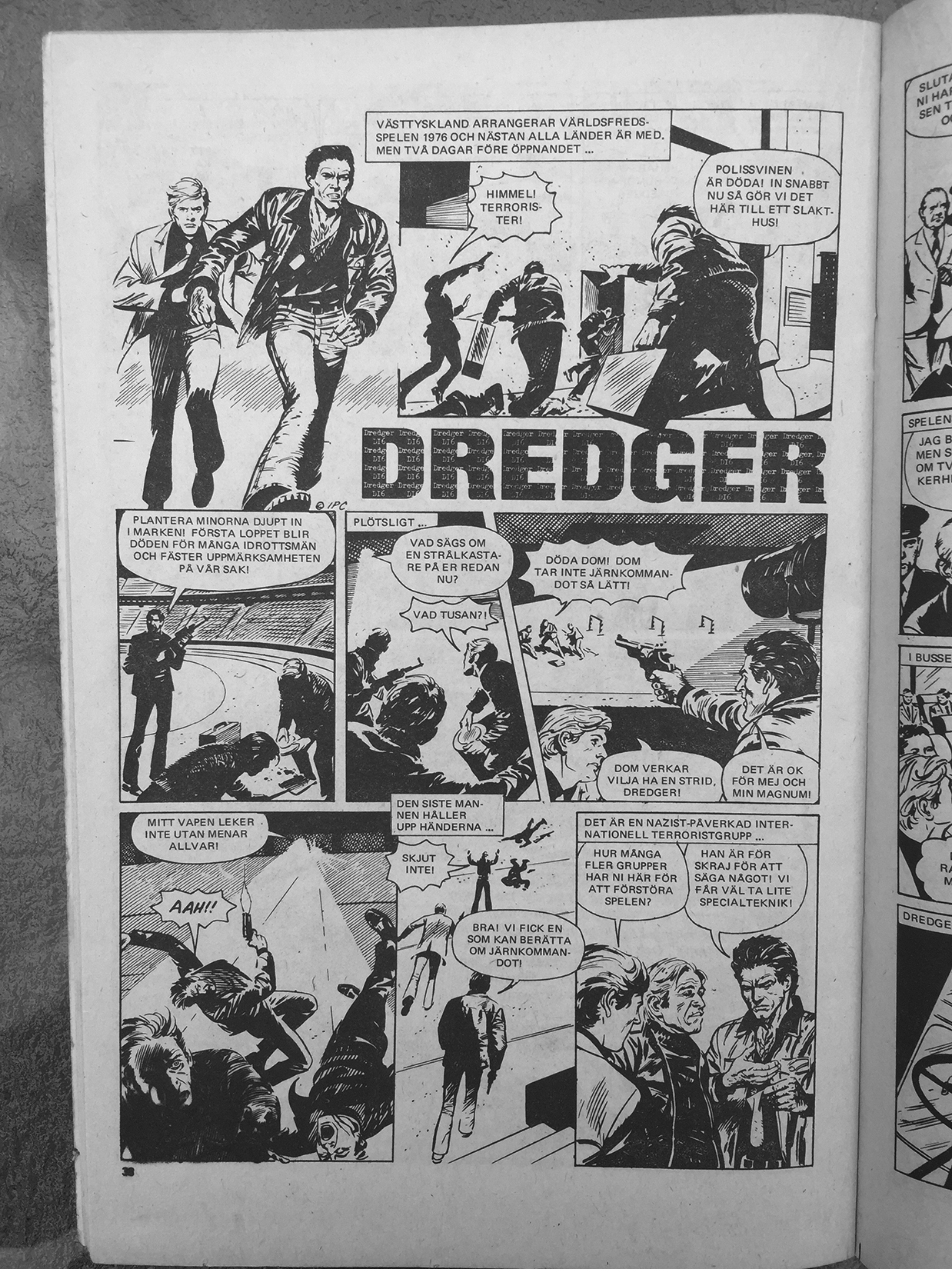
Serie magasinet 13

[Update: in my haste to figure out anything about the following comic, I originally misidentified it as Danish. It is, in fact, Swedish. My apologies! If you have any information on this comic book series, please feel free to leave a comment; the comments link is rather buried at the bottom of the post. Thank you].

Pratar du svenska??

FullSizeRender 17

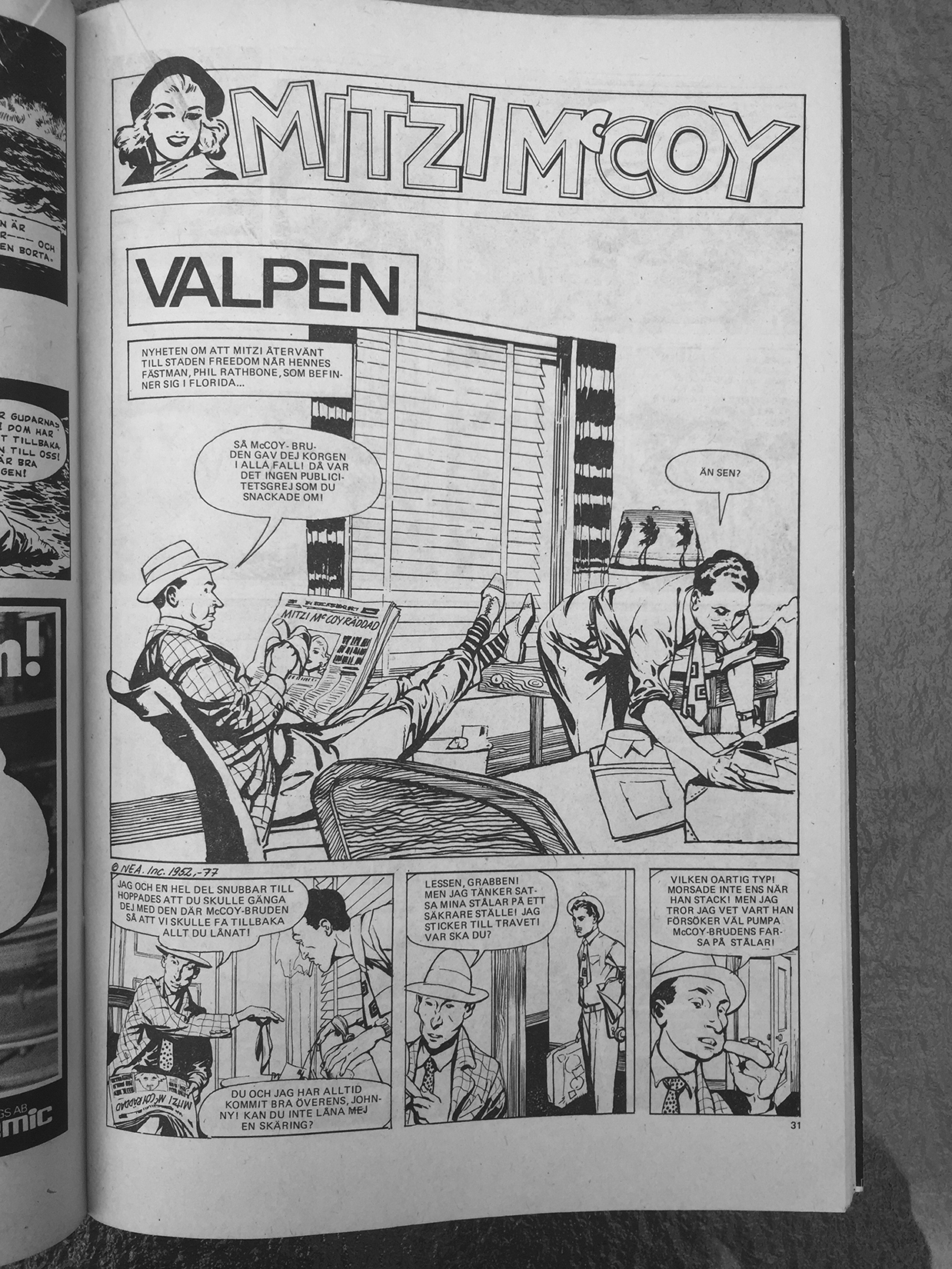
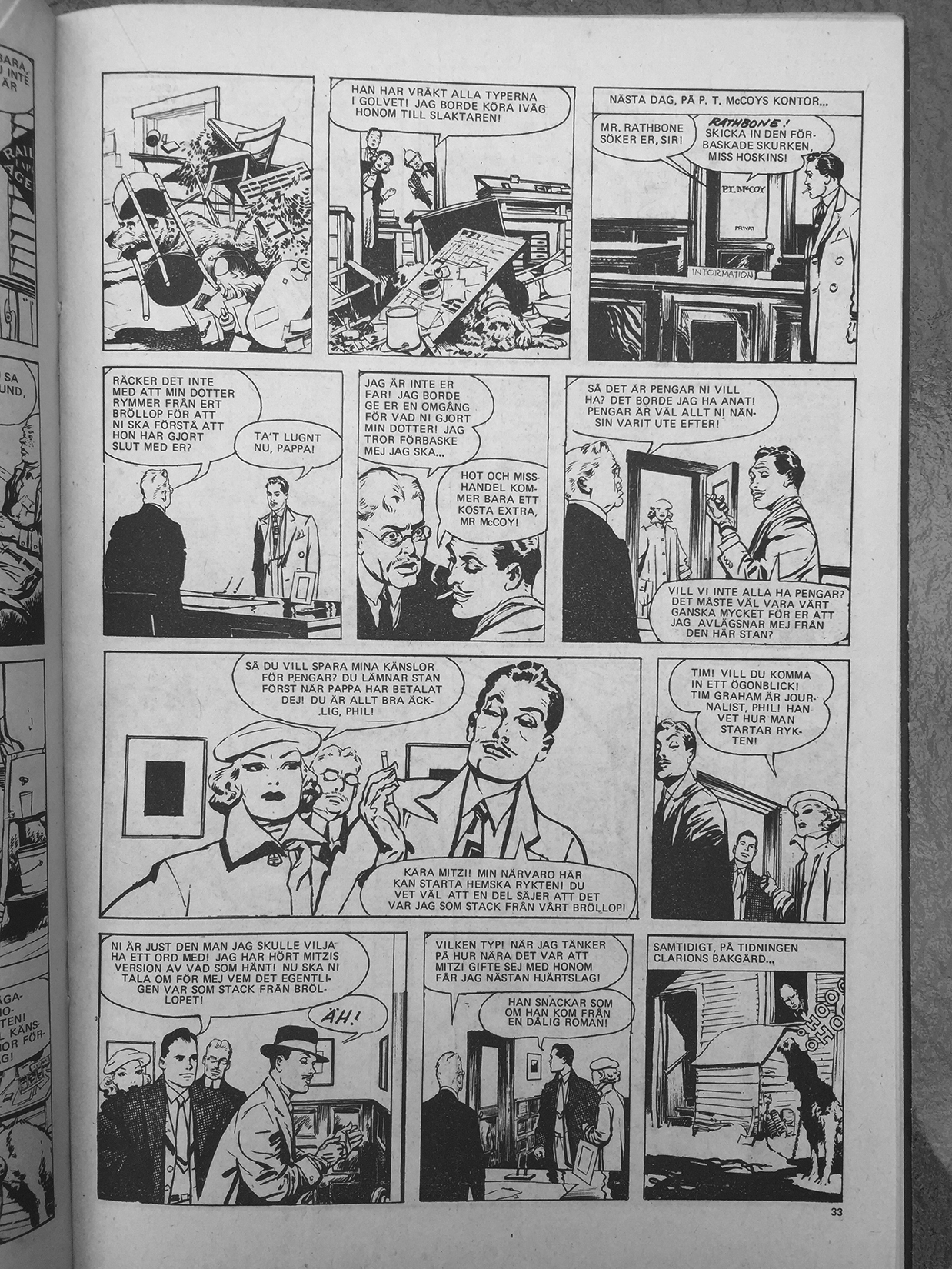
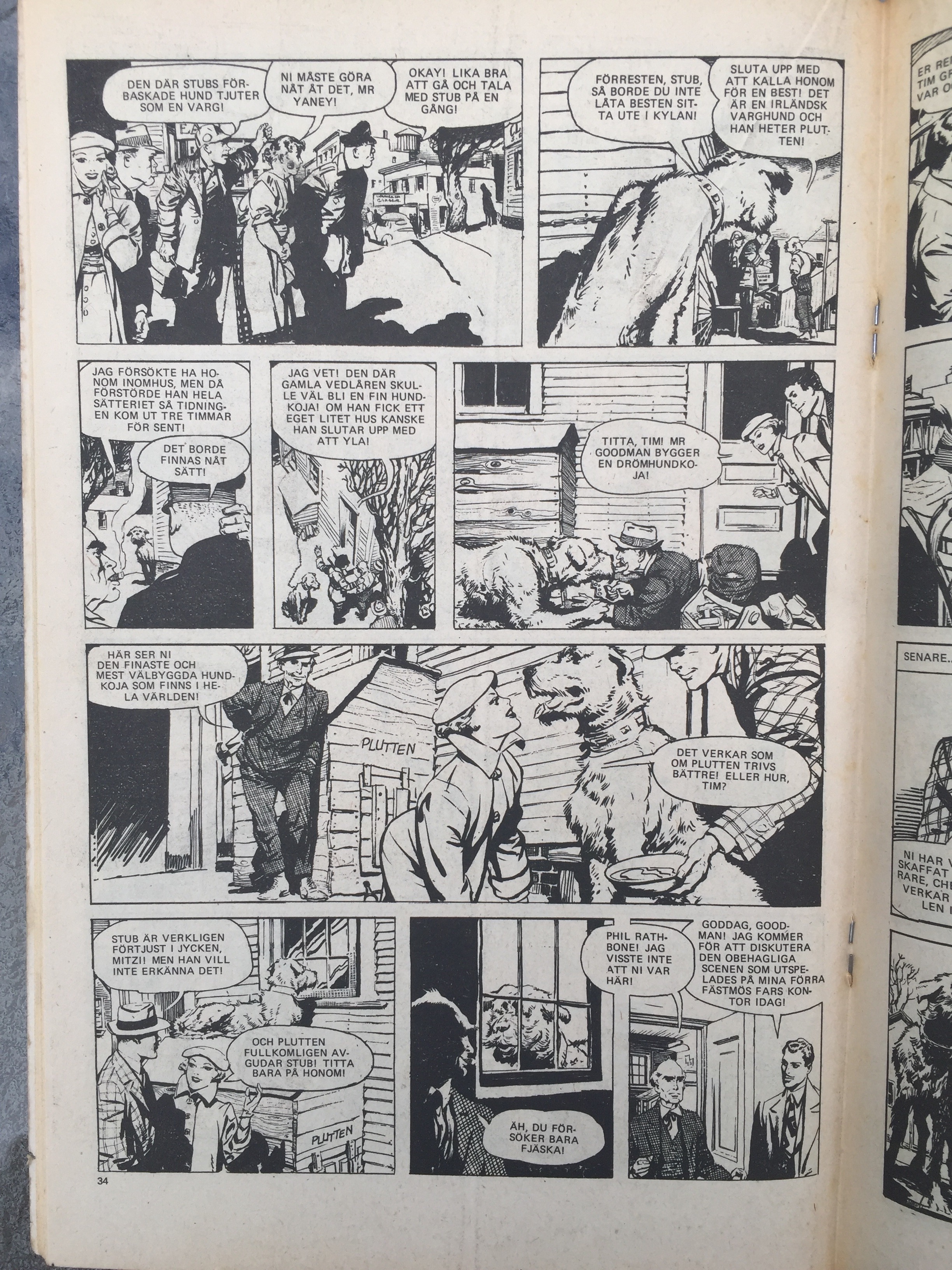
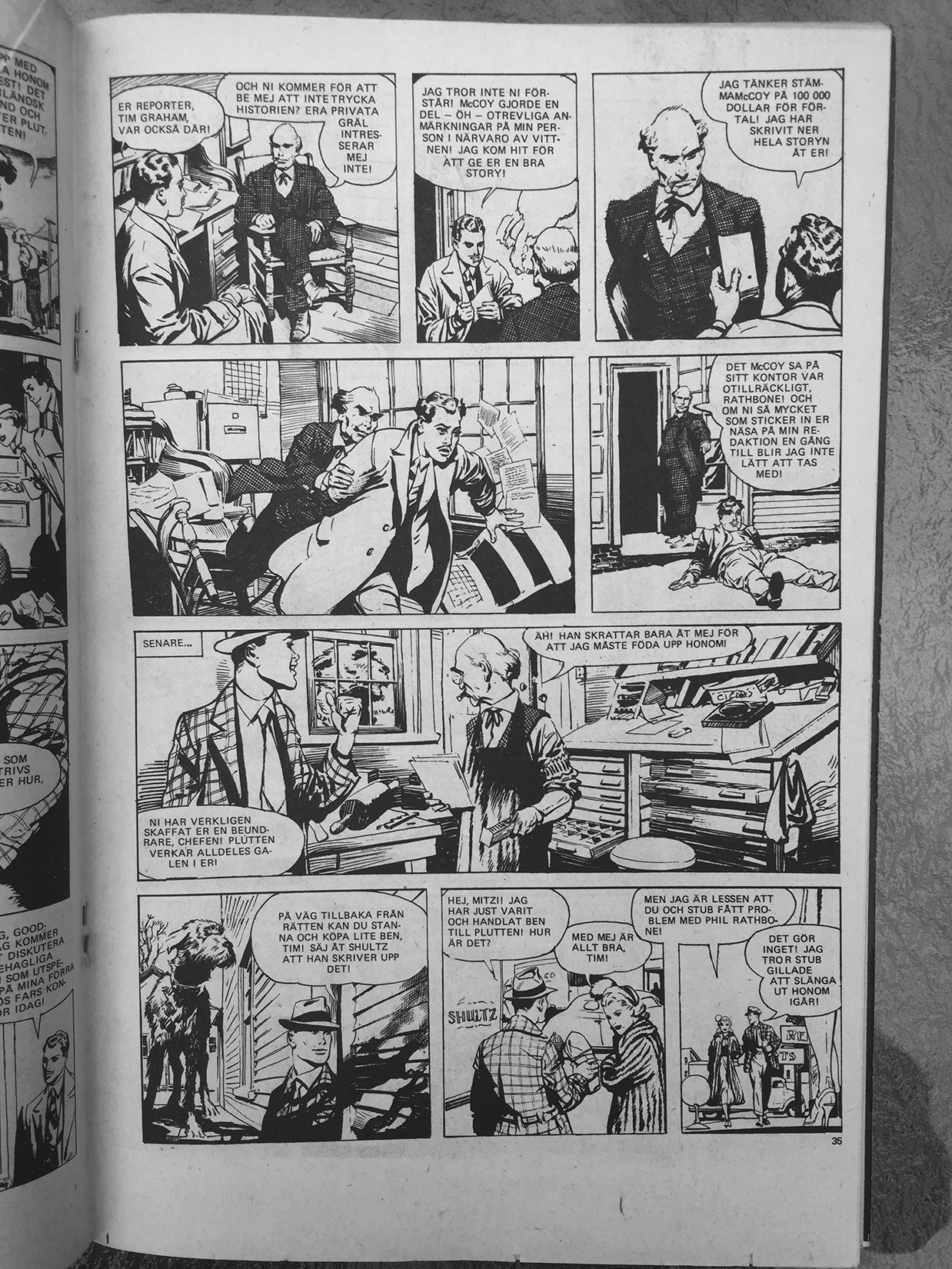
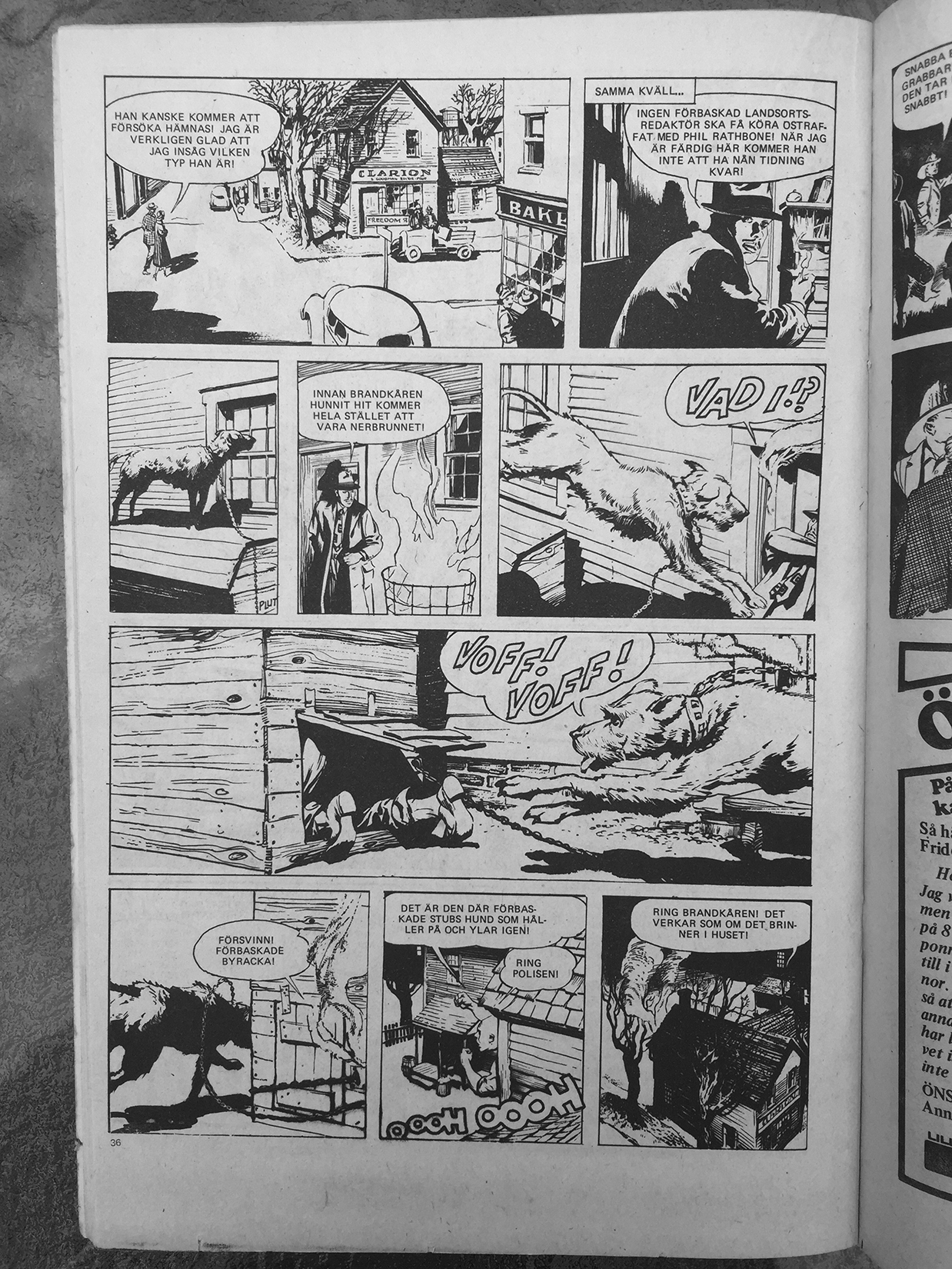
I do not speak Swedish, but I wish I did. This comic book caught my eye with the mention of “MItzi McCoy” among its coverlines. Knowledge of Swedish would come in handy in comparing the dialog of the Mitzi comics it contained to the original English, as it originally appeared in late 1940s.

I had been aware of Kreigh Collins’ comics being reprinted for Australian markets, and also for Argentina. I’d even come across some Norwegian comics. Usually these reprints all featured “Kevin the Bold.” But this one was a surprise, bringing Mitzi back nearly 30 years after the original Sunday comics ran.

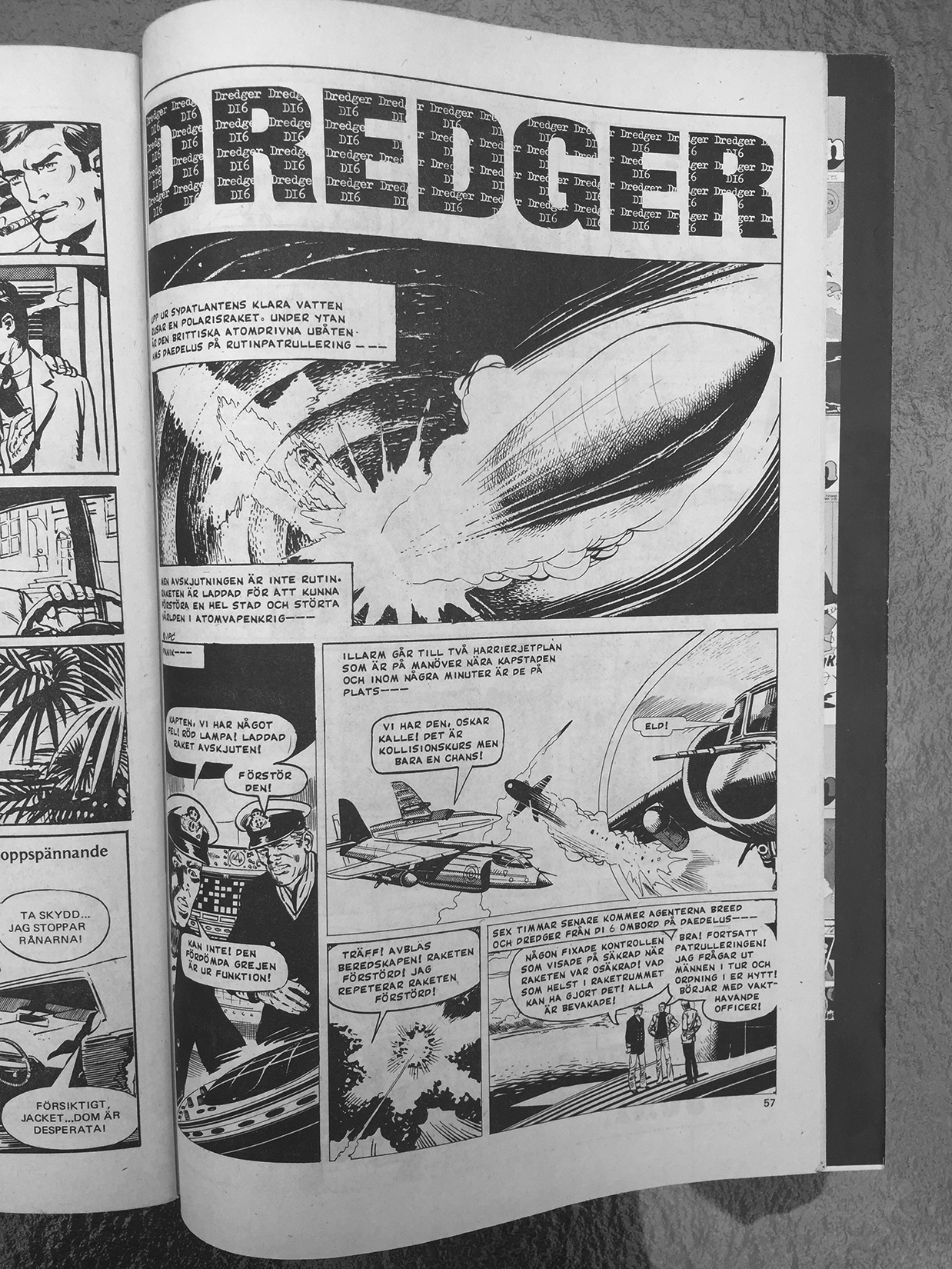
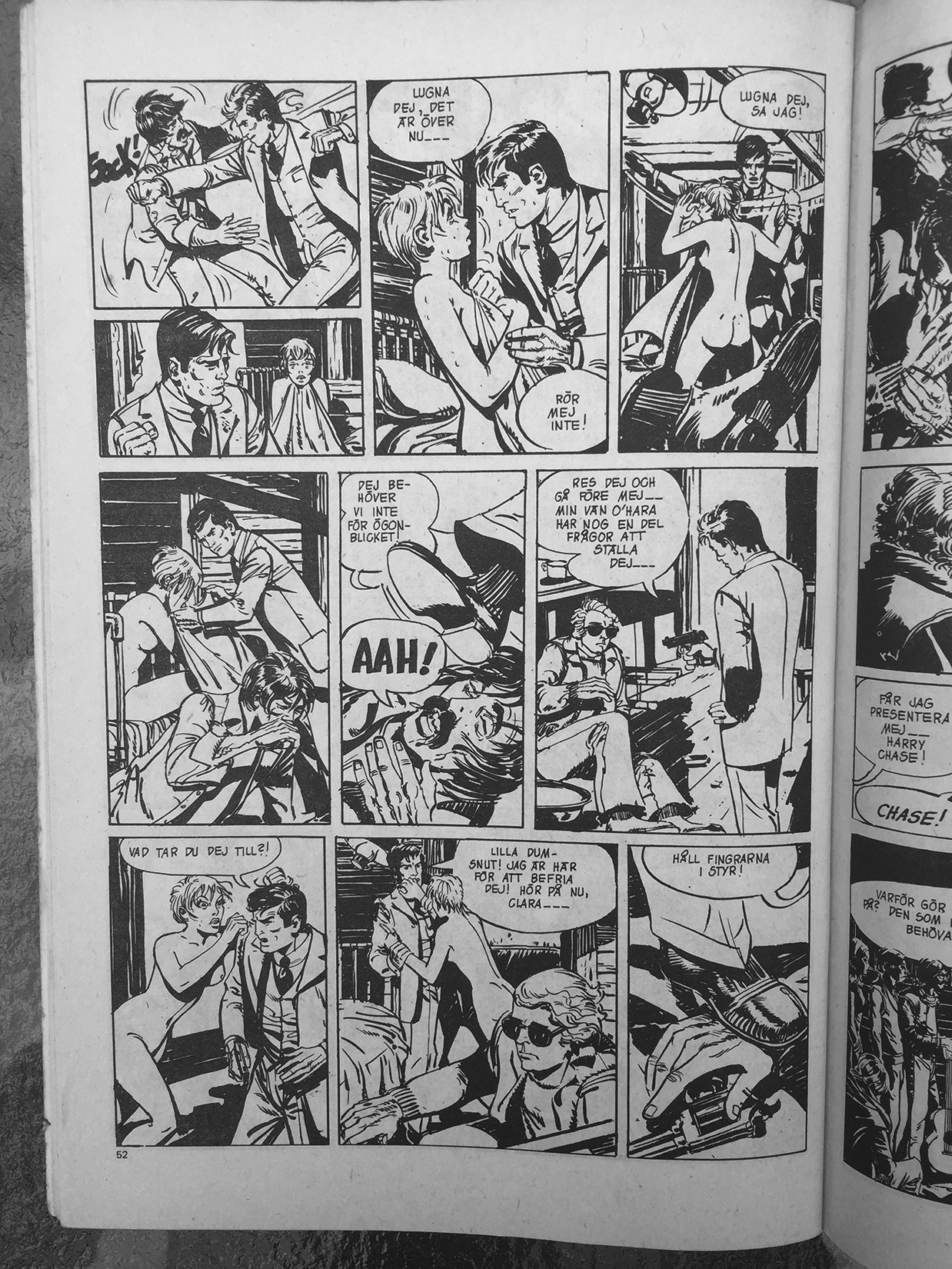
Serie magasinet 13 runs 68 pages, with plenty of preliminary action before what is for me, the main event. Inside there are a couple sequences of “Dredger,” and one each of “Harry Chase,” “Kerry Drake,” and something called “Larm I Distrikt 94.” Forgive me, I know nothing about these comics. I suspect at least one is of Scandinavian origin, as a female character is shown without the clothing typical of mainstream American comics.

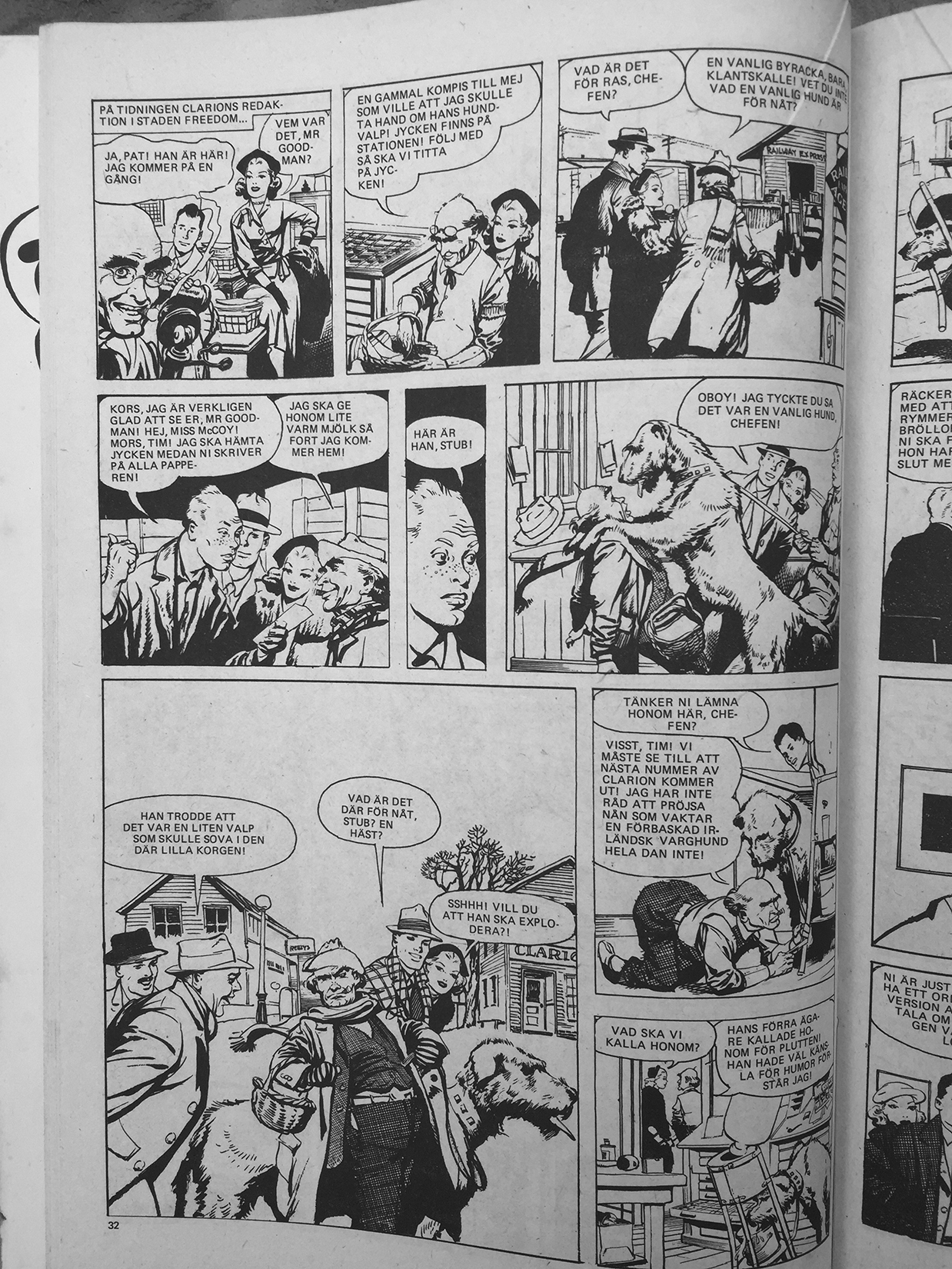
Starting on page 31 is the second sequence from “Mitzi McCoy”’. Its six comics were originally published from January to March in 1949. They show all of the strip’s main characters, and feature Stub Goodman’s Irish Wolfhound, Tiny, in his fist heroic role.

FullSizeRender 14

The comics are reproduced pretty much as they originally appeared as tabloids in the Sunday papers, with their throwaway panels omitted. The only real alteration I could spot is the artificial creation of the opening sequence’s splash panel (only the bottom half appeared in the original). Curious as to what “Valpen” meant, I learned it meant “the puppy.”

FullSizeRender 15
FullSizeRender 11
FullSizeRender 7.jpg

I was disappointed to see there was no translation evident of “Plutten,” Tiny’s name in the Swedish version of the comic (written on his doghouse).

FullSizeRender 20
FullSizeRender 16
FullSizeRender 10

The comics were reproduced from original proofs supplied by the NEA — it’s great to see Collins’ crisp black and white line work. Unfortunately, the whereabouts of these proofs at this time is unknown. Meanwhile, I’m trying to track down information on other Serie comic books.

Chasing Mitzi

When I first started collecting comics, I dreamed about putting together a book featuring “Kevin the Bold.” Being a graphic designer who worked in publishing, it didn’t seem too far-fetched. My Uncle Kevin had given me a large amount of my grandfather’s comics in 2011, and the question seemed to be what comics to use. I didn’t have the entire 18 year run, but I did have several years complete. The logical starting place for a serial like “Kevin” was its beginning, but my collection had some missing comics among the early ones. I didn’t get off to a flying start.

A year or so later, uncle Kevin sent me another massive package of Kreigh’s comics. Inside were hundreds of “Kevin the Bold”s, as well as the complete run of Collins’ earlier comic, “Mitzi McCoy.”  I’d heard about “Mitzi”, but had never seen any examples of the short-lived strip (it ran for less than two years). They comics were beautiful and fresh. Its run of 99 comics seemed like a manageable size to tackle in a first effort at publishing a book, so I switched gears.

MM 110748 72 cc wbg

Mitzi’s debut comic.

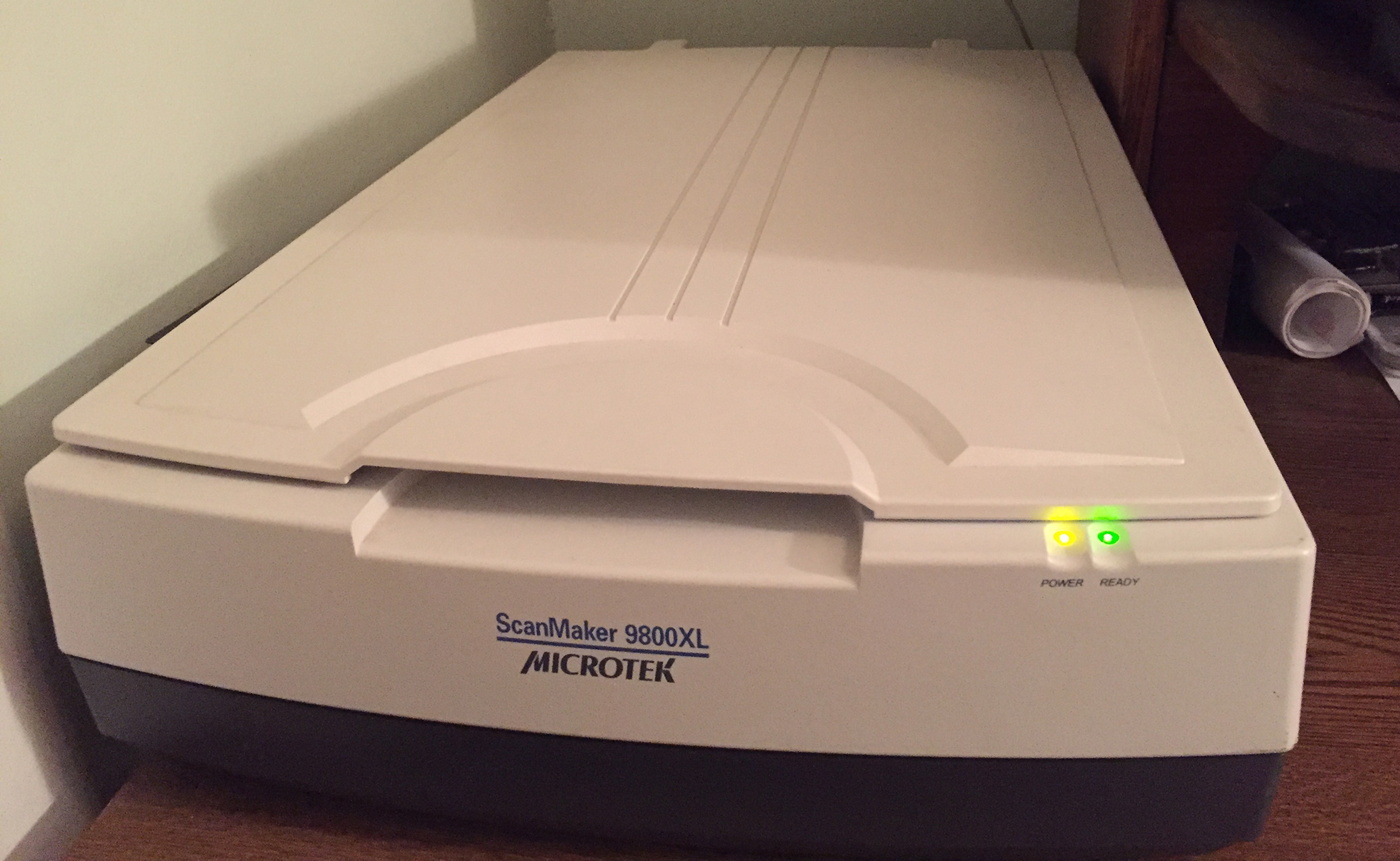
Unsure how to proceed, I got to work thinking I’d figure it out as I went along. I started scanning my “Mitzi”s. Although it was a time consuming task with my ancient Microtek tabloid scanner, in retrospect, it was the easiest part of the process.
9800XL

Every time I switch it on, I pray that its lamp hasn’t burned out.

Nearly three years ago, while scouring the internet for information on “Mitzi,” I came across an essay with a ton of information on the strip, much of which was new to me. I began corresponding with the essay’s author, and soon enough we had a loose agreement for him to write the introduction to the book.

The next progress was reconnecting with a publisher  with whom I had discussed the possibility of doing a “Kevin” book. He showed interest in “Mitzi,” and the project gained momentum.

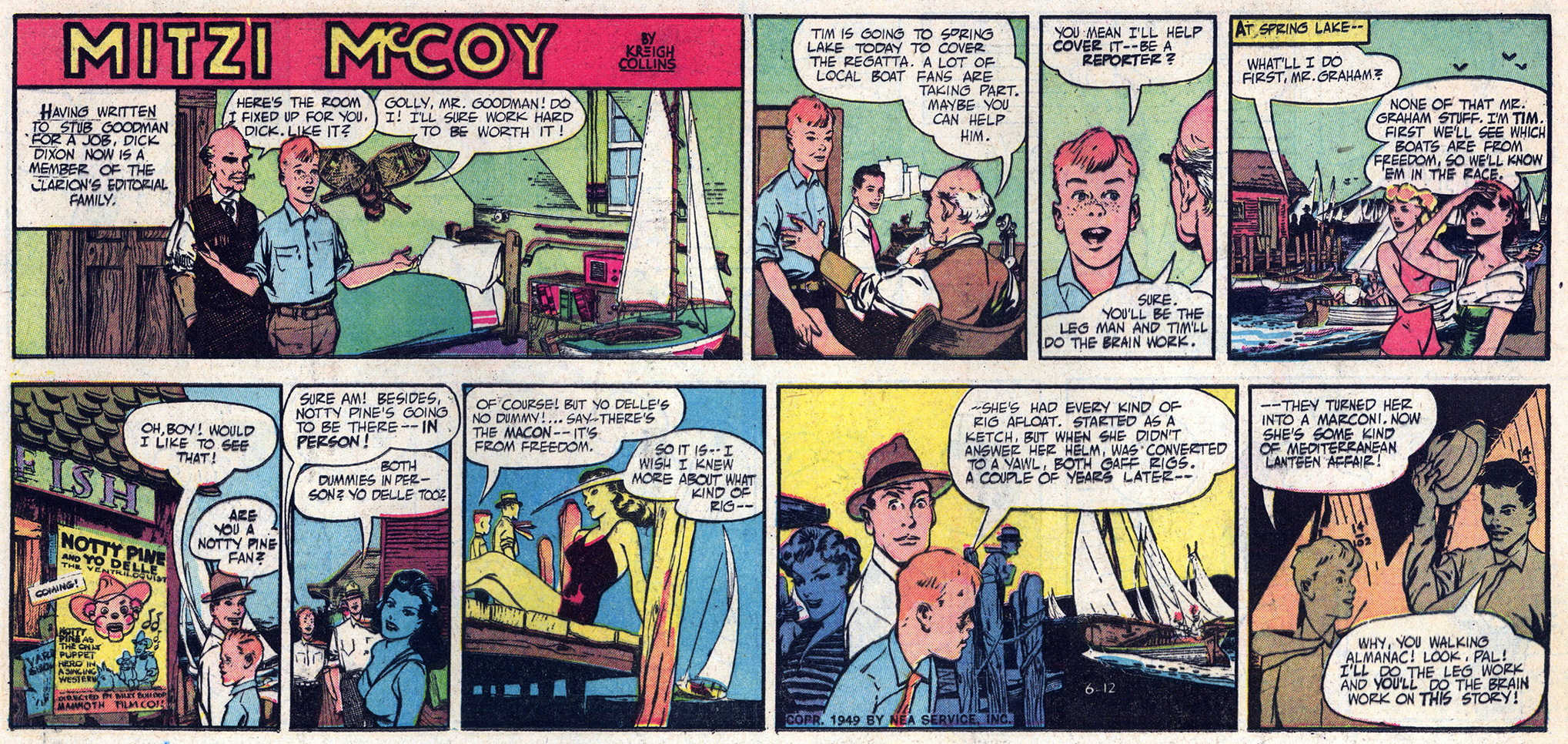
I started color correcting and retouching my comics in earnest, and I soon realized a major problem with my book was that for some of the comics, I only had one-third page versions. The bulk of my comics were half-pages (from the Indianapolis Times or the Pittsburgh Press), and others were tabloids or half-tabloids (New York Mirror).
MM 061249 TH 150 QCC

It’s so sad to see this comic cropped and squeezed into a one-third page format!

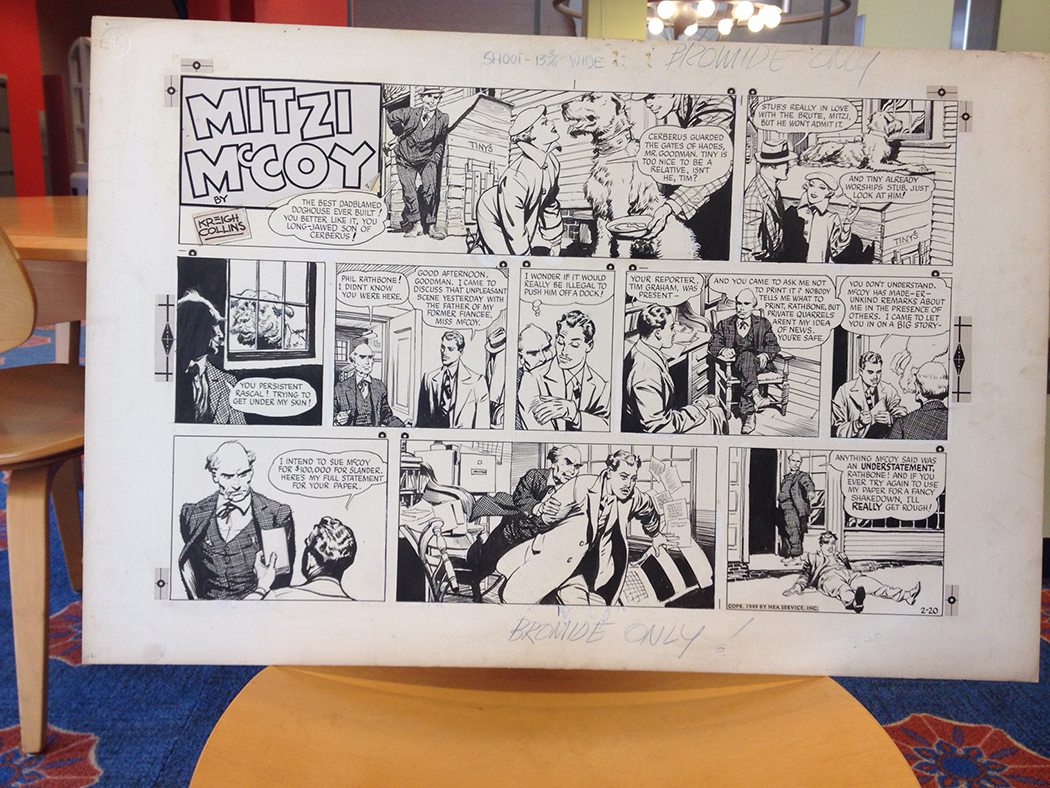
Two years ago I paid my first visit to the Grand Rapids Public Library. Its Local History department has a fantastic collection of Kreigh Collins’ illustrations and papers, with numerous original comic illustrations, including many original “Mitzi McCoy”s. Several of these originals were comics I had the inferior one-third page versions of, so I was getting closer to my goal of upgrading my lesser comics. Shortly afterward, I realized my prospective publisher had several more larger versions, and my list of inferior comics was down to six.
IMG_2875

Even though I live 800 miles away, the librarians are starting to recognize me (I’ve now made the trip three times).

Unfortunately, progress slowed during the next year and I wondered if I would ever find the elusive comics, or even get the book finished (and published). I’d been looking high and low, with occasional eBay purchases from sellers as far away as Switzerland.

However, my persistence paid off, and last month I found the last six comics I needed at a single source — a comic book shop 12 miles away from my house. The comics cost a bit more than I wanted to spend, as they were each part of intact New York Sunday Mirror comic sections. But being able to seal the deal made me willing to splurge.
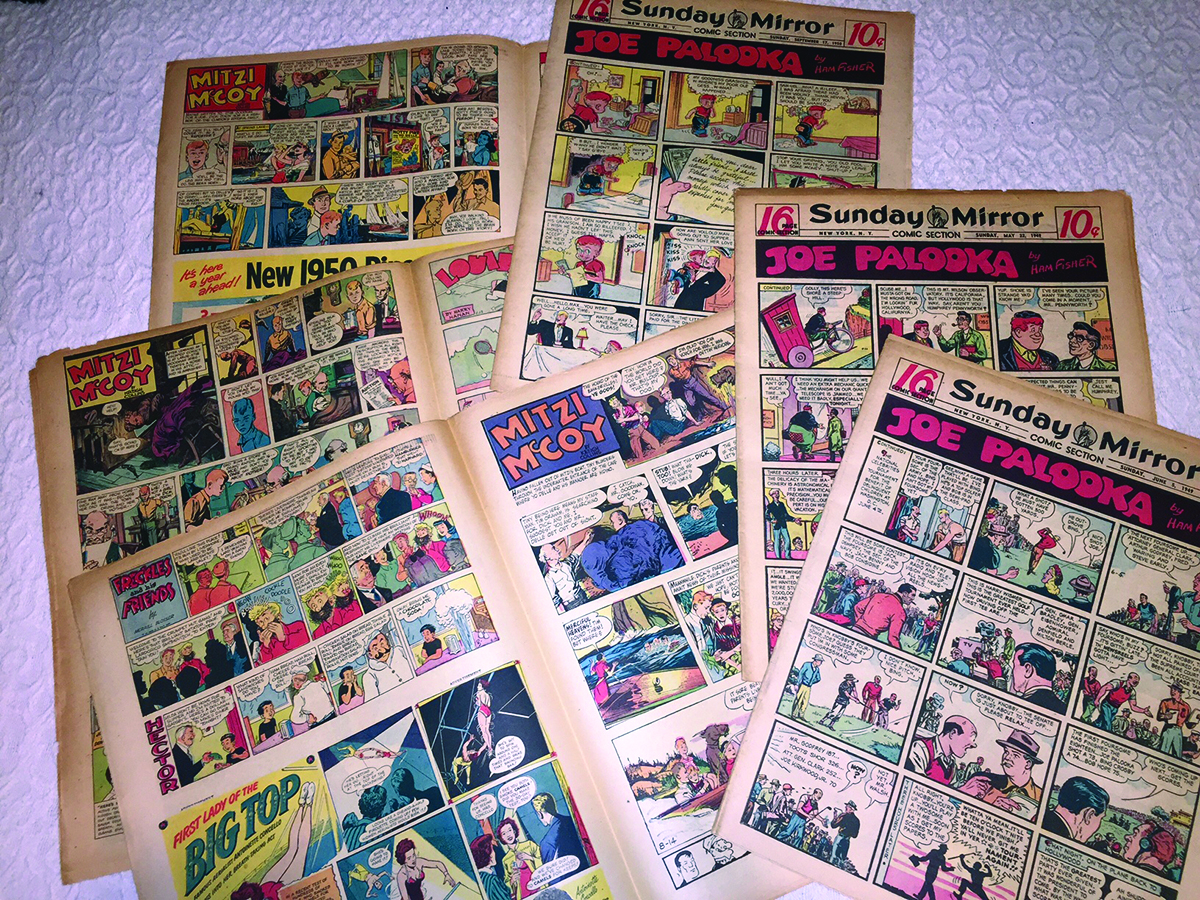
NY Mirror comic sections

Eureka! (But they cost more than 10 cents each).

Amazingly, the shop employee that sold me the comics was as much of a site for sore eyes as the comics themselves. I wondered if these comics had been lurking in Moonachie, NJ all along, but Shannon told me they’d been acquired relatively recently, at last year’s Baltimore Comic-Con.

20156065_1078529638949806_7694219993147927146_n

Shannon wasn’t in costume when she made the sale, but she was sweet as she is pretty.

The lesson I learned was to always follow your dreams.


Where’s Mitzi?

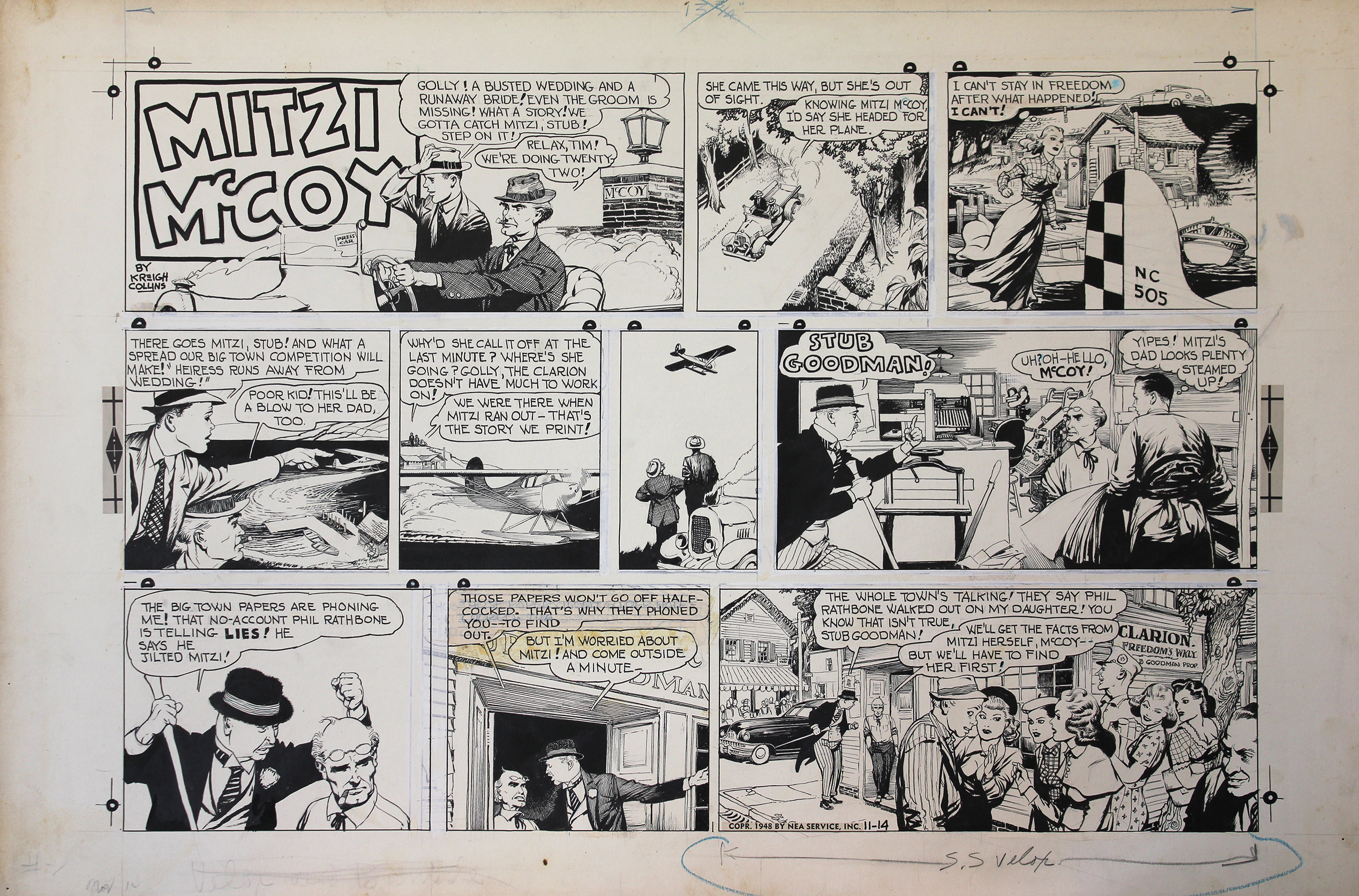
“Mitzi McCoy” was Kreigh Collins’ first syndicated (Newspaper Enterprise Association) comic strip, and in its November 7, 1948 debut, Mitzi bolted from her wedding after realizing her fiancé was a gold-digging jerk.

The comics that followed showed the transformation of Collins’ skills from that of a renowned illustrator to those of a successful cartoonist. Each panel of these early comics are jammed full of detail, and the original artwork is astonishing to behold. About half of the “Mitzi McCoy” originals are in the Local History collection of the Grand Rapids Public Library.

MM 111448 150 OA

These early Mitzi originals also show evidence of revisions to the artwork and dialogue. In addition to illustrating and scripting the comic, Collins did the lettering. Kreigh had similar responsibilities for his mid-1940s “Bible Stories Comics” (put out by the Methodist Publishing House) but the NEA required a more structured approach, and had more specific procedures to be followed. There were some growing pains, but the artwork is absolutely amazing.

MM 112148 150 OA.jpg

While comics fans might have been wondering where Ms. McCoy had gone in 1948, “Where’s Mitzi?” could also be a question posed more recently. Late last year, an announcement was made on the upcoming publication of a book collecting the comic strip’s entire run.
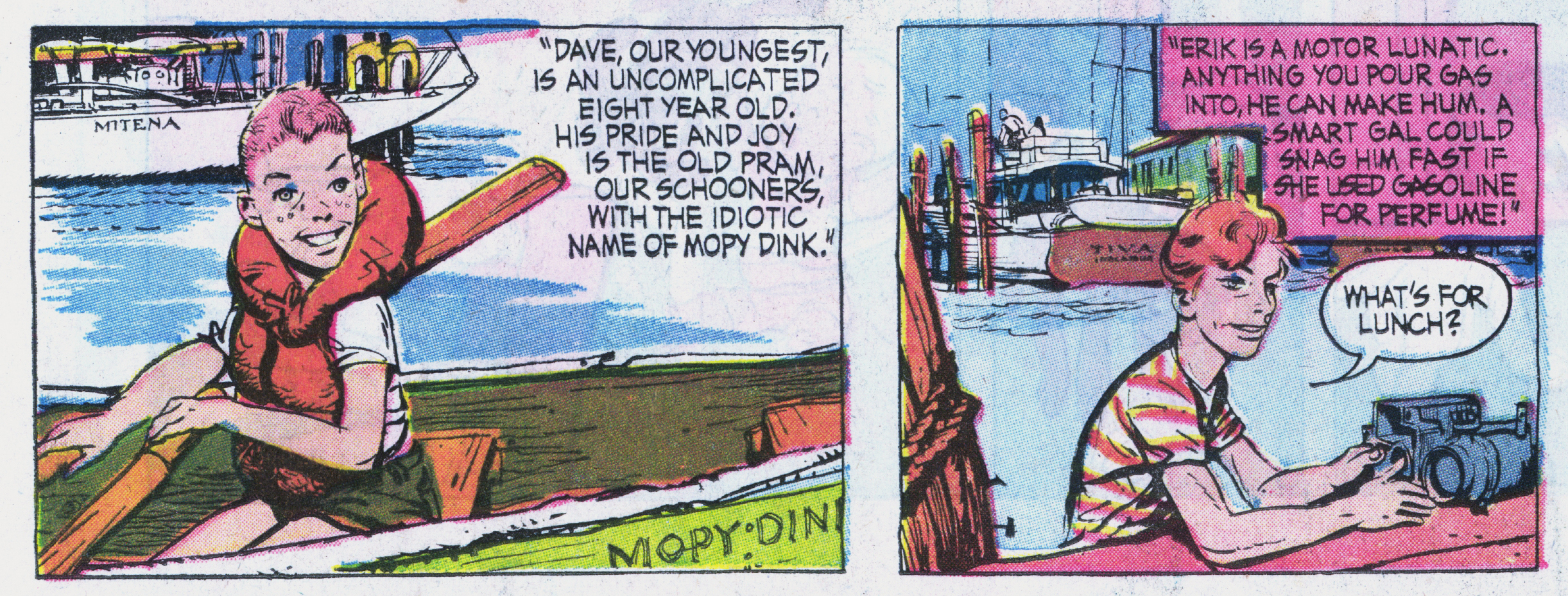
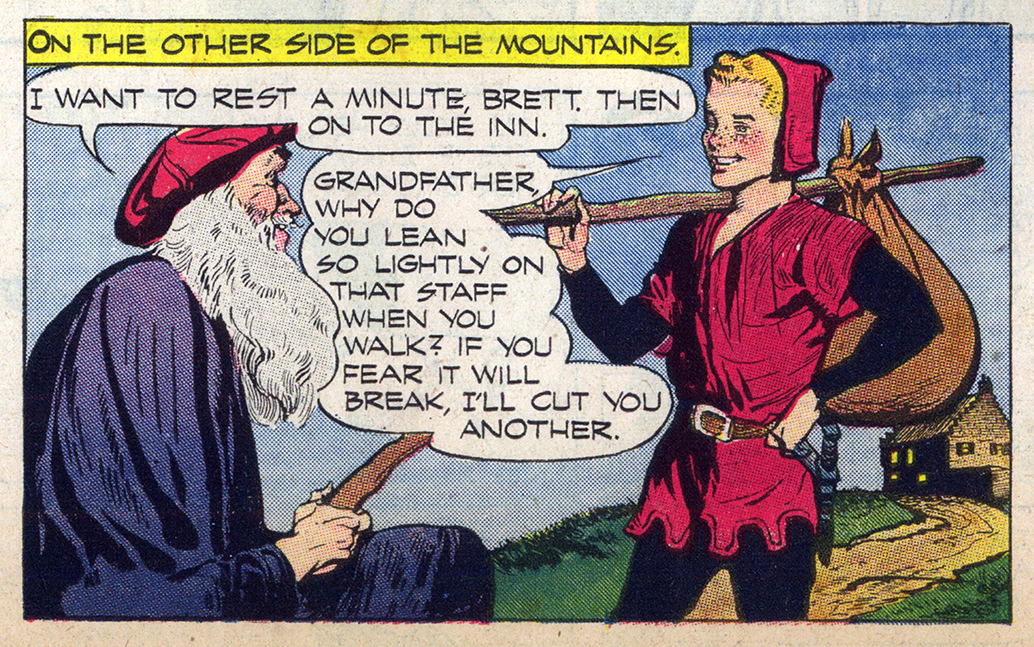
MM Sales Sheet LA1 150

While production of the book has been delayed, rest assured that the book is still in the works. Once it is published, Mitzi’s whereabouts will be more easily tracked.

Brett’s Friends

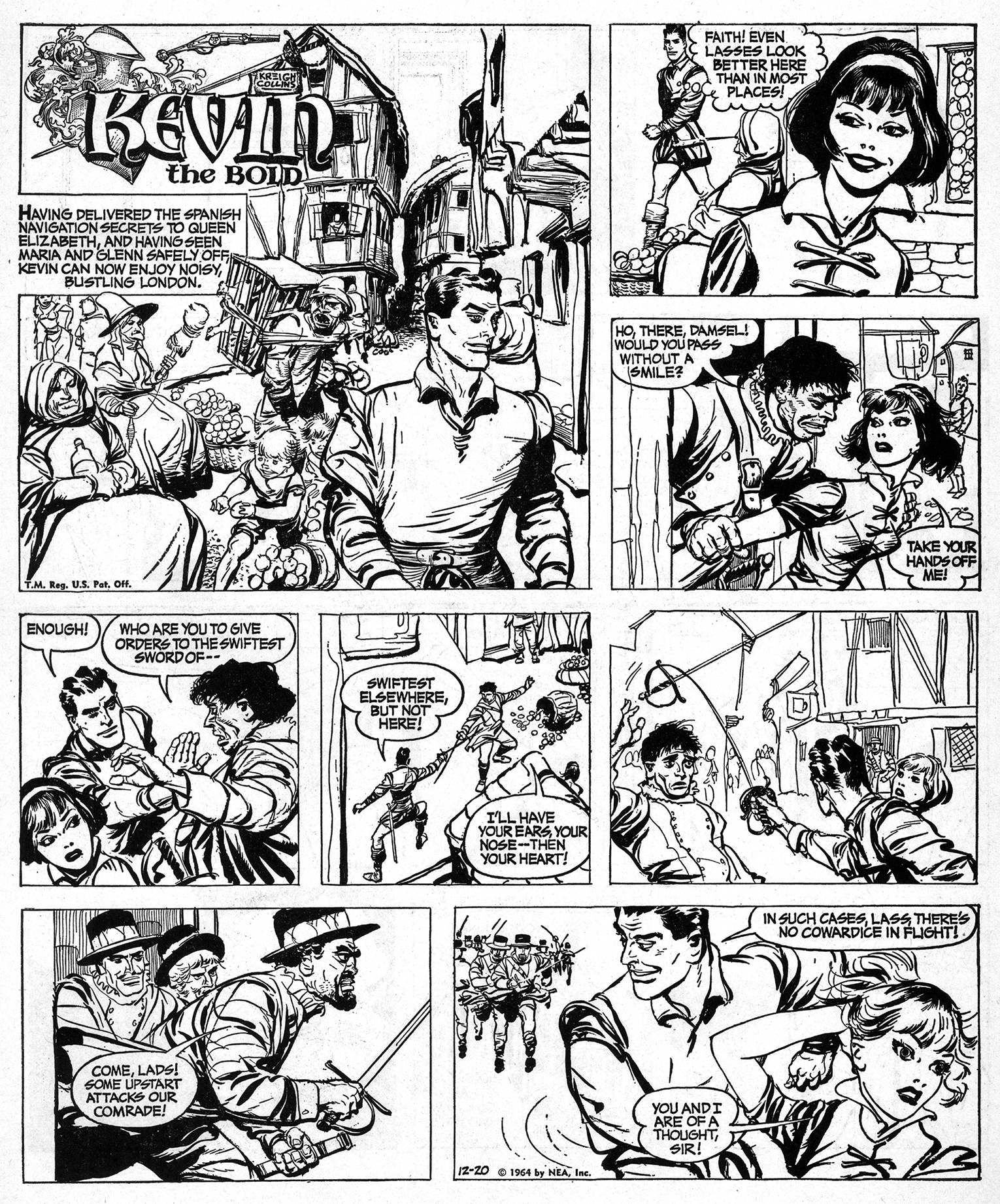
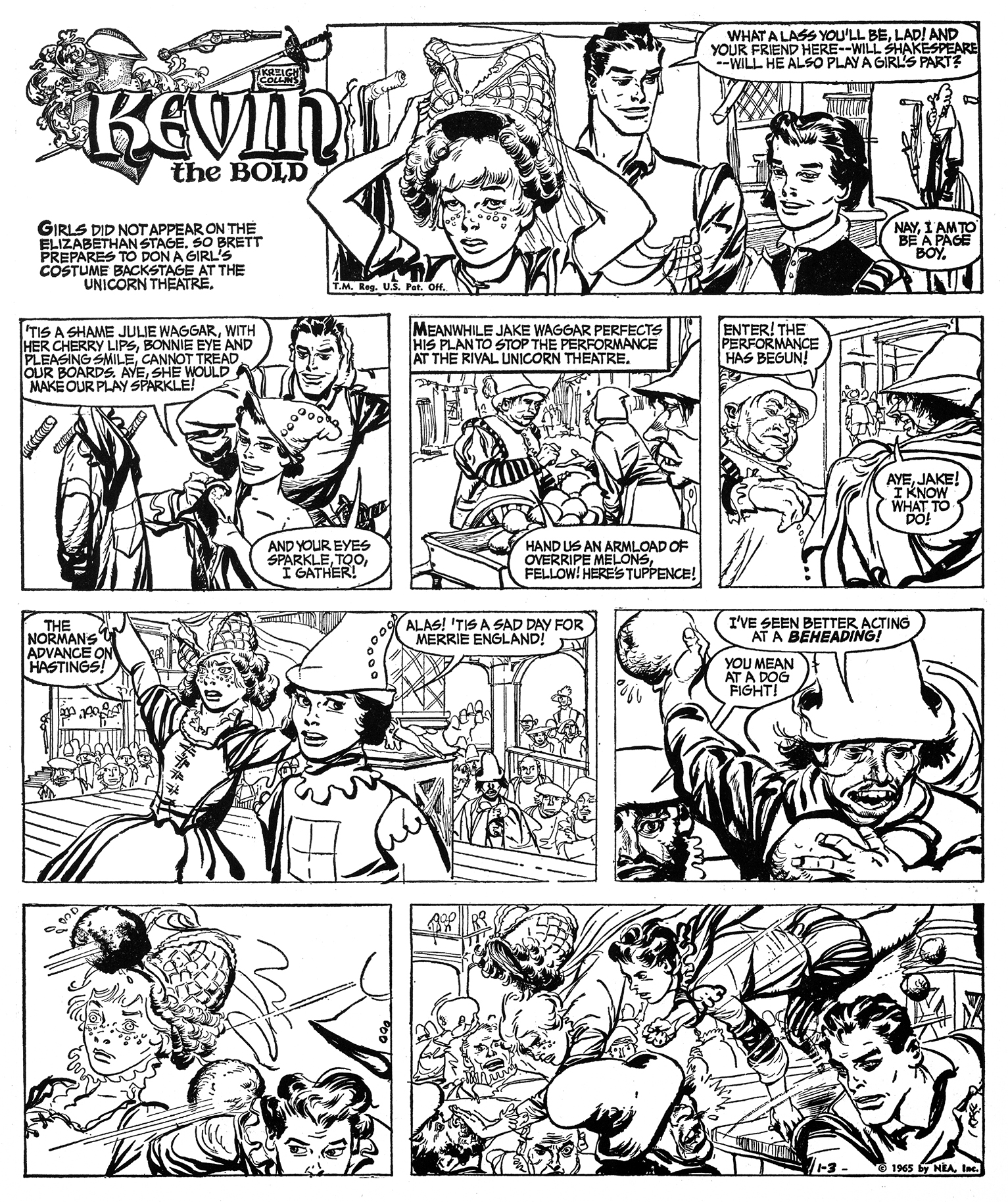
A new sequence deserves a knock-out opener, and Kreigh Collins delivers.  KTB 122064 BWT 150 qcc

Perhaps Kevin’s penchant for saving dameselles in distress comes from him always keeping his eye on the “scenery.” The character upon whom Kevin was molded (to a degree), Tim Graham, from “Mitzi McCoy,” had a similar predilection. In this case, Kevin has unknowingly rescued the pretty friend of his ward, Brett.

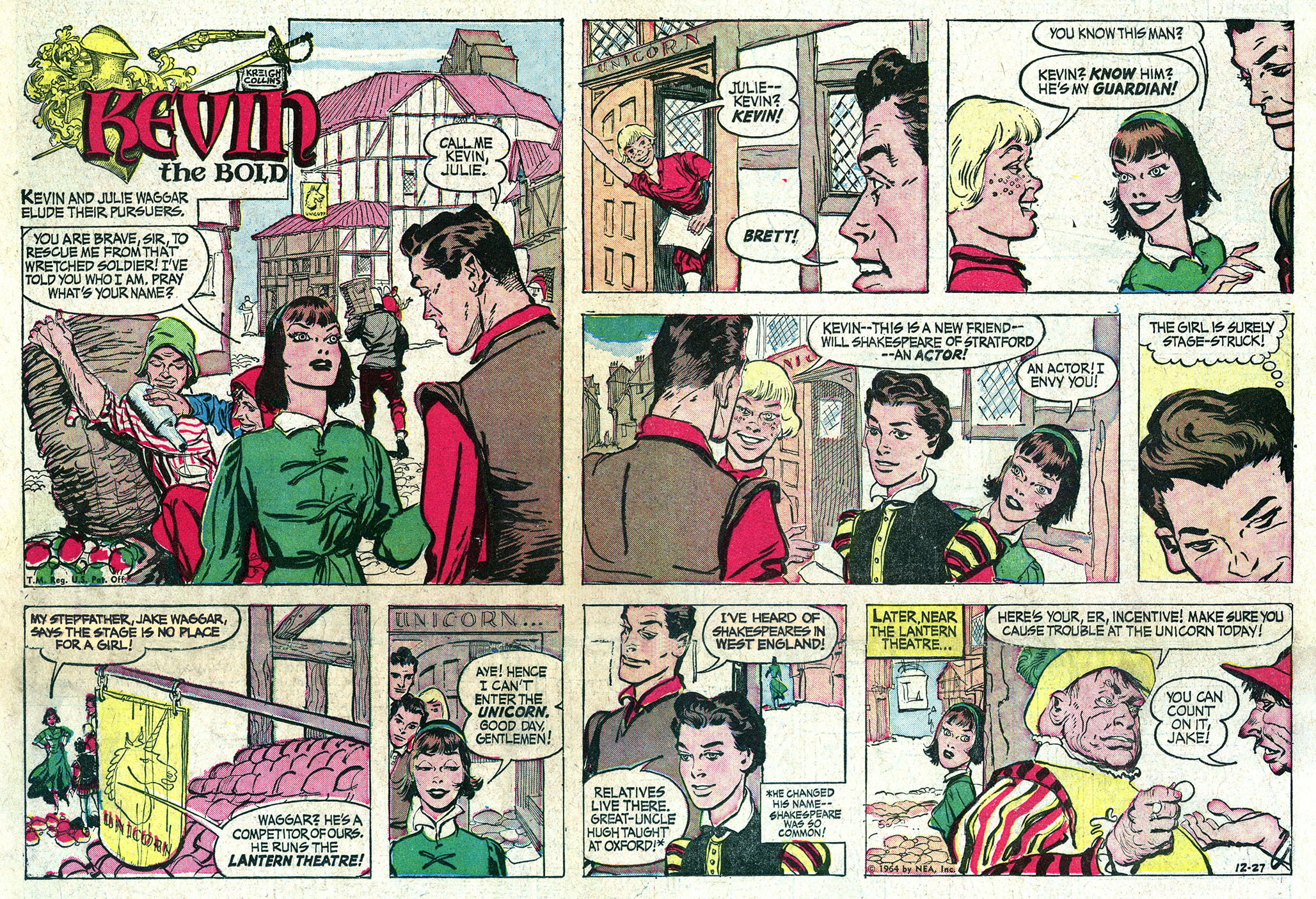
KTB 122764 HA 150 qcc

While Kevin spent the summer in the West Indies, Brett had stayed behind in London. Upon his arrival, Kevin meets another friend of Brett’s, a boy named Will Shakespeare (an example of the sort of historical figure that can be found in “Kevin the Bold.”) With the date established as 1588, Shakespeare would have reached the age of 14. Brett is likely a couple years younger, while Julie appears to be a young lady, about 18 years old.

Will and Brett are rehearsing a play at the Unicorn Theater, and it turns out that Julie’s step-father (Jake Waggar) owns the rival theater, the Lantern. As far as step-fathers go, Jake falls into the “evil” category, and he stoops low in his competition with the Unicorn.

KTB 010365 BWT 150 qcc

Along with the appearance of historical figures in his comics, Kreigh Collins could also be counted on for some related education. Collins was known for the depth or research he put into his subjects, all in the name of historical accuracy.

With Will Shakespeare a part of this storyline, one can expect numerous references to the famous author’s oeuvre. And with my personal knowledge of Shakespeare somewhat lacking, I bet my grandfather would get a kick out of the research I need to do in order to write these posts. I will mention references where I see them, but I would appreciate it if any reader would point out any that I have missed in the comments.

MFG Rarities

Most of the comic strips in my collection were given to me by Kreigh Collins’ son Kevin. My windfall covered about half of my grandfather’s NEA work, printed in one form or another. I received my first large batch from Uncle Kevin in 2008, with other packages arriving later. Between these deliveries, I purchased other comics to fill holes in my collection.

Initially, I bought anything I could afford that I didn’t already have. I soon learned to ignore one-third page comics and focus on half-pagers. Among the printed samples I received from Uncle Kevin were different types of black-and-white proofs, as well as other BW versions. I paid little attention to these; I was focused on the color halves from the Chicago Tribune and the Detroit News.

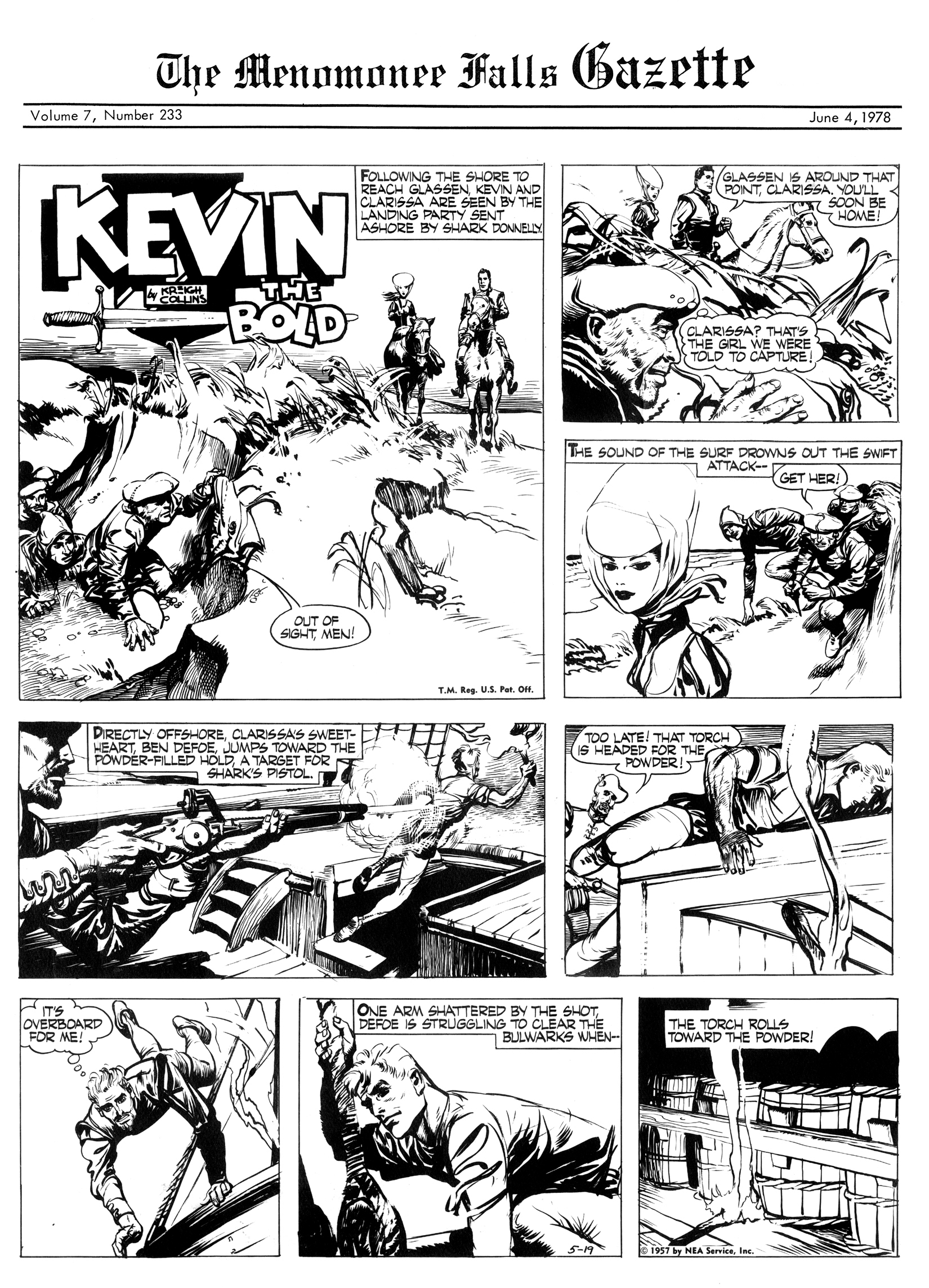
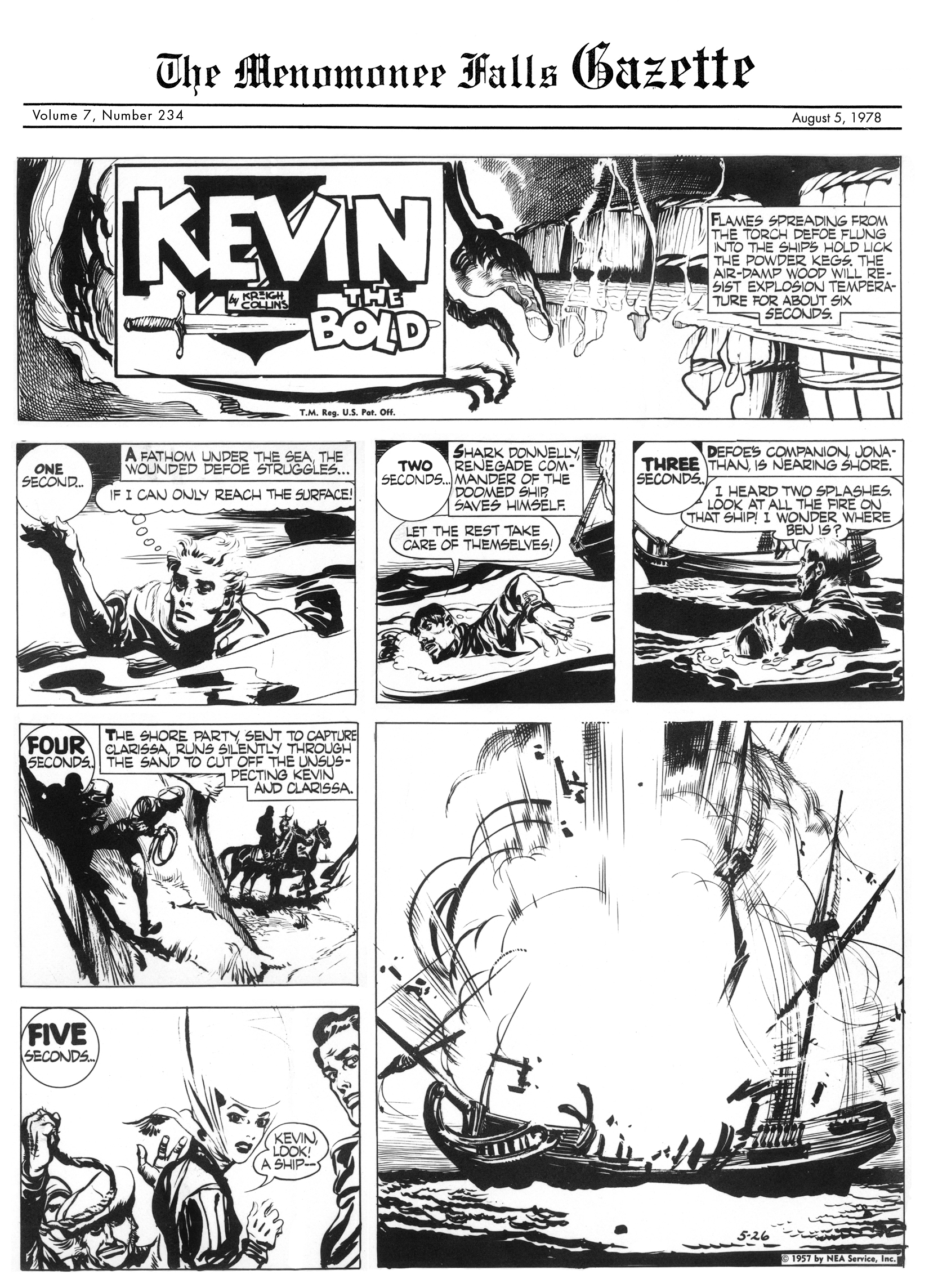
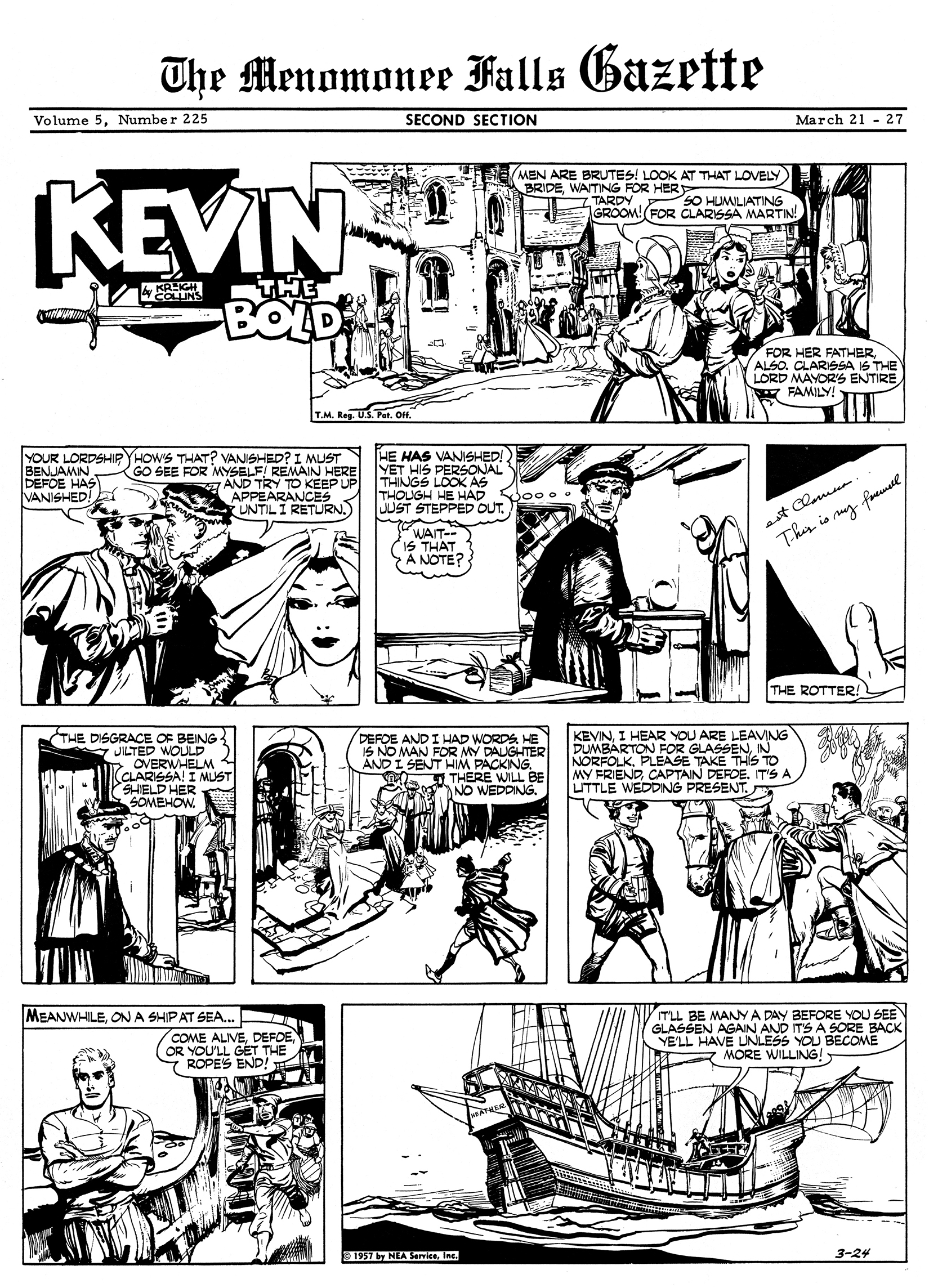
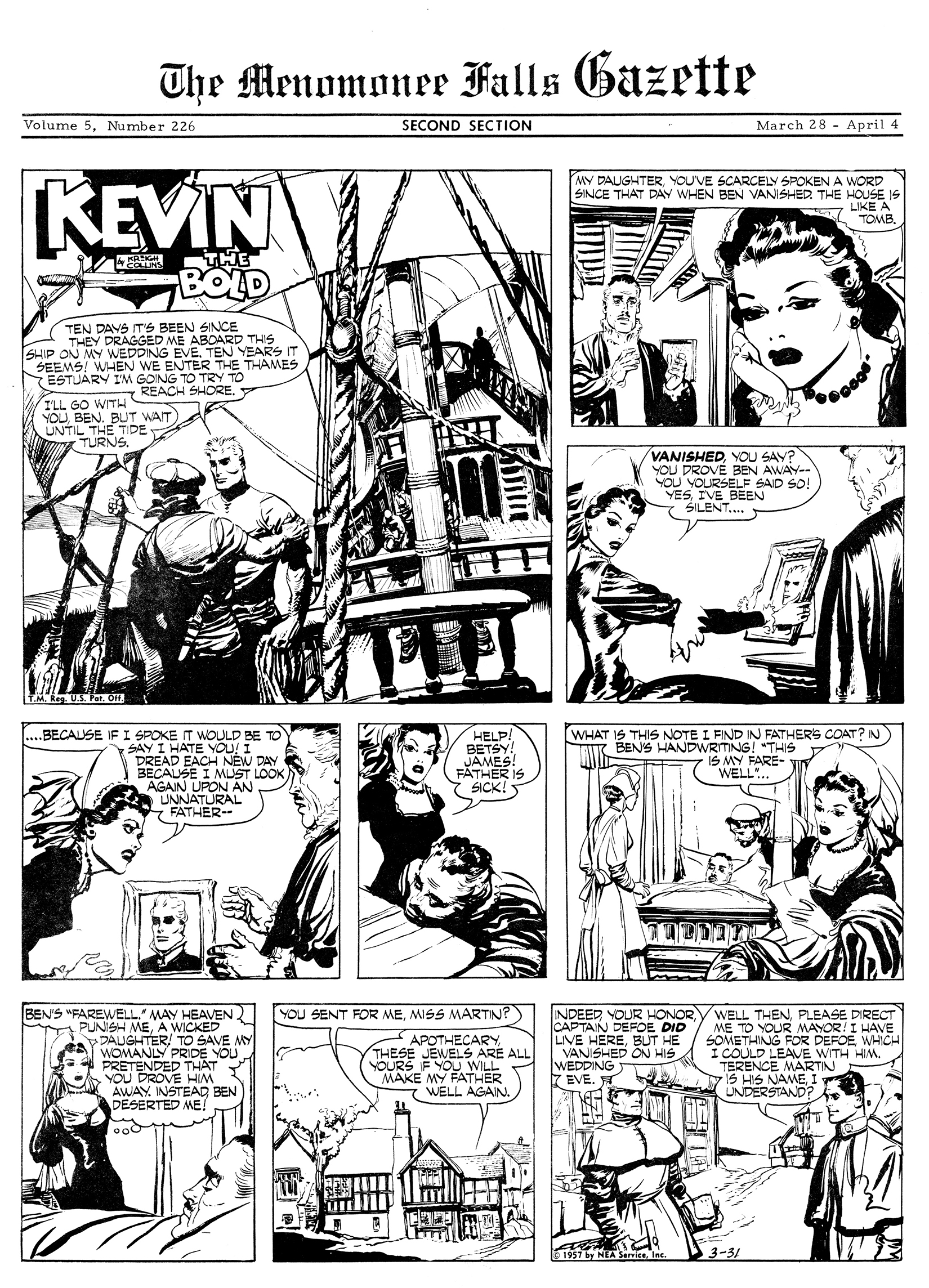
As I began working my way through my grandfather’s old tearsheets, I learned more about what I had, and a couple things I’d overlooked became more interesting. Included were a few late copies of the Menomonee Falls Gazette. Since I had half-page versions from the Trib of basically all of the comics that ran in the Gazette, I saw little value in these black-and-white tabloid versions. Only lately did I realize that a couple of the Gazettes I had must be extremely rare. Furthermore, they help complete the sequence featuring Benjamin Defoe, Clarissa and Shark Donnelly.

ktb-051957-mfg233-01-150

Following its customary two-month hiatus, issue #233 was dated June 4, 1978. The Gazette still had two sections, but they were now only 12 pages long. Kevin again appeared on the front page of the second section. The strip’s action picked up with Kevin and Clarissa in danger of being jumped by the bad guys while Ben DeFoe makes a desperate lunge aboard Heather. Hit by Shark Donnelly’s shot, Ben fails to get belowdecks but still manages to sew chaos.

Arriving another two months later, the comic in issue #234 was spectacular. Featuring a suspense-building device first proposed (but not used) by Collins for an old Mitzi McCoy comic, Donnelly and DeFoe are shown desperately swimming away from the tinderbox that is the Heather.

ktb-051957-mfg234-01-150

Now THAT’S more like it, a fitting end to this tabloid’s run. The crisp black lines of the Gazette highlight the drama of this final scene. Needless to say, this comic also looks spectacular as a color half-page.

Left at the Altar

From March 1978 issues of the Menomonee Falls Gazette, this Kevin the Bold sequence was originally published sixty years ago (1957). Printed from the original films, the reproductions were excellent, and Kreigh Collins’ strength as an illustrator was evident.

Despite the absence of romance in Kevin’s life, storylines involving lovers periodically ran, as did their drama. As with Mitzi McCoy, Collins enjoyed the freedom of having any character take the lead. Here, a new set of characters is introduced. Kevin doesn’t appear — he isn’t even mentioned.

ktb-031757-mfg224-17-150

Benjamin DeFoe has been pressed into service, leaving his bride jilted at the altar — an interesting twist on the action seen in Mitzi McCoy’s debut comic.

ktb-032457-mfg225-17-150

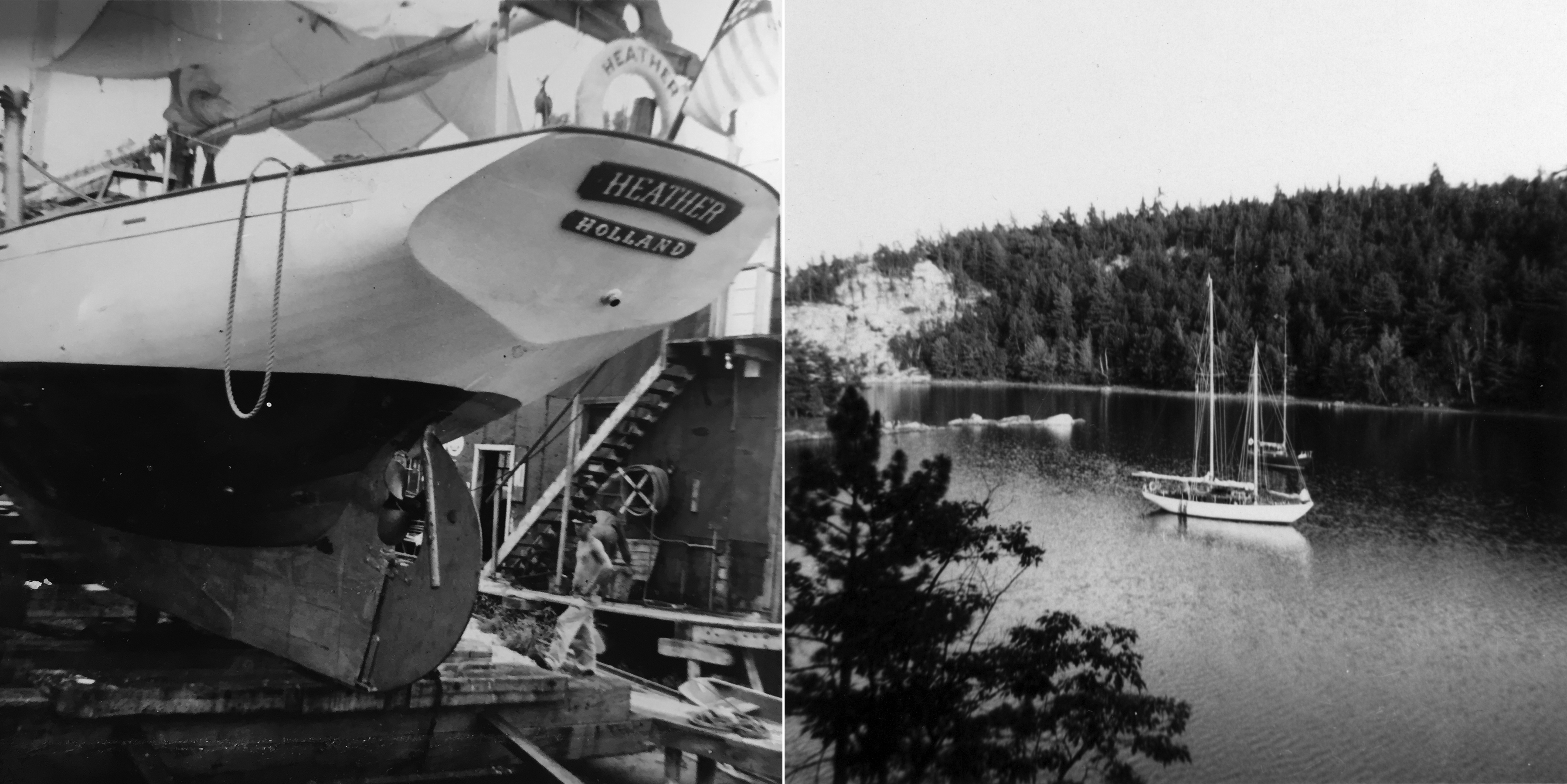
After a week’s absence, Kevin is briefly introduced. (Originally, it wasn’t clear to me where this action took place — I must have been distracted by the fantastic illustrations.) Meanwhile, Ben finds himself in an ugly situation aboard a beautiful ship — whose namesake Collins himself skippered.

heather-bw

Heather, circa 1957

ktb-033157-mfg226-17-150

Things are bleak. Ben plans a desperate escape, Clarissa’s heart is broken, and her father, the Lord Mayor, has taken ill. The lone sign of hope is the appearance of Kevin in the comic’s final panel.

Family Characters

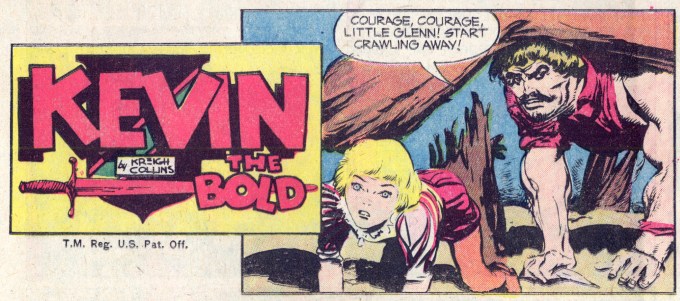
Like most artists, Kreigh Collins looked to his family and surroundings for inspiration. Kreigh’s young twins were named Kevin and Glen. Kevin obviously had a major part in his eponymous cartoon strip, whereas Glen didn’t show up until eight years later.

KTB 121050 Kevin intro

KTB 111658 Glenn panel

If you knew my Uncle Glen, you’d appreciate the irony of Pedro’s comment.

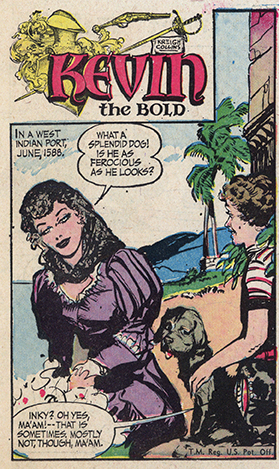
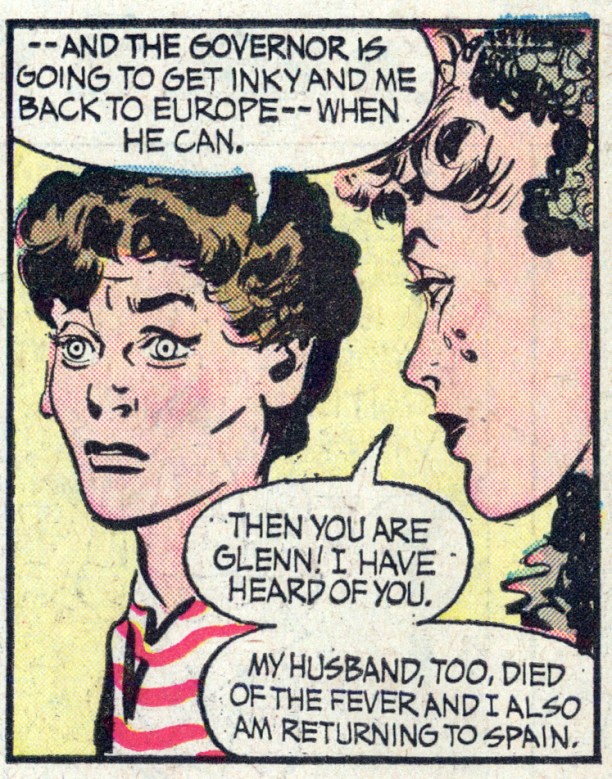
The sequence with “little Glenn” lasted nine weeks. Perhaps seeing the inequality of his twins’ like-named characters, Kreigh introduced another Glen six years later. This time, he was an orphan, stranded in the West Indies.

KTB 100464 Inky ktb-100464-glen-intro

Even Inky appeared. He was the neighbors’ dog.

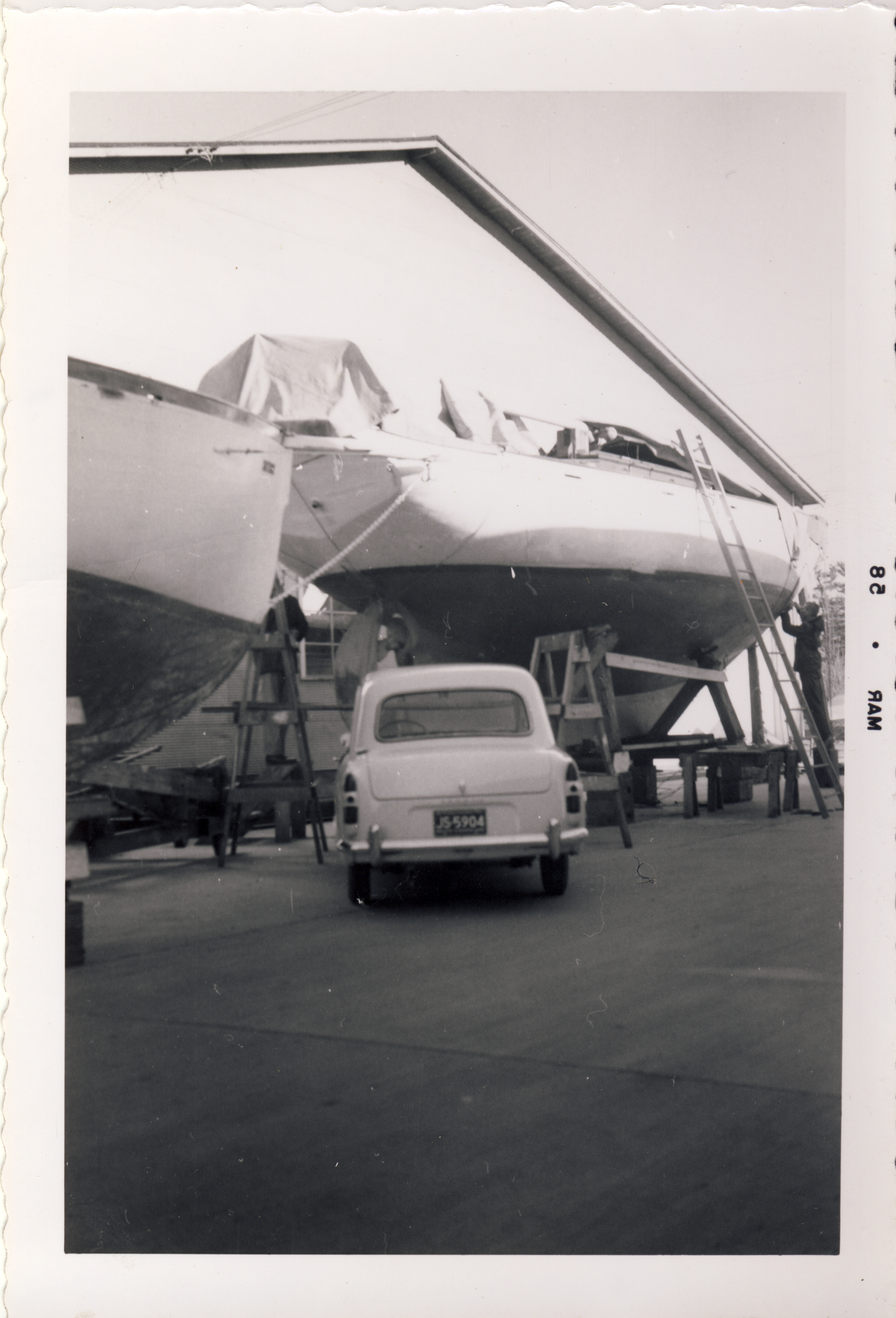
Kreigh’s oldest sons, Erik and David, had namesake characters in Collins’ final comic strip, “Up Anchor!” Like Kreigh’s, the Marlin family sailed aboard a schooner named Heather. (In reality, Erik and David were no longer living at home, and neither were redheads).

UA 110368 Dave Erik Intro

Fifteen months into its nearly two-decade run, “Kevin the Bold” introduced a new character, Brett. My brother Brett was Kreigh’s first grandchild, and as with Kevin, the character appeared in the funnies before the actual person was born (in Brett’s case, nearly ten years earlier).

KTB 011352 Brett Intro

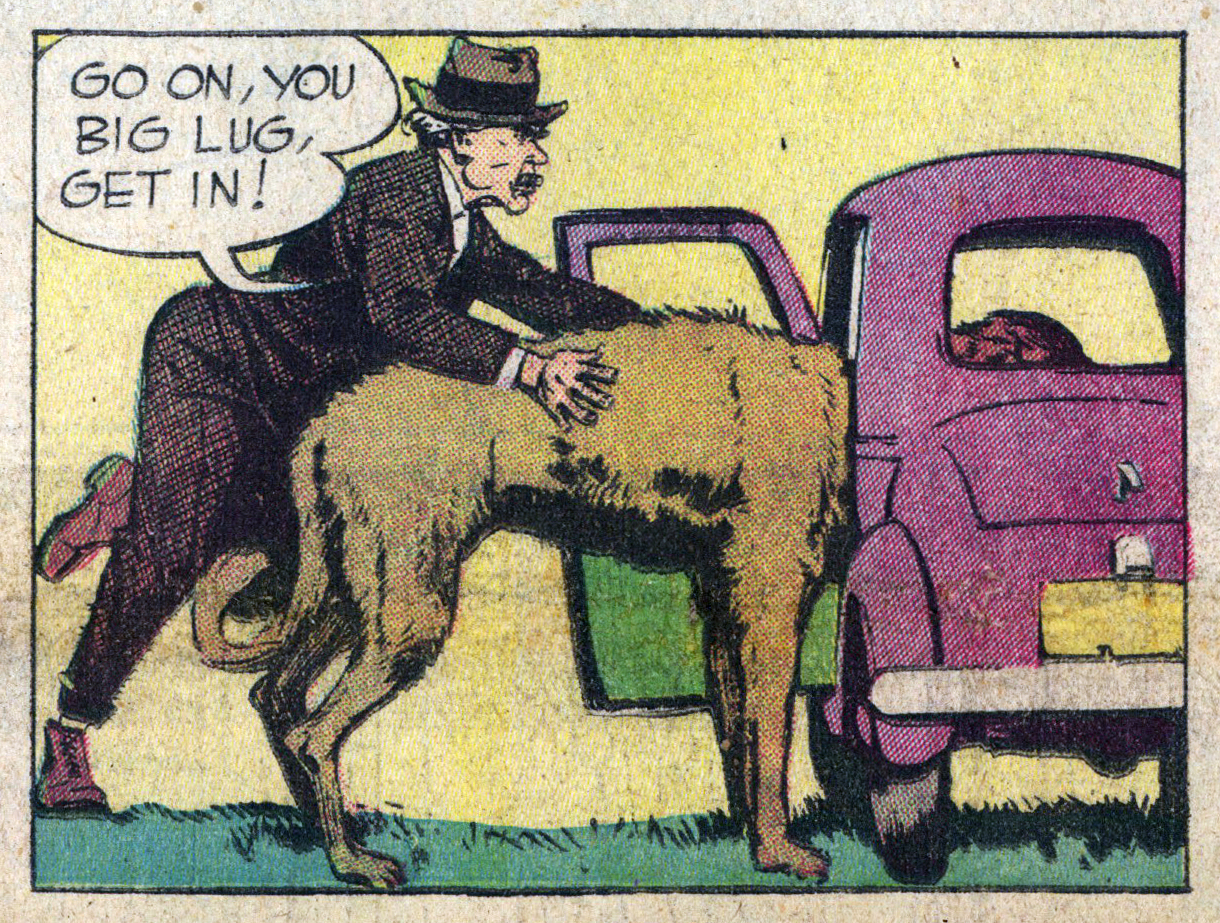
In “Mitzi McCoy” Stub Goodman drove a loaner car that looked a lot like Kreigh’s.

MM 070950 Bantam carCar and Heather

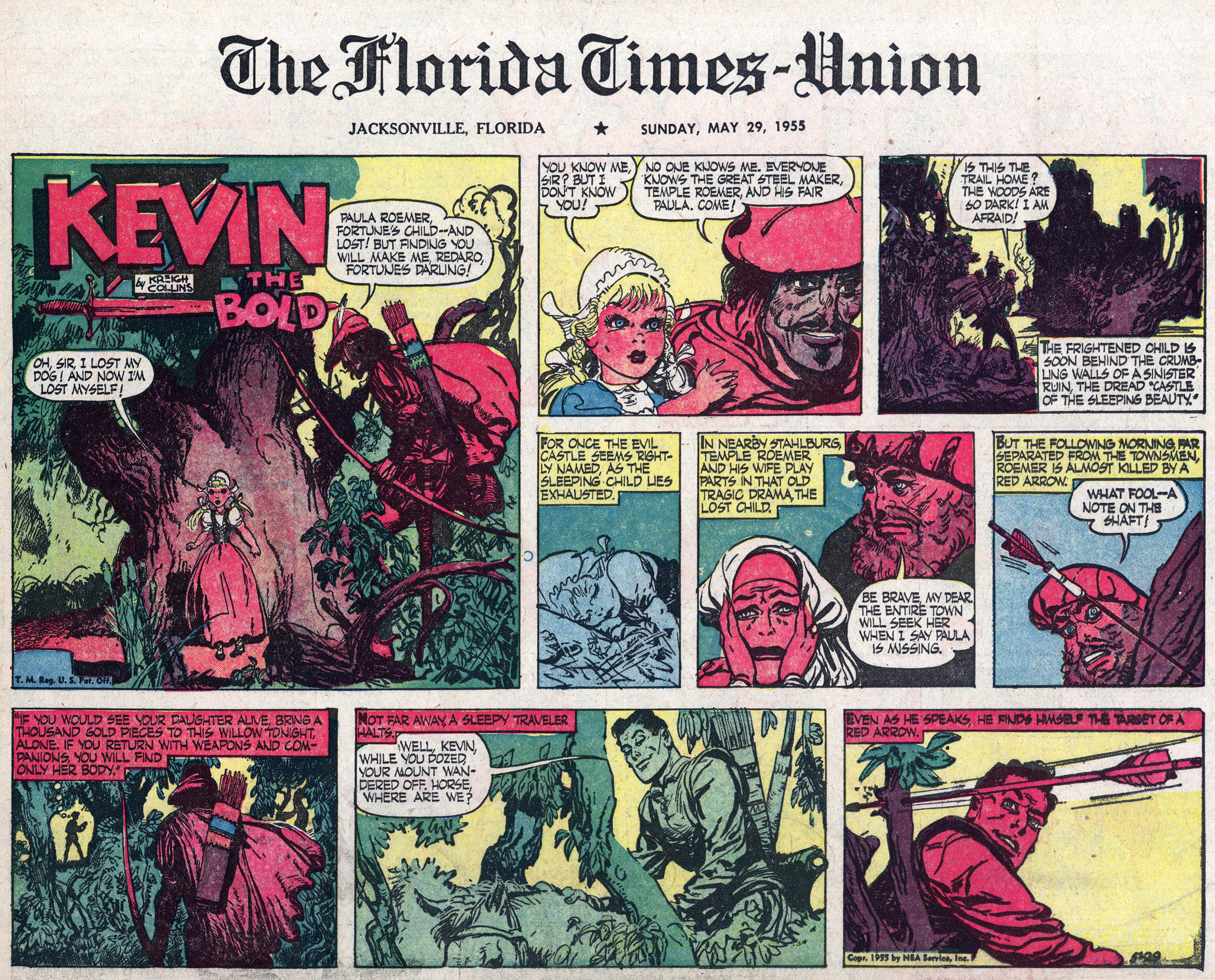
Another character with a name from the artist’s real-life experiences appeared in a mid-1955 sequence, “The Castle of the Sleeping Beauty.” A little girl had gotten lost in the woods, and her father, the “great steel maker Temple Roemer” was distraught. Tempel Smith, Kreigh’s brother-in-law, had started a steel-stamping business ten years earlier, and by this time it had grown into a massive steel company.

KTB 052955 HF 200 QCC.jpg

Paper Anniversary

In recognition of one year of posting the comics of Kreigh Collins, we will celebrate traditionally. 

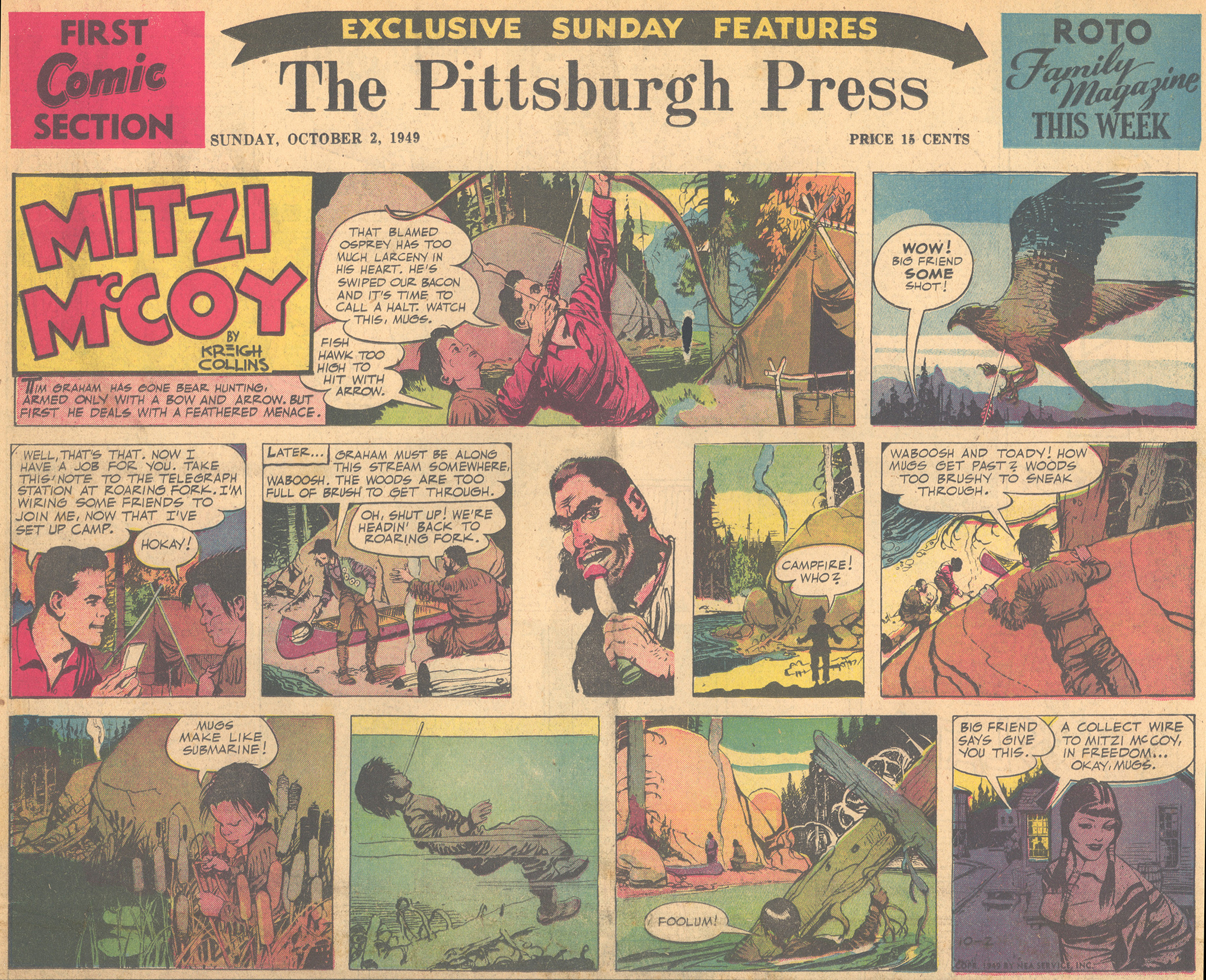
Among other papers, “Mitzi McCoy” initially appeared in its beautiful half-page format in the Pittsburgh Press and the Indianapolis Times. Tabloid newspapers, such as the New York Mirror, ran the comic as tabs or half-tabs. In some dailies, such as the Grand Rapids Press, it appeared in black and white.

MM 100249 150

MM 070850 BW TH qcc

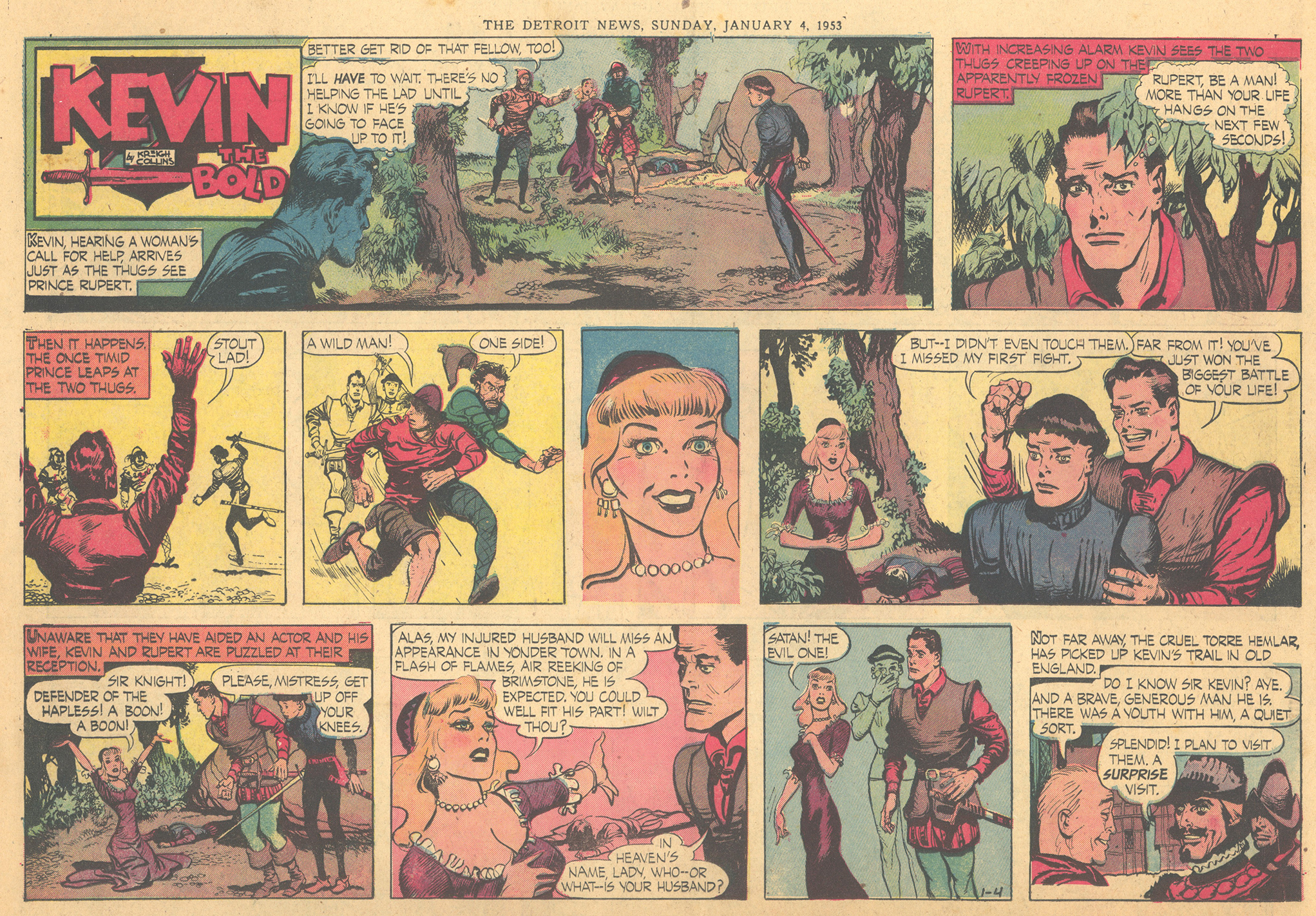
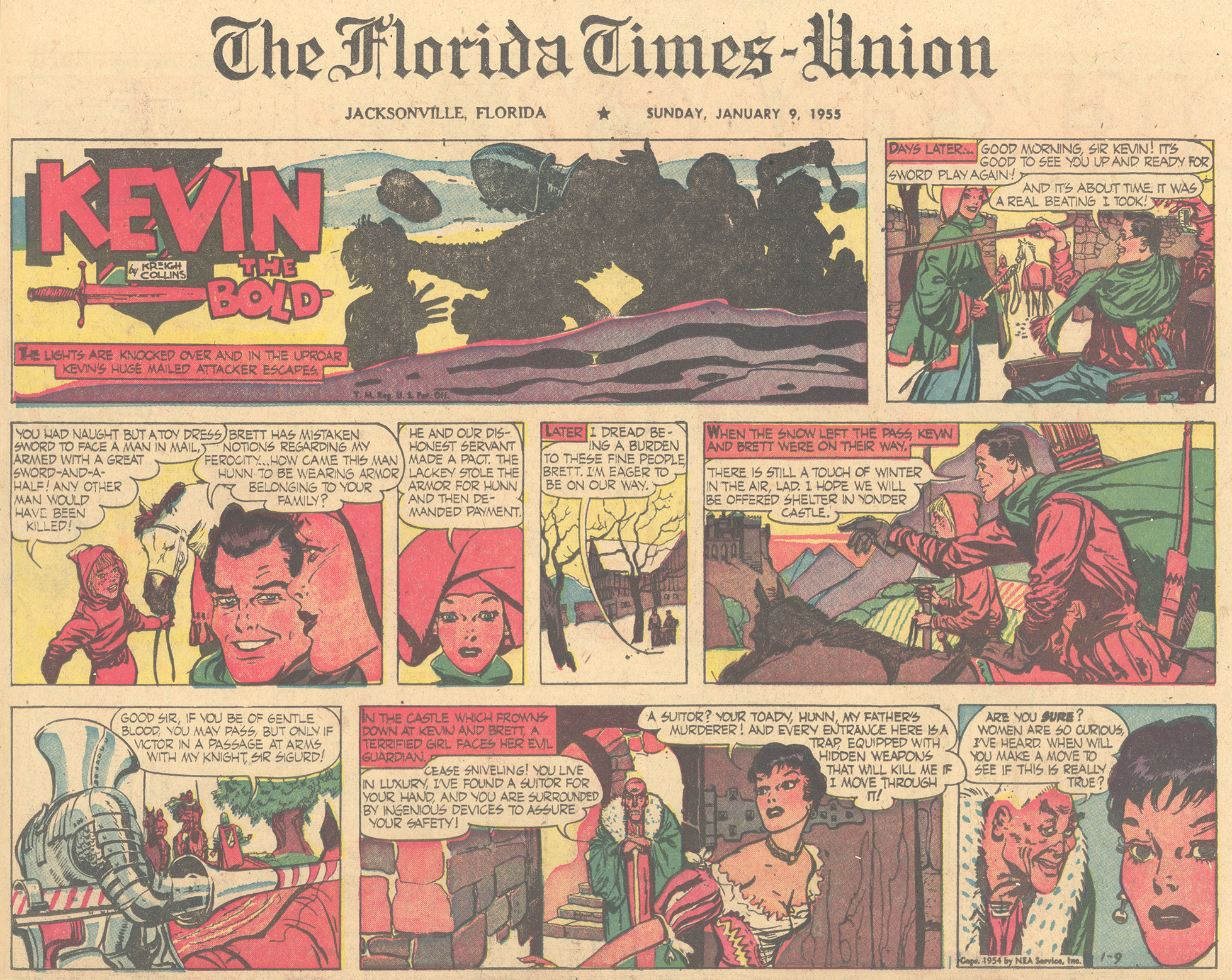
Famously appearing from its onset in the prestigious Chicago Sunday Tribune,  “Kevin the Bold” also ran in the Detroit News and other papers. As the Pittsburgh Press had done with “Mitzi,” the Florida Times-Union used “Kevin” to lead off its comic section.

KTB 010453 HF 150

KTB 010955 HF 150

My collection of comics largely consists of my grandfather’s original samples. They are mostly from the Chicago Tribune and the Detroit News. There are sometimes multiple versions of a particular Sunday, from different papers, in different formats. Entire comic sections are occasionally found, often from newspapers of places Kreigh visited during journeys aboard his schooner Heather.

The inclusion of one of these comic sections always piqued my curiosity. It’s a Tribune section dated December 27, 1959. “Kevin the Bold” is nowhere to be found.  Only recently did I realize the significance — in what must have been a devastating blow to the artist, it marked the point when the Tribune dropped the strip after carrying it for a decade. Notably, “Kevin” does appear in another intact section from the same day’s Detroit News.