This next chapter of Kreigh Collins’ comics comes from the mid-1966 run of KEVIN THE BOLD. Kevin is aboard a ship making a voyage to the New World. These early crossings were extremely challenging.
A detail that piques my personal interest is the name of Kevin’s companion, Erik. My father’s name was Erik, and while he and my grandfather didn’t always get along so well, it’s wonderful to see a virtuous character named for him.
From the Maritime Provences all the way to Montreal, Kevin and Erik have really covered some ground.
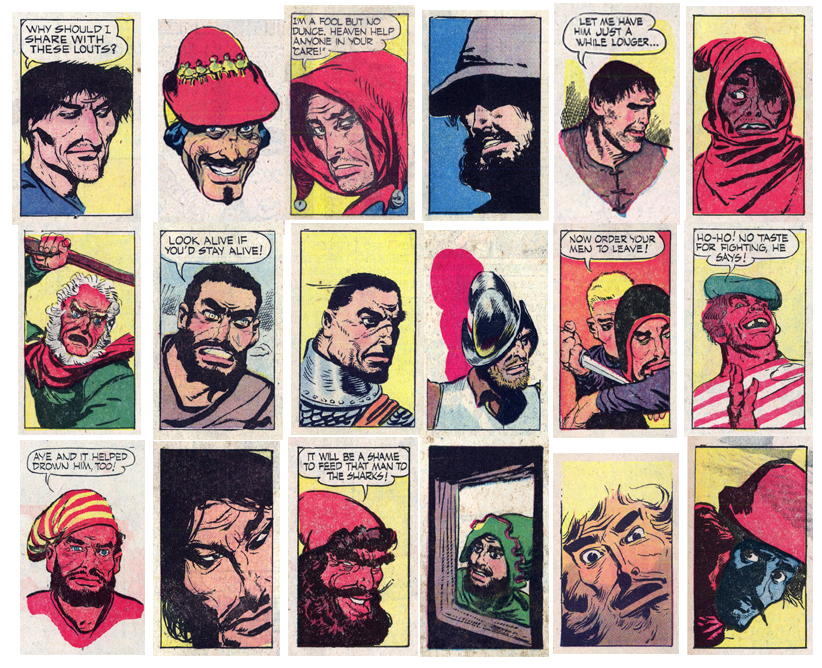
“Throwaway Panels” — such an unfortunate term for these wonderful little illustrations. Deleted in order to squeeze and rearrange a half-page comic into a tabloid format, they were usually incidental to the action. In “Kevin,” they often showed damsels — in distress, or otherwise.
Other options included villains, exclamations, or random bits of scenery. Kevin himself also made frequent appearances in this panel.
After seeing enough of these, I couldn’t help but be reminded of Lotería, a Mexican game of chance similar to Bingo. With the strip having a presence in Mexico (“Kevin el Denodado”), I think the NEA missed a marketing opportunity!
(From the Mexican monthly magazine “Revista Ferronales” magazine)
Counting the pre-Newspaper Enterprise Association (NEA) weekly BIBLE STORIES COMICS, Kreigh Collins’ comics career lasted three decades. UP ANCHOR! was his final comic feature, it ran for about three and a half years, until Collins retired.
As summer ended in 1959, Collins and his family packed up his sailboat and headed south. They ended up spending a year on the boat, traveling down the Mississippi, and wintering in Florida. He continued with his work while aboard Heather, producing artwork for the comic strip as the journey progressed.
With help from the NEA, Collins was happy to do promotion for his work, and given his unique situation as a sailing snowbird, this was sometimes front-page news. In an interview with the Panama City News-Herald that appeared in the daily’s November 1, 1959 edition, Collins explained how he was able to do it: “Maintaining a comic strip is a high-pressure sort of thing. You’re dealing with it every day, meeting deadlines, writing scripts, doing the artwork, and so on. To stay normal, you just about have to have your mental balance.” The article continued, Collins maintains his balance by writing children’s books, adventure stories, and travel articles. He also considers his 45-foot yacht a mental life saver.
A syndicate proof of the comic that appeared in Panama City News-Herald, above
After KEVIN THE BOLD had run its course, Collins launched his next comic strip, UP ANCHOR!, in 1968. Although he used many of his family’s experiences aboard Heather as fodder for his scripts, much of the material came from his imagination. While there was talk in 1966 of spinning off KEVIN into a television show, movies weren’t in the conversation. Nonetheless, Hollywood did come into focus in one of the final sequences of UP ANCHOR!
The original illustrations for the comics that will follow in the next several weeks are all in the collection of the Grand Rapids Public Library.
This spring, I visited Uncle Kevin, who lives in the Ada, Michigan home in which he grew up. Visits are always a treat—besides visiting family, and the memories of my grandparents that come from staying in their old house, there is also so much of my grandfather’s artwork hanging on the walls (or recently dug out of old boxes and bins).
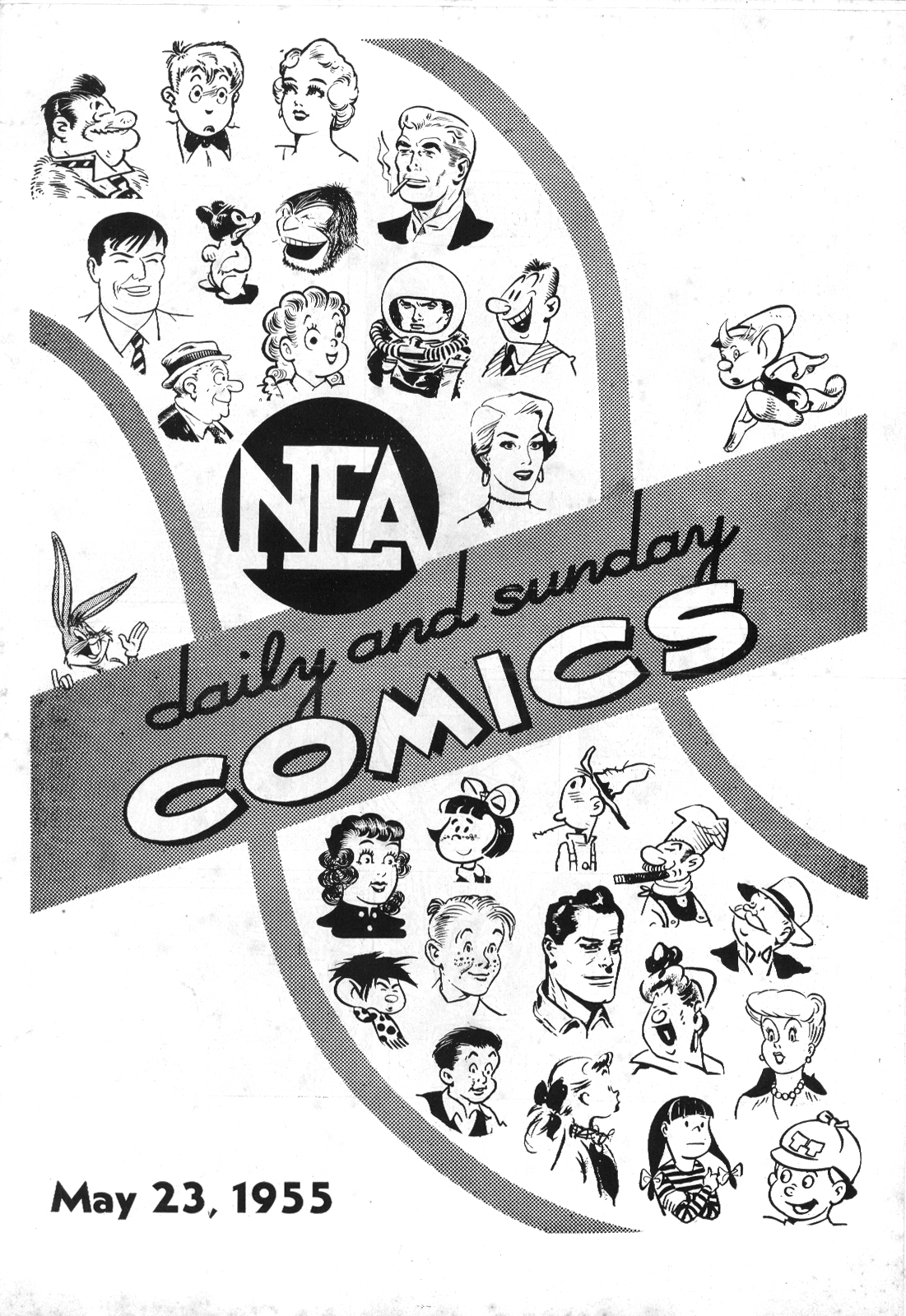
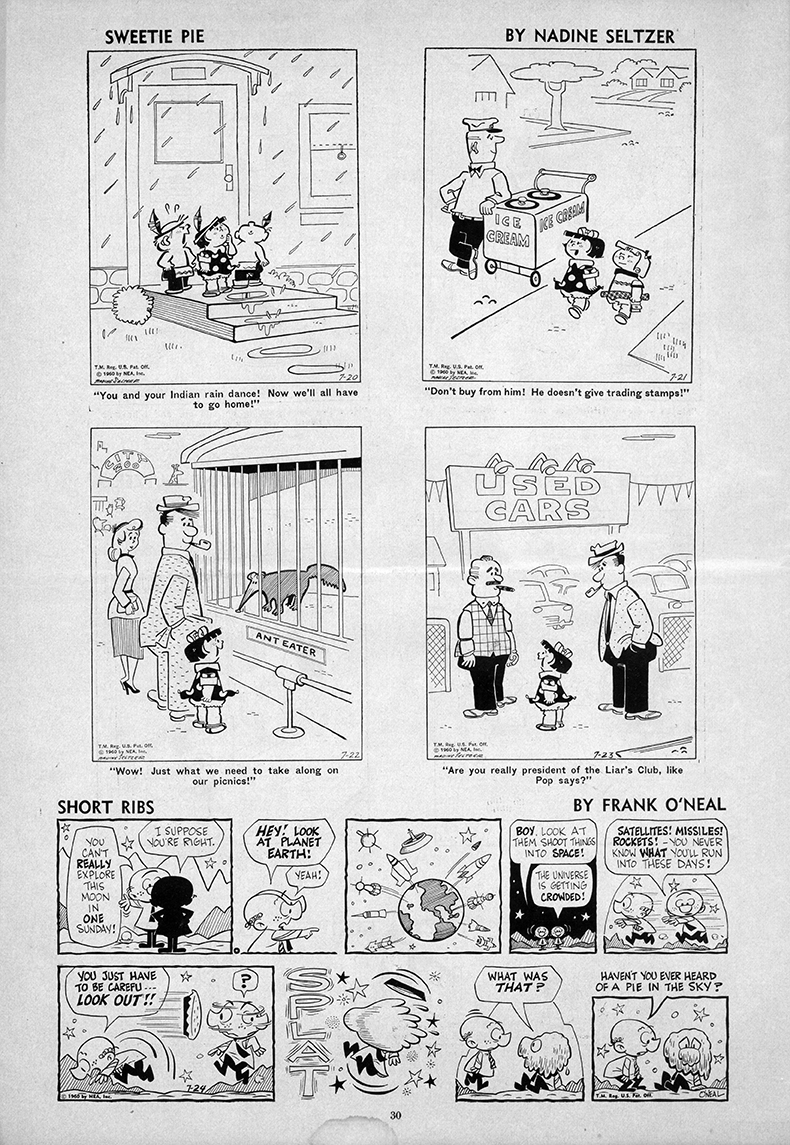
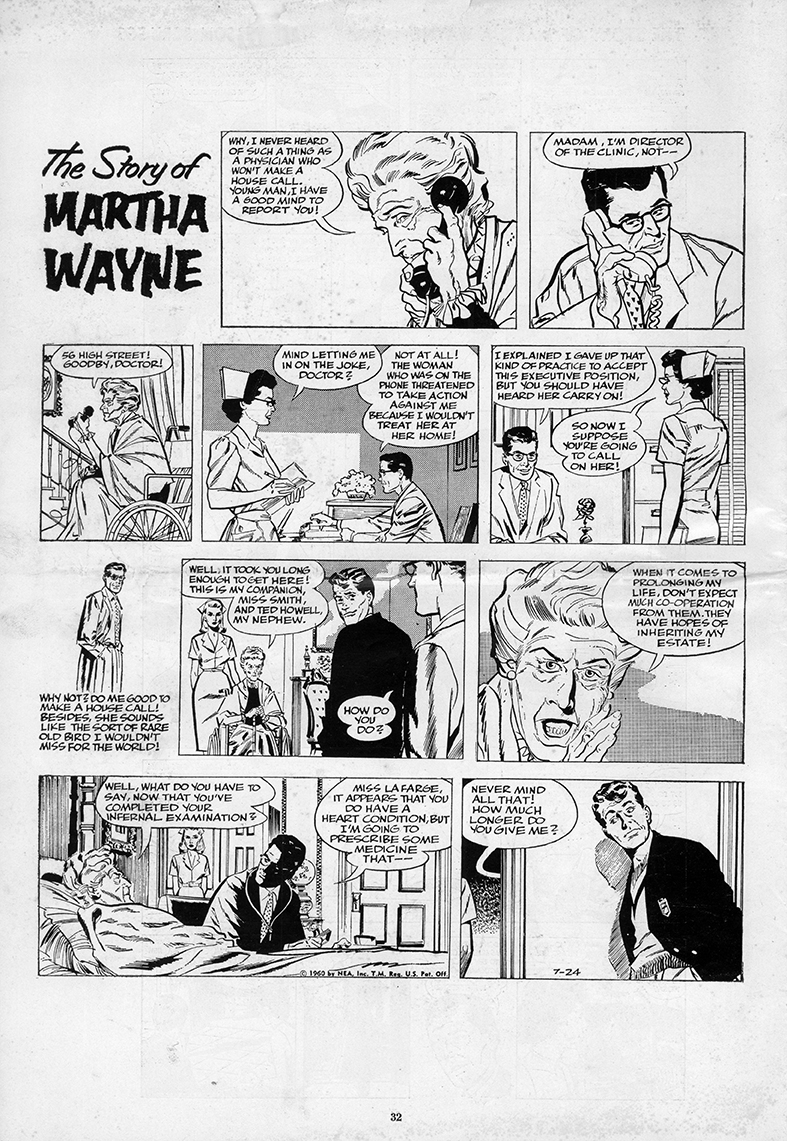
One bin turned up a copy of “NEA Sunday and Daily Comics.” It’s a 32-page, black and white tabloid, with the cover printed on a nice, coated stock and the interior pages on a lesser-grade paper. It’s a collection of NEA’s comics that was published by the syndicate each week. I have many examples of KEVIN THE BOLD excised from these issues, but only two intact copies of the publication.
The really sweet collage of the NEA’s comic heroes found on my other copy was no longer seen on the cover, but it was replaced by a KEVIN THE BOLD episode (promoted from the inside front cover). Who could complain? Not me, anyway.
Six-plus years ago, I posted the above copy of “NEA Sunday and Daily Comics.” I’m pretty sure it’ ha’s been my most-viewed post. Therefore, it seems appropriate to post this newly-acquired one in commemoration of this blog’s ninth (!) anniversary.
But first, I have a question. As I’ve mentioned before, I’m very intrigued by foreign language versions of my grandfather’s comics. Since I had a near-immediate answer the last time I asked this sort of thing, I’ll try again—is anyone aware of a German version of KEVIN THE BOLD? If so, please comment below or send me an email (brianedwardcollins1[at]gmail.com). Thank you!
Although the supplement was dated July 18, the Sunday episode of KEVIN it featured ran on July 24, 1960. (The supplement contains NEA’s daily comics from July 18–23 plus their July 24 Sunday-only features). This episode came from the middle of the Dover Pirates chapter.
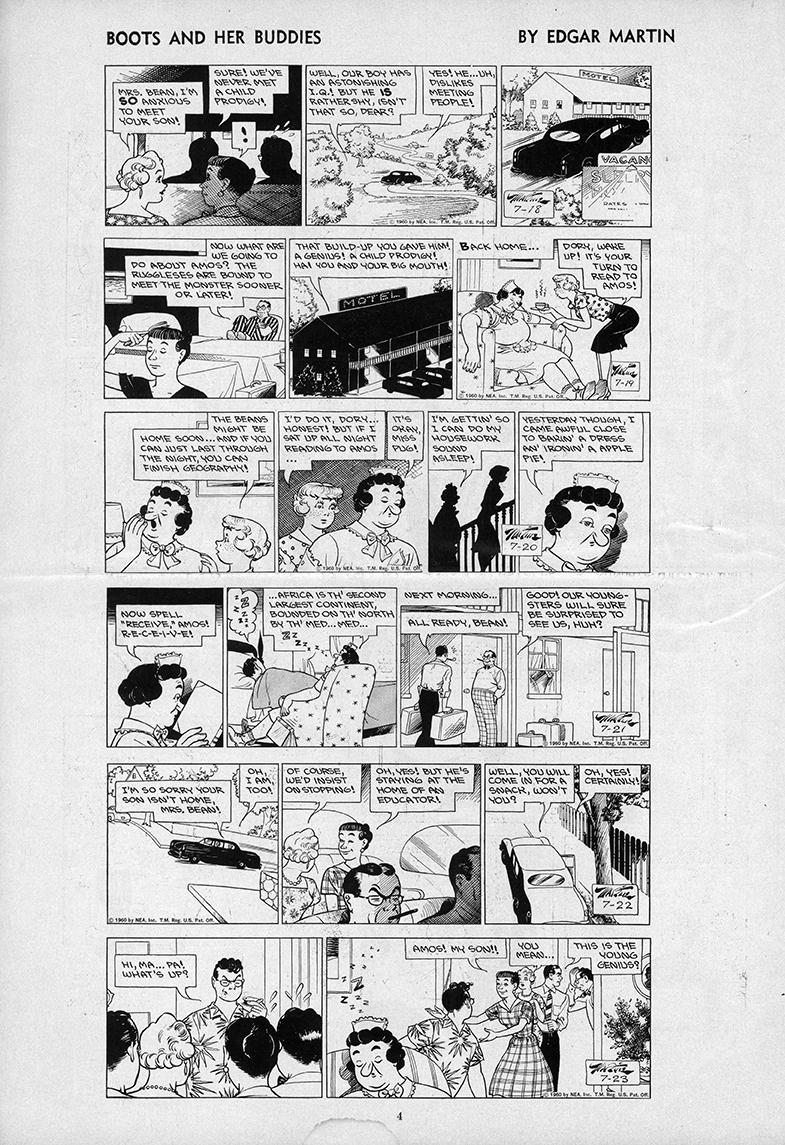
Kevin is followed on page 2 by a Sunday tabloid episode of Vic Flint (Dean Miller/Jay Heavilin). Page 3 includes half-tabloid versions of Boots and Her Buddies and Babe ‘n’ Horace/Boots Cutouts, with Boots and Her Buddies dailes the next page (all by Edgar Martin).
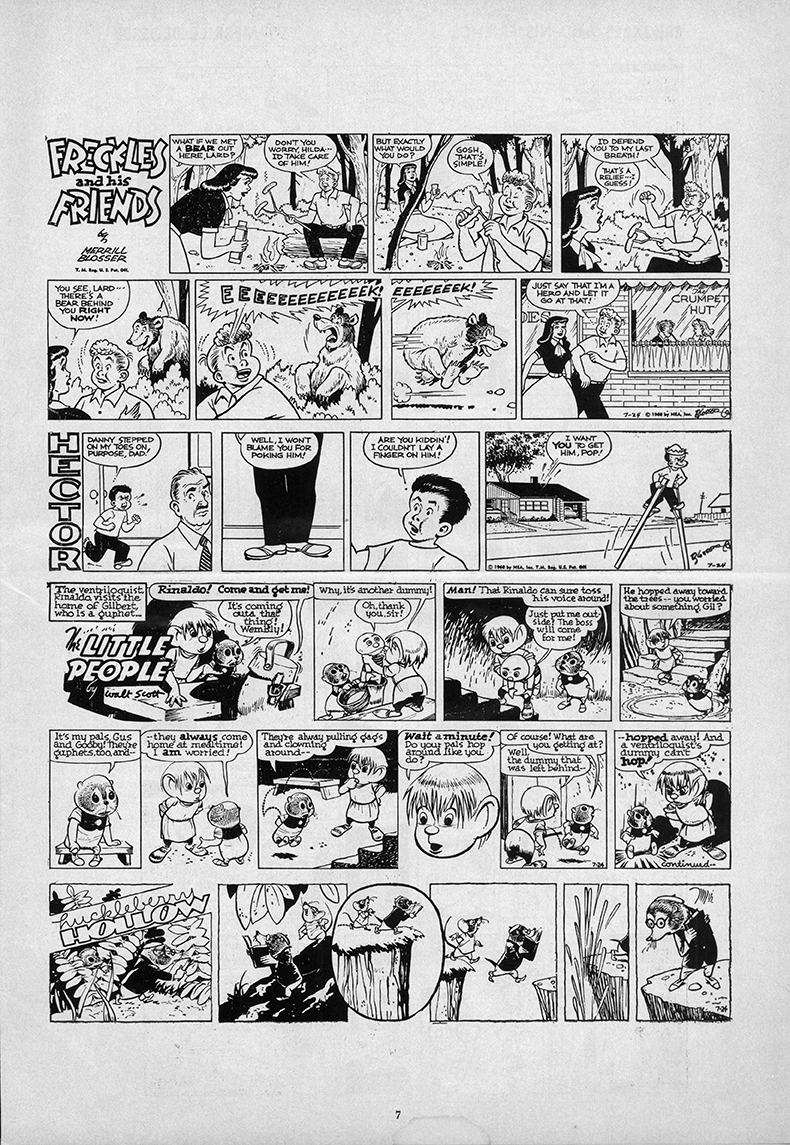
Pages 5 and 6 feature V.T. Hamlin’s Alley Oop Sunday and dailies, followed by Merrill Blosser’s Freckles and His Friends Sunday and dailies on pages 7 and 8.
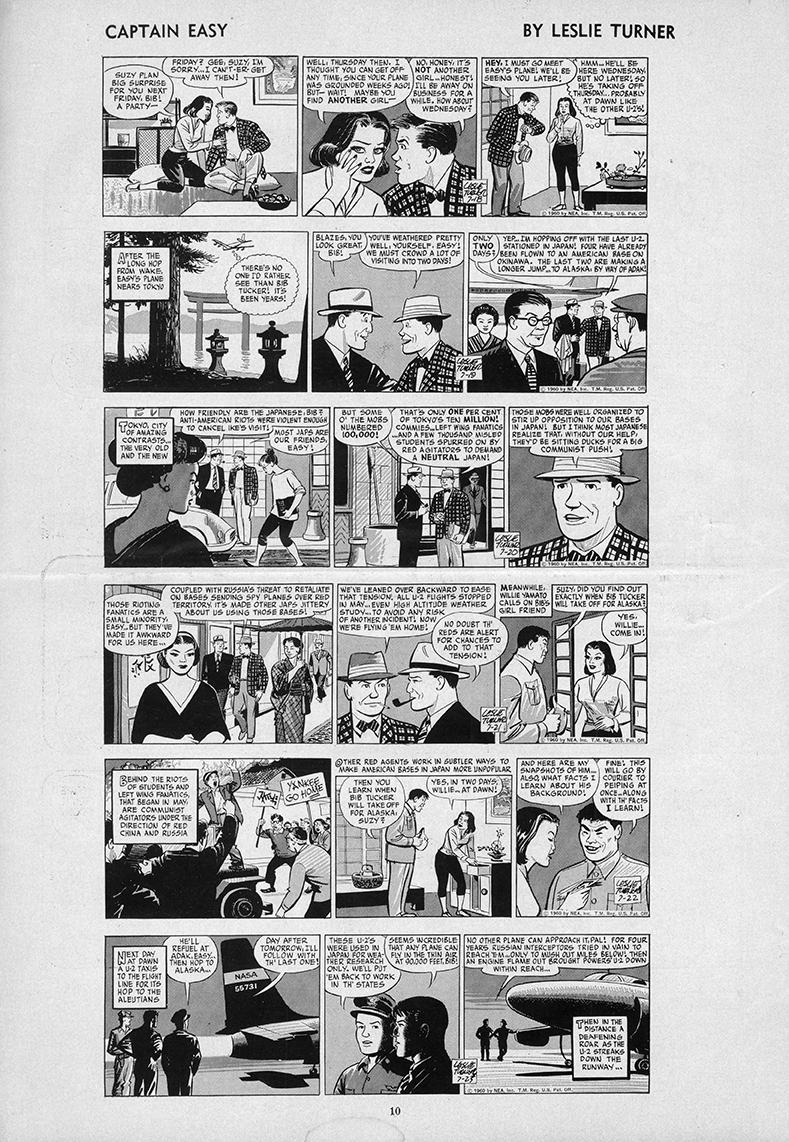
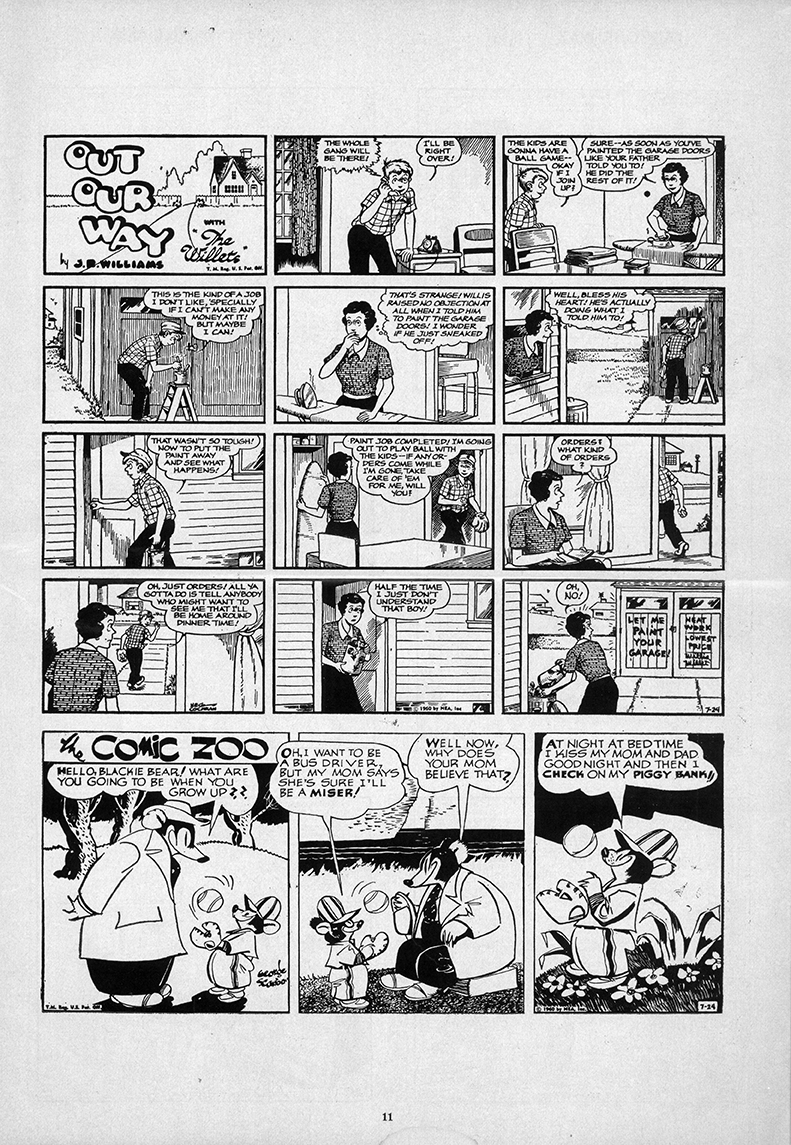
Pages 9 and 10 feature Captain Easy, by Lesley Turner (Sunday and dailies), followed by two pages of Sundays and dailies for J.R. Williams’s Out Our Way with “The Willets”.
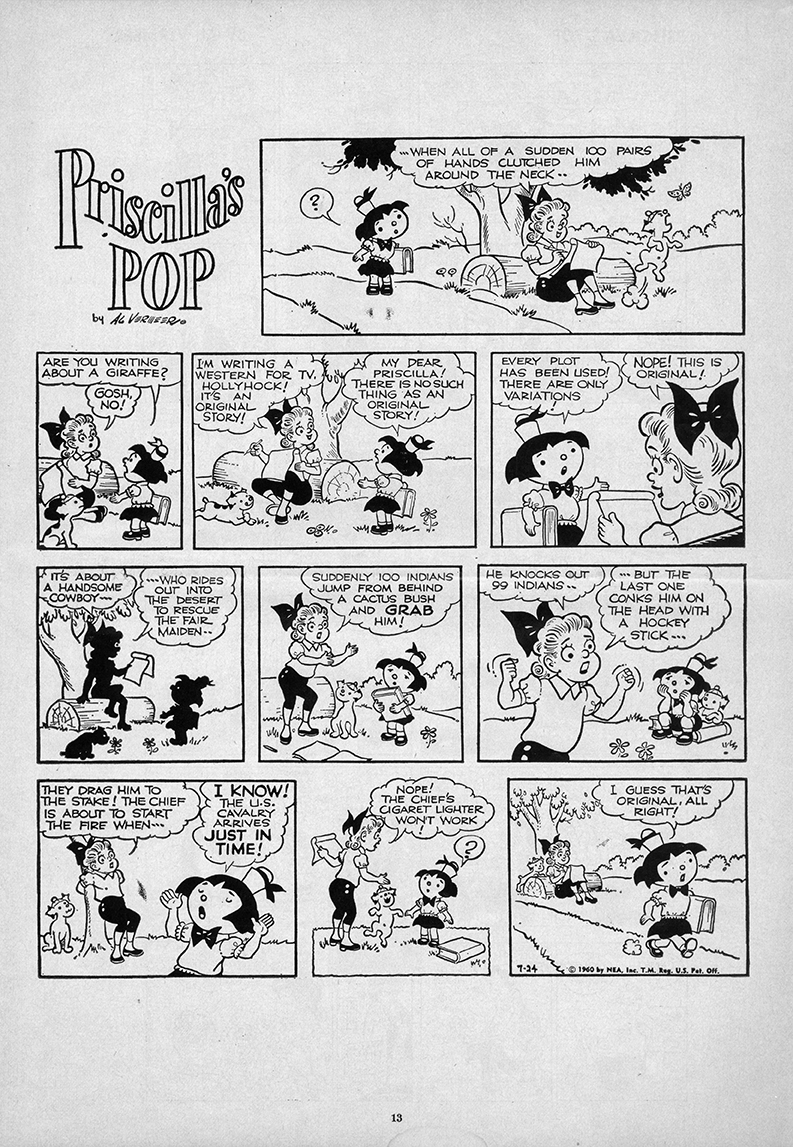
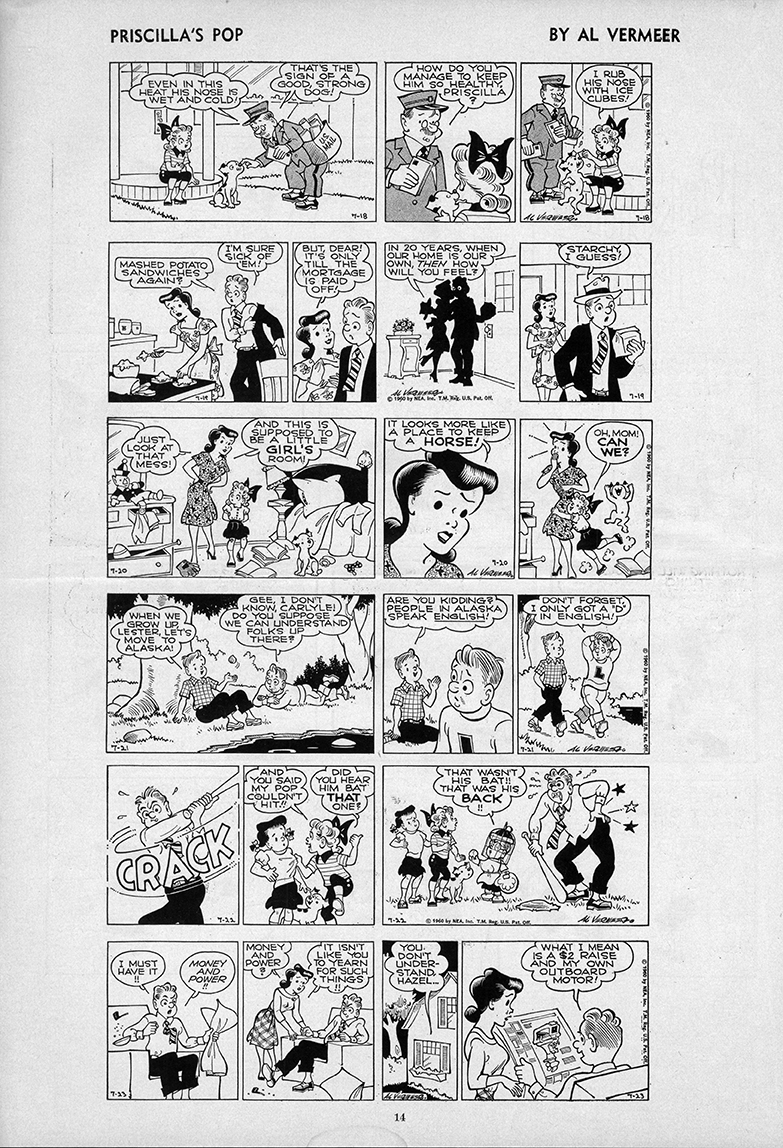
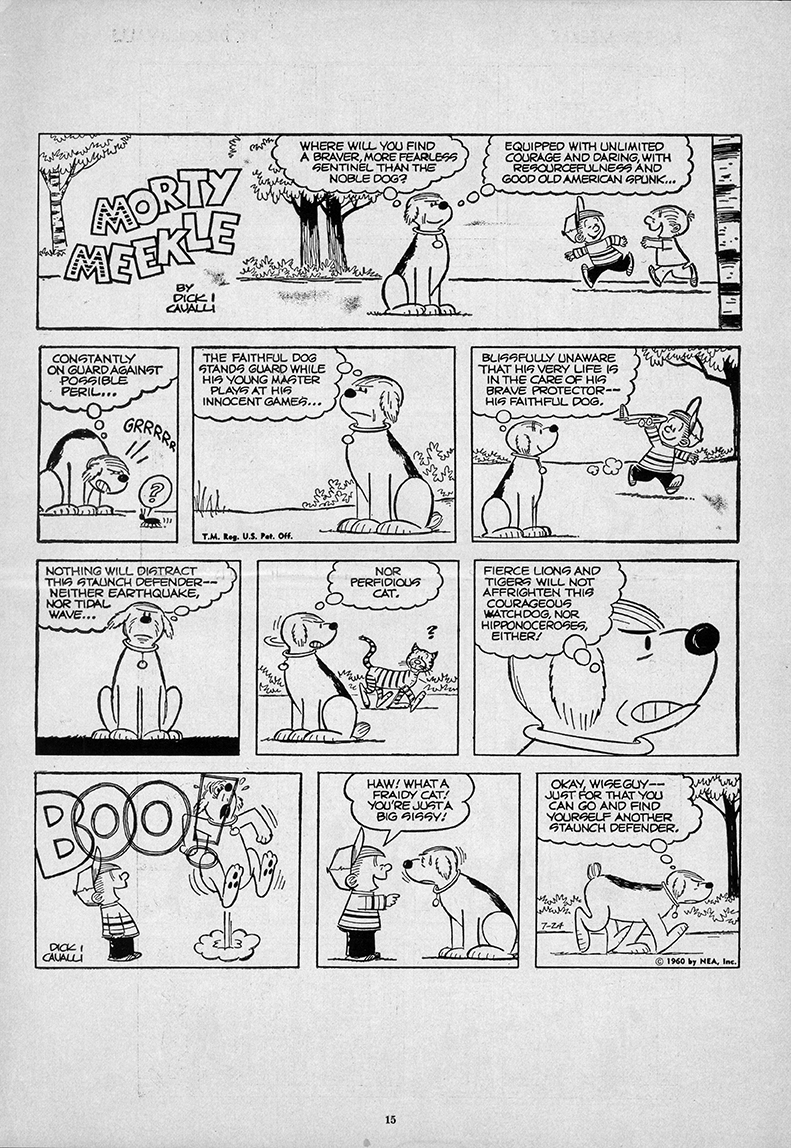
Next up is Al Vermeer’s Pricilla’s Pop (Sunday and dailies), followed by a new NEA title on pages 15–16, Dick Cavalli’s Morty Meekle. Outside of Kreigh Collins’ work, I’m not much of an authority on comics, but Morty’s cap looks mighty familiar. Sure enough, this title later evolved into a strip I remember as a kid—Winthrop. (I wasn’t much of a fan).
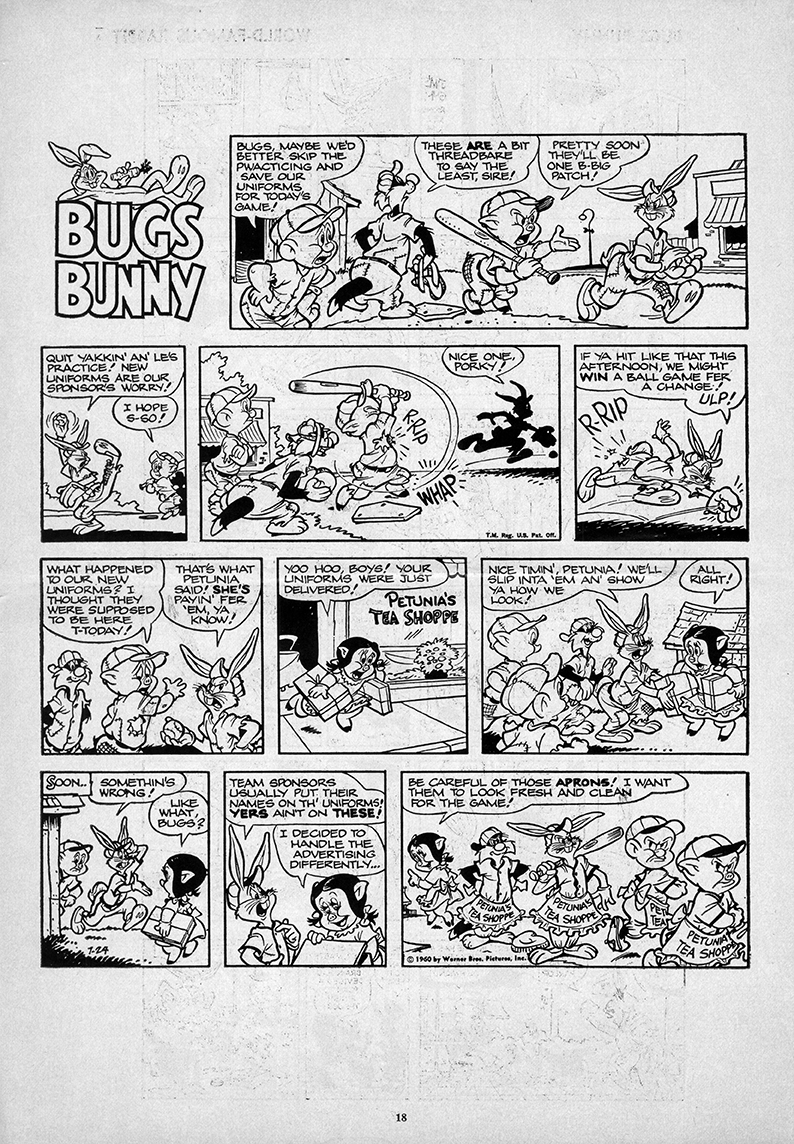
The second half of the publication brings us seven days of Bugs Bunny, Russ Winterbotham and Art Sansom’s Sunday-only Chris Welkin Planeteer, and a “fun page” with several small strips including Tom Trick Fun Detective (credited simply to Dale).
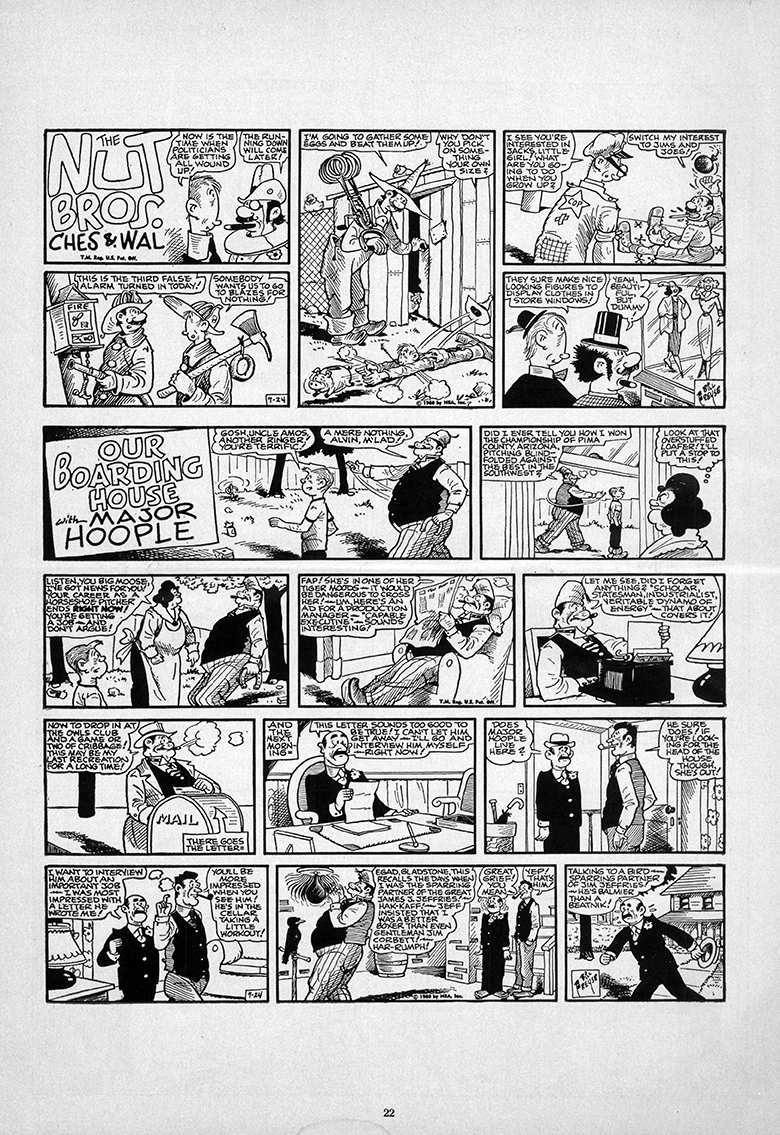
On page 21 are six days of single-panel Our Boarding House with Major Hoople dailies, and on page 22, the Sunday tabloid, which includes Bill Freyes’ topper strip The Nut Brothers. Pages 23 and 24 include the single-panel comics Side Glances (by Galbraith), Carnival (by Dick Turner), and Short Ribs (by Frank O’Neal).
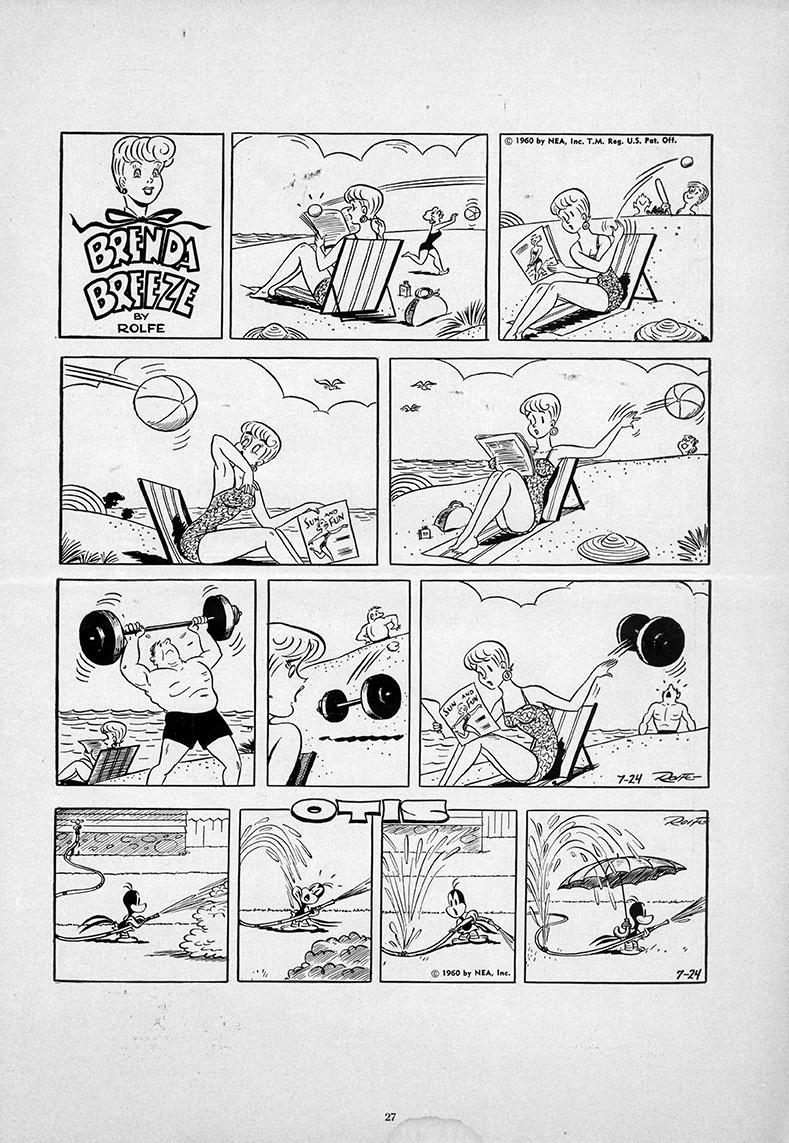
Pages 25 and 26 feature more single-panels: Carnival (Dick Turner), Short Ribs, plus Turner’s Sunday topper strip Mr. Merryweather. These are followed by Rolfe’s Brenda Breeze Sunday (with Otis as a topper) and several panels of Kate Osann’s Tizzie and Little Liz.
Pages 29 and 30 continue with more of Tizzie and Little Liz plus some Nadine Seltzer Sweetie Pie dailies and a couple left-ver Short Ribs. Bringing up the rear is seven days of Wilson Scruggs’s The Story of Martha Wayne.
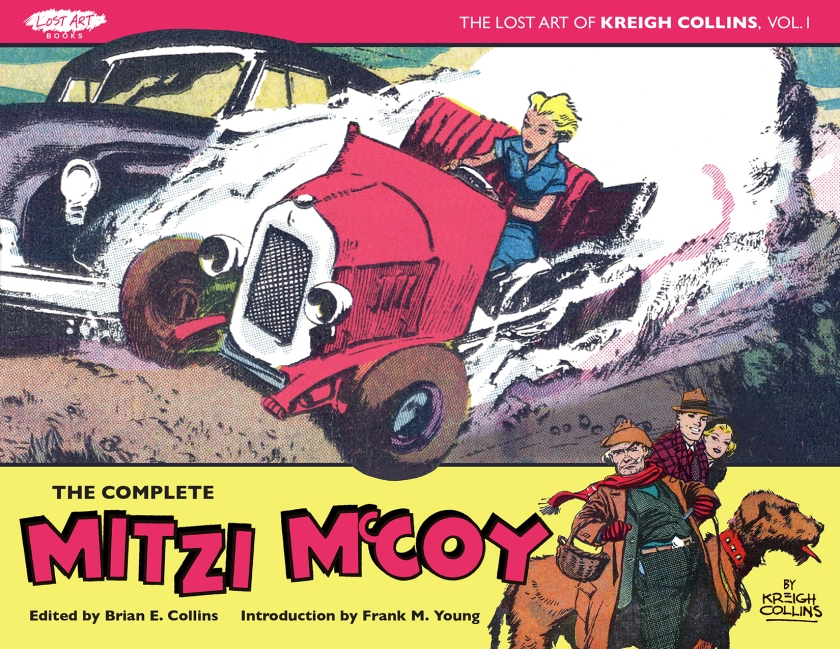
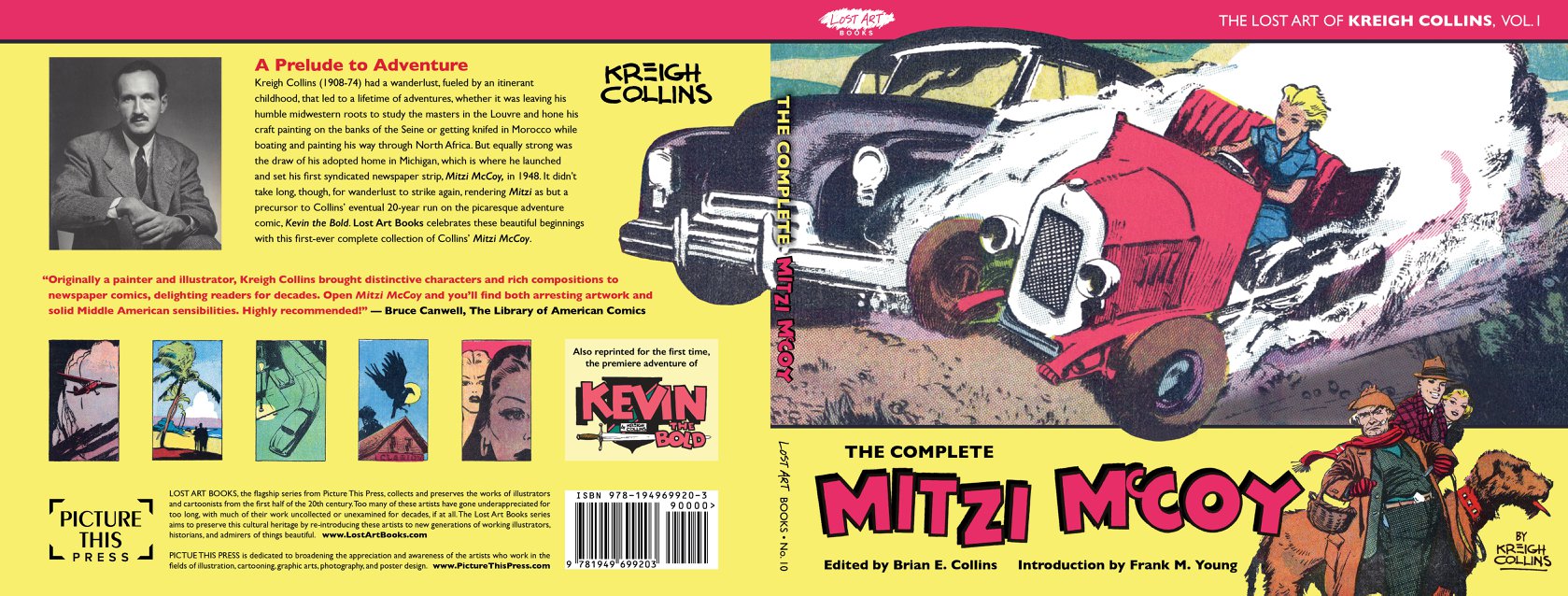
“The Lost Art of Kreigh Collins, the Complete Mitzi McCoy” features the entire run of Kreigh Collins’ first NEA feature.
MITZI McCOY ran from 1948 to 1950 and showcased Kreigh Collins’ skill as an illustrator and storyteller. His picturesque landscapes, lovely character designs, and thrilling action sequences brimmed with detail and charm, and the strip’s ensemble cast rotated in and out of the spotlight taking turns as protagonists in the dozen story arcs collected in this volume. The last story collected in “The Complete Mitzi McCoy” is the narrative bridge that set Collins and his characters off on a new journey, beautifully told for the next couple of decades in the much-lauded adventure strip Kevin the Bold.
The collection includes an introduction by Eisner Award-winning author Frank M. Young, an Afterward by Ithaca College’s Ed Catto, and previously unpublished artwork and photos. Longtime comics artist Butch Guice also provides a new pin-up of the character Mitzi McCoy.
The book is available for $30. For domestic shipping, add $4; for international orders, please add $25 to cover first class shipping. To place an order, leave a comment below or email me at BrianEdwardCollins1[at]gmail.com, and I will give you PayPal or Venmo information. Thank you!
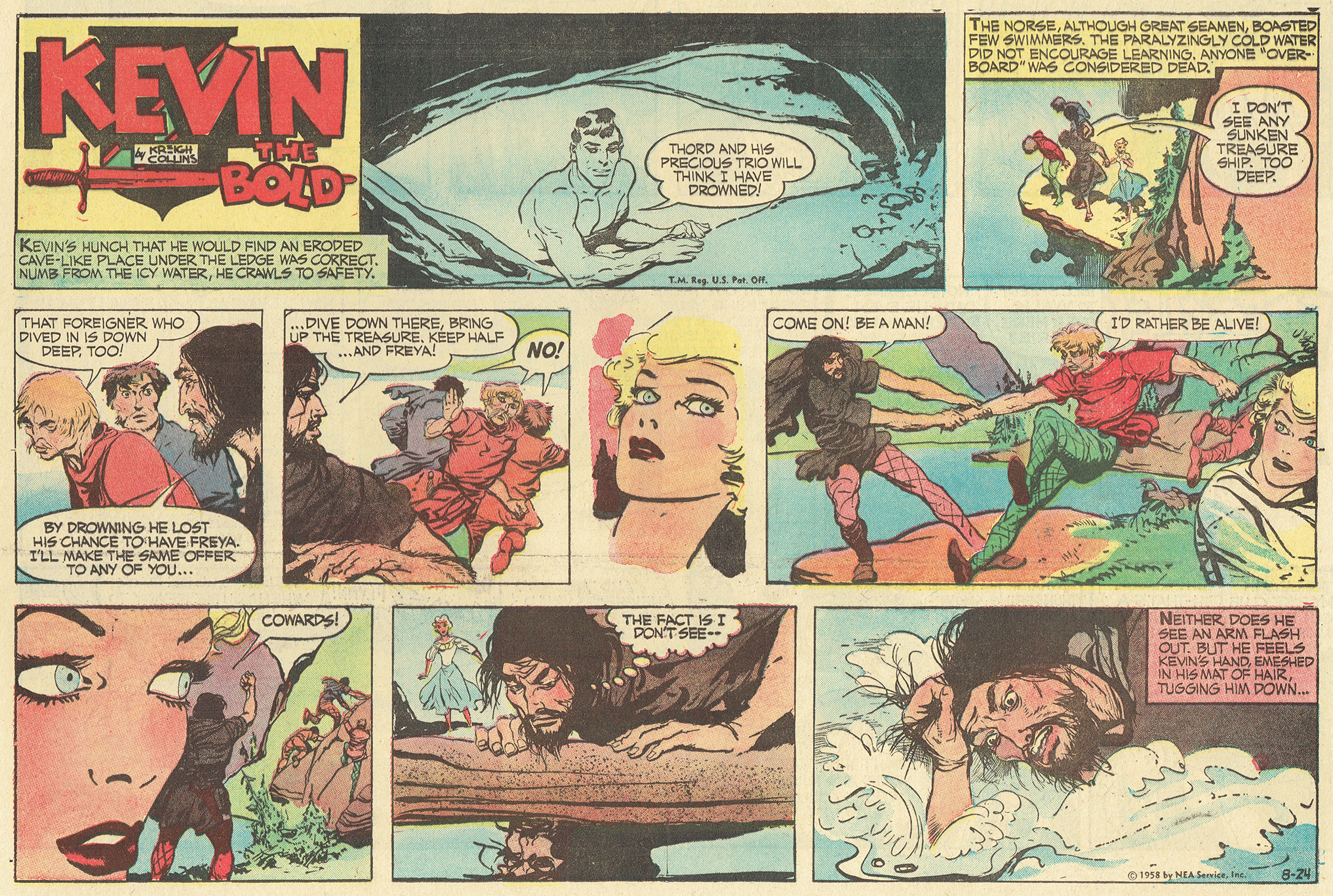
The illustration of underwater swimming in the final panel is evocative of a decade-old Mitzi McCoy comic and plot device, that of finding a hidden cave with an air pocket.
August 7, 1949
As in the mid-1949 Mitzi McCoy sequence, a cave is found with an air pocket. It allows Kevin to escape the frigid water, albeit briefly. Meanwhile, as Thord’s men squabble, Kevin seizes his opportunity.
Besides being a rather gruesome conclusion to a compelling storyline, the August 31, 1958 episode is notable for a couple of other reasons, among them a continuity problem. When Thord and Kevin resurface in the second panel, some stones are visible in the foreground, to Thord’s right. In the next panel, Thord gives Kevin a stiff-arm as he lunges for the stones to his left. The throwaway panel then shows a closeup of a stone in Thord’s left hand, but the following panel shows the stone in Thord’s right hand, as he’s about to strike at Kevin.
Also of note is the introduction of the character Pedro in the final transitional panels. A large and recurring character, Pedro was by Kevin’s side for many of his adventures over the final decade of Kevin the Bold’s run. No doubt he was a favorite of Collins, as a very similar Pedro character played a prominent role in Kreigh Collins’ third and final NEA feature, Up Anchor!
Did Someone Say “MItzi”?
“The Lost Art of Kreigh Collins, the Complete Mitzi McCoy” features the entire run of Kreigh Collins’ first NEA feature.
MITZI McCOY ran from 1948 to 1950 and showcased Kreigh Collins’ skill as an illustrator and storyteller. His picturesque landscapes, lovely character designs, and thrilling action sequences brimmed with detail and charm, and the strip’s ensemble cast rotated in and out of the spotlight taking turns as protagonists in the dozen story arcs collected in this volume. The last story collected in “The Complete Mitzi McCoy” is the narrative bridge that set Collins and his characters off on a new journey, beautifully told for the next couple of decades in the much-lauded adventure strip Kevin the Bold.
The collection includes an introduction by Eisner Award-winning author Frank M. Young, an Afterward by Ithaca College’s Ed Catto, and previously unpublished artwork and photos. Longtime comics artist Butch Guice also provides a new pin-up of the character Mitzi McCoy.
The book is available for $30. For domestic shipping, add $4; for international orders, please add $25 to cover first class shipping. To place an order, leave a comment below or email me at BrianEdwardCollins1[at]gmail.com, and I will give you PayPal or Venmo information. Thank you!
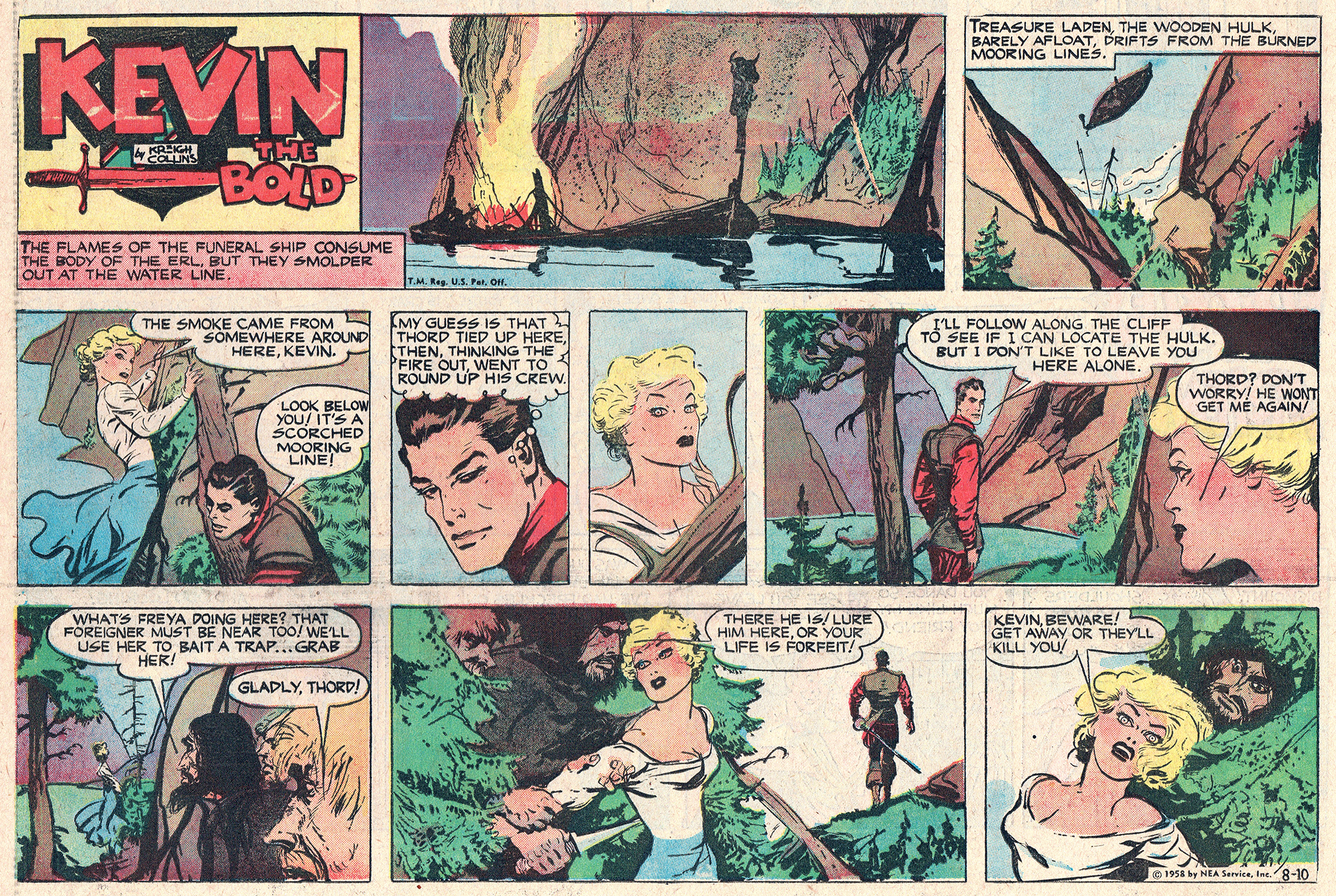
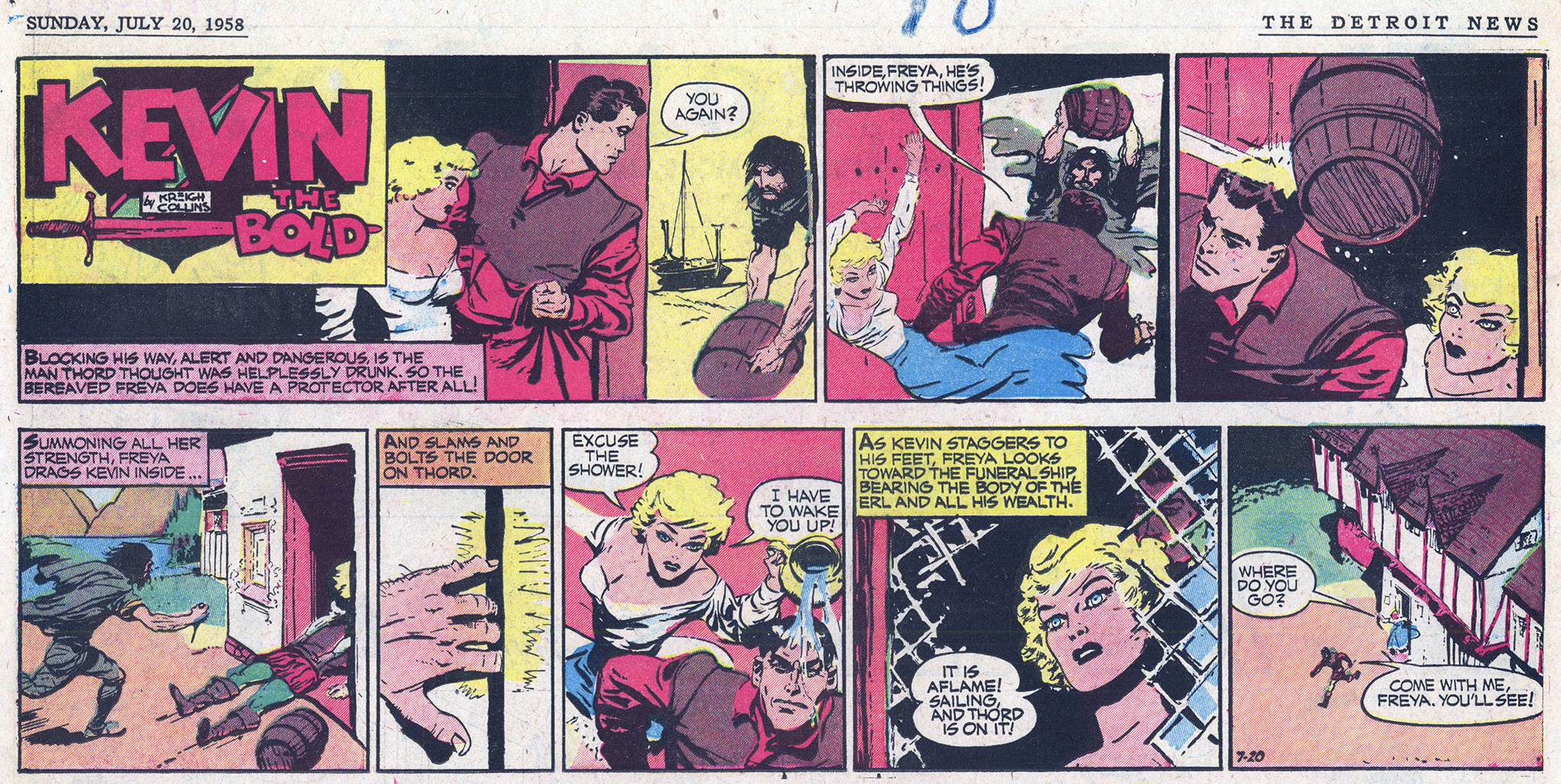
Freshly awoken from being knocked out, Kevin and Freya race to water’s edge only to see Thord sailing away on Sor Nordick’s dragon boat, repurposed as the Erl’s funeral ship.
After discovering that Thord intended to steal the venerable old man’s treasure (instead of following custom and letting it sink with the burning boat), Kevin and Freya set off in an attempt to thward Thord’s plans.
[Now about those “unscrupulous” Jesicks. Reading through these comics, that name rang a bell for me, and I realized where it likely came from. Notably, Kreigh Collins was an avid sailor, and for many years he docked his boat at a marina on Lake Macatawa, Michigan. The marina? Jesick’s Boat Yard. I suspect that the choice of names Collins gave to Thord’s lackeys was in fun, and not indicative of any malice toward the owners of his longtime marina. It sounds Polish to me, but perhaps Jesick is a Norwegian name?]
An unforeseen bugaboo in the evil man’s plans dooms them, but while Kevin strides off to for a better view, Freya herself is not out of the woods yet.
For more information on the career of Kreigh Collins, visit his page on Facebook.
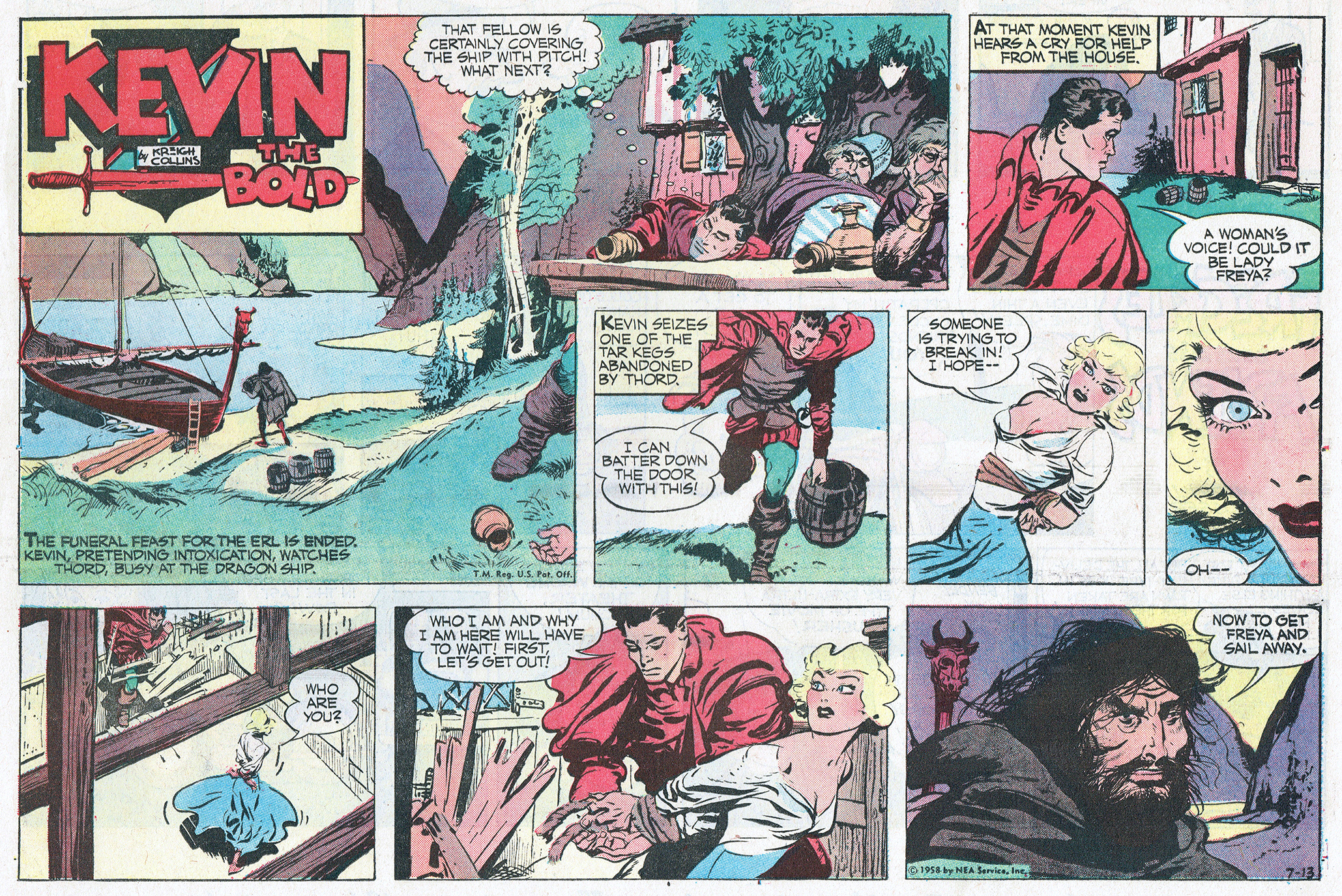
Smelling a rat, Kevin lingers to see what sort of plan is afoot. Thord quickly schemes to get Kevin out of his way, but as usual, the Irishman is one step ahead of his foe.
Pretending he has passed out from too much drink, Kevin leaps at an opportunity to search for Freya. Bound and vulnerable, Freya doesn’t know who her rescuer is, but she appears to like what she sees. Kevin hastens her away in the nick of time. Thord, with the menacing prow of the dragon ship looming over his shoulder, sets off to grab Freya.
Instead, he finds Kevin, and becomes enraged. Luckily, Freya is not only beautiful, but quick thinking and surprisingly strong.
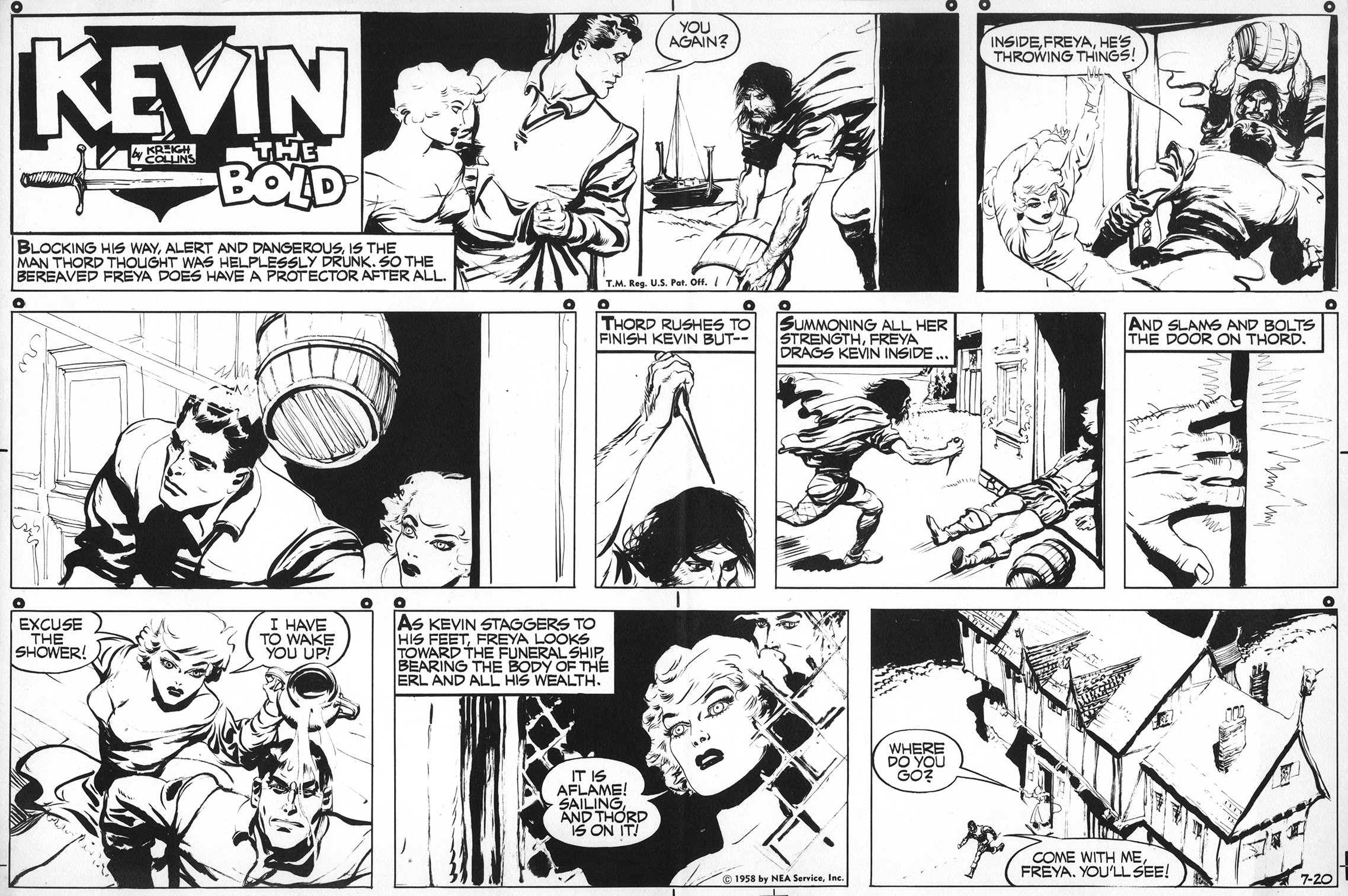
The July 20 episode is one of a few from 1958 for which I don’t have a half-page example. I’m fortunate to have a crisp black and white proof, and it reveals all the cropping that took place when one-third-page versions were created. Some nice details are lost, such as the fuller illustration of the house in the final panel, but the comparison also shows that Kreigh Collins had learned to deal with the inevitability of the third-pages. Several of the wider panels’ sides are rather empty, and ready to be sacrificed for the truncated version. Interestingly, the penultimate panel has been extended upward, with the caption moving up and over, so the overall width can be reduced without obscuring the fetching Freya’s face.
Now available!
Visit the Lost Art Books website to place your order for The Lost Art of Kreigh Collins, Vol. 1: The Complete Mitzi McCoy. In addition to the entire run of “Mitzi McCoy,” the book includes the opening sequence of the comic strip “Mitzi” evolved into, “Kevin the Bold.”
The book also features an extensive introduction by Eisner Award winner Frank M. Young and previously unpublished artwork and photographs.
For more information on the career of Kreigh Collins, visit his page on Facebook.
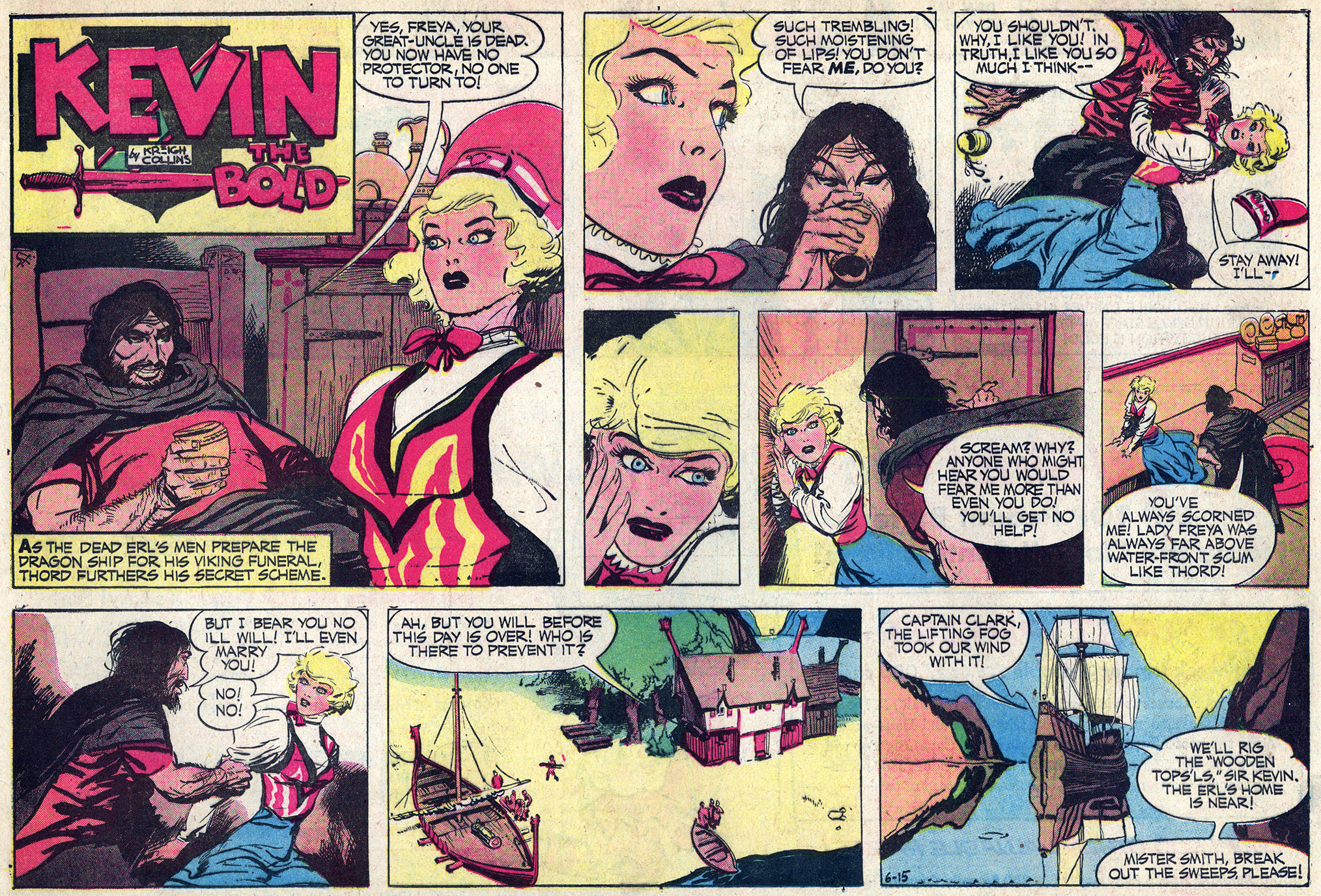
After learning that her great uncle has died, Freya realizes exactly how vulnerable she is.
Help is on its way, but not soon enough—the ship delivering Kevin is becalmed in the fjord.
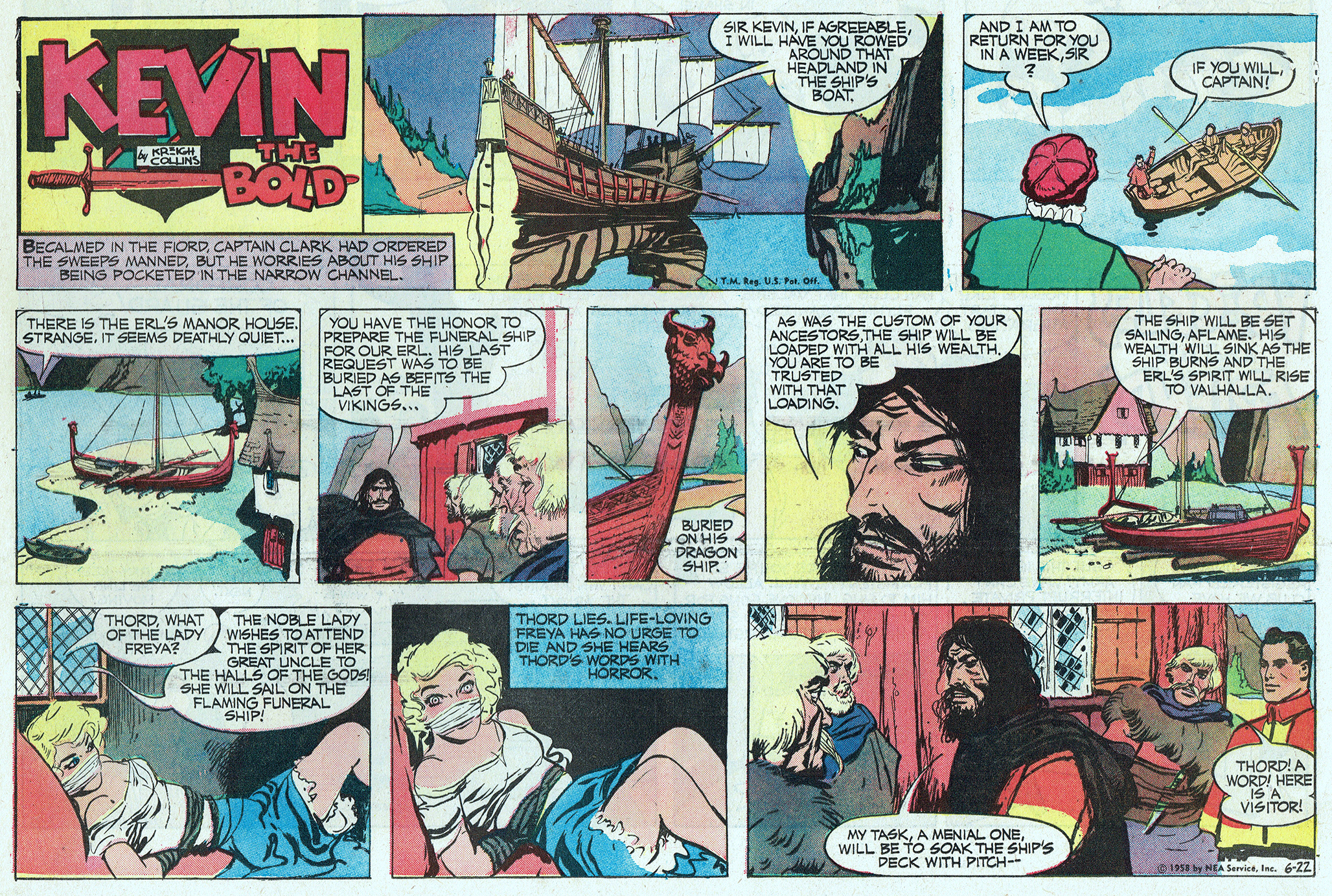
In an episode featuring beautifully rendered ships, Kevin learns the fate of the old man he had traveled so far to meet. What he doesn’t know are the circumstances in which the lovely Freya finds herself—bound, gagged, and close to panic.
Kevin’s suspicions aroused, he brushes off the suggestion that he presence isn’t welcome, and defiantly stands up to Thord. The danger passes, yet Kevin suspects more trouble ahead.
For more information on the career of Kreigh Collins, visit his page on Facebook.
The following chapter dates to the summer of 1958. The previous storyline transitioned dramatically with an enormous and beautifully illustrated splash panel. (Sincere thanks to my friend in the Netherlands, Arnaud, who sent me scans of many of the comics I’ll be posting over the course of the next five weeks).
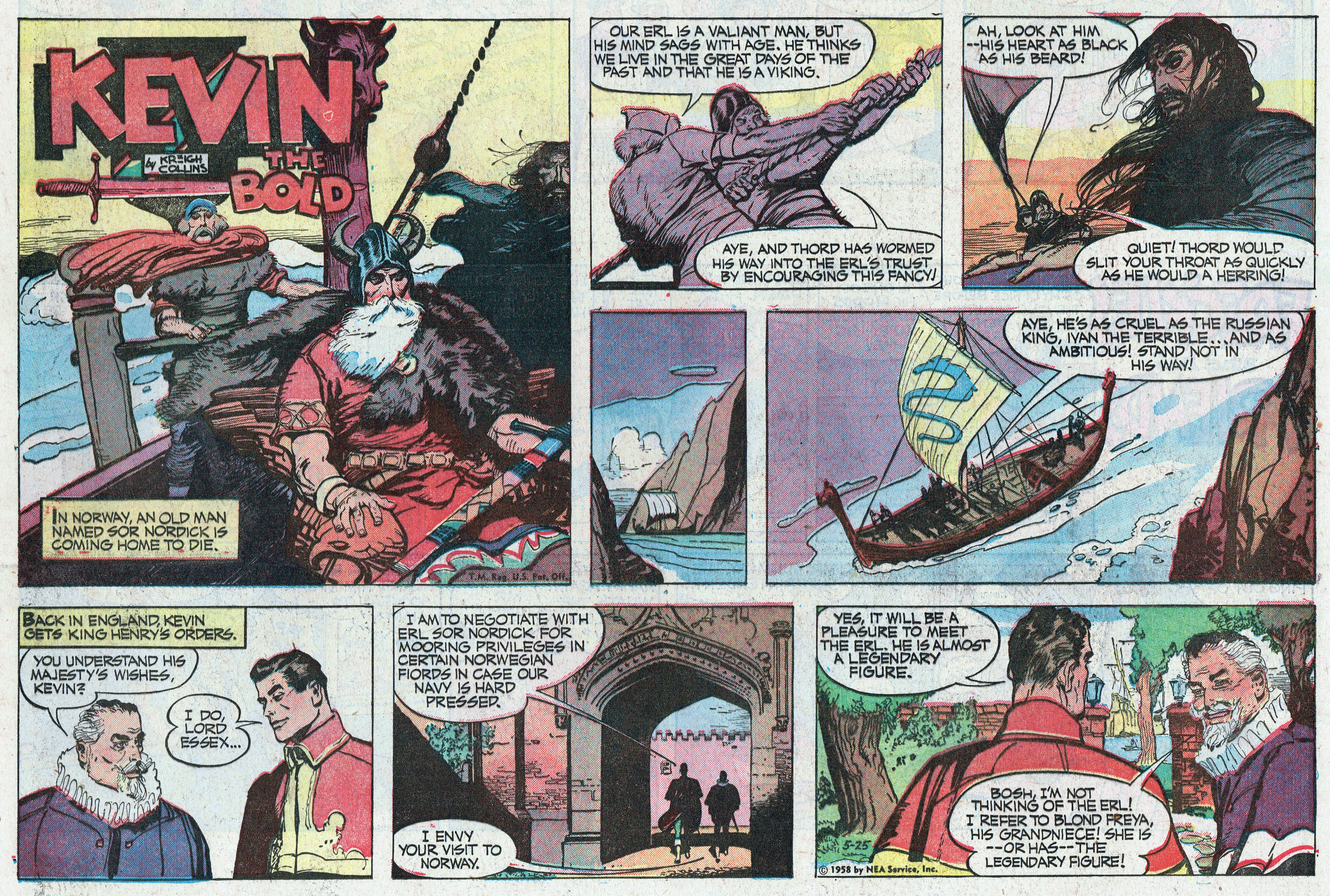
Thord, an evil man from the east has caught the ear of the declining, yet venerable Erl Sor Nordick, and is scheming to steal everything the old man holds dear.
It’s quite clear that Thord is the representation of evil incarnate, and an unusual graphic detail underlines this fact. Likely unintentional, in the bottom left panel of the episode above, a swastika is shown in the detailing on Thord’s left sleeve. In the next panel, the old man is dead. Fortunately, this evil will be countered by virtue, as Kevin the Bold’s arrival in Norway is imminent.
For more information on the career of Kreigh Collins, visit his page on Facebook.
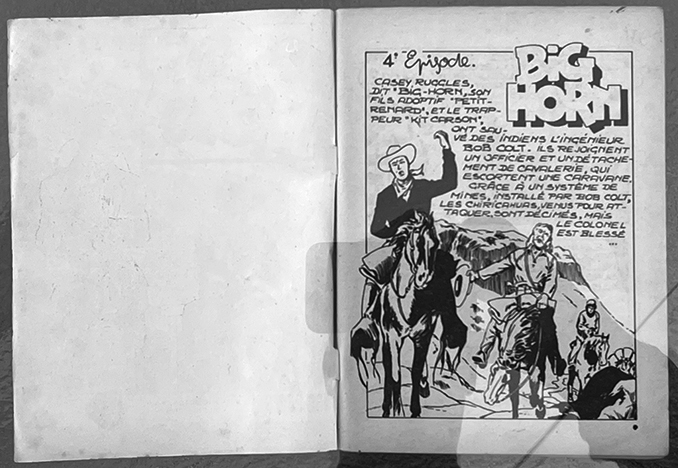
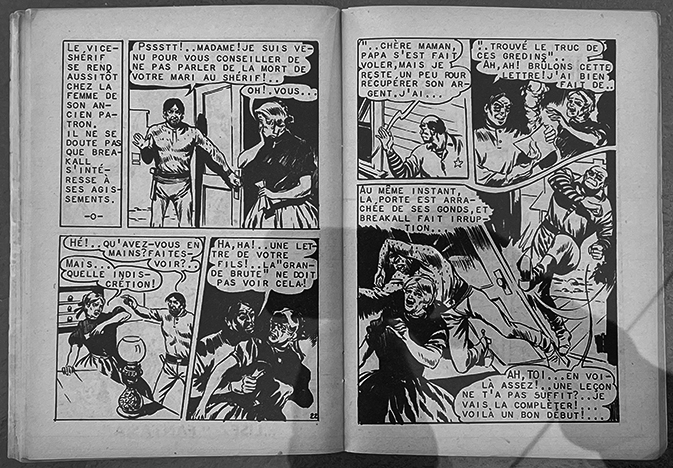
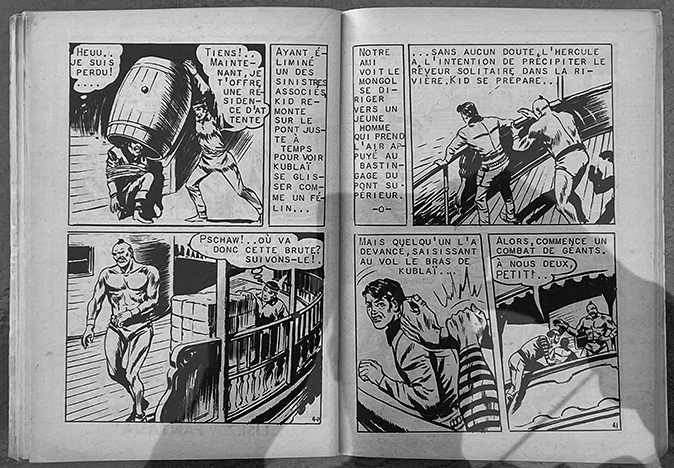
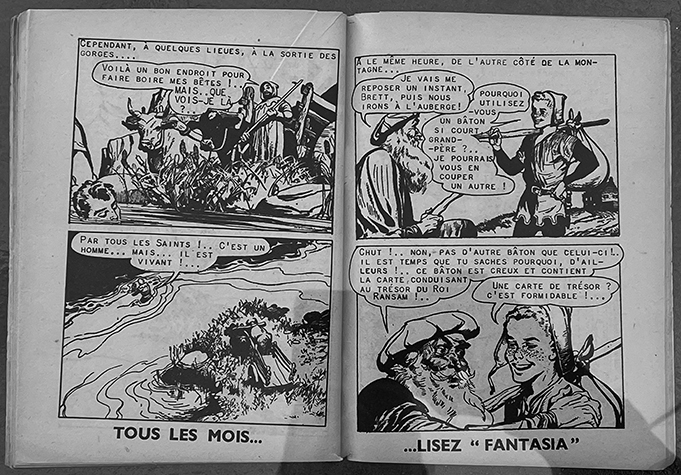
Published in late 1957, issue No. 4 of the French comic book Big Horn follows the same format as its three predecessors. In addition to Warren Tufts’ title comic, it also features John Wheeler’s KID COLORADO, a short story, and Kreigh Collins’ KEVIN LE HARDI (“Kevin the Bold”).
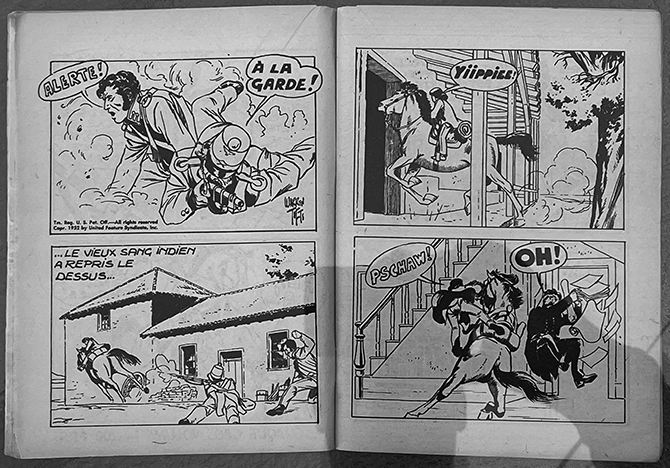
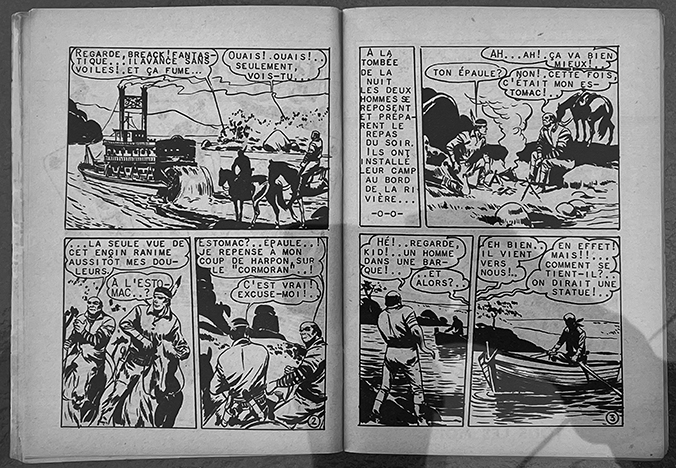
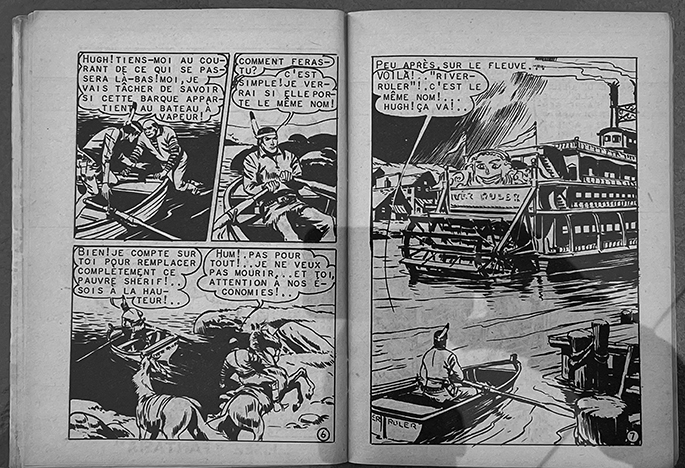
Because the smallish (5-1/4″ x 7-1/8″) BIG HORN comic books are so thick (132 pages), they don’t scan very well. These images are photos I took outside with the comic book spread flat beneath a piece of plexiglass. My apologies for the glare and shadows. First up is BIG HORN, which runs for 35 pages.
BIG HORN is followed by 62 pages of KID COLORADO. I love the introductory pages found in these comic books!
A space-filling three-page short story (“Smoke Signals”), buttresses the comic book’s non-titular features.
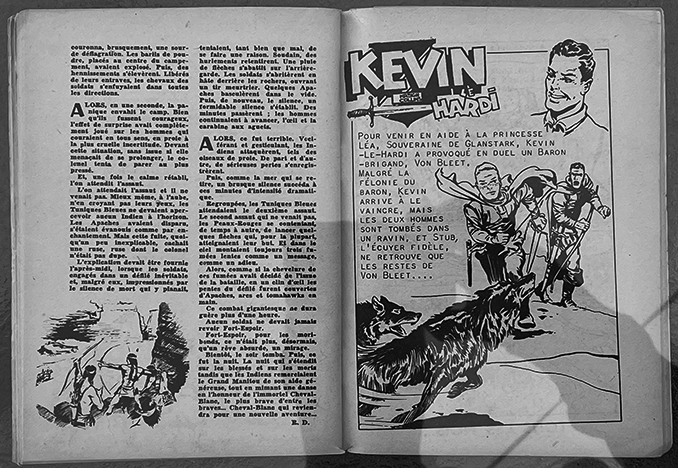
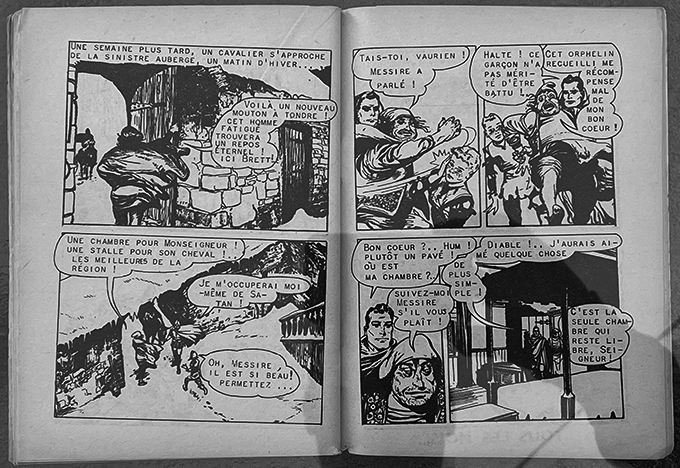
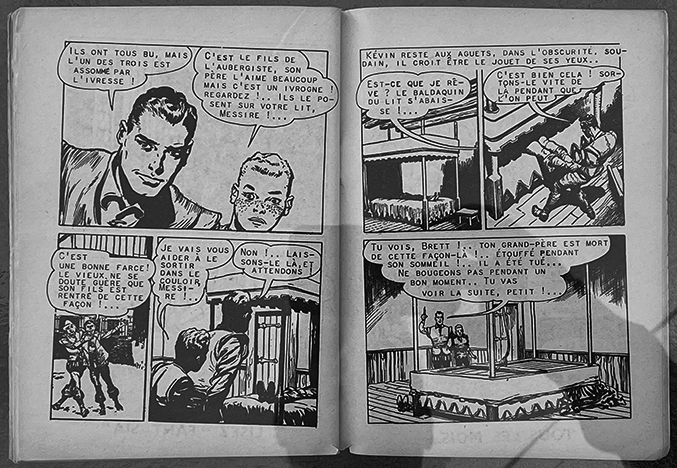
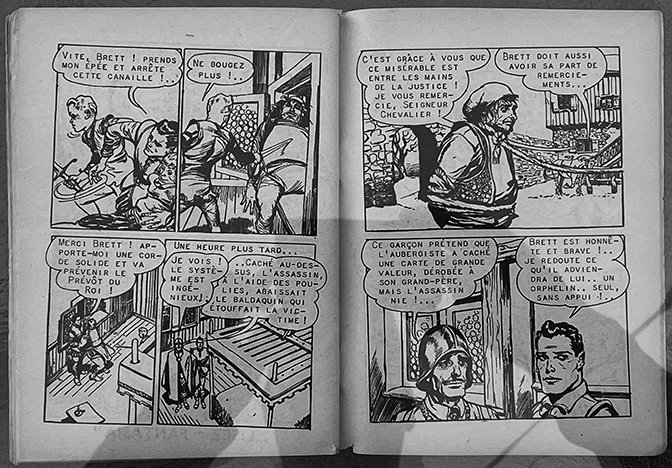
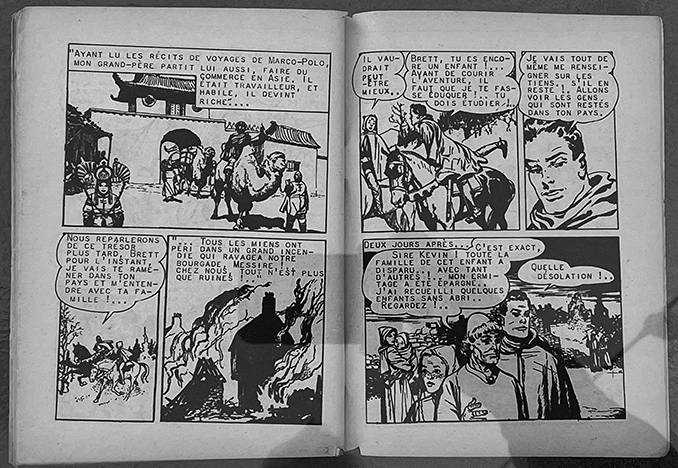
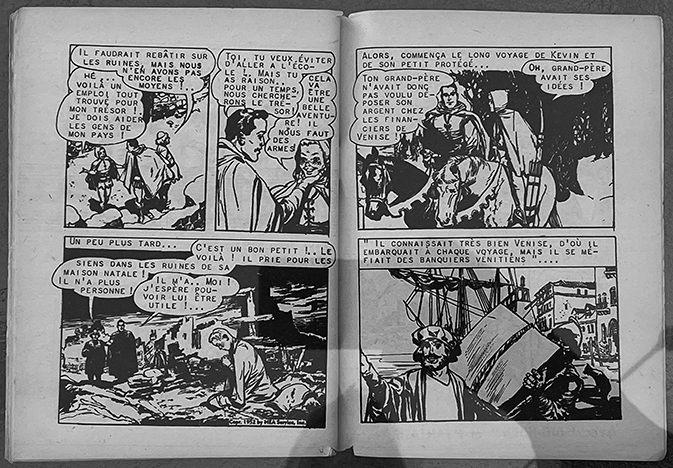
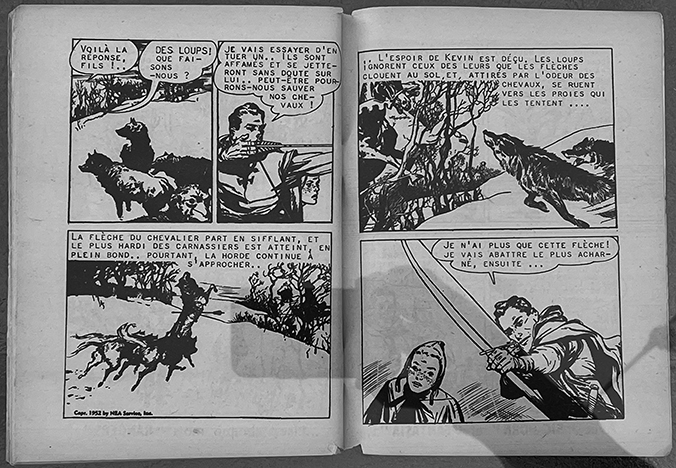
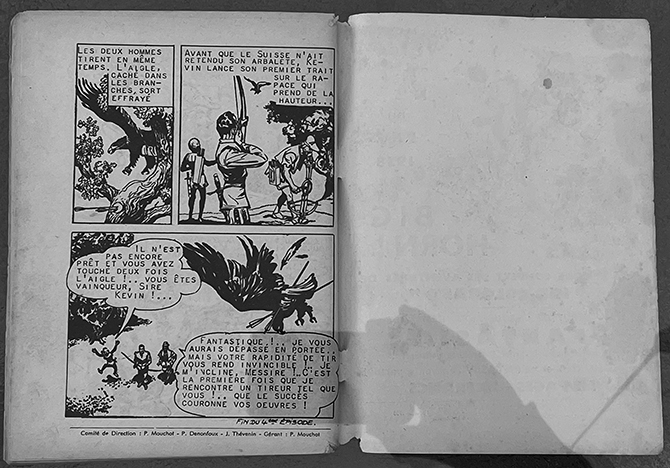
KEVIN LE HARDI brings up the rear of the book with the action picking up where it left off in BIG HORN No. 3. Originally published on January 13, 1952, the black and white comic book version pales in comparison to the beautiful Chicago Tribune color reproductions of the early 1950s.
Kevin le Hardi’s introductory page gives some back story (“To come to the aid of Princess Léa, sovereign of Glanstark, Kevin the Bold challenged a robber baron, Von Bleet, to a duel. Despite the Baron’s treachery, Kevin manages to defeat him, but the two men have fallen into a ravine, and Stub, the faithful squire, only finds the remains of von Bleet.”)
The comic book’s next 32 pages contain the conclusion of Kevin’s fifth chapter (Baron Von Blunt/Bleet), an entire (short) chapter, “The Deathtrap,” and the beginning of chapter seven, “The Treasure Hunt.” Although the episodes are edited and rearranged to some degree, the comic book covers 10 original Sunday episodes from January 13, 1952 to March 16, 1952.
As usual, a black and white ad promoting the next issue of BIG HORN is found on the back cover. No. 5 also features Kevin le Hardi.













































 Kreigh’s Comics