Girl Meets Boy

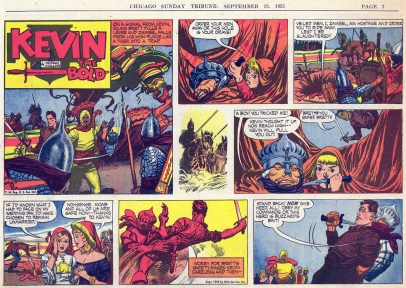
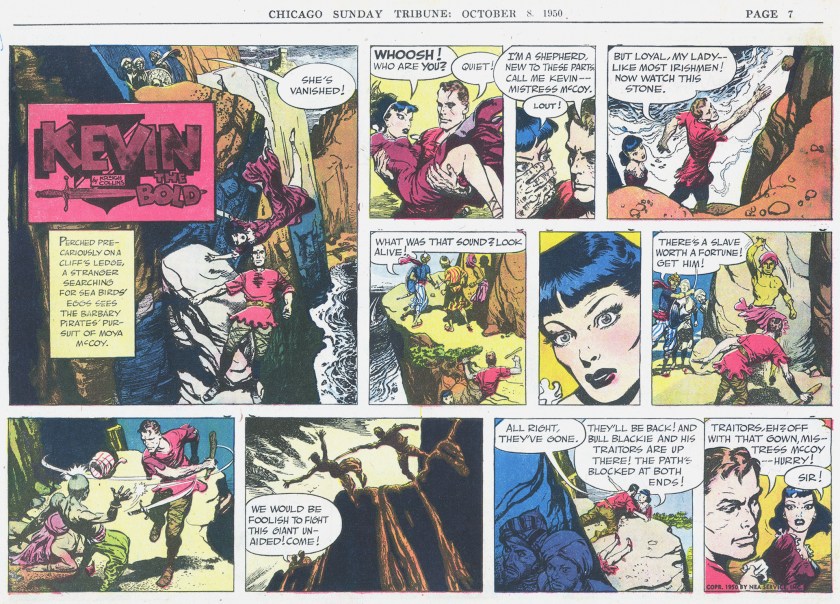
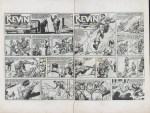
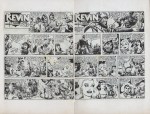
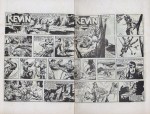
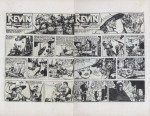
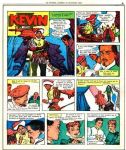
The first “Kevin the Bold” sequence features all the classic elements for which the strip would become known — dramatic action, monstrous villains, damsels in distress, heroism… and gorgeous artwork.

Moya McCoy is the first character introduced; Kevin doesn’t appear until the second episode, when the two abruptly meet (or as it says in the comic, “Whoosh!”).KTB 100150 HF 150 QCC

KTB 100850 HA 150 CC

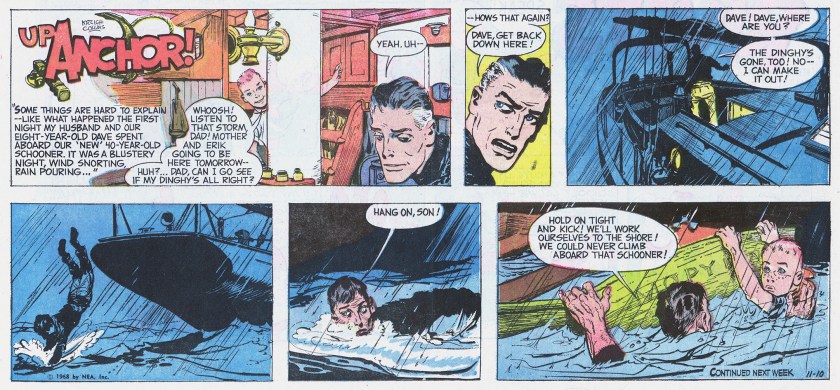
“Whoosh!” is a slang term with which I had been unfamiliar — until I started reading Kreigh’s comics. It must be dialogue suggested by the artist. By coincidence, the word appears in not just the second episode of “Kevin the Bold,” but also in the second episode of “Up Anchor.” Note to conspiracy theorists: it does not appear in the second (or any!) episode of “Mitzi McCoy.”

UA 111068 Th 150 QCC

Note: I stand corrected! See the fourth panel (or “frame,” as Collins called them) of the March 26, 1950 “Mitzi,” below.

MM 032650 150 cc wbg.jpg

Tit-Bits

Tit-Bits (originally named Tit-Bits from all the interesting Books, Periodicals, and Newspapers of the World) was a British weekly magazine with origins in the late 19th century. (It also makes for a blog post title that might come up in more internet searches than usual).

The publication’s emphasis was on dramatic human interest stories. An Argentinian version was created in 1909, and among other things, it featured American comics translated into Spanish.

In the 1950s, many of the comics it ran were King Features titles (“The Phantom,” “Judge Parker,” “Rex Morgan MD,” etc.) but it also ran “Terry and the Pirates” (the Chicago Tribune Syndicate, renamed “La Sombra”) and “Kevin the Bold” (Newspaper Enterprise Association/“Kevin el Denodado”), among others.

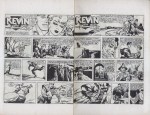
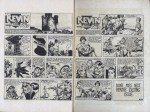
The Tit-Bits covers repurposed art from its variety of source material, and frequently used comics. “Kevin” was featured — generally in cases when it had dramatic double-decked illustrations. (Covers are shown with corresponding original Sunday comics).

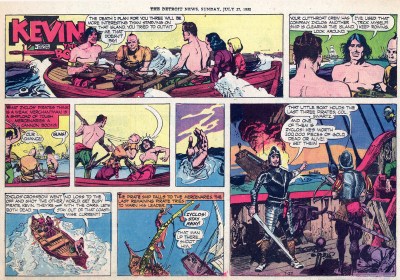
KTB Tit-Bits cover5 Ship SQKTB 072752 HF 100 QCC

KTB Tit-Bits cover3 R SQKTB 122852 HF 100 QCC

KTB Tit-Bits cover1 Bear SQKTB 080253 HF 100 QCC

KTB Tit-Bits Cover4 Kite SQKTB 091353 HF 100 QCC.jpg

KTB Tit-Bits cover2 Sword SQKTB 050954 HF 100 QCC

Looking at the five originals above, I’m reminded of other comics where Collins used similar devices or poses. The first two have echoes of throwaway panels from some of the earliest KTBs.

throwaway echos

At left, an earlier drowning victim (December 3, 1950). At far right, from the KTB debut strip,  Moya McCoy displays similar form to the damsel in the red dress.

Based on the publication dates of the Argentine monthlies (and the dates the comics originally ran), I’d speculate that each issue would contain four to six episodes of any given comic. The comics ran in a tabloid format, but in a much smaller size, with other stories wrapping around them on the pages.

Though many are currently listed on eBay, I haven’t seen any physical copies of these publications — the shipping costs put them out of my price range. However, I did spring for a rather unique full-page illustration from Tit-Bits. It shows a trussed up Moya McCoy, as she is being kidnapped by Moors. The artwork is from KTB’s opening sequence, and I will begin running that chapter in four installments starting next Sunday.
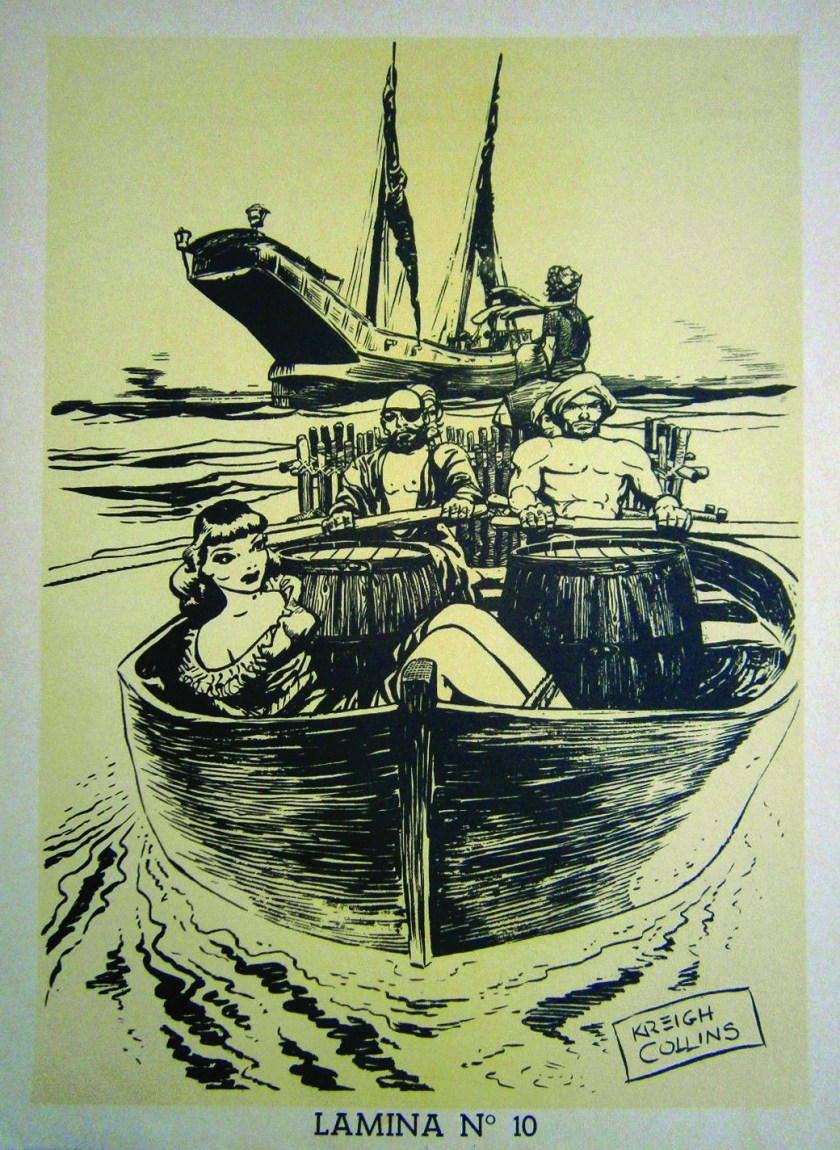
KTC Moya McCoy bound 111950 qcc

Nothing to see here — just a little pre-Code bondage!

Pt. 4: Stub ex machina

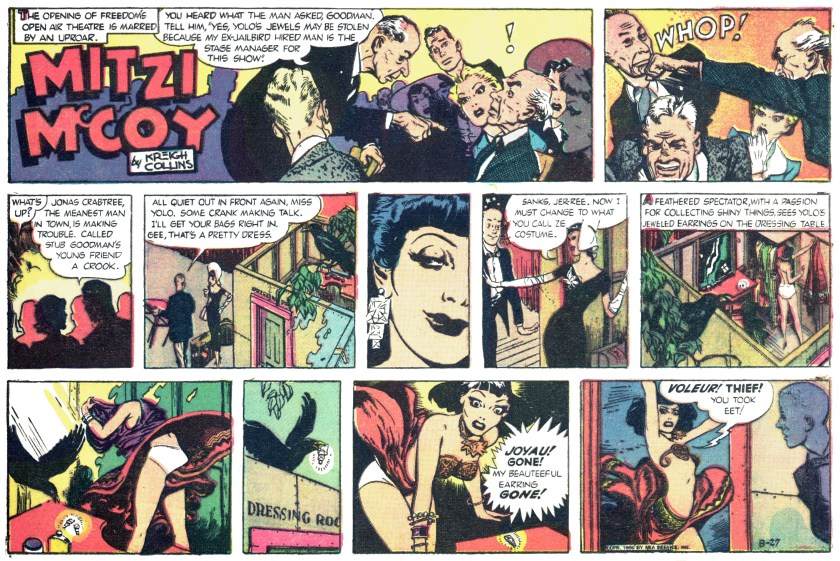
Though these past few “Mitzi McCoy” posts feature rather unique black and white one-third pages, last week’s final comic was quite titillating and deserves to be seen in full color.

MM 082750 300 cc wbg

Yolo’s beautiful and valuable earring has been stolen and it seems that poor Jerry is going to take the fall. Stub Goodman is determined to get to the bottom of the things, and comes up with a plan where he lives up to his surname — even if it means a little blackmail and tampering with a crime scene.

MM090250 BW TH cc

MM090950 BW TH cc

MM091650 BW TH cc

In the end, Jerry is exonerated. Stub fools everyone — except Mitzi. However, in two weeks, it will all be over as “Mitzi” is about to morph into “Kevin the Bold.” Goodman, who first appeared in the prototype comic “Tom Match and Stub,” was liked enough by Collins that he would reappear in the new comic as Kevin’s squire.

Pt. 3: Eye Appeal

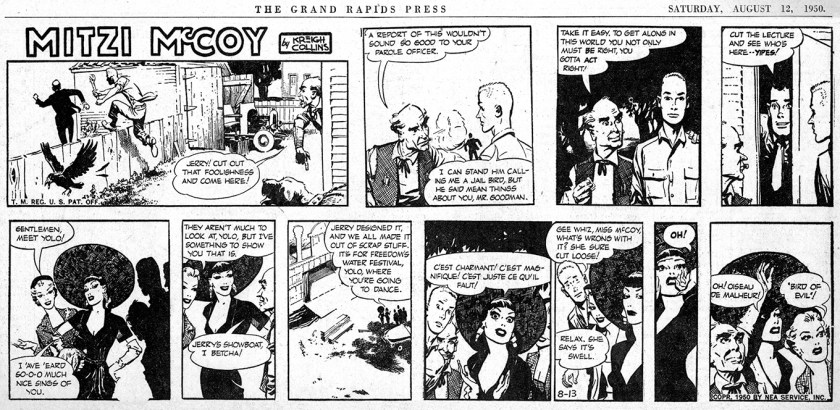
The mood shifts again as the beautiful Yolo meets the staff of the Freedom Clarion. Mitzi McCoy had met Yolo while travelling to Fez with her father, and now the McCoys are hosting Yolo during her stay in Freedom. Meanwhile, Jerry has built a fine stage for Yolo’s dance performance. The benefit for a new waterfront park promised to be the town’s social event of the season.

The tension mounts quickly as an agitated and evidently left-handed Stub clobbers Jonas. A temporary open-air dressing room gives an intimate view of Yolo as she readies for her performance and disaster strikes as some of Yolo’s jewelry goes missing.

MM081250 BW TH cc 100MM081950 BW TH cc 100MM082650 BW TH cc 100

Pt. 2: Darkness sets in

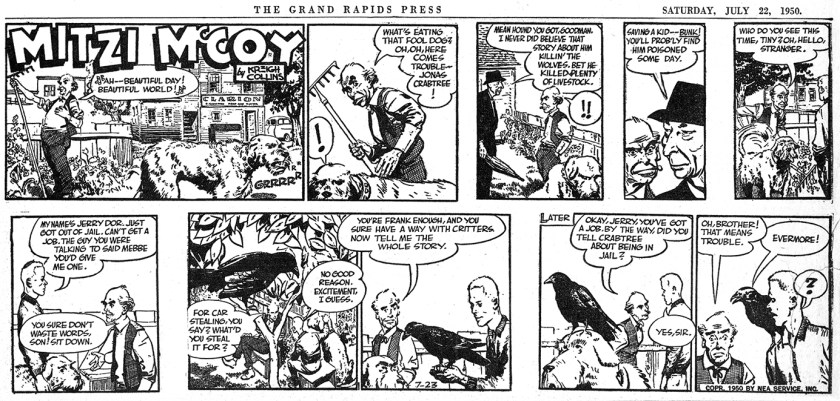
After the humor of the past two weeks’ transitional comics, a darkness sets in over Freedom as a new character is introduced. Jonas Crabtree, the “meanest man in town,” expresses his doubts to Stub about Tiny having saved a little girl from attack by wolves (in a previous sequence). He wishes the worst on Goodman’s Irish wolfhound.

Also introduced is the animal-loving ex-con Jerry Dor. After hearing his story, Stub puts him to work as stage manager for Yolo’s upcoming benefit performance. Danger comes Tiny’s way and Crabtree begins menacing Jerry, who shows a quick temper in defending his patron, editor Stub Goodman.

MM072250 BW TH cc 100MM072950 BW TH cc 100MM080550 BW TH cc 100

An interesting detail in these strips shows that in the time between the July 22 & 29 comics, Stub has returned the bantam car and gotten his hot rod back from the shop.

Yolo, Part 1

Following a week-long promotional blitz (see December 6, 2015 post), “Mitzi McCoy” finally launched in the Grand Rapids Press, Kreigh Collins’s local paper. It appeared on Saturdays, running in black and white as a one-third pager. The timing was a bit awkward as plans were already in place for “Mitzi” to transition into “Kevin the Bold.” Nonetheless, appearing in an additional newspaper meant more revenue for Collins.

The promotional ads promised adventure, dramatic artwork and eye appeal and Kreigh delivered on all counts (and then some). The strip’s last full sequence featured Yolo, a Moroccan beauty who was headed to Hollywood. As the Yolo character is introduced, editor Stub Goodman is taking his car in to the shop.

Tellingly, Stub’s mechanic lives “way out in Ada,” the town in which Kreigh Collins had built his home. These two comics served as a light-hearted, humorous transition between the thrilling conclusion of the previous sequence (The Counterfeiters, in which Stub’s old hot rod had taken quite a beating) and the drama that was yet to come in the next ten comics.

MM070850 BW TH cc 100MM071550 BW TH cc 100

A cute detail in the fourth panel of the July 8 comic shows a puppy sitting by Tiny’s side and looking on in admiration. The July 15 comic has an appearance by Clancy, a recurring policeman character whom has taken exception to Stub’s driving.

Kevin the Scandinavian

SeriemagasinetSolohaefte_1975_23  KTC Tom Mix Comicbook cvr.jpg

At some point in the 1970s, “Kevin the Bold” was published for a market in Norway. I have no information about the comic book shown (above, left) other than his new sobriquet translates as “fearless.”

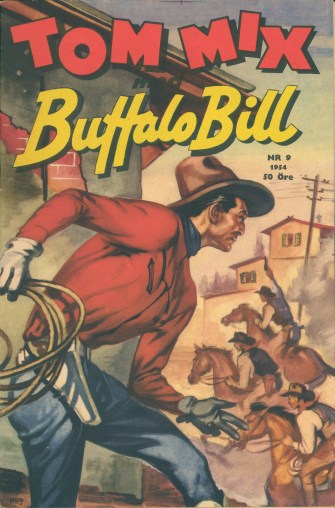
Another European market for American golden- and silver-age comics was Sweden. The wild west was a uniquely American subject that appealed enough for a comic to be assembled from various western-themed sources. Dating from 1953, the comics inside the beautifully-printed “Tom Mix with Buffalo Bill” ranged from classics (“Tom Mix,” “Frisco Kid,” “Buffalo Bill,” and “Lash LaRue”), to dense one-pagers (“De Dog Med Stövlarna På” [translation: They Died with their Boots On] and “Slaget vid [Battle of] Little Big Horn”) to the forgettable (“Ugh,” a silent comic featuring a native American girl). Also included, rather inexplicably, was “Kevin the Bold.” Maybe the comic’s connecting theme wasn’t the wild west — perhaps it was horses. At any rate, “Kevin” was the only American comic renamed in Swedish (here called “Roland den Djärve” — which indeed translates to “bold”.

KTC CB p02-03

The “Kevin” sequence covers three and a half comics that ran at the tail end of 1951 — a memorable sequence where Kevin fights Baron von Blunt to the death. Interestingly, the comics aren’t simply reprints of tabloid pages. The artwork has been edited quite a bit. Throwaways aren’t the only panels that disappear, and a few other panels are expanded with line work that isn’t a very convincing imitation of Kreigh’s. The comic ends abruptly — in fact, the next one in the sequence (January 6, 1952) is a cliff-hanger (literally!).


Australian Editions, Part 2

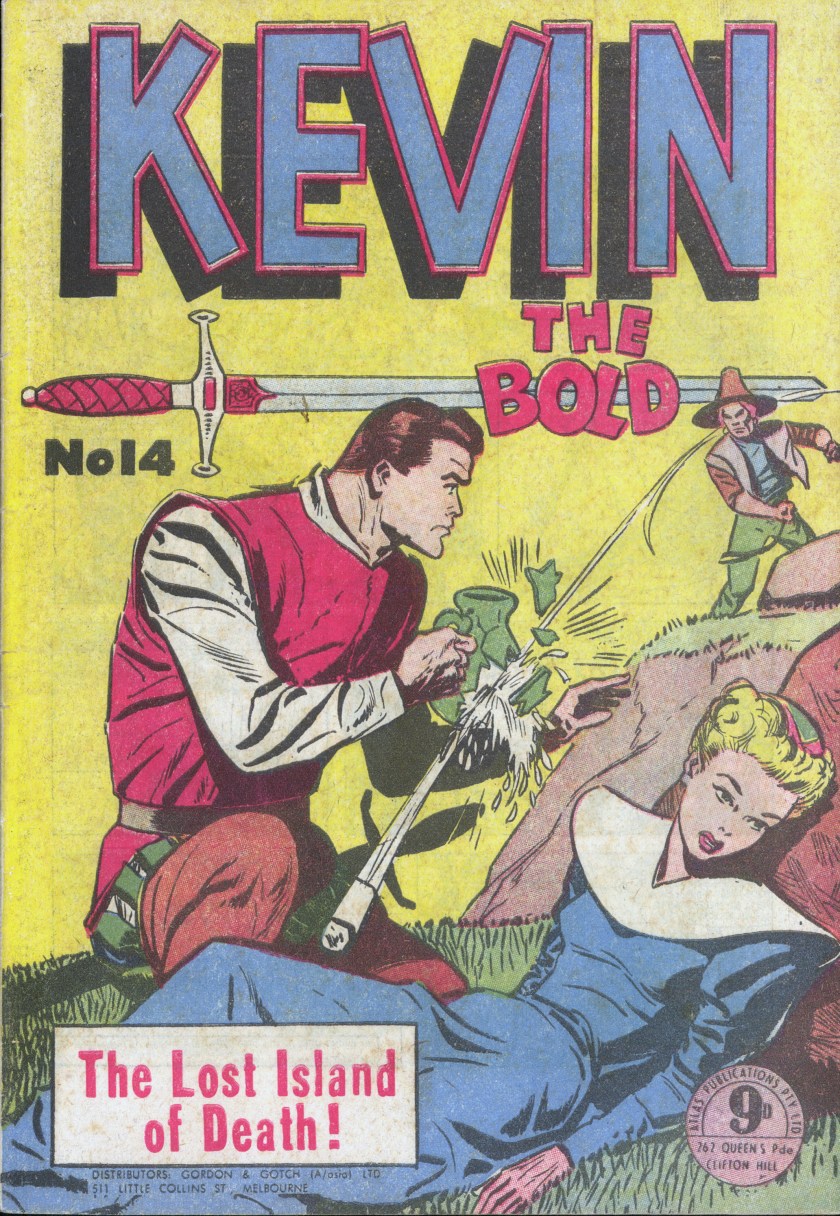
A third publisher of “Australian Edition” comic books was Atlas. The comics Atlas published came out later than those put out by Tip-Top and Thriller, and they seem to be better organized — the comics run in sequence without the randomness that occurred in some Tip-Top titles.

KTBCB 13 01 cover

The comics may run in sequence but the material in No. 13 (April 11–August 22, 1954) is older than that which is found in No. 14 (November 8, 1953–March 28, 1954). I found these titles on an eBay and was fortunate to win the lot of them for less than $20.00. They were listed by a seller in Australia, and don’t turn up very often — maybe once a year.

KTBCB 14 01 cover


Australian Editions, Part 1

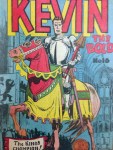
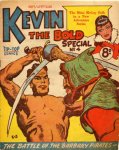
Many U.S. Golden Age comics were printed and distributed in Australia throughout the 1930s, 40s, and 50s. Tip-Top and Thriller were two publishers that first brought Kreigh Collins’s comics down under. Tip-Top No. 3 features later “Mitzi McCoy” comics, and No. 4 covers the opening sequence of “Kevin the Bold.” I’m not sure which comics are found inside the pages of No. 5; No. 6 has a hodge-podge of “Mitzi” (from 1949–50) and “Kevin” (1952) with no logical sequencing. Apparently the target demographic wasn’t overly concerned with continuity. The 24-page books would typically feature 20 Sundays’ worth of tabloid versions of the comics, plus the cover and a couple pages of ads.

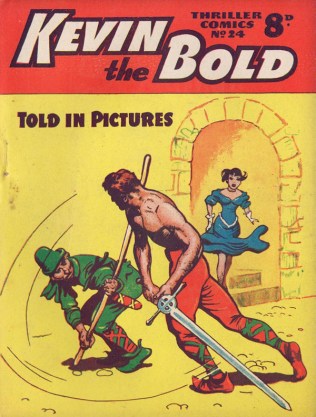
These “Australian Editions” are highly sought after due to their affordable prices and unique covers. The covers repurposed dramatic panels from the comics with backgrounds and dialogue eliminated (as shown in Thriller No. 24, which uses the opening panel from the December 24, 2950 “Kevin”).

KTB Comicbook 24LgKTB 122450 HA 72 P1

Foreign Tongues

When it was launched in 1948, “Mitzi McCoy” appeared in about three dozen newspapers. Nearly all were located in the United States, but two were from Canada — the Farmer from Winnipeg, Manitoba and Montreal’s La Patrie. Being situated in Quebec, “Mitzi” was translated into French and ran as the more Gallic-sounding “Mitzi Morot.” When the strip rebooted as “Kevin the Bold,” it continued to run in a translated form in the pages of La Patrie.

As the popularity of “Kevin” grew, its reach spread further and it was translated into other languages. Often, the comics ran after their original publishing dates, as was the case when “Kevin el Denodado” appeared in Argentina in a magazine called Tit-Bits. (Though it sounds like a girlie mag, it was actually the Argentinian version of an eponymous British weekly first published in 1881).

“Kevin” eventually made his way to South Africa and was translated into Afrikaans, as shown in this comic from 1965.

KTB 1965 09.12 afrikaans

The comic was also repackaged into comic books for overseas markets, and besides the relatively common examples from Australia, it was translated into Norwegian and Swedish for Scandinavian readers. (More on the comic books later).

[French “Mitzi Morot” and “Kevin the Bold” images at top of post courtesy of Encyclopédie de la Bande Dessinée de Journal au  Québec 1918-1988]