Happy Birthday

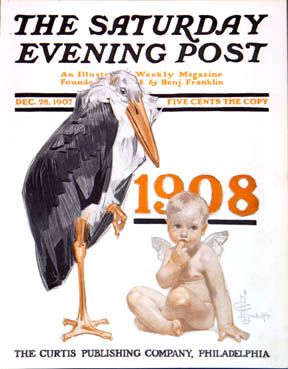
1908-saturday-evening-post-new-year

Kreigh Collins was born on New Year’s Day, 1908. As a baby he may have resembled the tyke on the Saturday Evening Post’s annual New Year’s cover, but he eventually grew up to be a large man — 6’3″ and 240 pounds.

Kreigh developed an interest in art and cartooning at an early age, and by the time he was about 11 years old, he was producing some rather fine work. His father served in the United States Army, and during the Great War, First Lieutenant Stephen Collins was stationed on the front lines in France. Germany was the enemy, and so it was that German soldiers played the fool in some of Kreigh’s early comics.

ktc-comic-fastest-runnerktc-comic-peace-terms

These comics are in the Local History collection of the Grand Rapids (Mich.) Public Library. Despite the horrors of World War I — trench warfare and the use of poisonous gas — it’s refreshing to see a more gentle take on the portrayal of our adversary.

Another cartoon seems to have been inspired by current events — likely the 1919 anarchist bombings or the 1920 Wall Street bombing. Approximately a year older than when he created the earlier cartoons, Kreigh had now advanced to a multiple-panel format.

KTC Comic Bomb Thrower.jpg

Some later drawings look like character studies, and appear to show a couple of British gents and a portly businessman. Two are nicely developed, and it seems Kreigh thought so too, as these were signed.

Our final comic is a two-panel job showing a clueless man strolling down the street reading a newspaper’s sports section. By this time, the Collins family had settled in Grand Rapids after living in various locales across the U.S. since Kreigh’s birth. Who knows, maybe Michiganders always made fun of those rubes from Toledo? A nice detail is the shading used in the second panel showing the subterranean darkness, and it’s interesting that the comic would still work today if a cell phone replaced the man’s newspaper.
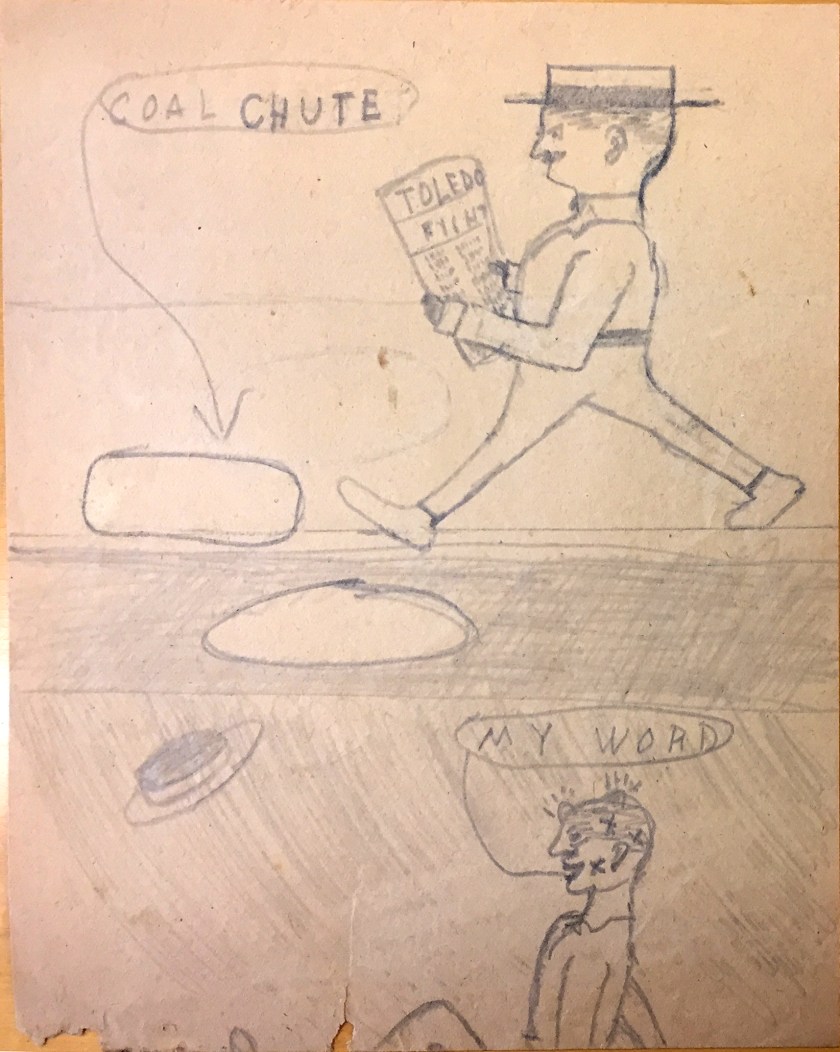
ktc-comic-holy-toledo

Happy New Year from the Kreigh’s Comics blog, and a happy 109th birthday to Kreigh Taylor Collins.

The Stoning of Stephen

In September, 1942, Kreigh Collins got a letter with some positive feedback on a job he did for one of his long-time clients, the Nashville-based Methodist Publishing House (MPH). In addition, the letter asked Kreigh to tackle a new project — illustrating a comic based on stories from the Bible.

An outline was included, and the editor’s instructions were purposefully vague (in order to give Collins plenty of leeway). A full page was requested, with six panels, featuring “as much action as a Superman comic.” The entire story was to be told in the characters’ speech balloons, with no explanatory captions.

A New York City publisher had started producing Bible comics, and they had approached the MPH to see if they would be interested in running them. If not, the New Yorkers planned to approach the Methodist Church directly. Not wanting to lose out on this business opportunity, the MPH turned to their favorite artist, Collins, and encouraged him to get right to work.

Three days later, in a letter accompanying his first sketch, Kreigh pointed out the difficulties of not using expository captions. Collins modified the outline in order to better set the scene, and added dialogue where appropriate. It also became apparent that the outline covered too much material for one comic. However, the suits at the MPH were pleased with the results, and after hiring a writer, the series began to take shape. The comic would appear in the weekly publication “Boys Today” and Collins would earn $75 per episode.

First dubbed “Pioneers of the Bible,” the series’ official title became “Stories from the Bible.” Work began in earnest for Collins in March, 1943, and by May he had finished the first nine comics. The editors were very pleased and felt the work far surpassed the perceived competition from New York. By July, the series had begun to generate fan mail.

The opening sequence was called “The Adventures of Paul the Apostle,” and the first comic told the story of the stoning of Stephen.

1943-bps-01-sketch-72

An early “sketch” clearly shows that it was a work in progress, despite the startling level of finish. The series title was tentative, as were the dimensions the comic would have. This illustration was dated February 10–12, 1943.


1943-bps-01-finish-72

“Adventures of Paul the Apostle, Number 1” Final version

Next week, a seasonally-appropriate sequence will begin, “The Story of Mary.”

Recycling

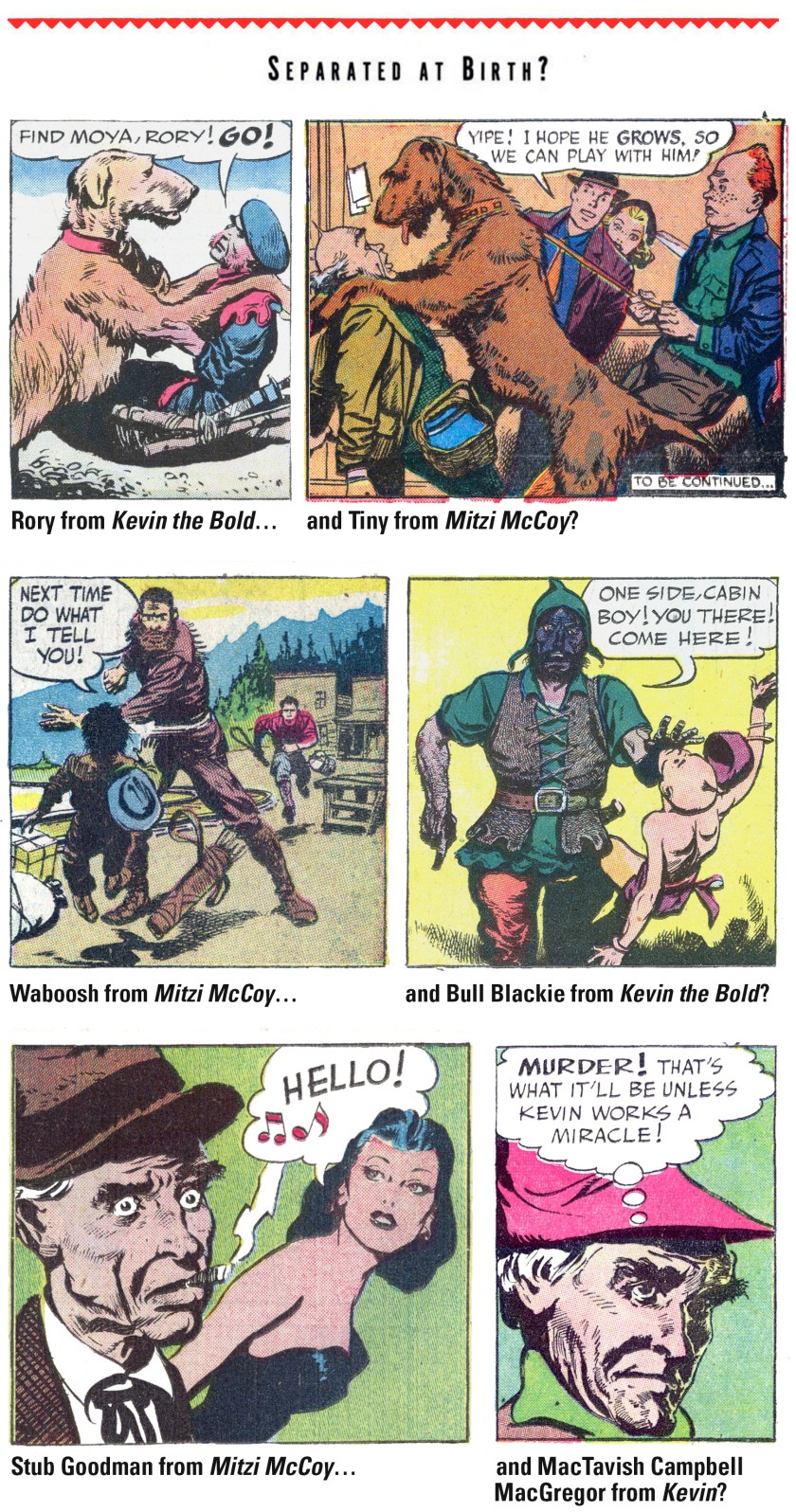
I started my professional career as a graphic designer in 1987. Like a lot of young people in the publishing industry, I was a big fan of Spy magazine. Spy was a satirical monthly that ran from 1986 to the mid-90s and was based in New York City, like me. There were plenty of interesting components of the magazine, among them “Separated at Birth.” It wasn’t a high-brow feature, and no doubt it’s been parodied to death.

Kreigh Collins often had characters that were inspired by ones from his previous comics. Occasionally ideas were recycled too, but these are examples of the former.

Separated 1-3

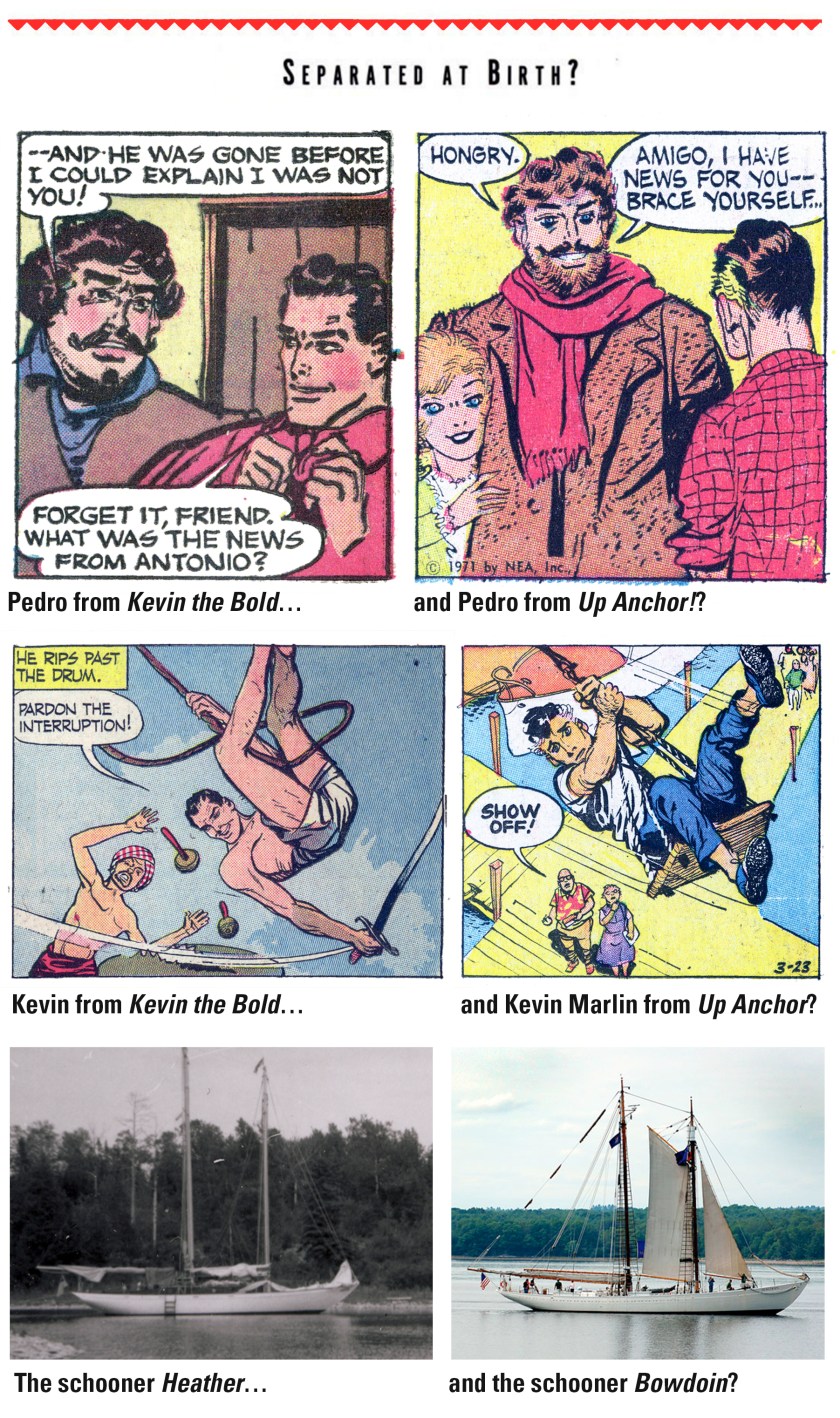
These examples might not be as elegant as those found in Spy, but they are still pretty interesting. Sometimes it wasn’t so much a recurring character as it was an object.

Separated 4-6

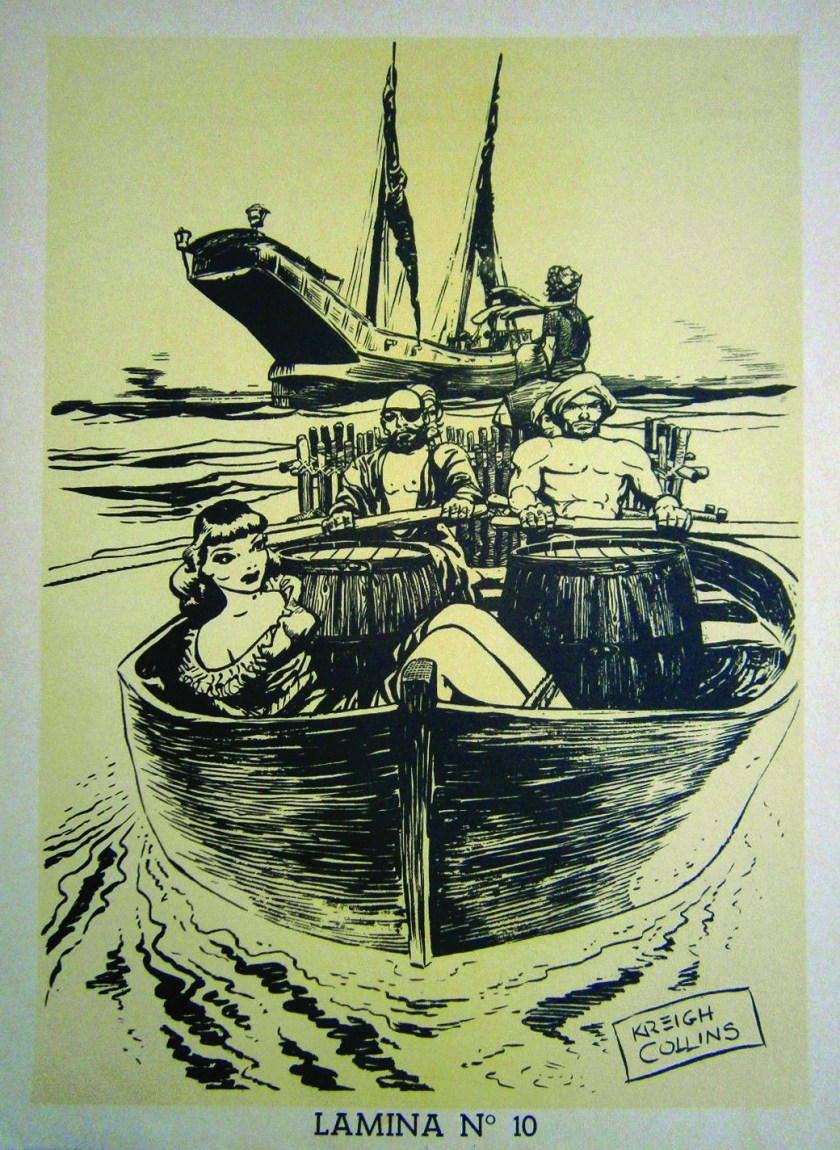
“Up Anchor!,” Kreigh’s final comic, was set aboard a representation of his own boat, the 45-foot long Heather. The Bowdoin didn’t feature in any of Kreigh’s comics, but the historic 88-foot long schooner was the design upon which the half-size Heather was based.

Uniquely designed for Arctic exploration, the Bowdoin was launched in 1921.Under the direction of skipper Donald B. MacMillan, it made dozens of trips above the Arctic Circle. Earlier, MacMillan had accompanied Robert Peary on his historic expedition to the North Pole in 1909.

Kreigh’s wife Theresa described how Heather came to be in the article she wrote, and which Kreigh illustrated, “The Wake of the Heather.”

When [Arctic] explorations were in the forefront of the news, a Chicago doctor wrote to the ship’s designer and asked him to design a half-sized schooner, built as she was and able to go anywhere and do anything. The doctor died two years after his boat was launched in 1927, and the superbly built schooner passed on to a succession of owners until we bought her twelve years ago. This is our Heather, little sister of the Bowdoin.

Kreigh and Teddy met MacMillan at Mystic Seaport in the summer of 1966. They had known of Heather’s parentage, and had sought out the Bowdoin. The 92-year-old MacMillan, a rear admiral in the Naval Reserve, invited the couple to dine with him and his wife aboard their boat.

Kreigh and his family sailed Heather for nearly 15 years, and she lived up to her go-anywhere, do-anything billing. Among the places they took her were all of the Great Lakes, the Erie Canal, the Hudson River, New York harbor, Long Island Sound, the Cape Cod Canal, Maine, the Bay of Fundy; and the Inter-coastal Waterway, Florida, the Gulf of Mexico and the Mississippi River. I’m not sure if they ever made it to the Bahamas, as a late-1950s newspaper article mentioned, but they certainly covered a lot of water.

Winning the Bet

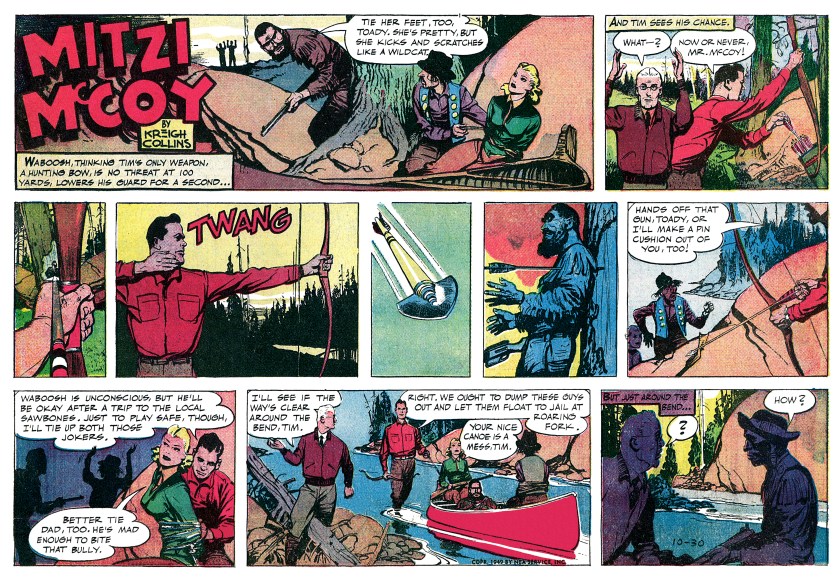
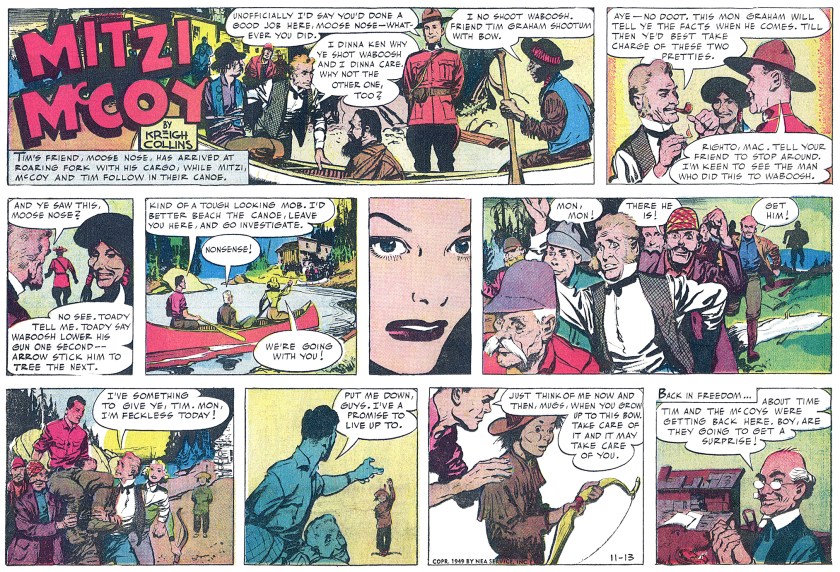
Having come to the north woods to win a bet, Tim has found no time for bear hunting. It’s a good thing that he has been keeping his archery skills sharp, as he does finally get a chance to use his bow.

MM 103049 300 cc wbg.jpg

With the accuracy he had displayed twice before, Tim takes a 100-yard shot and pins Waboosh to a tree with an arrow seemingly straight through his heart. It’s grim stuff for the comic strip, but it turns out that Waboosh’s wound is not fatal. And just as the tension eases, Mr. McCoy is startled by another gun-toting local.

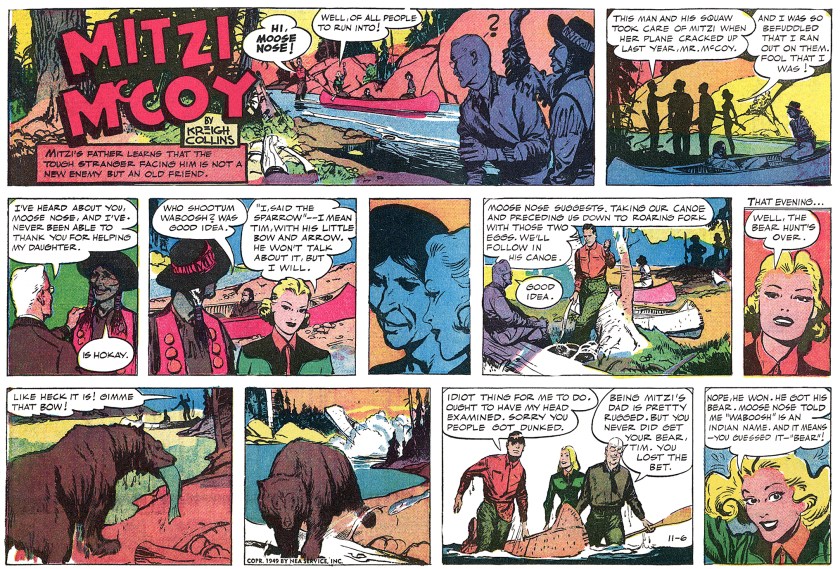
MM 110649 150 cc wbg.jpg

MM 111349 150 cc wbg.jpg

The “Bow and Arrow Bear Hunt” sequence ends neatly, with a chance encounter with an old friend, loose ends being tied up, and the final payment on a debt. “Mitzi McCoy” was hitting its stride nicely as it was about to transition into its most significant chapter to date, “The Christmas Story.”

The Hunt Begins

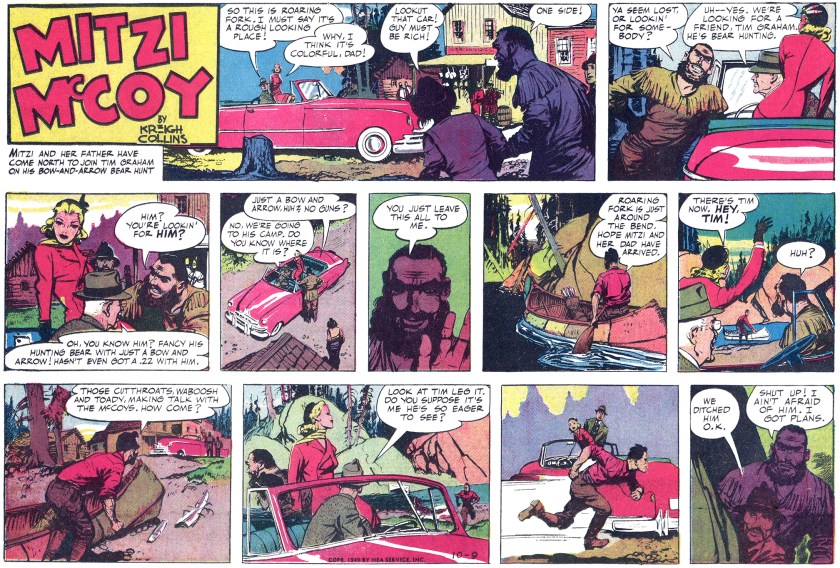
Features director “East” Lynn was no doubt glad to see Mitzi reappear in Kreigh’s illustrations. In correspondence with his artist, he reminds Collins to portray the heroine in flattering poses, and raved about her “equipment… facial, pectoral and callipygian.” However, Waboosh has also taken notice of her arrival in Roaring Fork, and the stage is set for further conflict.

MM 100949 150 cc wbg

MM 101649 150 wbg

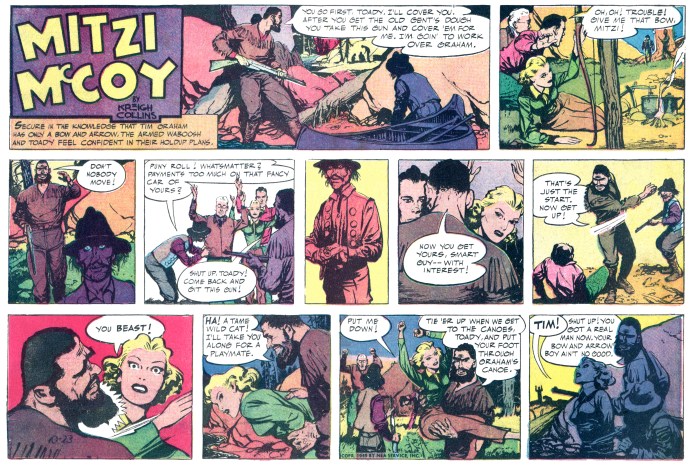
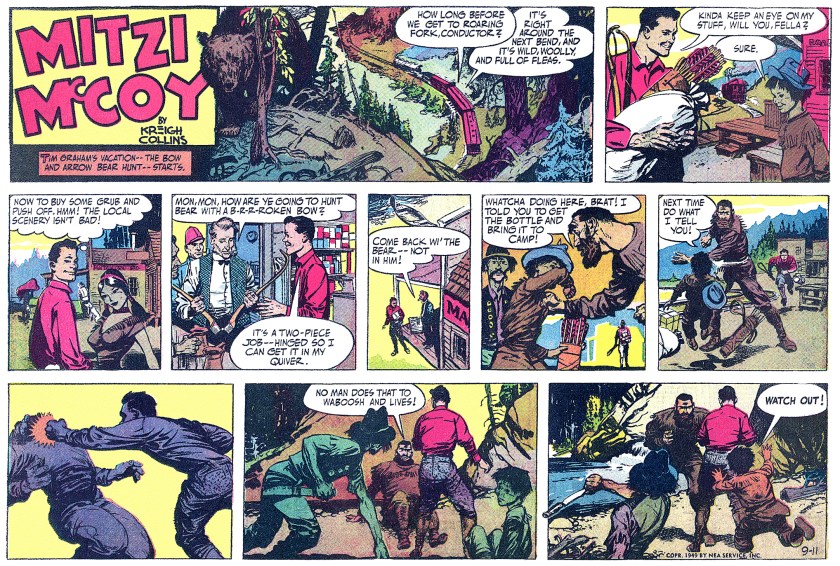
Coming to the north woods to hunt bears with a bow has left Tim and the McCoys at a disadvantage when confronted by Waboosh and Toadie. In the October 23 comic, things look especially dire as Waboosh kidnaps Mitzi at gunpoint.

MM 102349 300 wbg

October 23, 1949: click comic to enlarge.

A Close Shave

“Mitzi McCoy” was designed to have plot lines that could be carried by any of its main characters — Mitzi, Stub Goodman or Tim Graham. In this case, Tim grabs the spotlight, as he is the only regular character appearing in a string of four episodes. “Mitzi” also promised lively adventure, romance and human interest, and with Tim leading the way, the action veers into violence for the first time since Stub Goodman bounced Phil Rathbone from the offices of the Freedom Clarion.

Another strategy “Mitzi”used was to create new characters that would reflect various demographics it was trying to reach as it tried to grow its audience. A previous sequence had brought aboard young Dick Dixon, and Lynn and Collins had discussed the possibility of adding a girl to the Bow and Arrow Bear Hunt chapter. It was decided that a later sequence would feature a schoolgirl, and last week’s comic introduced Mugs, a native boy defended by Tim.

MM 091849 150 cc wbg2

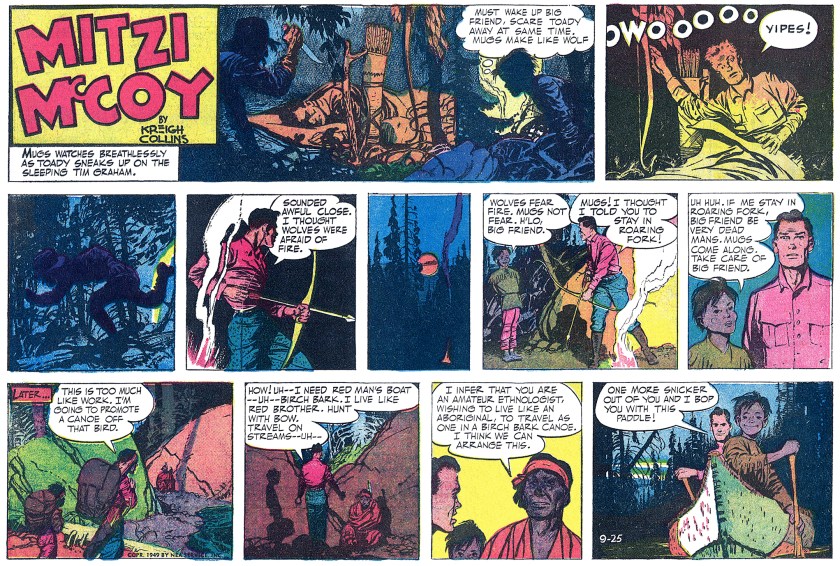
Fortunately for Tim, his unlikely ally Mugs returns the favor… in spades. Mugs saves Tim once and after being warned away, the boy lingers long enough to save Tim yet again. Later, while setting up camp, stereotypes are shattered and his bond with Mugs is sealed.

MM 092549 150 cc wbg

Perhaps reminding readers of the reason he had come to the north woods in the first place, Tim puts on an exhibition of his archery skills for his young friend. The October 2, 1949 comic also features some clever survival skills employed by Mugs. This comic proved to be very popular with Kreigh’s test audience (sons Erik and David, ages eleven and nine). In the final panel, an attractive young native woman heralds the return of the comic’s usual eye appeal, as Mitzi and her father have been summoned to Roaring Fork.

MM 100249 300 cc wbg

The Bow and Arrow Bear Hunt

Working with his usual three-month lead time, Kreigh Collins sent his initial story outline to NEA features director Ernest Lynn in mid-May. By this time, after having worked so closely over the past year, the two men had become good friends. Having heard that Ernest’s wife was sick, Kreigh’s wife Teddy had sent her a pair of gloves. By now, Ernest used his nickname, “East,” to sign his letters to Collins.

“Mitzi McCoy”’s sixth sequence was timed to conclude during hunting season, in a bid for more traction with readers. It followed a very successful chapter on the history of the Irish Wolfhound, and wanting to keep his momentum, Kreigh led off with his most alluring illustration of Mitzi to date. Smiling broadly and showing more leg than would fit in the double-decker panel, Mitzi was ready for her close-up.

MM 082849 300 cc wbg

The August 28, 1949 offering is a pretty typical transitional comic, in that it’s light-hearted, humorous fare. True to his name, Stub Goodman stubbornly insists he knows all about archery — and of course he finds trouble.

MM 090449 150 cc wbg

In the following comic, Tim gets a chance to show off his skills; no doubt these will come in handy soon enough. Mr. McCoy proposes a bet and the stage is set for a change of scenery, including some new, rough-looking characters.

MM 091149 150 cc wbg2

There are also some other, more attractive characters shown, such as the “squaw” suggested by Lynn who is seen in the third panel. But where there is beauty, there is often ugliness, and Tim’s good intentions have placed him in danger.

Earning His Epithet

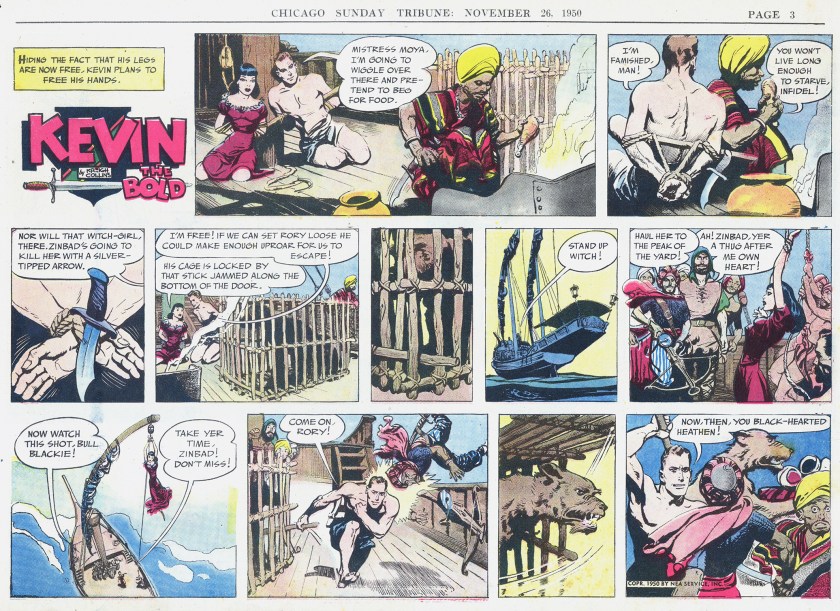
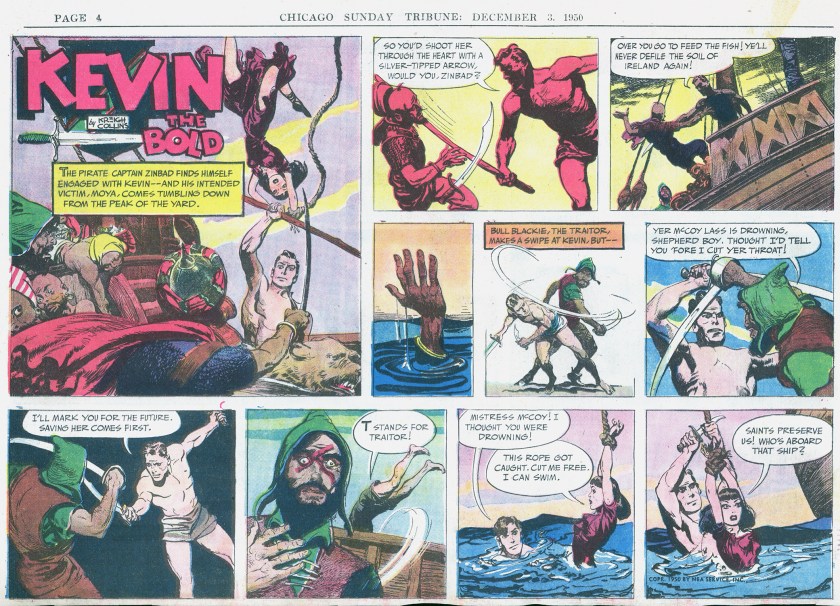
In this last part of the Moorish Pirates sequence, Kevin is determined to go down swinging, and he waits for the proper moment to make his move.

KTB 112650 HA 150 QCC

KTB 120350 HA 150 QCC

It’s a life and death situation on deck and overboard. Captain Zinbad is dispatched, but Bull Blackie’s life is spared. According to his code of honor, Kevin’s primary responsibility is to save those in danger. It’s unclear how the traitorous Bull Blackie escaped, and it seems he may have been spared in order to appear in future episodes of the comic.

KTB 121050 HA 150 QCC

Meanwhile, Rory took care of business aboard the pirate ship and cleared the decks of her crew. Moya’s grateful countrymen are freed as Kevin remains humble. As a reward for his bravery, the lord of  McCoy Castle presents Kevin with both an impressive trophy and a catchy moniker.

A Turn for the Worse

KTC Moya McCoy bound 111950 qccThe Moorish Pirates, part 3. With the aid of the Irish traitor Bull Blackie, Moorish pirates have been raiding the Irish coast, taking prisoners and selling them as slaves. Soon enough, the Pirates have scored quite a bounty. Despite fighting like wildcats (Moya) and dogs (Rory), all of our heroes have been captured — including Kevin.
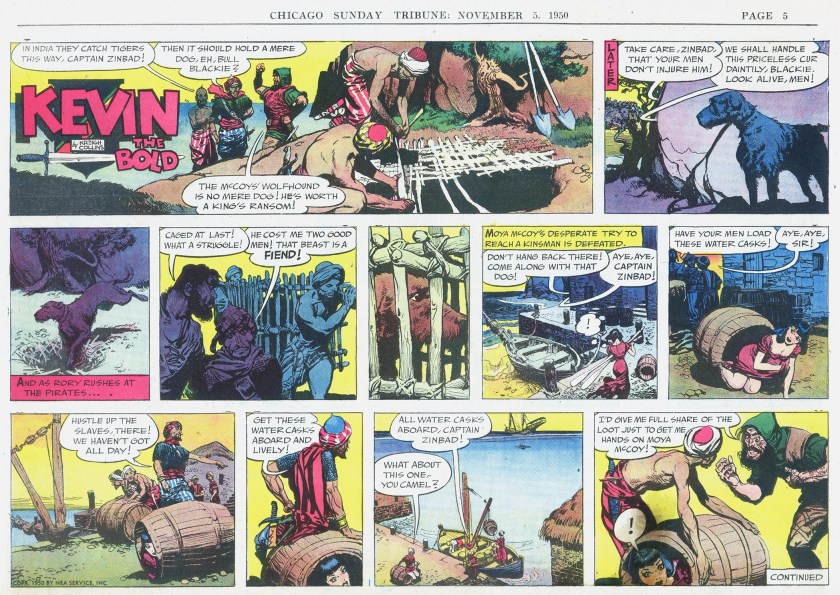
KTB 110550 HA 150 QCCKTB 111250 HA 150 QCC

KTB 111950 HA 150 QCC

The double-decked opener of the November 19, 1950 comic provided the artwork for the promotional illustration that appeared in Tit-Bits, at top.

The pirates decide that as a witch, Moya must be killed (not the only time witch-killing was portrayed in the strip). However, they soon learn of Kevin’s creativity and fierce determination to save those in peril, especially those he loves.

Colorful Characters

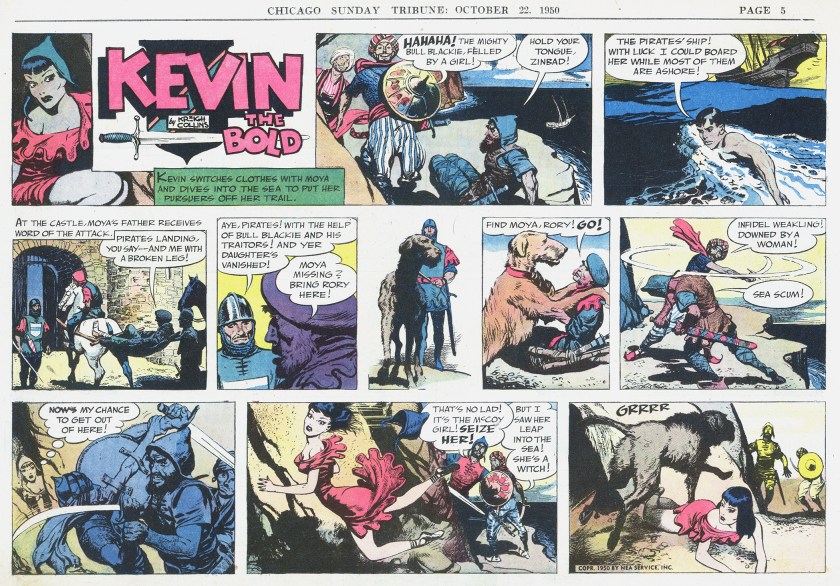
The third “Kevin” comic introduces the Irish traitor Bull Blackie — and includes cross-dressing and fight scenes. In the fourth episode we meet Rory the Irish Wolfhound, and in the fifth we see Kevin attempt to single-handedly capture a pirate ship.

KTB 101550 HA 150 QCC

Of course, the comics also feature fantastic artwork. There’s a nice high-angle perspective of the pirates’ ship, Moya showing off as many of her charms as she’s allowed to on Sundays, and some beautifully-composed panels (such as the fifth panel of the October 29 comic — there’s quite a bit of information packed into that frame!)

KTB 102250 HA 150 QCCKTB 102950 HA 150 QCC

For now, everyone is safe, but based on the events of these first five comics, no doubt there is danger ahead.