
Street fights, cat fights, and near-death experiences… typical Sunday fare for “Kevin the Bold.”
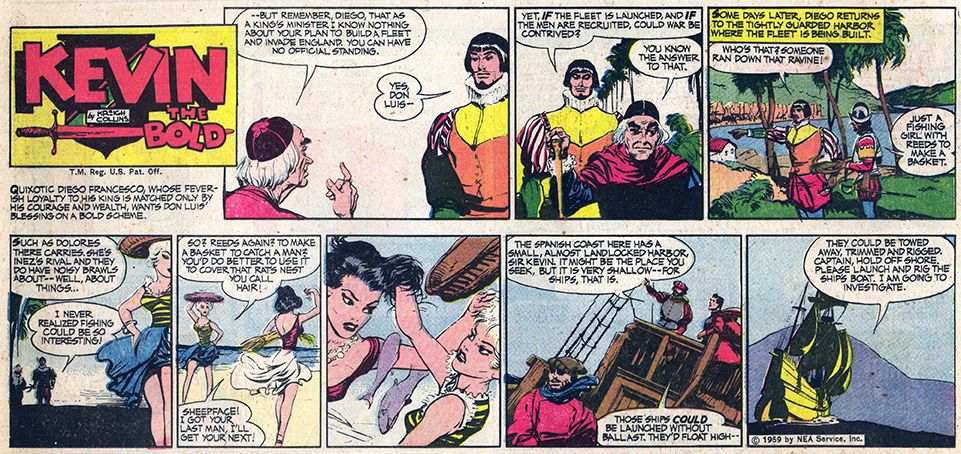
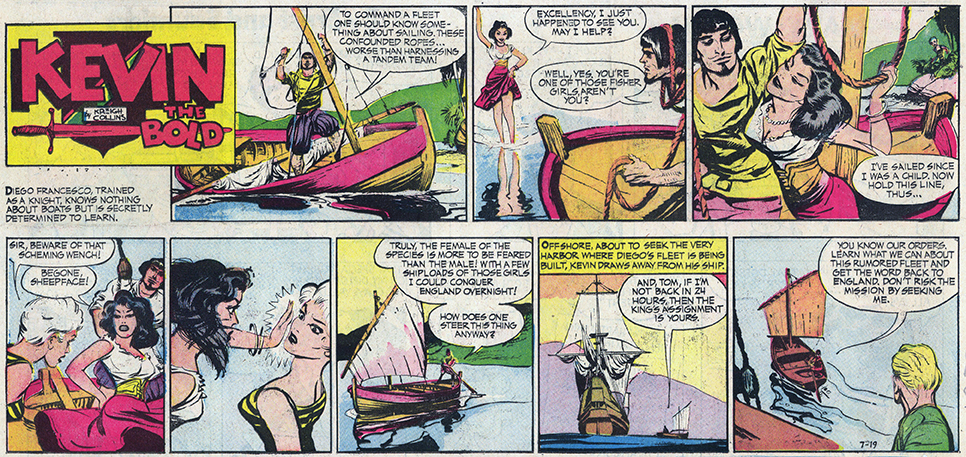


Street fights, cat fights, and near-death experiences… typical Sunday fare for “Kevin the Bold.”
Having received sealed orders from the King, Kevin seeks a comrade to help with the dangerous, vital task. Read on as the adventure continues.

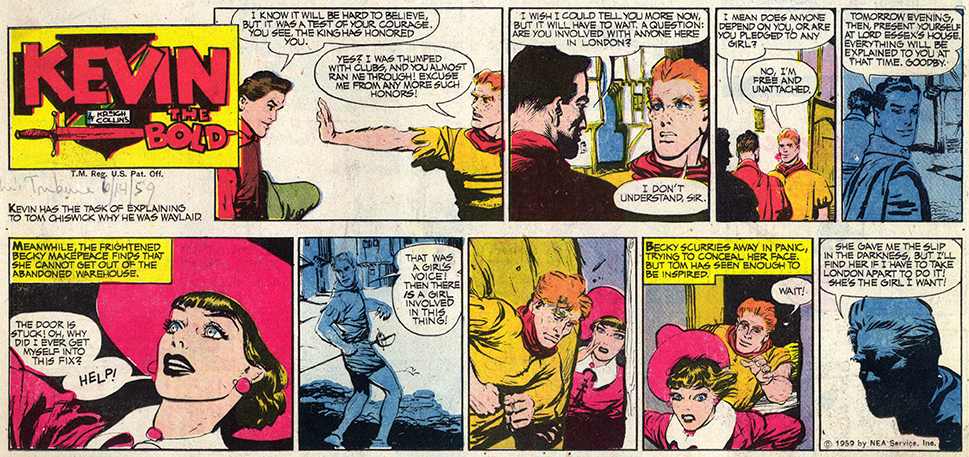


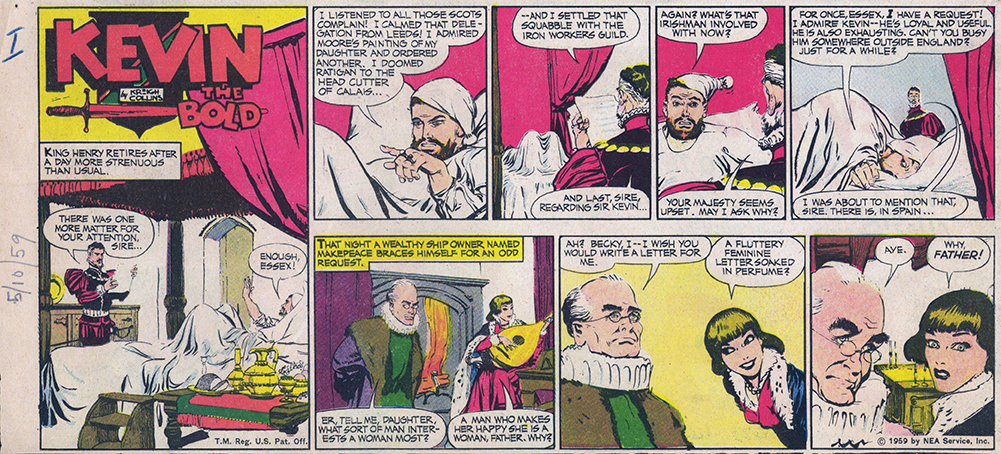
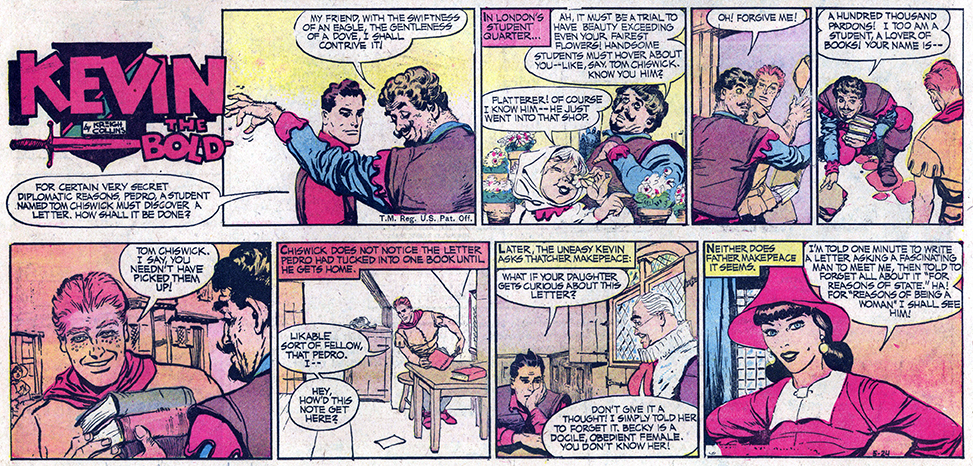
Kreigh’s NEA-syndicated comics, “Mitzi McCoy,” “Kevin the Bold” and “Up Anchor” each ran as serials. The individual storylines could be as short as six episodes, such as in “Mitzi,” or much longer, as was often the case with “Kevin.” The next few posts will feature a storyline from “Kevin” that ran from May to September, about halfway through the 18-year run of the comic. Unfortunately, these comics are third-pagers, but the story is highly entertaining. The first episode, from May 10, 1959 serves as the transition from the previous storyline to the new one.
The original comics are in decent shape, but they are rather yellowed due to exposure to sunlight (the mortal enemy of newsprint). The reason for this yellowing is that they came from Kreigh’s studio — they had been pinned up on the walls to allow him to keep track of continuity. (Note pinholes and Roman numeral “I” on the May 10 comic). The first three comics appear to be from the Detroit News, and the fourth one is from the Chicago Sunday Tribune, which generally had superior color reproductions.
I gave them a quick color correction to sharpen them up. Check in again next week as the story continues…



Common formats for Sunday strips include the half page, the one-third page, the tabloid page, and the half-tab. Usually, only the half-page format is complete, with the other formats dropping or cropping one or more panels. Such “throwaway” panels often contain material that is not vital to the main part of the strip. Collectors generally value half pages the most, since the other formats are incomplete by comparison. Half-tabs have approximately the same aspect ratio as half-page comics, so while their printed size is quite small (10″ x 7″ vs. 14″ x 10″ for half-pages), at least the reader sees all of the artwork. The half-page version of the October 27, 1957 episode of “Kevin the Bold” is shown above.
When Kreigh’s comics appeared in tabloid papers, the small center panel was generally the throwaway. When they appeared as one-third pages, severe cropping could occur (in addition to losing the throwaway panel). The storyline would continue but the impact of the comic was lessened.
Below are tabloid and third-page versions of the same comic. In this case, Black Llewellyn’s scowl is the throwaway. Too bad! And in the third-pager, each panel is cropped both left and right.


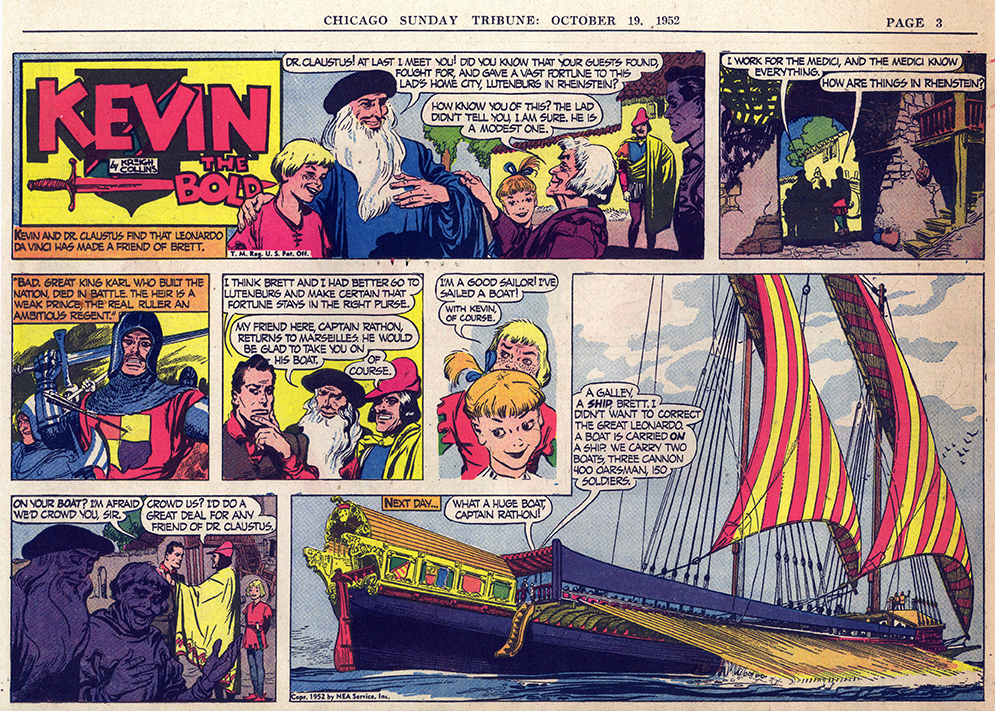
At bottom, examples of the “Kevin” that ran on October 19, 1952 show an even more unfortunate example of the cropping that could occur. (This strip also has an appearance by Leonardo Da Vinci. Leonardo would also show up toward the end of “Kevin” ’s run, in 1967).

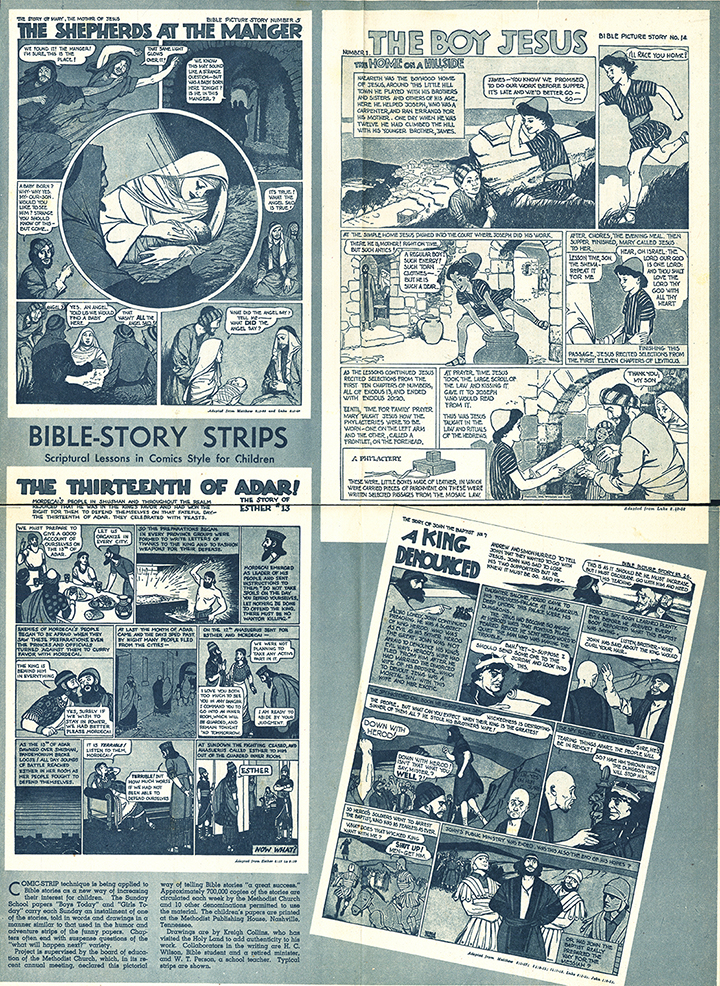
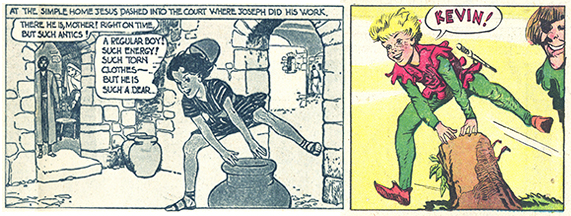
Before creating his NEA-syndicated comics, Kreigh Collins took all sorts of painting and illustration commissions; he also wrote and illustrated books. He found steady illustration work with religious publishers, including Pilgrim Press (“These Men Knew God,” from 1947), the Fideler Company (1948’s “Bible Days”) and The Graded Press (“The Story in the Bible,” 1949), among others. For Nashville’s Methodist Publishing House, he did comics which were reproduced in Sunday School brochures called “Boys Today” and “Girls Today.”
Comic-strip technique was being applied to religious stories in a new way in order to increase their appeal to children. The Methodist Church’s board of education declared this pictorial way of telling Bible stories a great success, and approximately 700,000 copies of the stories were circulated each week. Chapters often ended with suspense questions of the “what will happen next?” variety.
An item in the March 10, 1946 St. Louis Post-Dispatch (top) described the phenomenon and featured several of Kreigh’s comics. The blurb said that Collins had “visited the Holy Land to add authenticity to his work,” but it is more likely the authenticity was provided by hundreds of hours spend doing research at local libraries.
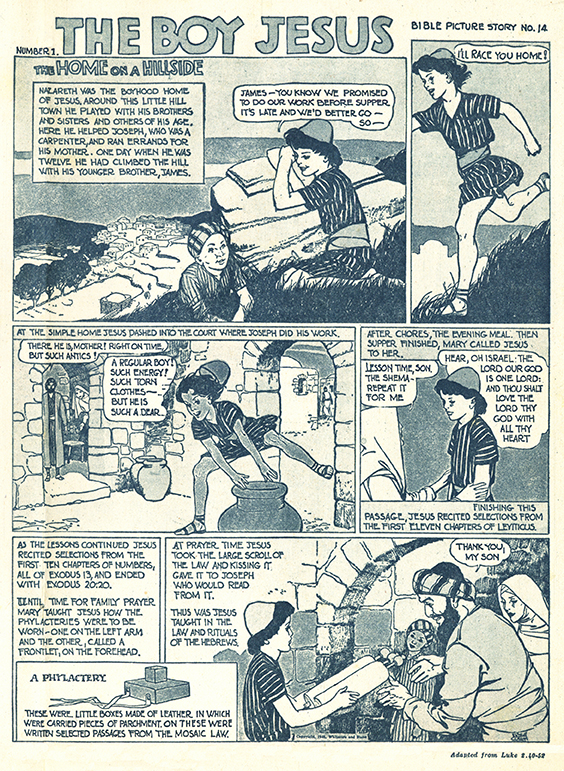
These early comics showed examples of Kreigh’s style and devices he would employ throughout his career. Note the distinctive lettering, the use of descriptive inset illustrations (above, a phylactery; below, a quintain), and even Jesus’s pose, as he leapfrogs the vase (compare to Brett, at bottom, from a 1955 Kevin).


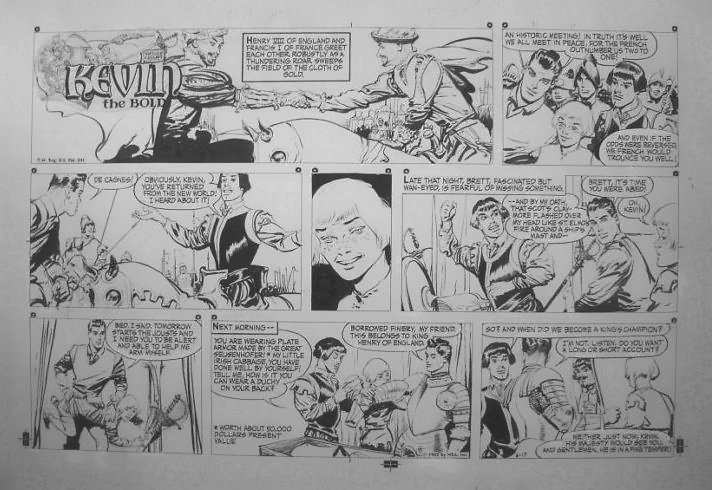
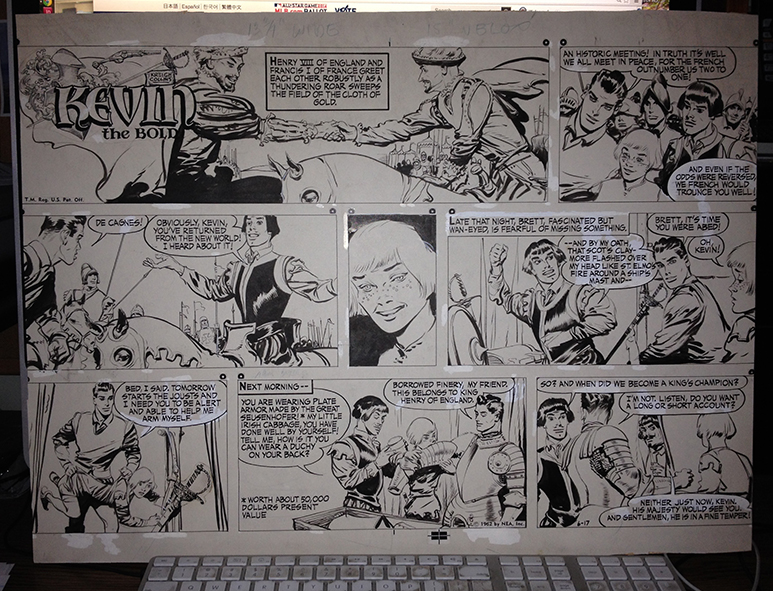
Original pieces of Kreigh Collins’s comic strip illustrations are quite amazing. They are large (drawn on 20 x 30″ illustration board), rich in detail, and interesting in other ways — corrected areas are readily apparent, stock elements are revealed to be pasted in, and instructions or notes are sometimes written in the margins. In the example shown above, Kreigh (my grandfather) personalized the illustration and gifted it to my other grandpa (“For Walt Palmer, May his trials be less than Kevin’s!”). Unfortunately, the art has a bit of wear and tear due to hanging on my brother’s bedroom wall through high school and college. He gets a pass as he shared a name with Kevin’s young ward — Brett accompanied Kevin on many of his adventures.
Originals can occasionally be found at auctions for a couple hundred dollars or so, depending on their condition. Another original I own was in quite nice shape when it was offered for sale about ten years ago. But by the time I won it on ebay in a later sale, its edges had been hacked down to fit into a cheap 18 x 24″ picture frame. I suppose its value has taken a hit, but I didn’t buy it as an investment. For me, it’s all about the family connection.
After illustrating 100 episodes of “Mitzi McCoy” and nearly 1,000 of “Kevin the Bold,” Kreigh Collins decided to create a new semi-autobiographical strip featuring the adventures of a sailing family.
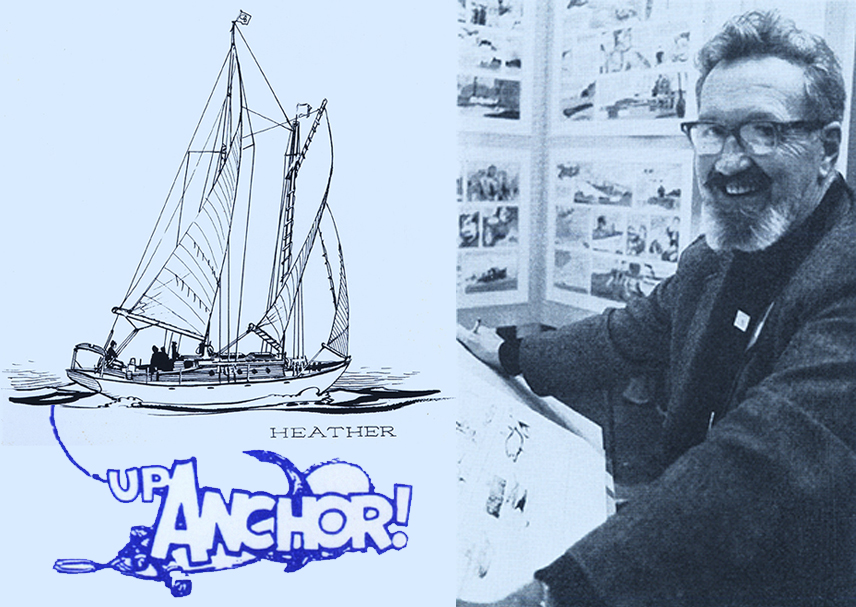
Kreigh Collins’ credentials to create and draw “Up Anchor,” America’s first color comic strip devoted to boating, are as bona fide as the burr on a thistle.
Collins is a sailor and for many years has skippered the family schooner Heather. Heather serves as a floating studio during the summer. Like most boaters, Kreigh started with a small sailing pram and graduated by degrees to the 47-foot Heather over a 30-year period. With Kreigh at the helm, Heather has plied the Great Lakes, the inland waterways of the mighty Mississippi, ridden out storms on the Gulf and found snug in Mystic, Conn. Home port is Ada, Mich.
The unique aspect of “Up Anchor” is that — unlike most Sunday comics — it is not fantasy. Kreigh conceived the idea for the strip on a family cruise. So the strip itself reflects real people in real situations.
Finding typical family situations afloat poses no problem for author Collins. Twin teen-age boys and wife Theresa (called Ted) provide a wealth of background for both the fun and serious sides of boating situations.
Through “Up Anchor,” Kreigh is trying to generate an appreciation of the sea, provide essential information for new converts to cruising pleasures — and, in fact, attract more people to this increasingly popular leisure time activity.
(from a promotional folder sent to newspapers upon the launch of “Up Anchor” in the fall of 1968).
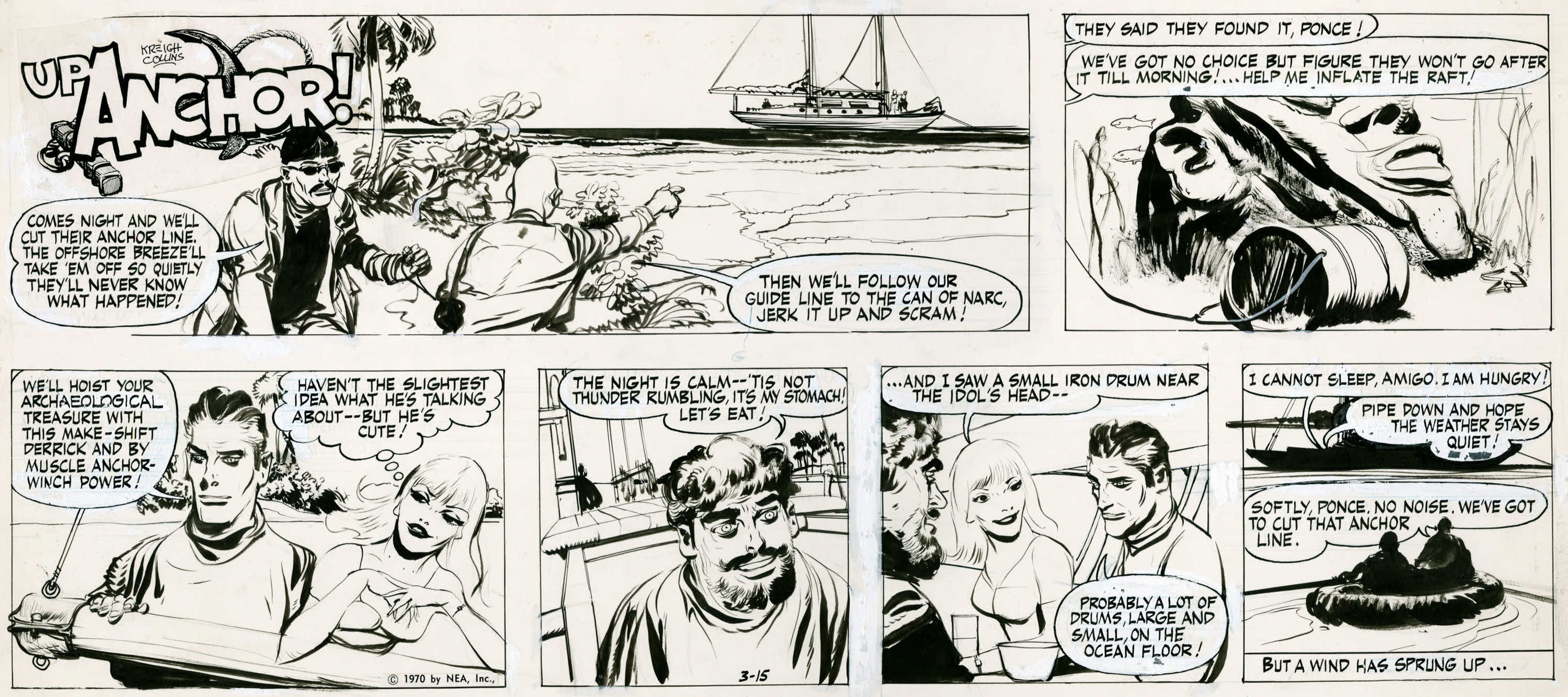 Above, “Up Anchor” from March 15, 1970.

One day at work, about a dozen years ago, I was asked if I could reprint a comic book cover (I worked in the art department, so we had the color printers). My co-worker collected comic books and he had bought one whose cover was missing. I mentioned how my grandfather had illustrated comics and the conversation led to where I could find used comics for sale. A week later, I was the proud owner of 105 “Kevin the Bold” half pages, 1955-56 complete, a great start to my collection. Unfortunately, they were from the Florida Times Union, a paper with poor-quality printing. Nonetheless, I was on my way. “Only” 838 more to go before I had the entire run.
Above, a half-page from January 16, 1955.

Kreigh Collins’s first comic strip was “Mitzi McCoy.” It premiered on November 7, 1948. Mitzi’s debut was appropriately dramatic — beautiful illustration and a runaway bride. This half-page ran in the Indianapolis Times. Collins obviously put a lot of time into the artwork, and the Times invested a lot of effort in a getting it to print so nicely. Cyan was used in addition to black for the speech balloons and most of the line work to create very rich blacks, and the registration is perfect, resulting in a nice crisp comic.
Along with Mitzi, the strip’s other two main characters (Stub Goodman and Tim Graham) were introduced, and I don’t think we’ve seen the last of that scoundrel Phil Rathbone.

This blog is dedicated to the comics created by my grandfather, Kreigh Collins. His NEA-syndicated comic strips were Mitzi McCoy (1948-1950), Kevin the Bold (1950-1968), and Up Anchor (1968-1972).
 Kreigh’s Comics