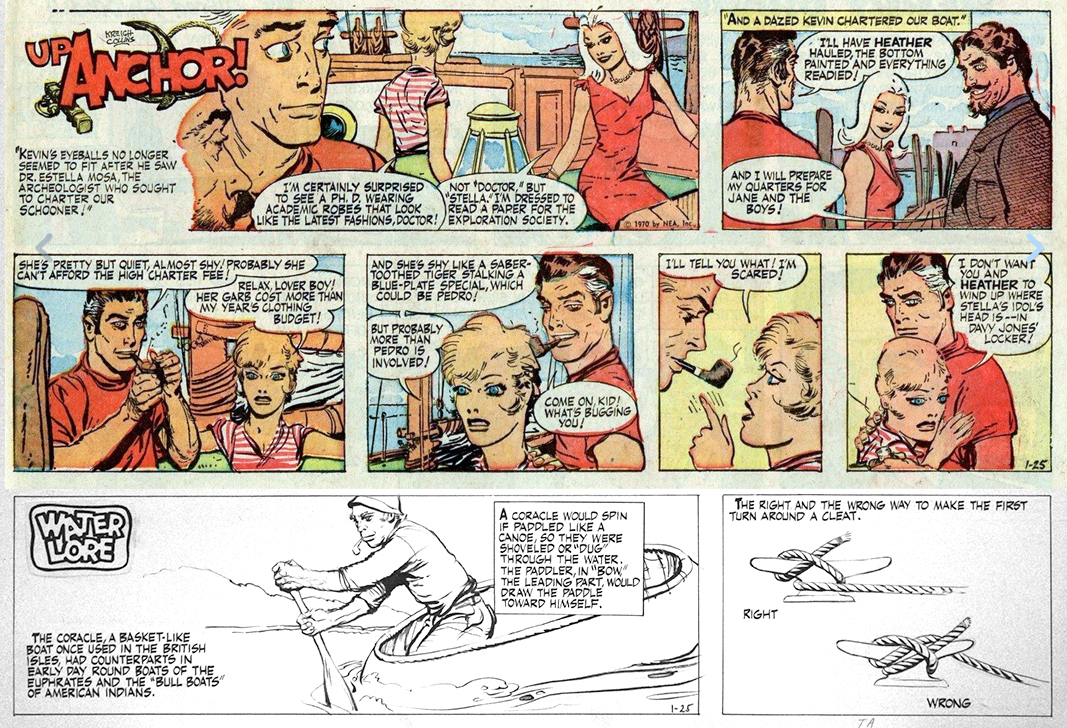
Pedro has found someone to charter Heather, and he introduces the prospective customer to Kevin Marlin—a lovely plot twist indeed.
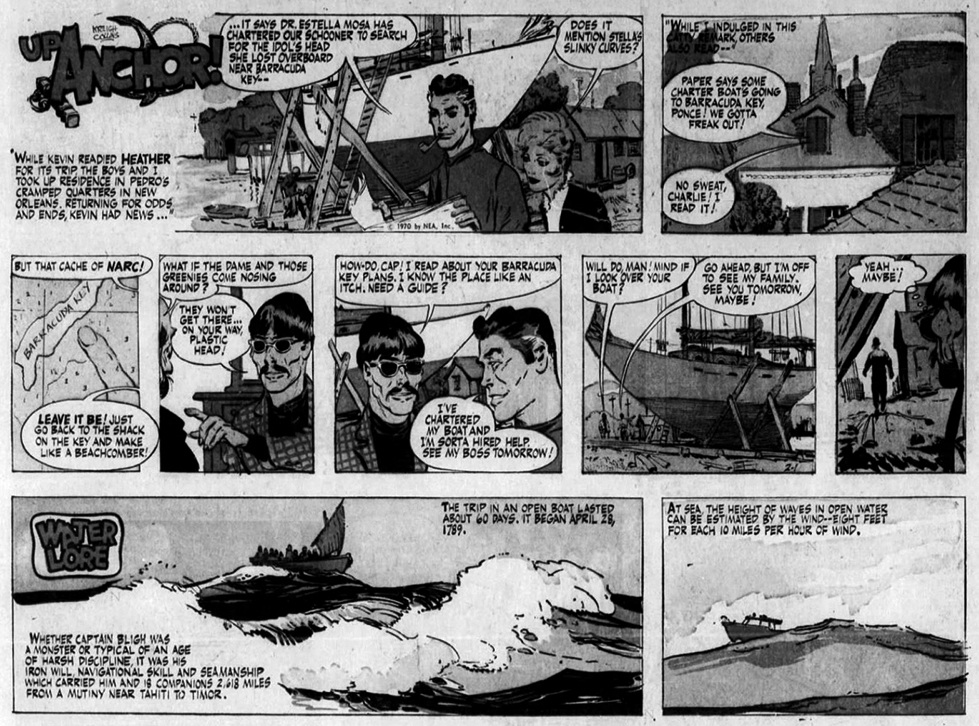
News of Heather’s upcoming charter reaches certain unsavory elements.
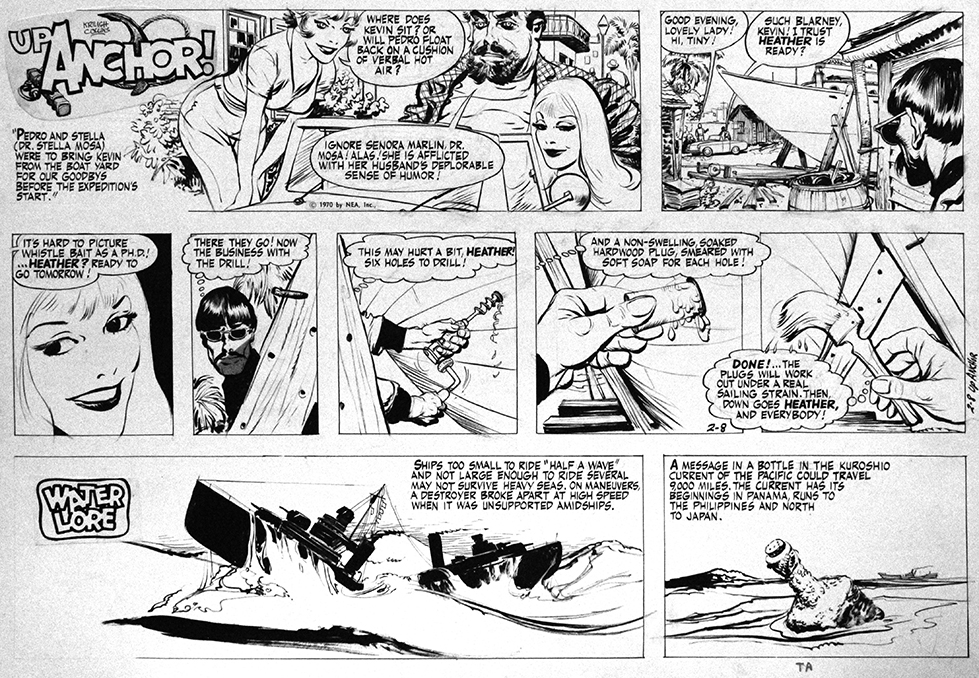
With Heatheron the hard, vulnerabilities are exposed.
It’s interesting to see “whistle bait” appear in the dialog (third panel)—that was the name of a song written in 1958 by 13-year-old Larry Collins of the Collins Kids. (Sadly—no relation). It’s 95 seconds of rockabilly heaven, and is arguably the first punk rock record ever. To my ears, it’s astonishing, but it’s impact is diminished by not being accompanied by live footage. To see the Collins Kids live, check out Hoy Hoy. Still don’t believe me? “They’re lip synching!”—then check out this live performance. Besides all that energy, Larry’s got some skills! He later earned a co-writing credit for a worldwide #1 hit, Helen Reddy’s Delta Dawn… but that’s a story for another blog.
Sailing has always been a popular hobby in my family. My grandfather owned a succession of boats, and for a number of years, so did my father. My dad was also fond of “improving” existing sailboat designs—using tracing paper and a pencil to refine designs seen in sailing magazines. He also built numerous small wooden craft, always starting with a scale model made from balsa wood. When I was in high school I recall him asking to use my scientific calculator to determine sail displacement/length ratios.
Displacement being the amount of volume a boat’s hull takes up that would otherwise be occupied by a water, and LWL representing the boat’s length at the waterline. You’ll have to ask one of my more boat-savvy family members for further explanation!
Uncle Kevin has had a boat for most of his adult life; he plies the waters of Lake Michigan each summer. As for my generation, the sailing bug didn’t bite me so hard—I’ve never owned a boat but am happy to be part of a crew. On the other hand, my brother (Brett), a boat-owning sailing enthusiast, recently arrived in the Virgin Islands to charter a 50-foot catamaran with some friends. Accordingly, I thought now would be a good time to switch things up and feature a chapter from my grandfather’s final NEA comic strip, UP ANCHOR!
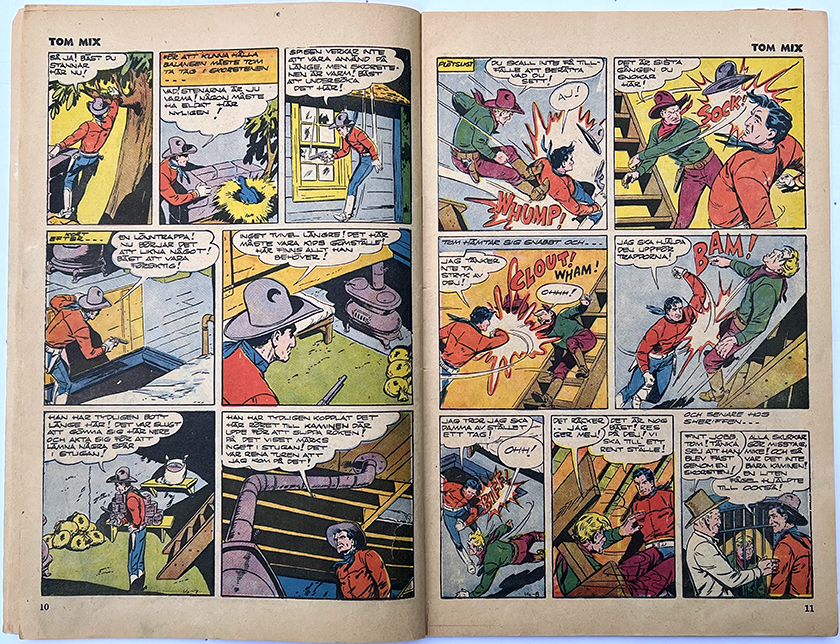
With a release date of September 11, 1953, TOM MIX Nr. 1 was the first of 18 comic books to carry the Swedish version of KEVIN THE BOLD (ROLAND DEN DJÄRVE). As hyped on the cover, the issues ran in color (mostly!) The covers were nicely printed on slightly heavier paper stock than the interior pages; oddly, the inside front and back covers only ran in black and white. The 6-3/4″ x 10-3/16″ comic book is 36 pages long.
This repackaged version (ROLAND) appeared about three years after KEVIN’s initial newspaper run, and wasn’t the first time Kreigh Collins’ comics appeared in Sweden. Nine months earlier, the weekly magazine Allas Veckotidning started running episodes of ROLAND DEN DJÄRVE.
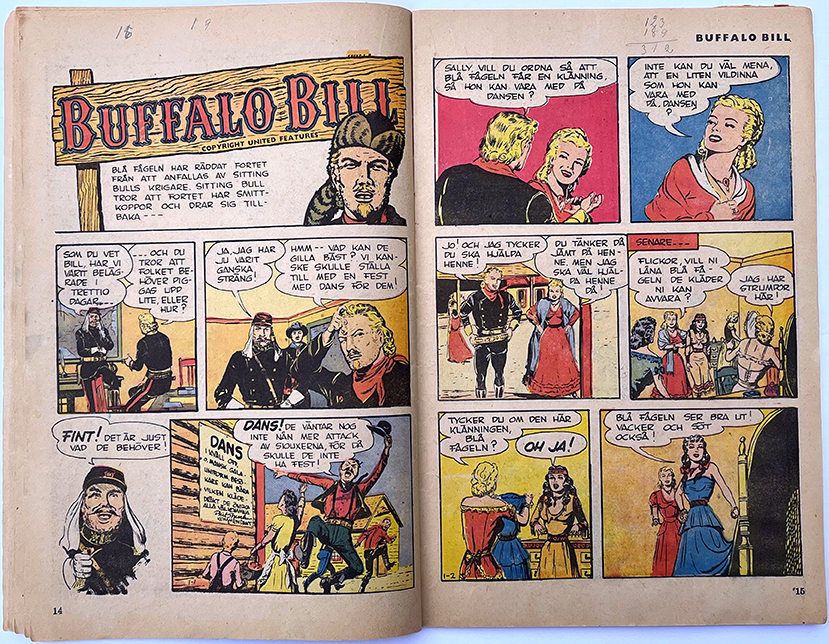
TOM MIX Nr. 1 was part of a wonderful gift from my friend Roger—18 comic books spanning ROLAND’s complete run. Having previously seen the 17th comic book in the series, I was familiar with UGH, the silent comic appearing on the inside front cover (I think it’s growing on me?) Facing it is an introduction modeled after a newspaper’s front page. This is immediately followed by the title comic, TOM MIX (possibly illustrated by Carl Pfeufer).
After the four TOM MIX spreads, a new feature is introduced—along with a contest. I wasn’t able to make out much of the text, and page 12 is very nicely composed, but what caught my eye were the illustrations on page 13, done by an unknown Swedish artist.
Roger graciously translated the text—page 12 reads as follows:
Giant Tom Mix competition Hail, noble knight! All brave and courageous men who can wield a two-handed sword as deftly as they wield their quill pen are invited to join my cruise! We intend to visit unknown shores, inhabited by heathens and Moors far away from our Ireland. Strange adventures await… We will reach ten different coasts on the journey, which you can follow in our cartoon log book. Unfortunately, our scribe is an uneducated chap and doesn’t know the names of all the places we sail past. Therefore, it is up to you to guess where each stage ends, guided by our drawings and scant text. If you manage to win one or more stages, you may travel to Ireland, my home country, and spend a week among my relatives on “The Green Island”! The first stage begins on the next page. Where did we get to on our first leg? Welcome aboard! Roland
Page 13 includes the contest’s questions:
Cruising with Roland
First log book sheet 1. Autumn had arrived in Ireland. All stores were on board when rain and windstorms whipped off the trees’ golden leaves, forming a thick carpet on the deck the day we sailed from the island of our birth.
The trip has now been going on for a week. A storm forced us to seek shelter yesterday. We did not understand the language of the local people. We were passing the southern tip of the country. A high rock island.
Shortly after we sailed through the strait, we were attacked by pirates. They were dressed like Arabs.
Another week passed. We approached a country populated by heroic men and women.
Arab horsemen attacked us. We sailed away… Like Odysseus, muttered Roland. What was the country?
Submit your answer to “Cruising with Roland” before September 25!
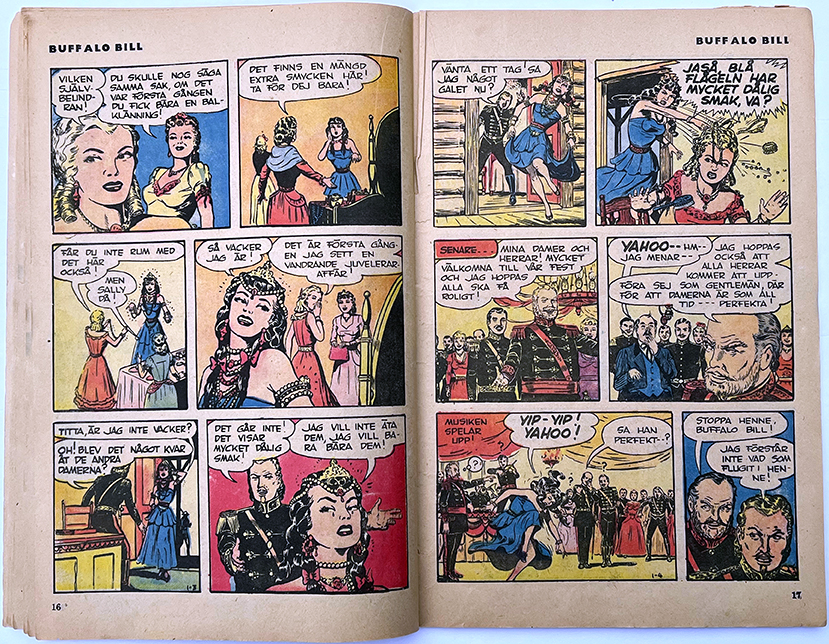
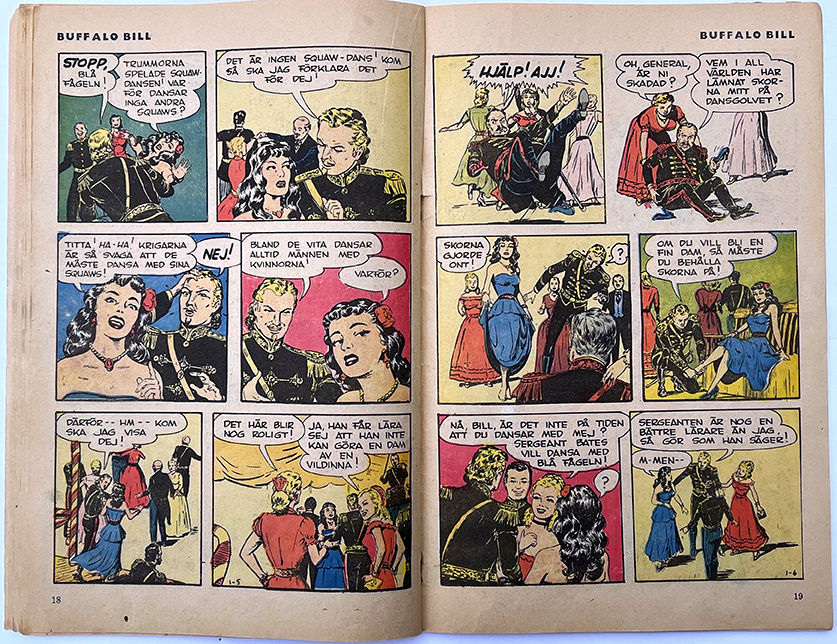
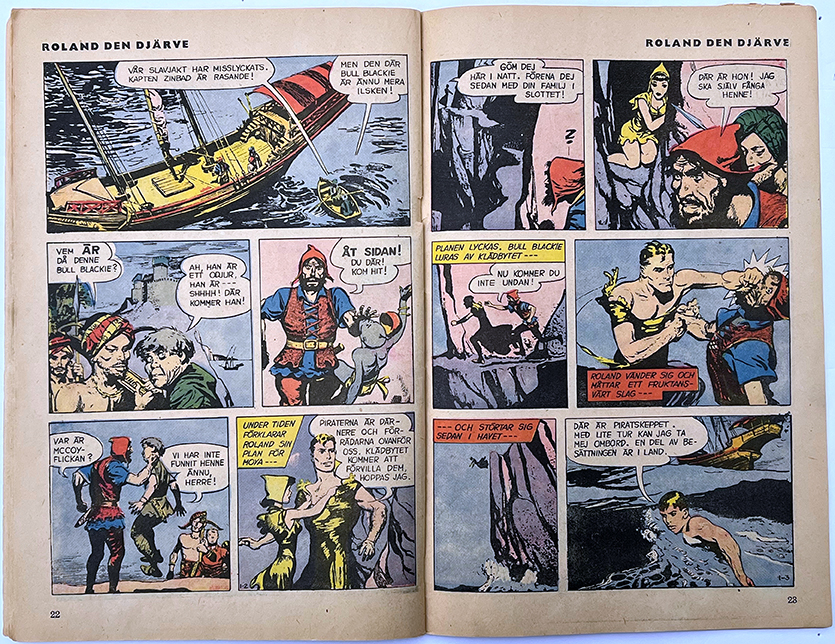
Following the Roland den Djärve teaser spread were seven pages of BUFFALO BILL. Next up was ROLAND DEN DJÄRVE!
ROLAND’s seven pages were sourced from three original Sunday episodes, minus their throwaway panels. The illustrations were given new color schemes, and avoided the occasional two- or three-color treatments that appeared in some of the originals’ panels. The original episodes, as printed in the Chicago Sunday Tribune, can be found here. Interestingly, the action starts with the third KEVIN THE BOLD episode—I guess the first two are seen as a transition away from Collins’ first strip, MITZI McCOY.
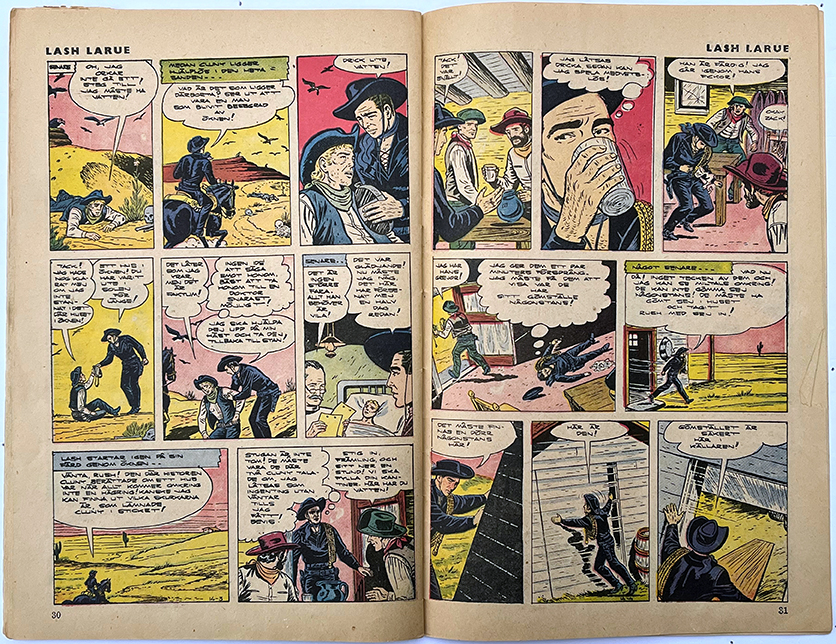
Following ROLAND were seven pages featuring Lash LaRue, and on the inside back cover was a short story about Native Americans’ use of smoke signals called “The Prairie Telegraph.”
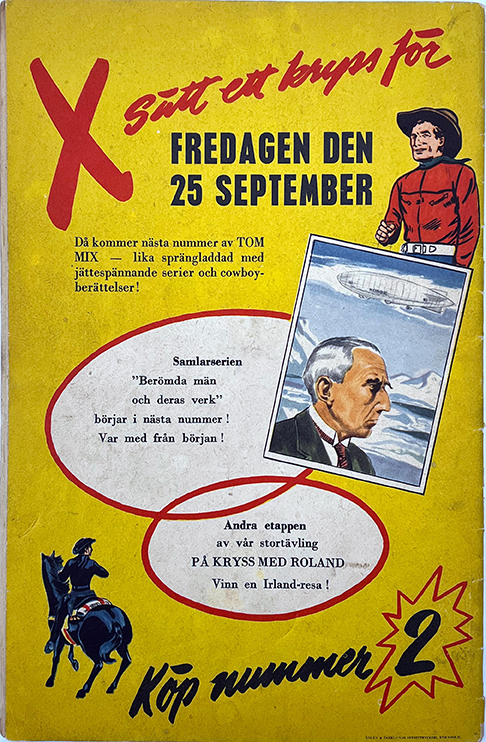
An ad promoting upcoming TOM MIX issues appeared on the back cover. Also mentioned were a series that would run on those future issues’ back covers, “Famous Men and their Accomplishments,” plus another mention of the ROLAND DEN DJÄRVE trip to Ireland contest (was this a real prize?!)
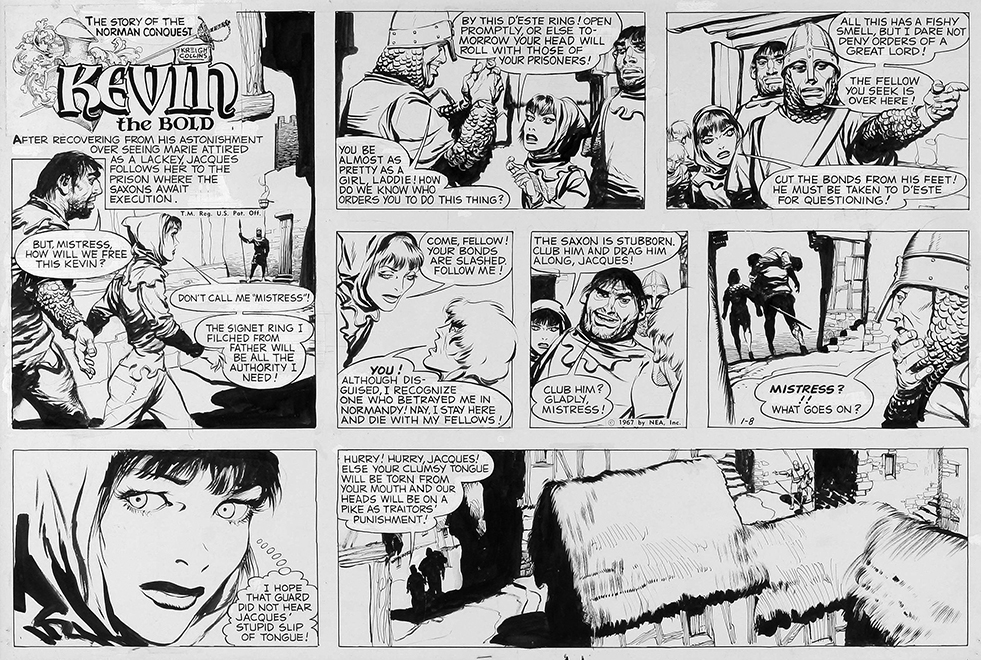
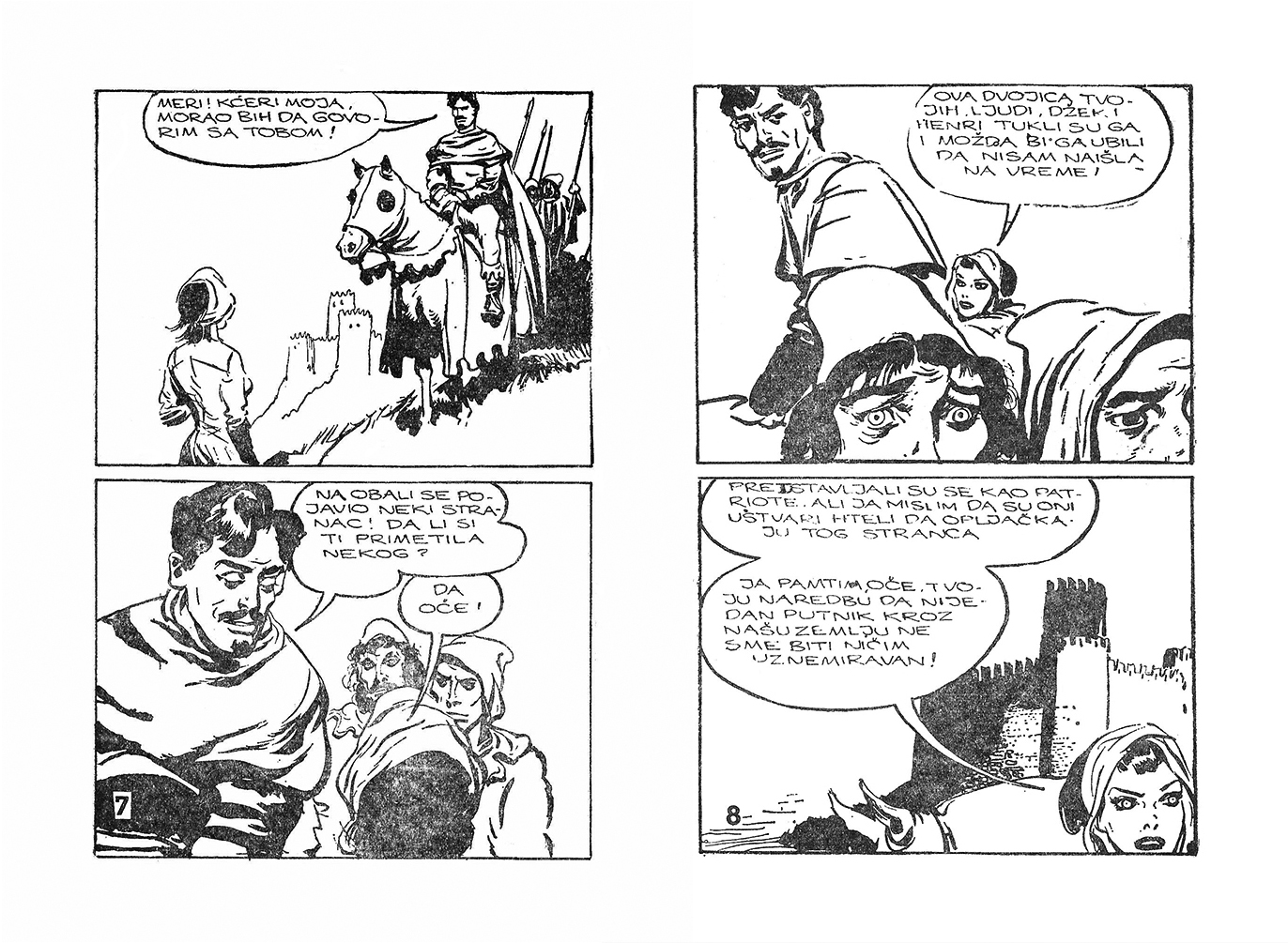
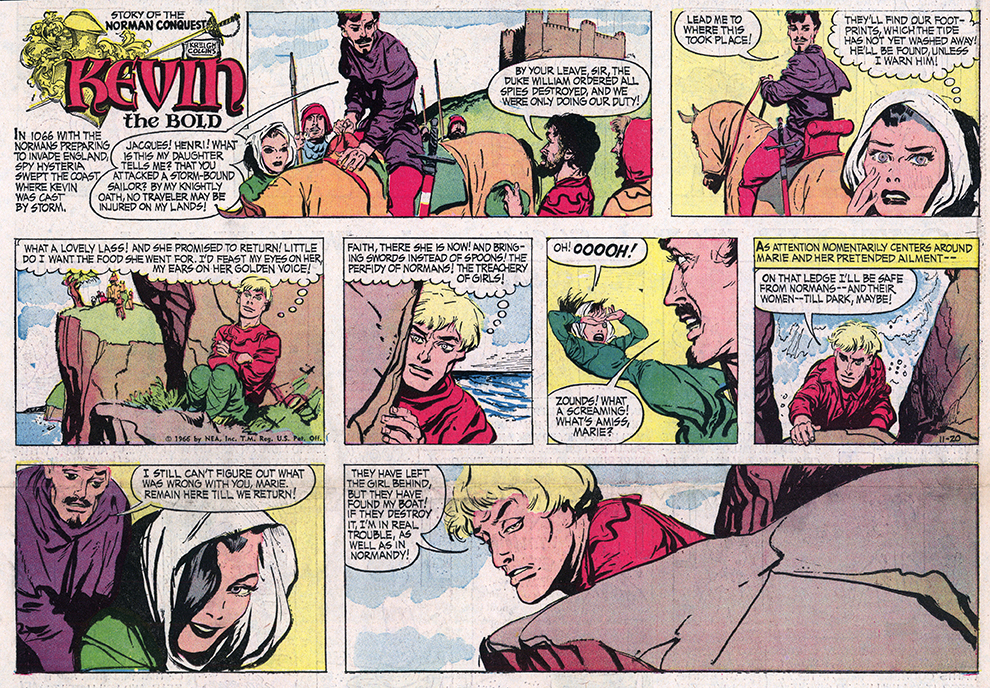
The ominous footsteps heard by Marie belong to none other than Jaques, the thuggish bodyguard she has chosen.
Original artwork for the January 8, 1967 episode.
Well! That’s quite a twist on the old trope of the caveman clubbing a woman and dragging her back to his cave!
Marie’s fears are well-founded!
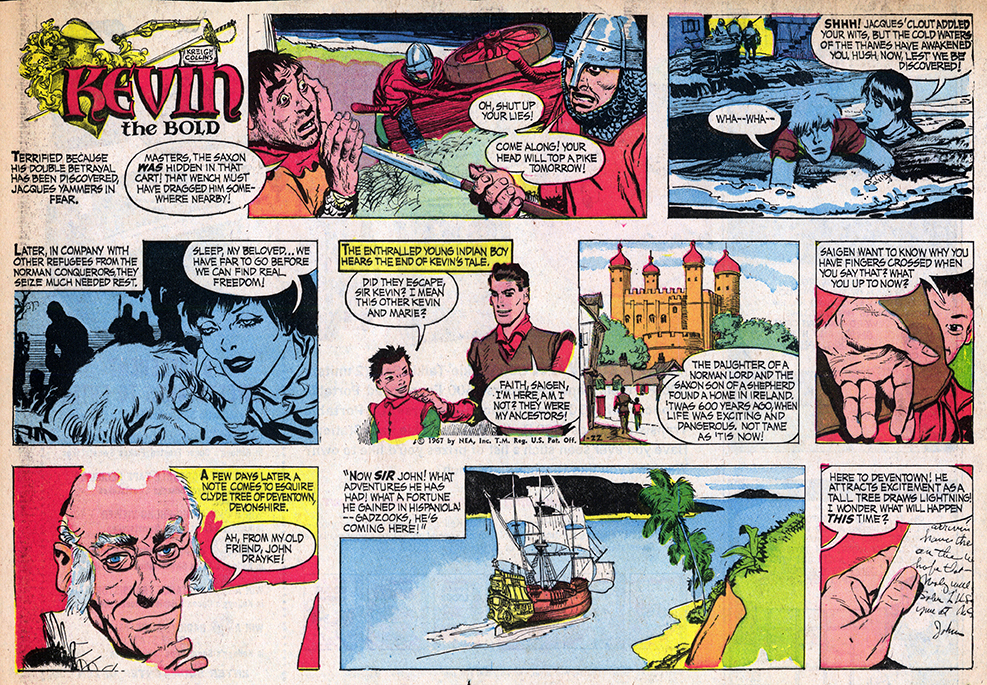
Jacques meets an unsavory end as the story concludes, and Saigen reappears as the audience for Kevin’s tale of the Norman Conquest, featuring his flaxen-haired ancestor.
The end of the chapter has arrived, but there are still 20 pages left in BIBLIOTEKA LALE — BROJ 174, most of which is filled with a military comic. I was curious to see who were the good guys and who was the enemy—after all, Yugoslavia was behind the iron curtain in 1968, when the comic book was published.
The series, apparently called “Partisan Ingenuity,” featured two episodes—the first of which was titled “Saboteur.” I had assumed the good guy was a Soviet soldier plotting against the Nazis. The saboteur was in fact a member of the Yugoslavian resistance. In real life, these partisans were led by Josip Broz Tito, who later became President of Yugoslavia. In the comic book, the saboteur is shown plotting against the fascists, and his mission is a smashing success. I was surprised to learn that Tito had in fact severed ties with Moscow in 1948, and by 1968, civic protests were erupting in cities, similar to what was happening in Paris and elsewhere. So, this comic basically served as nationalistic propaganda, much like Captain America and Sergeant Rock did in the USA.
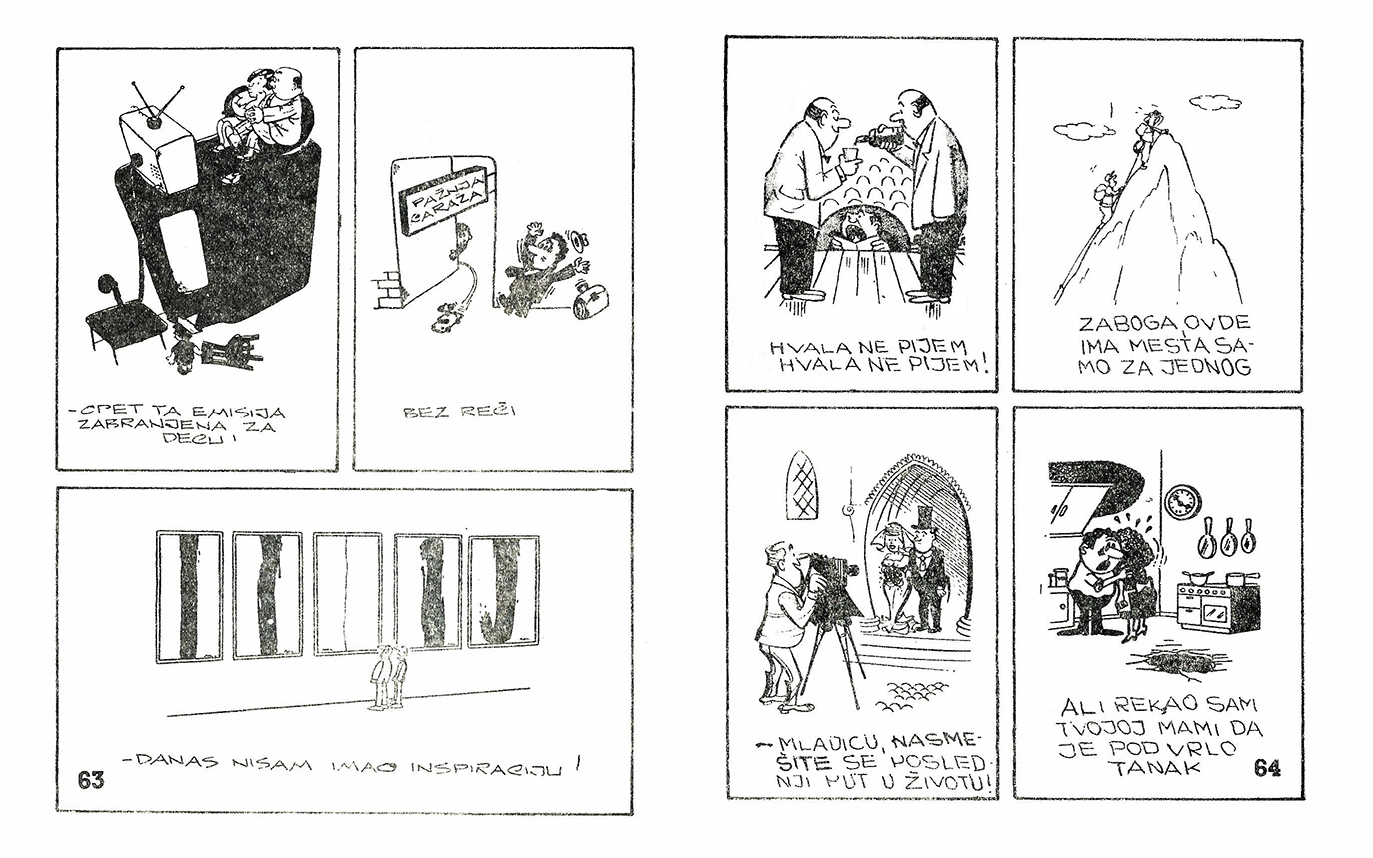
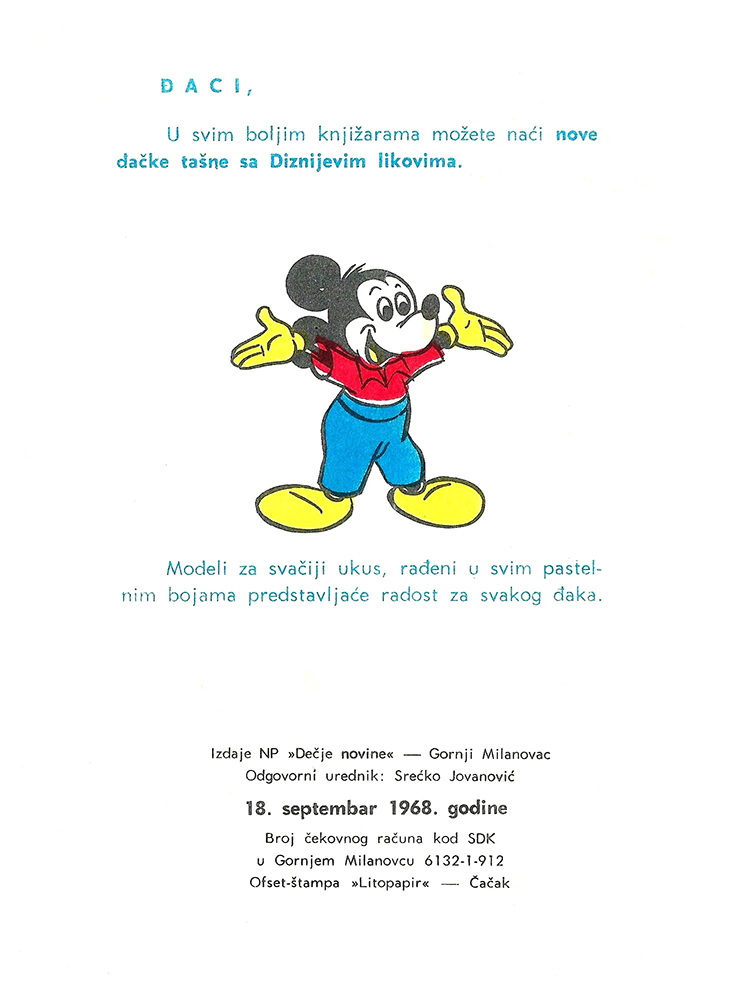
The last couple of pages featured gag comics, and the back cover seemed to be hawking Disney product knock-offs.
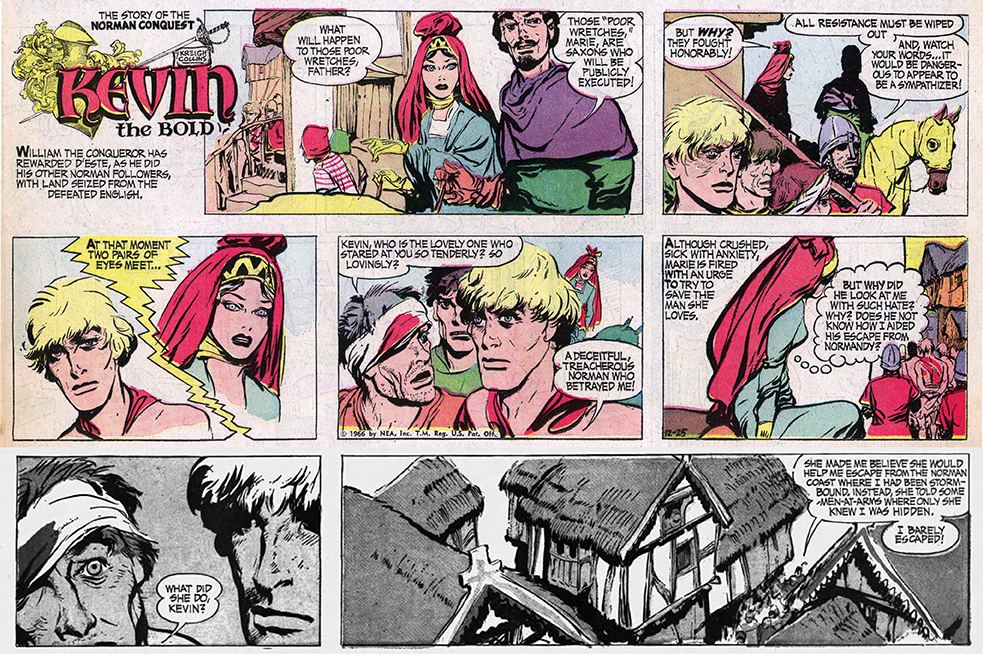
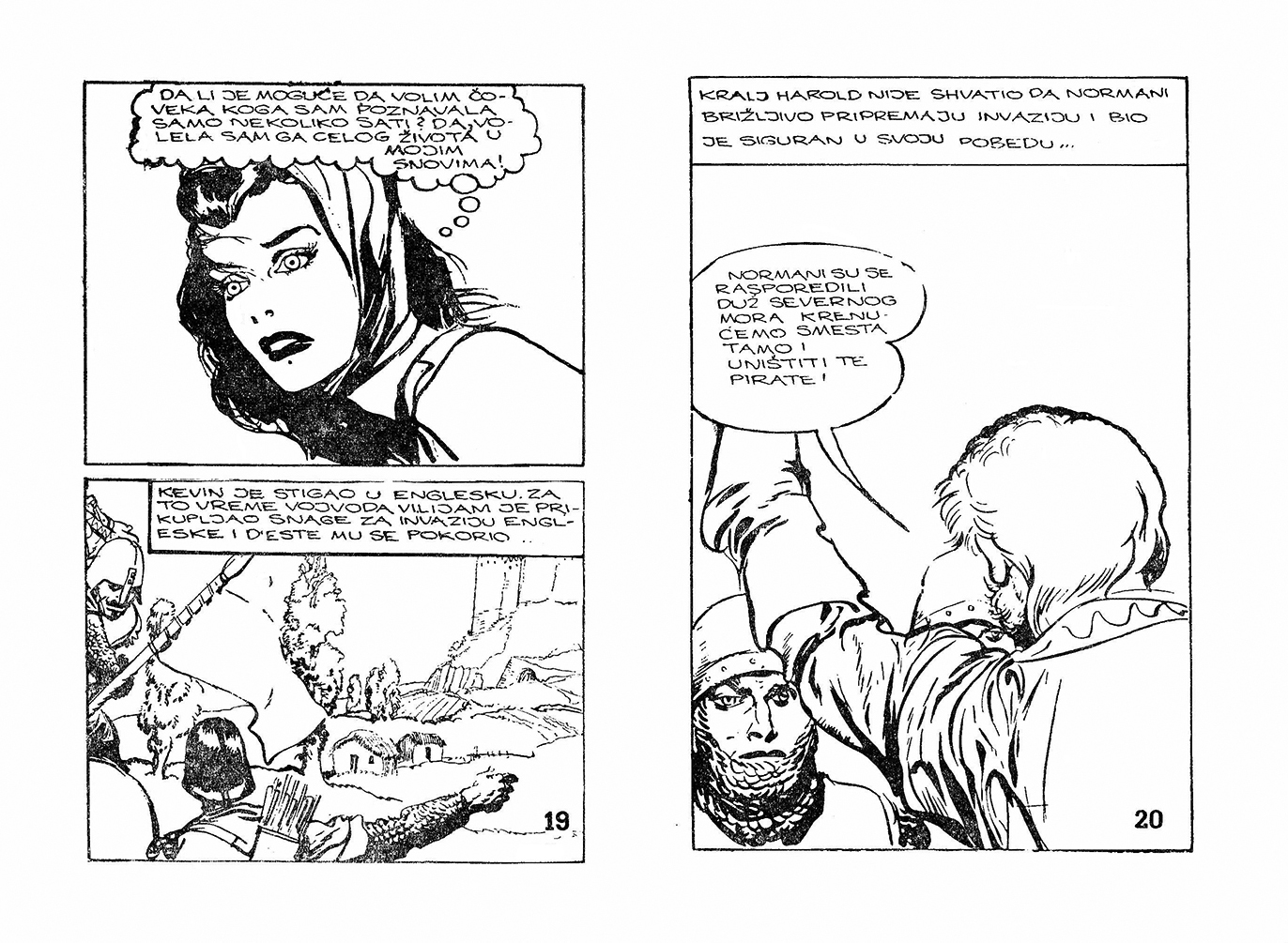
Kevin and Marie have both experienced the sensation of love at first sight, but it’s complicated—Kevin thinks she has forsaken him.
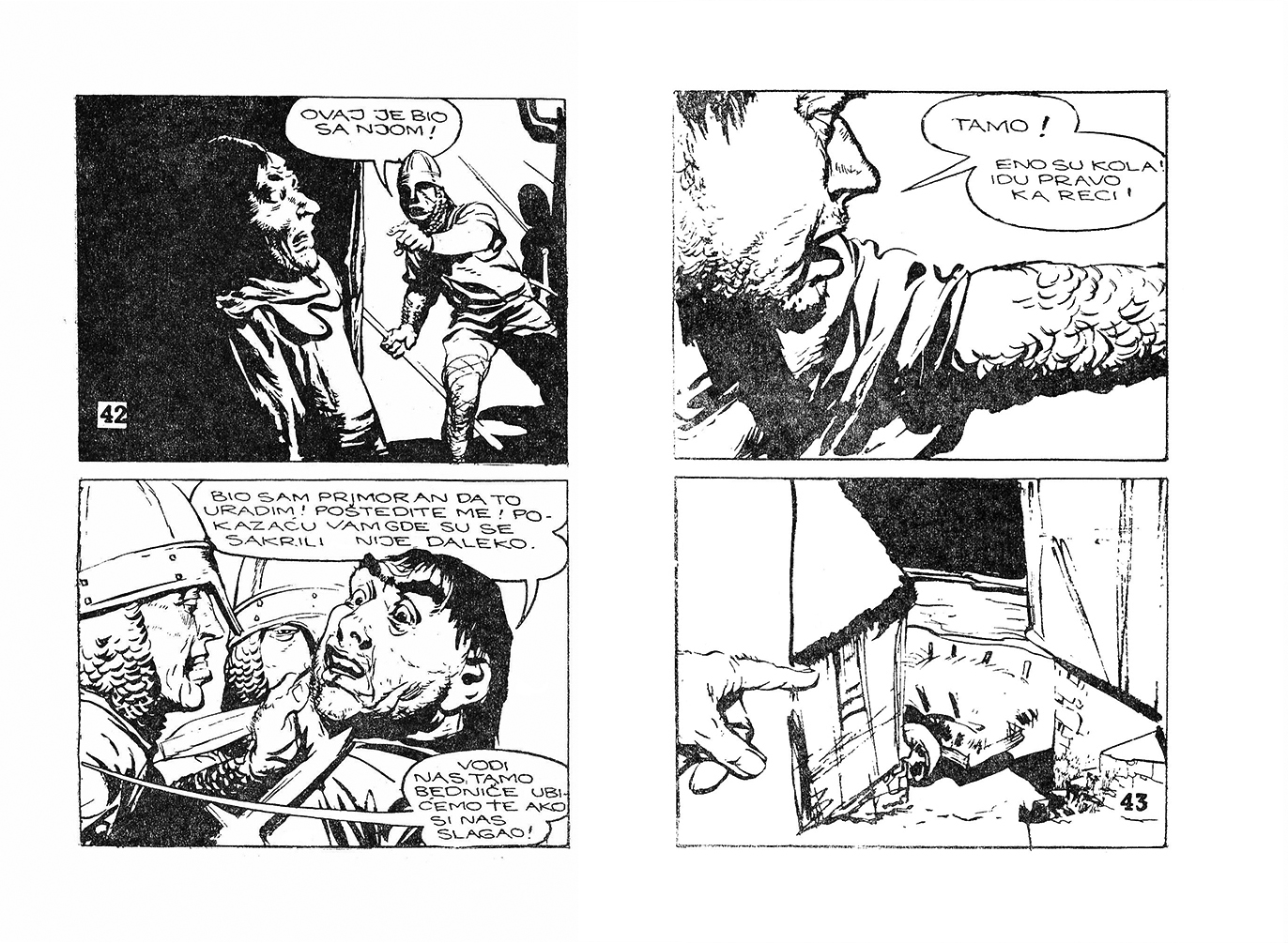
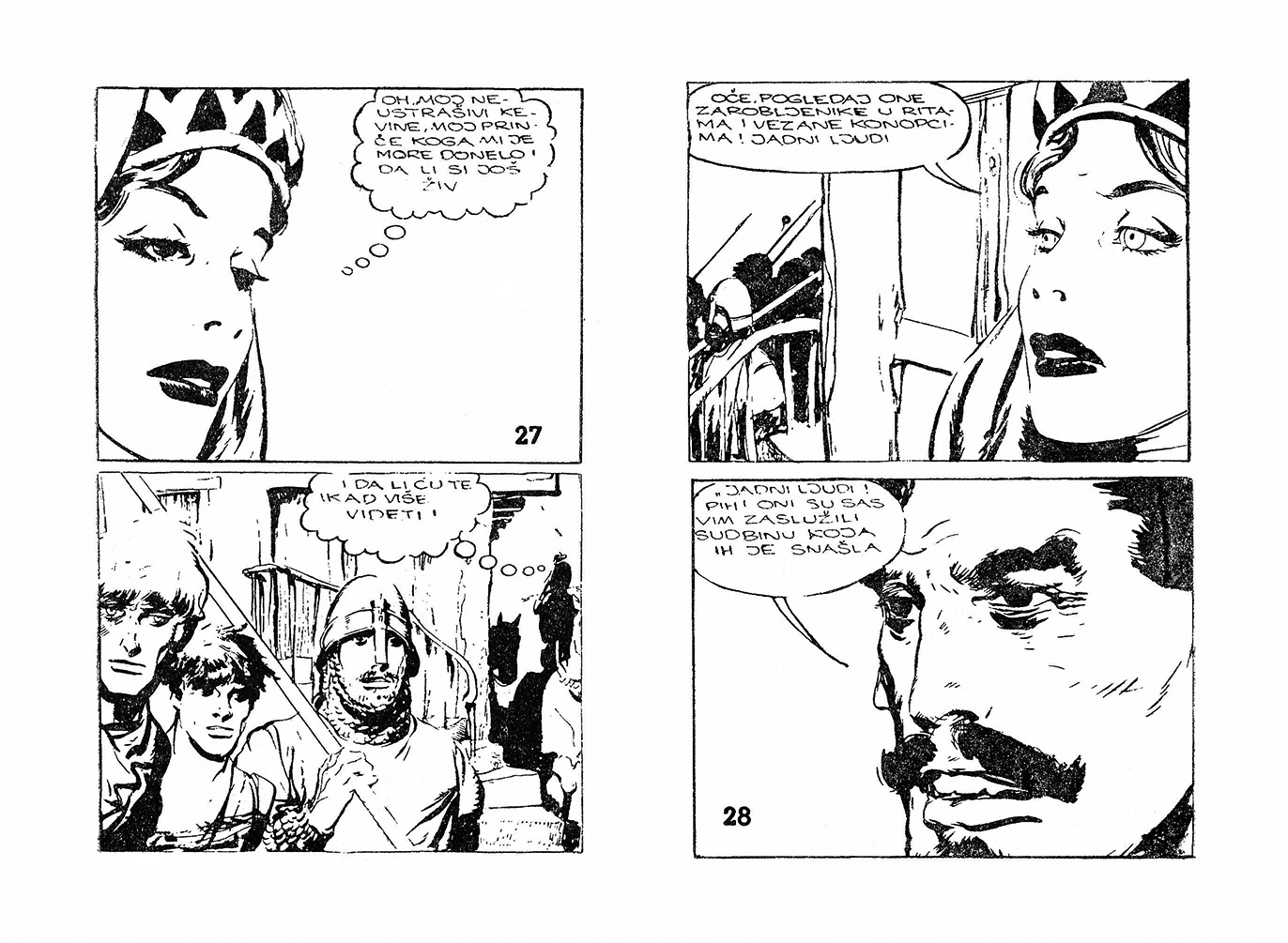
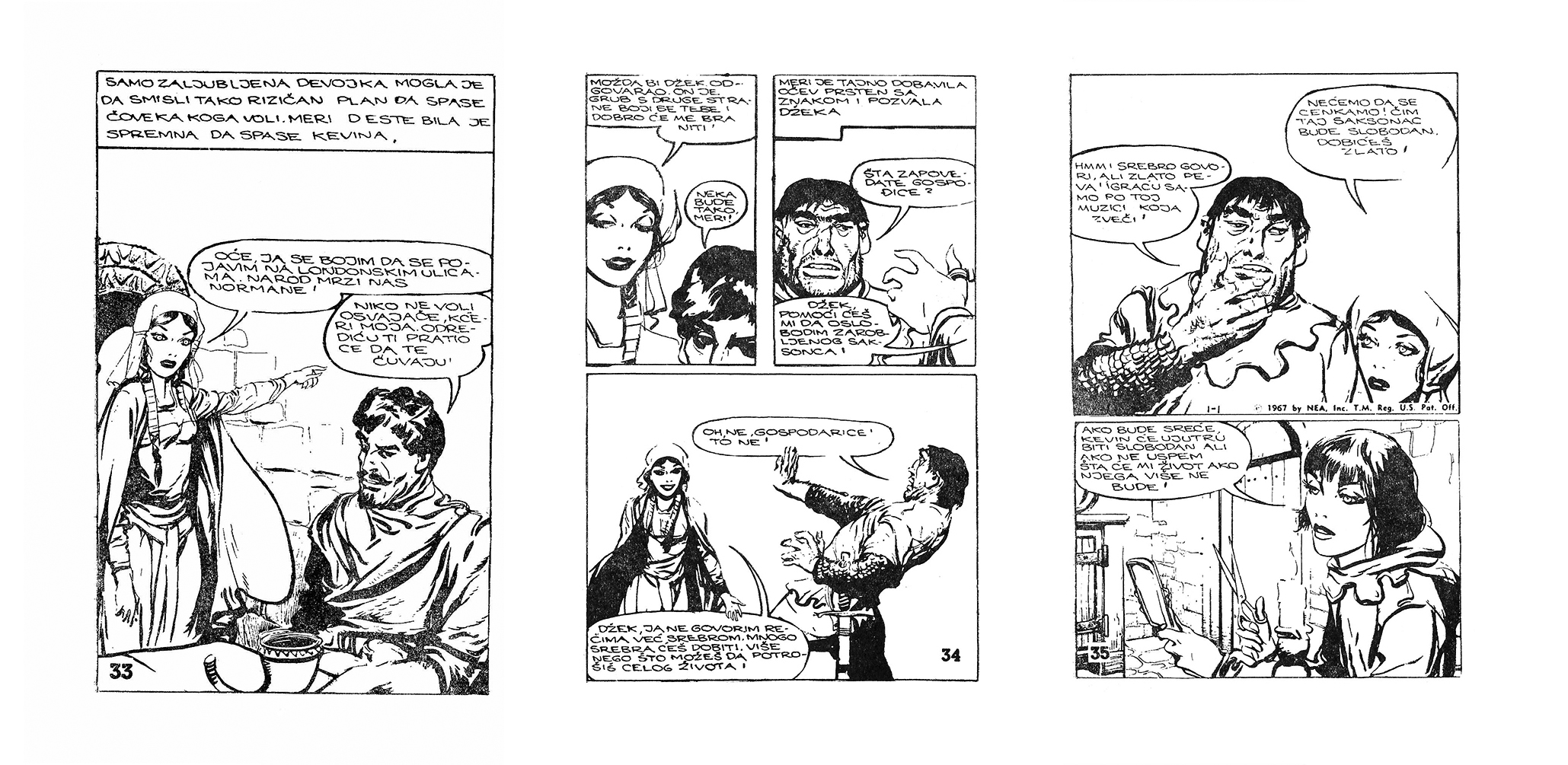
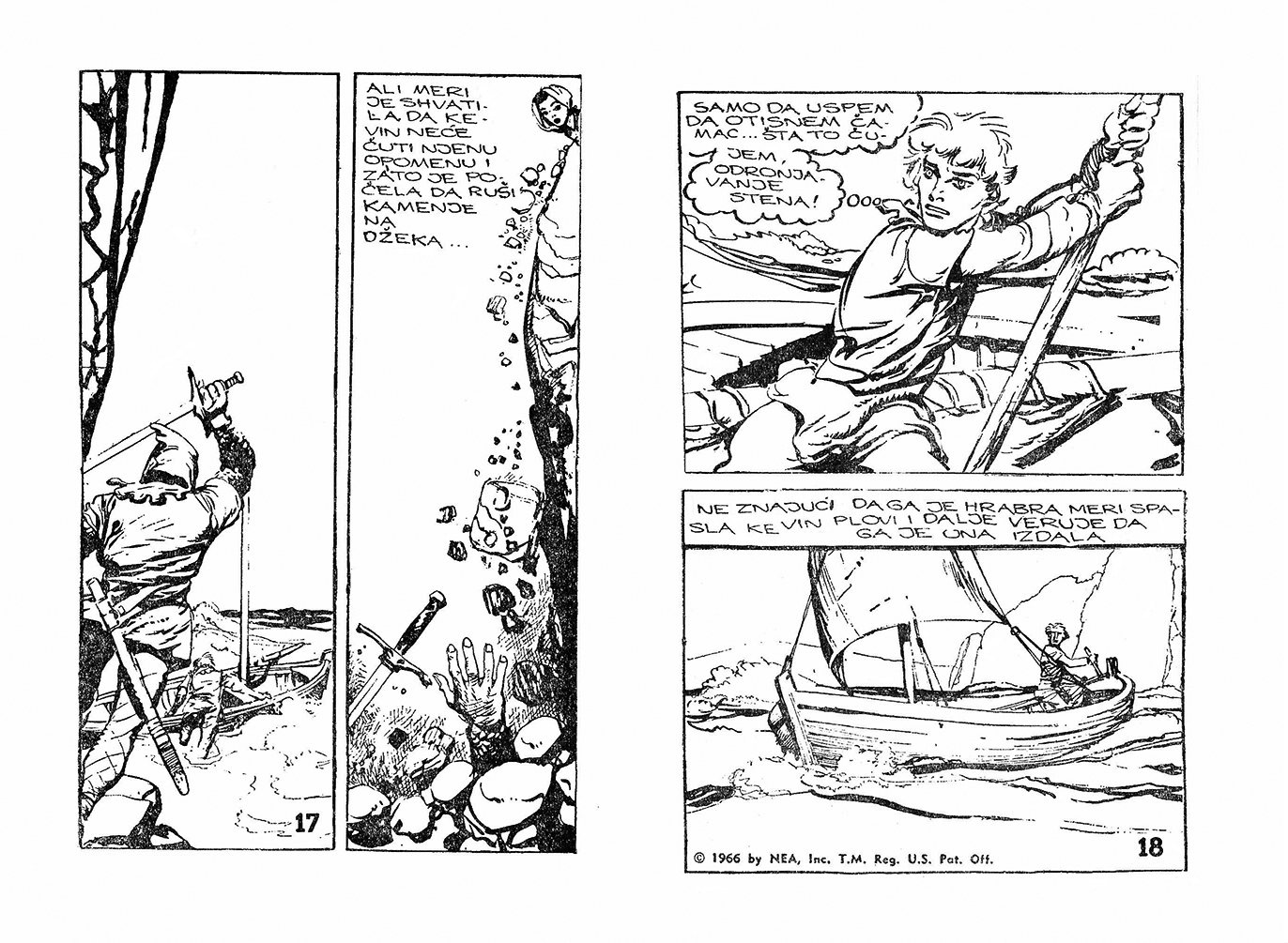
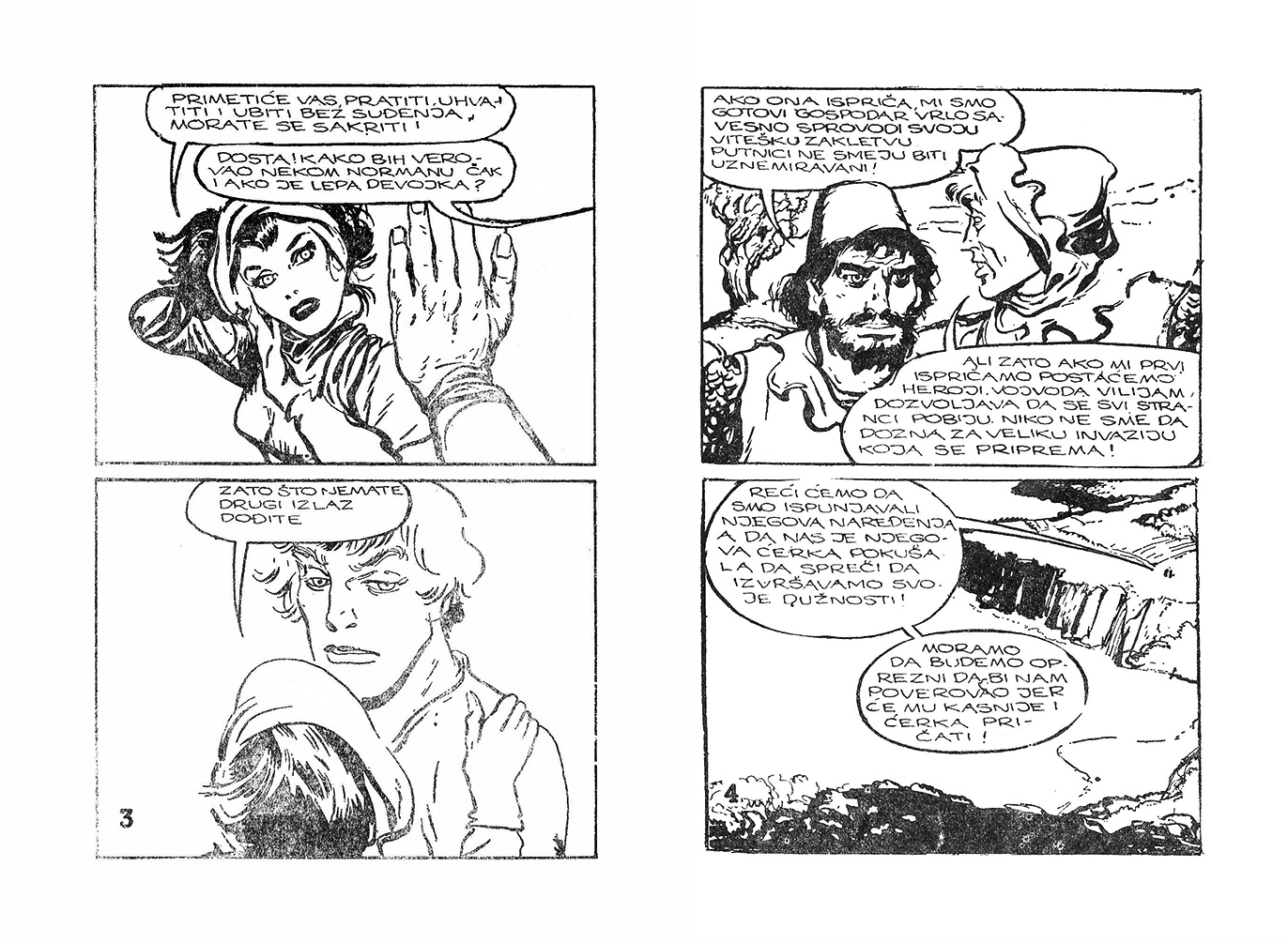
Dealing with mixed emotions, Kevin makes his escape. (The panels from the Yugoslavian comic book are shown below).
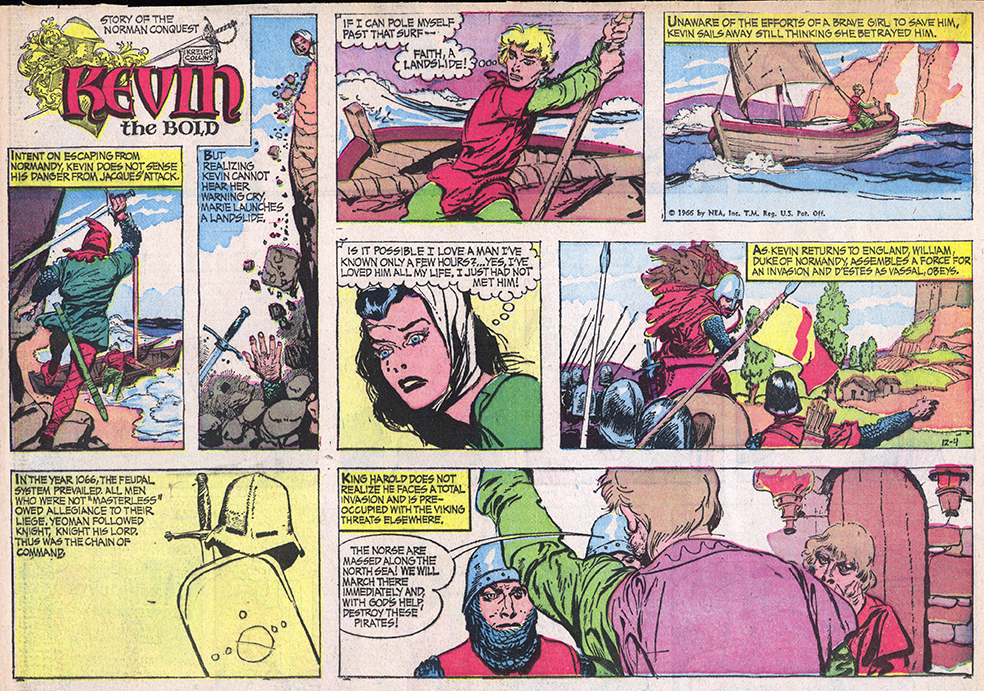
Even as she watches her newfound infatuation bolt, Marie continues to help him.
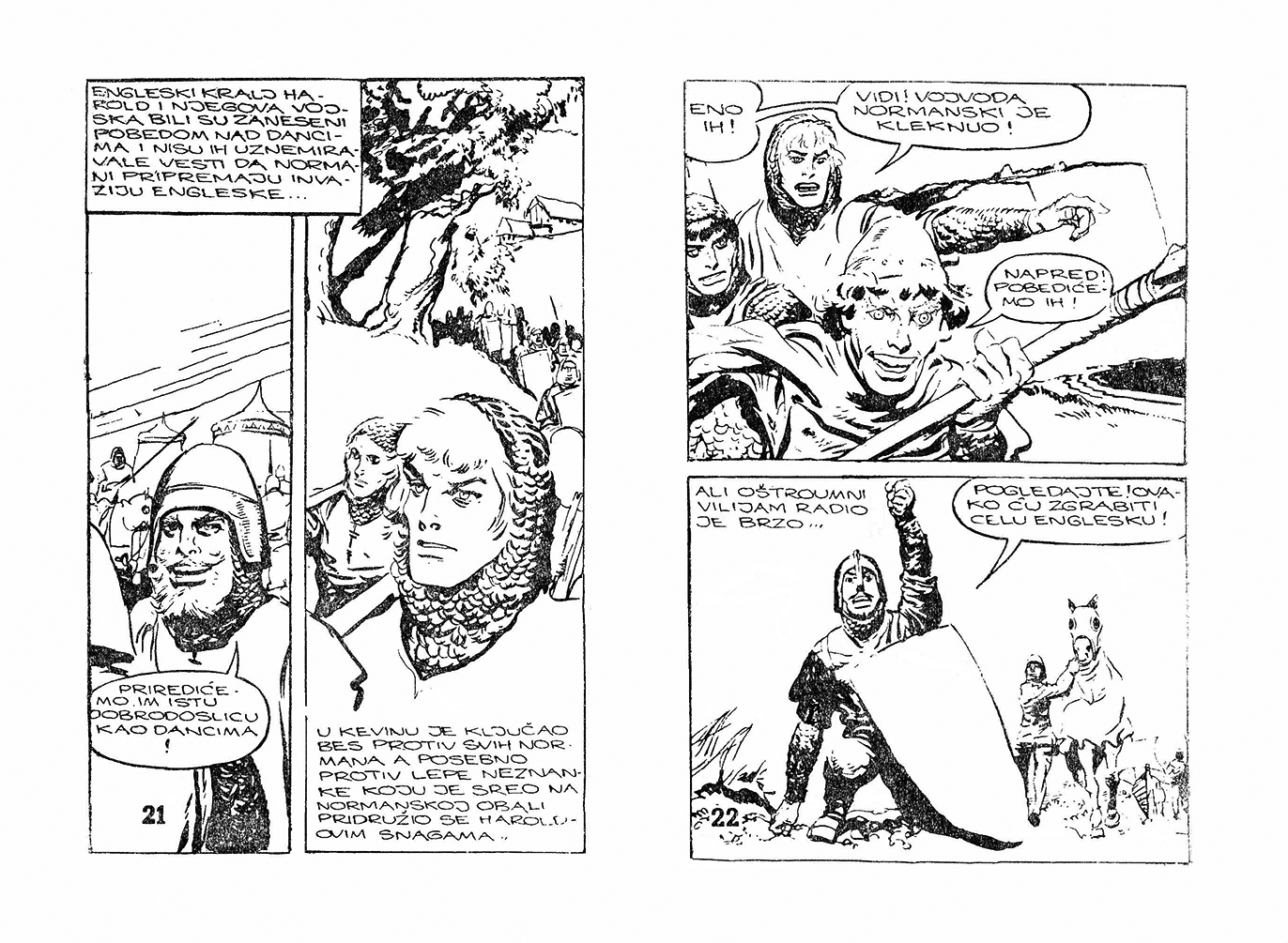
Meanwhile, back in England, King Harold is unaware of the real danger he faces.
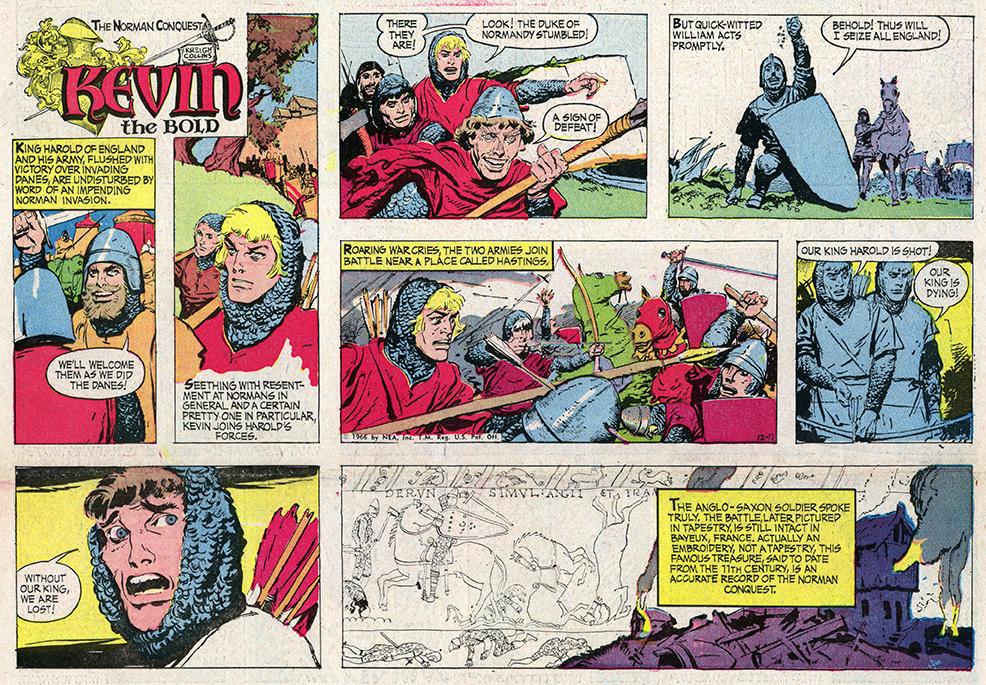
The December 11, 1966 episode is a wonderful example of Kreigh Collins’ skills as a cartoonist—the beautiful illustrations are filled with kinetic action and topped off with a historical tidbit found during his research of the subject matter.
The panel with the historical embroidery is also included in the Yugoslavian comic book.
Because the Yugolsavian comic book “BIBLIOTEKA LALE — BROJ 174” began with the third episode of the Norman Conquest chapter, some action at the beginning of the chapter is missing. And since the Norman Conquest story predates the action in KEVIN THE BOLD by a good five centuries, let’s back up a bit and take a look at the two omitted episodes to get a better handle on the events at the onset of the story arc.
The first several episodes (including the first two, below) used the standard KEVIN THE BOLD logo, but by the fourth episode, the title “Story of the Norman Conquest” was added just above the logo. The entire episode ran over 14 weeks, of which I have color 11 half-pages. Unfortunately, the opener is not one of them.
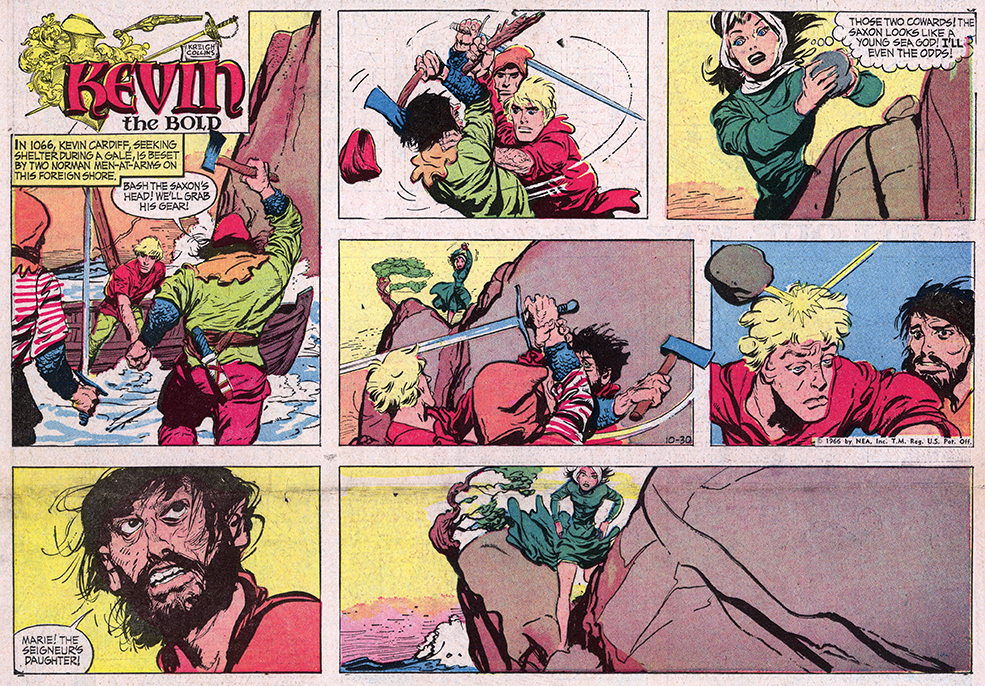
Poor Kevin Cardiff! The lad is out for a sail, dreaming of Saucy foreign gals, when a storm hits, his boat is ruined, and he is set upon by a couple of murderous thugs.
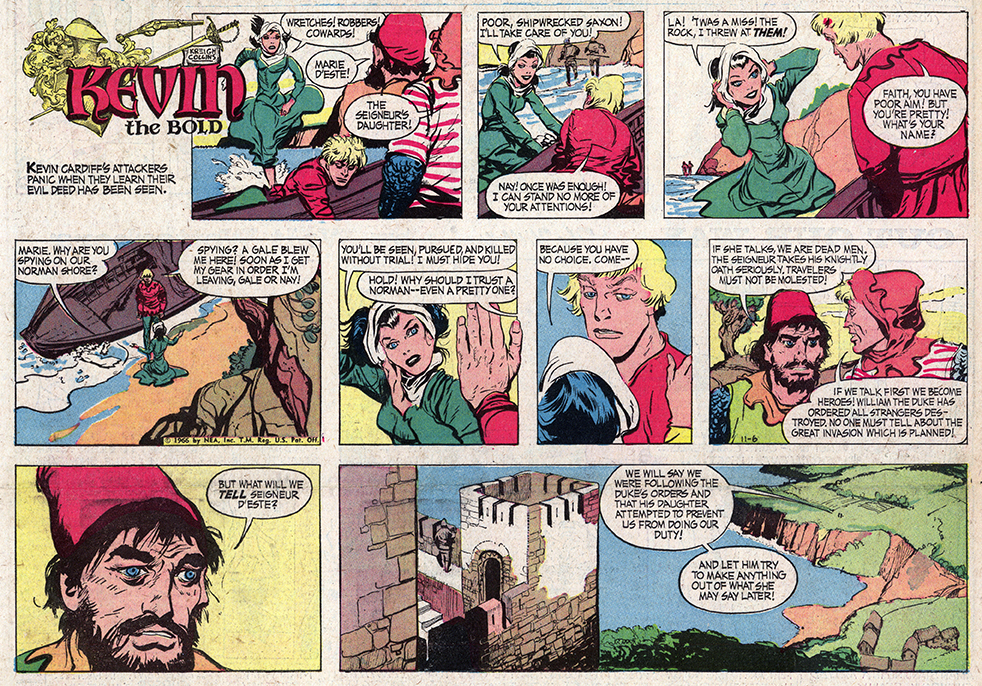
But the beautiful French of his dreams exists, and she quickly takes a shine to Kevin.
The action in the Yugoslavian comic book picks up after this episode (from October 30, 1966)
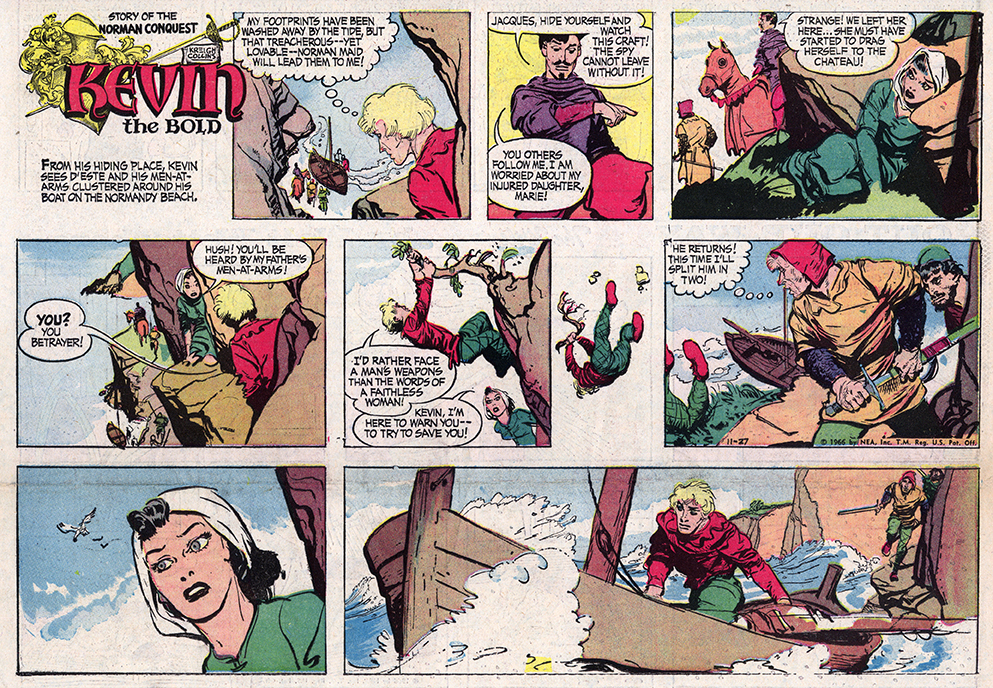
Lovely Marie certainly resembles Kevin the Bold’s first love, Moya McCoy, and the belle fille even steals a play from Moya’s playbook—with similarly disastrous results.
Sacrebleu! Marie is also taking fashion tips from Moya! I guess that green dress is timeless.
I recently wrote about a wonderful Christmas present I received from my friend Roger in Sweden—another awesome gift I received over the holiday season was sent by a friend in Serbia. Marko sent me scans of a KEVIN THE BOLD comic book published in the former Yugoslavia, likely from the early 1970s.
According to Marko, Biblioteka Lale was a magazine published by in the town of Gornji Milanovac, near Belgrade (now part of Serbia). It was released by Dečje novine, the largest comic book publisher in Yugoslavia. Besides this one, issue numbers 160, 180, and 206 also included Croatian translations of KEVIN THE BOLD.
Appearing on the first 46 pages of the comic book, Issue 174 features the entire “Story of the Norman Conquest” chapter, which originally ran from November, 1966 until January, 1967. Some other interesting comics in the rear portion of the comic book.
The first time I saw these Sunday comics I was confused—Kevin had blond hair! Because my collection was incomplete, I missed the fact that the chapter was a flashback, and the blond Kevin was an ancestor of Kreigh Collins’ protagonist.
The timeframe of the Norman Conquest preceded the action in KEVIN THE BOLD by about five centuries.
For a late-period episode, the illustration work is inspired, and the meeting of Marie and Kevin (Cardiff) is reminiscent of the one between Moya McCoy and Kevin (the Bold) from the comic strip’s debut chapter.
At this late stage in KEVIN THE BOLD’s existence, remember that the entire third tier of panels was absent from the more common third-page version—such a shame!
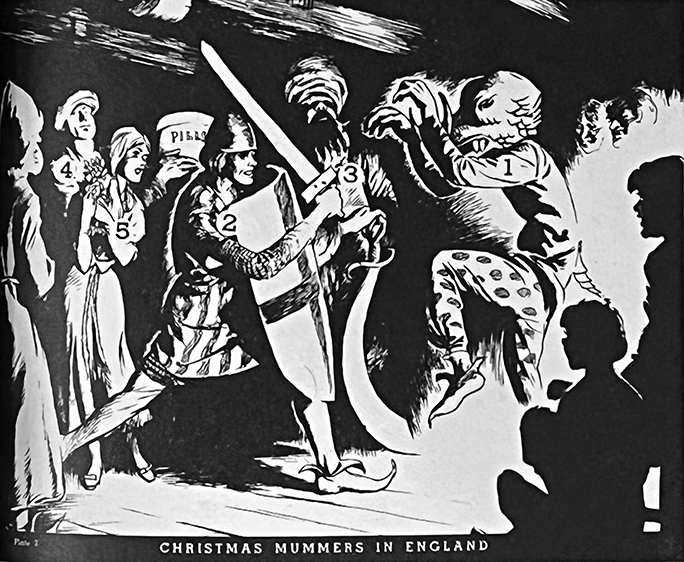
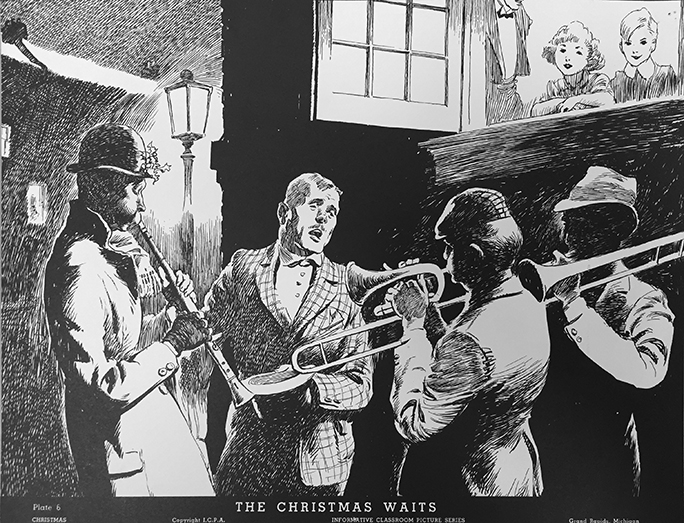
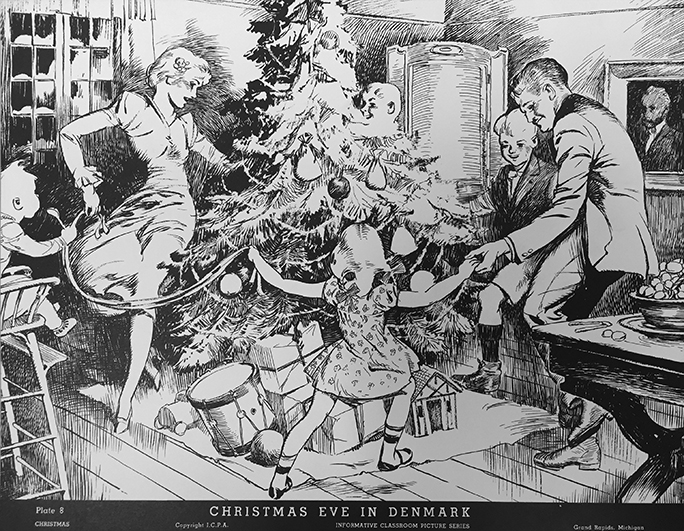
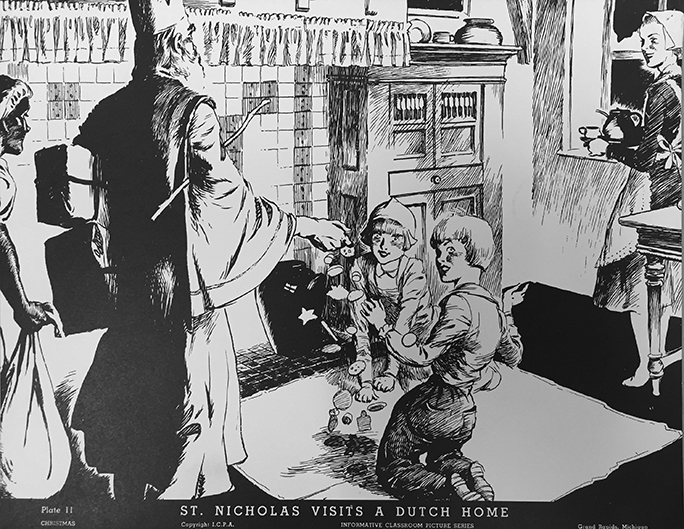
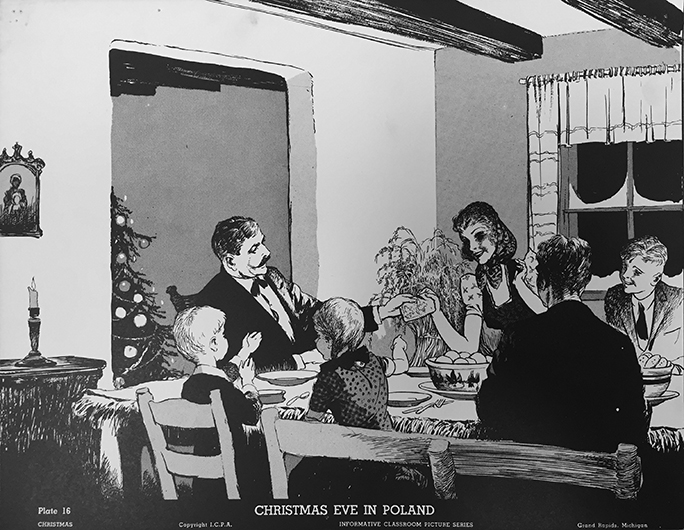
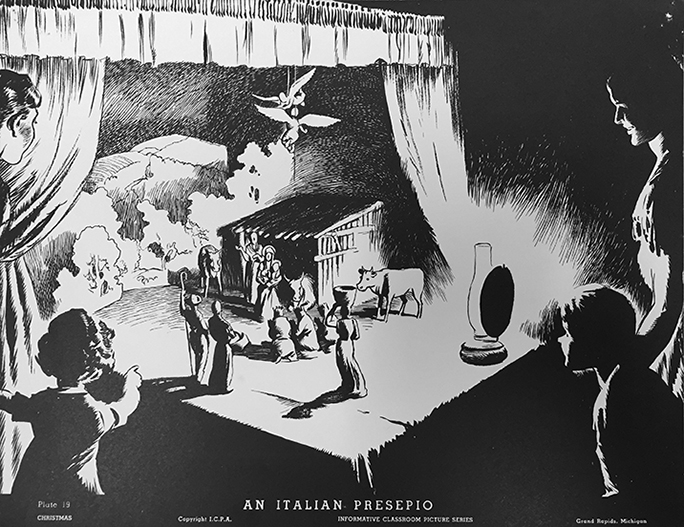
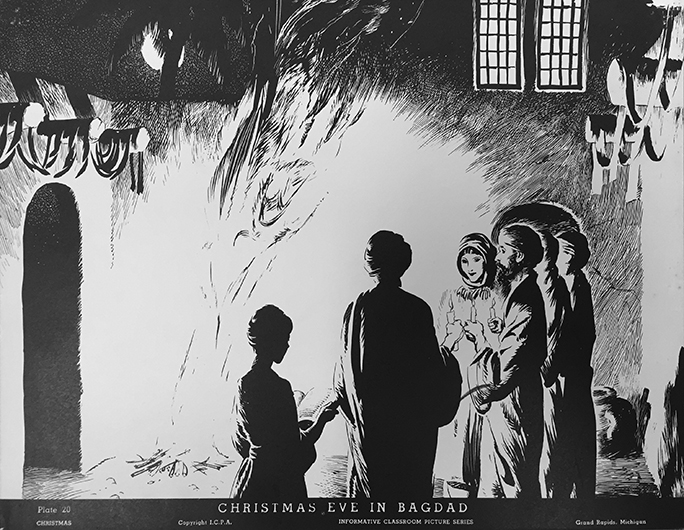
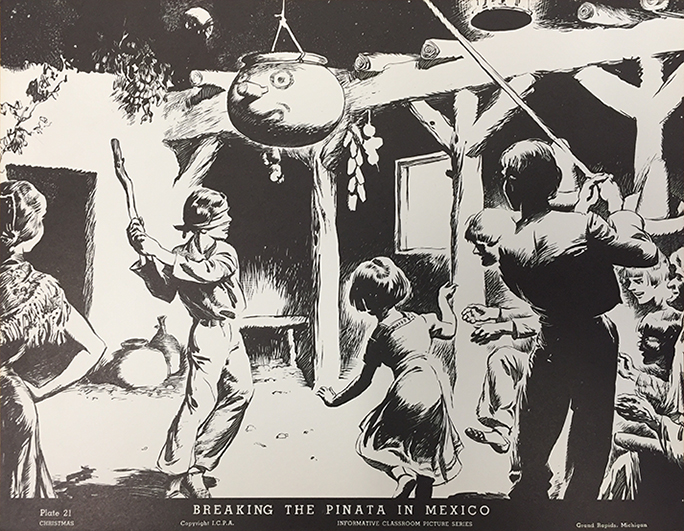
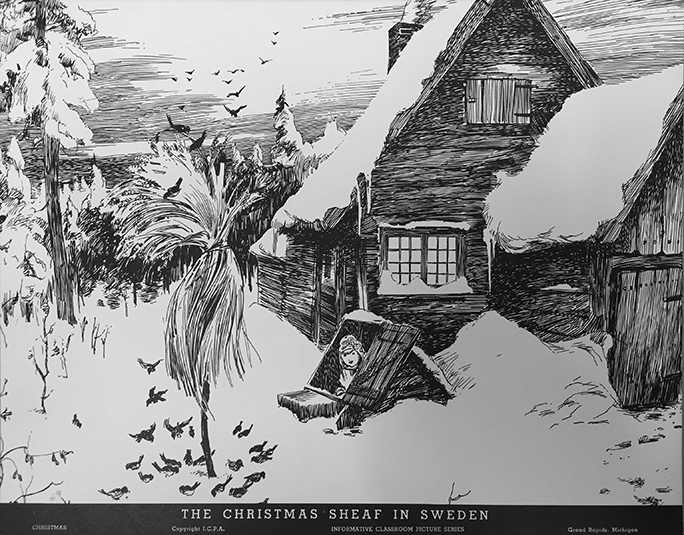
Early in his career, Kreigh Collins did freelance work for the Fideler Company, a publisher in Grand Rapids, Michigan. One of his early projects was illustrating various “Unit of Teaching Pictures” programs from Fideler’s Informative Classroom Picture Series.
It was a plum assignment. Each unit included 20+ detailed black and white illustrations, and there were at least 18 different units. The unit’s historical themes were right in Collins’s wheelhouse, and the project kept him busy for several years starting in 1937. The Informative Classroom Picture Series was used by primary school teachers as a part of a social science curriculum.
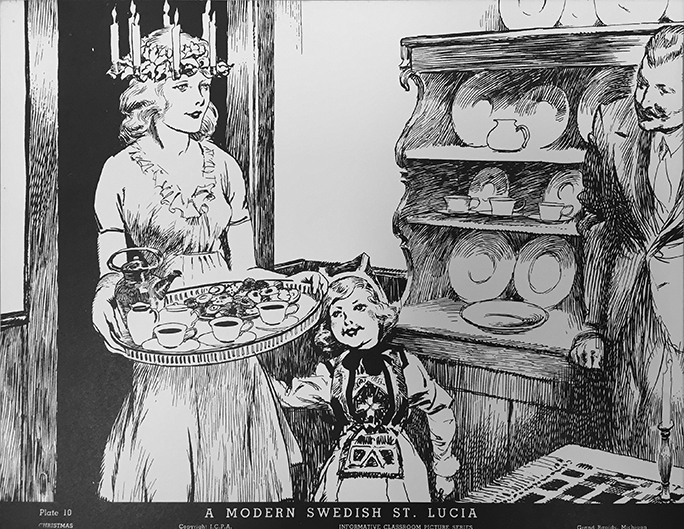
CHRISTMAS IN MANY LANDS was one of the later themes. It included 21 plates showing different countries’ holiday customs and traditions. Not surprisingly, European countries featured prominently, but a couple of unexpected outliers were included (Plates 20 and 21). Perhaps a scene from your home country is included…
A new custom to me was the Festival of St. Lucia (Plate 10). Celebrated on December 13, it kicks off the Christmas season in Sweden. What caught my eye was the woman’s “crown of light”—my kind of holiday!
Another Swedish custom involves the Christmas Sheaf, which I can only understand to mean gifting sheafs of paper, such as comic books.
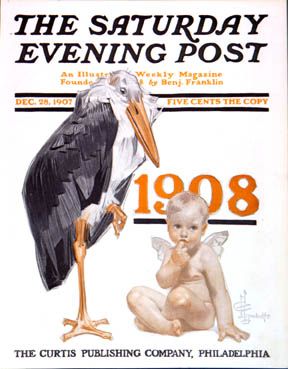
An interesting detail noted on Roger’s site notes how the size of the BUFFALO BILL logo grew until it surpassed that of TOM MIX, and how Bill eventually displaced Tom as the cover subject (bottom row).
I received a gift of such sheaves from my friend Roger. It consisted of 18 TOM MIX comic books, originally published in 1953–54. Included is ROLAND DEN DJÄRVE—a Swedish translation of KEVIN THE BOLD. Most of the covers featured cowboys (either Tom or Bill), but three sported Kevin-inspired artwork.
The grand Tom Mix competition is hereby opened!
I first laid hands on a copy of TOM MIX nearly ten years ago; it was included in a box I received from Uncle Kevin and basically disproved my theory that my grandfather was unaware of these foreign versions of his brainchild. Roger has written extensively about the TOM MIX comic book series (and so many others) on his remarkable website, and I look forward to featuring more of TOM MIX in the New Year.
Wherever you are celebrating—happy holidays and best wishes for a wonderful new year!





































 Kreigh’s Comics