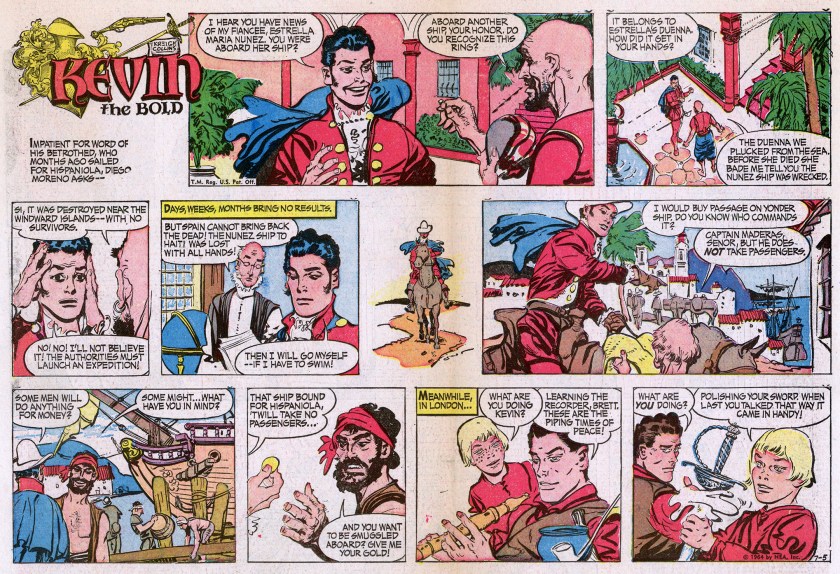
Unbelieving that his fiancée has been has been lost at sea, Diego has stowed away in a ship bound for Haiti, in a valiant search for her. And what do you know…
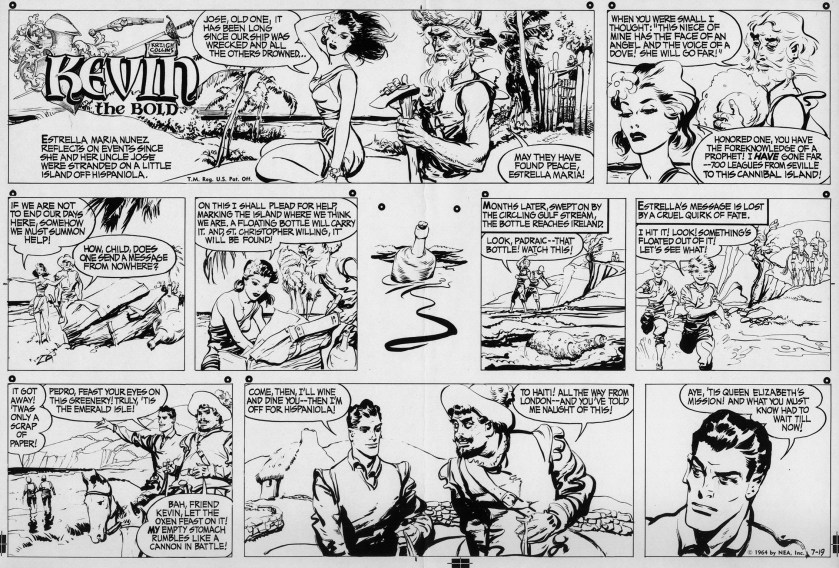
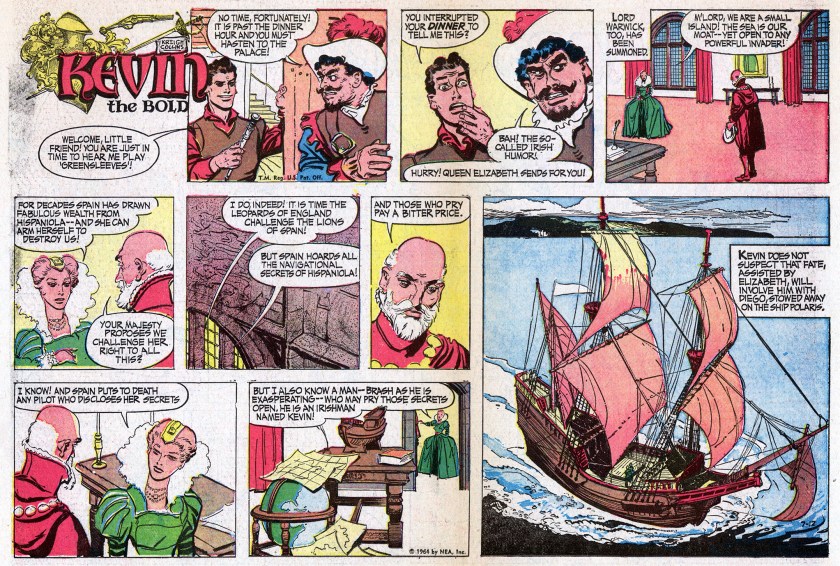
Estrella’s desperate plea for help is on target, but in vain.
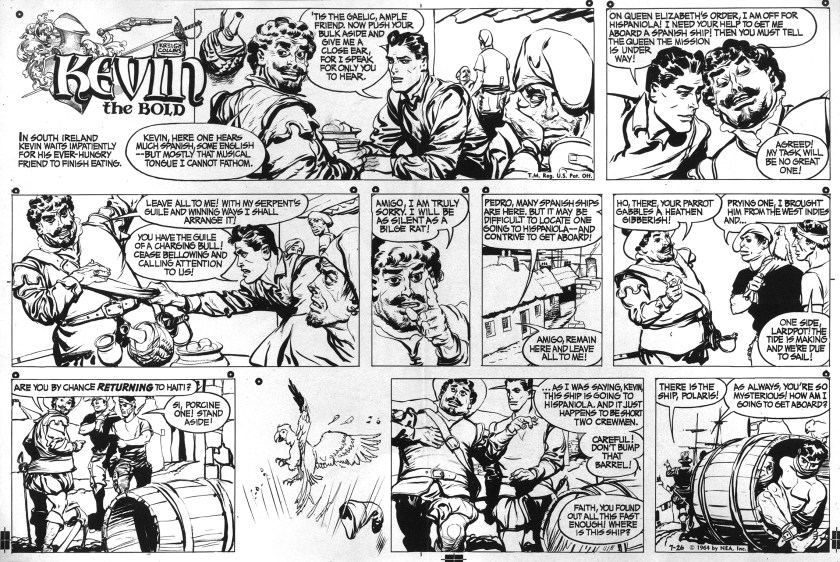
Pedro is able to make quick work of his task after spending most of his time eating. This is a running joke that continues whenever Pedro appears — even after the comic strip morphs into “Up Anchor!,” in which the characters Kevin and Pedro are again prominent.
While Pedro wraps up some loose ends, Kevin starts snooping around for knowledge of the Spaniards’ navigational secrets.
For more information on of Kreigh Collins’ career, visit his page on Facebook.
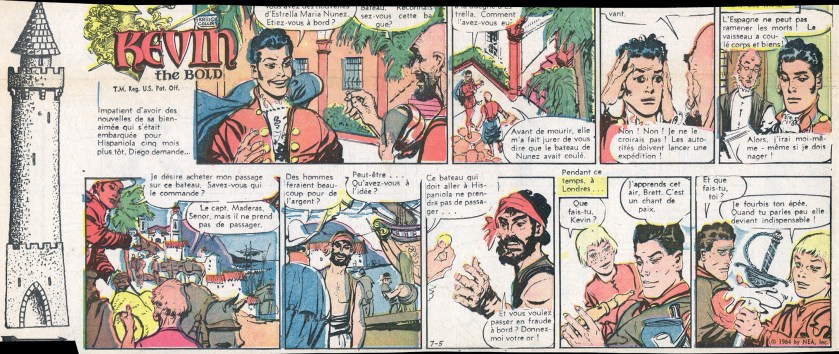
To follow last week’s post, which dealt with travel and this blog’s far-flung visitors, I had the idea to run a “Kevin the Bold” sequence with comics from my collection that appeared in a Québec newspaper. Because they had been translated into French, it seemed appropriate — most of my blog’s visitors were from France. I planned to run English versions, too.
After I started collecting my grandfather’s comics, these were the second batch I acquired — some one-third pages covering most of 1964. I hadn’t looked at them in a while, and I remembered them being rather sub-standard reproductions. Nonetheless, after two years of posting, and with this blog’s rather limited scope, I’m willing to try any angle.
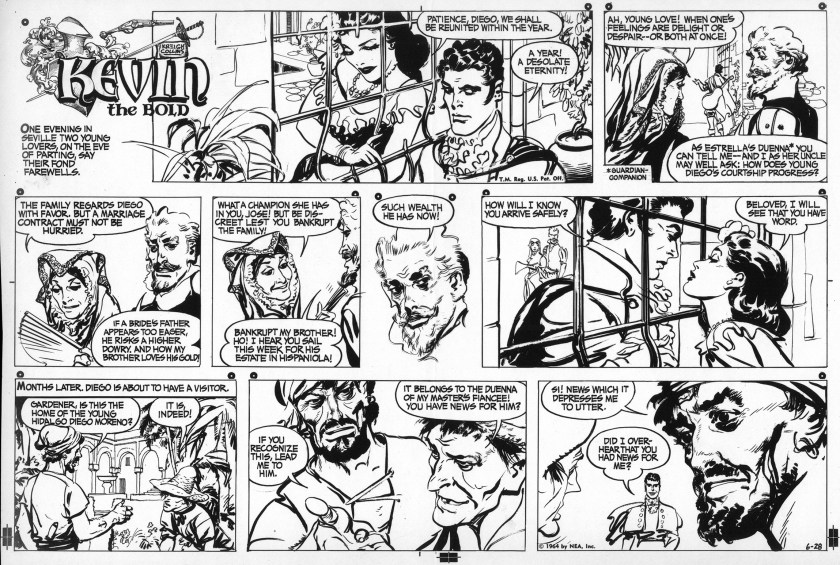
The following sequence featured the young Spanish lovers Estrella and Diego. Since I didn’t have the French version of the opener, this printer’s proof of the English version would have to suffice. (I had French versions of the sequence’s remaining episodes).
However, once I dug out the French-Canadian comics, mon dieu! I realized it would be a misguided attempt to honor my French readers — the tops were sheared off the comics and much of the dialog was lost. Adding insult to injury, this week the U.S. nosed past France as far as blog visitors are concerned. So I guess there is some justification in continuing the comics in English.
Following the exposition, Kevin and Brett finally appear. Kevin’s friend Pedro turns up, and he brings word of what will become Kevin’s next quest. To be continued…
For more information on the career of Kreigh Collins, please visit his page on Facebook.
In each of Kreigh Collins’ three NEA comics, travel is a frequent theme.
Mitzi McCoy flew her private airplane into the northern Canadian wilds, and later to Chicago. She also spent time in Florida. Kevin originated in Ireland but traveled widely throughout Europe, Northern Africa, the Middle East — he even visited the New World toward the end of his run (c. 1967). The Marlin family’s travels in “Up Anchor!” mirrored Collins’ own — besides sailing the Great Lakes and the Great Loop, the schooner Heather also called New England and Maine home for two seasons. A change of scenery provides a cartoonist an opportunity for varied tableaux, new storylines, and a chance to meet new characters.
Two years ago, I started this blog with the goal of raising awareness of my grandfather’s career (in advance of the publication of the collected “Mitzi McCoy” comics). While I’m not sure how successful I’ve been, I do know that my blog has done a fair bit of traveling too. According to its statistical data, it has been viewed by people in 55 countries across the world, amazing! I wish I could thank each visitor, I’m sure I’d also meet some characters.
The statistics are interesting, and I am pleased to note surprises. There have been slightly more viewers from France than from the United States, and there have been no visitors whatsoever from mainland China or Russia. Punching above their weight class are #4 Portugal and #6 Croatia (the 88th- and 129th-most populous countries in the world). The top twelve countries make up about 96% of my traffic, and while this is great, it’s more exciting to reach especially distant and smaller places. To my singular readers from Luxembourg, Uruguay, Greece, Guam, Romania, Slovenia, Qatar, the Philippines, Indonesia, Tunisia, Ecuador, Costa Rica, Malaysia, Taiwan, Ukraine, European Union (is that even a country?), Singapore, and Greenland (population 56,412), thank you!
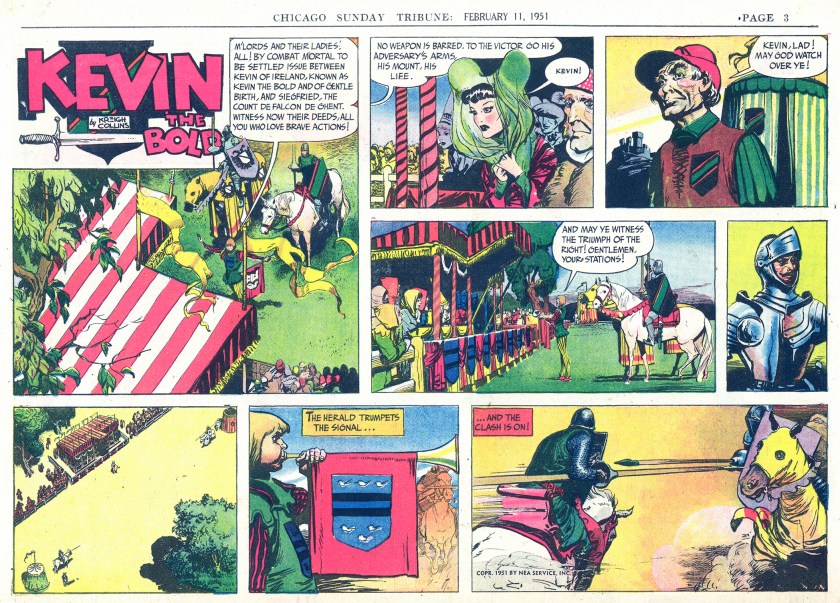
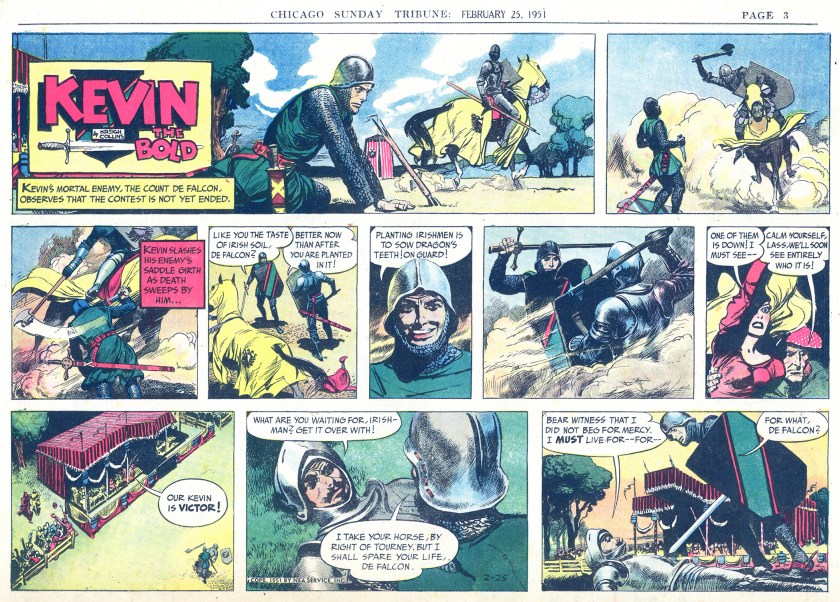
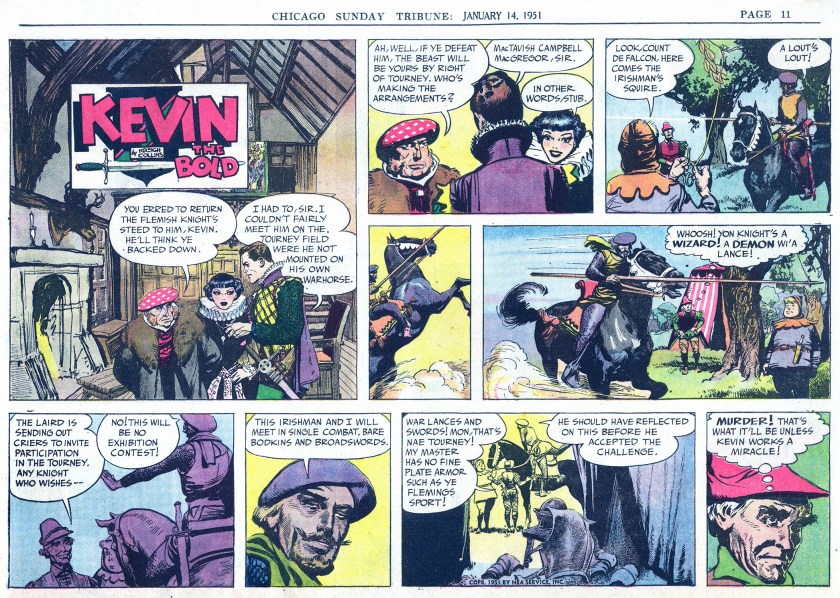
Tournament preparations are completed; it is time for the show. The few rules are explained. The dramatic sequence of the Chicago Sunday Tribune’s new comic feature begins.
With a lot less color and not as much fanfare, the action also unfolded in another recent subscriber to the NEA’s new comic. Kreigh Collins had a longstanding business relationship with a local paper, the Grand Rapids Press, for whom he had previously done illustrations. Like many cities of the era, Grand Rapids had several daily newspapers, but It took a while before any of them started running his comic. (A few months ahead of the strip’s transition to “Kevin,” the Press started running “Mitzi McCoy” in July of 1950).
Now, with the Trib’s vivid reproduction.
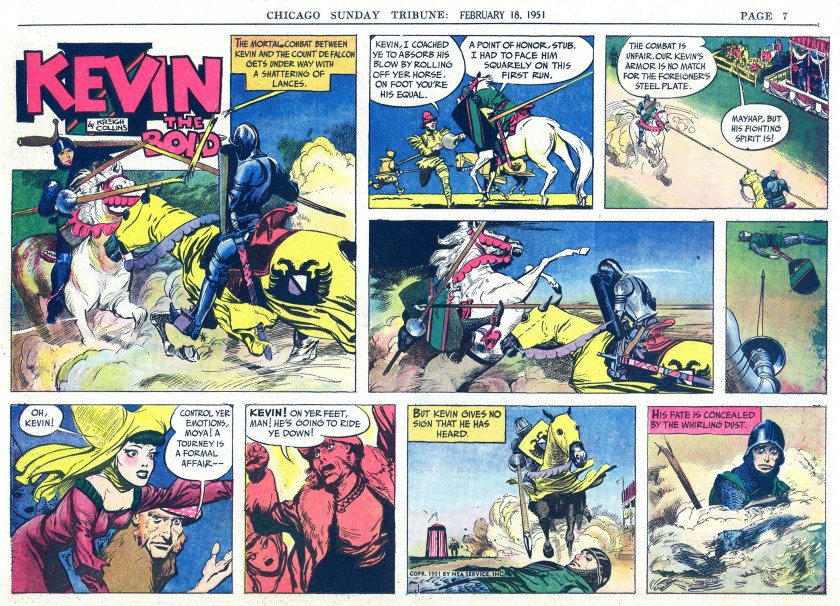
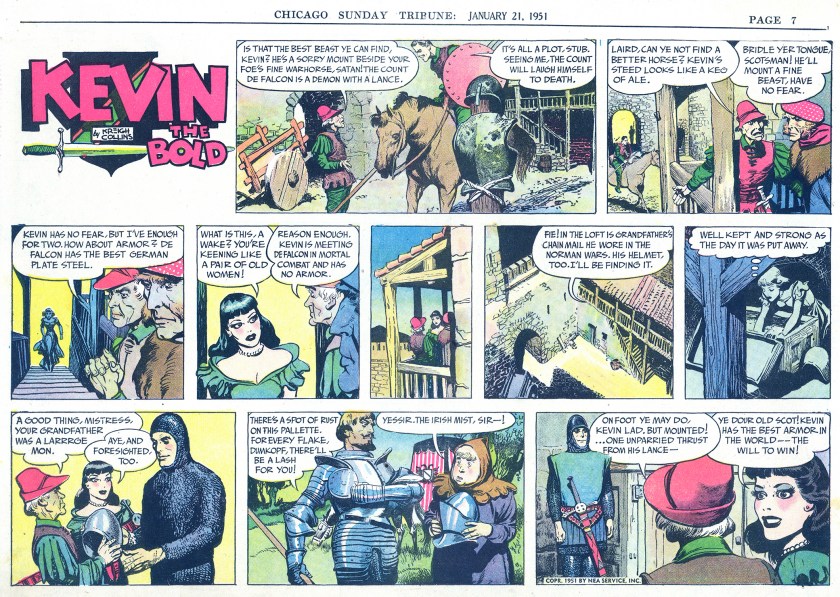
Kevin followed Stub’s plan to slide off his mount in order to try to lure De Falcon into combat on foot. The only problem — De Falcon is still astride his warhorse, Satan. However, playing possum proves effective, and Kevin avoids the Baron’s coup de grâce.
Kevin’s own quick thinking leads to his desired outcome of mano a mano, where Stub declared, “On foot, ye’re his better.”
Stub is absolutely correct, as Kevin makes quick work of De Falcon. Claiming the Count’s horse, but sparing his life, Kevin realizes he has done well to allow him to live. He discovers the fallen man’s humanity, and is about to set out on another quest.
For more information on the career of Kreigh Collins, please visit his page on Facebook.
From its onset, “Kevin the Bold” had much going for it. Kreigh Collins was bursting with enthusiasm for its subject matter, he had the experience and artistic chops to pull of such a period comic, and he had the backing of the Chicago Sunday Tribune to give his work a wider audience. Collins also had a compelling collection of original storylines to illustrate.
The result was some exceptional work. These next three comics neatly distill the essence of the comic strip and its protagonists. Kevin is honorable and humble, yet invincible; MacTavish Campbell MacGregor (“Stub”) is steadfast and loyal; and Moya is cheerful, smart, and beautiful. It’s important to note that as Mitzi McCoy’s ancestor, Moya more closely resembles the heroine of Collins’ earlier comic feature than Kevin and his squire resemble their forebearers, Tim and Stub (despite the older man’s familiar sobriquet). Sadly, Moya does not last long as a prominent character in “Kevin”.
With the date of his fight against De Falcon looming, Kevin starts training, and he also begins to upgrade his gear. In addition to his Claymore, he now has chain mail. With Stub as his tactician, Kevin gets to work.
Acknowledging his past heroism, one of Moya’s father’s subject presents Kevin with a horse more suitable for his tournament date. Appropriately, she is mare, leading to a false sense of confidence in Kevin’s opponent. Like Kevin, she is not to be underestimated, an error made by many of Kevin’s adversaries.
The comics also contrast the two sides in the upcoming battle. Despite the obvious differences, maybe Kevin and the Baron have more in common than they realize.
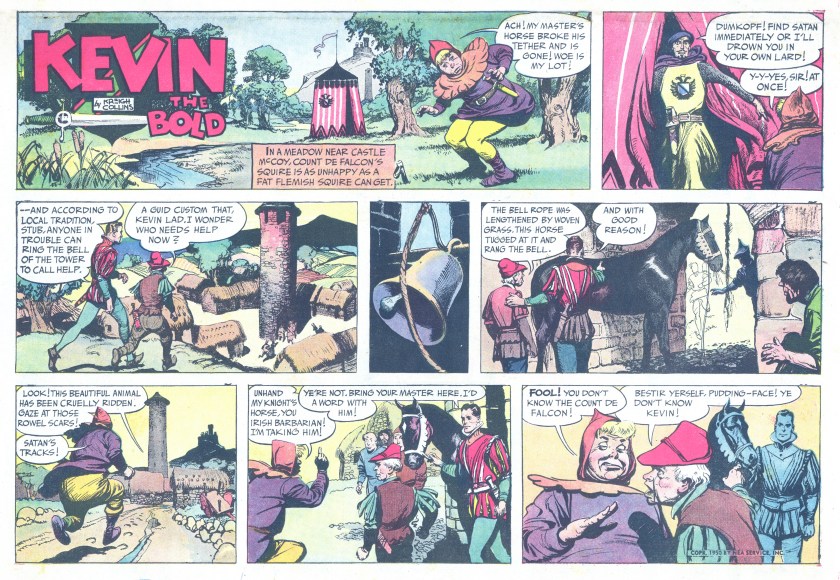
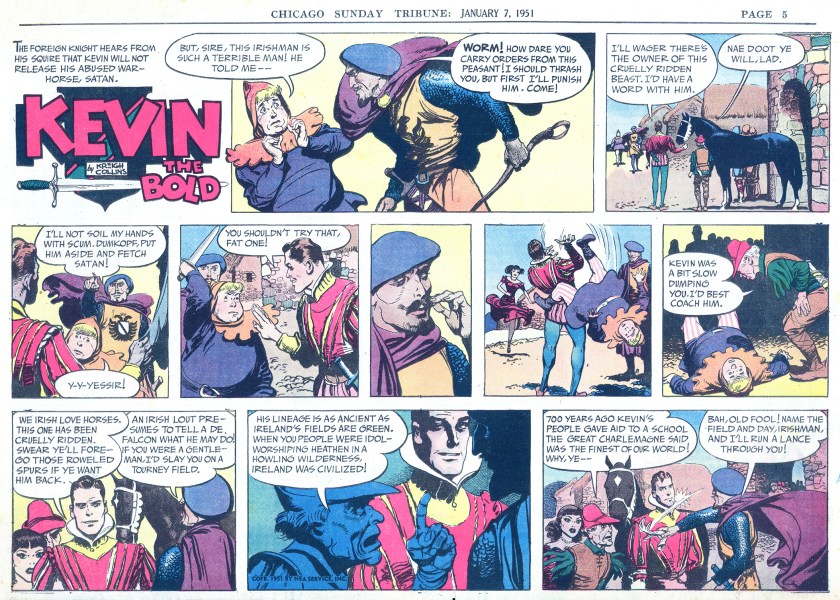
There is trouble in town, as someone has rung the bell at the village tower. Kevin and Stub arrive and are surprised to find out who was calling for help. Also arriving on the scene is the squire for a formidable German, the Count de Falcon.
The light-hearted atmosphere of the previous comics dissipates quickly as the tension builds, and matters escalate quickly. The Baron throws down the gauntlet, and formally challenges Kevin to a duel.
Making matters worse, Stub realizes the terms of battle are not negotiable. As his trainer, the squire knows Kevin’s abilities well, but is worried about the advantages the Count will have. We shall see if Kevin’s strongest suit, his sense of honor, will somehow help him prevail.
Following the abrupt transformation of the comic strip “Mitzi McCoy” into “Kevin the Bold,” Kreigh Collins was ready with several dynamic storylines for his new hero, and his artwork was equally up to the task.
At the end of the new comic strip’s first chapter, Kevin defeated the Moorish pirates and saved the locals from enslavement. As a reward, Moya McCoy’s father presented Kevin with a historically significant claymore, as well as his distinguished title.
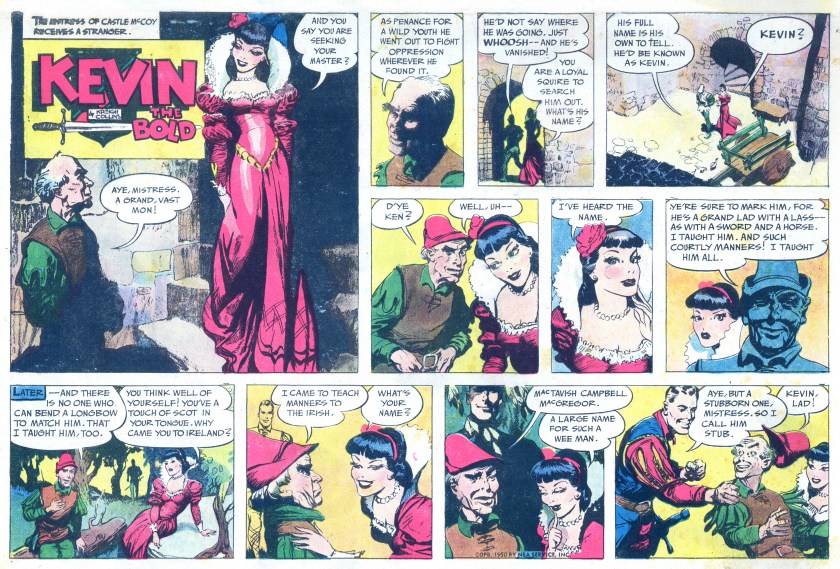
The second chapter of “Kevin the Bold” begins with a marvelous comic. Its splash panel shows a beautifully garbed Moya, as MacTavish Campbell MacGregor is introduced. Upon meeting Moya, “Stub” announces Kevin’s simple credo. Moya instantly takes to the prickly Scotsman and fires a snappy line at her new friend.
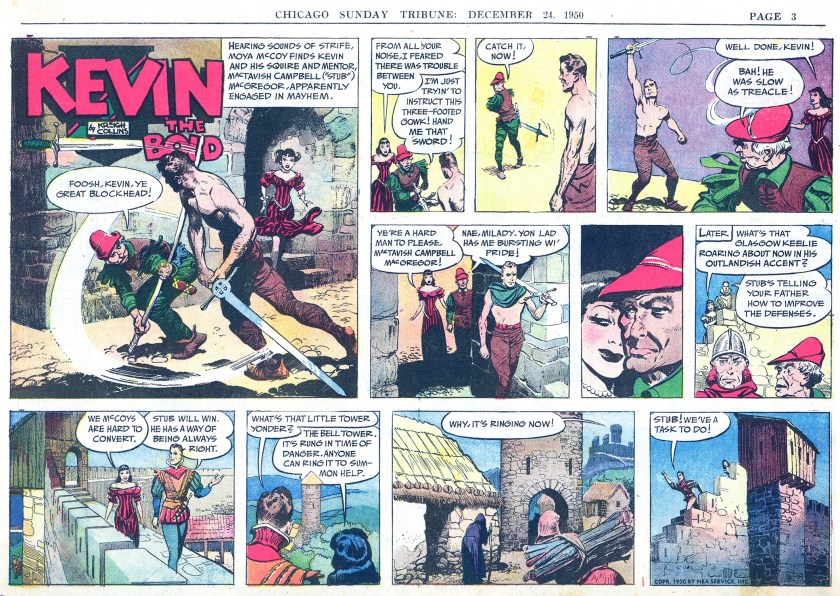
As is often the case, the transitional comics between the main sequences are lighthearted, but action comes to the fore in the next comic, with another exciting splash panel. Stub has resumed Kevin’s training, with our protagonist getting acquainted with his fearsome new weapon. No doubt this training will come in handy at a later time.
The comic also shows the amazing reproductive abilities of Collins’ newest champion, the Chicago Tribune. The Trib typically ran its new feature near the front of its comic section, and the newspaper was able to showcase the Kreigh’s skills with its own superb coloring, including a very nice example of aerial perspective in the ninth panel.
Significantly, this panel shows a distant bell tower, which calls Kevin to action.
[Update: in my haste to figure out anything about the following comic, I originally misidentified it as Danish. It is, in fact, Swedish. My apologies! If you have any information on this comic book series, please feel free to leave a comment; the comments link is rather buried at the bottom of the post. Thank you].
Pratar du svenska??
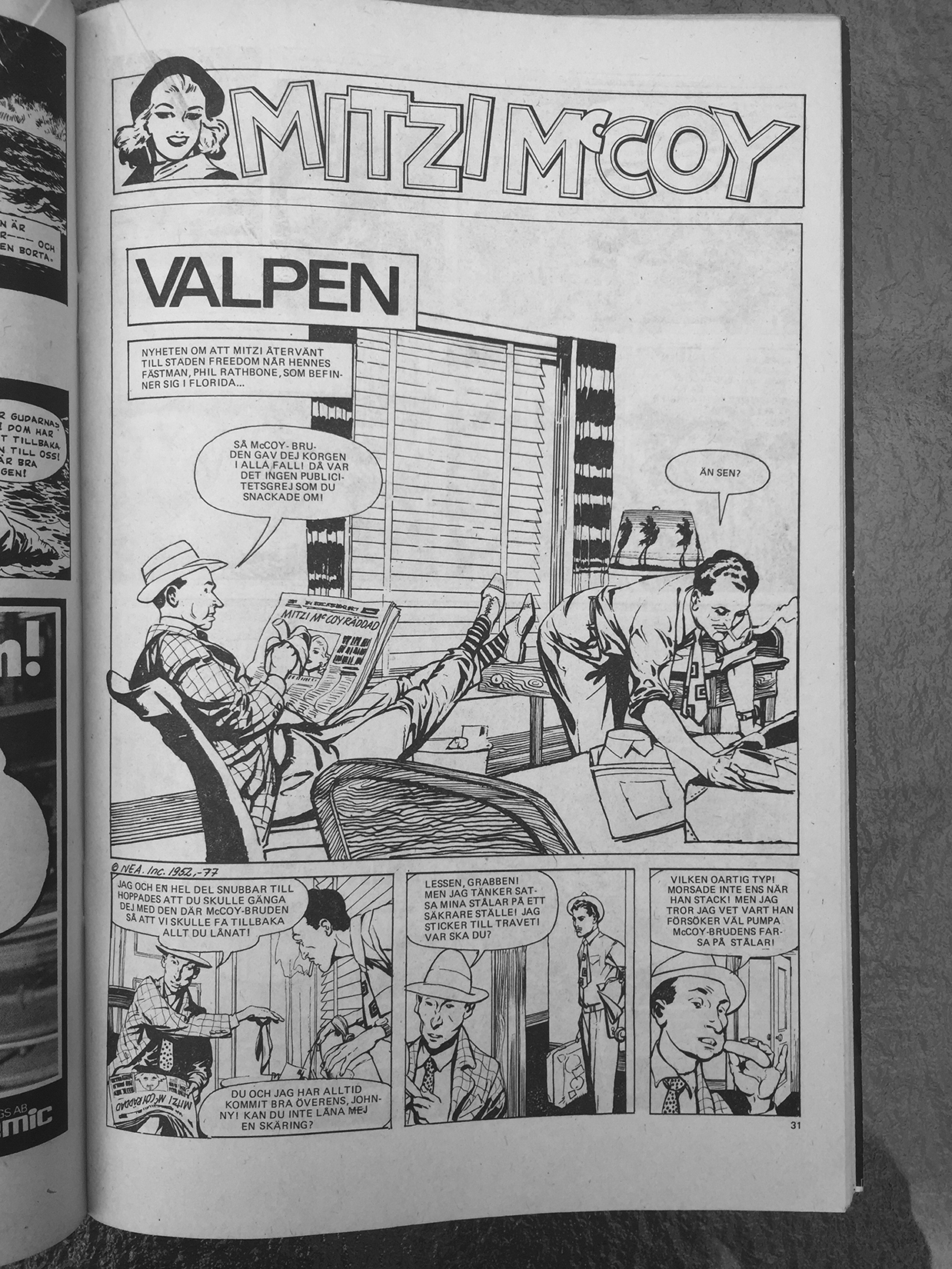
I do not speak Swedish, but I wish I did. This comic book caught my eye with the mention of “MItzi McCoy” among its coverlines. Knowledge of Swedish would come in handy in comparing the dialog of the Mitzi comics it contained to the original English, as it originally appeared in late 1940s.
I had been aware of Kreigh Collins’ comics being reprintedforAustralianmarkets, and also for Argentina. I’d even come across some Norwegian comics. Usually these reprints all featured “Kevin the Bold.” But this one was a surprise, bringing Mitzi back nearly 30 years after the original Sunday comics ran.
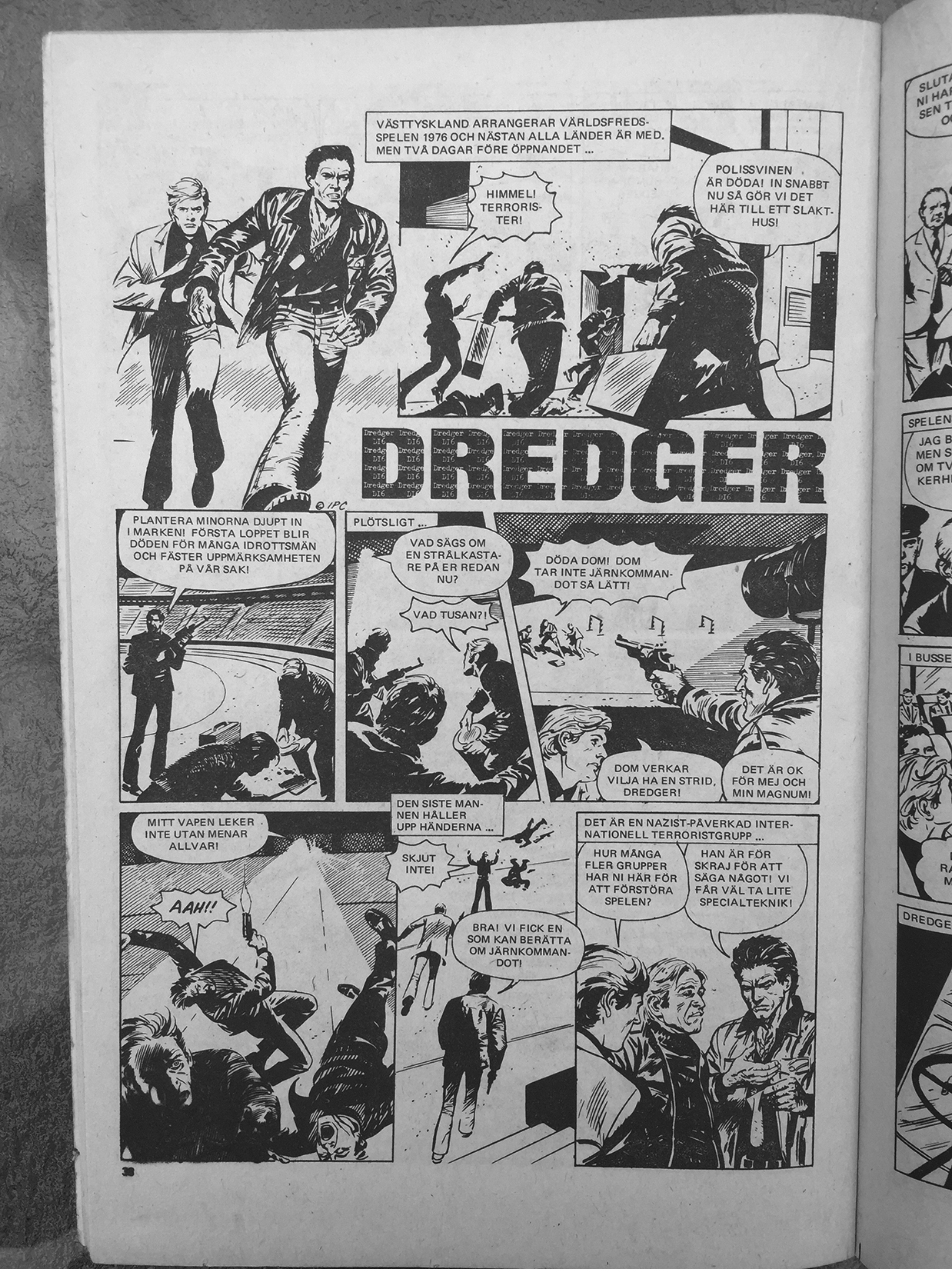
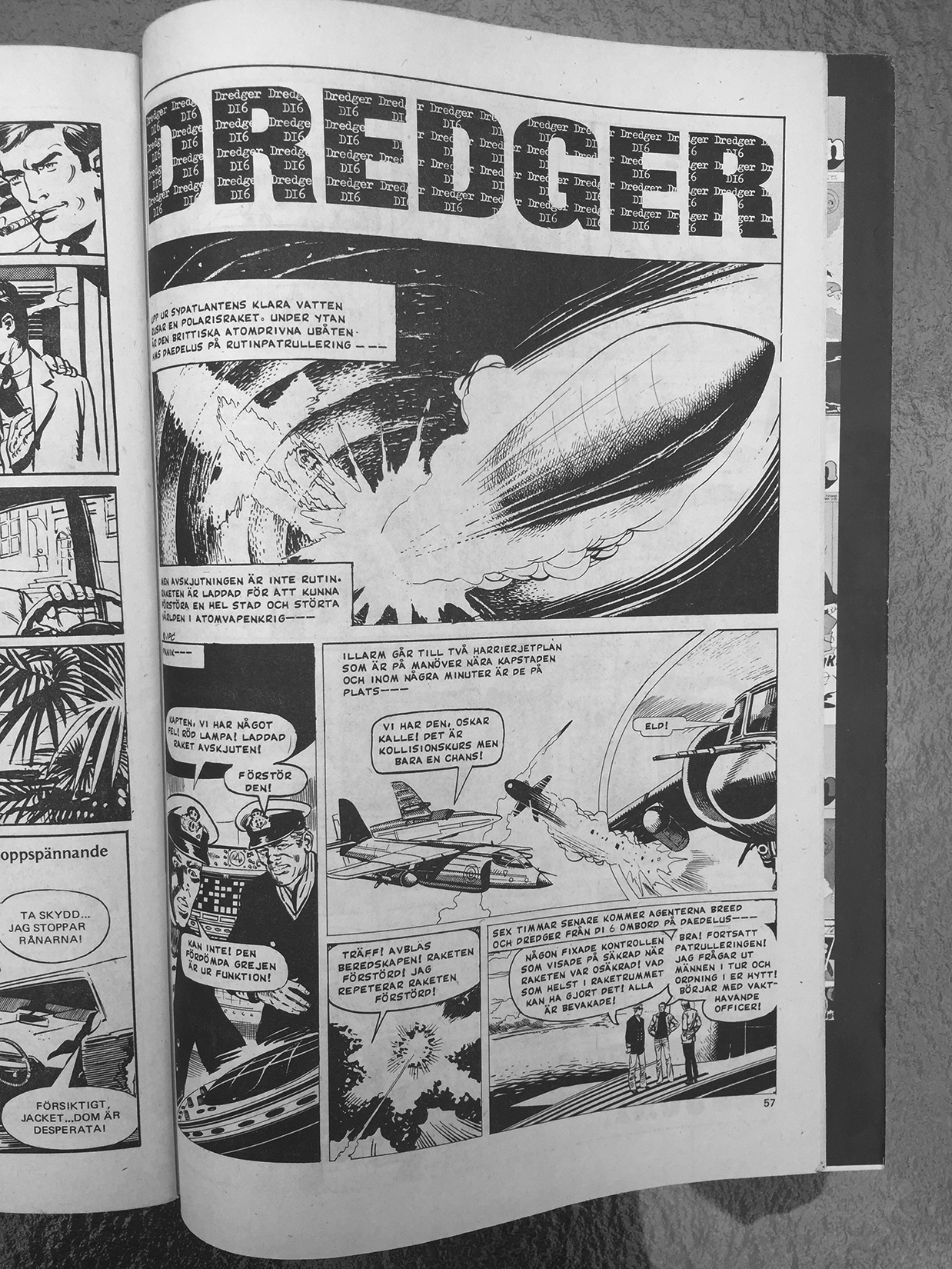
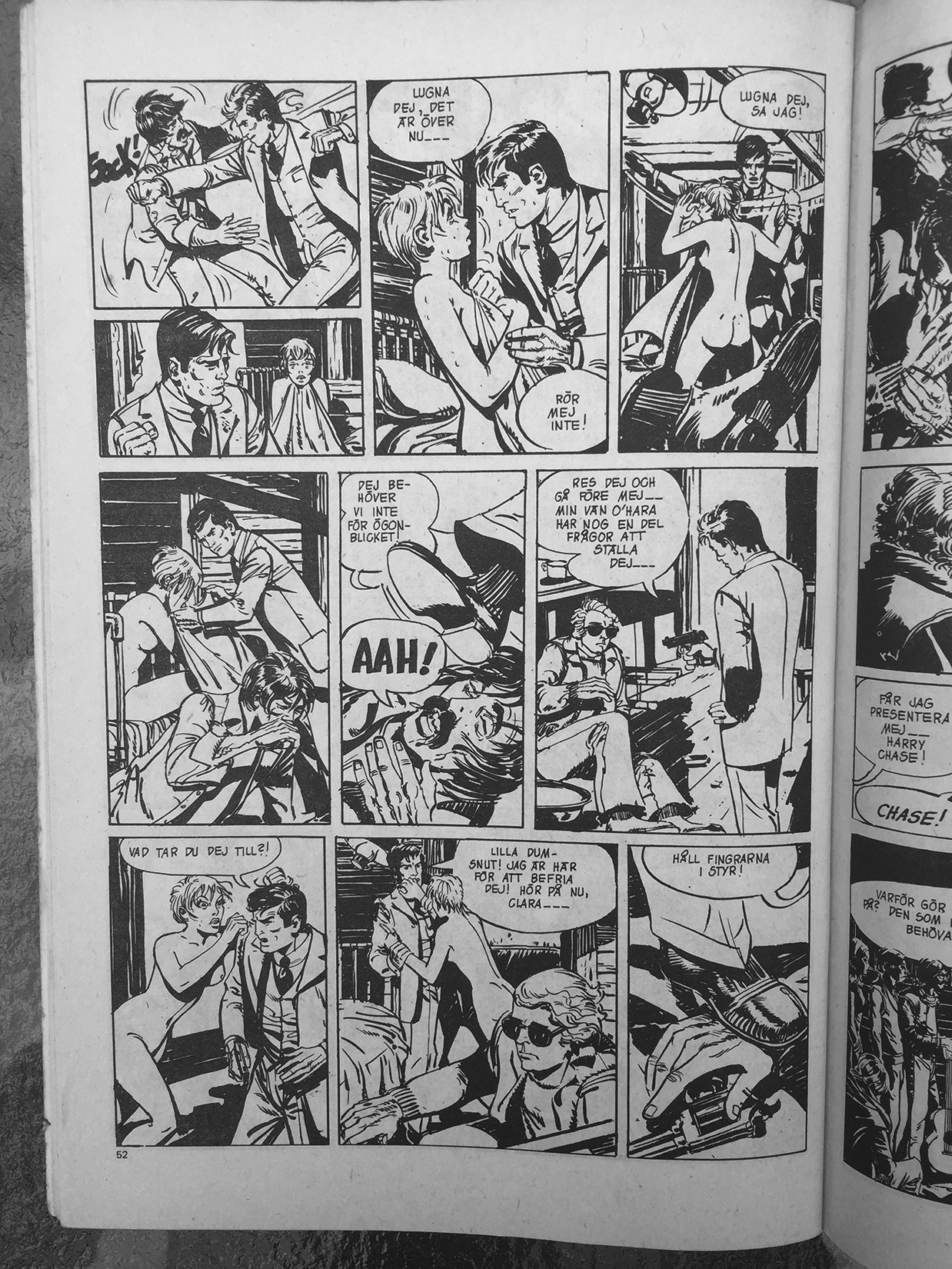
Serie magasinet 13 runs 68 pages, with plenty of preliminary action before what is for me, the main event. Inside there are a couple sequences of “Dredger,” and one each of “Harry Chase,” “Kerry Drake,” and something called “Larm I Distrikt 94.” Forgive me, I know nothing about these comics. I suspect at least one is of Scandinavian origin, as a female character is shown without the clothing typical of mainstream American comics.
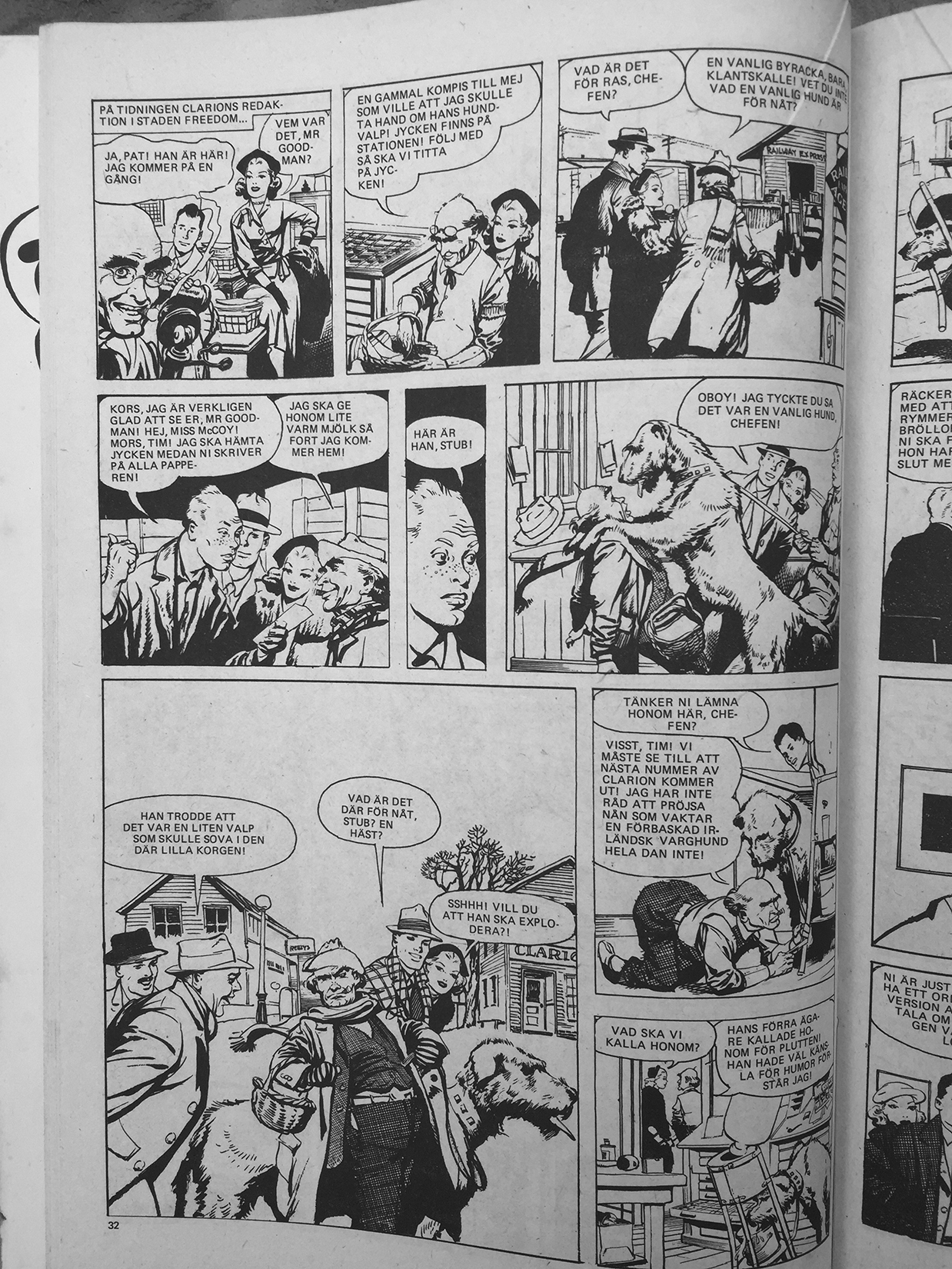
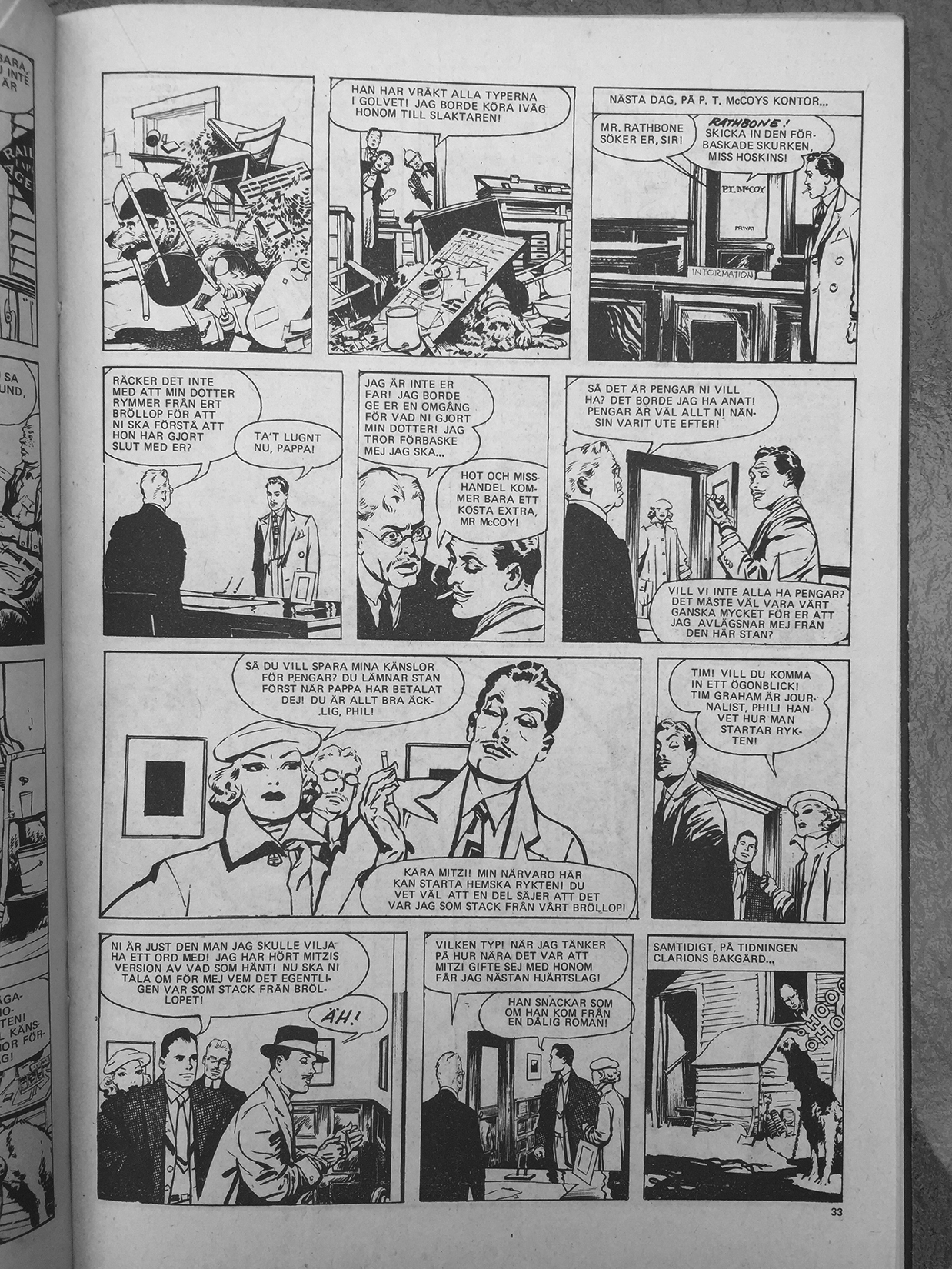
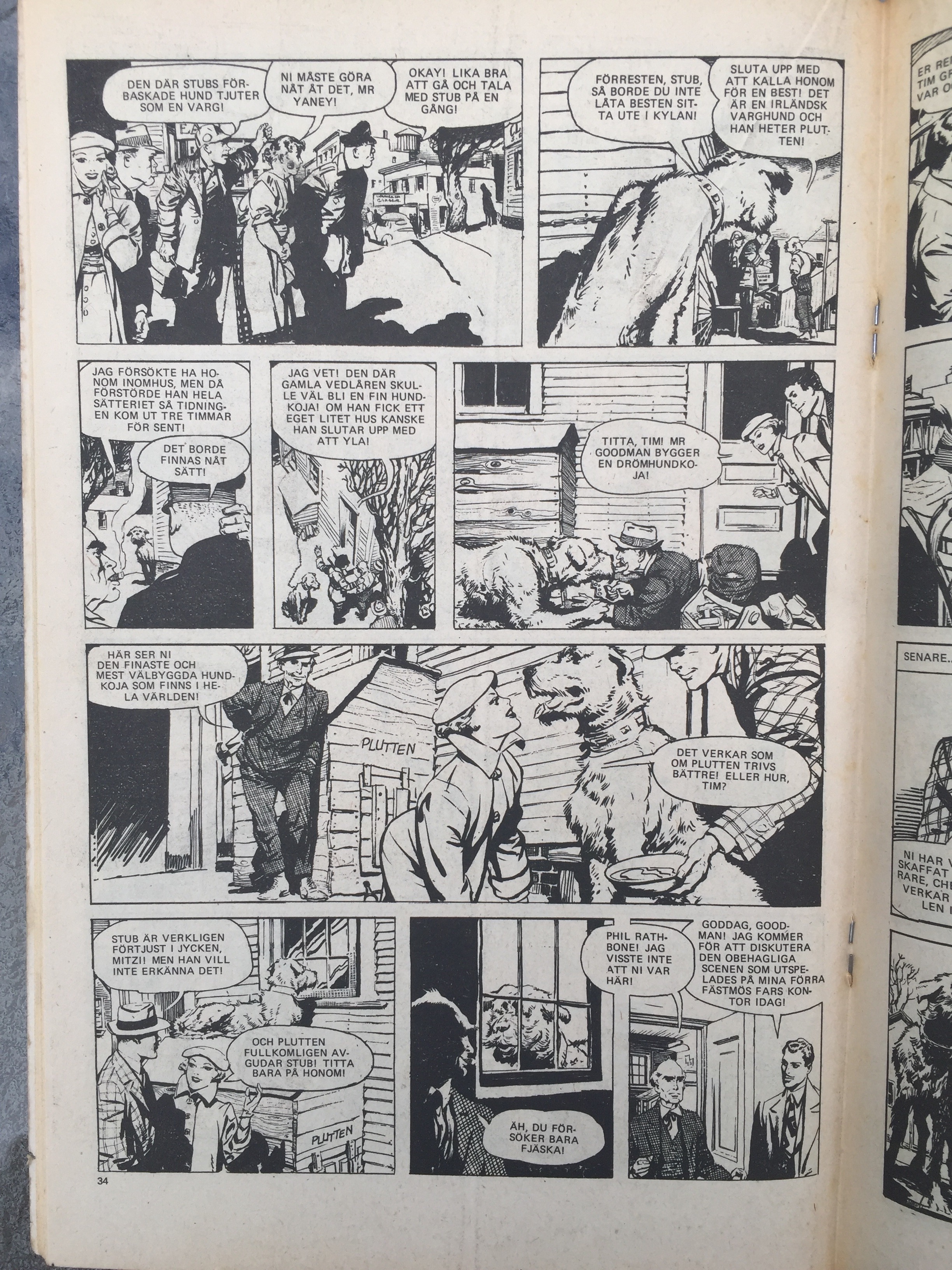
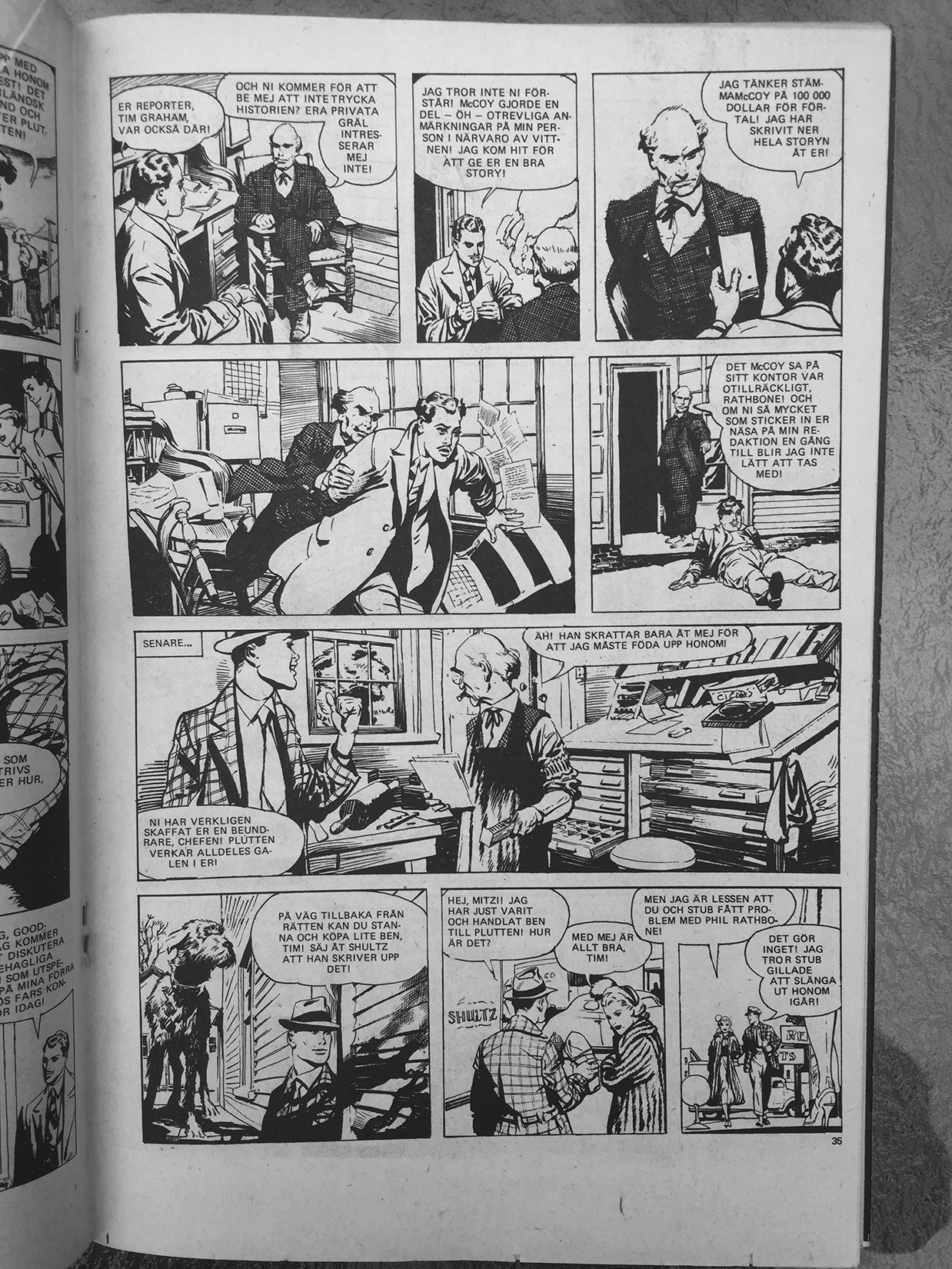
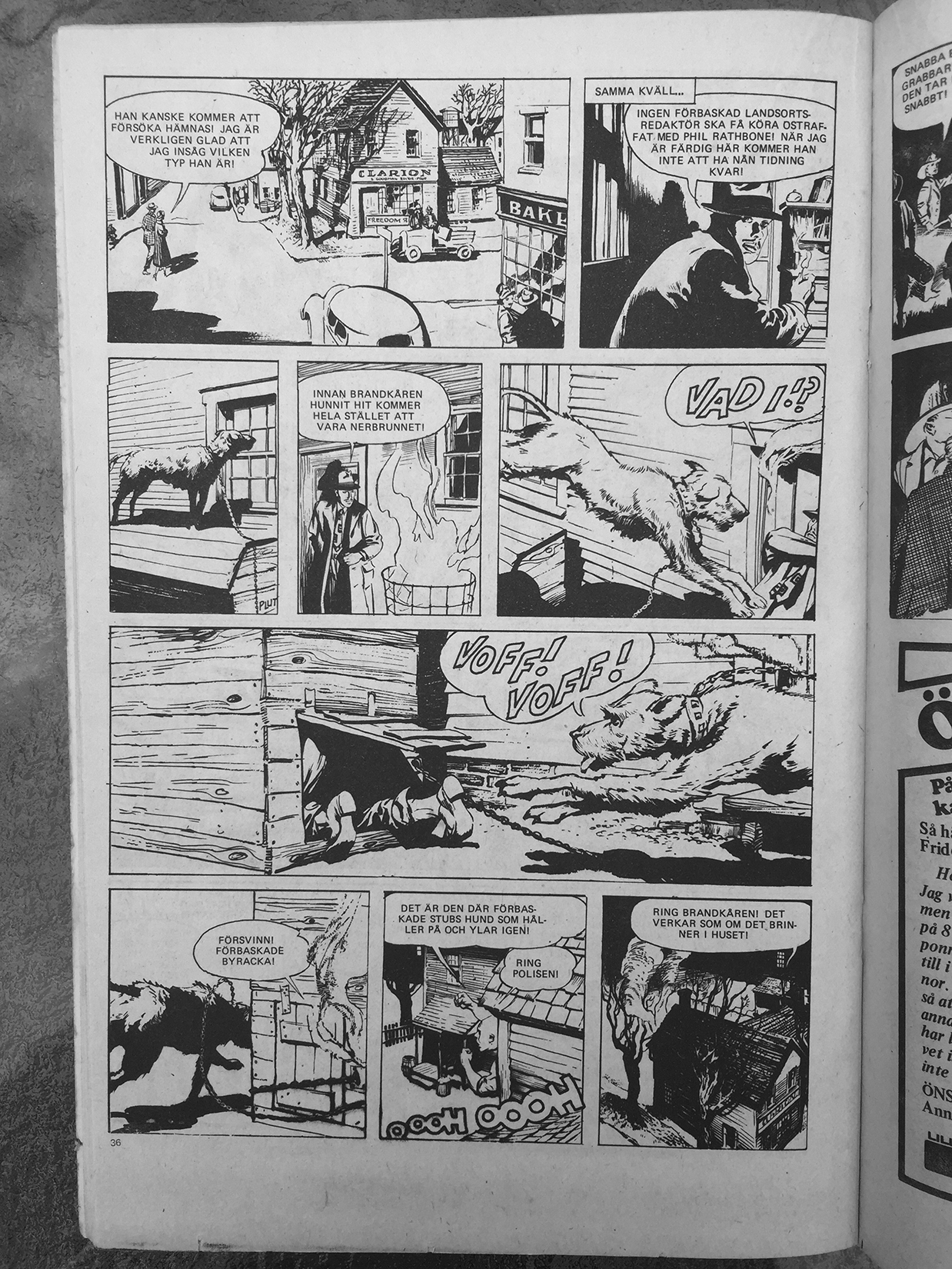
Starting on page 31 is the second sequence from “Mitzi McCoy”’. Its six comics were originally published from January to March in 1949. They show all of the strip’s main characters, and feature Stub Goodman’s Irish Wolfhound, Tiny, in his fist heroic role.
The comics are reproduced pretty much as they originally appeared as tabloids in the Sunday papers, with their throwaway panels omitted. The only real alteration I could spot is the artificial creation of the opening sequence’s splash panel (only the bottom half appeared in the original). Curious as to what “Valpen” meant, I learned it meant “the puppy.”
I was disappointed to see there was no translation evident of “Plutten,” Tiny’s name in the Swedish version of the comic (written on his doghouse).
The comics were reproduced from original proofs supplied by the NEA — it’s great to see Collins’ crisp black and white line work. Unfortunately, the whereabouts of these proofs at this time is unknown. Meanwhile, I’m trying to track down information on other Serie comic books.
If one was to include the pre-Newspaper Enterprise Association (NEA) weekly “Bible Stories Comics,” Kreigh Collins’ comics career lasted nearly three decades. “Up Anchor” was his final comic, and it ran for nearly three and a half years.
As summer ended in 1959, Collins and his family packed up his sailboat and headed south. They ended up spending a year on the boat, traveling down the Mississippi, and wintering in Florida. He continued with his work while aboard Heather, producing artwork for the comic as his family’s journey progressed.
With help from the NEA, Collins was happy to do promotion for his work, and given his unique situation as a sailing snowbird, this was sometimes front-page news. In an interview with the Panama City News-Herald that appeared in the daily’s November 1, 1959 edition, Collins explained how he was able to do it: “Maintaining a comic strip is a high-pressure sort of thing. You’re dealing with it every day, meeting deadlines, writing scripts, doing the artwork, and so on. To stay normal, you just about have to have your mental balance.” The article continued, Collins maintains his balance by writing children’s books, adventure stories, and travel articles. He also considers his 45-foot yacht a mental life saver.
A syndicate proof of the comic that appeared in Panama City News-Herald, above
After “Kevin the Bold” had run its course, Collins launched his next comic, “Up Anchor!,” in 1968. He used many of his family’s experiences aboard Heather as fodder for his scripts, but much of the material came from his imagination. While there was talk in 1966 of spinning off “Kevin” into a television show, movies weren’t really in the conversation. Nonetheless, Hollywood did come into focus in one of the final sequences of “Up Anchor!”
The original illustrations for the comics that will follow in the next several weeks are all in the collection of the Grand Rapids Public Library.
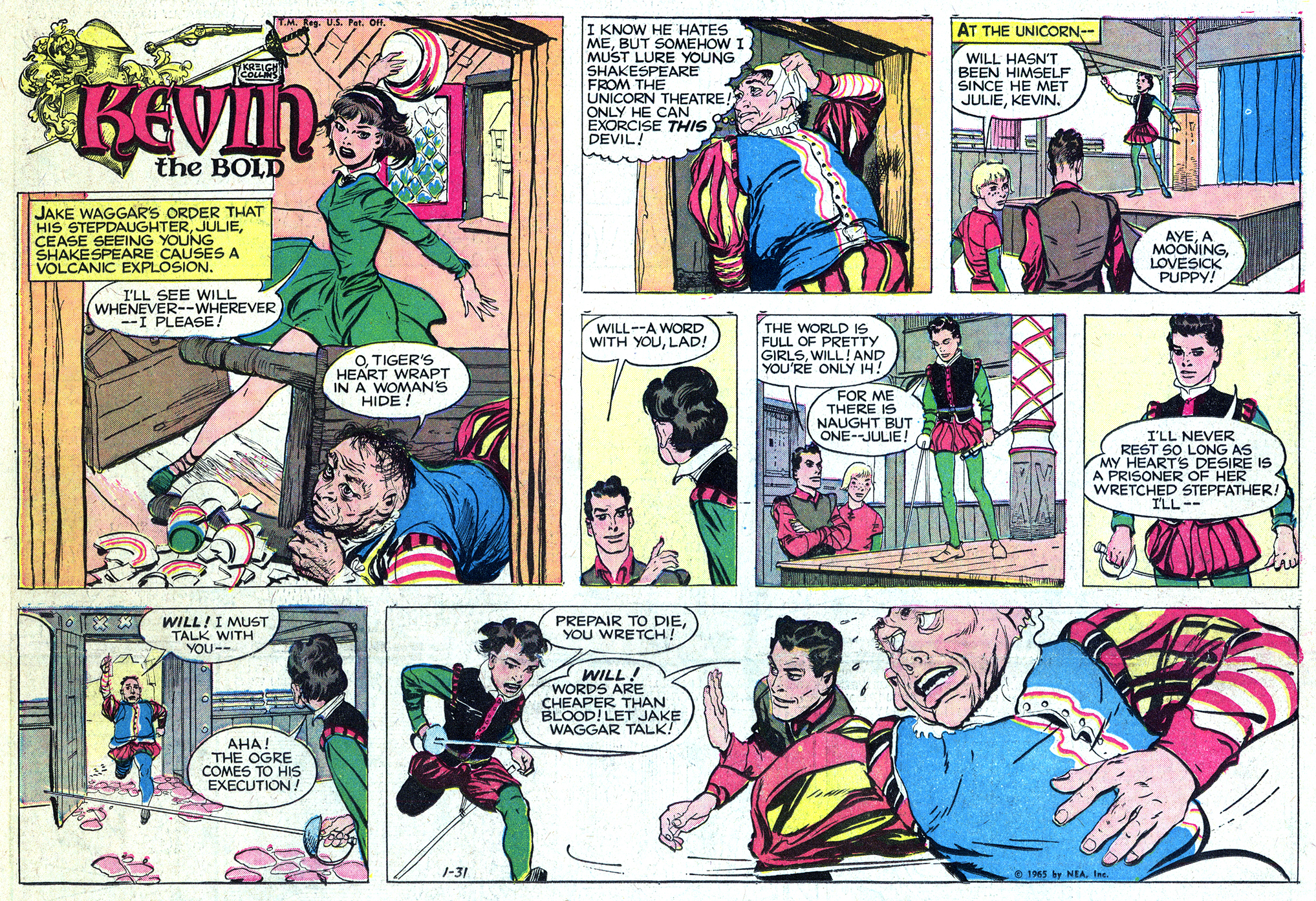
The light-hearted sequence with young Will Shakespeare continues, and so do the cribbed lines. Looking them up is a nice way to be introduced to some of Shakespeare’s body of work, and I imagine Kreigh Collins and his editor had fun working them into the dialog. Who knew? (not me), there’s some good stuff in there. O tiger’s heart wrapt in a woman’s hide, and prepare to die… this stuff would keep me coming back for more if I was a reader of mid-’60s Sunday comics… which I guess I was, sort of (well, big brother Brett anyway).
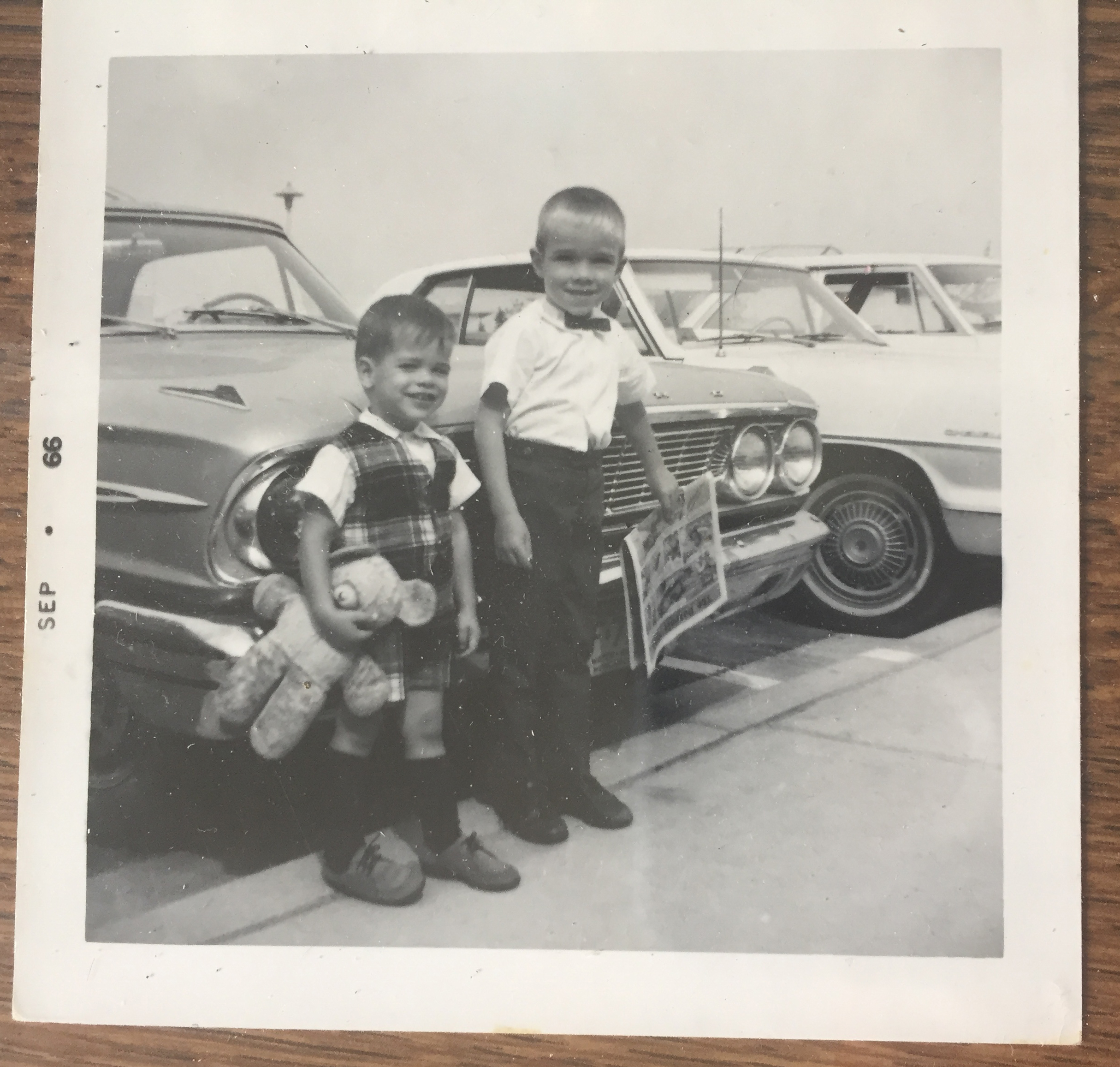
Standing in front of our ’64 Ford Fairlane 500, from left to right, Edward Bear, Brian, and Brett (holding the Detroit News’ comics section).
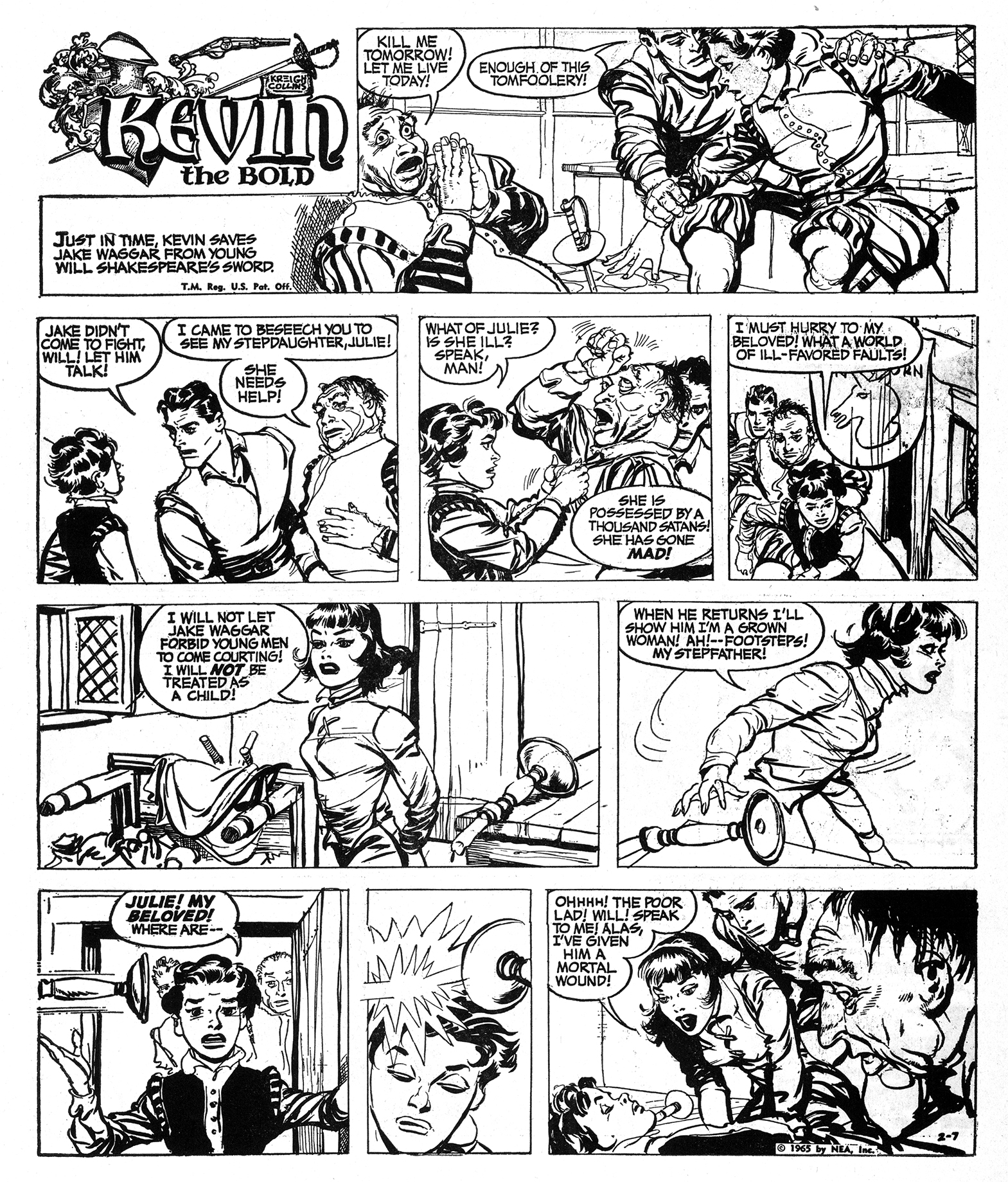
The sequence is nearing its curtain, but there is still time for more fun with Shakespeare’s lines (Kill me tomorrow…).
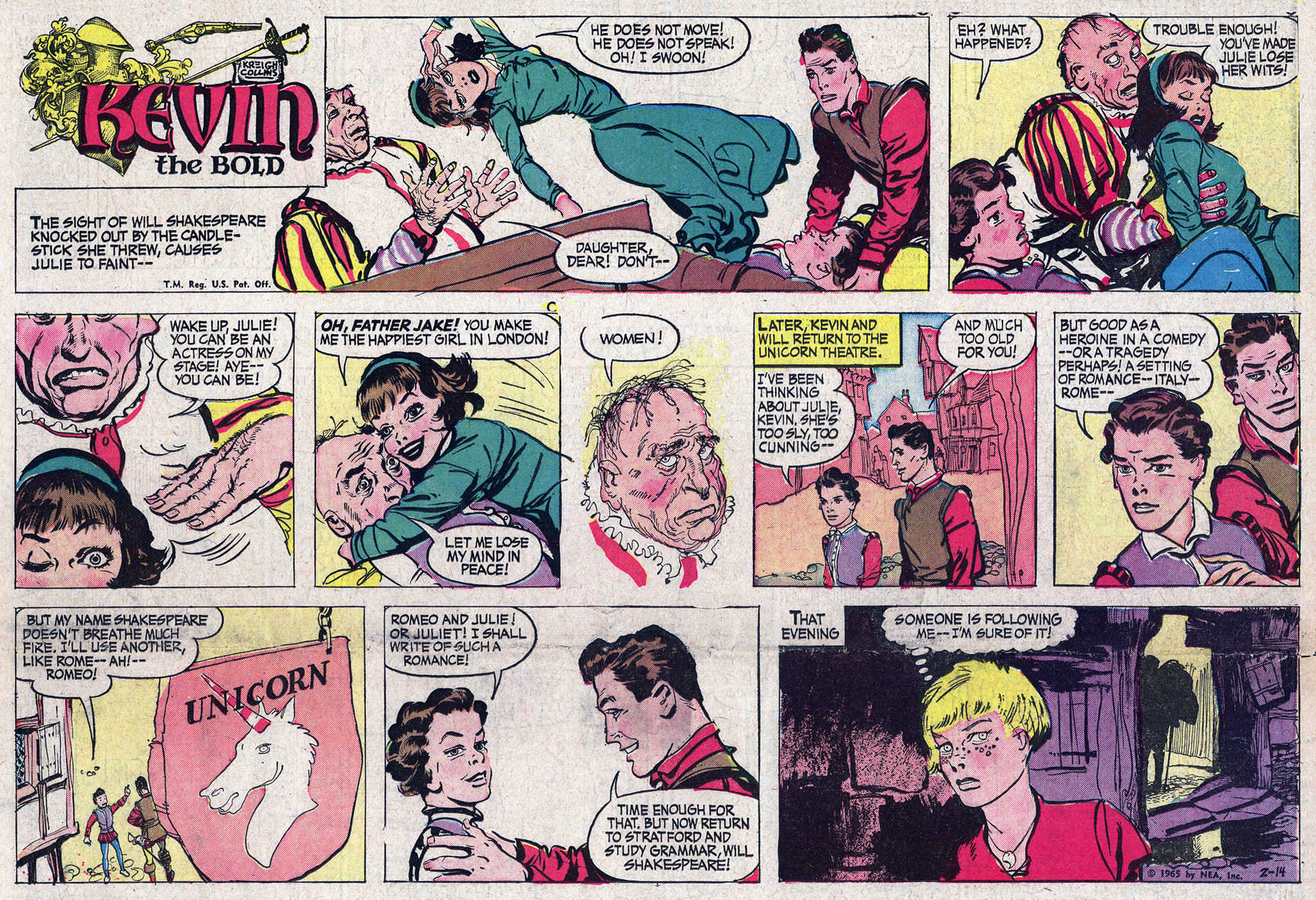
Overall, the sequence is more whimsical than any other I can think of, as far as “Kevin the Bold” is concerned. Its mood is more reminiscent of “Mitzi McCoy,” and it serves as a nice change of pace from Kevin’s usual antics dealing with despots, pirates and thugs. It is followed by another sequence in which Brett plays a prominent role, likely these were an attempt to engage younger readers.














 Kreigh’s Comics
