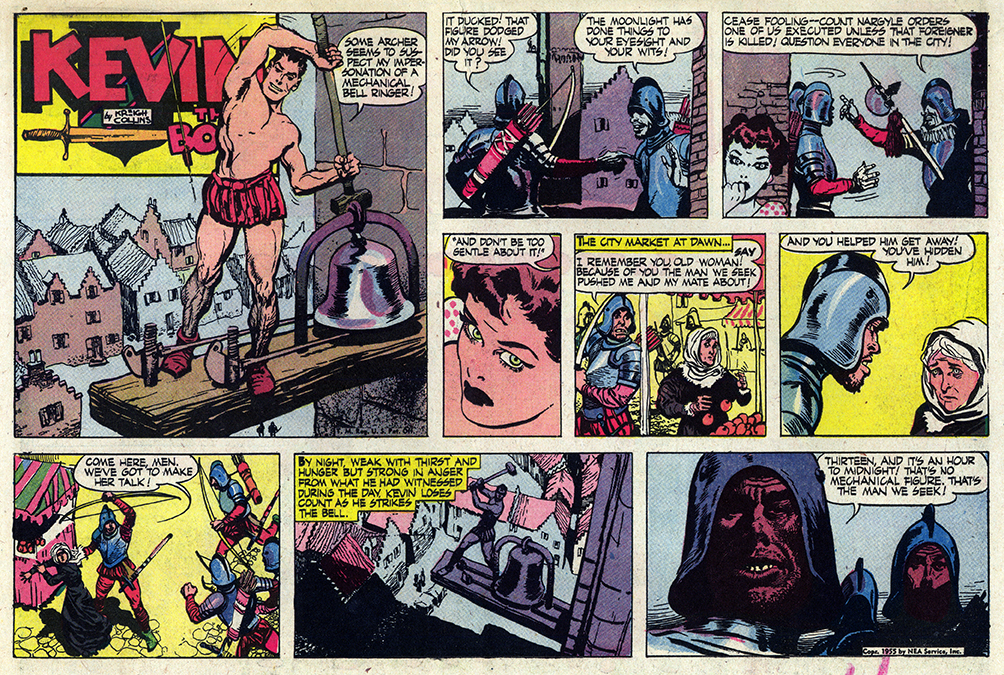
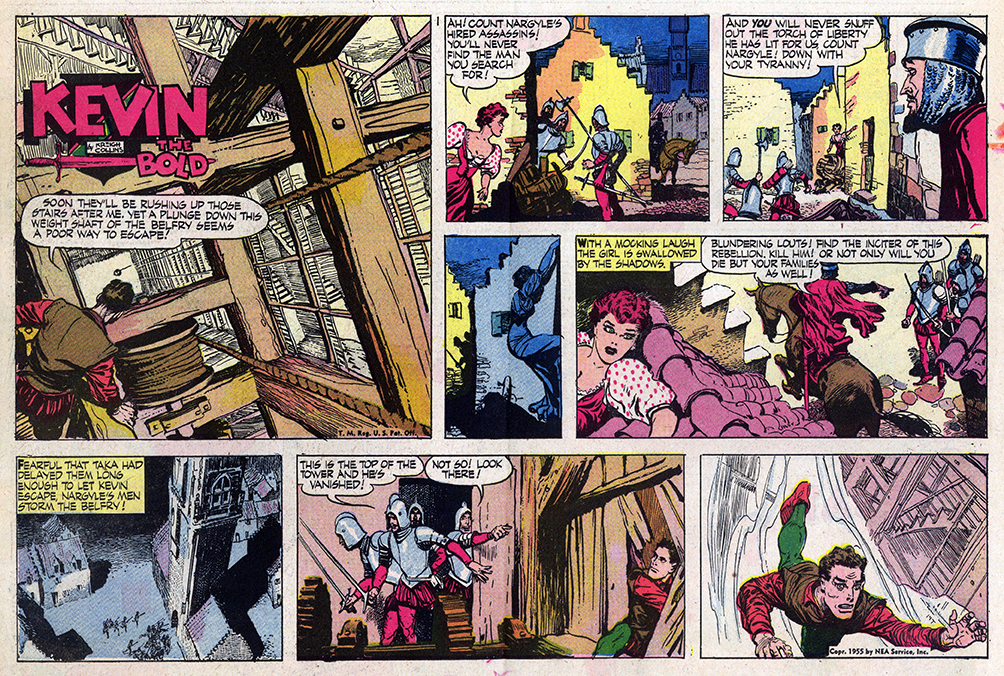
The chapter continues with three more beautifully-drawn episodes. Of note, each of the ten episodes includes a double-decked splash panel. The September 11 installment features one with a wonderful rendering of the town’s imposing bell tower (possibly inspired by the famous Belfry of Bruges); the rest of the episode’s panels match it in quality and drama. Meanwhile, trapped in the belfry, Kevin’s options are limited.
Kevin’s imitation of the bell-ringer is inspired. Nonetheless, it puts him in danger…
…and time is not on Kevin’s side. Meanwhile, lovely Taka eavesdrops on the soldiers.
Another magnificent splash panel, as arresting as the others, hints at Kevin’s only escape.
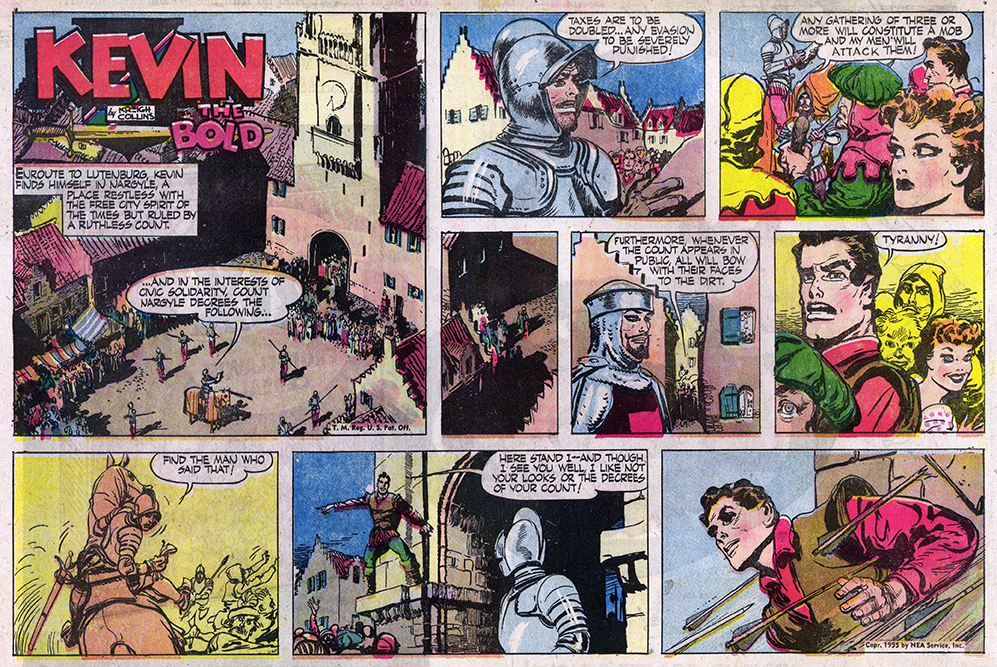
Today, a 10-episode chapter—KEVIN THE BOLD’s 22nd—begins. Originally, I had planned on featuring the following sequence, but when I realized it was a continuation of this one, I decided it made sense to run them both consecutively. These 22 half pages came from the Chicago Tribune (August 28, 1955 through January 22, 1956).
Many chapters start slowly, with an episode or two setting the scene, but in this case Kevin rolls into town and quickly inserts himself in its affairs.
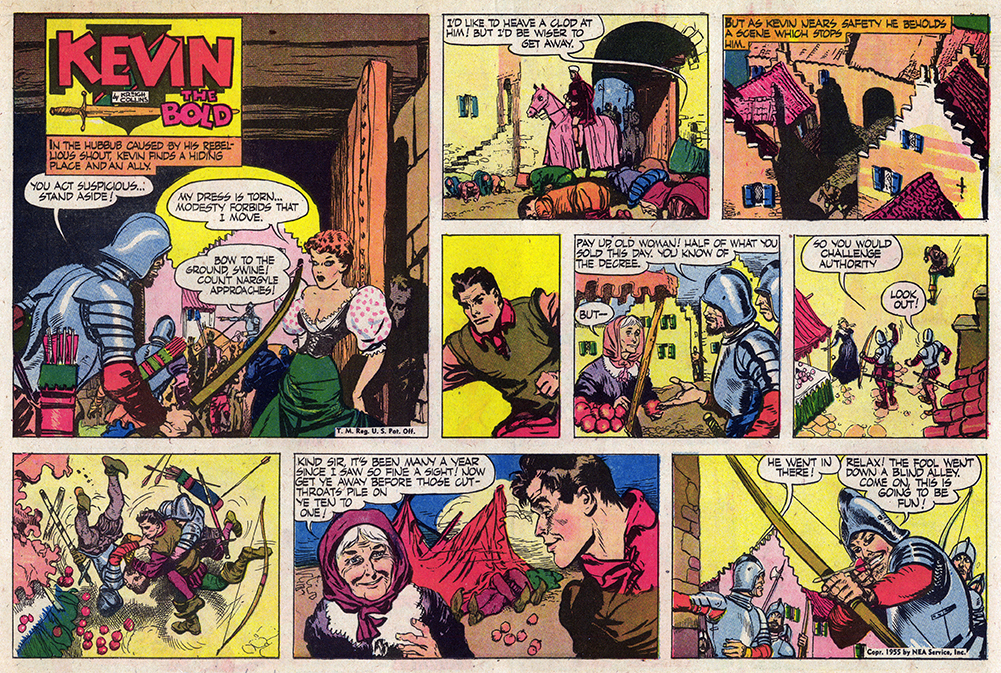
It’s also clear who the villain is—Count Nargyle—and that his ruthless ways run counter to Kevin’s code of behavior. But by making himself a target, Kevin realizes he needs a place to hide. He finds a great spot to seclude himself—and if the redhead’s dress is indeed torn, no doubt the chivalrous Kevin would avert his eyes. A wise move, as this lovely lass, named Taka, is one with whom Kevin will be glad to be allied.
Despite his earlier narrow escape, Kevin can’t help himself and again makes waves.
His intentions are honorable, but his rash decisions bode ill of his future…
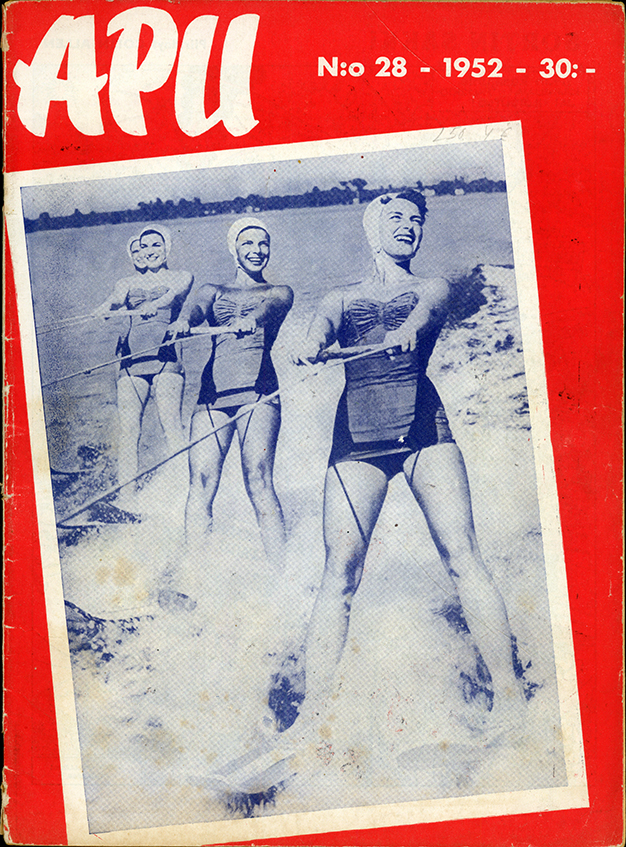
Apu is a weekly magazine from Finland. Like similar publications in Denmark (Hjemmet) and Sweden (Allas Veckotonig), its content was typical—human interest stories, short fiction, photos of pretty girls, horoscopes, etc.—and comics. And like the other Scandinavian weeklies, it carried a translated version of KEVIN THE BOLD—in Finnish, Kreigh Collins’ creation was known as “Haukka Temmeltäväin Tuulten Kasvatti,” which translates very roughly to “The Hawk Grew the Breezes.” Another translation I found online is likely more accurate: “Hawk—The Most Uplifting of the Winds.” (It is interesting to see that the title references a bird of prey, much like the Swedish version, “Falcon Stormfågeln”). The covers printed in two colors, blue and red; the text pages ran in black with red as an occasional spot color.
Apu didn’t include any advertising, which made for a shorter publication. (44 pages, including covers).
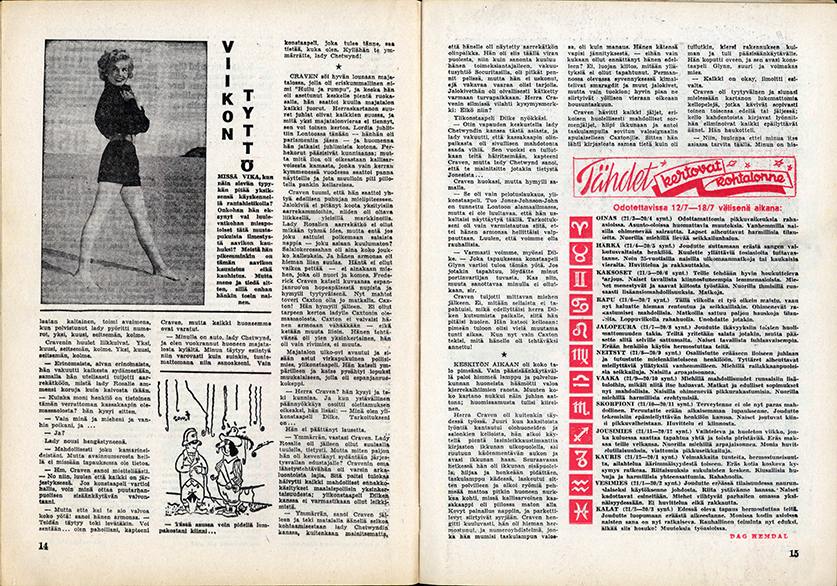
One feature was called Viikon Tyttö (“Girl of the Week”). I think this works in any language. Here, it shared a page with a single-panel gag cartoon (plenty of these were found throughout the magazine). Had I been alive, my horoscope (Gemini) said Tällä viikolaei työ oikein… (“This week does not work properly…” I don’t want to know the rest!)
Appearing near the middle of the magazine was Haukka Temmeltäväin Tuulten Kasvatti. The episide originally appeared in Sunday comics sections on February 10, 1952; this Finnish version ran in mid-July, meaning it had a shorter lag than other similar weeklies’ episodes (which typically ran about a year after their original publication date).
This was part of the sixth KEVIN THE BOLD story arc, and was based on the 19th century short story A Terribly Strange Bed by the English novelist Wilkie Collins. (For more details, read here). Among all of KEVIN THE BOLD’s chapters, it is the shortest—its duration was only four weeks.
A few pages later was the King Features Syndicate title Viidakko Bill (“Jungle Bill”), which seems in fact to have been JUNGLE JIM. (Later, I think it becomes apparent why “Jim” became “Bill”). With the added red tint, it was given the most prominence of Apu’s interior comics.
invalideja (“Disabled”)—a couple photos of cute but disabled animals—was followed by a full-page version of Väiski Vemmelsääri (“Bugs Bunny”). Another full-page comic followed (Luola-Lennu/“Cave Flight”). My guess is that this unsigned comic was a Finnish original.
I love doing crossword puzzles, but because this one is just a bit out of my league, I don’t mind that someone already did most of it. It faces another King Features title, Pipsa Pippuri pürt. Jimmy Hatlo (Jim #2 for those keeping track; originally titled “Little Iodide”), which ran in two colors on the inside back cover.
Of all of Apu’s commics, I’m obviously most interested in Haukka Temmeltäväin Tuulten Kasvatti., but Taika-Jim (Jim #3, originally King Features Syndicate’s “Mandrake the Magician”) gets my vote as weirdest. I ran the words through an online translator to try to follow the action—see below for what I found.
1. Raivostuneiden villien hyökättyä jättiläisflyygeliä vastaan ja sytytettyä sen tuleen (After an enraged wild man attacked a giant grand piano and set it on fire)
2. Syöksyy eriskummallinen musiikin mestari turvaan pianistinorsujensa kanssa (A strange maestro rushes to safety with his piano-playing elephants
3. Jättiläisflyygelin sisällä juoksevat taika-jim tovereilleen (Inside the giant grand piano runs magic Jim with his comrades)
4. Liekkejä uhmaten saattaa prof. metro norsunsa turvaan maanpinnalle (Defying flames, prof. Metro safety lowers his elephant on the ground
5. Alas päästyään käy hän villien kimppuun salaperäisen äänettömän aseensa avulla. villit pakenevat kauhuissaan! (When he gets down, he attacks the wild with his mysterious silent weapon. the wild flee in horror!)
6. Tämä oli raskas isku hänelle, lausuu taika-jim, mutta villejä tuskin voi syyttää. Professorin jättiläismusiikki sai koko tienoon järkkymään joten villien tunteet ymmärtää! (This was a heavy blow to him, says magic-Jim, but the wild can hardly be blamed. The professor’s giant music made me all upset so the wild feelings are understood!)
Perhaps something was lost in translation!
Thank you to the readers whose comments identified “Little Iodide” and “Mandrake the Magician.”
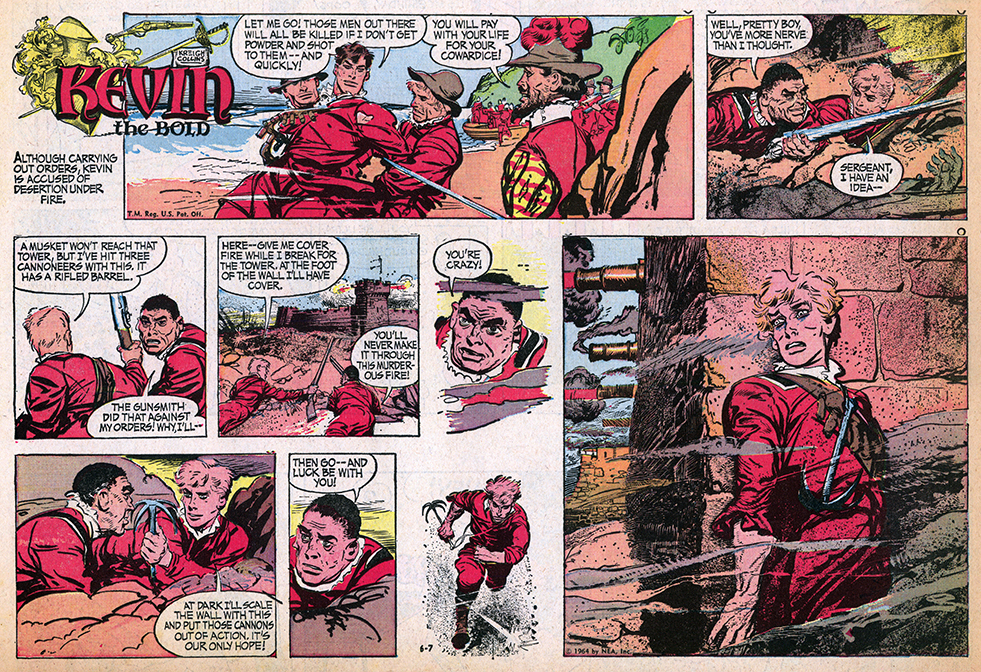
As the chapter with Cecil the Musketeer neared its conclusion, Bob Molyneux lauded Collins’ efforts on the ninth episode, and especially the tenth (shown below).
A veteran of World War II, “Moly” especially appreciated Collins’ renderings of the battle scenes.
As Kevin is accused of desertion, Cecil wins over sergeant Stubbs and makes a daring effort to silence the fort’s cannons.
The plot points of having Cecil using a grappling hook to scale the walls and open the gates were discussed as the script developed, but weren’t actually shown—the dialog helped fill in the blanks. This situation was likely the result of the changes happening at NEA, both in staffing and procedures.
After having mentored Cecil through his Musketeer training, the lad now has a chance to repay Kevin in his moment of need.
With the June 21 episode, the chapter ends rather abruptly—Mary’s father is now happy to have Cecil as his daughter’s suitor. The following week offered a completely new chapter, without the usual sort of transition.
Next week, a new market for KEVIN THE BOLD is revealed.
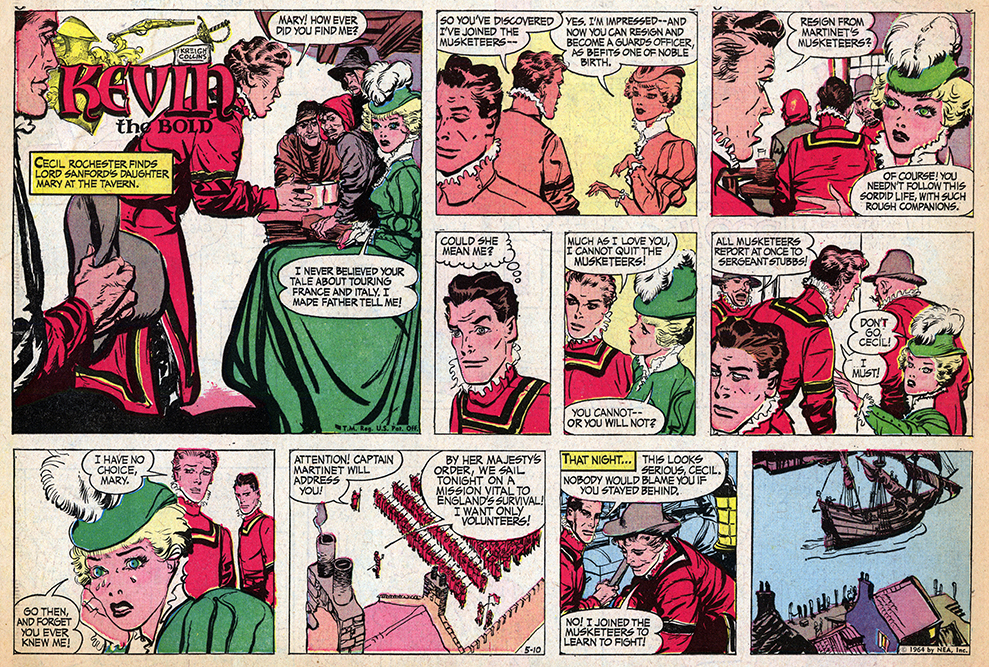
As they approach their destination—one of the Channel Islands—the musketeers hear details about their risky mission. (Based on the appearance of the model of the island, it seems their destination is Jersey).
Behind the scenes, the working relationship between Molyneux and Collins was still being established, with Molyneux taking pains to accommodate his artist. A late February letter from “Moly” indicates the two have already had a face-to-face meeting, and while their wives hadn’t met each other yet, they had been corresponding too. In late spring, a trip through the Great Lakes would bring Collins and his family east, and when they reached Cleveland, Collins offered to take Molyneux out for a sail aboard Heather.
The smudges on the letter are evidence of Collins breaking out his watercolors for the purpose of creating color guides on the bromide proofs he received from NEA (like the one below).
Collins usually received two bromides of each inked episode. He made a color guide from one for NEA, and kept the other for his records.
Despite the kinks in the story’s development, Collins’ artwork has turned out rather nicely, showing the grittiness of war. While the story’s main characters have survived, others weren’t so lucky.
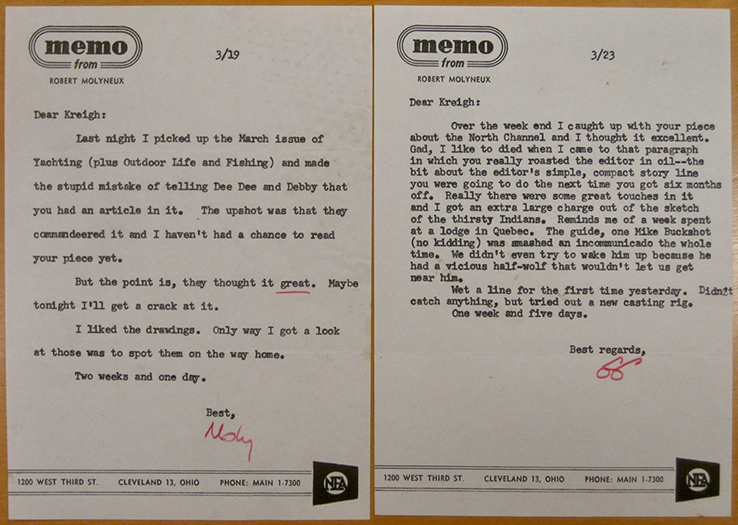
Meanwhile, the relationship between Collins and Molyneux has become more relaxed, with “Moly” often eschewing his secretary’s help in firing off notes to Collins. Here, he reacts to a story written and illustrated by Collins that had been published in Yachting, a monthly sailing magazine.
Collins also had an article published in Yachting (1962) about his family’s 1959 voyage down the Mississippi.
Cecil and Kevin continue to hang tough in their difficult assignment, but an unexpected problem soon arises.
For these next three episodes, color half-pages stand in for last week’s black-and-white bromide proofs. Meanwhile, Sergeant Stubbs assembles Captain Martinet’s new musket company.
There is a bit of tension among the troops, but in this case I’m talking about writer Dave Ward and new recruit, Bob Molyneux.
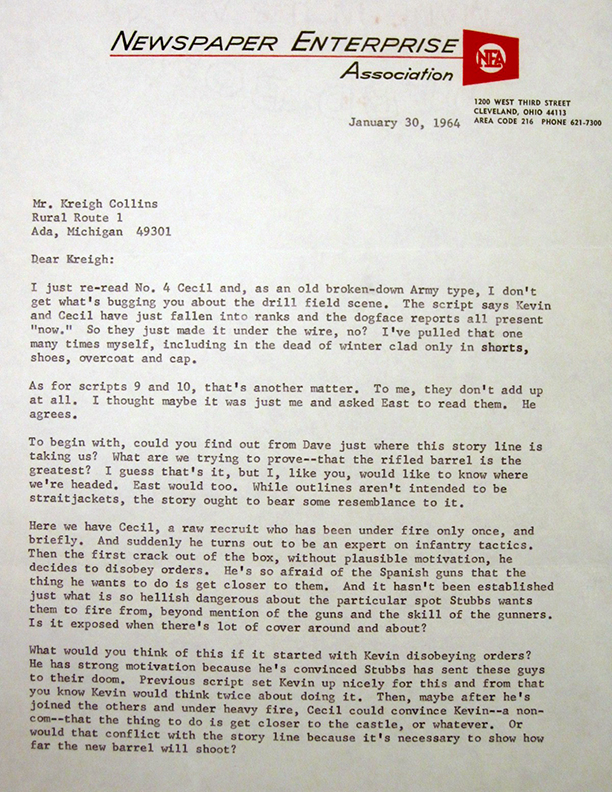
This tension is illustrated in a pair of letters Collins received, both written on Thursday, January 30. Molyneux (perhaps doing Ernest Lynn’s bidding), complains about the trajectory of Ward’s story, and asks for some clarity regarding a plot point involving a gun’s rifled barrel. Feeling defensive about criticisms to his work (again), Ward digs into some minutiae, and takes a potshot at Molyneux (“Maybe Moly should practice on something else — maybe VIC FLINT or BEN CASEY”, referring to two other NEA comic strips, both of which were on the downward arc of their popularity.
Around this time, Collins had his own complaints, more of a physical nature—a sore wrist—no small matter. A letter from Moly reveals another long-time NEA artist was having serious health problems—the business seemed to take its toll on many of its practitioners. In the same letter, Molyneux tells Collins that he sells himself short as a writer (a common refrain in other correspondence between the two).
Merrill Blossar recovered and lived for nearly 20 more years.
As for the plot of this KEVIN THE BOLD chapter, I might be inclined to agree with the suits at NEA—it’s a bit contrived. Since I tend to root for the underdog, seeing the high-born Cecil succeed through luck rubs me the wrong way.
In a memo sent to Collins the following Monday, Moly (pronounced “Molly”) addresses the KEVIN story that follows the Musketeers (Hispaniola), and updates Collins on how he traffics scripts and revisions back at the office.
These little 5″ x 7″ notes became Molyneux’s preferred stationery for his messages to Collins (This memo originally ran to a second page; I edited the image so it ran as a single sheet).
Despite his connections and flukey luck, Cecil is committed to the cause, and Captain Martinet’s musketeers shove off.
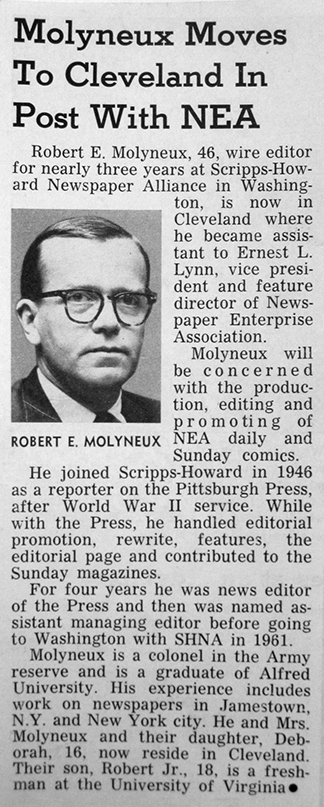
From the start, Ernest “East” Lynn proved to be a rather persnickety boss for Kreigh Collins at NEA. After fifteen years, their once cordial relationship had cooled considerably, and when Lynn handed off KEVIN THE BOLD to Robert Molyneux, Collins must have felt some sense of relief.
Because of the nature of doing a weekly strip, with different stages of development happening on several storylines simultaneously, it wasn’t a simple turnkey situation. While Molyneux was introducing himself and learning the ropes, Collins was busy wrapping up existing storylines and scripts with Dave Ward. An erstwhile employee at the Newspaper Enterprise Association’s Cleveland office, Ward was now working on a freelance basis out of Ann Arbor, Michigan. This information comes from Collins’ correspondence with Lynn, Molyneux, and Ward, and with the exception of the new guy, there is plenty of sniping going on. As most acknowledged, Collins was caught in the middle.
It’s a shame that I don’t have copies of Collins’ letters—his tended to be entertaining reads too.
It’s bewildering trying to keep track of who was doing what, with all the different things happening simultaneously. While Kreigh Collins no longer handled all of KEVIN’s writing, he did provided outlines for upcoming chapters. He also collaborated on plot developments, and he was inclined to contribute to the scripts he received.
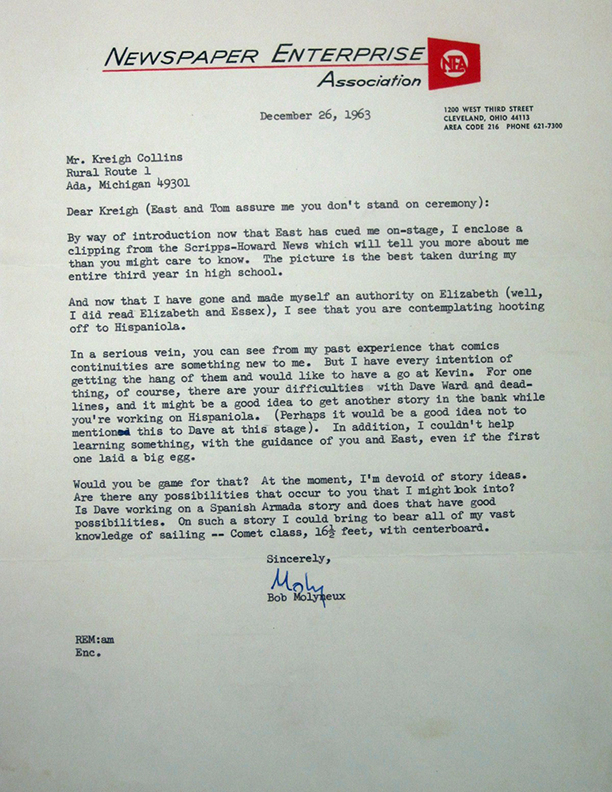
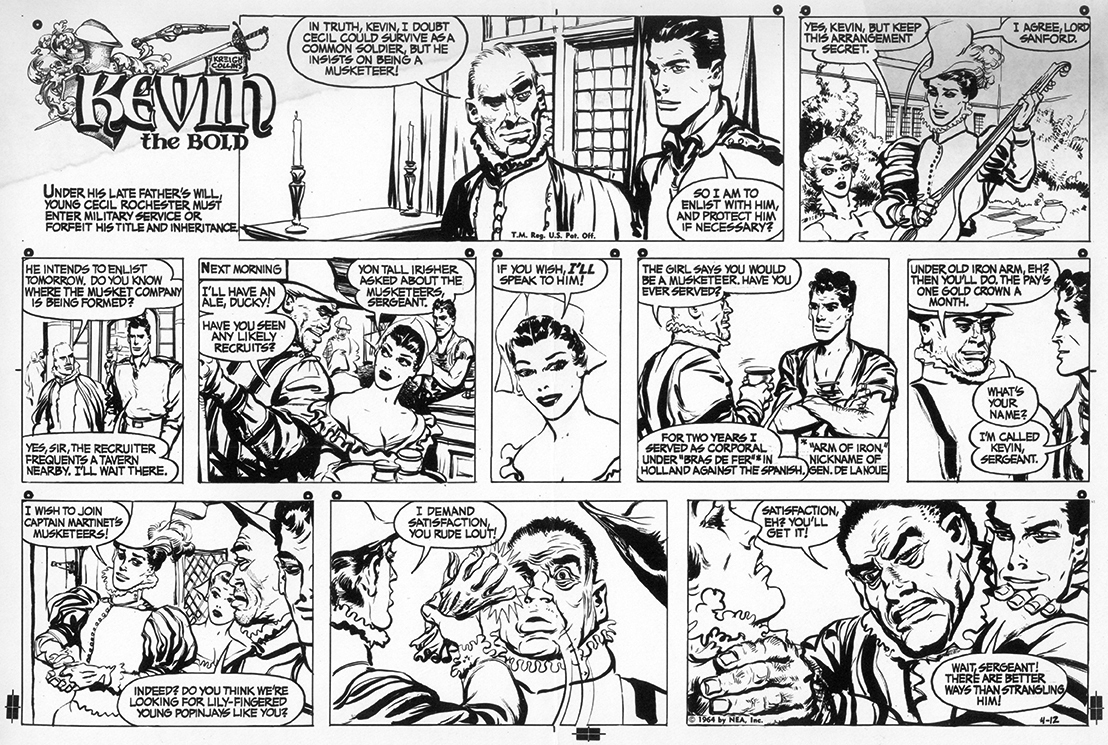
Both Molyneux and Ward played parts in the development of the sequence running below, featuring young Cecil Rochester. (In order to collect a sizeable inheiritance, Cecil must become a soldier). Ward was the writer and Molyneux handled the back end of its development. Correspondence shows that Collins generally gets along with Ward, Ward was resented by Lynn (whose demeanor had caused Ward to quit in the first place), and Ward resented Molyneux (who appears positioned as Ward’s replacement). Meanwhile, Molyneux and Collins start figuring out how to work together.
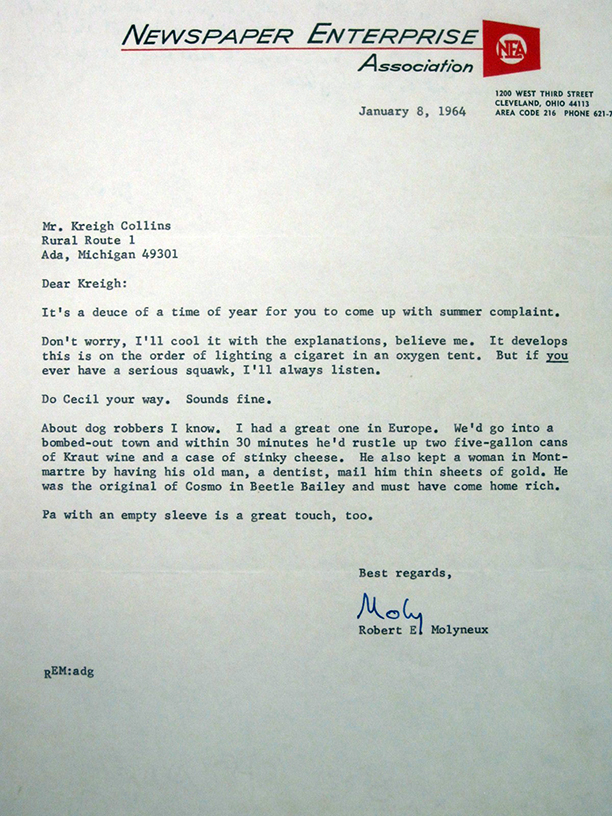
Here is a selection of these parties’ correspondence. The oddly-cropped images were the result of photos taken in haste as I plowed through the Grand Rapids Public Library’s Special Collection #56.
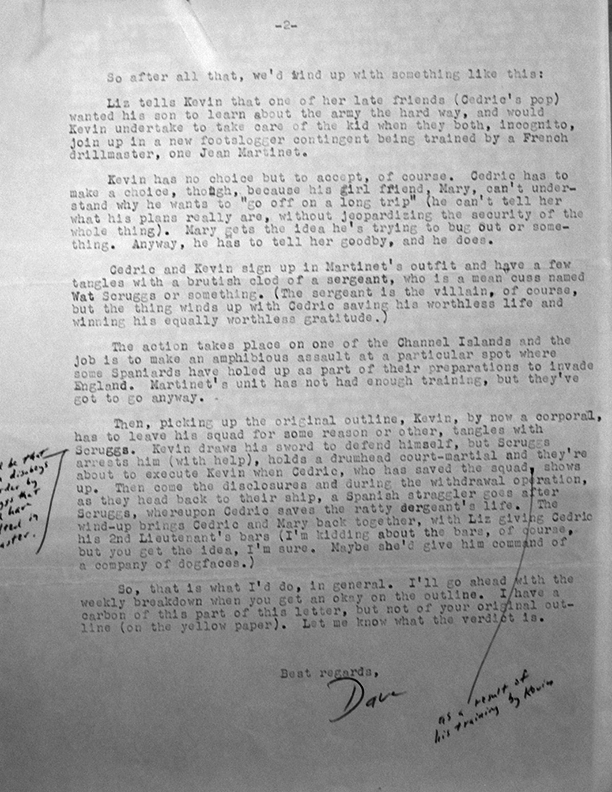
In this letter (or separate letters) from Dave Ward, Ward approves of Colllins’ original story outline and makes some suggestions for plot developments. One is to have the regiment of Musketeers let by the historical figure Jean Martinet (which requires bending time in order to fit him into Kevin’s 16th-century world). The story introduces a new guy, Cedric, whose name eventually becomes Cecil.
Meanwhile, Molyneux introduces himself, tells Collins that he has boned up on some episodes already in the pipeline (#69 – “Queen Elizabeth,” and “#71 – “Hispaniola;” Cecil’s story is #70); he also admits to being new to the game of comics continuations. Yet a few days later, he asks for Collins’ permission to write a story for KEVIN.
Molyneux settles in to the routine of handling Collins, but is getting pushback on some of his suggestions. Nonetheless, he includes an interesting anecdote from his WWII Army background with a reference to Mort Walker’s BEETLE BAILEY character, Cosmo. No doubt Collins was relating some doozies of his own in the return mail.
Another missive from Ward reveals how defensive he is toward his story, and below, he starts nitpicking at things Molyneux is doing (interestingly, also one of Lynn’s bad habits). But it’s also clear that Ward knows his stuff.
So many words! Enough! Now for some pretty pictures.
The April 5 episode is transitionary; Cecil is introduced in the final panels. Here is an early version of the episode’s script.
Lord Sanford has made it known that Queen Elizabeth wants Kevin to serve secretly as Cecil’s chaperone.
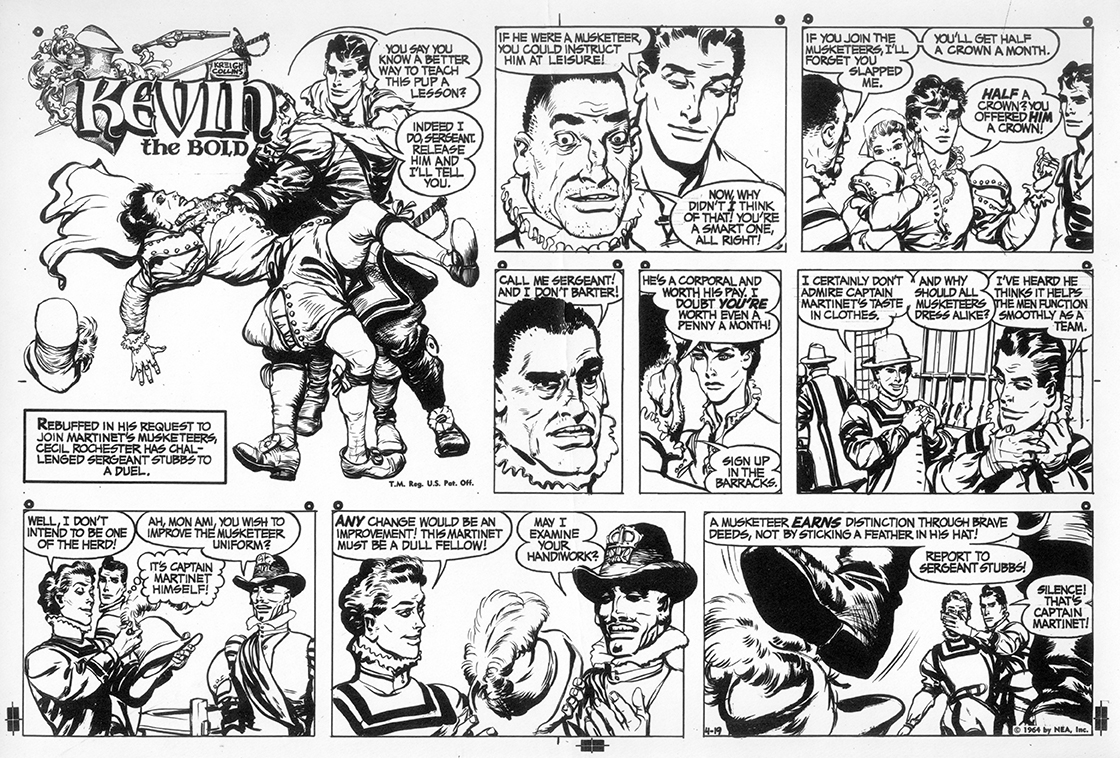
A round peg for a square hole, Cecil makes poor first impressions on both Sergeant Stubbs and Captain Martinet. Kevin has his hands full!
A really cool thing about the beautiful April 19 episode (what a splash panel!), is that I have its Finnish version, where it was titled Haukka – temmeltäväin tuulten kasvatti, which translates to “Hawk—The Most Uplifting of the Winds” (a rather romantic take on the usual sort or rebranding the strip received for foreign markets).
Incidentally, I hope to receive a couple physical examples of HAUKKA in the coming months.
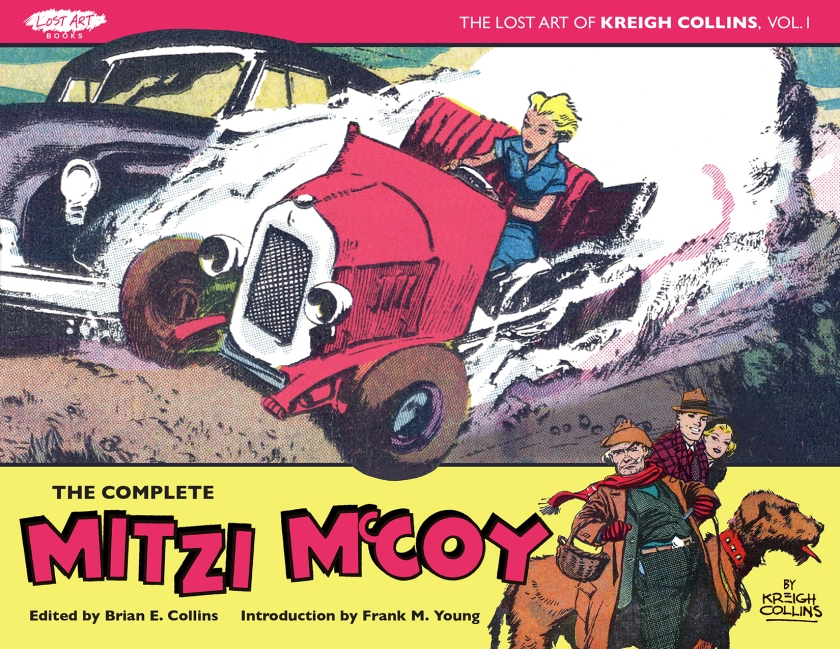
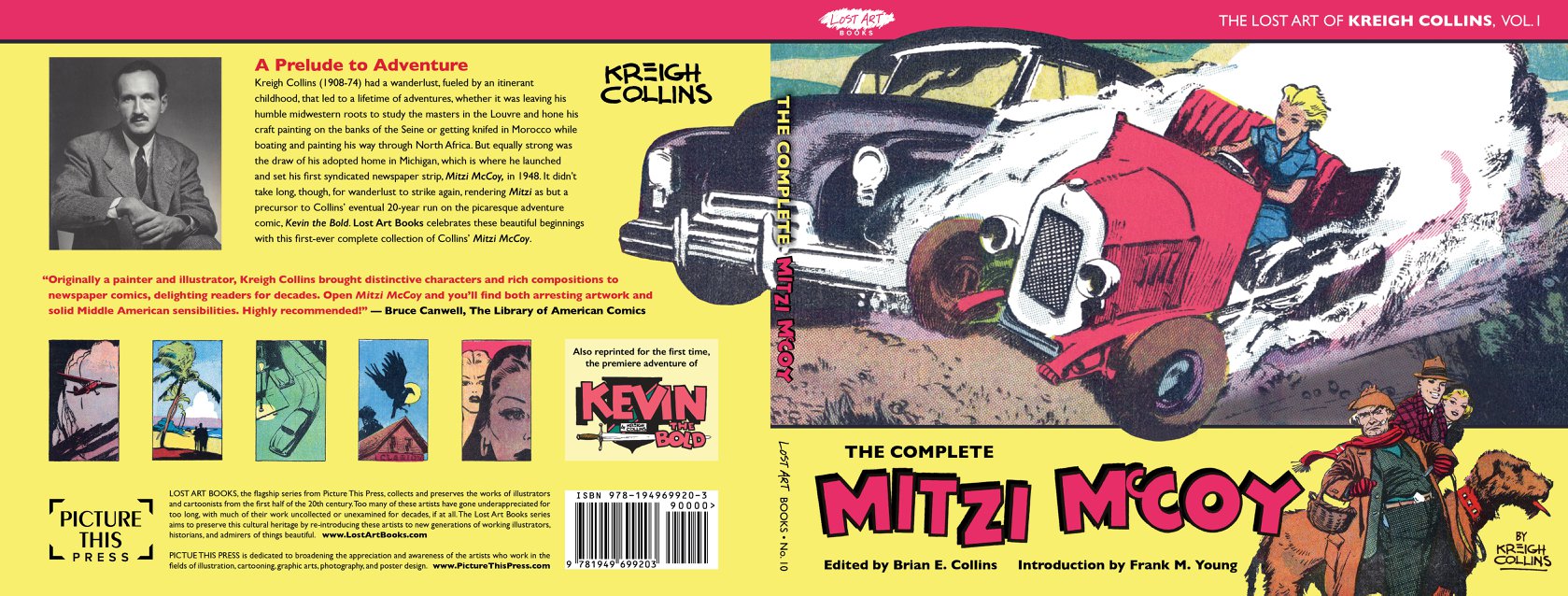
“The Lost Art of Kreigh Collins, the Complete Mitzi McCoy” features the entire run of Kreigh Collins’ first NEA feature, and is available for a limited time at a reduced price.
MITZI McCOY ran from 1948 to 1950 and showcased Kreigh Collins’ skill as an illustrator and storyteller. His picturesque landscapes, lovely character designs, and thrilling action sequences brimmed with detail and charm, and the strip’s ensemble cast rotated in and out of the spotlight taking turns as protagonists in the dozen story arcs collected in this volume. The last story collected in “The Complete Mitzi McCoy” is the narrative bridge that set Collins and his characters off on a new journey, beautifully told for the next couple of decades in the much-lauded adventure strip Kevin the Bold.
The collection includes an introduction by Eisner Award-winning author Frank M. Young, an Afterward by Ithaca College’s Ed Catto, and previously unpublished artwork and photos. Longtime comics artist Butch Guice also provides a new pin-up of the character Mitzi McCoy.
The book is available for $30ONLY $20! For domestic shipping, add $4; for international orders, please add $25 to cover first class shipping. To place an order, leave a comment below or email me at BrianEdwardCollins1[at]gmail.com, and I will give you PayPal or Venmo information.
Grand Rapids History & Special Collections, Archives, Grand Rapids Public Library, Grand Rapids, MI
As 1963 was about to end, so was the fifteen-year period of direct supervision of Kreigh Collins by Ernest Lynn at NEA. That it was disclosed without fanfare in the third paragraph of a memo hinted at how strained the relationship between the two had become. Happy New Year?
On a more cheerful note, January 1 was Collins’ 114th birthday. Beginning next week, a new chapter—overseen by neophyte Robert Molyneux—begins.
Today is Boxing Day, a day on which servants, tradespeople, and the needy are traditionally presented with gifts. It originated in the United Kingdom, and is primarily celebrated in countries formerly part of the British Empire.
It precedes Kevin the Bold, who might have celebrated it differently.
Panel taken from KEVIN THE BOLD’s third episode (October 15, 1950)
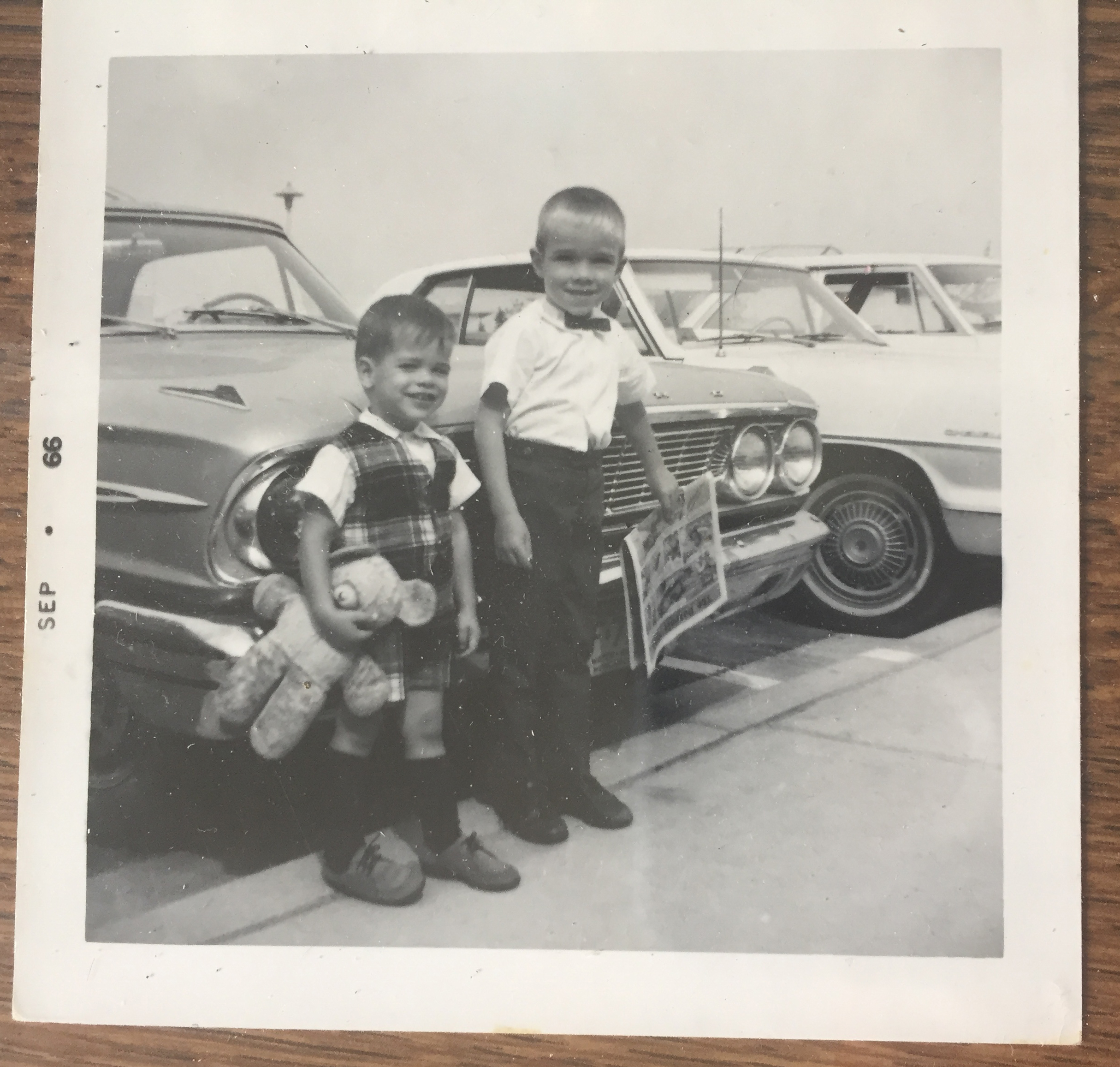
I learned of Boxing Day more as a day to share holiday leftovers and good cheer, and this post will follow that line of thinking. In my more freewheeling younger days, my brother (Brett) and I would often host Boxing Day parties where we’d encourage attendees to dress in boxer shorts and play a few rounds of Rock-em Sock-em Robots.
Brett and I are comics fans from way back but didn’t start throwing Boxing Day Parties until the late ’80s.
Brett was Kreigh Collins’s first grandchild and my brother’s namesake character was a major player in KEVIN THE BOLD from January 1952 until April 1965.
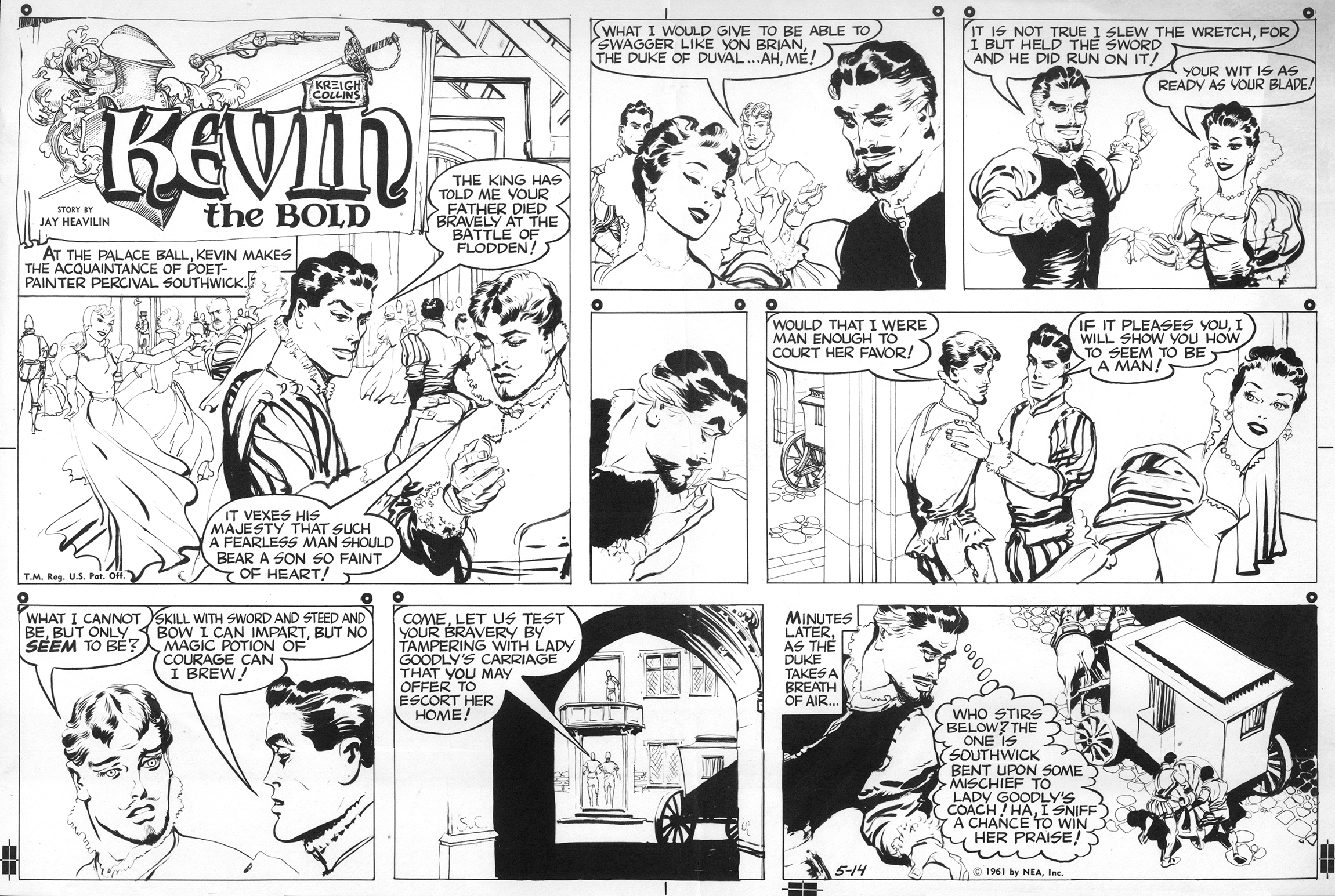
A character named Brian only appeared in a single 1961 sequence and although the characters Brett and Brian both preceded my brother’s and my existence, I can’t help but feel a bit jealous about the discrepancy in those characters’ roles—though I’d be smart to avoid mentioning this to my Uncle Glen (Uncle Kevin’s brother).
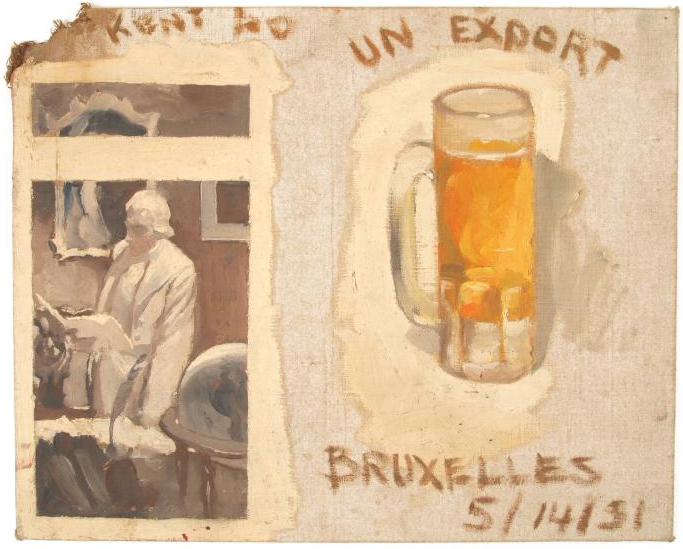
At least Brian, the Duke of Duval, was a bad guy and basically shared a name with a tasty Belgian beer.
Speaking of Belgian beer, the painting above, from the Grand Rapids Public Museum’s collection, with its unusual composition, is unlike any other I have seen by Kreigh Collins. Its date (5/14/31) indicates it was produced while Kreigh and his wife Theresa were summering in Europe, shortly after they were married.
Although there were no major characters named Brian in my grandfather’s comic strips, I was bestowed a cool nickname in the Christmas letter he and my grandmother sent out in 1964. (I was born three days before his third grandchild, my cousin Josh).
With that, I wish you all a Merry Christmas, a gay holiday season, and that you look forward to 1965 2022 with as much anticipation as I look forward to all of the adventures the year promises to bring.
At each others’ throats just moments before, Kevin and Karl are now completely aligned.
The short chapter’s quick pace continues, and with Brett’s lion cub/baby switcheroo, the story begins to transition to Kevin’s next adventure.
Before Kevin’s lady friend gets a chance to share it, her story comes alive!
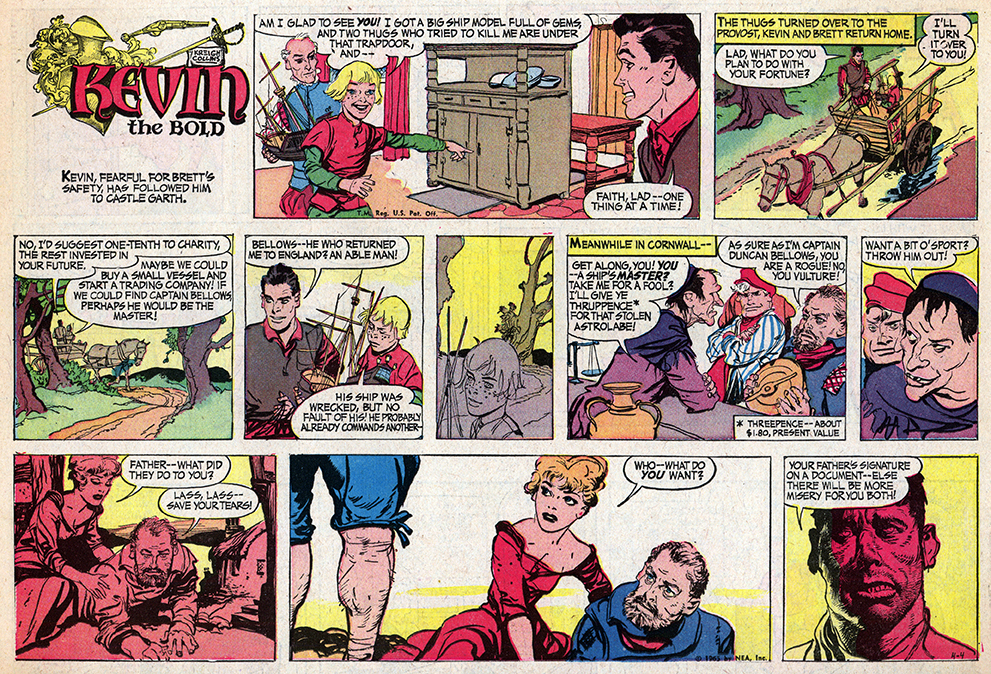
This story line would continue in the pages of the Monomonee Falls Gazette. KEVIN THE BOLD debuted in issue No. 109 (January 14, 1974), which featured Kreigh Collins’ artwork on the cover. For the next six months, KEVIN ran on the gazette’s back cover, and continued inside until the demise of the publication four years later.
In case you can’t get your hands on MFG issues 109–232, the next dozen or so KEVIN THE BOLD chapters are collected in the book Kevin the Bold: Sunday Adventures. The 154-page collection, about 97% of which was compiled from BW syndicate proofs, is available on Amazon.com.
























 Kreigh’s Comics