I generally think of Brett as being Kevin’s ward, but the more accurate term would be page. A boy served as a page for about seven years; at age fourteen he could graduate and become a squire. A page’s duties were acting as a messenger, serving, cleaning clothing and weapons, and learning the basics of combat. He also received a more general education from his master.
The January 16, 1955 episode shows Brett at work.
Again, Brett shows his skills (combat training this time). While it might seem unlikely that a lad as young as Brett was shown wielding a crossbow, it was not unheard of—the wikipedia article that described a page’s responsibilities also states “The mechanical and long-range nature of [crossbows] made them almost the only medieval weapon which could be employed effectively by a youth.”
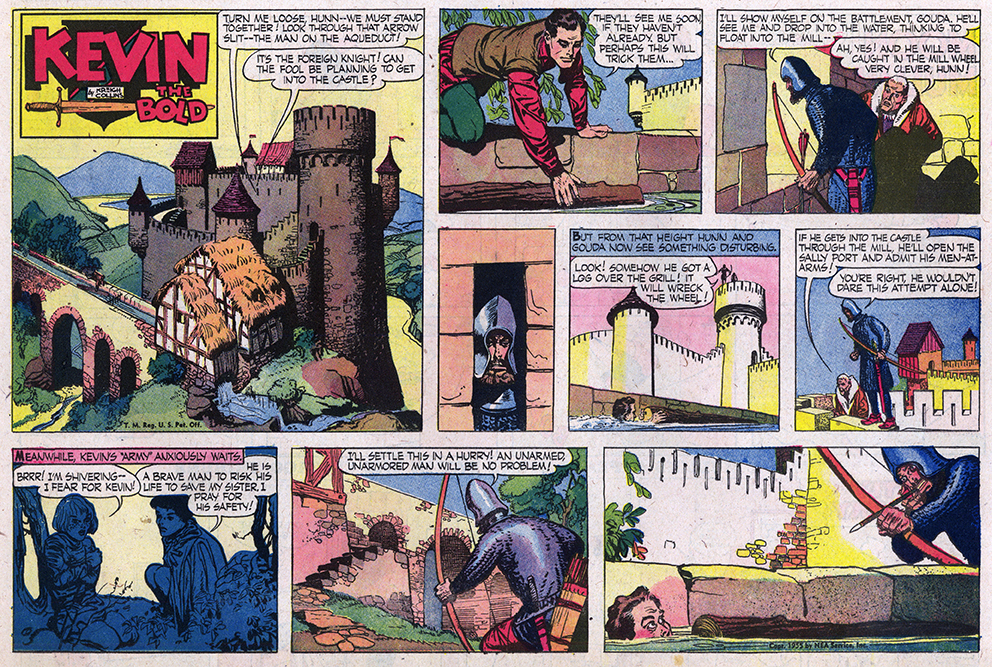
This example of the January 30, 1955 episode taken from the Chicago Sunday Tribune reproduced beautifully.
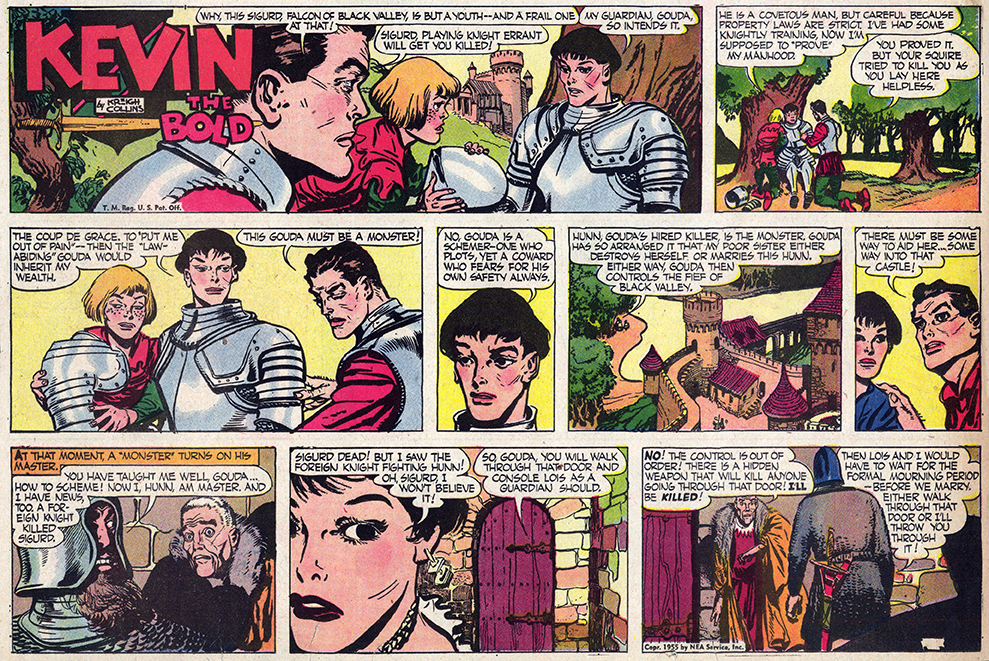
Meanwhile, young Sigurd—more squire than knight—is being conspired against by his supposed guardian, Gouda, who is using the thug Hunn as a means to his end.
In 1954’s final episode, the previous story arc wraps and transitions to the next chapter by way of an extremely dynamic splash panel.
Kevin’s lady friend yearned for some excitement, proving the adage “be careful what you wish for!”
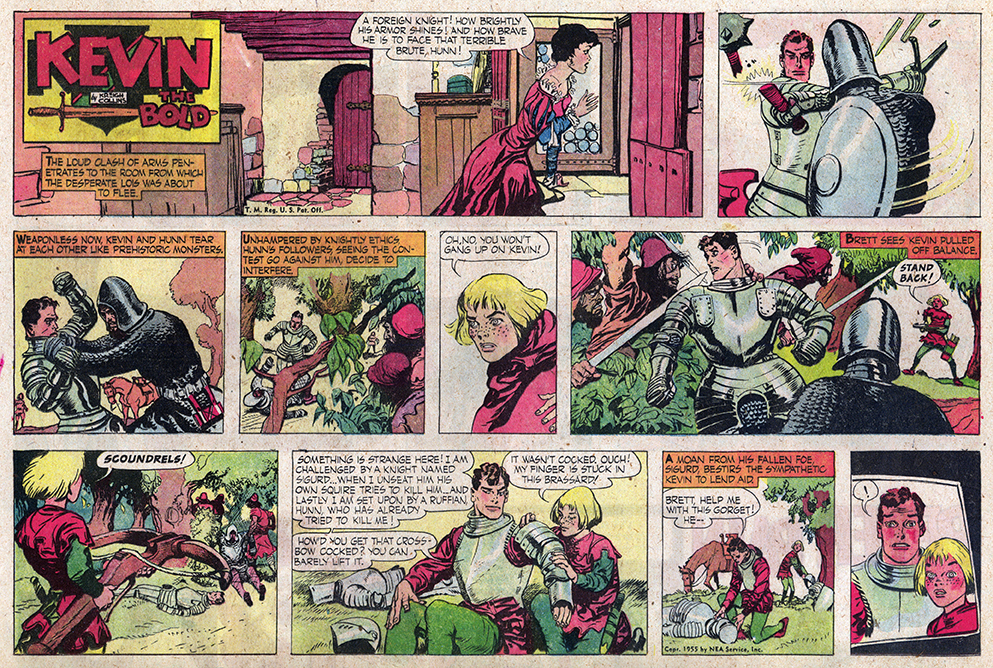
The action takes a rather grim turn as the giant intruder rampages. After his futile attempt at stopping him, Kevin looked to suffer the same fate as the fallen servant, only to be saved by the quick-thinking (and strong-armed) Brett.
Although they were both sourced from the Chicago Sunday Tribune, the color scheme changed significantly between the last two episodes. Such problems were avoided when KEVIN THE BOLD began appearing in the black and white Menomonee Falls Gazette (Issue 109, which also featured Kevin on the cover).
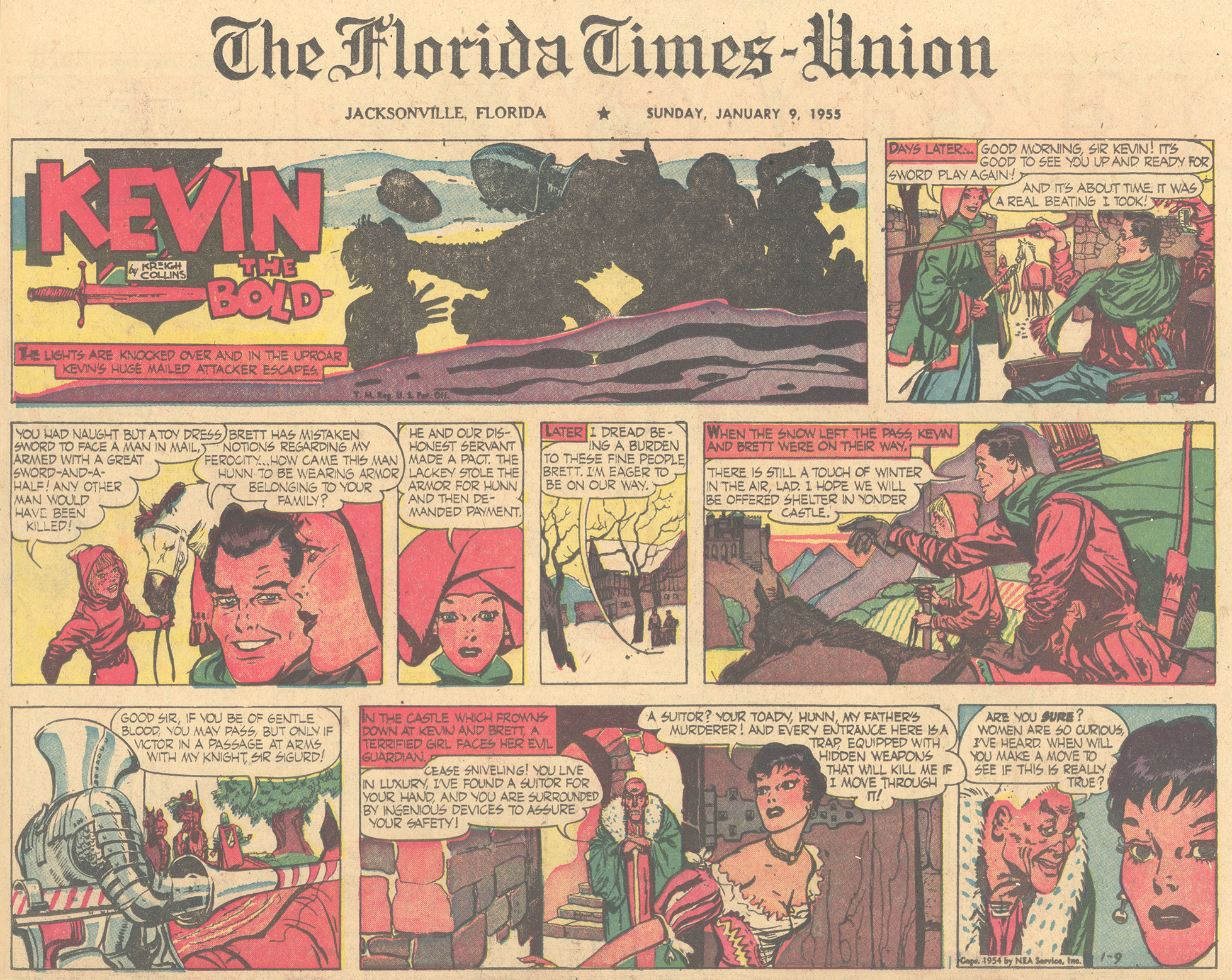
Further mayhem was avoided, and after healing up, Kevin and Brett continued on their way.
When I originally posted this episode, for some reason I neglected to do color correction.
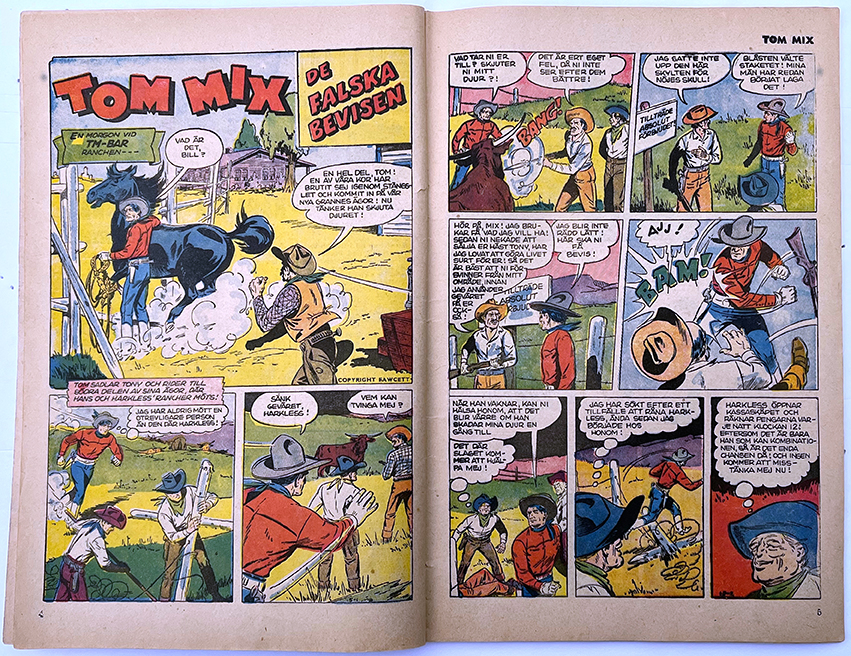
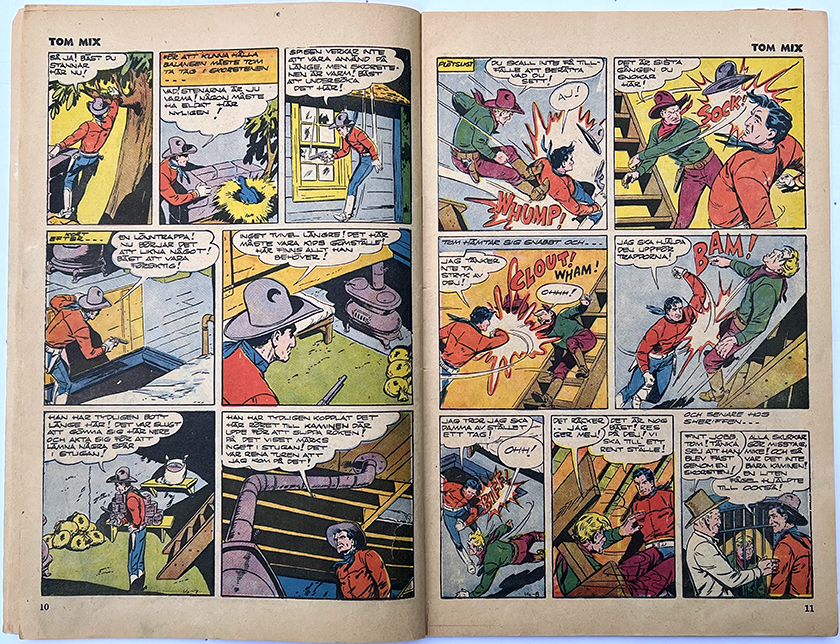
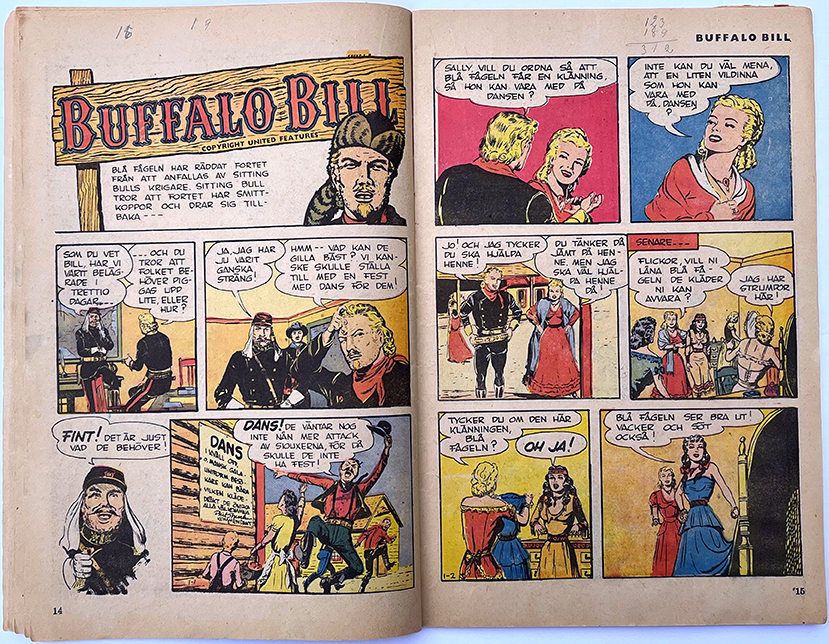
Appearing two weeks after its predecessor, TOM MIX Nr. 2 again featured the titular character on its cover, the silent comic UGH on the inside front cover, and was followed by a mocked-up newspaper front page.
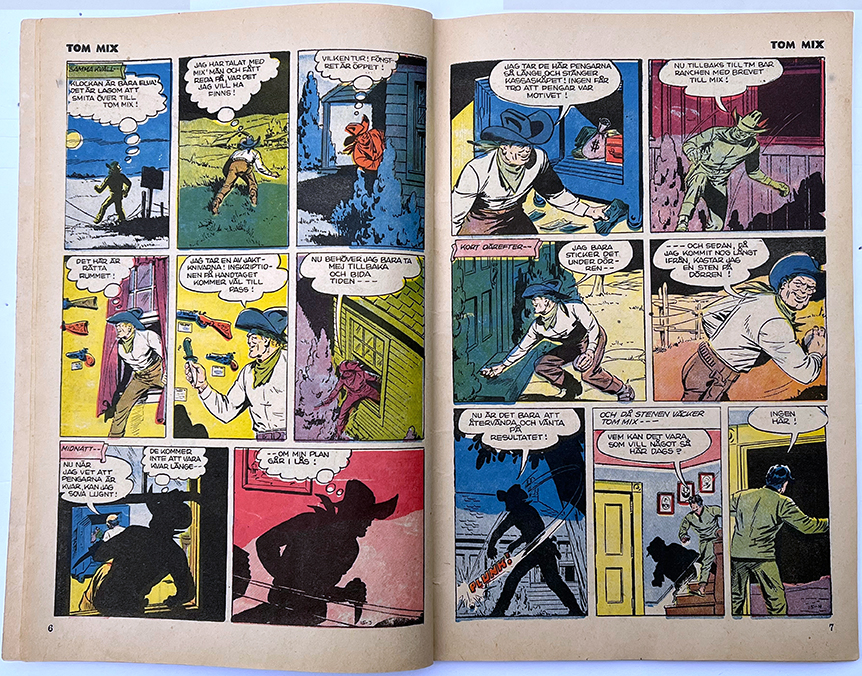
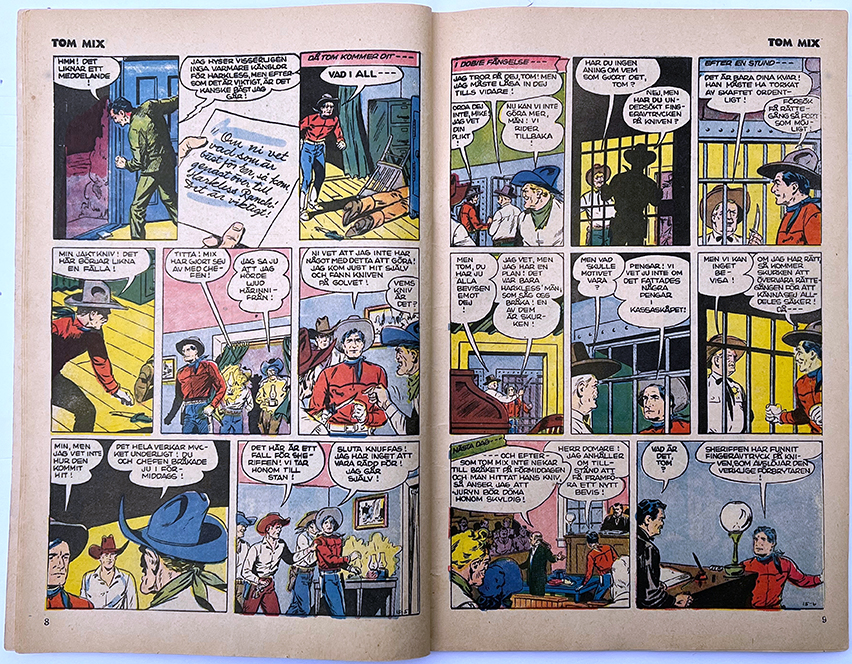
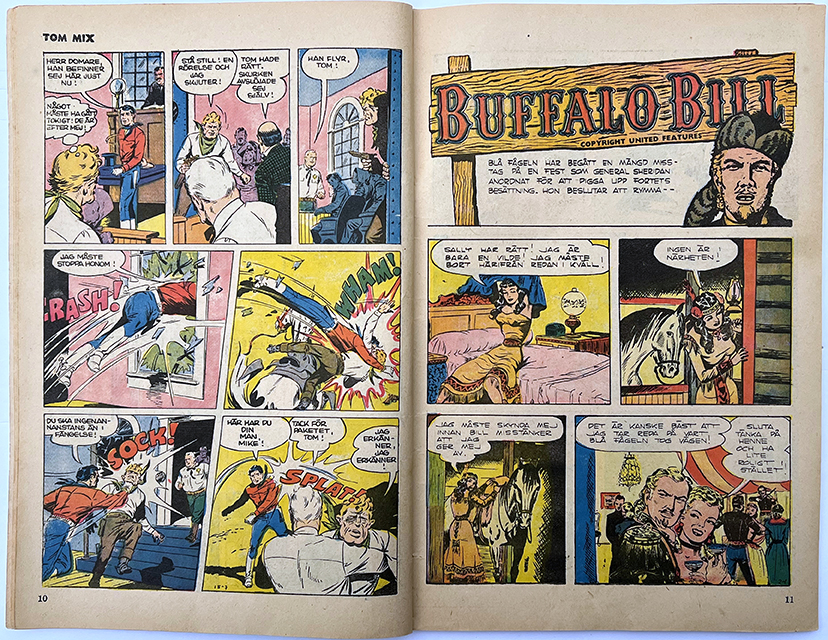
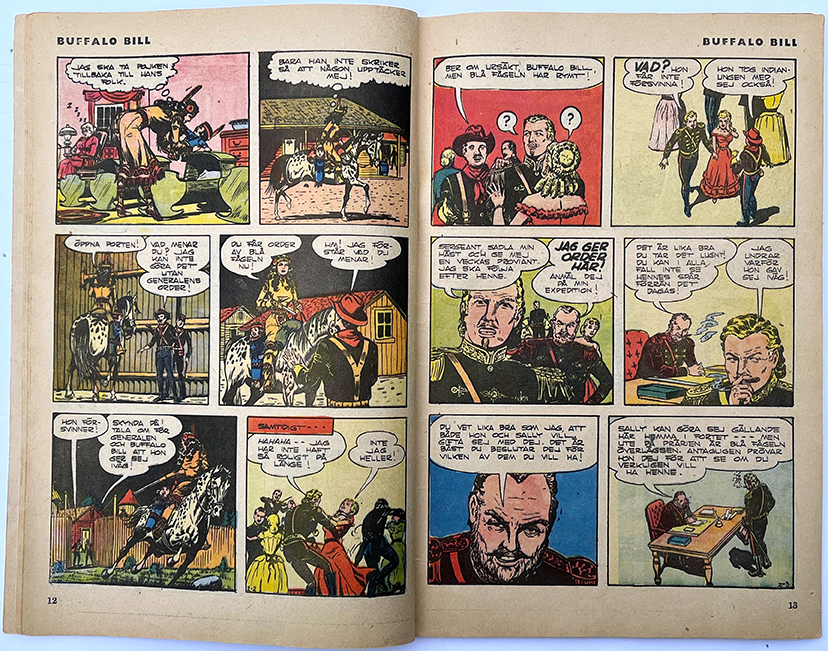
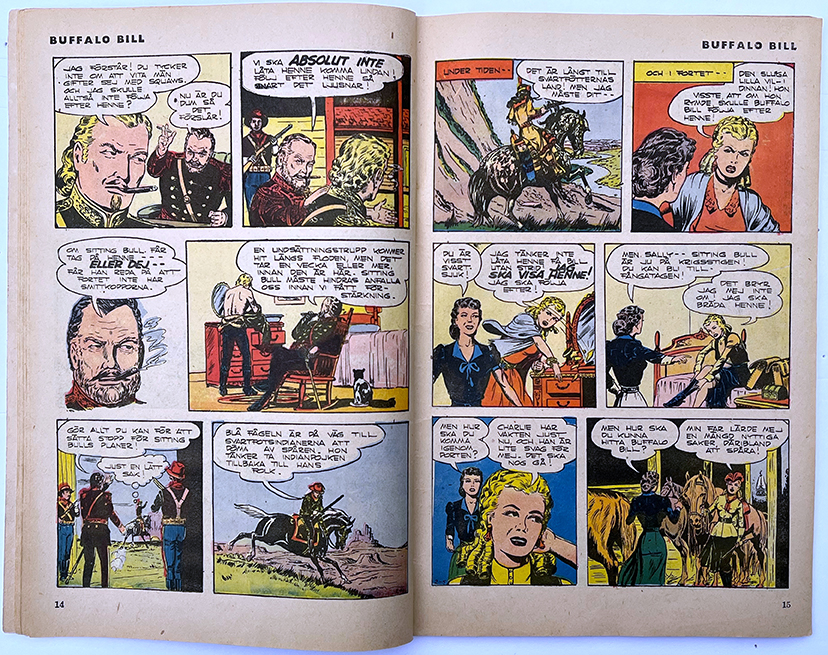
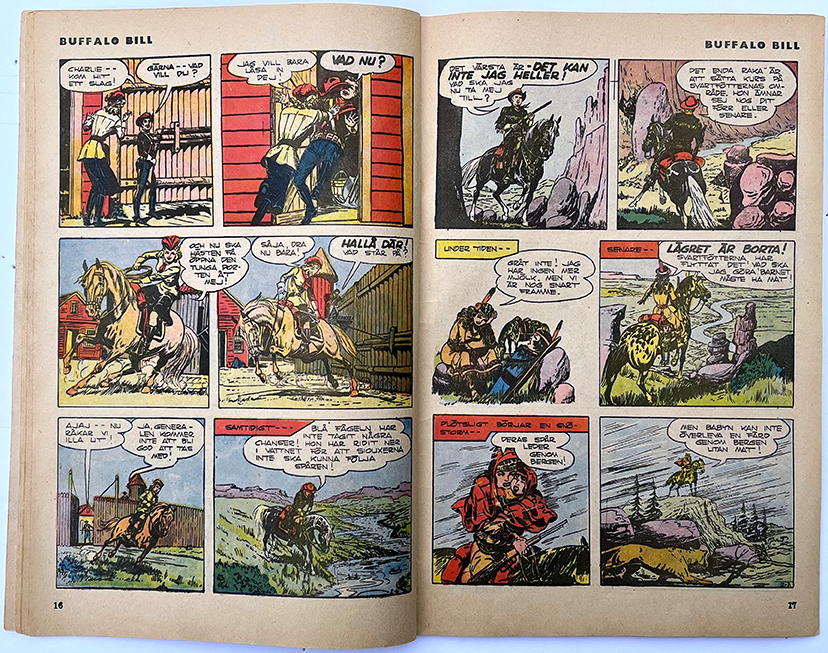
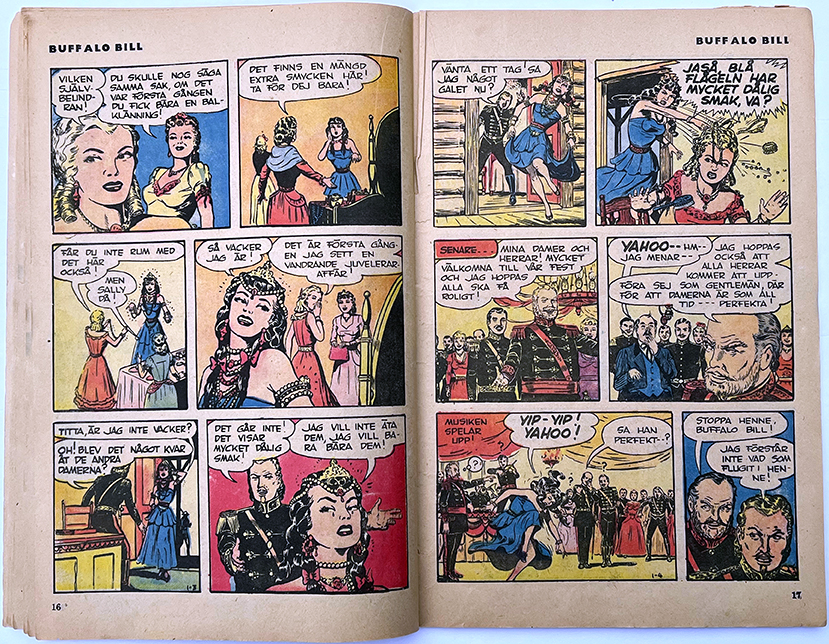
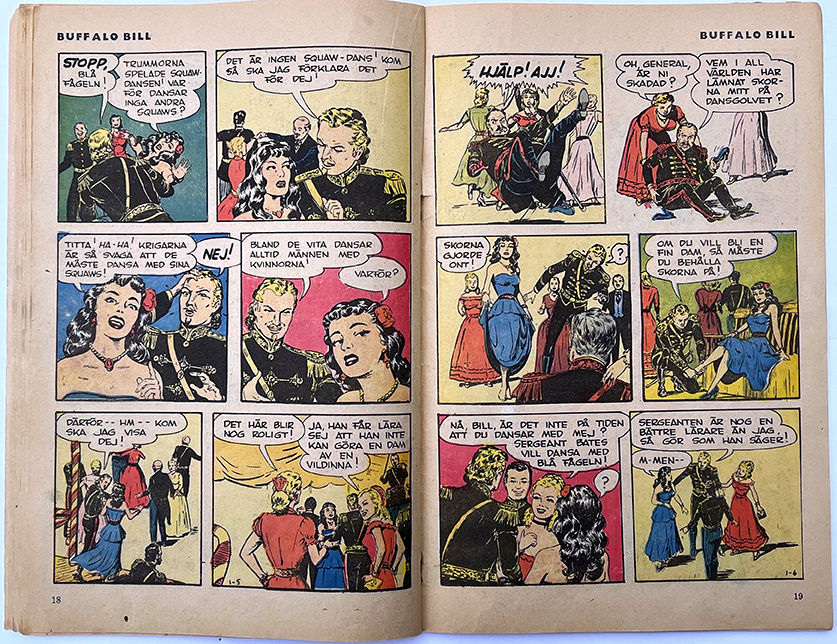
TOM MIX runs for seven pages, followed by BUFFALO BILL’s nine pages.
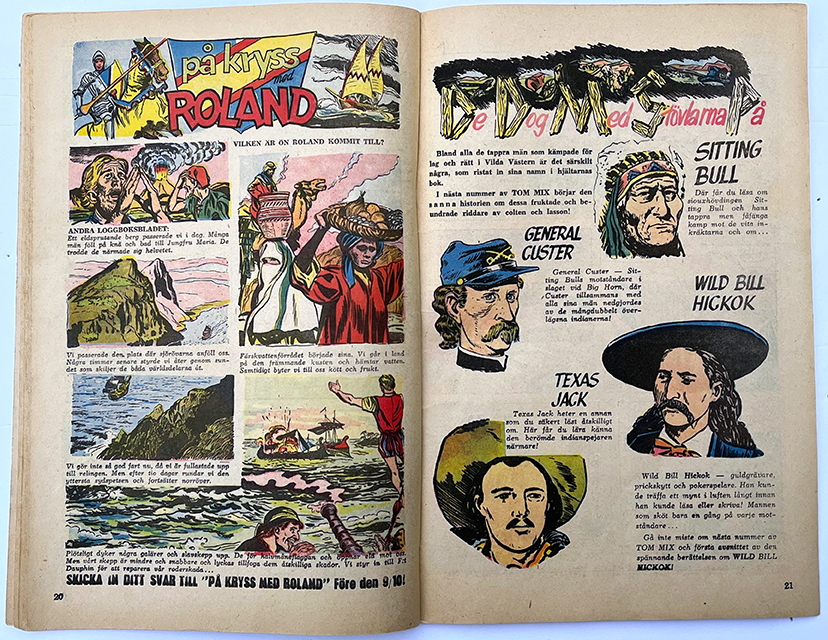
On page 20, a contest that began in TOM MIX Nr. 1 continued. Facing the contest was a page with the memorable title De Dog Med Stövlama På (“They Died with their Boots On”). It consisted of profiles of notable 19th century western figures, with a presumed focus on their grisly demises.
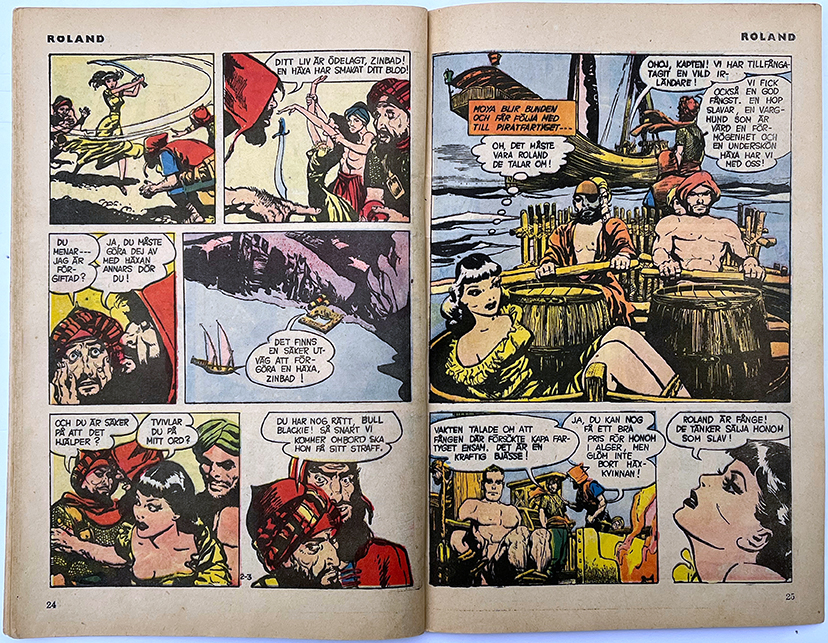
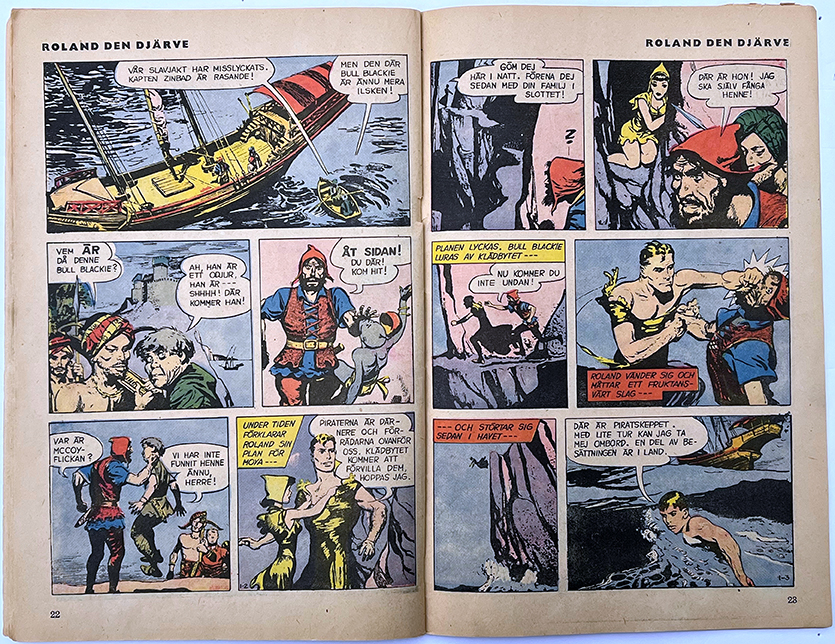
Next up was ROLAND DEN DJÄRVE. The action picks up where it left off in TOM MIX Nr. 1, with the episode that originally appeared on November 5, 1950. Like the previous issue, the publisher has come up with its own color scheme. While a copyright is given to United Press (?), no credit is given to the illustrator, Kreigh Collins.
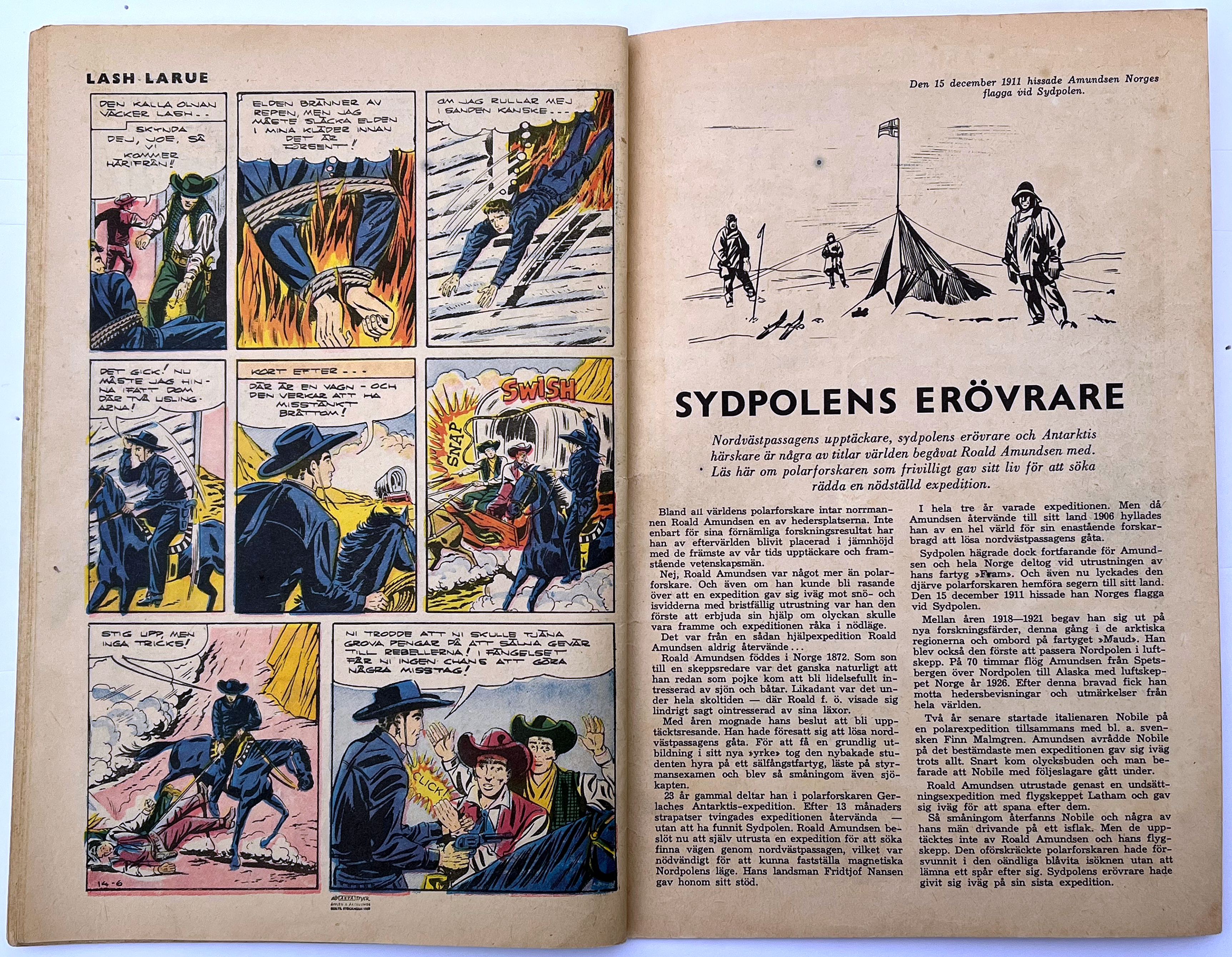
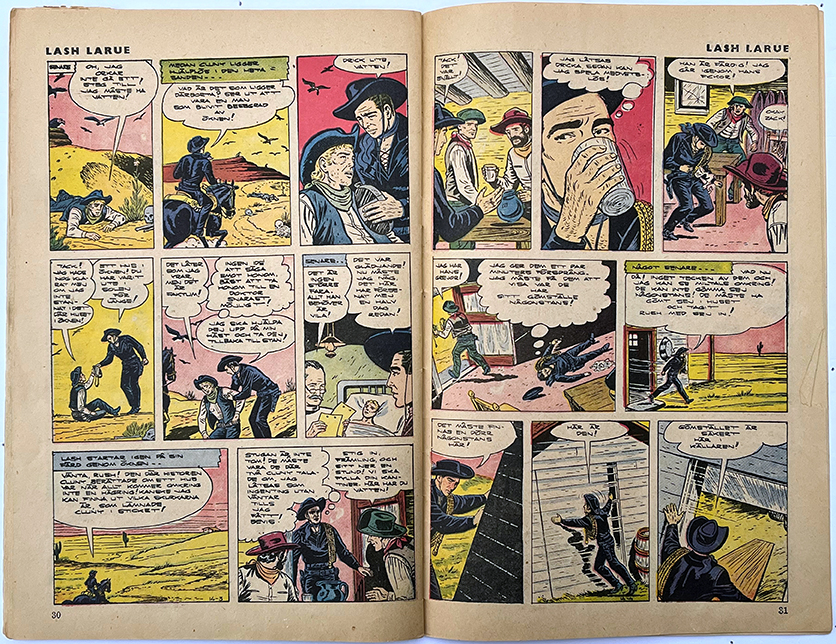
After the equivalent of four Sunday episodes—Roland’s time is up. LASH LaRUE follows.
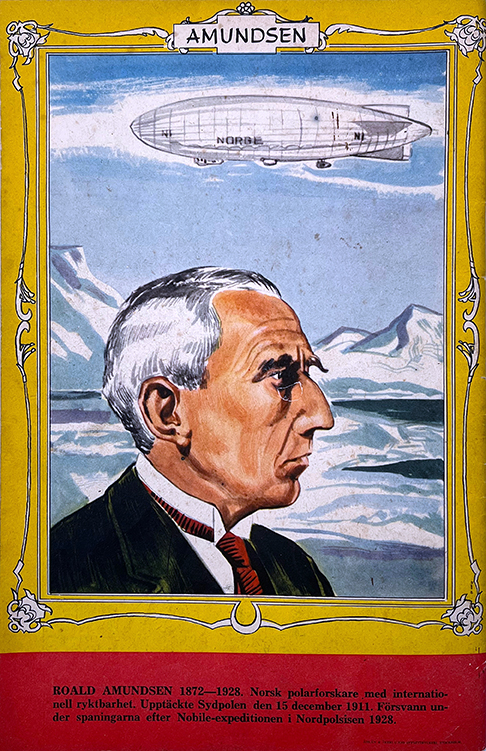
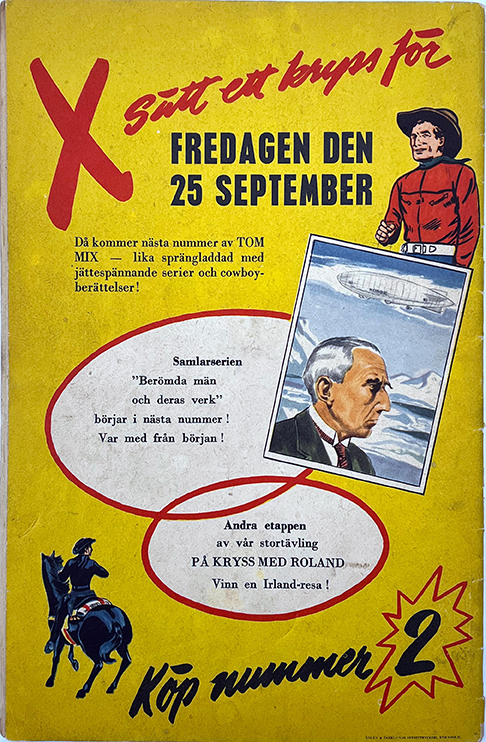
On the inside back cover, Sydpolens Erövrare (“Conquerors of the South Pole”) is an account of famed Norwegian explorer Roald Amundsen’s polar exploits. Amundsen is also featured on the back cover; similar portraits will appear in the back covers of future issues of TOM MIX.
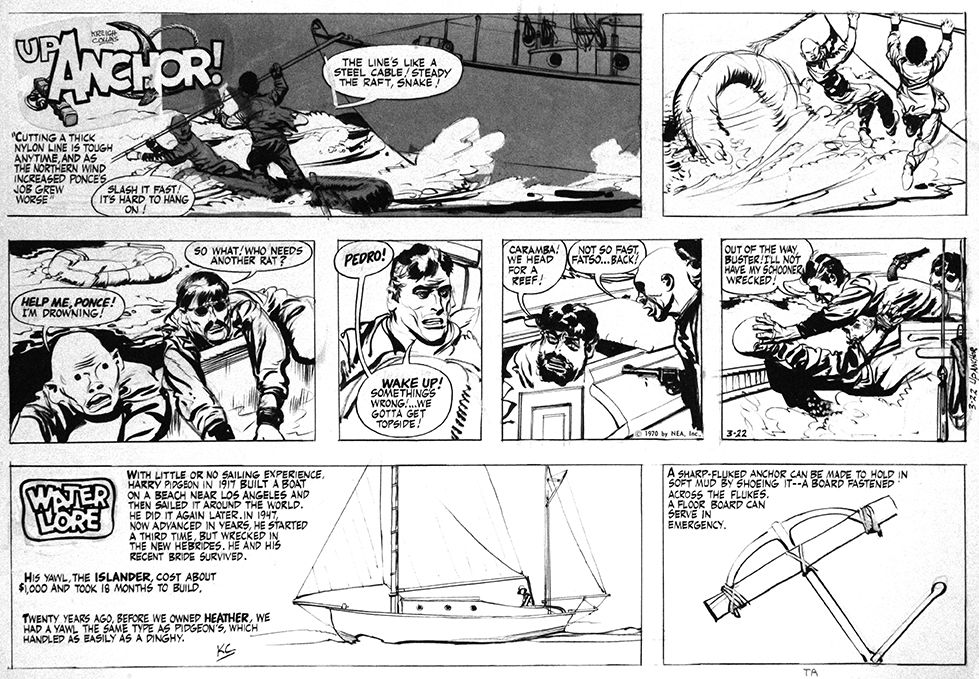
After too many black and white episodes—eleven out of twelve, in case you lost count—the sequence wraps up with a couple of splashes of color.
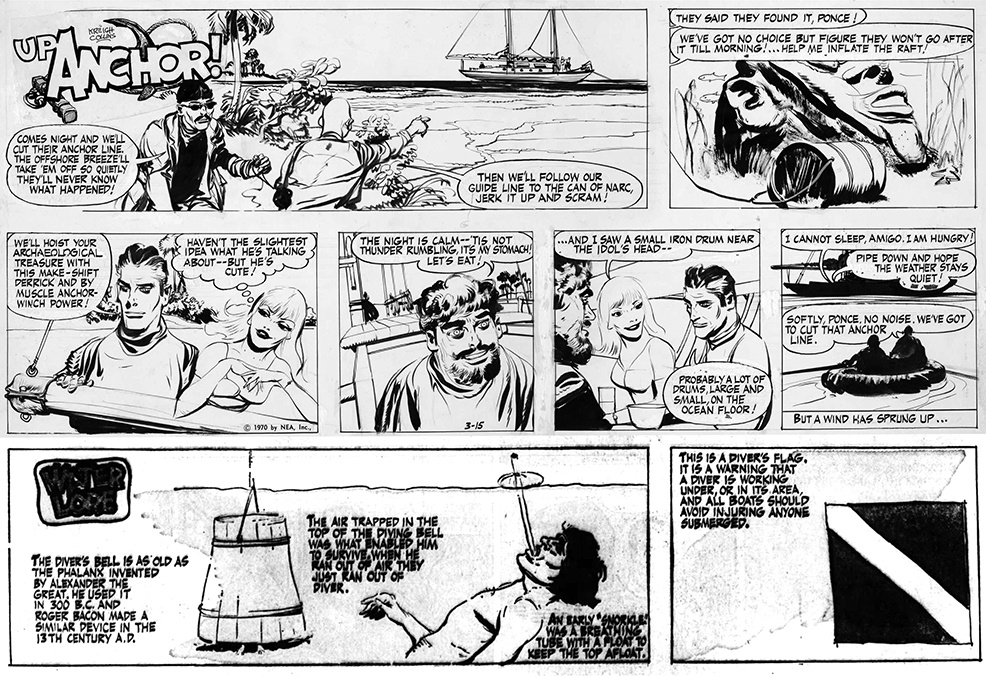
Ponce and Snake, weakened by seasickness, can only watch as their nefarious plan unravels.
The story comes to a happy ending, with the messier details of the bad guys’ detainment left to the reader’s imagination. As the sequence transitions to a new chapter, my eye is caught by the action in the background of the second panel.
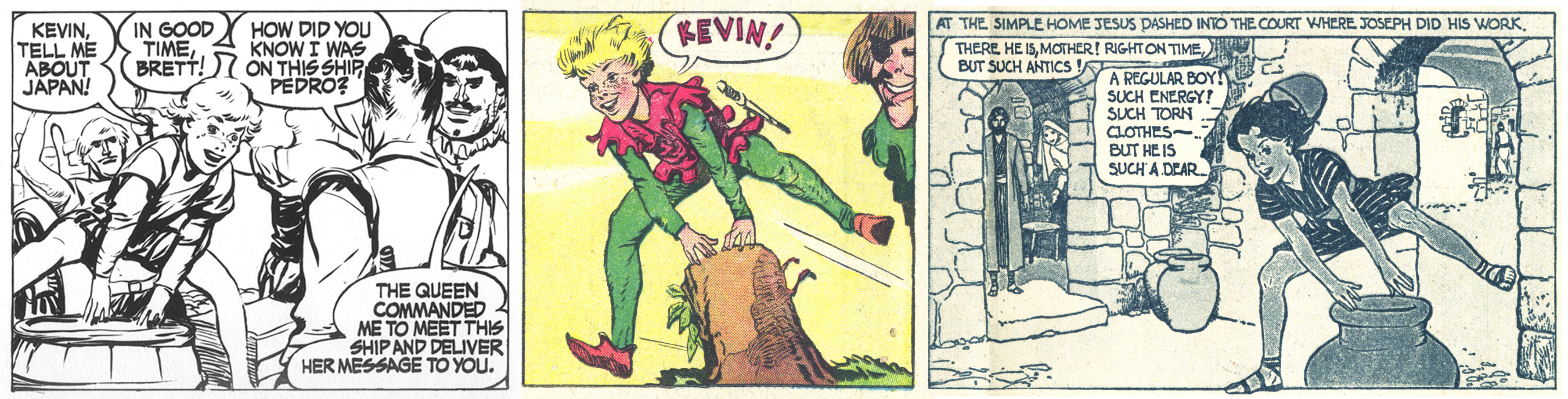
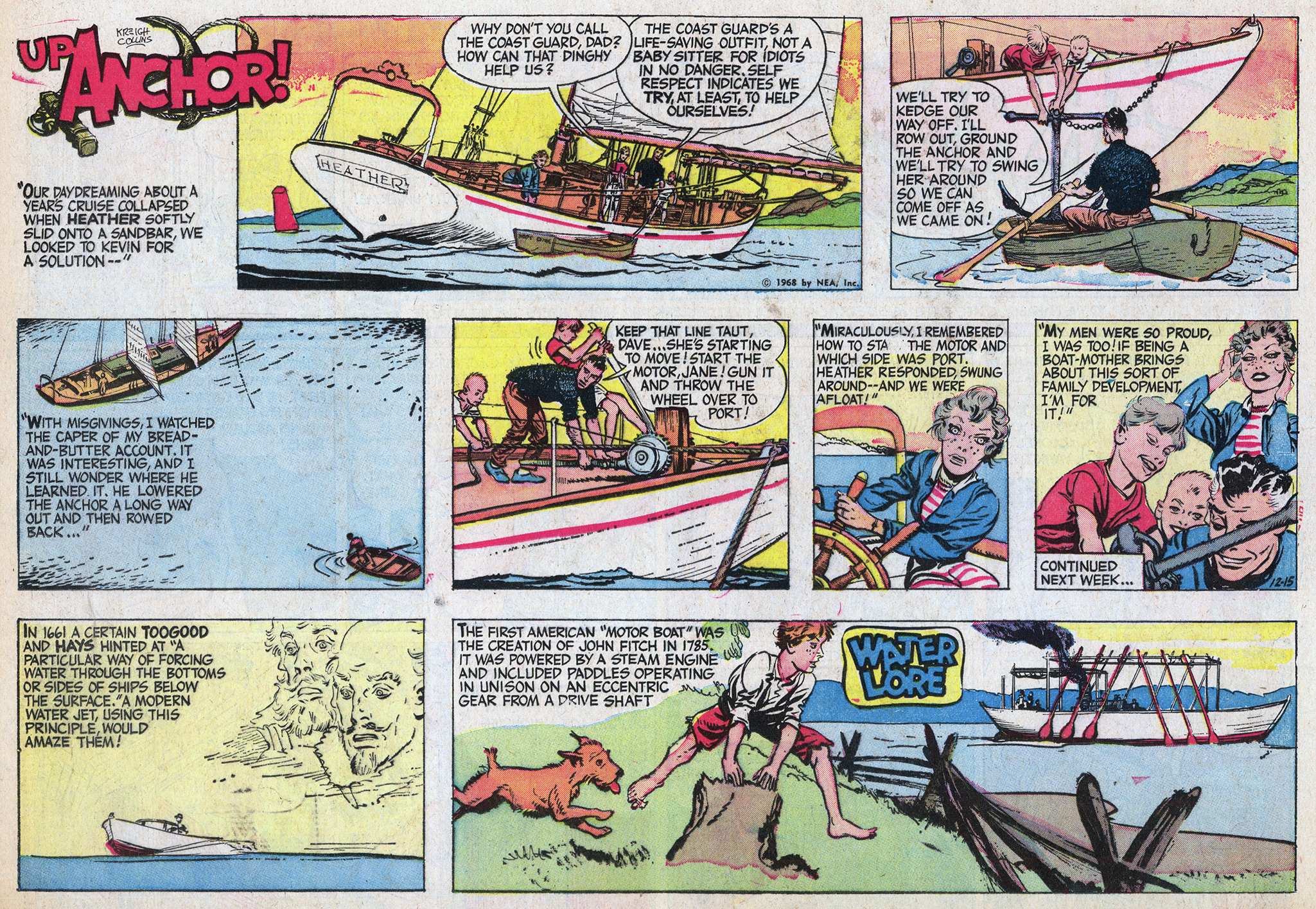
Young Dave is playing leapfrog (jumping over Heather’s boom?). The pose—used by Collins numerous times over the years—always makes me wonder of the whereabouts of the original illustration used as its source.
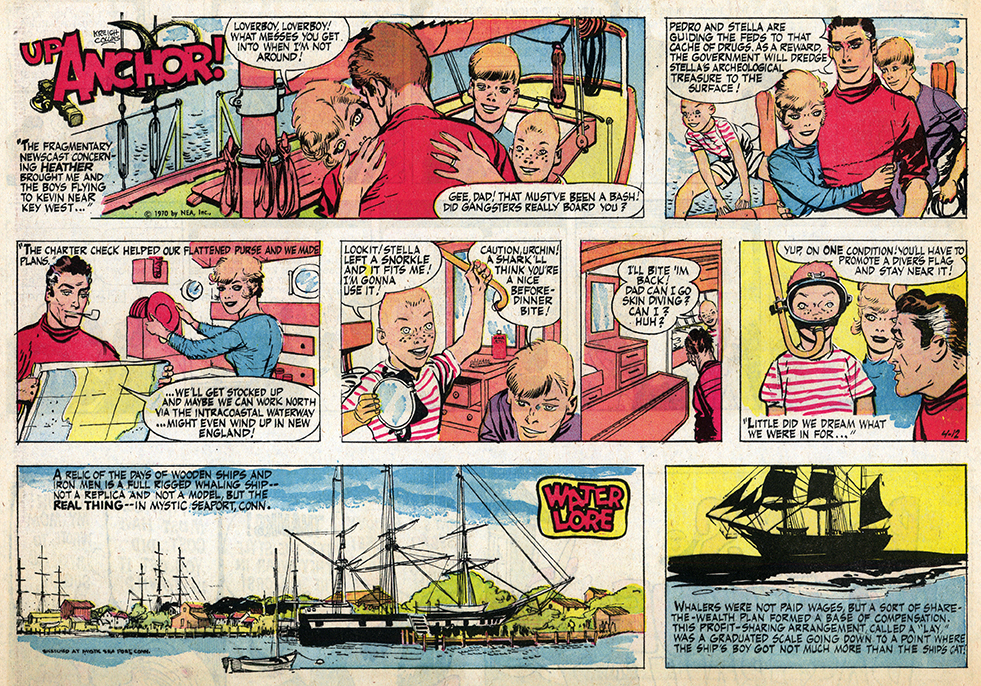
It first appeared in an episode of BIBLE STORIES COMICS (far right, c. 1944) and then twice in KEVIN THE BOLD (October 30, 1955 and December 15 1963). Collins used it another time in UP ANCHOR!’s seventh episode (December 15, 1968), when it popped up in the topper strip, “Water Lore.”
It’s a shame Dick Dixon never busted the move in MITZI McCOY!
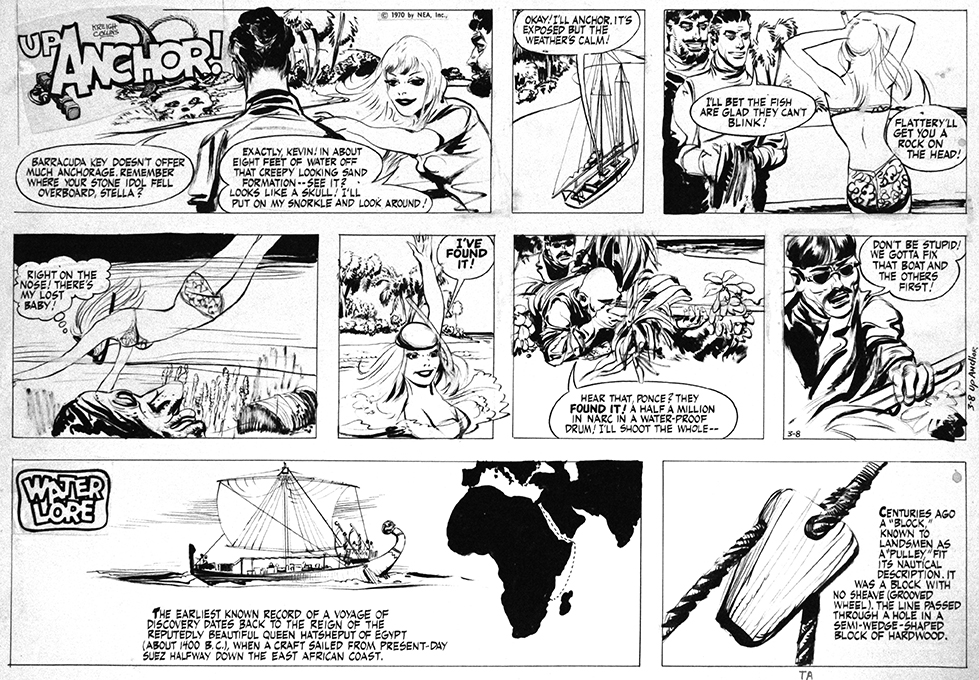
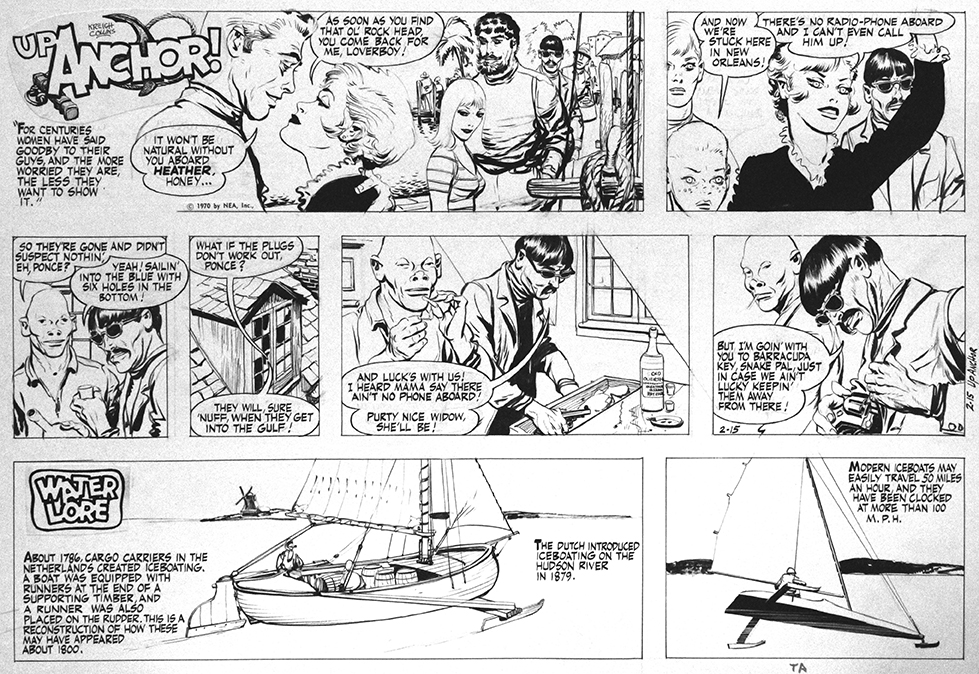
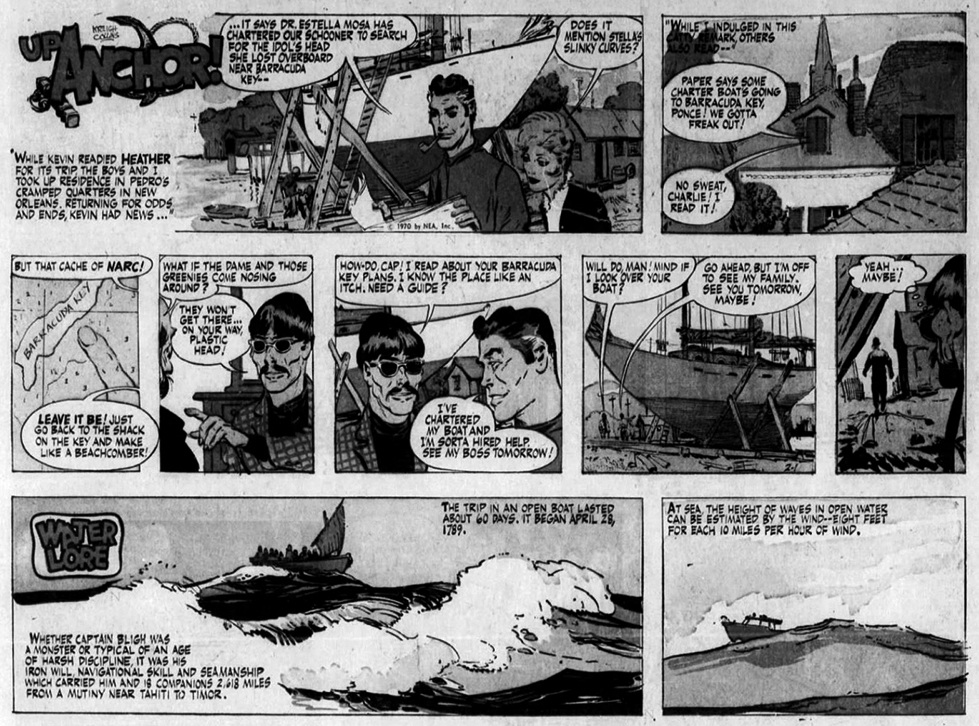
Barracuda Key is a real place, located about nine miles west of Key West, Florida. In 1959–60, My grandparents sailed to Florida (via the Mississippi River and New Orleans), but not as far south as the Keys. However, visiting the chain of islands was likely on their original itinerary, which included sailing to the Bahamas, as per a profile that appeared in the Chicago Tribune’s Sunday Magazine.
Ironically, their plans changed due to a downturn in Kreigh Collins’ business affairs—as the 1950s drew to a close, the Tribune dropped KEVIN THE BOLD from its stable of comic strips.
While Barracuda Key is real, the story told here with Ponce and Snake (and Dr. Estella Mosa) is obviously fiction.
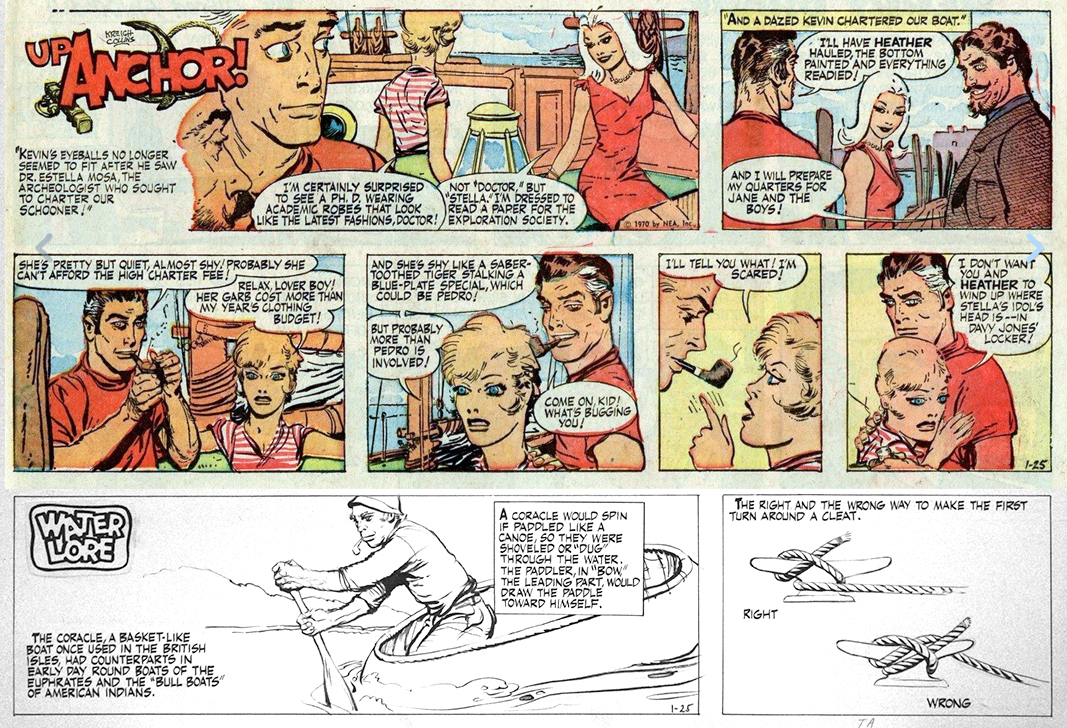
Jane Marlin sees her husband off at the dock, seemingly not worried about the pretty crew member joining Kevin and Pedro. But she has cause for concern—and it’s not Estella, the blonde PhD chartering Heather.
In UP ANCHOR!’S topper strip, WATER LORE, Kreigh Collins incorporated all sorts of nautical trivia, instructional information, and historical tidbits. When UP ANCHOR! appeared in its third-page format, the topper solved the problems caused by cropped panels, by serving as a throwaway. When running as a tabloid, only the larger panel appeared, filling the entire fourth tier of the comic. Generally, the subject of the topper strip wasn’t related to the feature at all (here, ice boats vs. sailing in the Gulf of Mexico).
Much of the information was recycled from or related to various former projects. For instance, a child-sized ice boat project was featured in a book Collins wrote and illustrated 30+ years earlier, called “Tricks, Toys and Tim.” (I highly recommend the book, if you can find a copy).
“Tricks, Toys and Tim” was published in 1937 by Appleton Century.
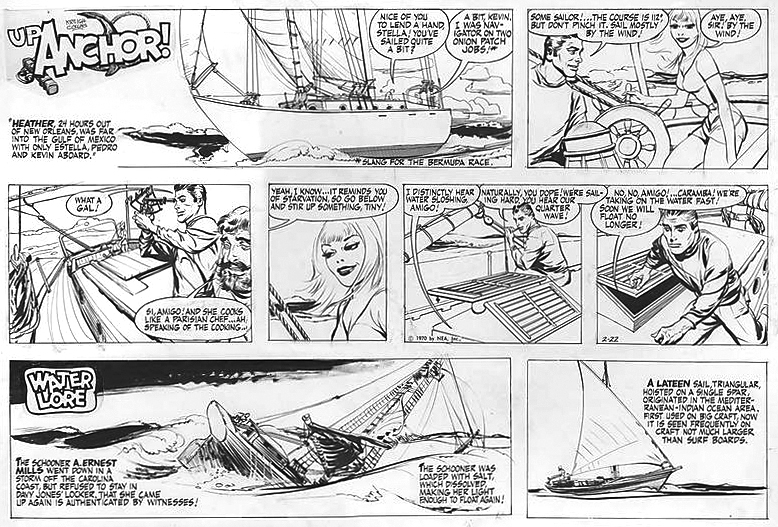
As Pedro looks for a snack, he is shocked to discover the damage caused by the saboteurs. And in this case, the subject of WATER LORE, a sinking schooner, is directly related to the events in the feature.
The resourceful skipper quickly comes sup with a plan to patch the holes, and the crisis is averted.
Occasionally, WATER LORE featured boating safety, essentially functioning like a Public Service Announcement. Somehow, I’m reminded of this strange PSA. It warns of the dangers propane can present on boats (and features an extremely spacious galley for a boat of the size shown at the end of the clip).
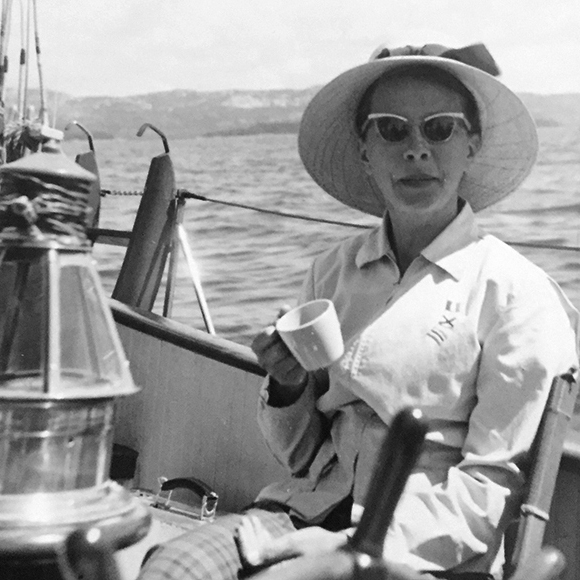
Kreigh’s wife Theresa wasn’t afraid to boil a kettle on a boat—here she is enjoying a spot of tea aboard Heather.
However, the cooking done on Heather was done safely using an alcohol stove more typical for a boat built in the 1920s.
Pedro has found someone to charter Heather, and he introduces the prospective customer to Kevin Marlin—a lovely plot twist indeed.
News of Heather’s upcoming charter reaches certain unsavory elements.
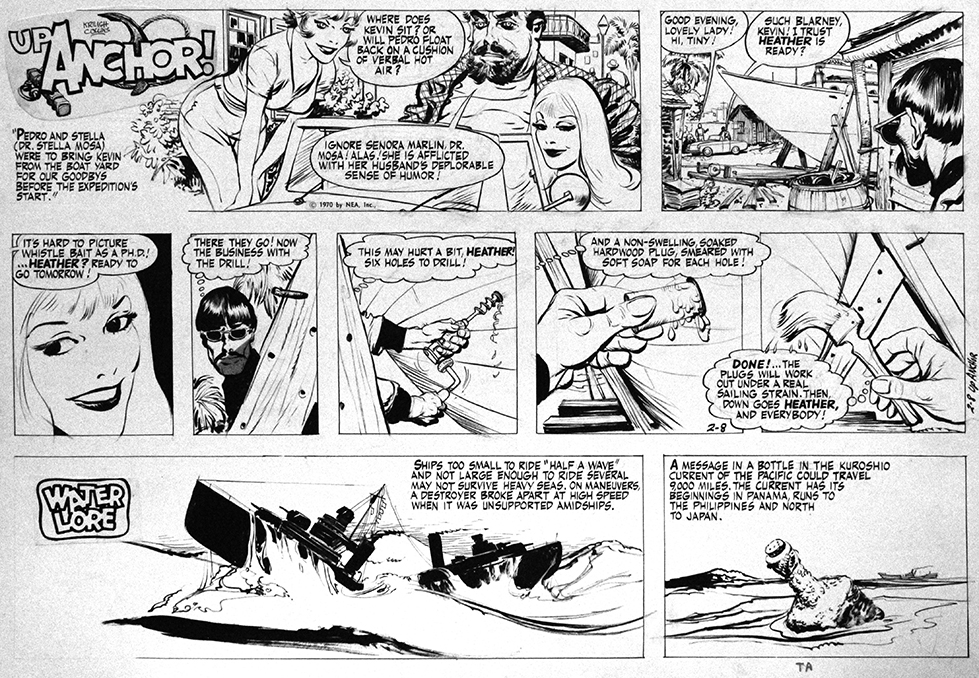
With Heatheron the hard, vulnerabilities are exposed.
It’s interesting to see “whistle bait” appear in the dialog (third panel)—that was the name of a song written in 1958 by 13-year-old Larry Collins of the Collins Kids. (Sadly—no relation). It’s 95 seconds of rockabilly heaven, and is arguably the first punk rock record ever. To my ears, it’s astonishing, but it’s impact is diminished by not being accompanied by live footage. To see the Collins Kids live, check out Hoy Hoy. Still don’t believe me? “They’re lip synching!”—then check out this live performance. Besides all that energy, Larry’s got some skills! He later earned a co-writing credit for a worldwide #1 hit, Helen Reddy’s Delta Dawn… but that’s a story for another blog.
Sailing has always been a popular hobby in my family. My grandfather owned a succession of boats, and for a number of years, so did my father. My dad was also fond of “improving” existing sailboat designs—using tracing paper and a pencil to refine designs seen in sailing magazines. He also built numerous small wooden craft, always starting with a scale model made from balsa wood. When I was in high school I recall him asking to use my scientific calculator to determine sail displacement/length ratios.
Displacement being the amount of volume a boat’s hull takes up that would otherwise be occupied by a water, and LWL representing the boat’s length at the waterline. You’ll have to ask one of my more boat-savvy family members for further explanation!
Uncle Kevin has had a boat for most of his adult life; he plies the waters of Lake Michigan each summer. As for my generation, the sailing bug didn’t bite me so hard—I’ve never owned a boat but am happy to be part of a crew. On the other hand, my brother (Brett), a boat-owning sailing enthusiast, recently arrived in the Virgin Islands to charter a 50-foot catamaran with some friends. Accordingly, I thought now would be a good time to switch things up and feature a chapter from my grandfather’s final NEA comic strip, UP ANCHOR!
With a release date of September 11, 1953, TOM MIX Nr. 1 was the first of 18 comic books to carry the Swedish version of KEVIN THE BOLD (ROLAND DEN DJÄRVE). As hyped on the cover, the issues ran in color (mostly!) The covers were nicely printed on slightly heavier paper stock than the interior pages; oddly, the inside front and back covers only ran in black and white. The 6-3/4″ x 10-3/16″ comic book is 36 pages long.
This repackaged version (ROLAND) appeared about three years after KEVIN’s initial newspaper run, and wasn’t the first time Kreigh Collins’ comics appeared in Sweden. Nine months earlier, the weekly magazine Allas Veckotidning started running episodes of ROLAND DEN DJÄRVE.
TOM MIX Nr. 1 was part of a wonderful gift from my friend Roger—18 comic books spanning ROLAND’s complete run. Having previously seen the 17th comic book in the series, I was familiar with UGH, the silent comic appearing on the inside front cover (I think it’s growing on me?) Facing it is an introduction modeled after a newspaper’s front page. This is immediately followed by the title comic, TOM MIX (possibly illustrated by Carl Pfeufer).
After the four TOM MIX spreads, a new feature is introduced—along with a contest. I wasn’t able to make out much of the text, and page 12 is very nicely composed, but what caught my eye were the illustrations on page 13, done by an unknown Swedish artist.
Roger graciously translated the text—page 12 reads as follows:
Giant Tom Mix competition Hail, noble knight! All brave and courageous men who can wield a two-handed sword as deftly as they wield their quill pen are invited to join my cruise! We intend to visit unknown shores, inhabited by heathens and Moors far away from our Ireland. Strange adventures await… We will reach ten different coasts on the journey, which you can follow in our cartoon log book. Unfortunately, our scribe is an uneducated chap and doesn’t know the names of all the places we sail past. Therefore, it is up to you to guess where each stage ends, guided by our drawings and scant text. If you manage to win one or more stages, you may travel to Ireland, my home country, and spend a week among my relatives on “The Green Island”! The first stage begins on the next page. Where did we get to on our first leg? Welcome aboard! Roland
Page 13 includes the contest’s questions:
Cruising with Roland
First log book sheet 1. Autumn had arrived in Ireland. All stores were on board when rain and windstorms whipped off the trees’ golden leaves, forming a thick carpet on the deck the day we sailed from the island of our birth.
The trip has now been going on for a week. A storm forced us to seek shelter yesterday. We did not understand the language of the local people. We were passing the southern tip of the country. A high rock island.
Shortly after we sailed through the strait, we were attacked by pirates. They were dressed like Arabs.
Another week passed. We approached a country populated by heroic men and women.
Arab horsemen attacked us. We sailed away… Like Odysseus, muttered Roland. What was the country?
Submit your answer to “Cruising with Roland” before September 25!
Following the Roland den Djärve teaser spread were seven pages of BUFFALO BILL. Next up was ROLAND DEN DJÄRVE!
ROLAND’s seven pages were sourced from three original Sunday episodes, minus their throwaway panels. The illustrations were given new color schemes, and avoided the occasional two- or three-color treatments that appeared in some of the originals’ panels. The original episodes, as printed in the Chicago Sunday Tribune, can be found here. Interestingly, the action starts with the third KEVIN THE BOLD episode—I guess the first two are seen as a transition away from Collins’ first strip, MITZI McCOY.
Following ROLAND were seven pages featuring Lash LaRue, and on the inside back cover was a short story about Native Americans’ use of smoke signals called “The Prairie Telegraph.”
An ad promoting upcoming TOM MIX issues appeared on the back cover. Also mentioned were a series that would run on those future issues’ back covers, “Famous Men and their Accomplishments,” plus another mention of the ROLAND DEN DJÄRVE trip to Ireland contest (was this a real prize?!)























 Kreigh’s Comics