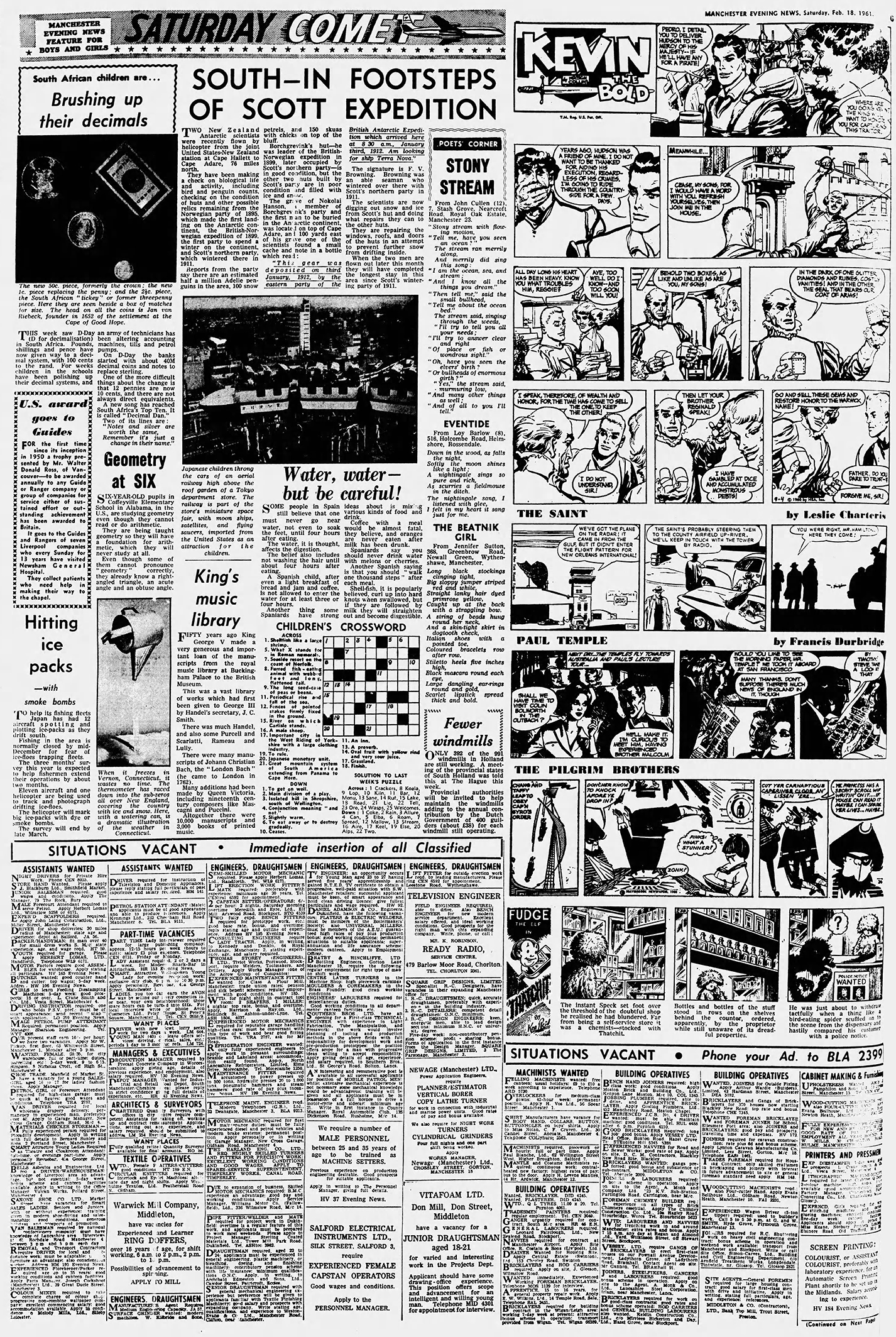
In its 21 July, 1956 edition, the Manchester Evening News (England) began to include KEVIN THE BOLD on its “Saturday Comet” kids page. These syndicated versions appeared five-plus months after their original NEA publication dates, and ran in a black and white tabloid format. The NEA likely pitched the News because of a new face being added to KEVIN’s roster—King Henry VIII.
For six years, Henry VIII became a recurring KEVIN THE BOLD character; his swan song was September 16, 1962. (And no surprise, once ”Old Coppernose” was gone, the News dropped KEVIN). As part of the “Saturday Comet,” KEVIN appeared with a few other comic strips—likely Saturday dailies. The News occasionally labelled this section the “Evening News International Cartoon Page,” and KEVIN’s neighbors included THE SAINT, by Leslie Charteris, Francis Durbridge’s PAUL TEMPLE, plus THE PILGRIM BROTHERS and FUDGE THE ELF.
The following story arc ran for a couple of months in early 1961. It’s a parable about wealth and honor involving two unalike brothers, other interesting characters, swordplay, and more.
When possible, the News’ version will be accompanied by third-page versions from the Detroit News.
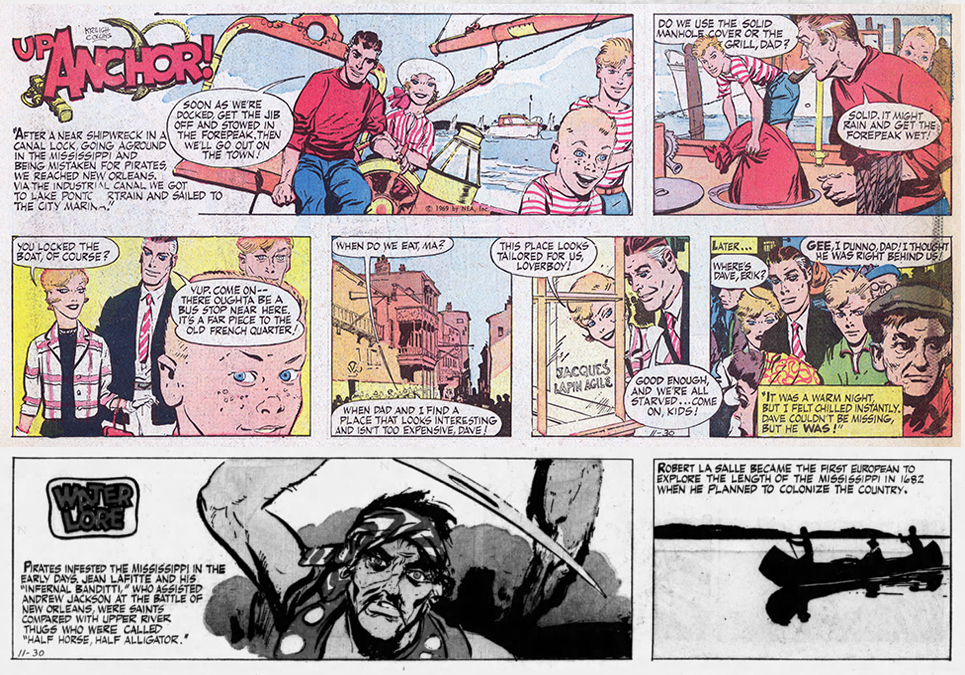
The following article appeared in an in-house NEA publication, and also ran in various newspapers that had picked it up from NEA. Written by Jay Heavilin, it picks up the story about Heather and her crew’s Great Loop journey as the schooner neared home. Since the NEA offices were located in Cleveland, Kreigh Collins and crew would be sailing directly past NEA HQ as they neared the western end of Lake Erie on their way to Heather’s home port on Lake Macatawa. They still needed to nearly circumnavigate the lower peninsula of Michigan—nearly 500 miles through lakes St. Clair, Huron, and Michigan—but with 5,000 miles already logged, they were on the homestretch.
The final installment of this story arc includes two new additions to my collection—the two color third pages shown below. These episodes (and three dozen others) came from my new friend Dave, a vendor from New Jersey. This spring, I paid him a visit, intending to purchase the episodes, but he insisted on giving them to me. Thank you, Dave!
The black and white portions of final three episodes come from photographs I took of the originals, which are located in one of the Grand Rapids Public Library’s special collections. (If I remember correctly, they are found on the fourth floor. Highly recommended!)
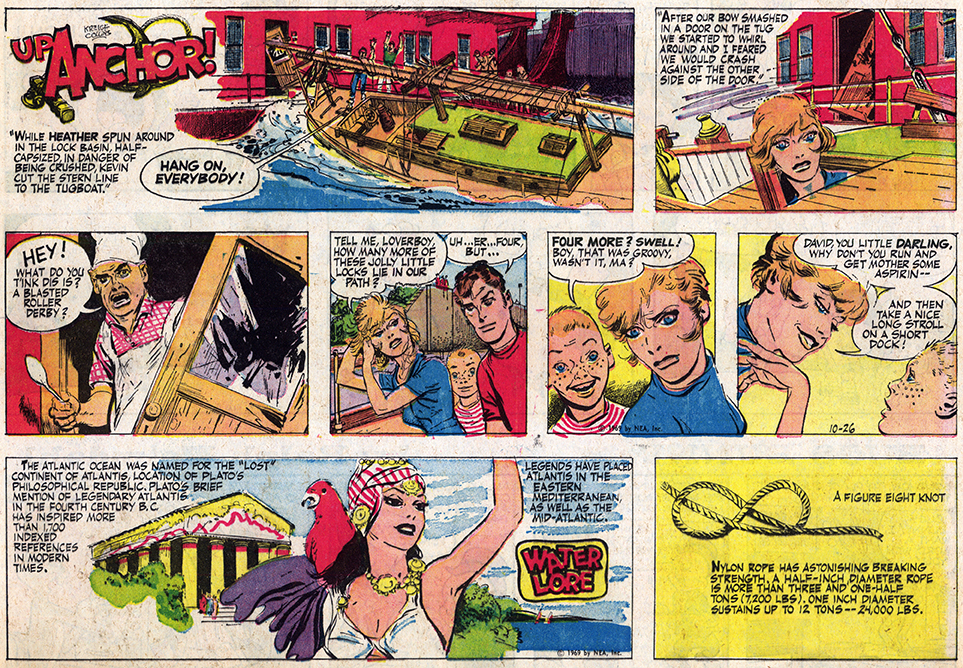
Meanwhile, back in New Orleans, the situation is frantic.
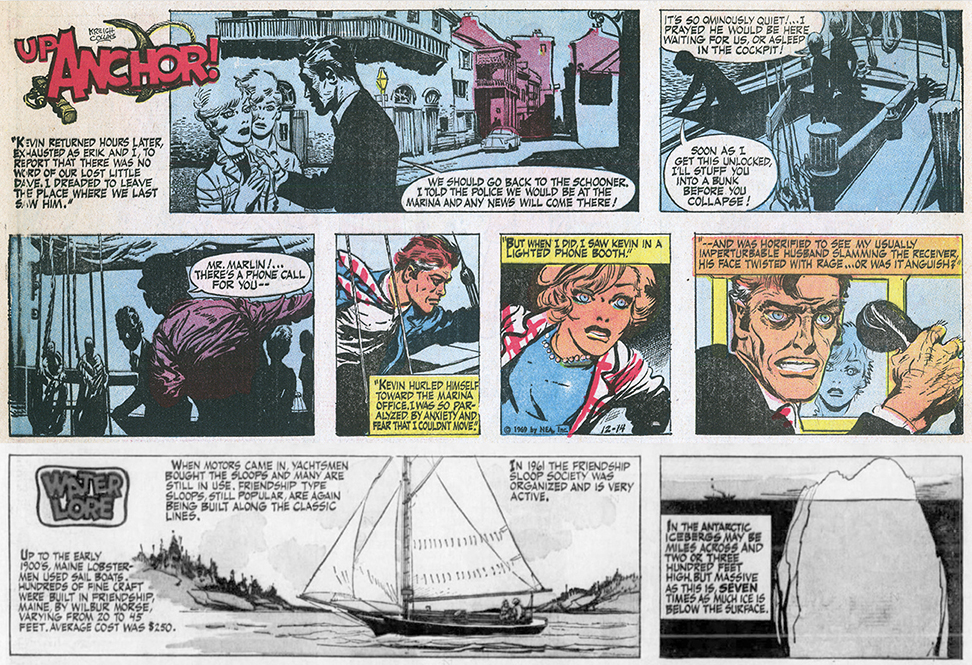
And when things couldn’t get worse…
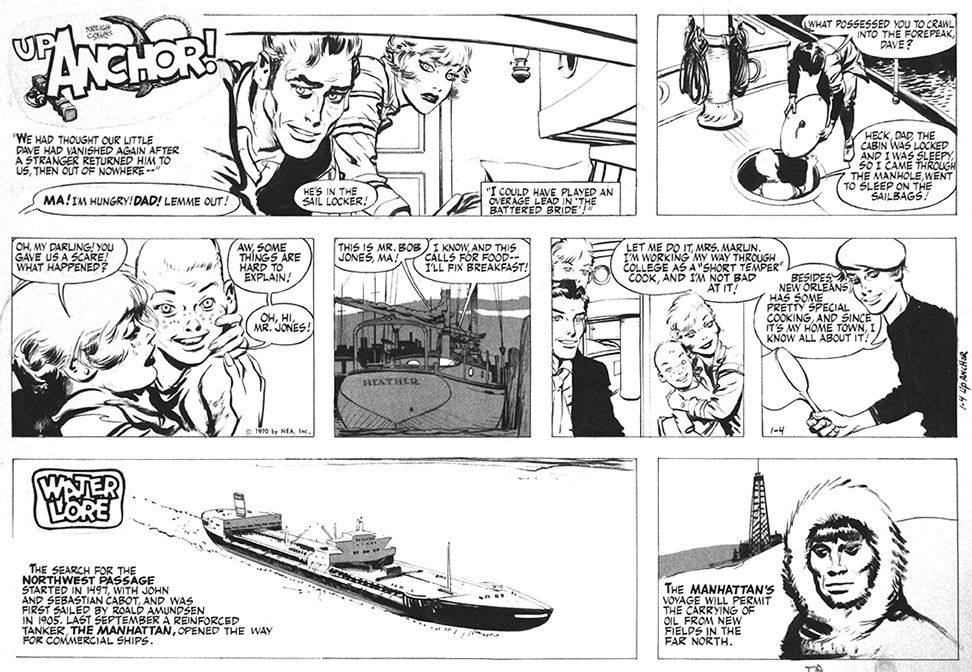
Oh, what a relief!
In the third frame of the final episode of the chapter, young Dave utters what seems to have become something of a catchphrase, “Some things are hard to explain.” I haven’t kept track of all the instances, but I recall Pedro uttering the line in a mid-1960s episode of KEVIN THE BOLD.
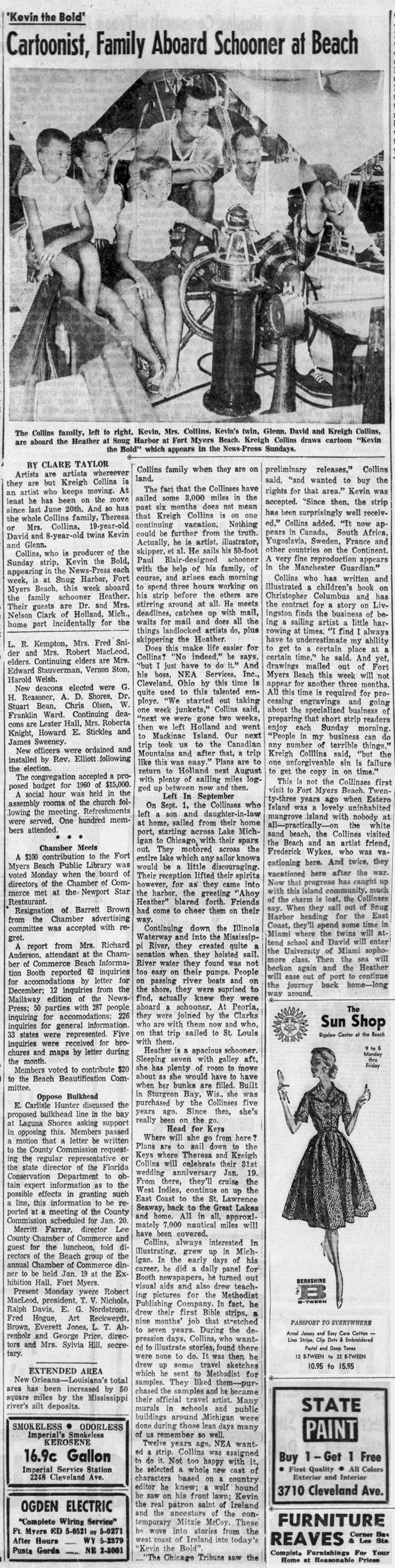
On this journey south, articles often appeared in the newspapers of the towns Heather and her crew visited. I don’t know if my grandfather acted as his own publicist, or if the mere sight of his boat drew reporters looking for some interesting local news (47-foot schooners were a rarity on the Mississippi). It certainly helped if the newspaper featured KEVIN THE BOLD in their comic sections. However they came about, the articles sometimes provided some interesting information, such as this one, from the January 13, 1960 Fort Meyers News-Press.
Over the years, as my comics collection has grown, the thing that surprised me most was the number of countries in which Kreigh’s comics were published. Aside from a single Swedish Tom Mix comic book and a tear sheet from a Cuban newspaper, my research had yielded no acknowledgement of his work appearing in markets outside the US and Canada—and I always wondered if Collins was aware of (and compensated for) these additional NEA revenue streams.
Finally, that question was answered—check the top of the article’s third column. Speaking of KEVIN THE BOLD, Collins is quoted as saying, “…the strip has been surprisingly well received. It now appears in Canada, South Africa, Yugoslavia, Sweden, France and other countries on the Continent. A very fine reproduction appears in the Manchester (England) Guardian.”
This example from the Manchester Guardian ran December 31, 1960, five an a half months after its original publication date (July 10, 1960)
I hadn’t been aware of any British papers carrying his work—it’s wonderful to learn something new after all these years of research!
Meanwhile, back to the funny pages’ version of Heather…
More obstacles—and more helpful strangers. By the time they reached New Orleans, Kevin Marlin and his crew had to be feeling pretty good about their state of affairs.
Like sailing weather, things can change change quickly, and not always for the better. Where’s David?!
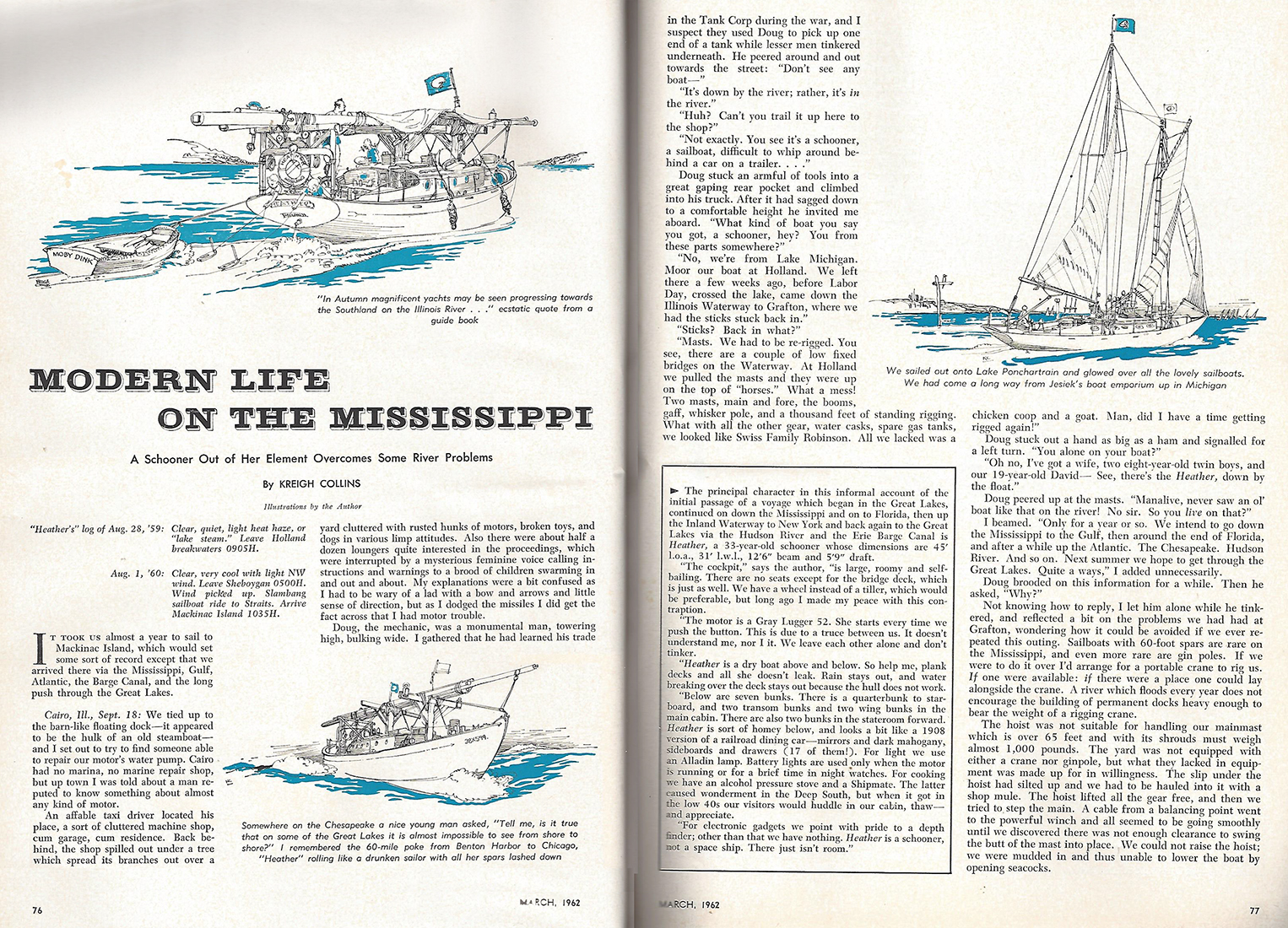
Yachting is a monthly magazine first published in 1907; it’s still on newsstands today. I’m most familiar with issues from the 1960s–80s, because my father had stacks of them piled in his library. Little did I know then, but on at least two occasions my grandfather wrote and illustrated features for Yachting. The first that I’m aware of was included in the March, 1962 issue.
Due to the times, these articles occasionally contained language now considered politically incorrect. Otherwise they are well-written, informative, and very funny. The March, 1962 article described the trip down the Mississippi that became the inspiration for this blog’s current story arc.
A cute detail are the two toy boats trailing behind Heather, in addition to the dighy, Mobe Dink.
While the opening spread relates some of Heather‘s mechanical troubles, the following page describes the incident later featured in the October 26, 1969 episode.
No doubt some liberties were taken in both versions of the story, and it’s not surprising that in the comic strip version, the smashed window was placed in the galley (kitchen), not the head (bathroom).
The article jumps to the back of the magazine, and continues for three more pages. (If you’re interested in the complete article, copies are usually available on ebay).
Heather and her crew survived this first drama, but surely there would be more to come.
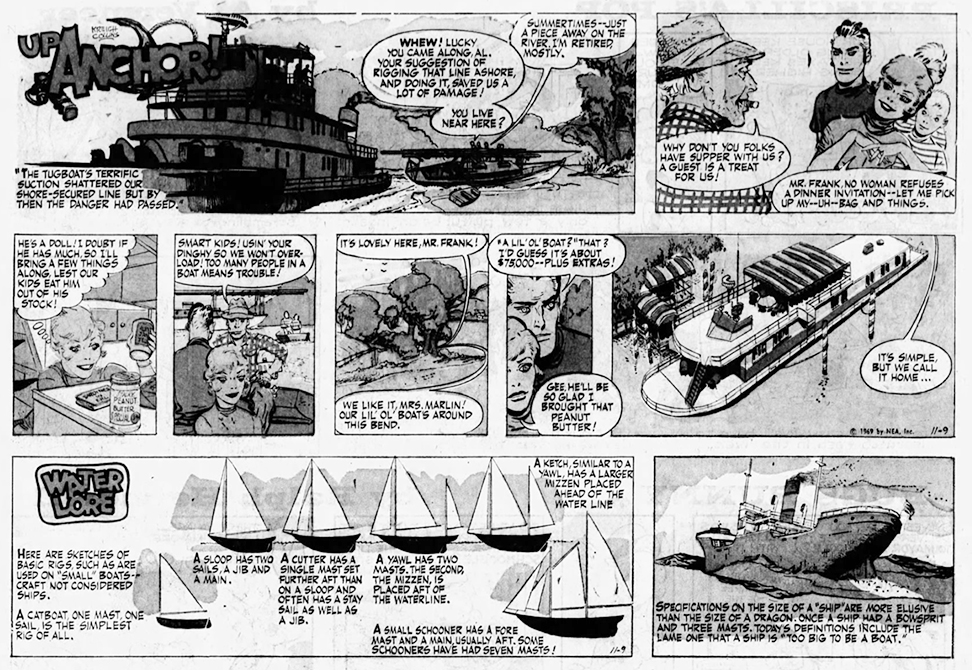
The Marlin family’s new friend had some good advice, but it was to no avail. Making sure not to judge a book by its cover, they graciously accept Al’s generous offer. (Of note, the November 2 WATER LORE episode consists of three panels, not two—the only such instance I can recall).
More surprises awaited—thankfully, this one was pleasant.
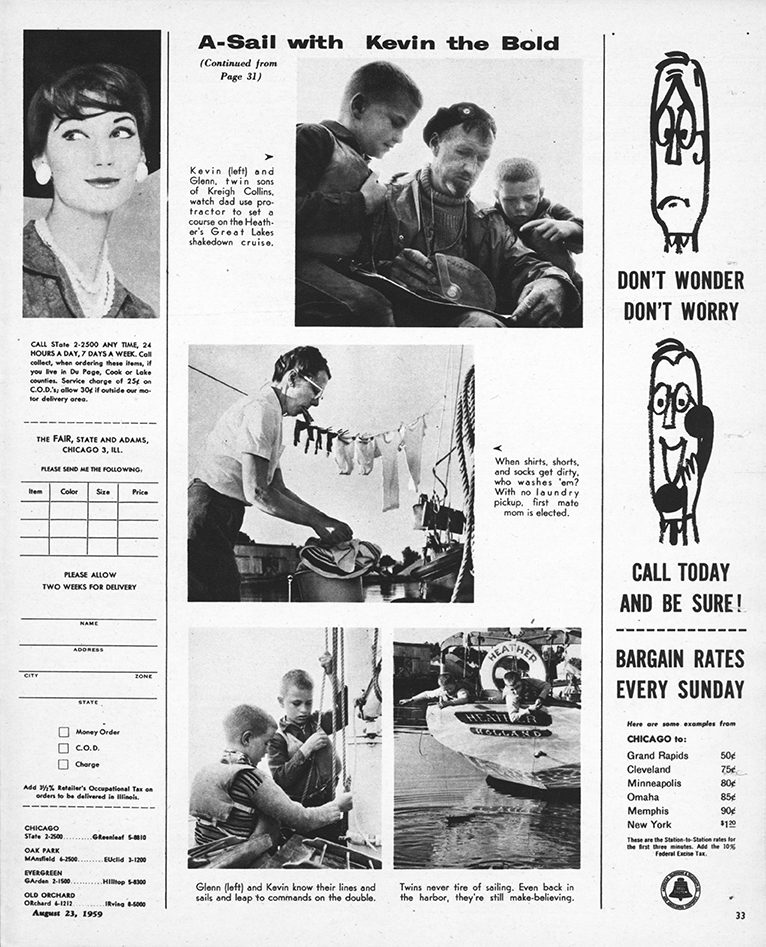
On August 23, 1959, a short photo-essay appeared in the Chicago Sunday Tribune Magazine. It described life aboard Heather for the Collins family as they prepared for their journey south. The short profile was a nice promotional piece for the artist, whose work appeared every Sunday in the Trib’s funny pages. (Sadly, it is likely the last promo the Tribune ran for Collins—four months later, after a nine-year run, KEVIN THE BOLD was discontinued.)
Now back to the story that resulted from the trip south.
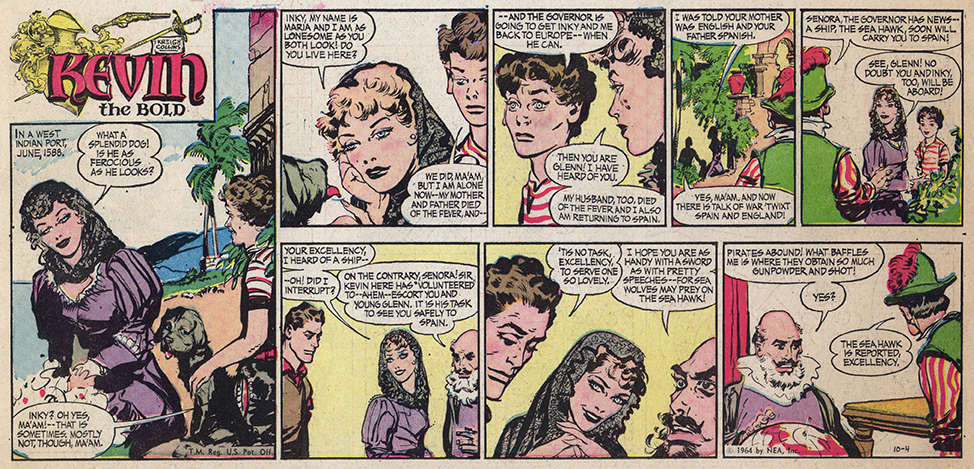
Say… that dog and little boy in WATER LORE… they sure look familiar.
Ah yes, it’s Inky—a dog that, in real life, belonged to one of the Collins’ neighbors. But I digress. Heather has arrived for her overnight stay in Chicago, with an early morning departure and a date with its first lock.
It was smooth sailing through the lock, so much that Jane Marlin thoughts turn to Robert Burns’ Duncan Gray.
With summer here, it seems appropriate to feature a sequence from Kreigh Collins’ sailing-themed comic strip UP ANCHOR!. In this chapter, Kevin Marlin and his family are making plans for an extended journey south aboard Heather. Of the 19 episodes, only half are in color, but they will be supplemented in the coming weeks with some interesting articles on the real-life events that inspired the action in UP ANCHOR!.
The voyage was begin in the fall, and the story picks up on a late summer shakedown cruise.
As Jane learned to sail, so did the readers, with help from the topper strip WATER LORE.
Written with help from his wife, Theresa, no doubt some license was taken, but I’d be inclined to believe that this incident actually happened.
A point of pride for me are the capable actions of Erik. My father, eldest of my grandparents four sons, was actually the only one who was not aboard Heather during this period. Ironically, relations between him and my grandfather were somewhat strained, so this is something of an idealized version of events.
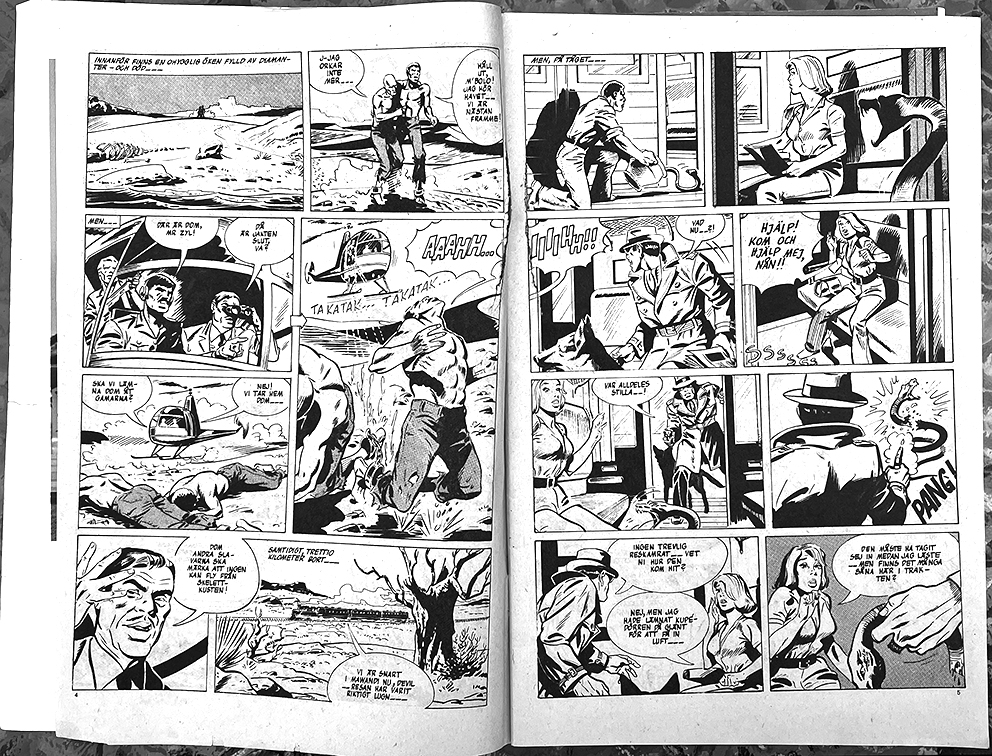
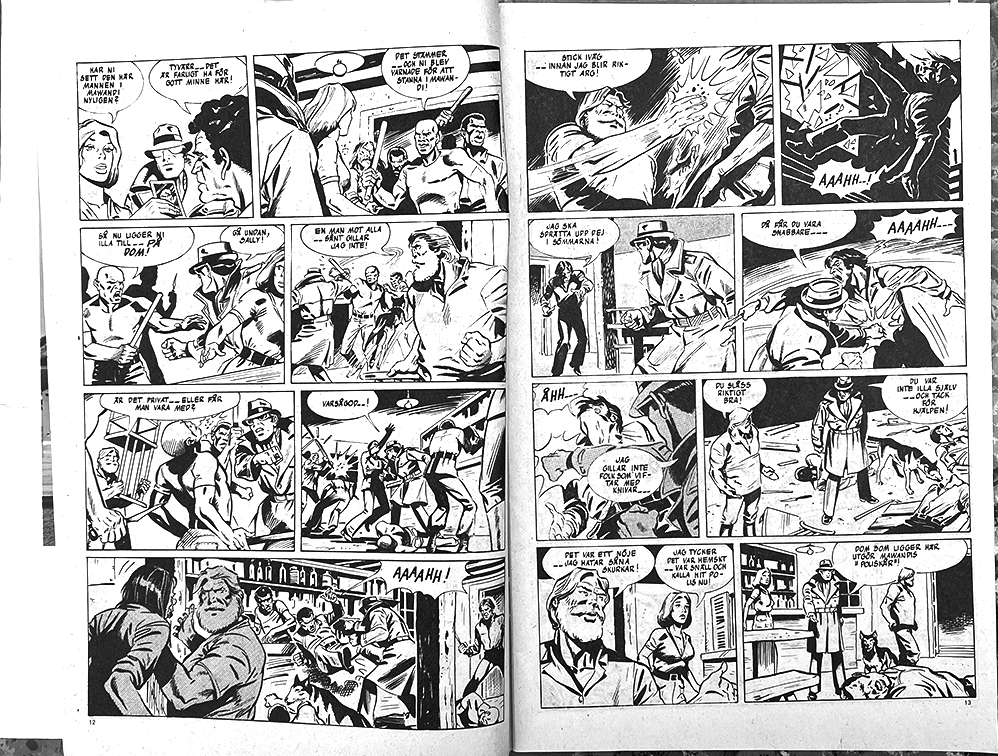
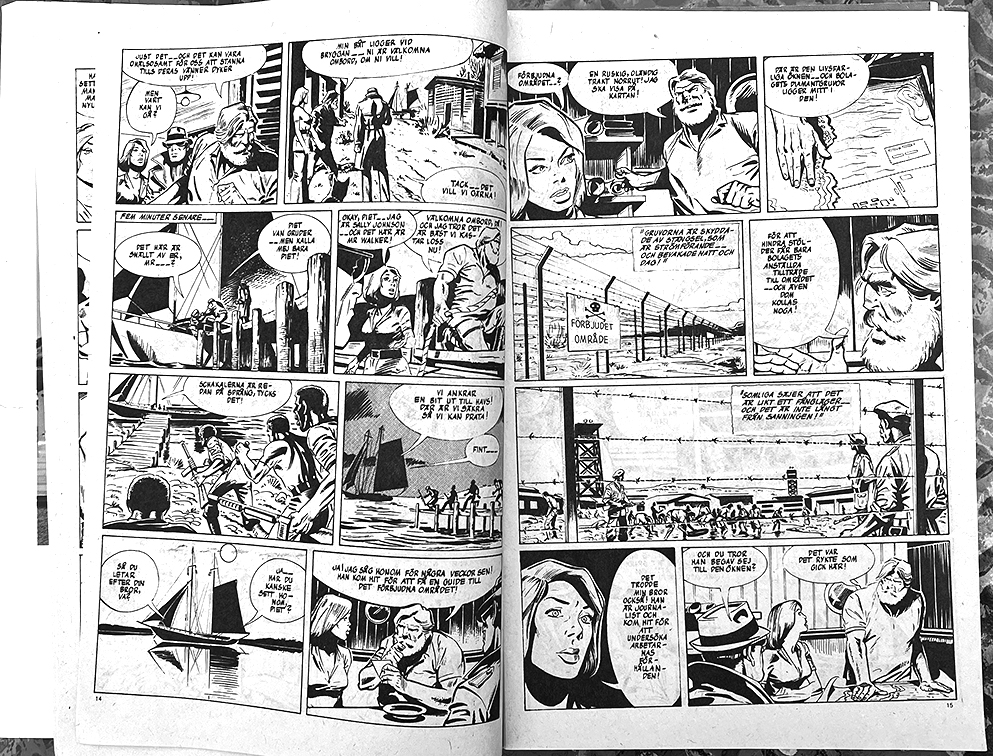
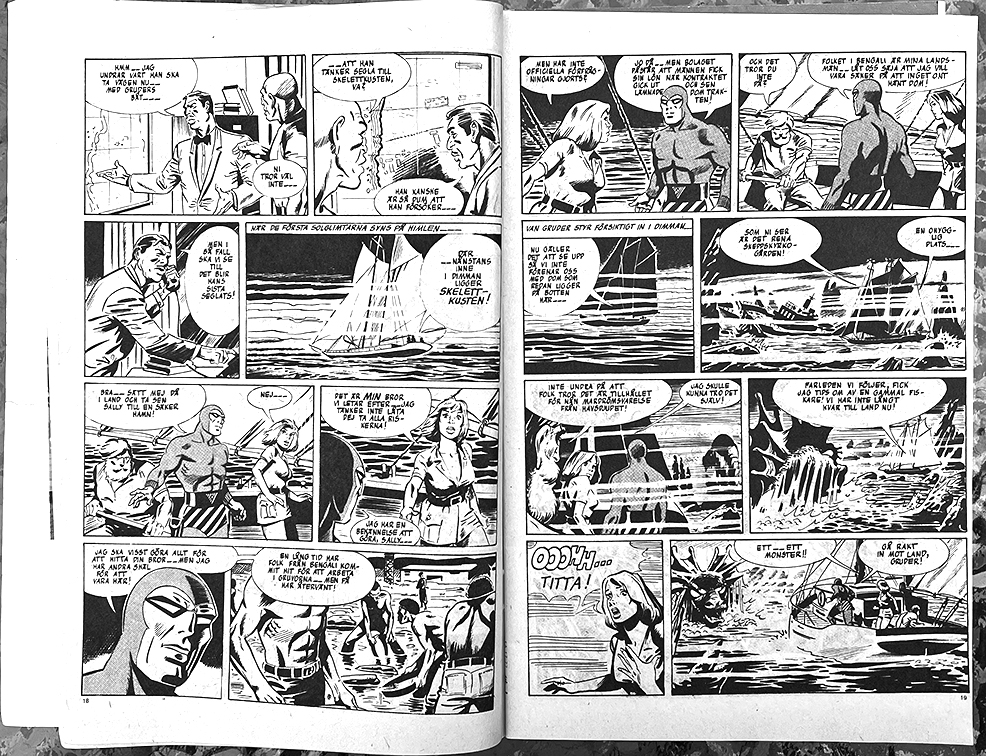
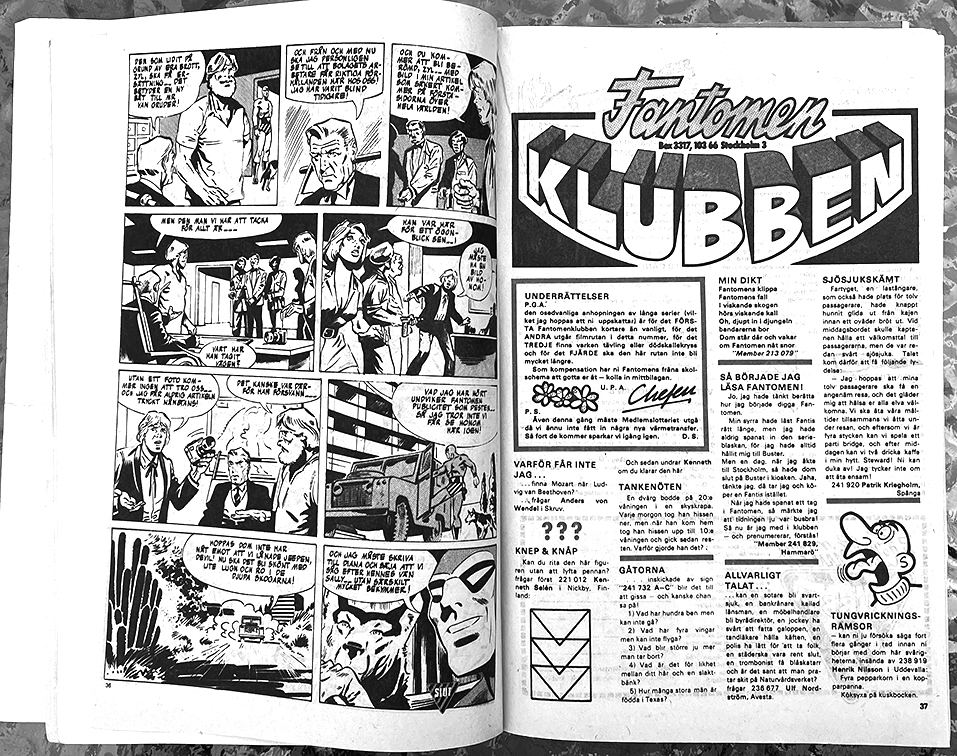
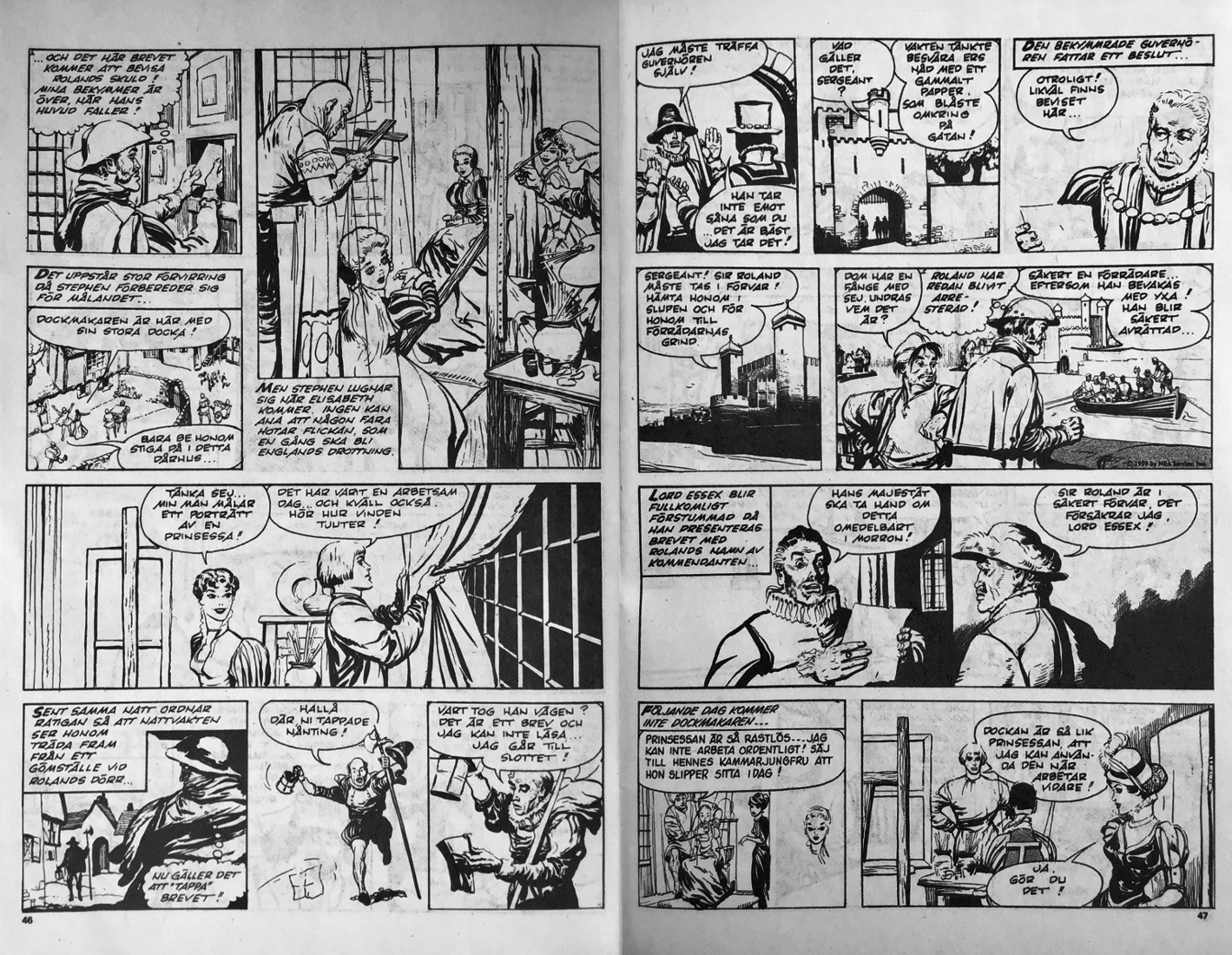
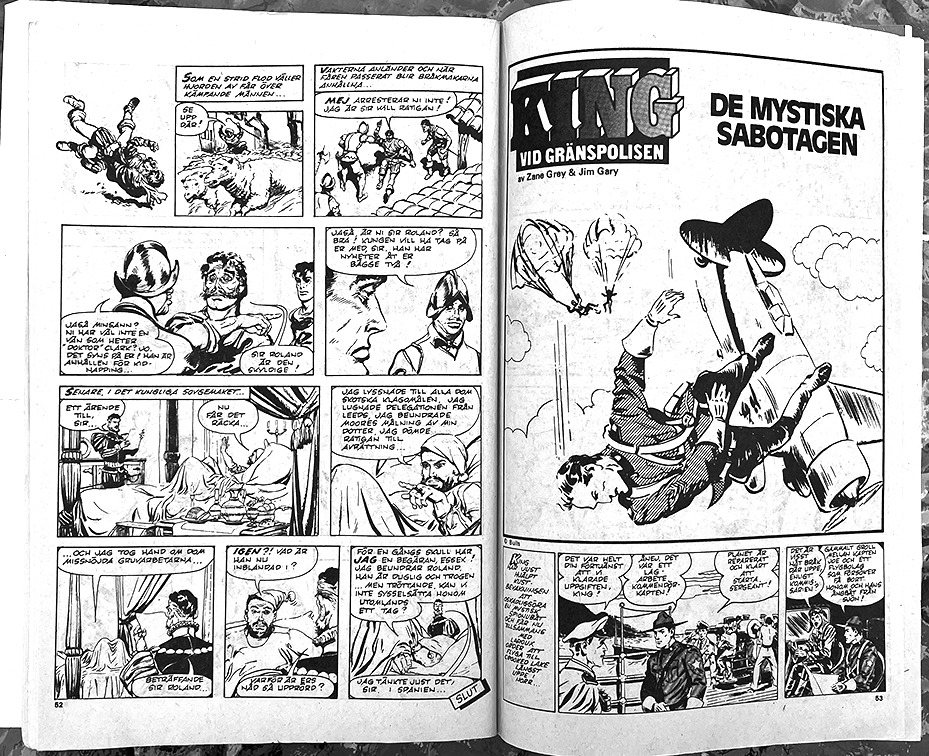
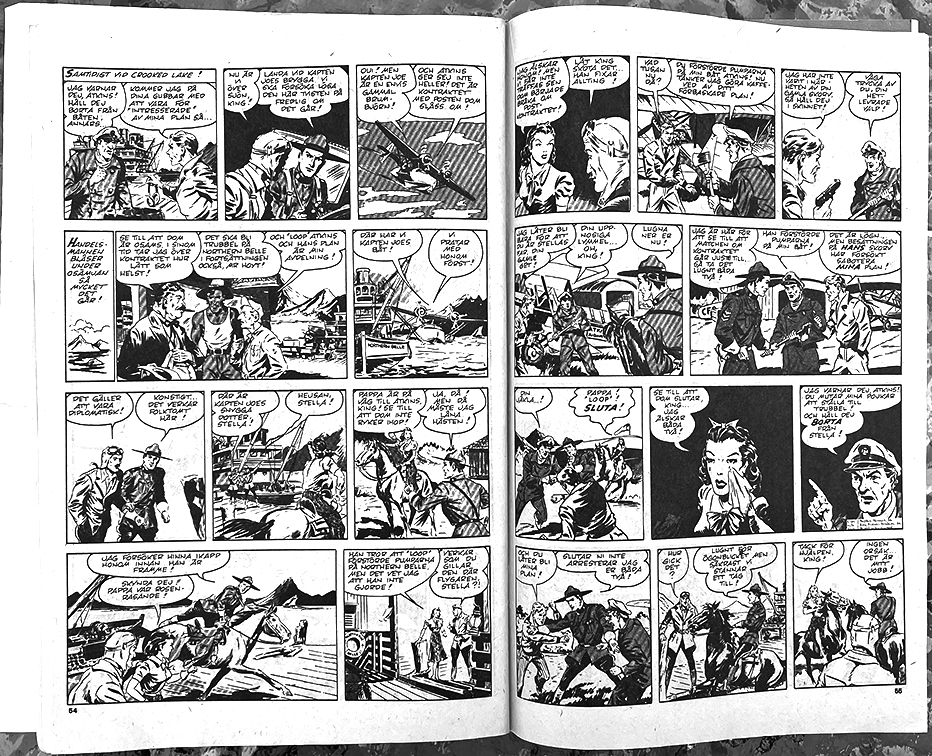
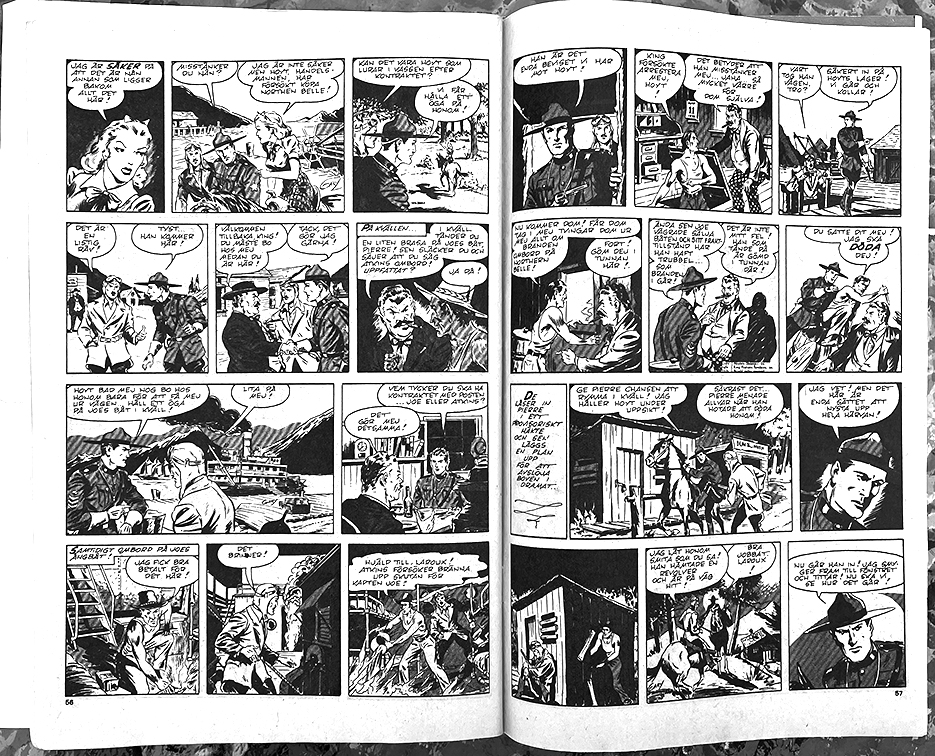
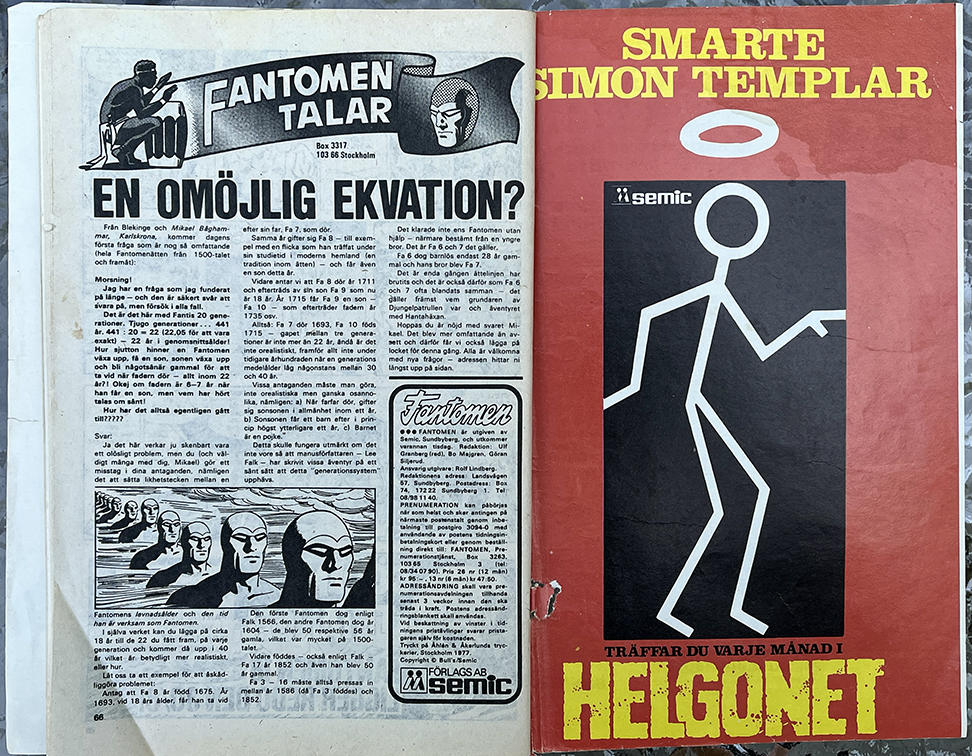
Stop me if you’ve heard this before, but I recently received a package in the mail from Roger, my blogger friend from Sweden. In addition to some “Falcon Stormfågeln” tear sheets from Allas Veckotidning magazine, It contained seven issues of the comic book Fantomen (featuring Lee Falk’s long running comic, THE PHANTOM). These issues of Fantomen were published in 1977, ran 70 pages, and had color covers and black and white interiors. In addition to the title feature, “Fantomen Nr. 17” included 13 pages of the Zane Gray/Jim Gary comic “King vid Gränspolisen” (KING OF THE ROYAL MOUNTED), and 15 pages of “Roland den Djärve” (KEVIN THE BOLD). “Roland” had previously appeared in Swedish TOM MIX comic books, published in the mid-1950s; Kreigh Collins’ work had first appeared in Allas Veckotidning as “Falcon Stormfågeln” about 11 months after the NEA versions ran in Sunday comic sections.
The inside front cover has a very cool ad for Serie Magisinet featuring Björn Borg, who had just achieved worldwide #1 ranking in tennis (I wonder if he’s reading 1977’s issue 13, which included MITZI McCOY?*)
About half the issue was devoted to THE PHANTOM, which debuted as a daily strip on February 17, 1936 (and continues to this day). A nice color poster was included, and luckily for me, it’s still attached and in perfect shape. The purpose of the poster is a mystery to me—perhaps it was intended to be used as a school schedule for the comic book reader.
A two-page PHANTOM fan club section followed.
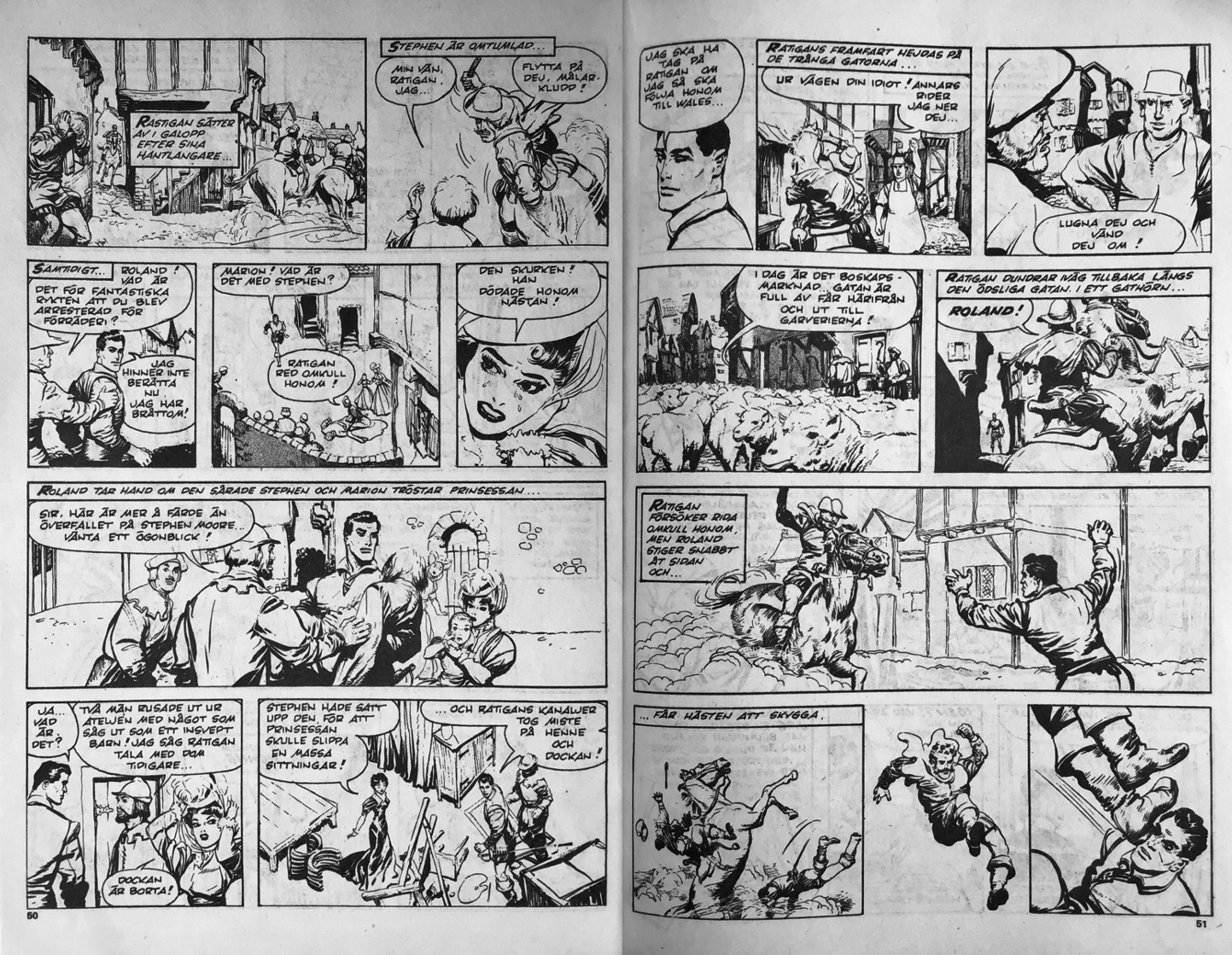
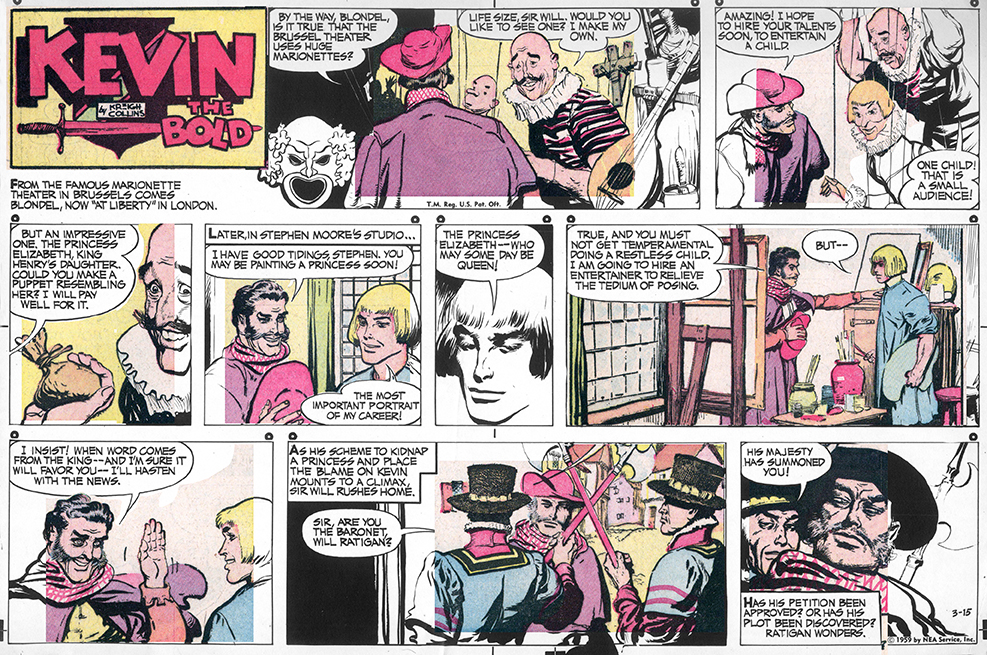
Next up was Roland. The story arc (Förrädaren, or “The Traitor”) is the Swedish version of the one that appeared on this blog over the past five weeks, featuring the no-good Sir Will Ratigan. (The following scans originally appeared on Roger’s fantastic blog).
Bringing up the rear of the issue was “King vid Gränspolisen” (KING OF THE ROYAL MOUNTED started its nearly two-decade long run in the Sunday funnies in 1935).
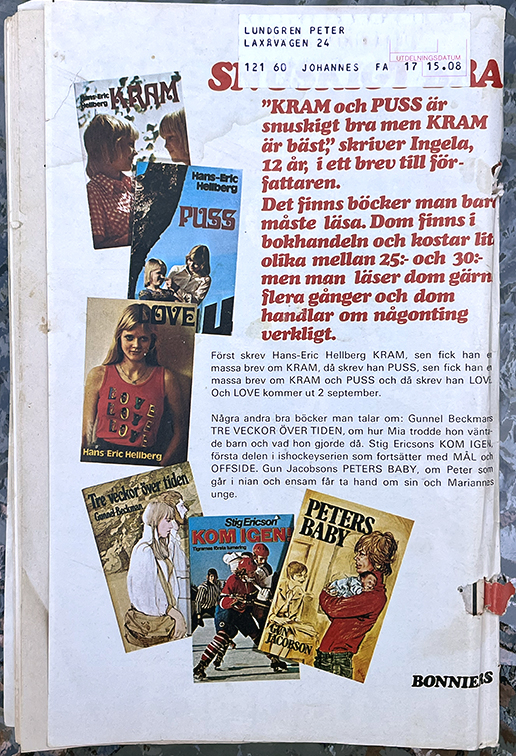
Facing an ad for “The Saint” on the inside back cover was a PHANTOM letters section, plus an ad for a juvenile book publisher on the back cover.
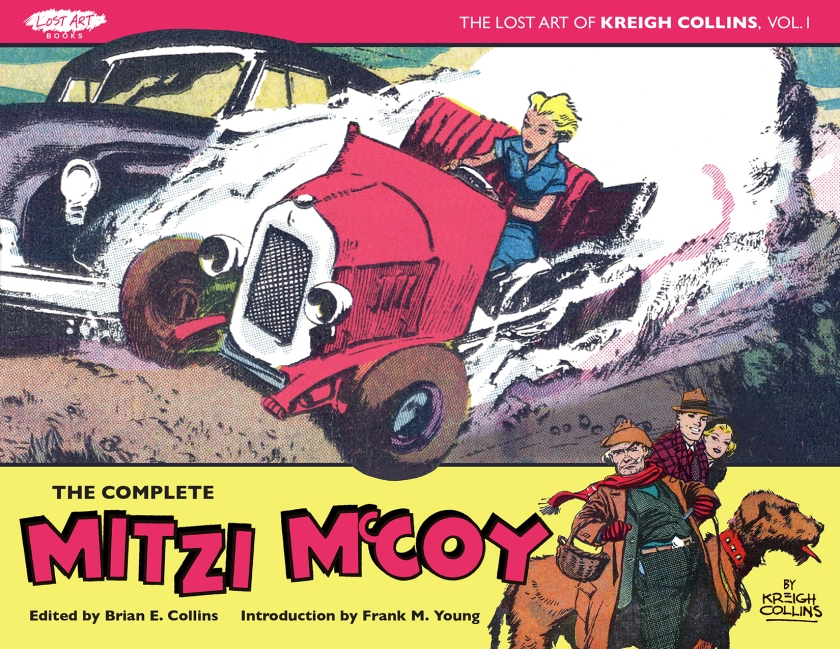
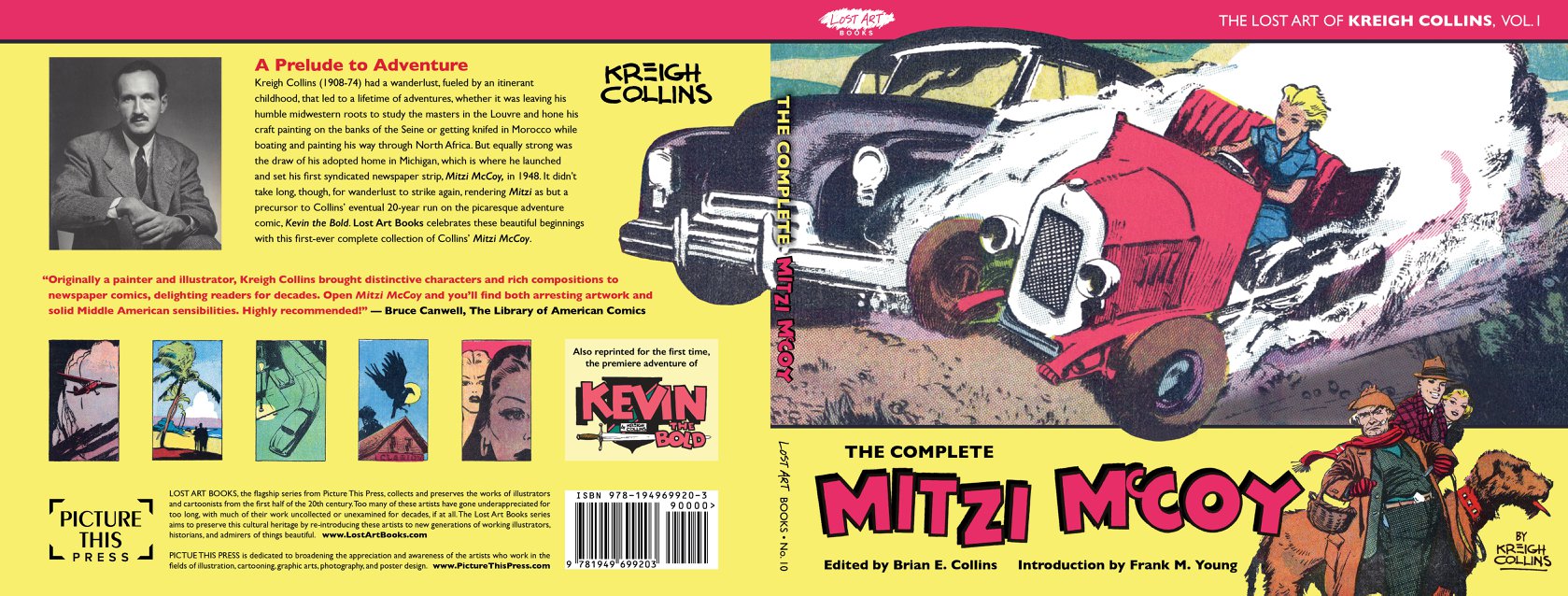
“The Lost Art of Kreigh Collins, the Complete Mitzi McCoy” features the entire run of Kreigh Collins’ first NEA feature, and is available for a limited time at a reduced price.
MITZI McCOY ran from 1948 to 1950 and showcased Kreigh Collins’ skill as an illustrator and storyteller. His picturesque landscapes, lovely character designs, and thrilling action sequences brimmed with detail and charm, and the strip’s ensemble cast rotated in and out of the spotlight taking turns as protagonists in the dozen story arcs collected in this volume. The last story collected in “The Complete Mitzi McCoy” is the narrative bridge that set Collins and his characters off on a new journey, beautifully told for the next couple of decades in the much-lauded adventure strip Kevin the Bold.
The collection includes an introduction by Eisner Award-winning author Frank M. Young, an Afterward by Ithaca College’s Ed Catto, and previously unpublished artwork and photos. Longtime comics artist Butch Guice also provides a new pin-up of the character Mitzi McCoy.
The book is available for $30ONLY $20! For domestic shipping, add $4; for international orders, please add $25 to cover first class shipping. To place an order, leave a comment below or email me at BrianEdwardCollins1[at]gmail.com, and I will give you PayPal or Venmo information. Thank you!
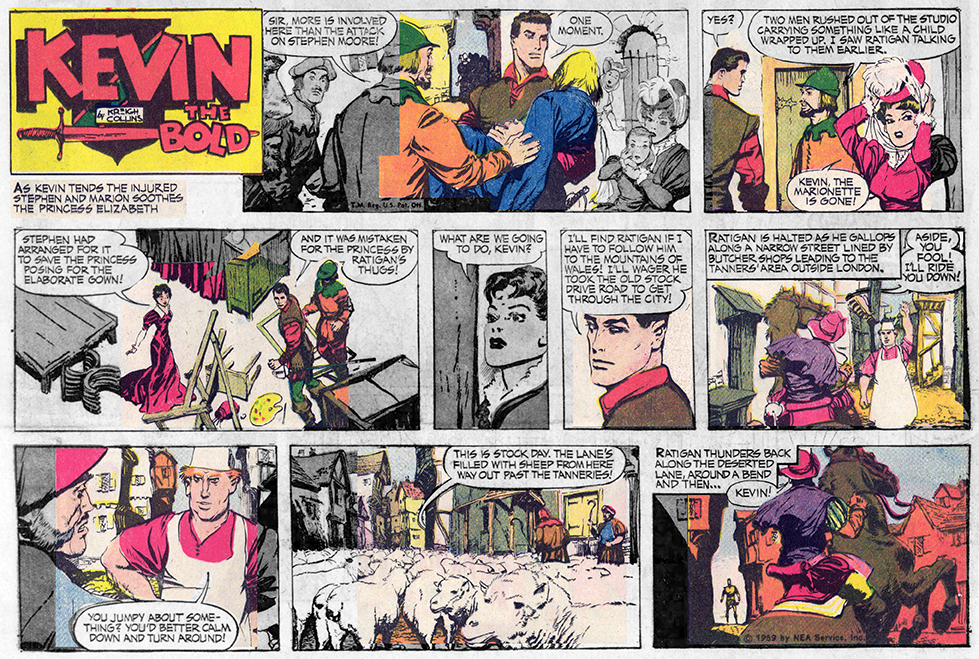
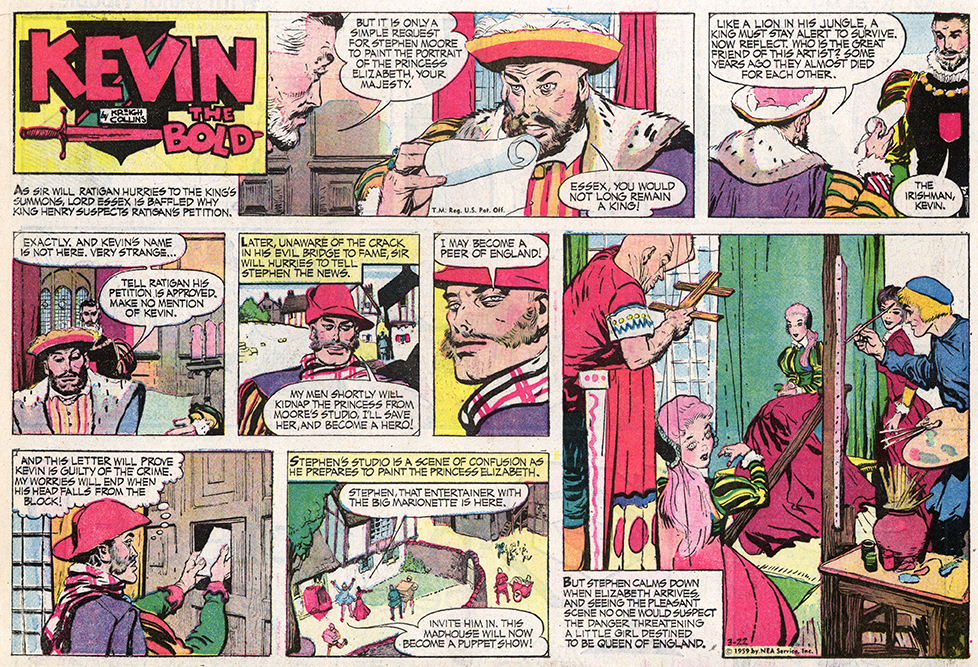
The story nears its conclusion, with the April 26 episode represented by a combination of a third-page and black and white half page found online. The third-page format really butchered Collins’ artwork—in the first panel, young Princess Elizabeth is cropped from the action, despite being mentioned in the introductory caption.
Blocked by a street full of livestock, Ratigan turns and finds his escape blocked again.
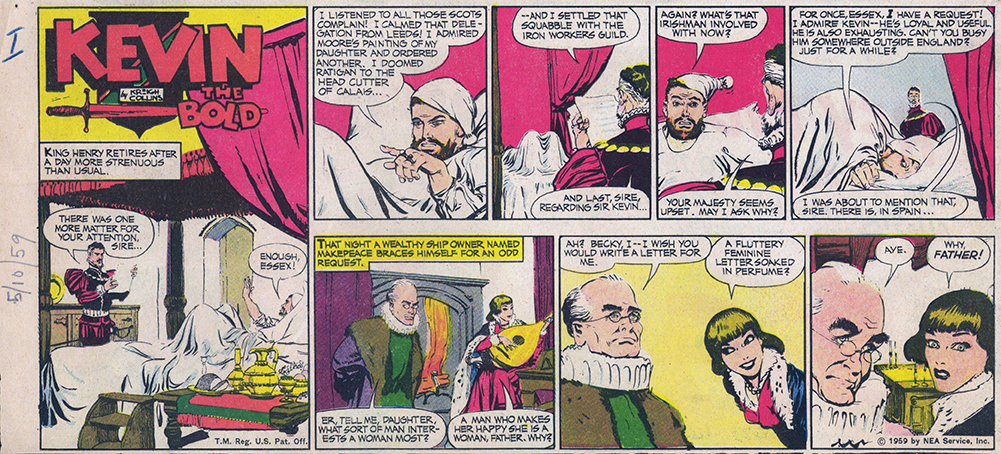
The story transitions in a light-hearted half page, one of ten halves in the 14-week story arc.
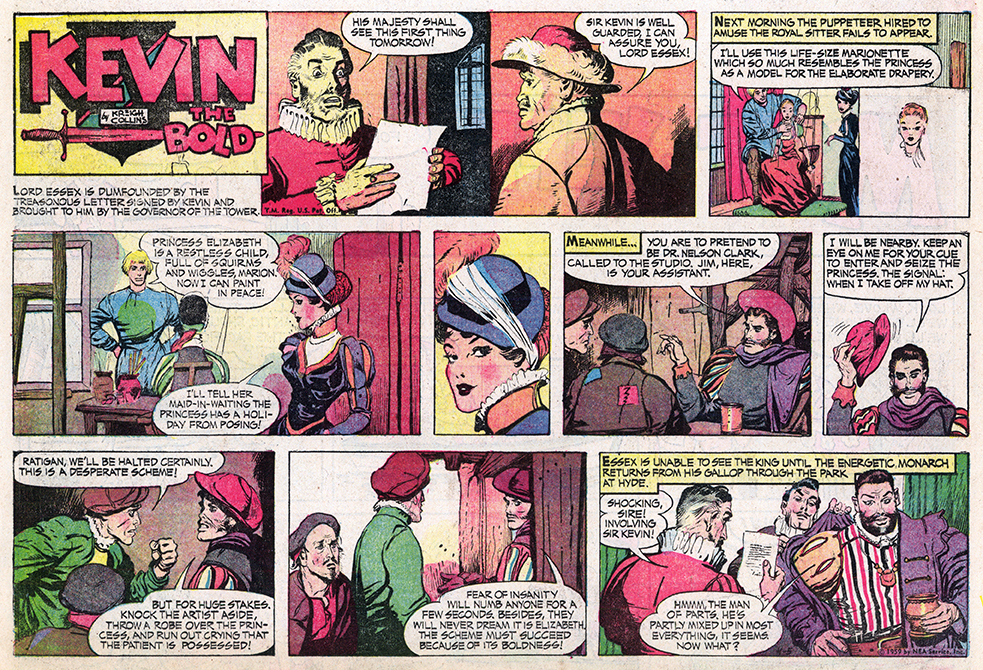
The merits of the half-page format are on full display compared to its third-page version. Next week, a look at this sequence from a different perspective.
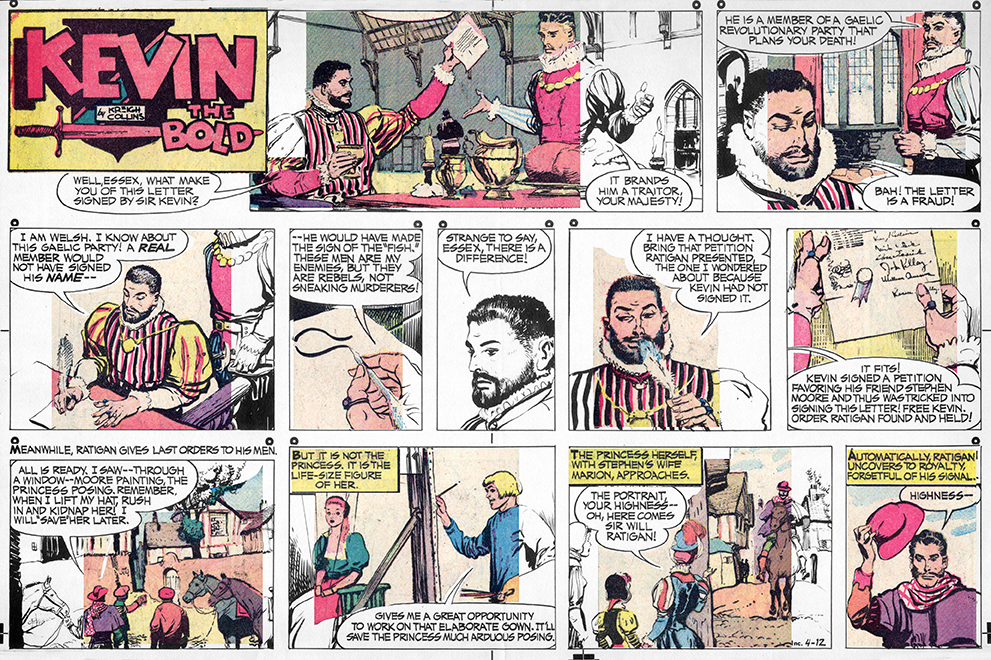
Knowing Kevin so well, King Henry is suspicious about the incriminating letter.
The last panel of the second tier has a unique composition, with the caption placed in the center instead of its usual spot in a corner. Meanwhile, Ratigan will soon have more agitation than listening to female chatter!


























 Kreigh’s Comics
