
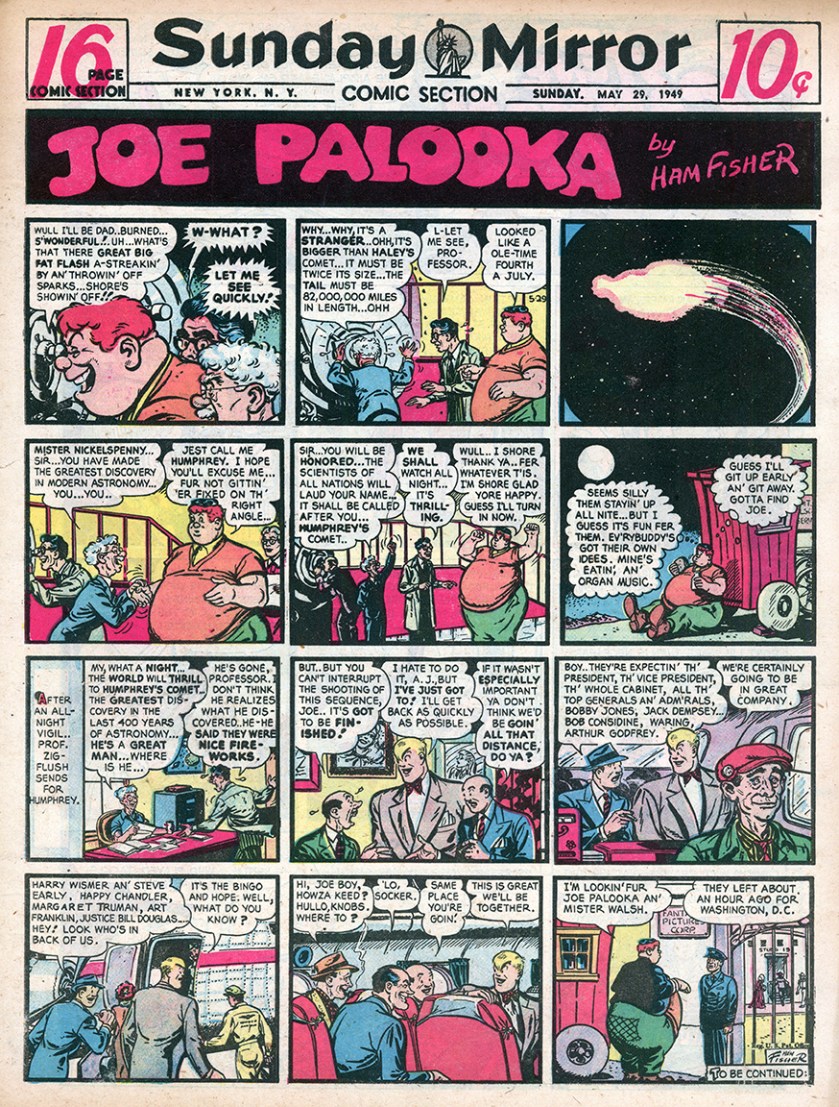
When I was putting together The Lost Art of Kreigh Collins, Vol. 1, The Complete Mitzi McCoy, a late stumbling block was finding replacement comics for the episodes I only had third-page examples of. Ironically, after searching far and wide for several years, I located them in a comic book shop about a dozen miles from my home. The catch was that I had to purchase them as part of complete comic sections. I left the shop with six 16-page New York Sunday Mirror Sunday comic sections and while I spent far more than I hoped, my quest was over. The Mirror carried MITZI for the duration of its run—usually in a half-tabloid format, but occasionally as a full tabloid page. Flipping through it reveals both big name features and comics now forgotten.
As usual, Ham Fisher’s JOE PALOOKA ran on the front page, followed by Milton Caniff’s STEVE CANYON and MICKEY FINN by Lank Leonard. Next up are HENRY by Carl Anderson, KERRY DRAKE, and SUPERMAN (neither credited, but by Alfred Andriola/Allen Saunders and Stan Kaye/Wayne Boring respectively). Then it was THE FLOP FAMILY by Swan, an advertisement for Philip Morris tobacco, and Frank Miller’s BARNEY BAXTER IN THE AIR.


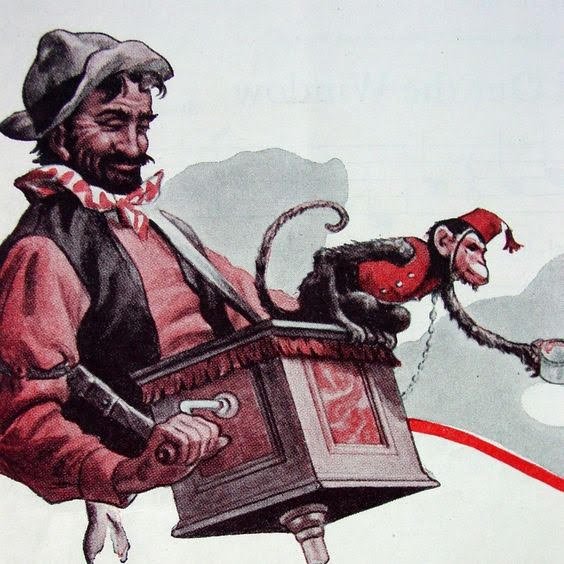
The Philip Morris ad is interesting, it promotes both cigarettes and pipe tobacco. In the cigarette portion of the ad, Dick is behaving like a dick—due to a sore throat (caused by some other brand of smokes). He is given advice by a character dressed in a bizarre uniform who seems to be a golf course clubhouse attendant (was the illustrator’s reference an organ grinder monkey?), and appears to be about nine years old. Astonishingly, the dapper dandy offers Dick a Philip Morris cigarette, and ultimately, Dick’s love life is back on track. (Perhaps the attendant is an adult but his cigarette habit stunted his growth?)
The pipe tobacco portion of the ad, masquerading as a topper strip, has a character mentioning that he was from the class of ’89. With this newspaper edition dating to 1949, that means the gent was class of 1889 (!). Another character claims she loves the clean, fresh smell of her husband’s pipe. (Could it be that tobacco companies lied to consumers? Egad).
For me, the funny pages’ highlight probably falls into a category I mentioned earlier, “comics now forgotten.” This episode, MITZI McCOY’s 30th, is from the middle of the strip’s fourth story arc, and appears in the half-tabloid format. Half-tabs have small dimensions, but they include the throwaway panel, which full-page tabloid versions do not. It’s a sweet episode where a runaway child is discovered, and is notable for not showing the strip’s titular character. Of personal interest to me is the appearance of the child, Dick. Like many artists, Kreigh Collins used his family as models; for Dick, the model was my father, Erik—Kreigh’s oldest son. Dad was 10 years old when this episode was drawn. Sharing a page with MITZI is an advertisement for Pepsi, a rather saccharine affair with another kid saving the protagonist’s love life.





Next up were Harry Hanan’s silent comic LOUIE and an ad for Kellogg’s Corn Flakes (completely devoid of relationship advice from youngsters—how refreshing!). A page with Roy Crane’s CAPTAIN EASY, drawn here by Walt Scott, and V.T. Hamlin’s ALLEY OOP FOLLOWS; opposite these two strips is an ad for Fab detergent. The ad features a cartoonish family looking suspiciously similar to the family from the Corn Flakes ad, and hypes a pretty cool giveaway—a free house!—valued at $18,000 (things have certainly changed in the last 74 years!). then it’s Frank Godwin’s RUSTY RILEY, REX MORGAN, MD by Bradley and Edgington, BOOTS by Martin, and Merrill Blossar’s FRECKLES AND HIS FRIENDS (plus the topper strip HECTOR).
The last full spread in the section features OUT OUR WAY by J.R. Williams, PLUS OUR BOARDING HOUSE.


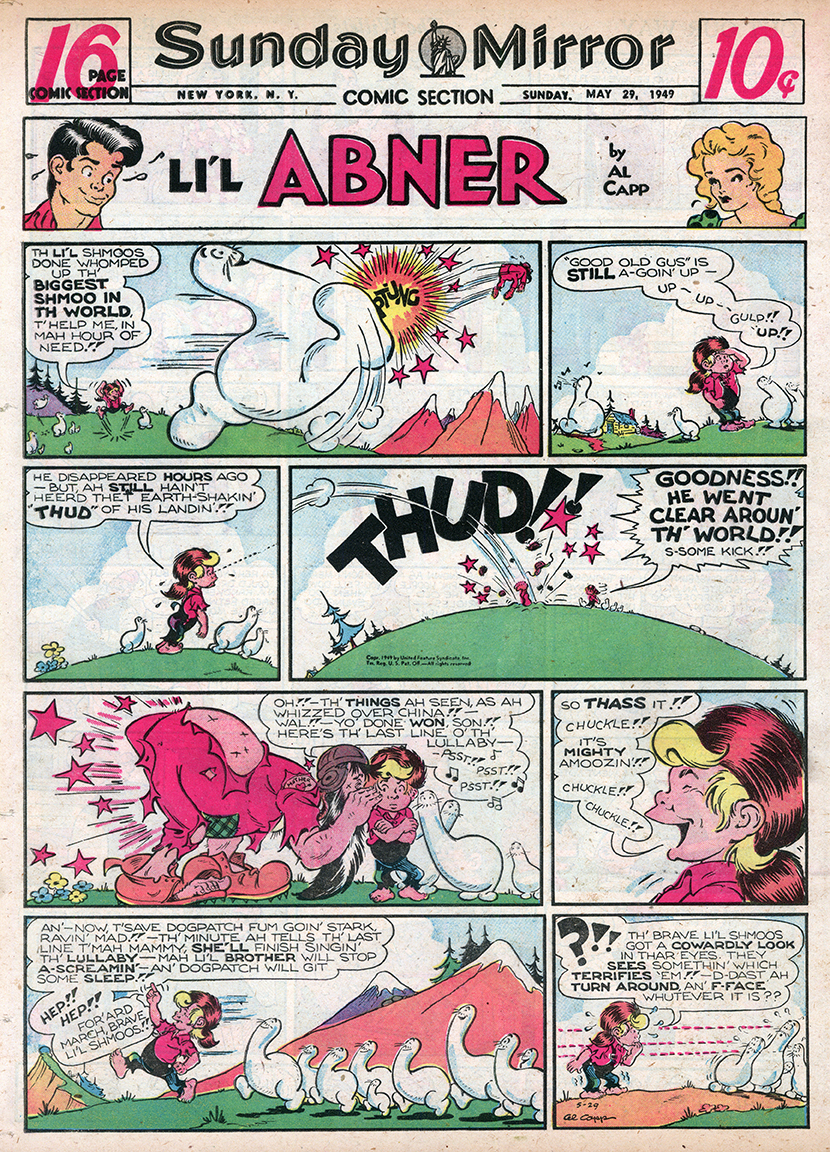
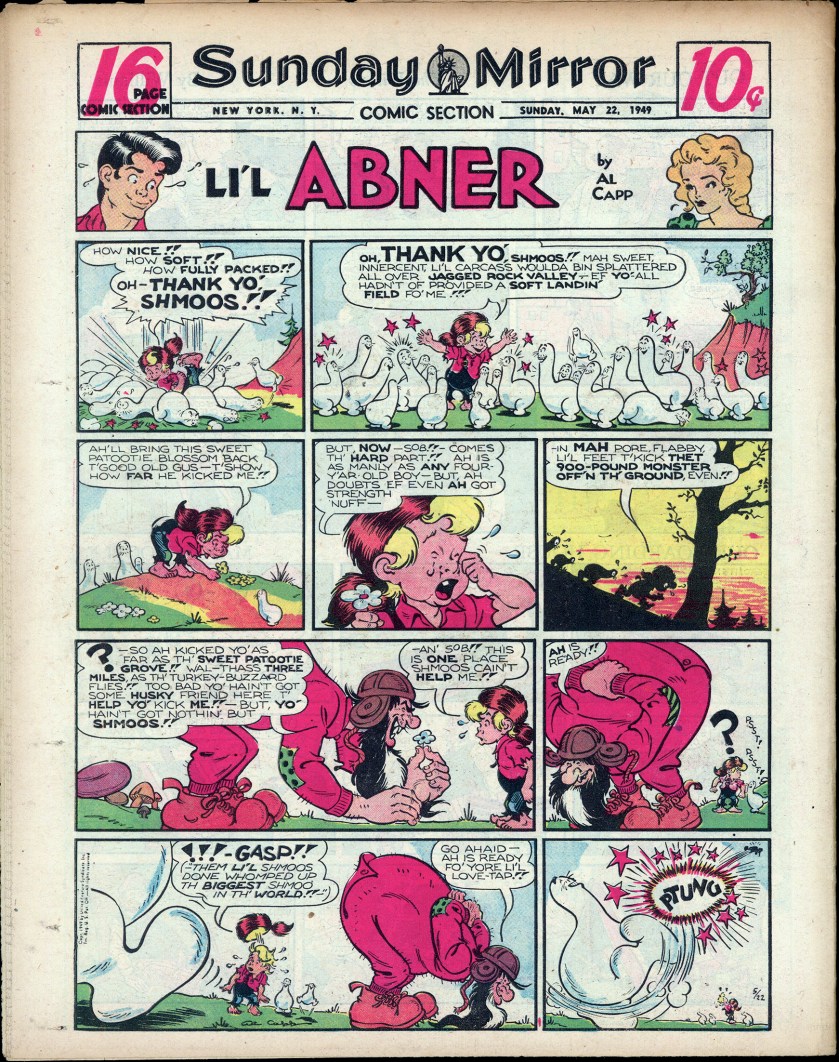
Taking its usual spot on the back cover is LIL’ ABNER by Al Capp.
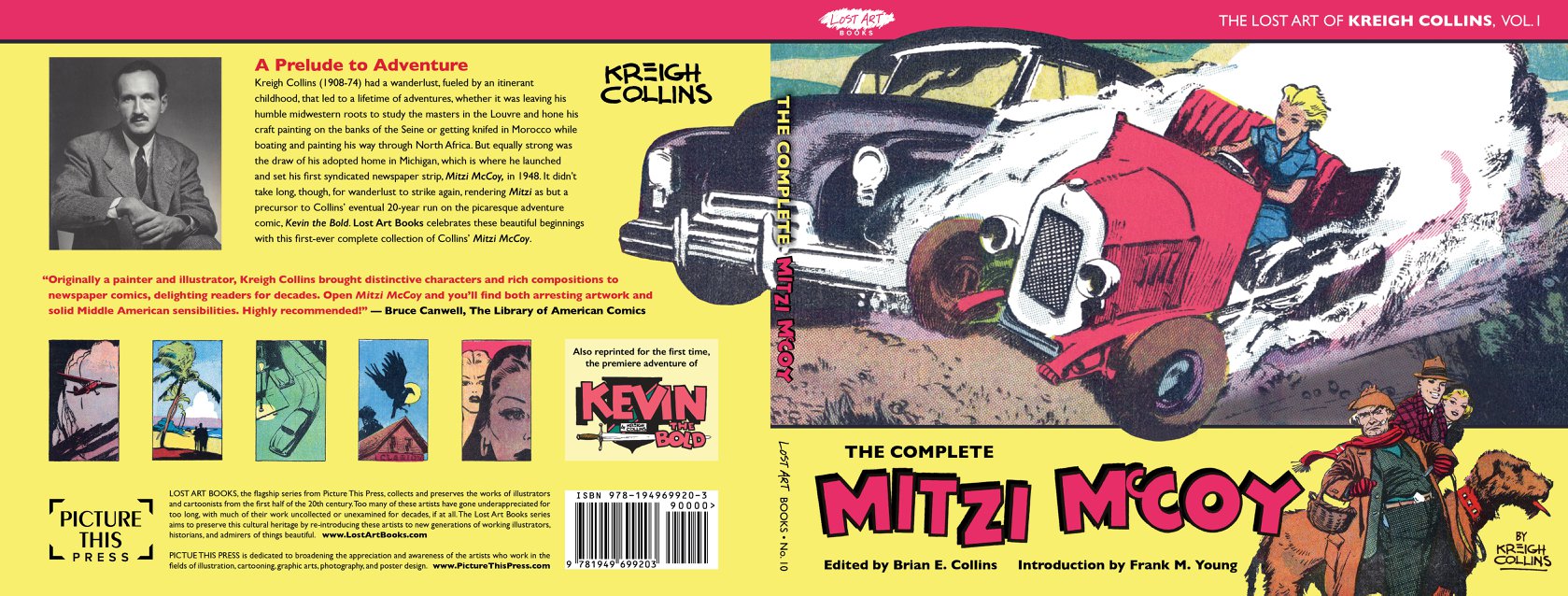
Want to See More of Mitzi?
“The Lost Art of Kreigh Collins, the Complete Mitzi McCoy” features the entire run of Kreigh Collins’ first NEA feature.

MITZI McCOY ran from 1948 to 1950 and showcased Kreigh Collins’ skill as an illustrator and storyteller. His picturesque landscapes, lovely character designs, and thrilling action sequences brimmed with detail and charm, and the strip’s ensemble cast rotated in and out of the spotlight taking turns as protagonists in the dozen story arcs collected in this volume. The last story collected in “The Complete Mitzi McCoy” is the narrative bridge that set Collins and his characters off on a new journey, beautifully told for the next couple of decades in the much-lauded adventure strip Kevin the Bold.
The collection includes an introduction by Eisner Award-winning author Frank M. Young, an Afterward by Ithaca College’s Ed Catto, and previously unpublished artwork and photos. Longtime comics artist Butch Guice also provides a new pin-up of the character Mitzi McCoy.
The book is available for $30. For domestic shipping, add $4; for international orders, please add $25 to cover first class shipping. To place an order, leave a comment below or email me at BrianEdwardCollins1[at]gmail.com, and I will give you PayPal or Venmo information. Thank you!
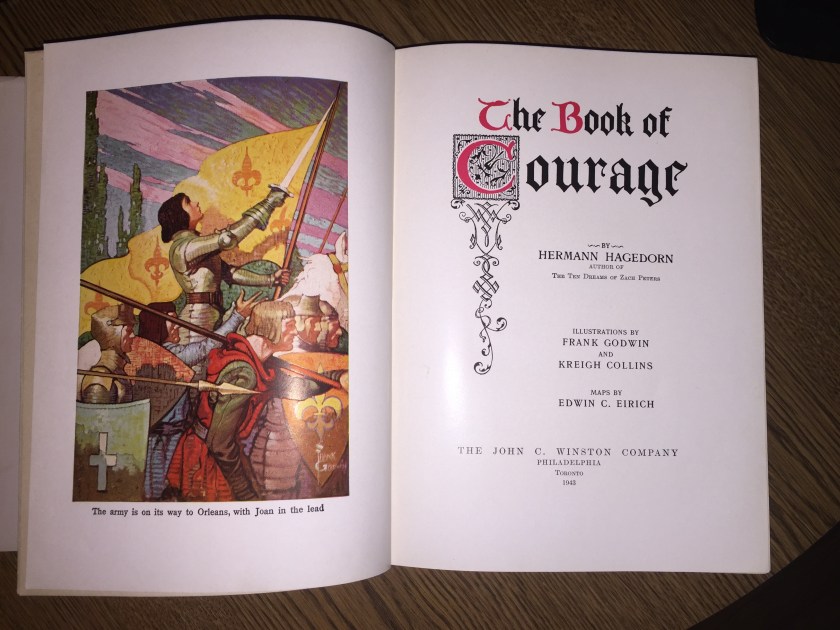
For more information on the career of Kreigh Collins, visit his page on Facebook.




 Kreigh’s Comics