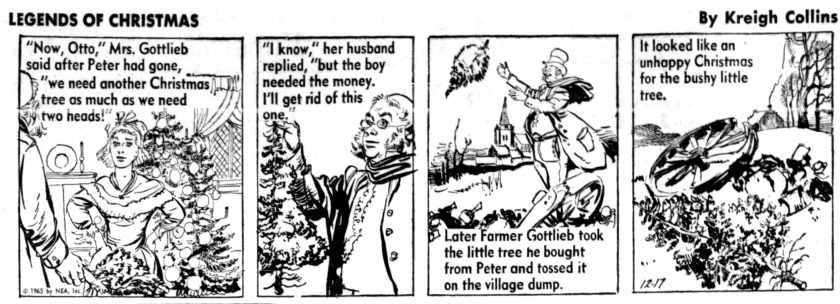
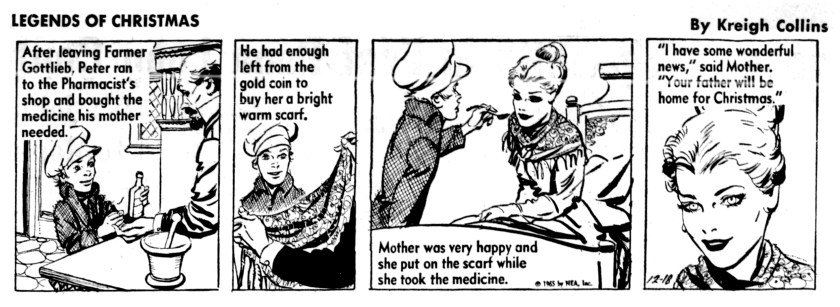
The second week of Kreigh Collins’ daily LEGENDS OF CHRISTMAS comic featured an easier-to-follow legend. It starred Peter, a young boy trying to care for his ailing mother while his father was away.
Speaking of legends, joining the bastions of journalism that appeared last week (The Manhattan Mercury, Hazleton Standard-Speaker and Terre Haute Star) is the one and only Kingston Daily Freeman.
The medicine Peter brought his mother worked wonders — she looks radiant!
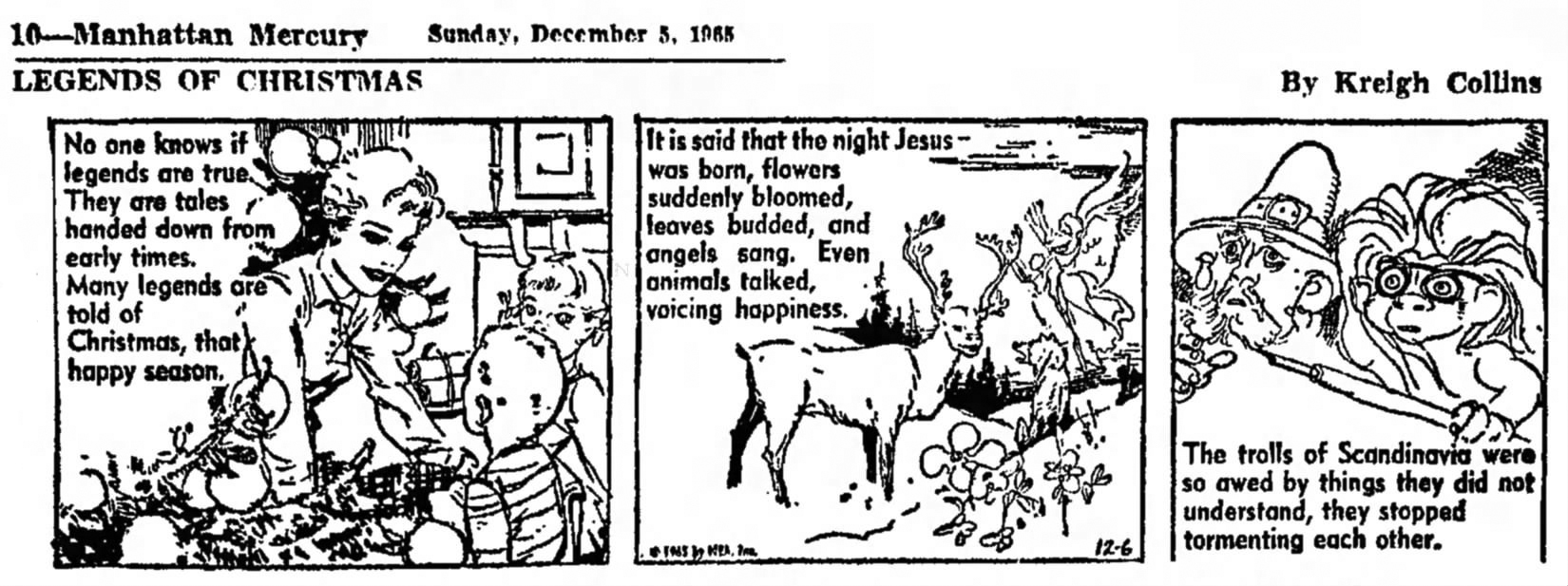
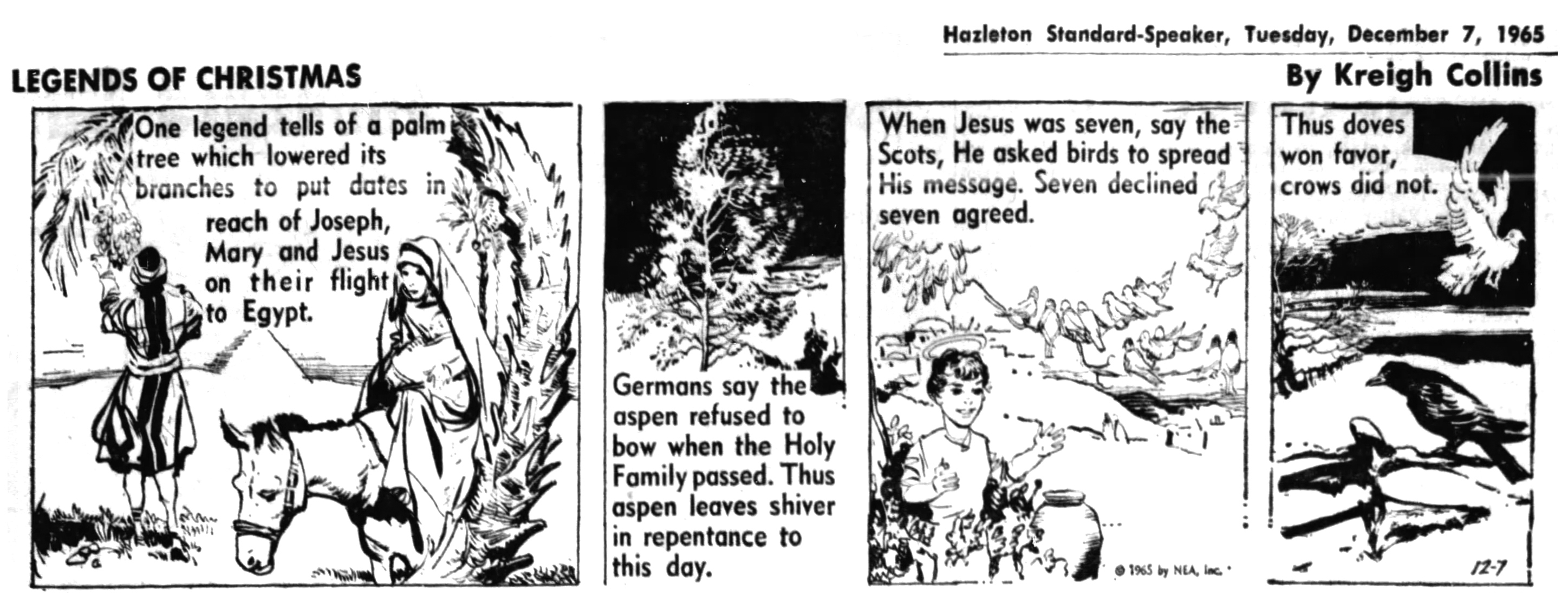
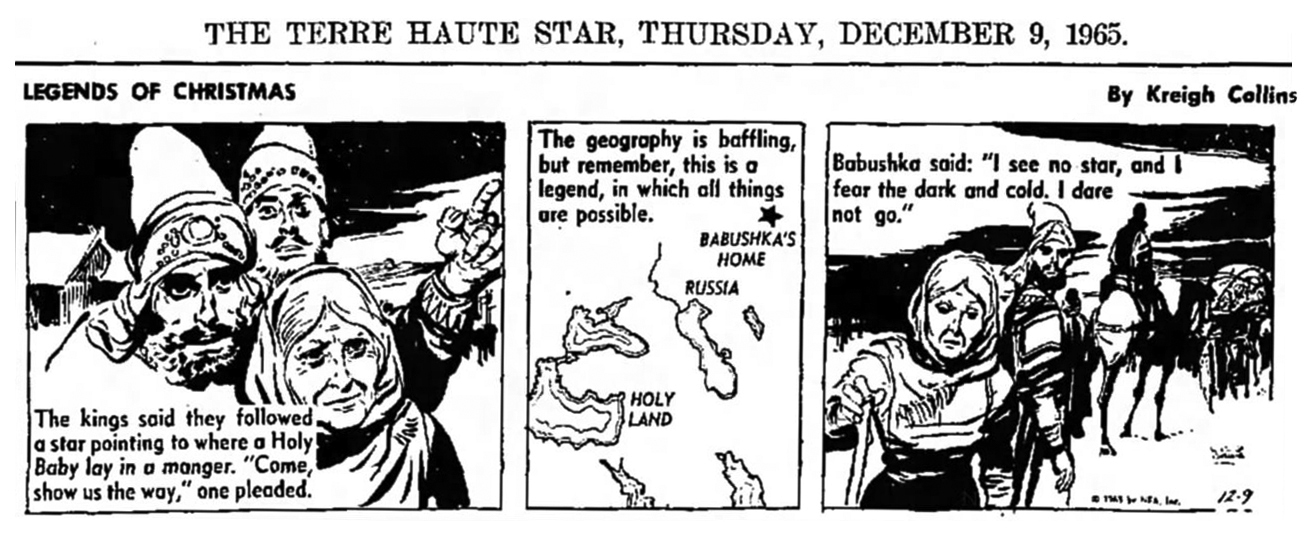
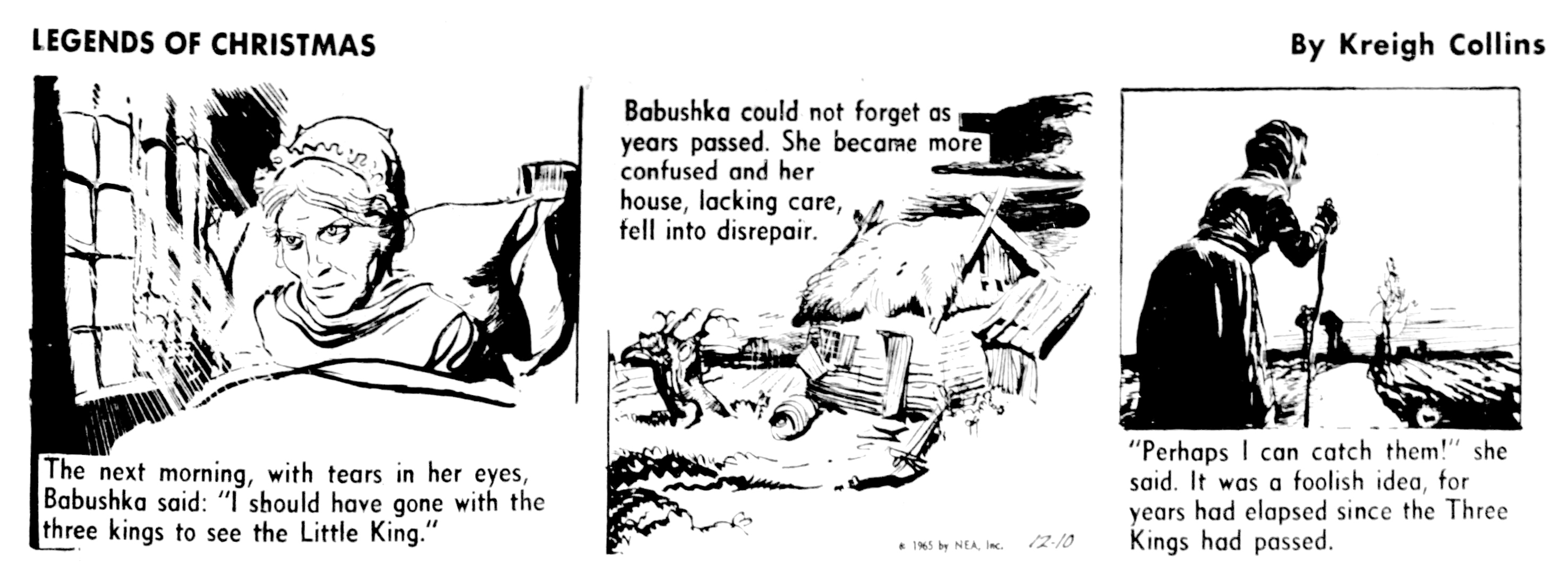
Kreigh Collins’ comics were familiar to readers of Sunday funnies, and periodically there were discussions with his bosses at the Newspaper Enterprise Association about changing MITZI McCOY or KEVIN THE BOLD into a daily. Although these plans never came to fruition, in 1965 Collins illustrated a short-lived seasonal daily for the NEA called LEGENDS OF CHRISTMAS.
Running in various small-market papers that were typical for the NEA, the LEGENDS OF CHRISTMAS comics are rather curious, and despite their yuletide theme, there was room to squeeze in a little anti-Soviet Cold War-era commentary (December 8). Take that, Brezhnev!
A tip of the cap to Alec Stevens of Calvary Comics for sending these comics my way!
At each others’ throats just moments before, Kevin and Karl are now completely aligned.
The short chapter’s quick pace continues, and with Brett’s lion cub/baby switcheroo, the story begins to transition to Kevin’s next adventure.
Before Kevin’s lady friend gets a chance to share it, her story comes alive!
This story line would continue in the pages of the Monomonee Falls Gazette. KEVIN THE BOLD debuted in issue No. 109 (January 14, 1974), which featured Kreigh Collins’ artwork on the cover. For the next six months, KEVIN ran on the gazette’s back cover, and continued inside until the demise of the publication four years later.
In case you can’t get your hands on MFG issues 109–232, the next dozen or so KEVIN THE BOLD chapters are collected in the book Kevin the Bold: Sunday Adventures. The 154-page collection, about 97% of which was compiled from BW syndicate proofs, is available on Amazon.com.
This past week, Thanksgiving was celebrated here in the USA. It is traditional for the professional football team I grew up rooting for, the Detroit Lions, to play on Thanksgiving Day. One thing I am especially thankful for is my close relationship with my brother Brett, Kreigh Collins’ eldest grandchild. Growing up in Ann Arbor, Michigan, Brett was originally a Lions fan, too. Here, Kevin the Bold’s ward, Brett, stars in the short story arc that follows.
I originally posted this sequence a few years back. This “encore presentation” is due to the unfortunate circumstances my brother finds himself, battling a very nasty form of cancer—I’m currently helping his wife while he is hospitalized.
The five episodes that will appear were all taken from the Chicago Sunday Tribune, and although they are a bit past that newspaper’s prime years (as far as reproduction and printing of Sunday comics is concerned), they are beautiful examples nonetheless. This early chapter—KEVIN THE BOLD’s 17th—immediately precedes the episodes that ran in the Menomonee Falls Gazette.
As noted in the opening caption, the action is set in 1491. The year is somewhat arbitrary—my feeling is that it just serves to peg the action as occurring just before Christopher Columbus’ first voyage to the New World. It was a busy year for Kevin—the strip’s three previous chapters also took place in 1491. These were the first times a specific date was referenced for KEVIN THE BOLD’s action.
This sequence also kept Kevin busy—quite a bit of action was packed into its five episodes, which lacked the longer exposition normally found at the beginning of a chapter.
Having just arrived, Kevin makes immediate impressions on both the town’s law and order man and his pretty female friend. The jealous Swiss guardsman insults Kevin and moments later they square off to fight. Oh, and there are lions!
As quickly as it started, the fight ends, and the two combatants join forces in a common goal, finding the lioness’s cub. It’s all happened so quickly that I barely had time to look up the definition of mountebank—if he’s a charlatan, the townsfolk don’t seem to mind. Now back to the action!
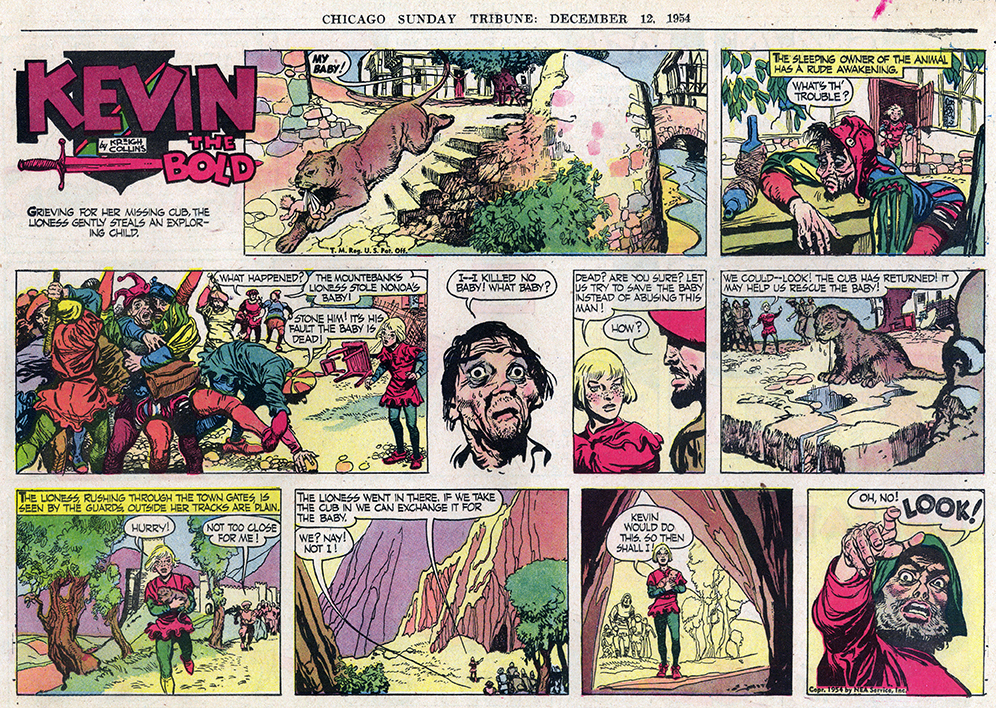
In an odd form of payback, the lioness kidnaps a baby. Brett emerges as the voice of reason, the lion cub returns and… has Brett lost his mind?
I started my professional career as a graphic designer in 1987. Like a lot of young people in the publishing industry, I was a big fan of Spy magazine. Spy was a satirical monthly that ran from 1986 to the mid-90s and was based in New York City, like me. There were plenty of interesting components to the magazine, among them “Separated at Birth.” It wasn’t a high-brow feature, and no doubt it’s been parodied to death.
Kreigh Collins often had characters that were inspired by ones from his previous comics. Occasionally ideas were recycled too, but these are examples of the former.
These examples might not be as elegant as those found in Spy, but they are still pretty interesting. Sometimes it wasn’t so much a recurring character as it was an object.
“Up Anchor!,” Kreigh’s final comic feature, was set aboard a representation of his own boat, the 45-foot long Heather. The Bowdoin didn’t feature in any of Kreigh’s comics, but the historic 88-foot long schooner was the design upon which the half-size Heather was based.
Uniquely designed for Arctic exploration, the Bowdoin was launched in 1921. Under the direction of skipper Donald B. MacMillan, it made dozens of trips above the Arctic Circle. Earlier, MacMillan had accompanied Robert Peary on his historic expedition to the North Pole in 1909.
Kreigh’s wife Theresa described how Heather came to be in the article she wrote, and which Kreigh illustrated, “The Wake of the Heather.”
When [Arctic] explorations were in the forefront of the news, a Chicago doctor wrote to the ship’s designer and asked him to design a half-sized schooner, built as she was and able to go anywhere and do anything. The doctor died two years after his boat was launched in 1927, and the superbly built schooner passed on to a succession of owners until we bought her twelve years ago [1955]. This is our Heather, little sister of the Bowdoin.
Kreigh and Teddy met MacMillan after they sailed into Mystic Seaport in the summer of 1966. They had known of Heather’s parentage, and had sought out the Bowdoin. The 92-year-old MacMillan, a rear admiral in the Naval Reserve, invited the couple to dine with him and his wife aboard their boat.
Kreigh and his family sailed Heather for nearly 15 years, and she lived up to her go-anywhere, do-anything billing. Among the places they took her were most of the Great Lakes (Heather never plied the waters of Gitche Gumee, aka Lake Superior); the Erie Canal, the Hudson River, New York harbor, Long Island Sound, the Cape Cod Canal, Maine, the Bay of Fundy; and the Intracoastal Waterway, Florida, the Gulf of Mexico and the Mississippi River. Although they never made it to the Bahamas, as a late-1950s newspaper article mentioned, they certainly covered a lot of water.
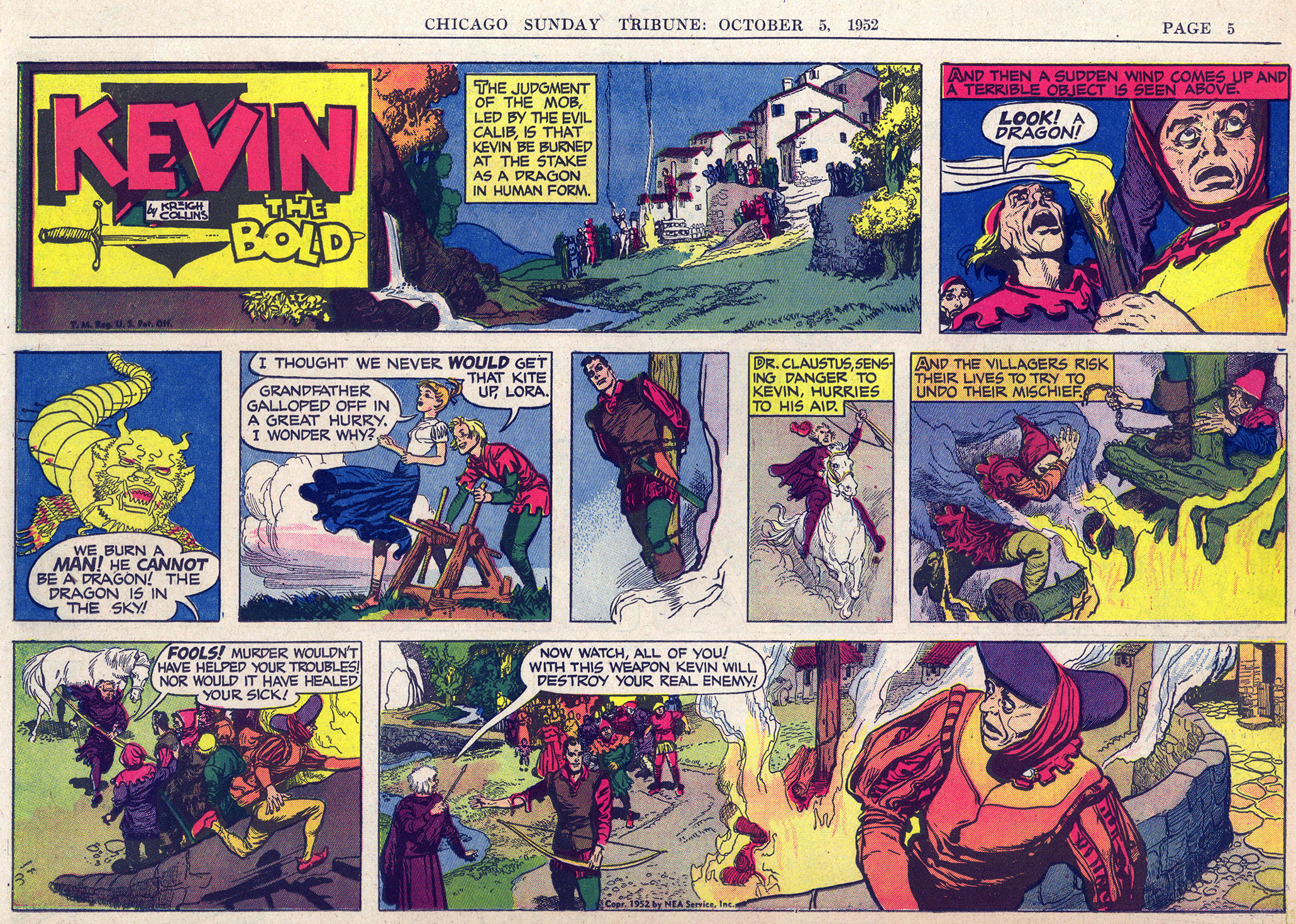
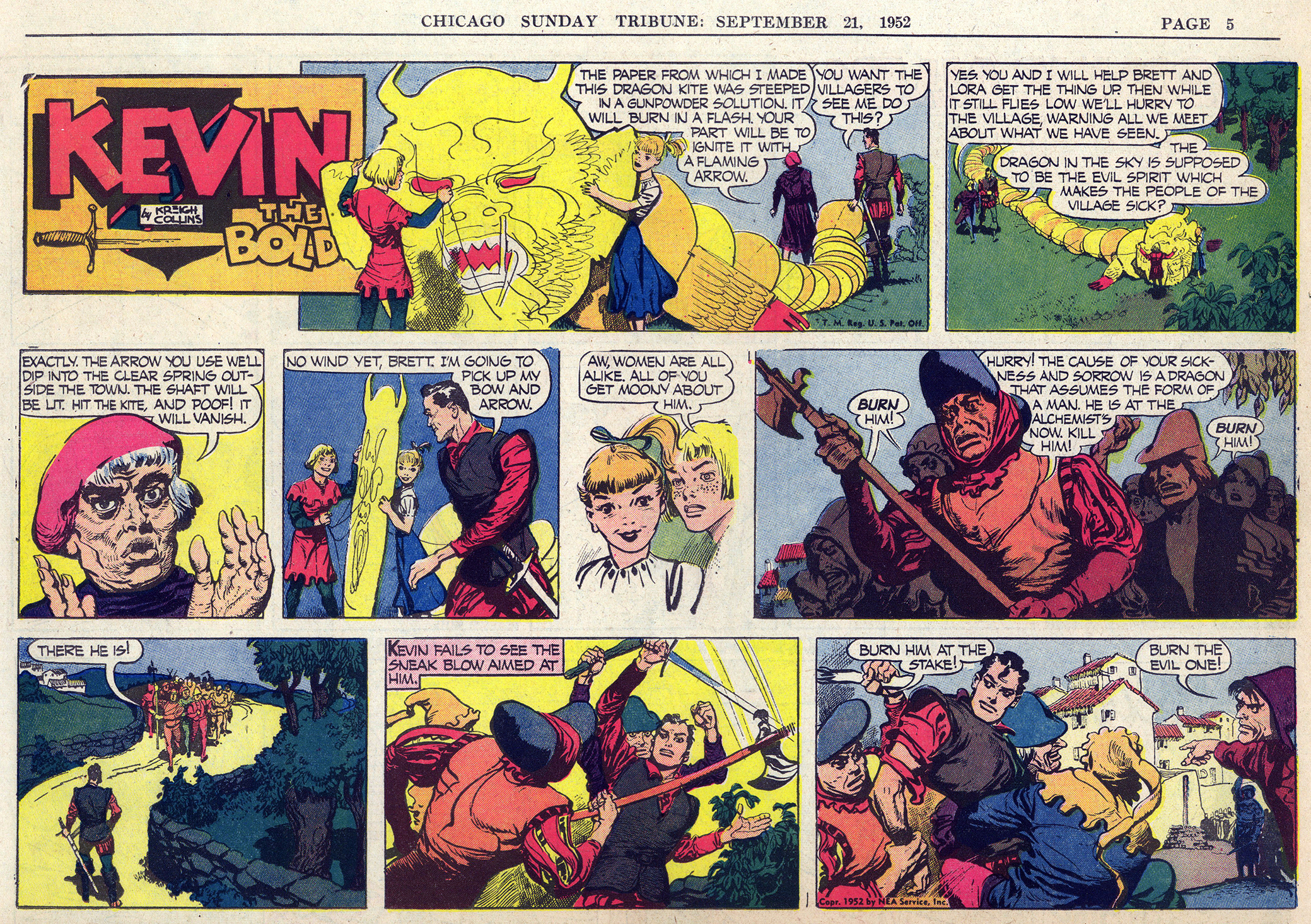
It starts innocently enough as Brett and Lora spend some time together in a pleasant, bucolic setting… not realizing Kevin’s peril as the kite was readied for flight. The comics are excellent examples of Collins’ skill as an illustrator, and contain beautiful costumes, settings and perspectives.
After having been manipulated by an evil man, the superstitious townsfolk desperately set Kevin free.
The sequence ends with some very heavy karmic payback for Calib. The announcement that Leonardo Da Vinci has returned heralds the next chapter of “Kevin the Bold.”
Fearing for his safety, Dr. Claustus asks Kevin to stay. This provides an opportunity for Dr. Claustus to receive assistance with an experiment inspired by the drawings Leonardo da Vinci had left for him.
The experiment succeeds, but provides an opportunity for Calib to turn the townsfolk against Dr. Claustus and Kevin.
In the ninth sequence of “Kevin the Bold,” some new characters are introduced. Kevin and Brett meet Dr. Claustus, an alchemist, and Lora, his granddaughter. Calib (a thug from the nearby Castle) is the villain, and Leonardo da Vinci has a cameo appearance. Da Vinci will reappear in the following sequence (and again in 1967, near the end of the comic strip’s long run).
When in need, Dr. Claustus is the type of brilliant man people seek out to solve problems. However, he is mistrusted by others. After a couple of scene-setting comics, the characters become entwined, and the drama starts.
Twice, Kevin makes a fool of Calib and soon enough his new adversary seeks revenge.
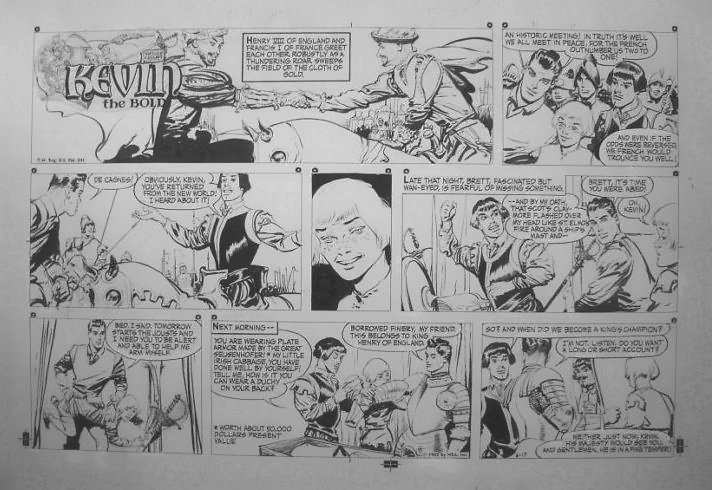
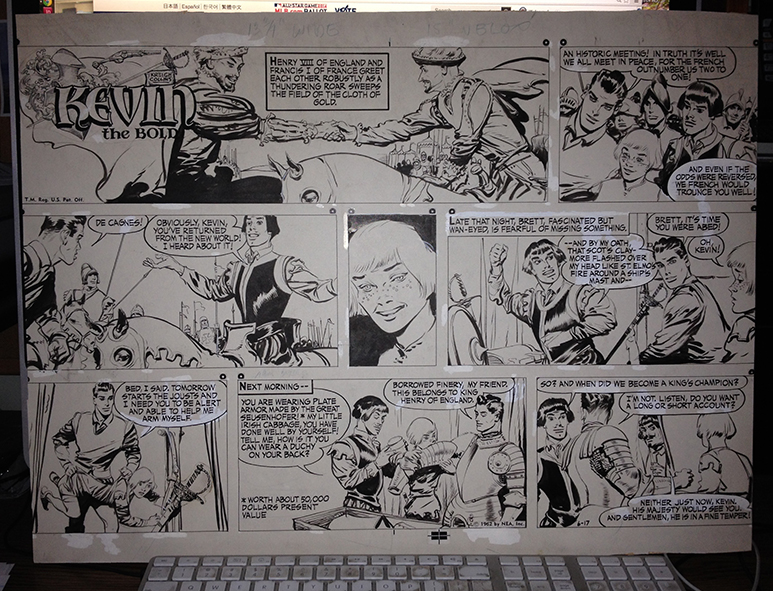
Original pieces of Kreigh Collins’s comic strip illustrations are quite amazing. They are large (drawn on 20 x 30″ illustration board), rich in detail, and interesting in other ways — corrected areas are readily apparent, stock elements are revealed to be pasted in, and instructions or notes are sometimes written in the margins. In the example shown above, Kreigh (my grandfather) personalized the illustration and gifted it to my other grandpa (“For Walt Palmer, May his trials be less than Kevin’s!”). Unfortunately, the art has a bit of wear and tear due to hanging on my brother’s bedroom wall through high school and college. He gets a pass as he shared a name with Kevin’s young ward — Brett accompanied Kevin on many of his adventures.
Another feather in Brett’s cap is being Kreigh Collins’ first grandchild. I was his second—barely—having been born three days before my cousin Josh. I don’t recall any characters named Joshua, and there was only one minor character named Brian that I’m aware of.
Originals can occasionally be found at auctions for a couple hundred dollars or so, depending on their condition. Another original I own was in quite nice shape when it was offered for sale about ten years ago. But by the time I won it on ebay in a later sale, its edges had been hacked down to fit into a cheap 18 x 24″ picture frame. I suppose its value has taken a hit, but I didn’t buy it as an investment. For me, it’s all about the family connection.
These half-page episodes are very nicely illustrated, and it’s interesting to remember that in this era, when third-page versions KEVIN appeared, the original artwork’s entire third tier of panels was eliminated (an enormous “throwaway”).
I don’t have an example of the May 29, 1966 half-page but I did manage to find an image of the original artwork—which is included in a collection at the Smithsonian.
Drawing. Comic strip, “Kevin the Bold,” art by Kreigh Collins. GA*22482.
Things look grim as Kevin’s right arm is imapled by a Potawatan arrow—just as Captain Spur lunges at him.
Luckily, Spur’s exuberance causes him to lose balance and fall overboard, where he presumably meets his demise.
After imparting a bit more “Viking-Indian” history on his readers, Collins transitions to KEVIN’s next chapter.














 Kreigh’s Comics