Lovesick Louise

The action from the preceding story arc continues, and with many of the same characters. Sir Guy Thornberry has skulked offstage, but for how long? For reasons unknown, Louise Essex is smitten with the scoundrel. Meanwhile, King Henry has an important job for Kevin—once he overcomes a certain obstacle.
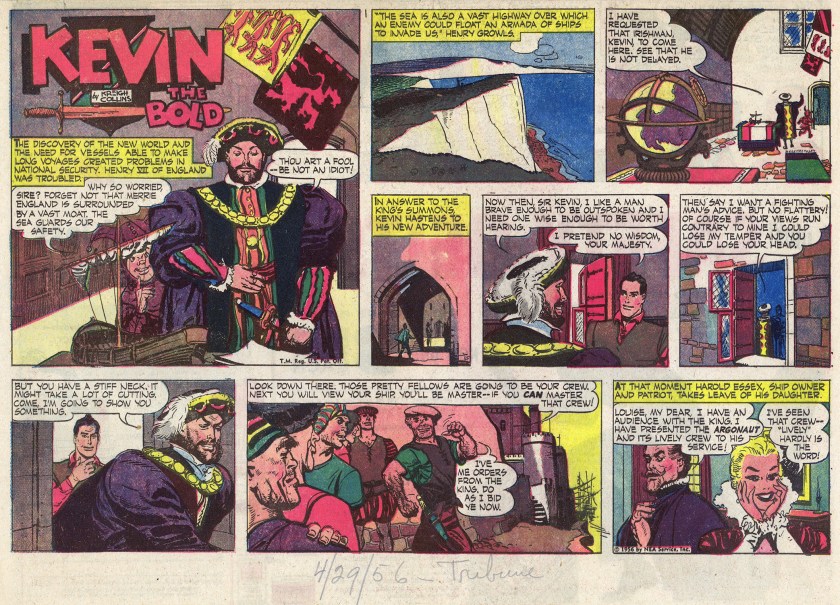
KTB 042956 HA 150 CST qcc

The second panel has a nice rendering of the Cliffs of Dover.
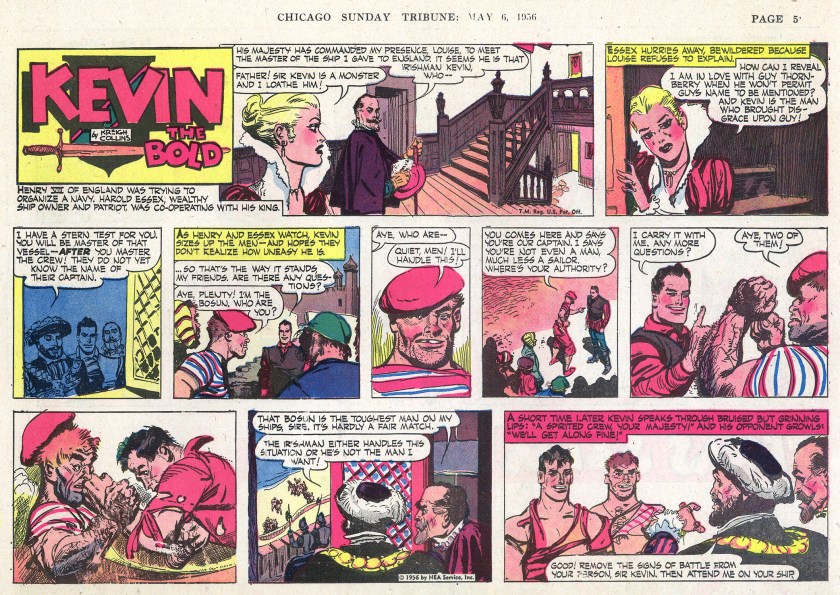
KTB 050656 HA 150 CST qcc

By this point, there wasn’t much difference in the print quality of the comics in the Chicago Sunday Tribune and the Detroit News (as shown below). One detail the Tribune versions lacked was the comic’s date inked into one of the panels (shown in the final panel of the News version). For Trib comics that didn’t appear at the top of a page, with the date typeset directly above, a nice personal detail for me is the date written on them, recognizable to me as done by my grandmother, Theresa. (“Teddy” also frequently modeled poses for her husband and basically served as his secretary).
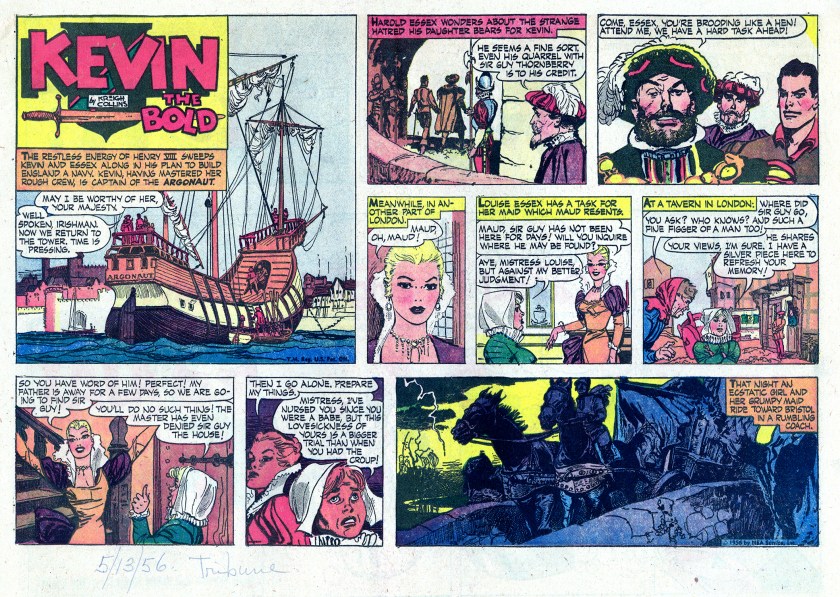
KTB 051356 HA 150 CST qcc

The colors are a bit richer in the “Tribune” version, but in the third panel there seems to have been some indecision whether to include a yellow background or not.

KTB 051356 HA 150 DN qcc

I think the second and third panels look better with a white background.

Another nice family detail is found in the name of the ship Kevin captains. Argonaut was the name of Kreigh Collins’ own sailboat, a yawl—somewhat smaller than her namesake (I think she was only 25′ long). And while Collins purchased his schooner Heather later this same summer, she too was dwarfed by Kevin’s ship.

Argonaut-Heather

Collins and his family sailed aboard “Argonaut” (shown at left in Racine, WI) from 1952–1956, and aboard “Heather” (shown in Annapolis, MD) from 1956–1972.


For more information on the career of Kreigh Collins, visit his page on Facebook.

Bargaining with the King

This story arc concludes with three episodes taken from three different newspapers: the Chicago Sunday Tribune, the Florida Times-Union, and the Detroit News. The reproduction quality varies noticeably. Despite being years past its early 1950s prime, the Tribune is superior, the News is decent, and the Times-Union… not so much.

Kevin finds himself in the King’s good graces and is soon made an offer that he cannot refuse. Kevin agrees, under one condition.

KTB 040856 HA 150 CST qcc

Where Kevin has brought Marion Drake and Stephen Moore untold happiness, he has served an equal amount of misery to Sir Guy Thornberry.

KTB 041556 HF 150 QCC

What’s the deal with all of that magenta?

KTB 042256 HA 150 DN qcc

As Thornberry crawls off, tail between his legs, Kevin receives an assignment from his new champion, King Henry. In fact, the King becomes an oft-recurring character in KEVIN THE BOLD, appearing in at least 14 more story arcs over the next 6-plus years of the comic strip’s run.

Next week: Sir Guy Thornberry seeks revenge!


For more information on the career of Kreigh Collins, visit his page on Facebook.

Historical Fiction

Generally set in the fifteenth and sixteenth centuries, Kevin the Bold can be labelled as historical fiction, with its early story arcs and characters being Kreigh Collins’ brainchildren.

After a couple of years, famous historical figures started appearing—sometimes as ancillary characters, and at other times being more integral to the action. The first of these was Leonardo da Vinci, who made a couple of brief appearances in 1952. (Da Vinci would make another memorable cameo in 1967, in one of Kevin’s final adventures).

KTB 082452 HF 150 QCC

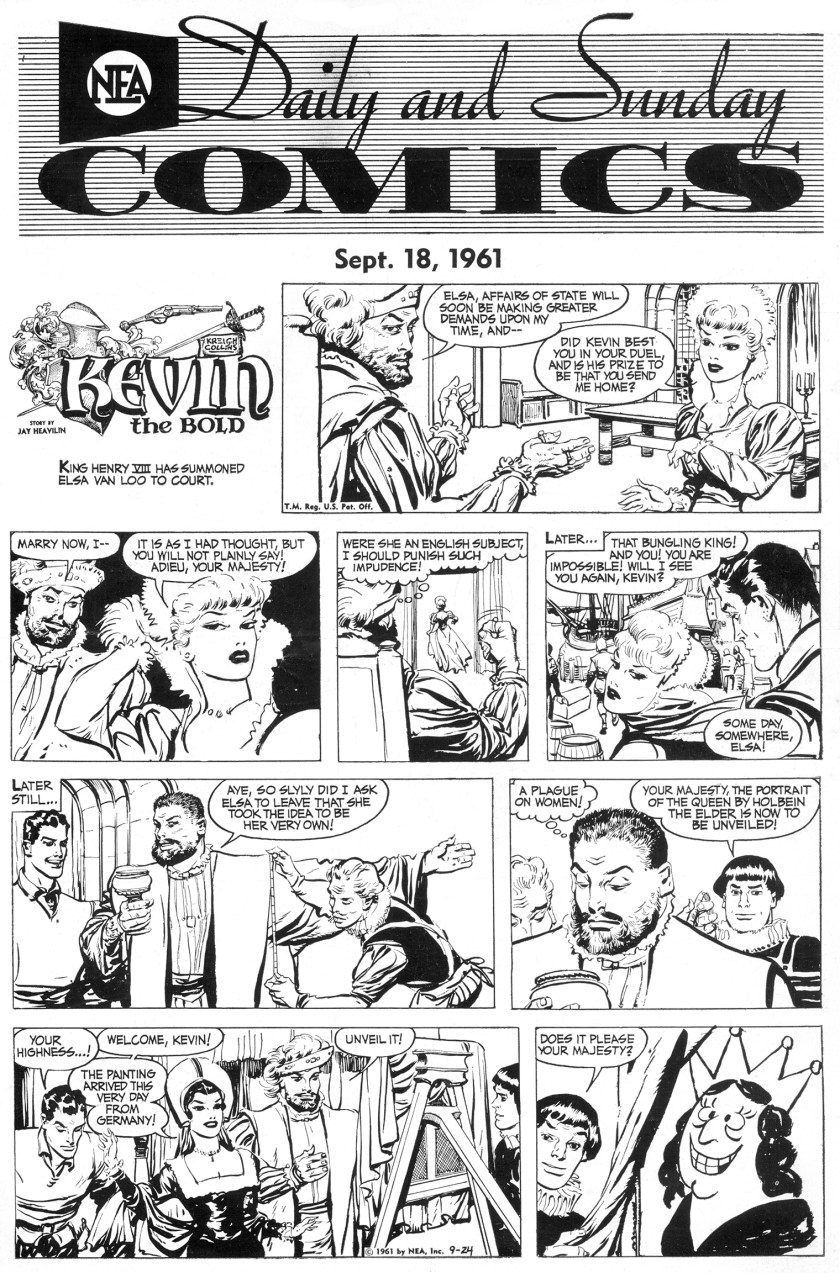
The historical figure appearing most frequently was King Henry VIII; in the September 24, 1961 episode he appears along with a mention of a noted portraitist of the era, (Hans) Holbein the Elder .

KTB 092461 BT 150 QCC

In 1964, a young William Shakespeare was a central character, and a few years later Captain John Smith figured prominently.

King Henry first appeared in 1956, and that entire sequence will run over the next few Sundays. The tone of this story arc is different than most of what had preceded it, and it is likely that Kreigh Collins was extensively using other’s scripts for the first time. In between the more historical storylines (with King Henry, Shakespeare, etc.), Collins’ own chapters become easier to spot. This change in direction was caused in part by burn out. According to an oral history done by Kreigh’s wife Theresa , “Kreigh was always trying to think up the next story. It was the equivalent of writing a full novel every ten weeks.” Giving up the writing likely meant a cut in pay but with the overall ascendance of “Kevin the Bold” and the income it generated, it was a good tradeoff for Collins.

As Henry’s first chapter got off the ground, any time Collins saved by not writing looks like it may have been spent on the illustration. The Florida Times-Union‘s reproduction is mediocre, but the artwork is quite nice, with many compelling scenes and characters.

KTB 012956 HF 150 QCC

To be continued…


For more information on the career of Kreigh Collins, visit his page on Facebook.

Special Man Is Wanted

Artists and illustrators often have models pose for them — Kreigh Collins frequently enlisted his family with the task. Occasionally, a special situation would call for a hired model, and such was a case for an early “Kevin the Bold” sequence. Getting a help wanted ad on the front page of the local paper was helpful, and the Grand Rapids Herald provided some nice promotion for Collins’ year-old comic.

KTB Man 01 cc

The “special man” needed to be of a specific stature, as he would be donning a centuries-old suit of armor recently donated to the Grand Rapids Public Museum. Since historical authenticity was important to Collins, having a live model for reference would be very useful, as knights in armor were a staple of his comic strip.

The newspaper page was trimmed so that no publication date showed, but an article on the page had some information that placed it in late July of 1951. The NEA’s production schedule required comics to be inked two to three months ahead of their publication date, and with this sequence appearing in September, the timing of the newspaper article made sense.

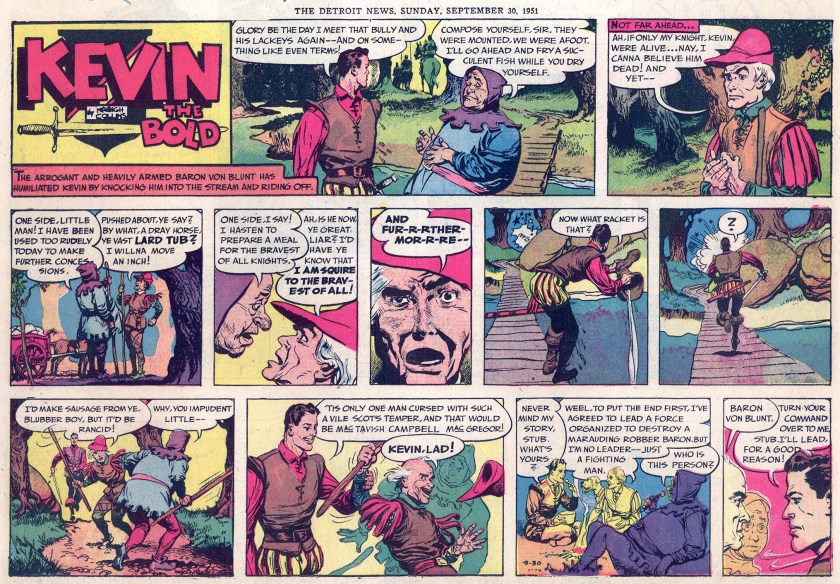
The fifth “Kevin the Bold” sequence introduced a new villain, Baron Von Blunt. Was his new Flemish armor modeled after the set from the Grand Rapids Public Museum?

KTB 092351 hf 150 qcc

KTB 093051 HF 150 QCC

Most of the early “Kevin” comics in my collection are from the Chicago Sunday Tribune, but the September 30, 1951 comic shown above ran in the Detroit News. (Most likely, the comic had debuted in the News with this sequence). Collins’ artwork is especially strong in this period, but the printed results from the News are no match for those of the Tribune.

KTB 100751 HF 150 QCC

Kevin and his squire, Stub, had been separated during the previous sequence, in which Kevin was gravely injured. Once reunited, Stub fills his knight in on the details of the task he has been assigned — training an army of men to face Baron Von Blunt, the same ruthless man that had already made an enemy of Kevin. The October 7 comic is another beauty from the Trib, with more to follow.

Of note: The Grand Rapids Public Museum has a rather impressive collection of Kreigh Collins’ original artwork.


For more information on the career of Kreigh Collins, please visit his page on Facebook.

Allure of the Bad Boy

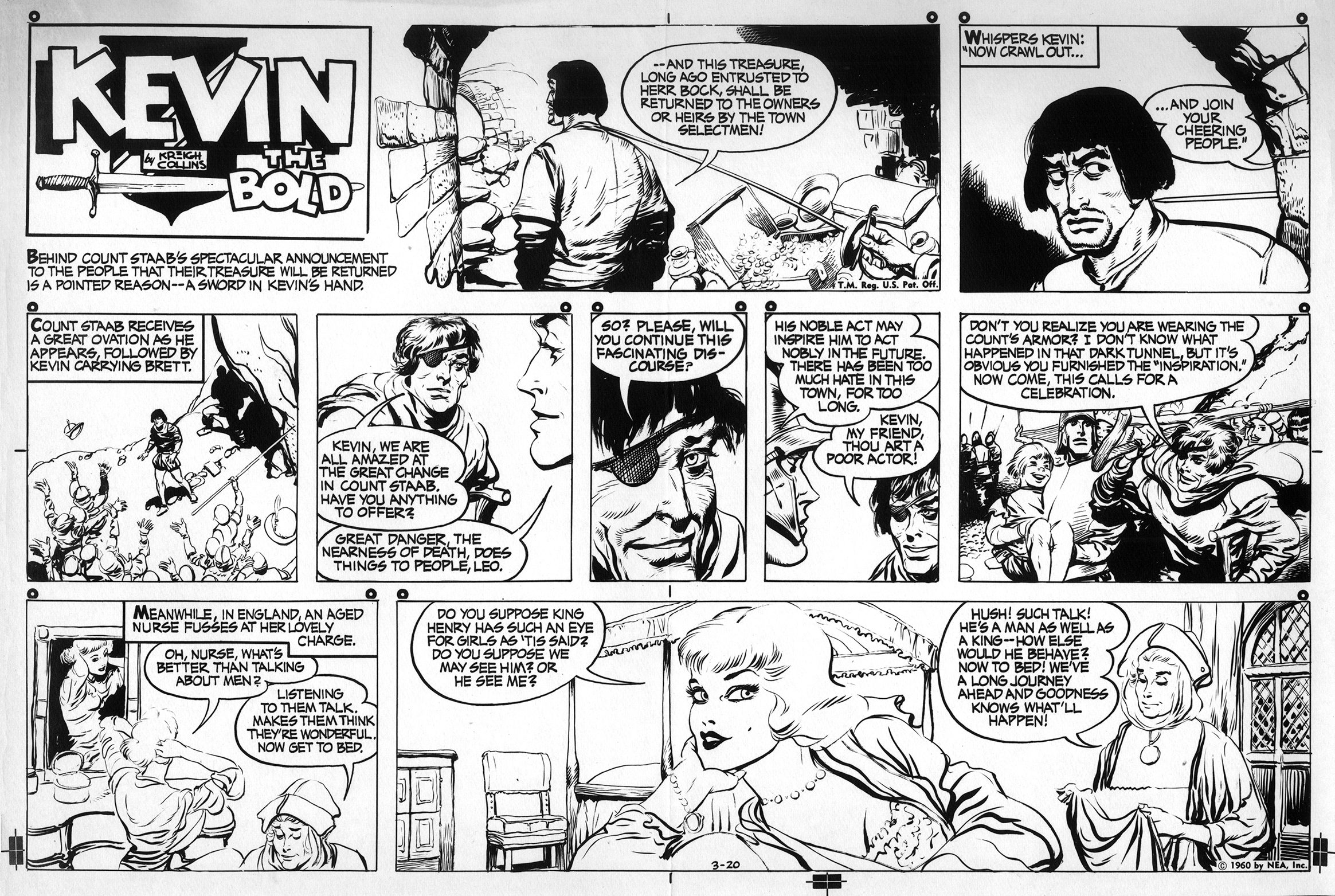
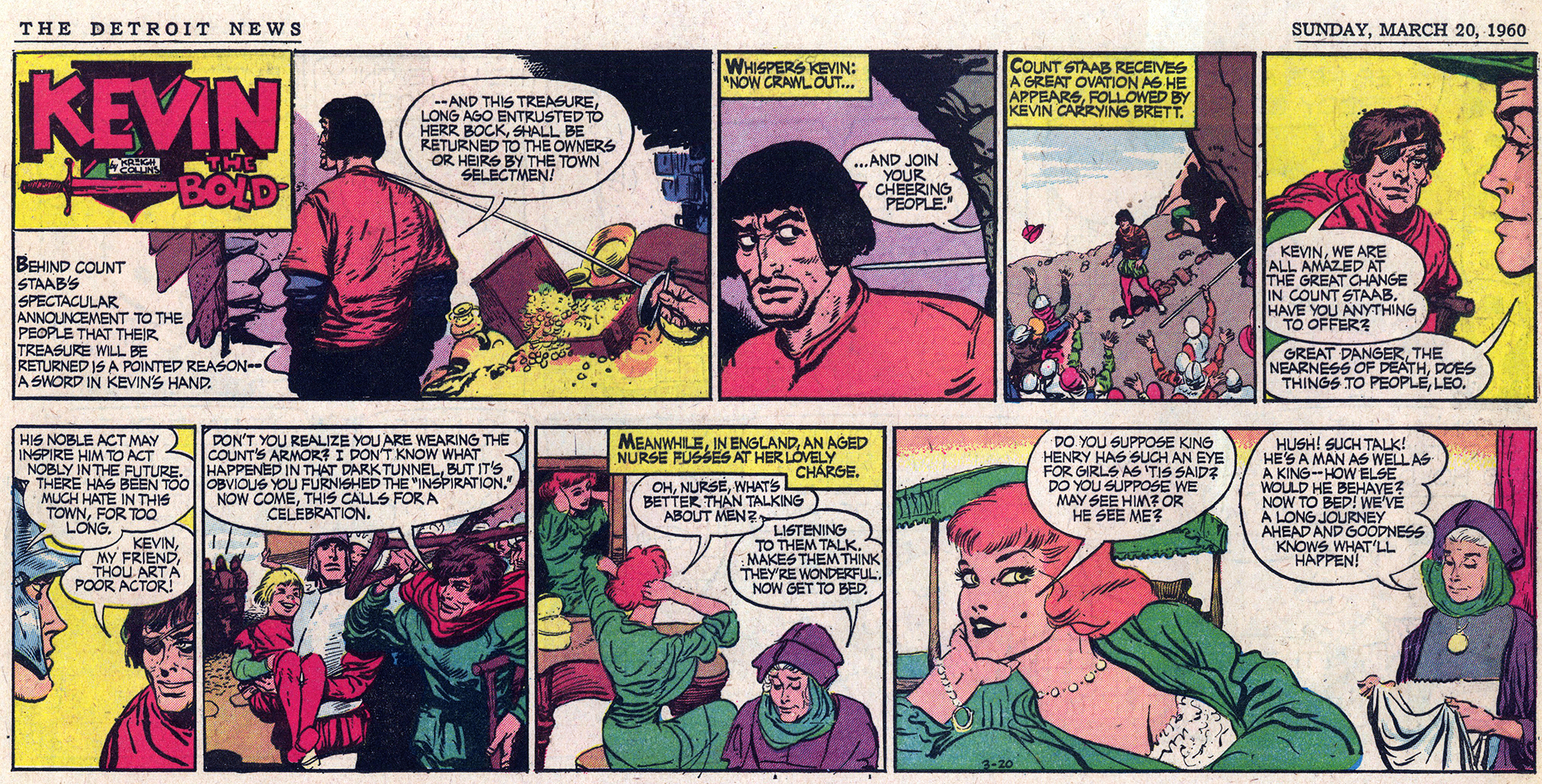
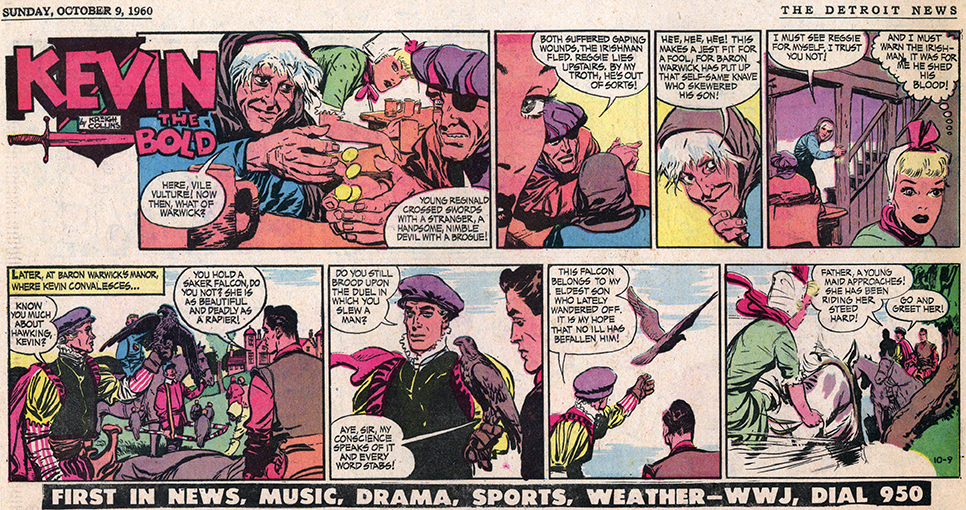
This chapter dates from 1960. In March 20’s transitional episode, readers meet Anne Hayes. She’s quite a handful for her guardian, a nurse who attends her.

For the most part, I have both black and white velox half-page proofs and third-page tearsheets of its episodes. Going forward, I will combine them when I can.

Now, back to Miss Hayes. At seventeen, she’s more woman than girl, and to the chagrin of those around her, she is attracted to a certain type of man.

To be continued…

_______________________________________________________________

For more information on the career of Kreigh Collins, visit his page on Facebook.

Reggie Returns

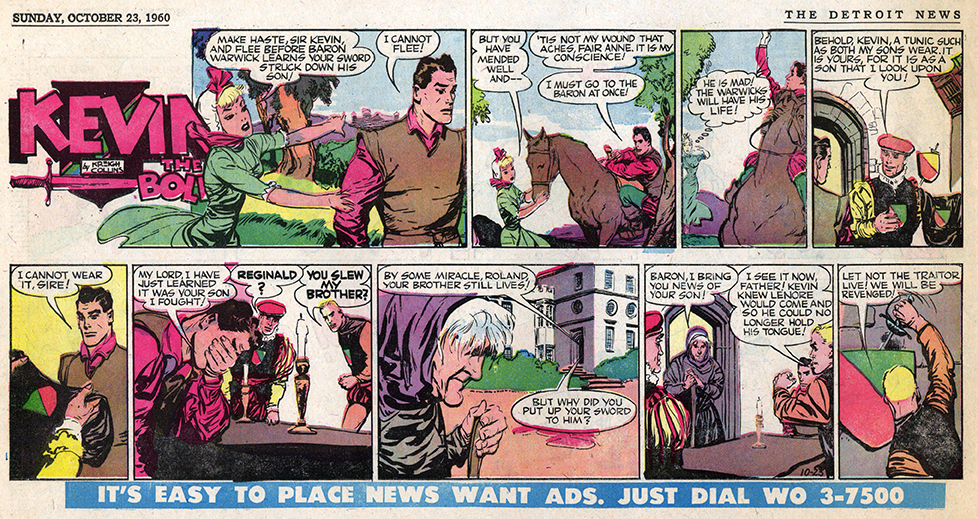
Kevin heads back, bearing terrible news for Baron Warwick.

Despite his contempt for his brother Reggie, Roland is enraged, and Lenore’s appearance spells more trouble for Kevin.

The Baron urges patience but refuses to stop Roland. Meanwhile, Reggie has found his usual form.

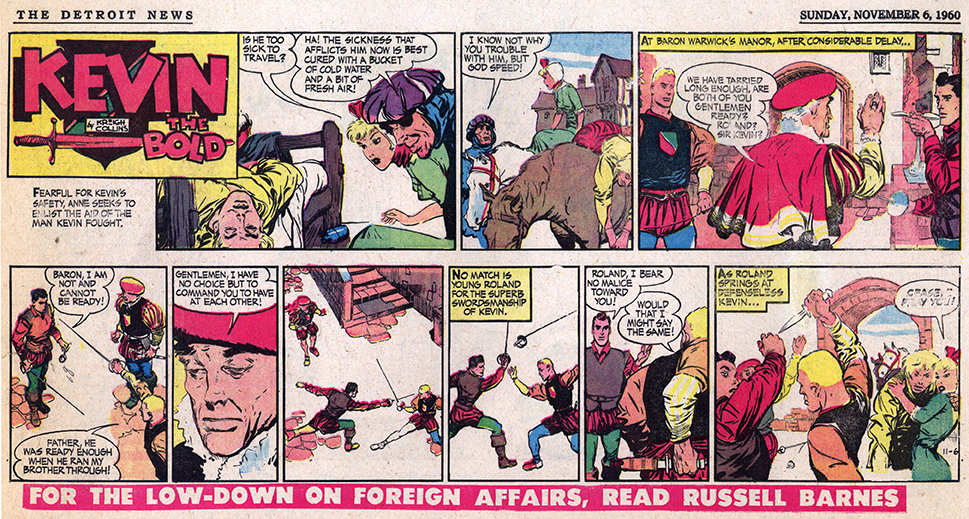
Despite his failings, Reggie is much the superior swordsman to Roland, and Kevin easily disarms his opponent, using a favorite trick. My Detroit News third page is lacking in quality; in the final panel, Anne shouts, “Cease it, I pray you!”

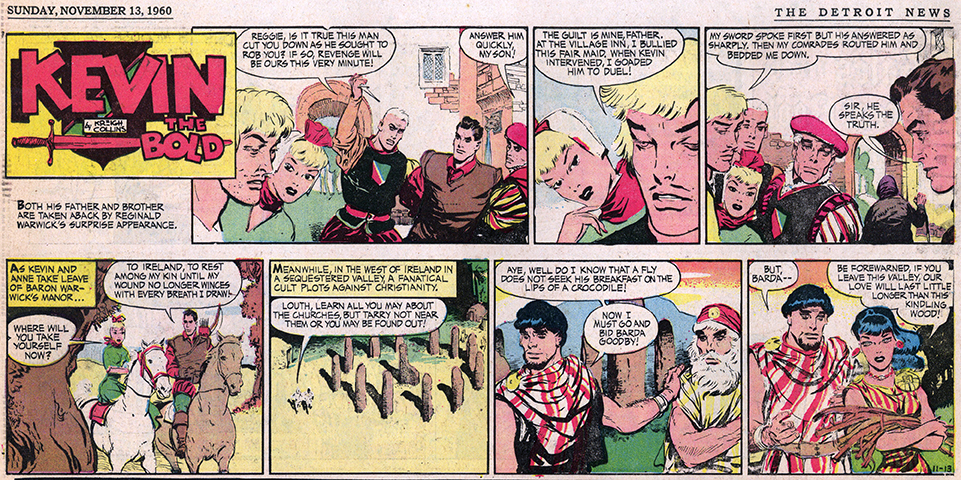
In a shocking turn of events, Reggie admits the truth. The chapter ends quickly and the action transitions to Ireland, and a group of pagans. (It’s a beautifully-illustrated chapter that begins here).

_______________________________________________________________

For more information on the career of Kreigh Collins, visit his page on Facebook.
Awkward!

Five episodes into the chapter, we finally learn the name of Reggie’s more responsible brother, Roland, when Baron Warwick instructs him to go and fetch Lenore. In KEVIN THE BOLD, generally the villains are men—but not always. Enter the medicine woman—or is she more of a witch?

Lenore’s medicine has helped Kevin, who is convalescing at Baron Warwick’s home.

As the news gets out about what happened at the tavern, Kevin eventually finds out too.

To be continued…

_______________________________________________________________

For more information on the career of Kreigh Collins, visit his page on Facebook.

Restoring the Family Name?

In an odd move, Baron Warwick has sent his less responsible son on a mission to restore honor to the family name. Let’s check in on Reggie’s progress.

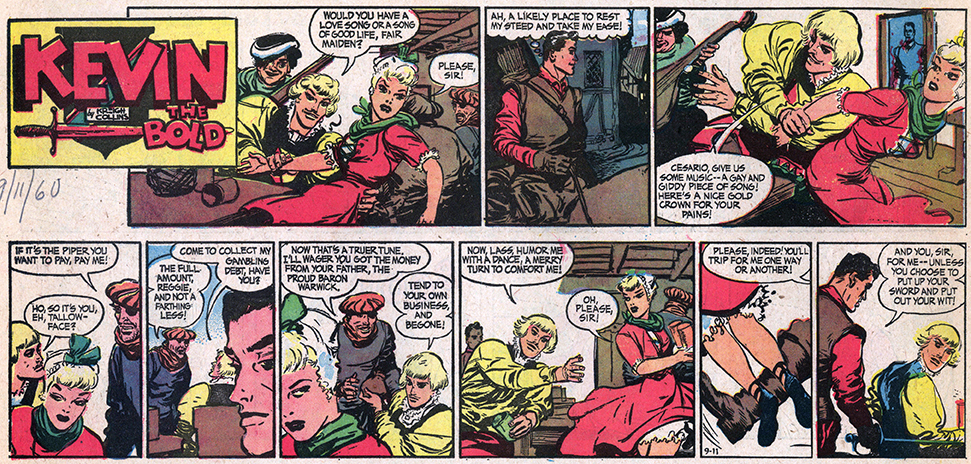
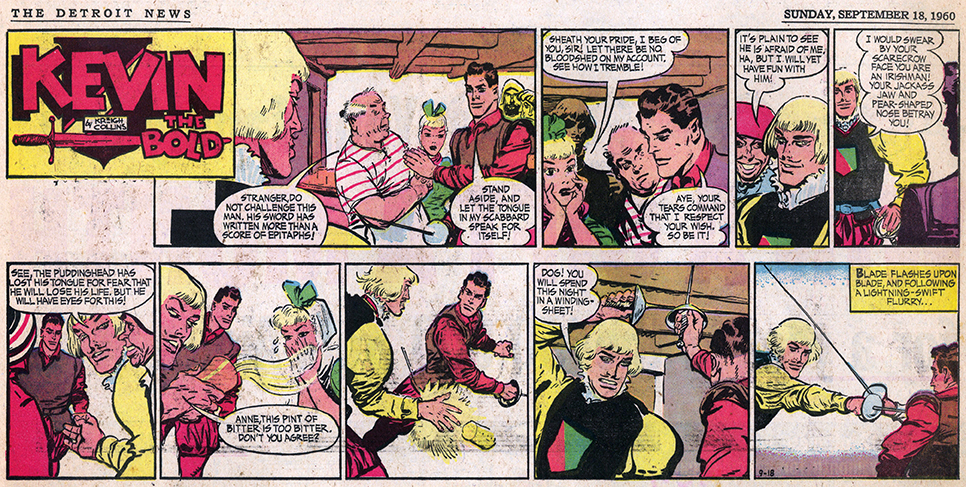
Harassing a barmaid and raising Kevin’s ire—so much for that whole “restoring honor” thing!

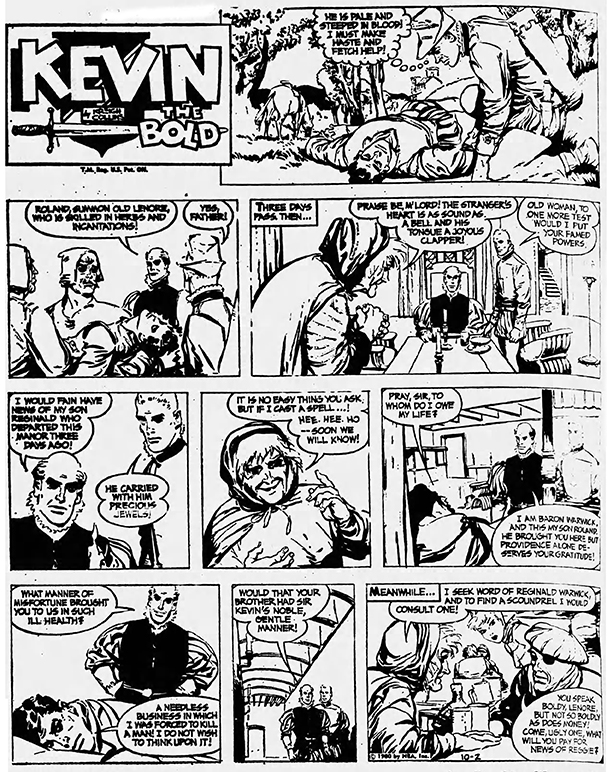
At this point, the Manchester Evening News had been featuring episodes of KEVIN THE BOLD for over three years—nonetheless, things could go wrong. The March 4, 1961 edition carried the episode above (originally published on September 18, 1960) but the following issue (March 11, 1961) carried the October 2, 1960 episode. The missing episode (September 25, 1960) is shown below.

It’s a very unfortunate that it had been skipped—it features the most critical action of the entire story arc!

Unsure of Reggie’s fate, a weakened Kevin runs for his life.

_______________________________________________________________

For more information on the career of Kreigh Collins, visit his page on Facebook.

The Manchester Evening News

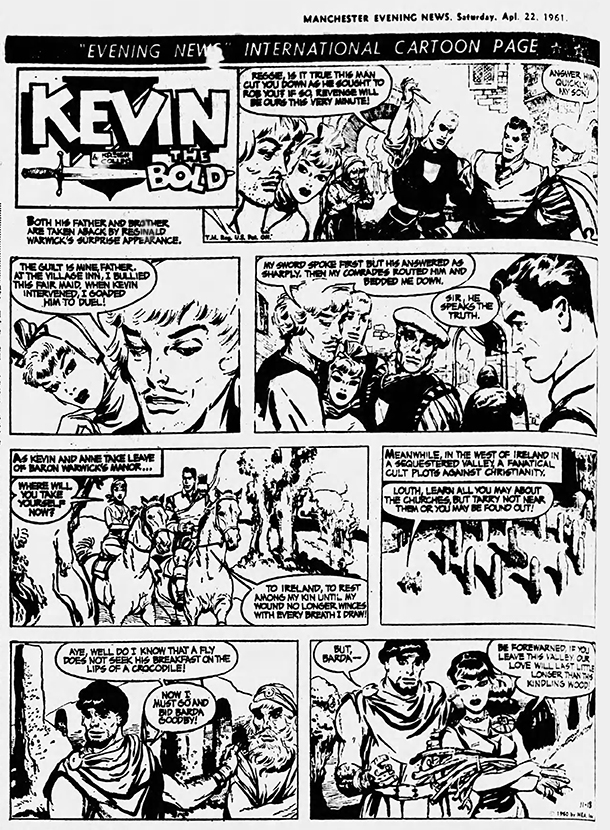
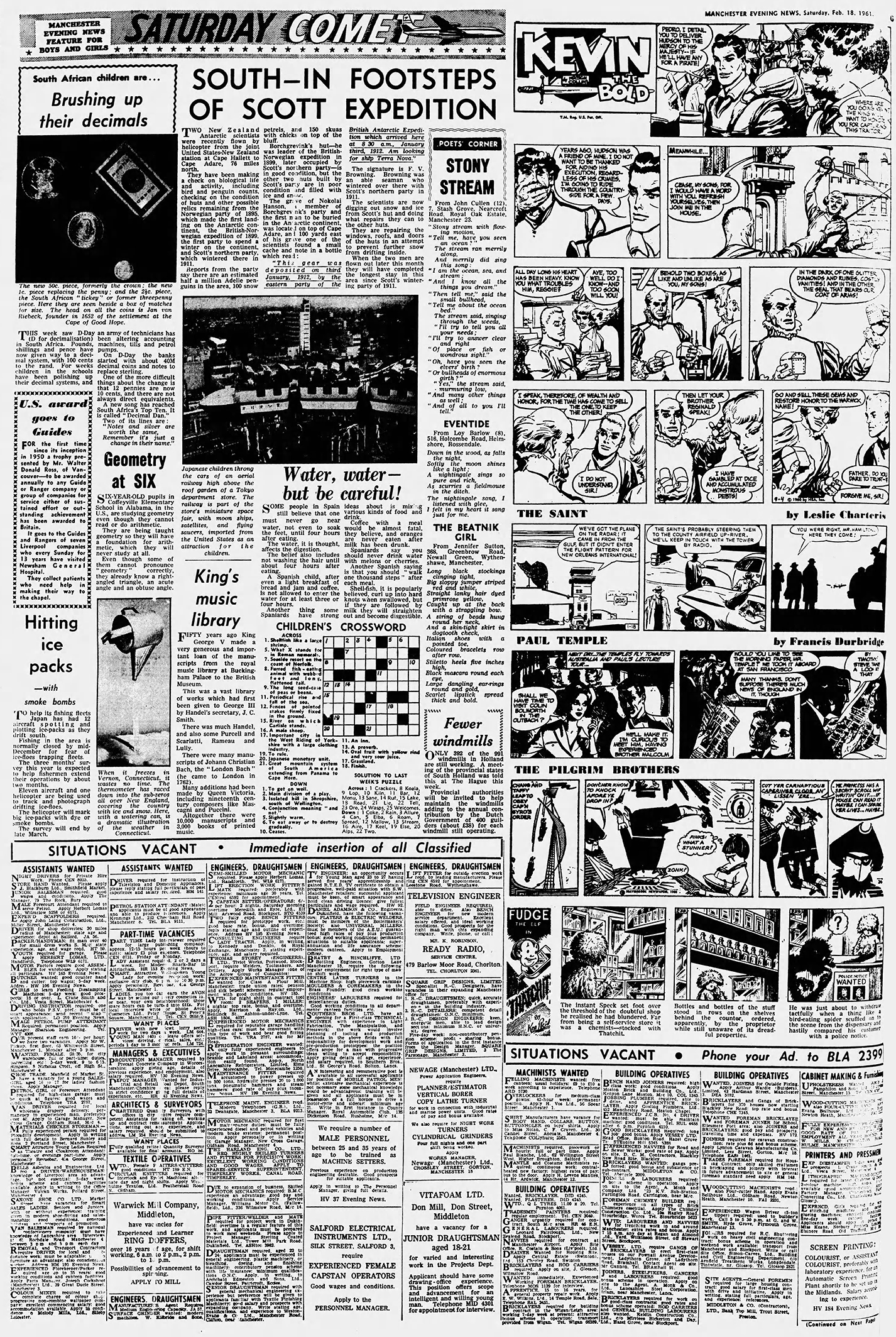
In its 21 July, 1956 edition, the Manchester Evening News (England) began to include KEVIN THE BOLD on its “Saturday Comet” kids page. These syndicated versions appeared five-plus months after their original NEA publication dates, and ran in a black and white tabloid format. The NEA likely pitched the News because of a new face being added to KEVIN’s roster—King Henry VIII.

For six years, Henry VIII became a recurring KEVIN THE BOLD character; his swan song was September 16, 1962. (And no surprise, once ”Old Coppernose” was gone, the News dropped KEVIN). As part of the “Saturday Comet,” KEVIN appeared with a few other comic strips—likely Saturday dailies. The News occasionally labelled this section the “Evening News International Cartoon Page,” and KEVIN’s neighbors included THE SAINT, by Leslie Charteris, Francis Durbridge’s PAUL TEMPLE, plus THE PILGRIM BROTHERS and FUDGE THE ELF.

The following story arc ran for a couple of months in early 1961. It’s a parable about wealth and honor involving two unalike brothers, other interesting characters, swordplay, and more.

When possible, the News’ version will be accompanied by third-page versions from the Detroit News.

To be continued…

_______________________________________________________________

For more information on the career of Kreigh Collins, visit his page on Facebook.

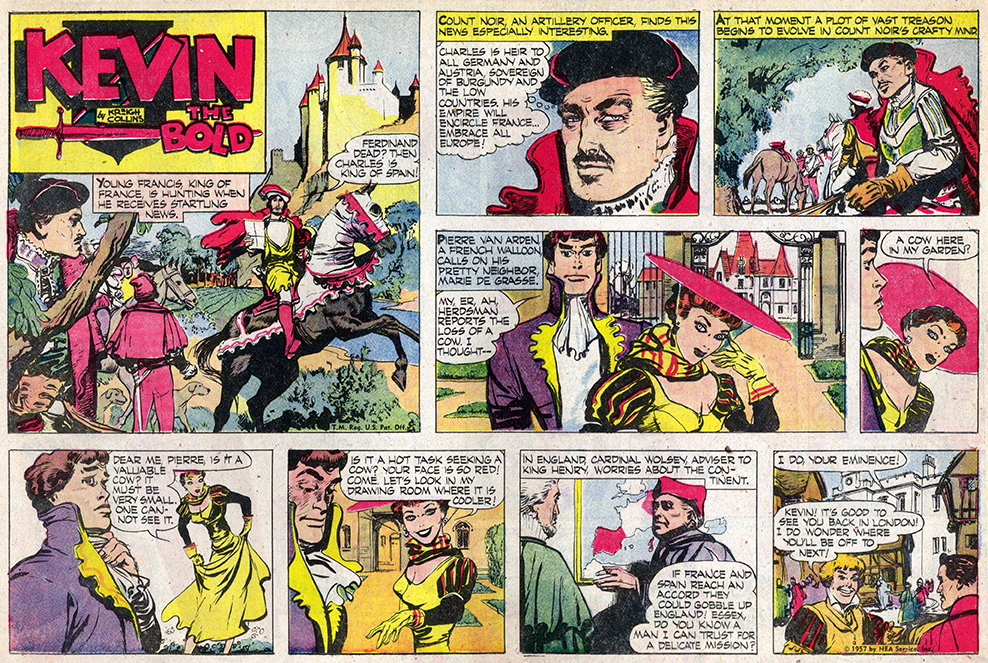
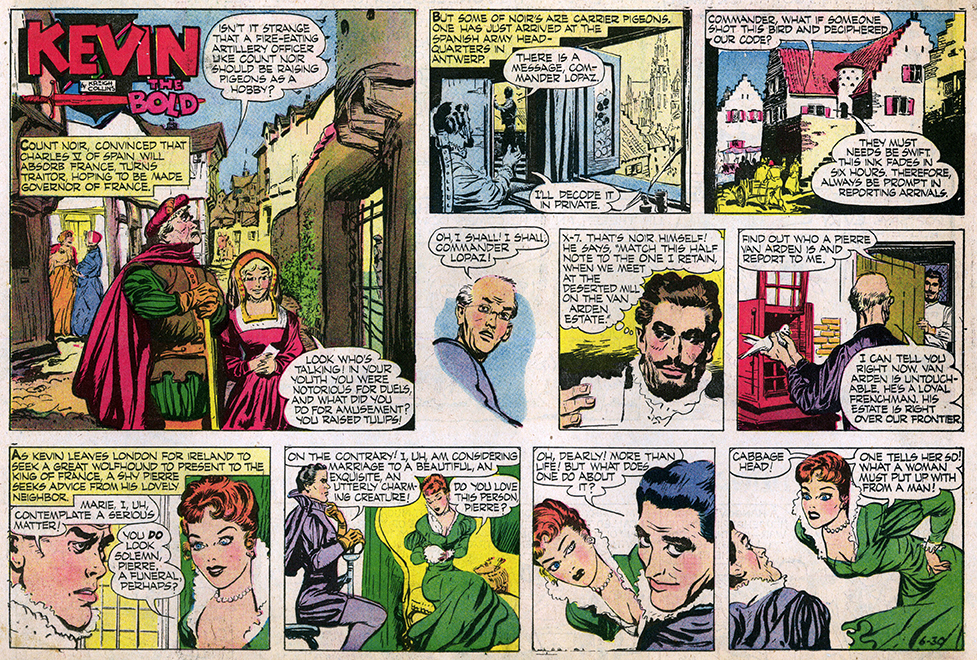
Count Noir

This chapter, represented primarily by half-page comics from the Detroit News, features a scheming count and a playful young widow; it ran in Sunday comics sections 65 years ago.
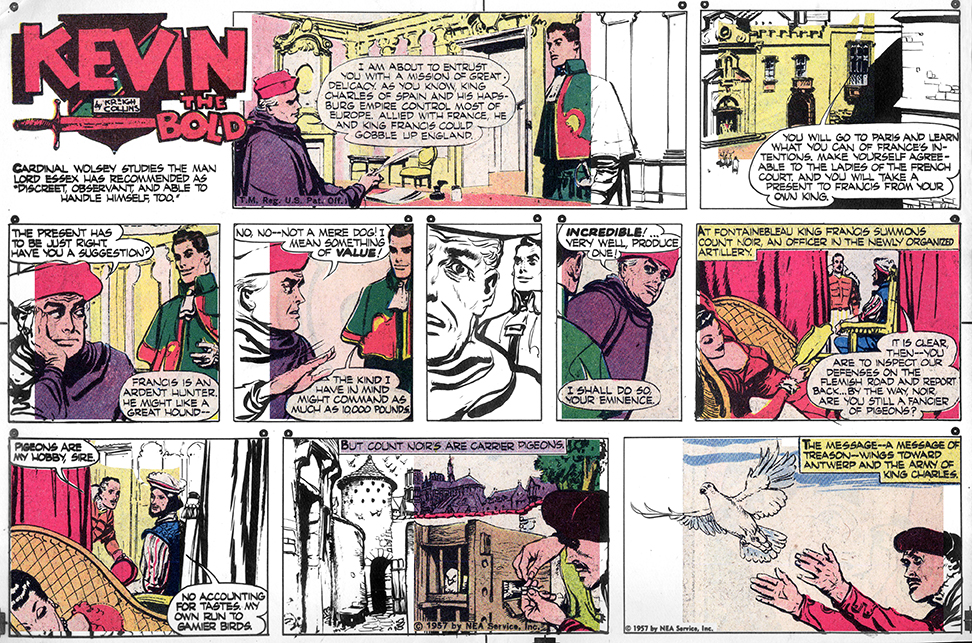
The widow (Marie de Grasse) had made her situation clear in the transitional strip that preceded this one.

By the summer of 1957, the Chicago Tribune generally ran KEVIN in its loathed third-page format, and in the absence of half pages from the News, episodes will get the collage treatment—which is a shame because June 23 is a very nice example.

In stark contrast with Noir’s machinations, lovely Marie has her own methods to get what she wants.

To be continued…

_______________________________________________________________

For more information on the career of Kreigh Collins, visit his page on Facebook.