Among some recently-acquired UP ANCHOR! half pages were most of the episodes of a story arc with an unusual plot element—murder. The choice of portraying hippies as villains was likely inspired by the tragic and ugly Manson family murders, which had occurred in the summer of 1969. In fact, the Tate-LaBIanca trial was under way when these episodes were published in late 1970.
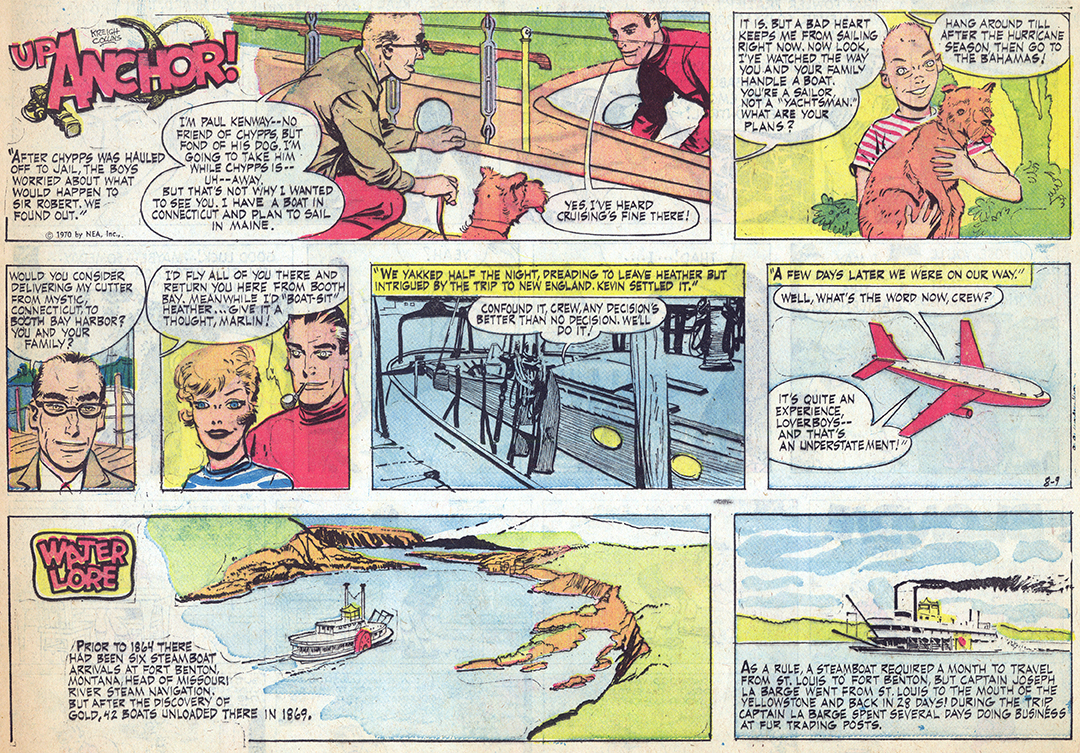
The Marlin family, whose journey aboard Heather had led to a temporarily relocation in Florida, had just returned from Maine. Kevin Marlin had been hired to sail a cutter from Connecticut Down East. To return “home” and hear such terrible news would be very unsettling.
A couple things from the October 11, 1970 episode that caught me eye were the Manson Family lookalikes in the center panel and the second panel of WATER LORE. Occasionally, Kreigh Collins would directly reference his personal life, but I had never seen him mention his father. He was much closer to his mother.
As Heather is being provisioned, some Easter Eggs are revealed on the labels of the packages being brought aboard. In the first panel, Kevin caries a case of “Jesiek’s Oil.” Back home in Michigan on Lake Macatawa, Heather spent her winters “on the hard” at Jesiek Brothers Shipyard. Based on the box carried by his friend, I’d wager that “Schottenburg’s” was a nearby grocer the Collins family patronized. The second tier’s second panel shows Dave and Erik pestering their mother about dinner—here a box is simply labelled “Boy Food.”
The provisions were needed for an upcoming trip to the Bahamas. While many of the adventured that take place in UP ANCHOR! were based on real events, alas, a trip to the Bahamas was a dream that was never realized for Kreigh’s family. The Marlin family’s adventures in Florida were inspired by the journey the Collinses took in 1959–1960, but the Chicago Tribune’s sudden cancellation of KEVIN THE BOLD in December, 1959 necessitated a reappraisal of the family’s financial situation and resulted in the cancellation of the Bahamas leg of the trip.
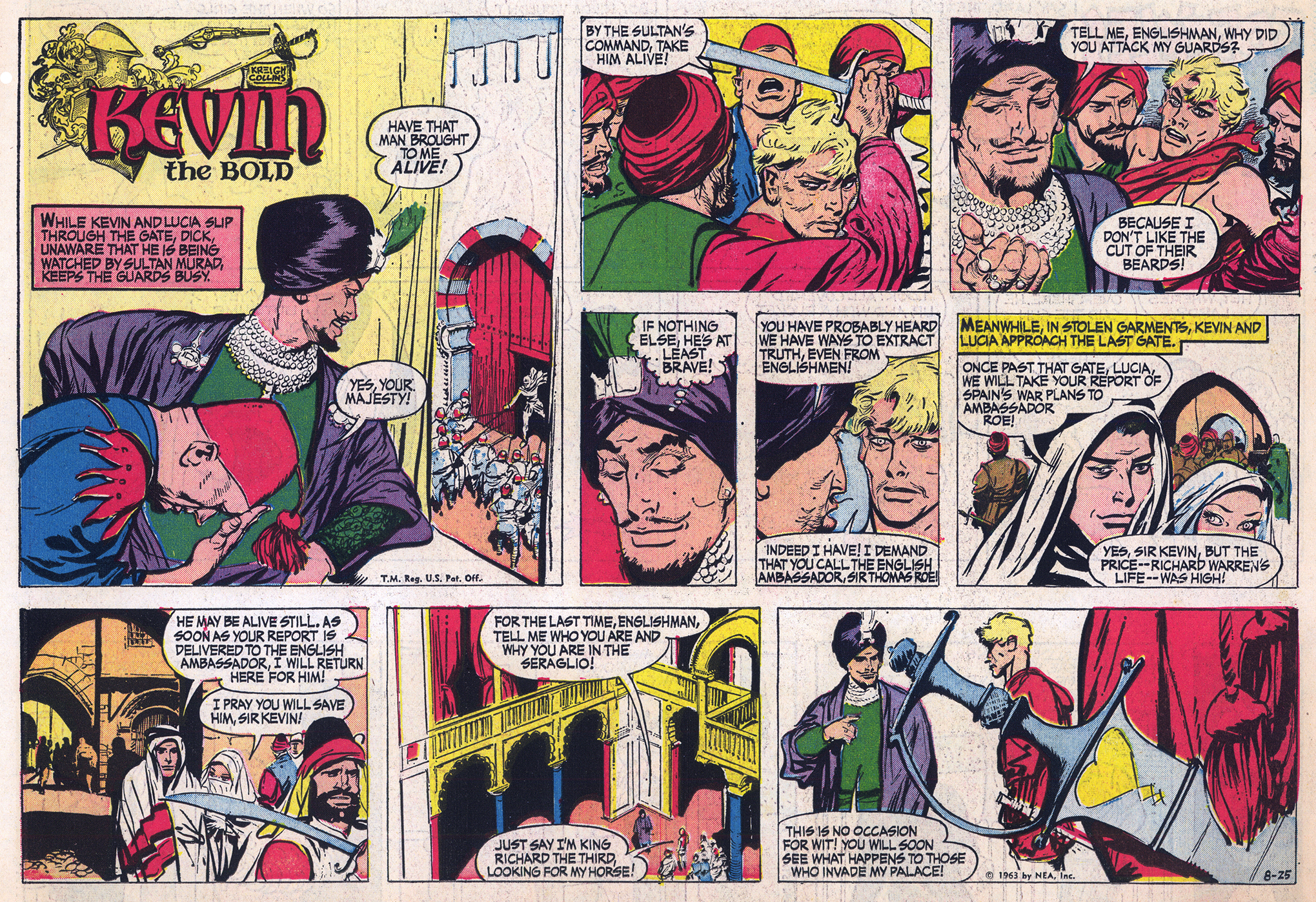
After experiencing Sir Richard’s foolhardiness first hand, Kevin witnesses it again. This time it seem certain that it will cost Sir Richard his life.
In a shocking turn of events, Sultan Murad releases Richard. And sure enough, the foolish Englishman puts them all in harm’s way again. How many times can Kevin overcome Richard’s ineptitude?
For more information on the career of Kreigh Collins, visit his page on Facebook.
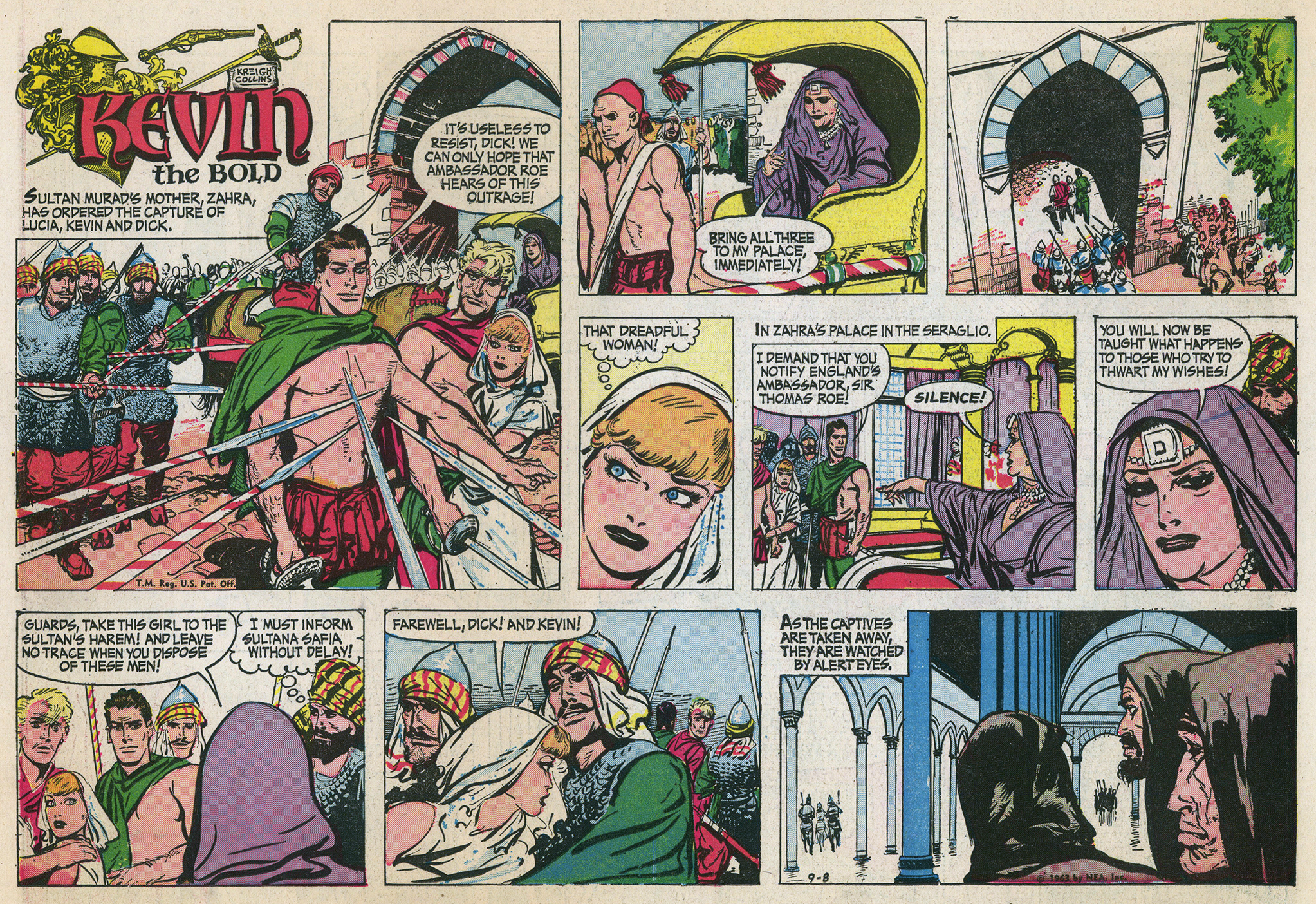
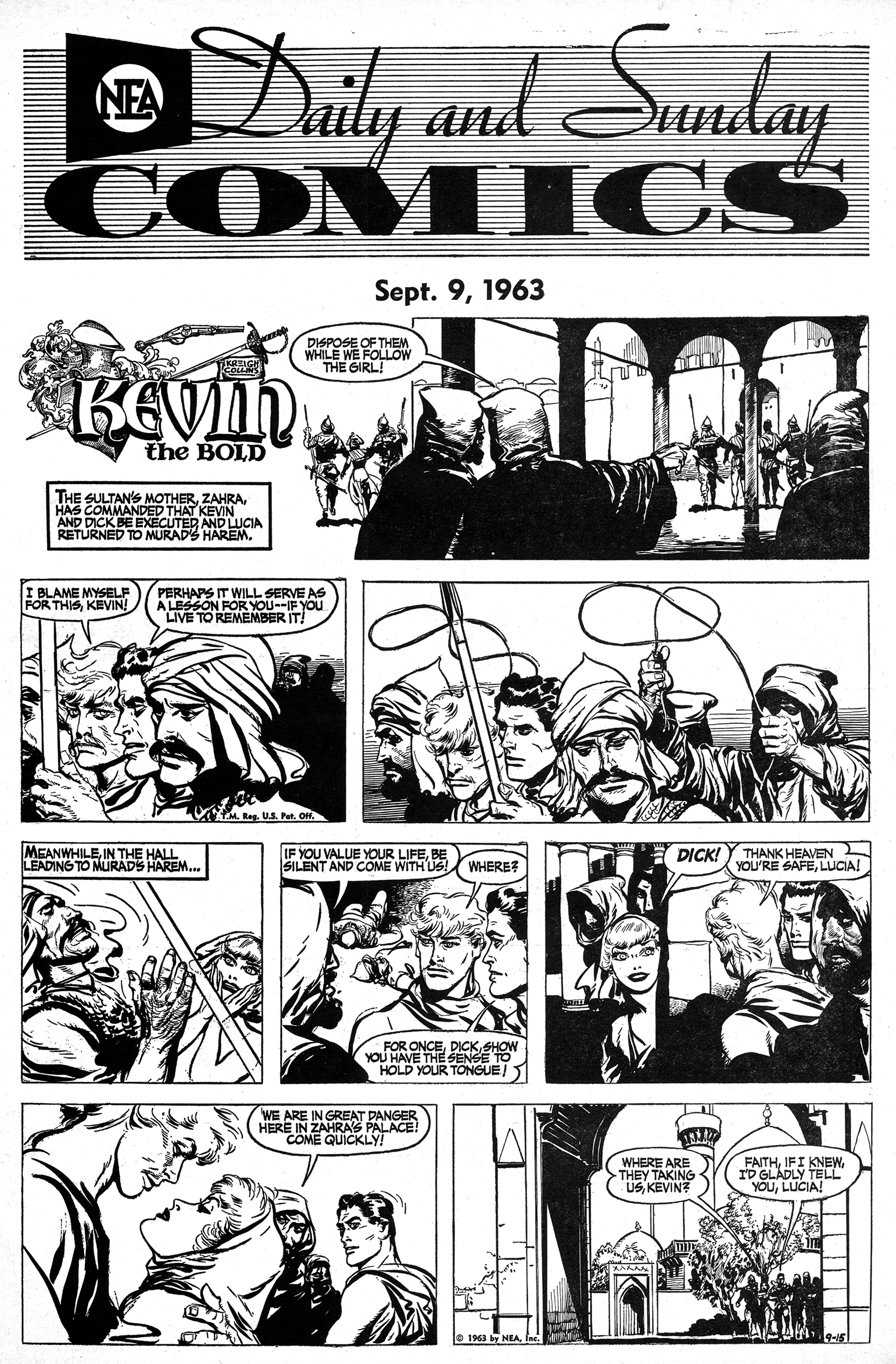
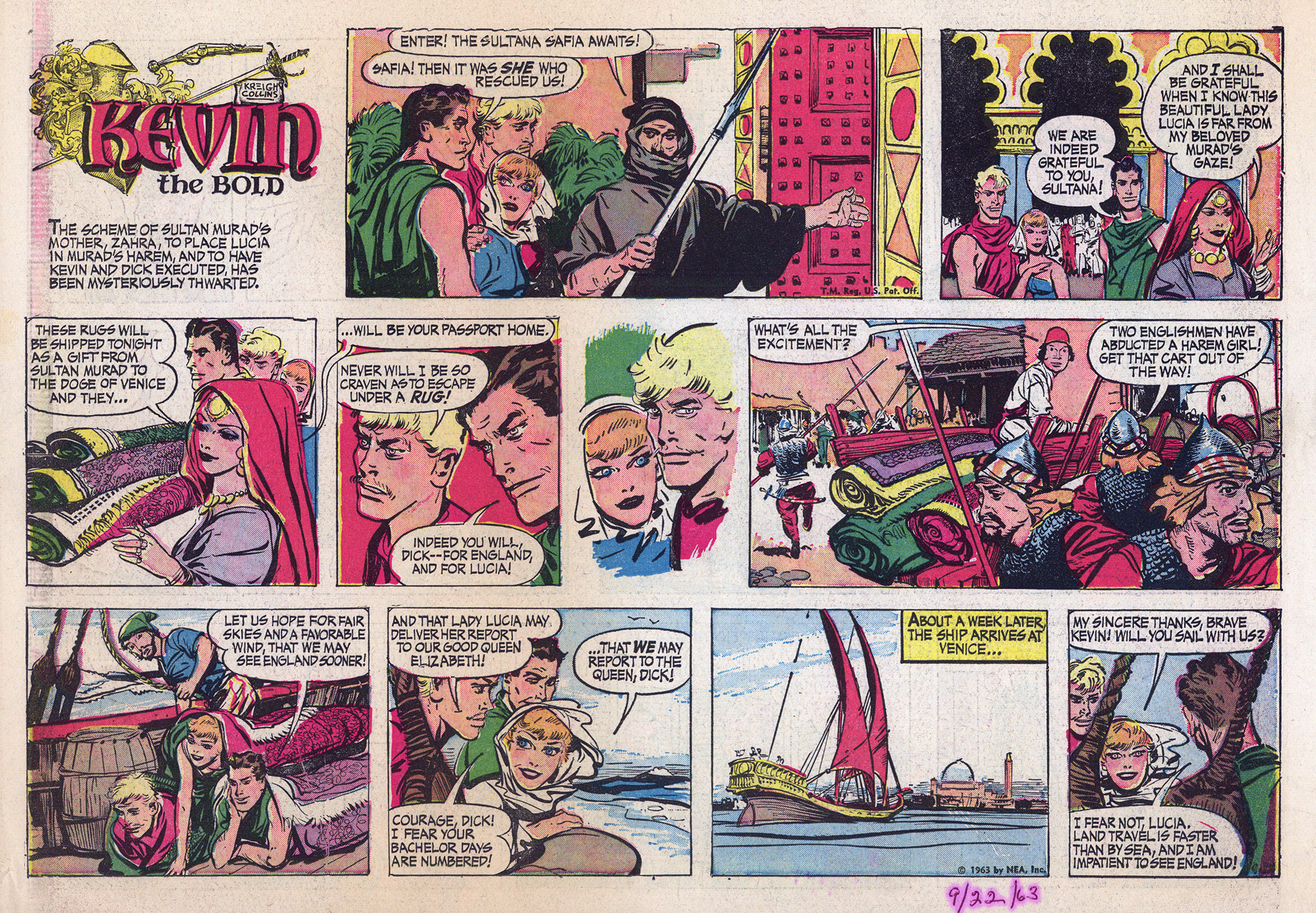
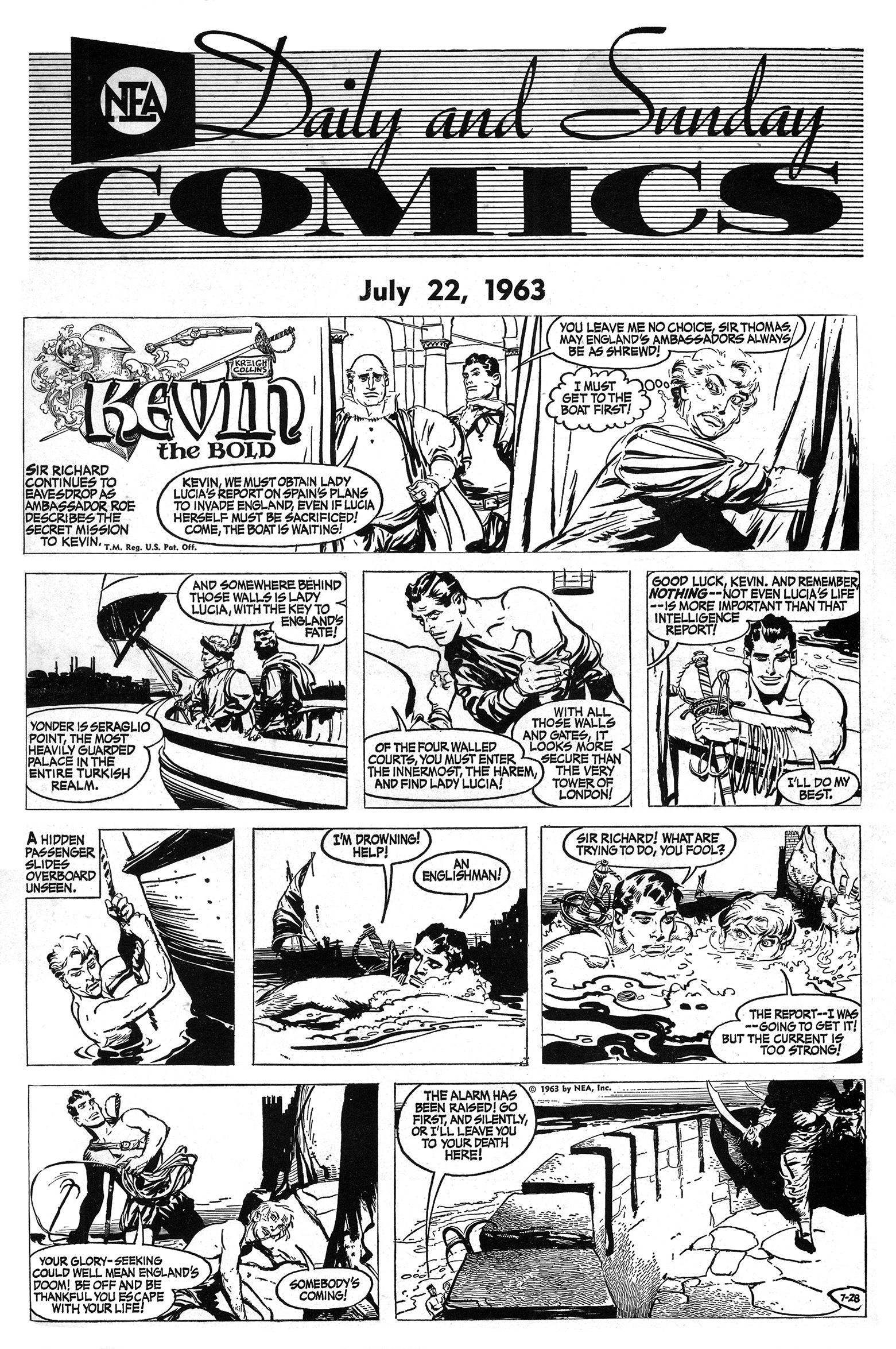
As this new adventure begins, Kevin is aboard a sailboat near Istanbul, a seemingly unusual place to secure intel on Spain’s plans to invade England.
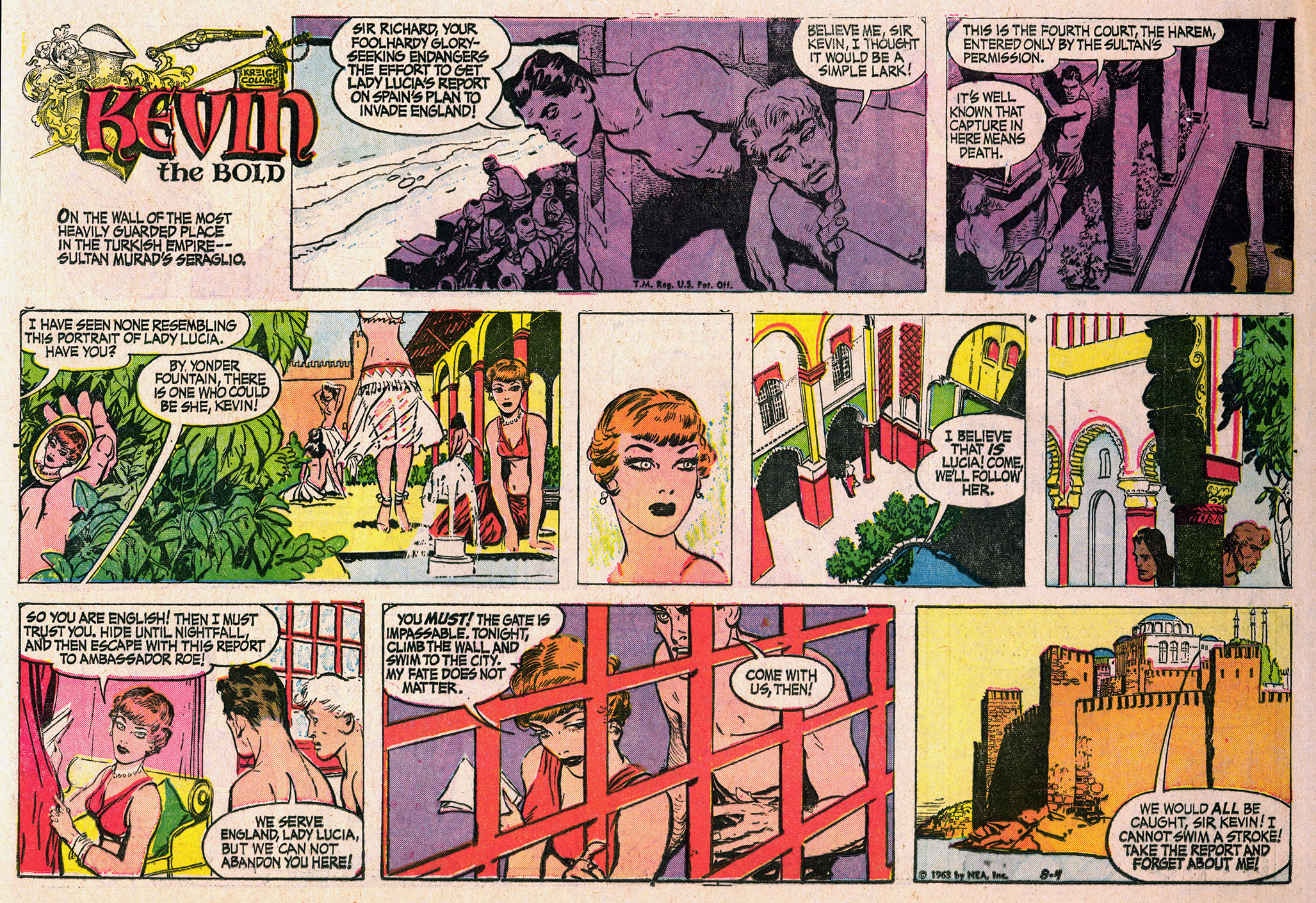
Due to the reference to Sultan Murad (III), the events depicted would be occurring c. 1580, the height of the Ottoman Empire. Kevin and tagalong Sir Richard are set to rescue the fetching English spy, Lucia.
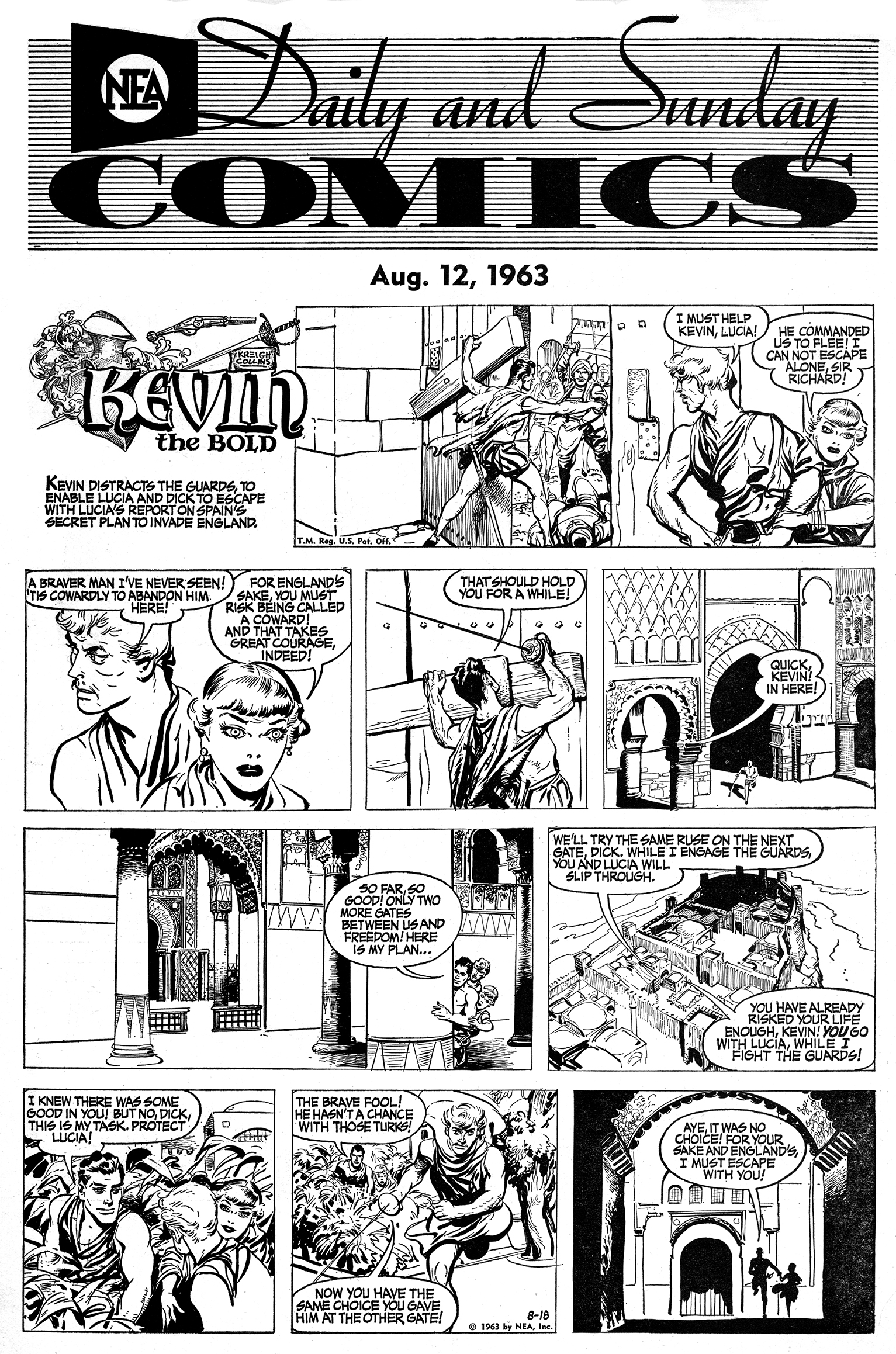
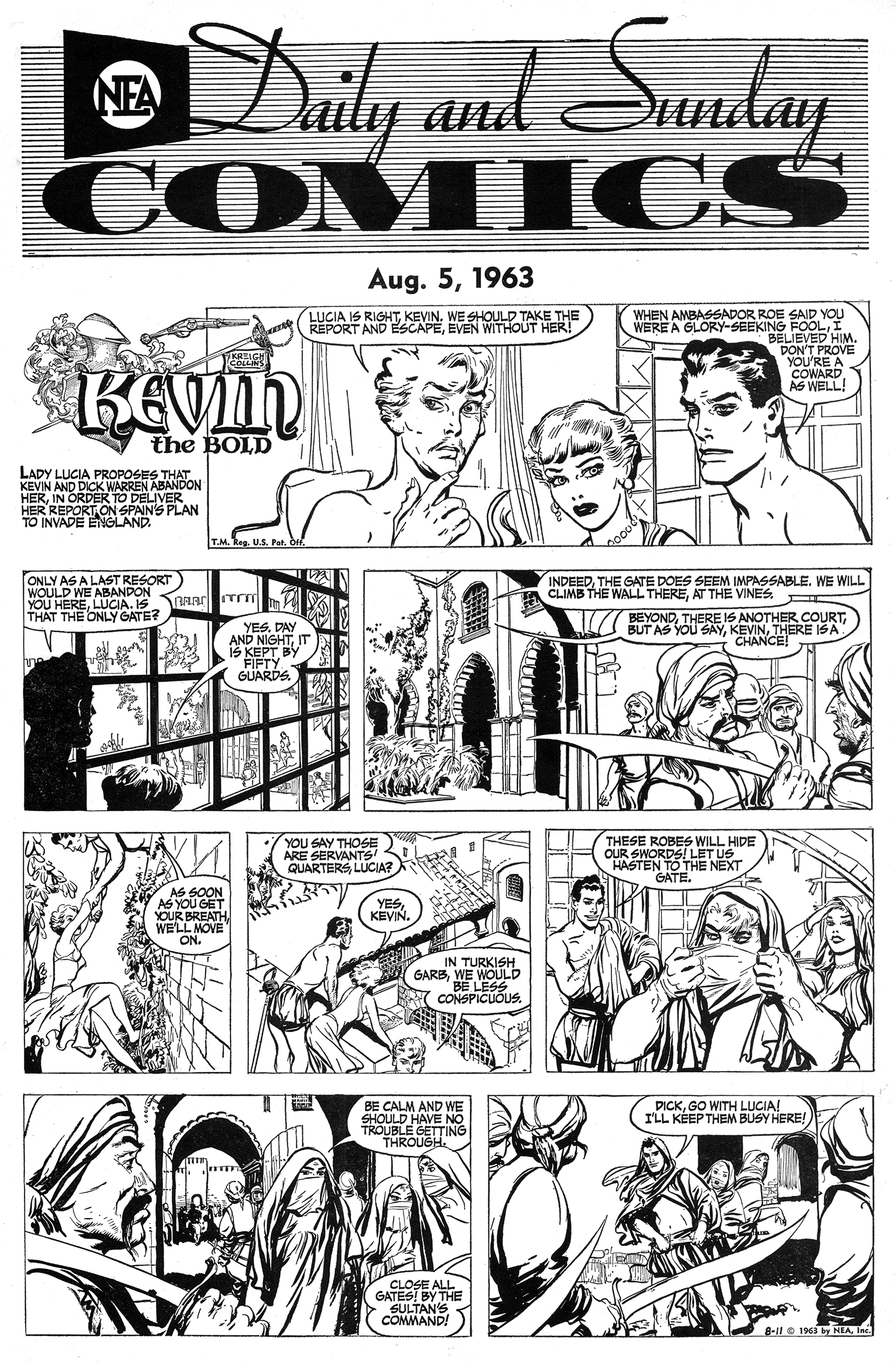
The August 11 episode is a marvel, and Collins’ beautiful line work is fully on display in the NEA Daily. Despite Sir Richard’s timely suggestion to change into less conspicuous clothing, their daring escape is noticed.
For more information on the career of Kreigh Collins, visit his page on Facebook.
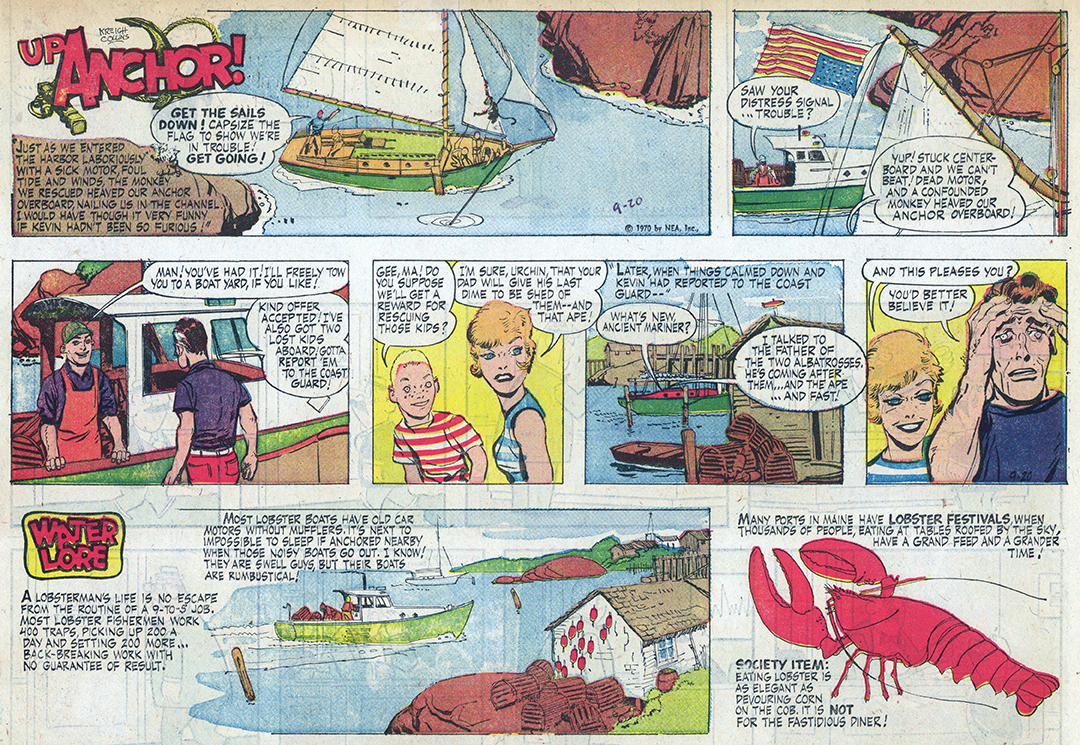
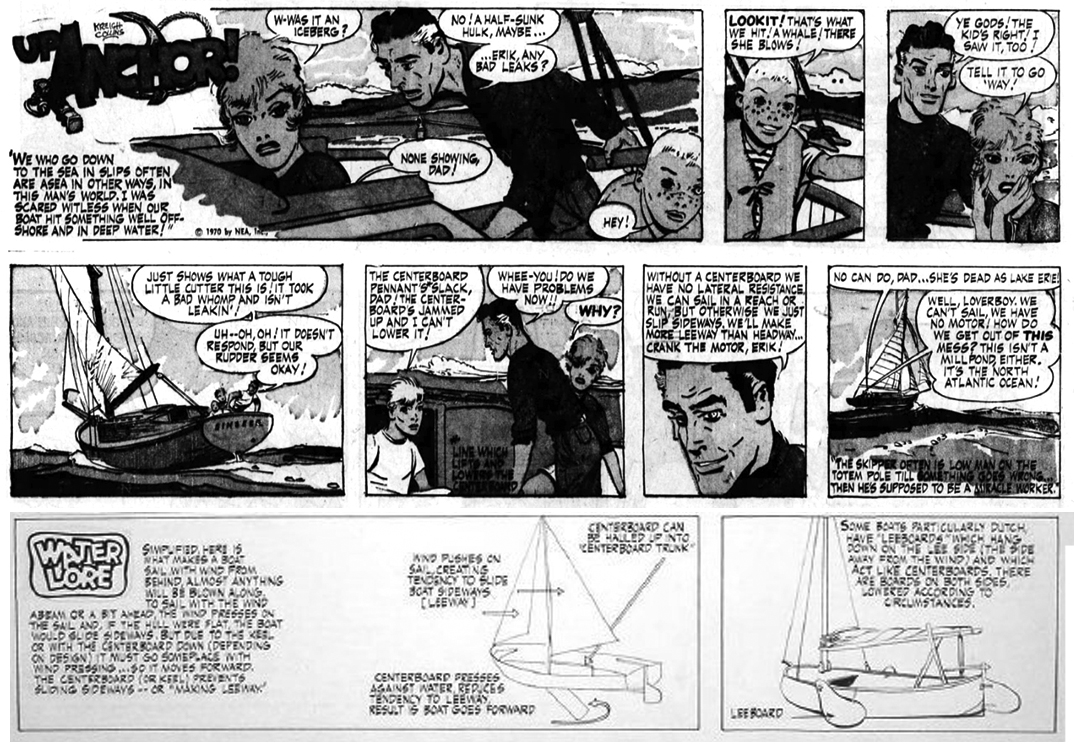
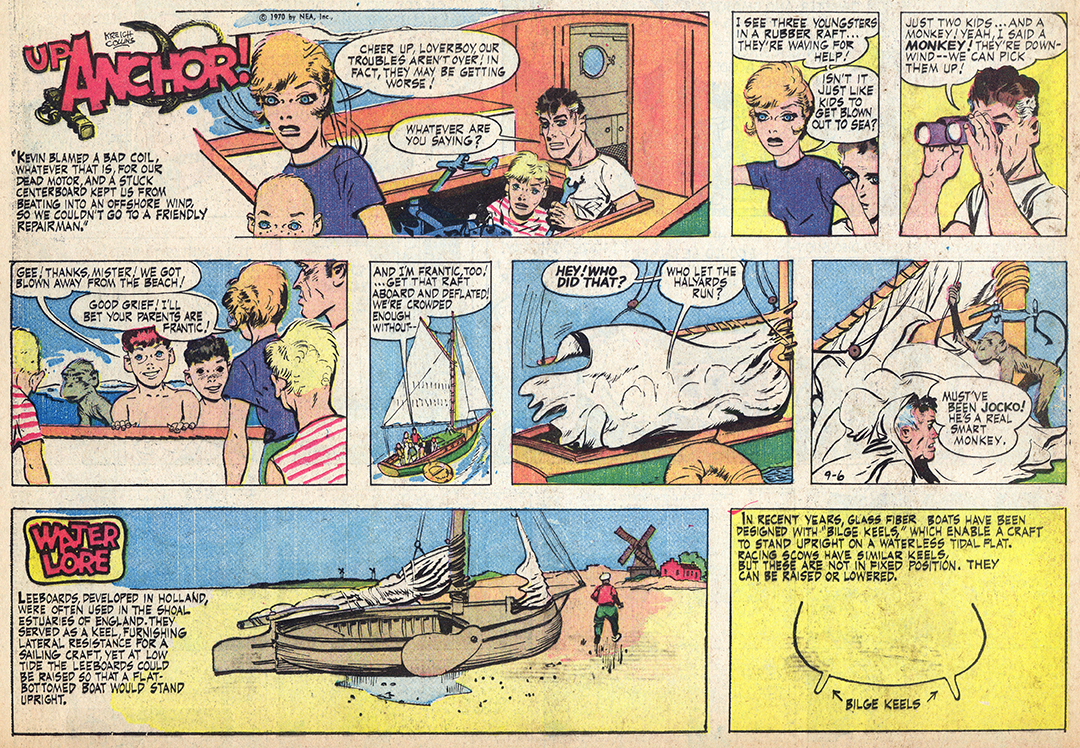
Since rescuing two kids and their monkey from a drifting rubber raft, everything that could go wrong did go wrong. However, Heather’s crew is pretty good at problem solving.
A leeboard was improvised, and worked pretty well until the monkey dropped anchor.
Luckily, tying up the loose ends wasn’t too challenging.
Unfortunately, the chapter concludes with an episode I don’t have. And Murphy’s Law dictates that the original artwork isn’t among the 75 examples found in Collection 56 at the Grand Rapids Public Library, either. (All told, there are 174 episodes of UP ANCHOR!).
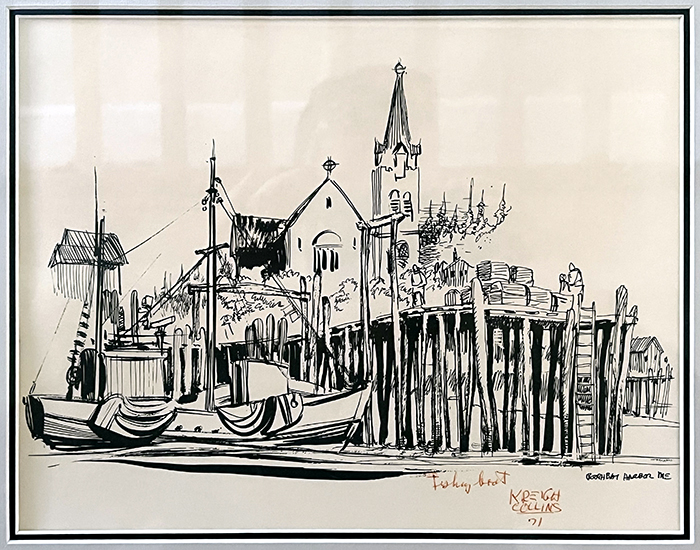
Nonetheless, it shows the family sailing into Boothbay Harbor, Maine, aboard the cutter they were delivering.
This ending was inspired by Collins and his family reaching Boothbay Harbor, Maine, aboard their schooner Heather in the summer of 1965. After a year of sailing, Boothbay Harbor was the furthest point east that they reached—over 1,000 miles from Lake Macatawa.
After wintering in Maine, Heather would start her return trip to west Michigan in the spring. By August she would be home.
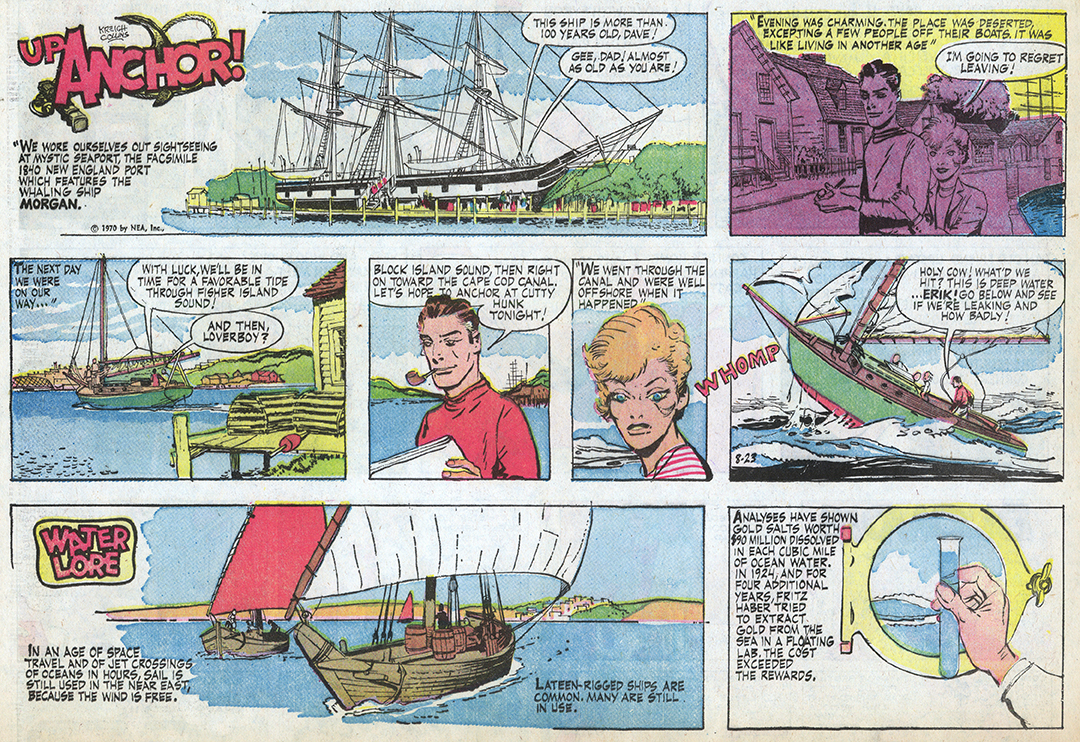
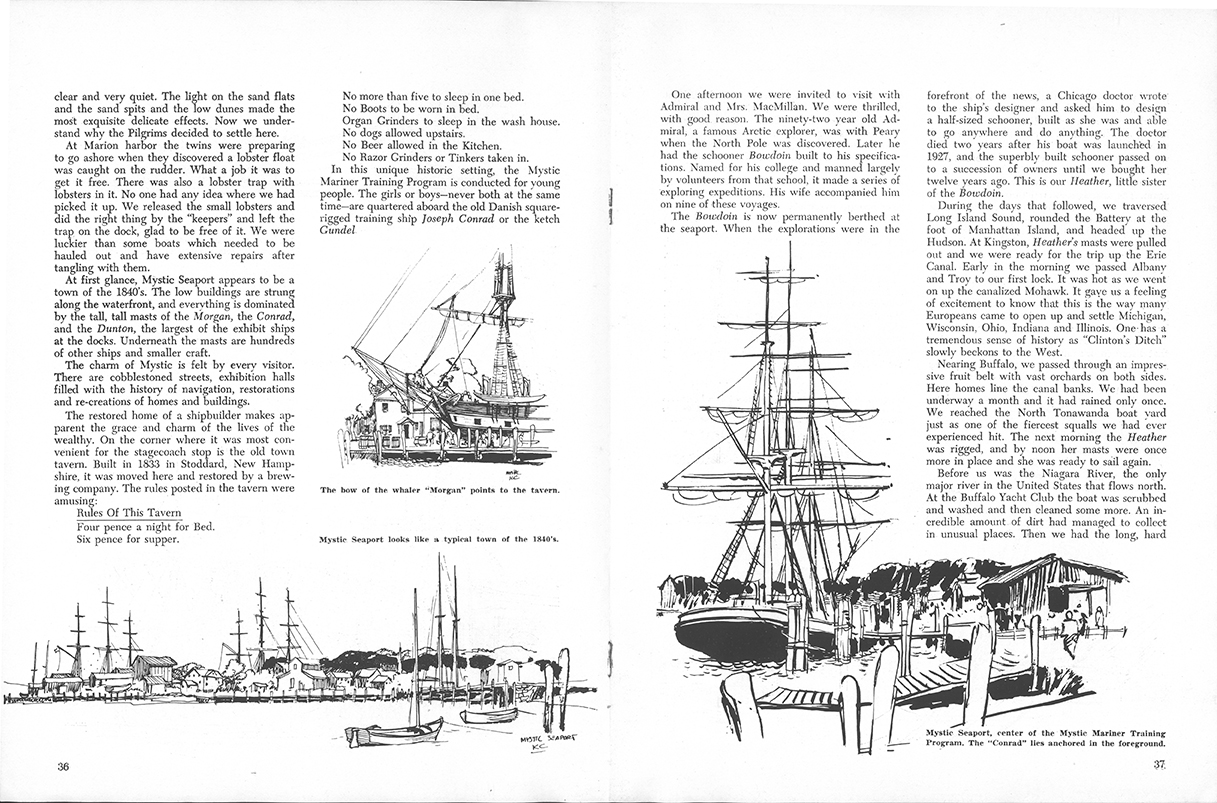
Heather and her crew spend a short time in Mystic, then continue their journey eastward. An interesting parallel is found to a three-week sailing trip I took with my Brother aboard his Gulfstar 43.
In the spring of 1989, we sailed from South Amboy, New Jersey and made some of the same stops as UP ANCHOR’s Marlin family. After sailing through Long Island Sound, we visited Block Island (and hit Mystic on the return trip). We also spent a night at Cuttyhunk Island, but from there our courses diverged. Where Heather headed northeast toward the Cape Cod Canal (and Down East), Brett and I sailed east to Martha’s Vineyard and Nantucket. Also, we didn’t hit any whales. The only bit of trouble we ran into was getting pulled over by a Coat Guard Cutter in Buzzard’s Bay… but that’s another story.
The damage is assessed and while it could have been worse—losing the engine and centerboard is not good!
Introducing a monkey might seem like a bit of a stretch, but it is a nice call back to a KEVIN THE BOLD episode from a couple decades back.
A recently-acquired batch of UP ANCHOR! half pages included most of the episodes of a story arc which ran 53 years ago, in the summer of 1970. The action begins in Florida, but the Marlin family soon land in New England, in order to handle the delivery of a sailboat.
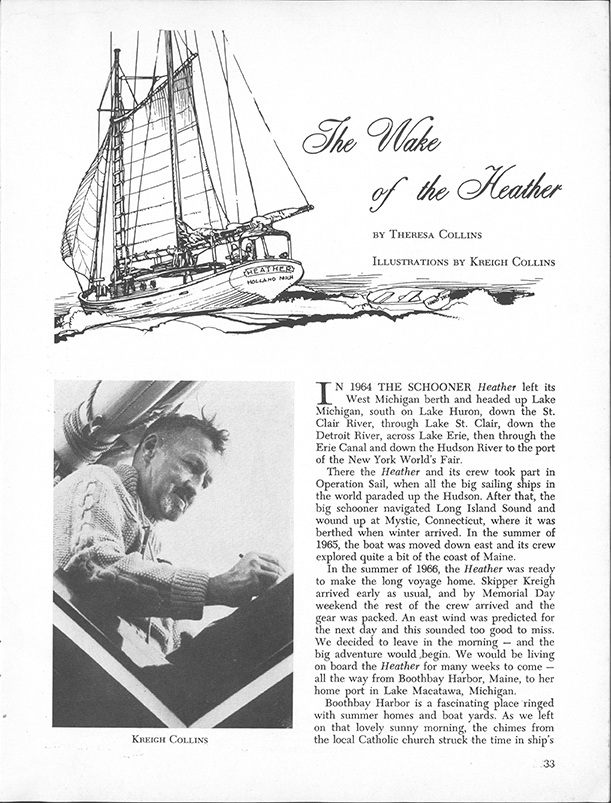
UP ANCHOR! was based on the Collins’s experiences cruising and living aboard their boat. In May, 1964, Kreigh, Theresa, and 13-year-old twins Kevin and Glen left West Michigan and journeyed to New York City to take part in the first Operation Sail, which was a tie-in to the 1964 New York World’s Fair.
Coinciding with this trip was the imminent birth Of Kreigh and Teddy’s second grandchild (Ahoy! That’s me!). In order to simplify things for my parents (Judy and Erik), the decision was made for my older brother Brett (not quite three years old), to accompany his grandparents and the “Uncle Boys” on the first leg of Heather’s trip. My family was living in Ann Arbor, Michigan at the time, so my dad drove Brett to Ada, dropped him off, with plans to pick him up in the Detroit area, after Heather had made the trip up and around Michigan’s “mitten.” (It must have made an impression on Brett, who has owned numerous sailboats during his adult life). In a letter, Kreigh described his youngest crew member as “not too much trouble,” which I always thought was pretty funny.
After dropping Brett off, the journey continued down the Detroit River, through Lake Erie and the Erie Barge Canal, and down the Hudson River. From there they sailed through Long Island Sound and made port at Mystic, Connecticut.
Theresa kept as diary during the voyage, and much of the material was eventually used as raw material for UP ANCHOR! Before turning into the comic strip’s storylines, it was edited, illustrated by Kreigh, and published as “In the Wake of the Heather.”
When I was putting together The Lost Art of Kreigh Collins, Vol. 1, The Complete Mitzi McCoy, a late stumbling block was finding replacement comics for the episodes I only had third-page examples of. Ironically, after searching far and wide for several years, I located them in a comic book shop about a dozen miles from my home. The catch was that I had to purchase them as part of complete comic sections. I left the shop with six 16-page New York Sunday Mirror Sunday comic sections and while I spent far more than I hoped, my quest was over. The Mirror carried MITZI for the duration of its run—usually in a half-tabloid format, but occasionally as a full tabloid page. Flipping through it reveals both big name features and comics now forgotten.
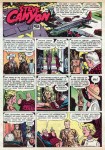
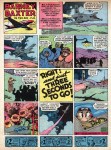
As usual, Ham Fisher’s JOE PALOOKA ran on the front page, followed by Milton Caniff’s STEVE CANYON and MICKEY FINN by Lank Leonard. Next up are HENRY by Carl Anderson, KERRY DRAKE, and SUPERMAN (neither credited, but by Alfred Andriola/Allen Saunders and Stan Kaye/Wayne Boring respectively). Then it was THE FLOP FAMILY by Swan, an advertisement for Philip Morris tobacco, and Frank Miller’s BARNEY BAXTER IN THE AIR.
The Philip Morris ad is interesting, it promotes both cigarettes and pipe tobacco. In the cigarette portion of the ad, Dick is behaving like a dick—due to a sore throat (caused by some other brand of smokes). He is given advice by a character dressed in a bizarre uniform who seems to be a golf course clubhouse attendant (was the illustrator’s reference an organ grinder monkey?), and appears to be about nine years old. Astonishingly, the dapper dandy offers Dick a Philip Morris cigarette, and ultimately, Dick’s love life is back on track. (Perhaps the attendant is an adult but his cigarette habit stunted his growth?)
The pipe tobacco portion of the ad, masquerading as a topper strip, has a character mentioning that he was from the class of ’89. With this newspaper edition dating to 1949, that means the gent was class of 1889 (!). Another character claims she loves the clean, fresh smell of her husband’s pipe. (Could it be that tobacco companies lied to consumers? Egad).
For me, the funny pages’ highlight probably falls into a category I mentioned earlier, “comics now forgotten.” This episode, MITZI McCOY’s 30th, is from the middle of the strip’s fourth story arc, and appears in the half-tabloid format. Half-tabs have small dimensions, but they include the throwaway panel, which full-page tabloid versions do not. It’s a sweet episode where a runaway child is discovered, and is notable for not showing the strip’s titular character. Of personal interest to me is the appearance of the child, Dick. Like many artists, Kreigh Collins used his family as models; for Dick, the model was my father, Erik—Kreigh’s oldest son. Dad was 10 years old when this episode was drawn. Sharing a page with MITZI is an advertisement for Pepsi, a rather saccharine affair with another kid saving the protagonist’s love life.
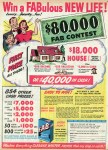
Next up were Harry Hanan’s silent comic LOUIE and an ad for Kellogg’s Corn Flakes (completely devoid of relationship advice from youngsters—how refreshing!). A page with Roy Crane’s CAPTAIN EASY, drawn here by Walt Scott, and V.T. Hamlin’s ALLEY OOP FOLLOWS; opposite these two strips is an ad for Fab detergent. The ad features a cartoonish family looking suspiciously similar to the family from the Corn Flakes ad, and hypes a pretty cool giveaway—a free house!—valued at $18,000 (things have certainly changed in the last 74 years!). then it’s Frank Godwin’s RUSTY RILEY, REX MORGAN, MD by Bradley and Edgington, BOOTS by Martin, and Merrill Blossar’s FRECKLES AND HIS FRIENDS (plus the topper strip HECTOR).
The last full spread in the section features OUT OUR WAY by J.R. Williams, PLUS OUR BOARDING HOUSE.
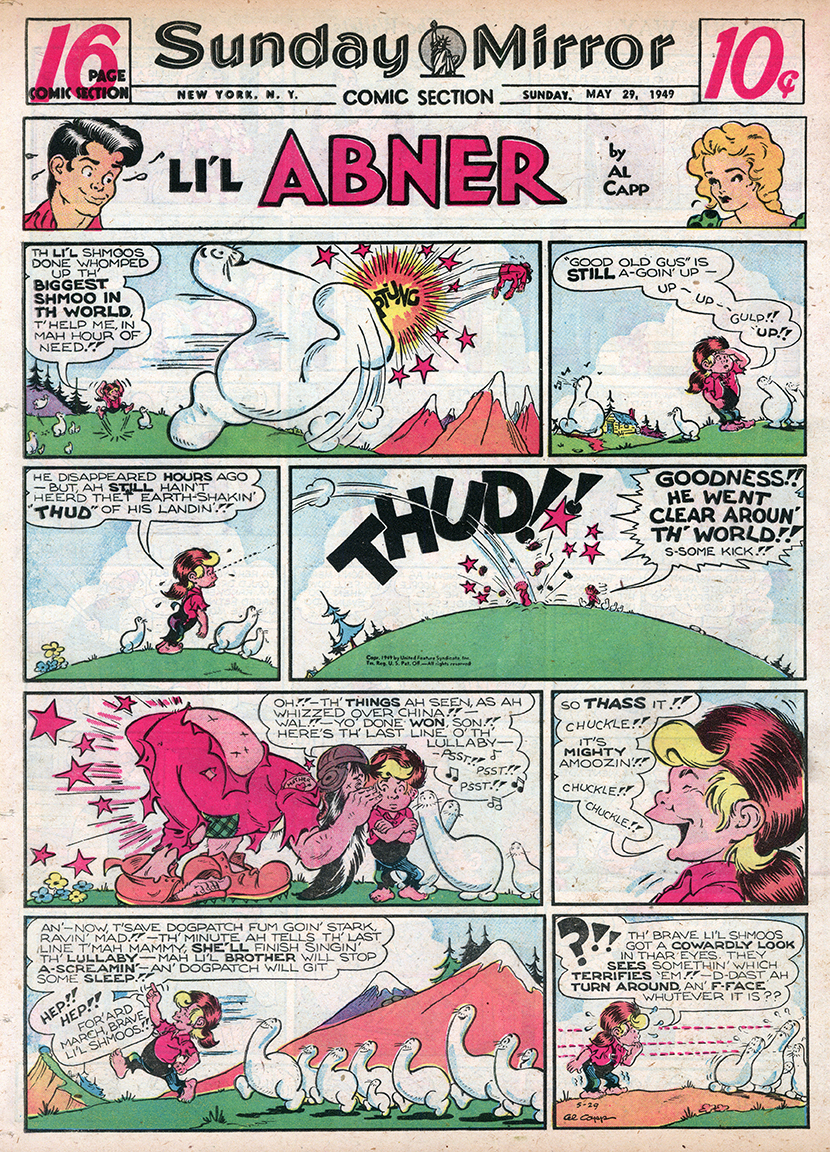
Taking its usual spot on the back cover is LIL’ ABNER by Al Capp.
Want to See More of Mitzi?
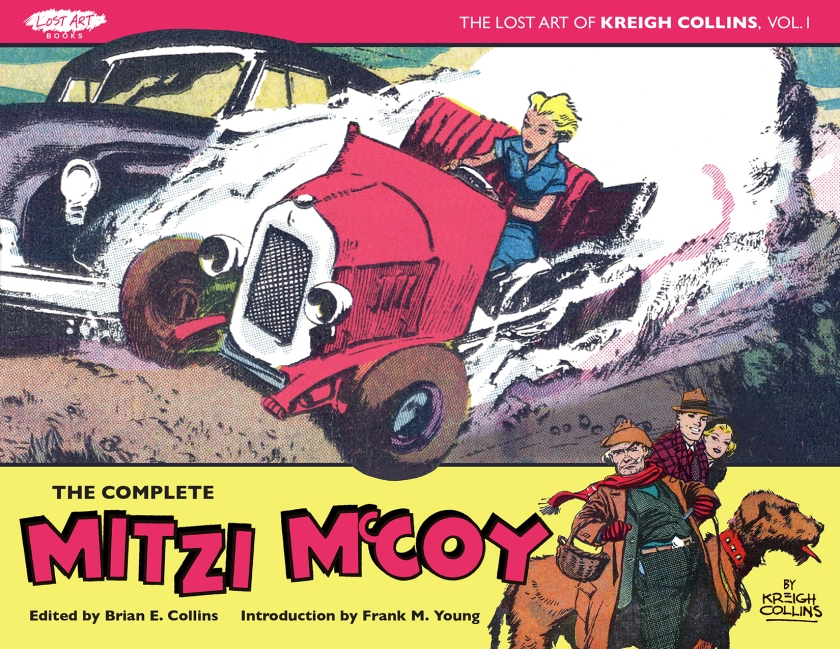
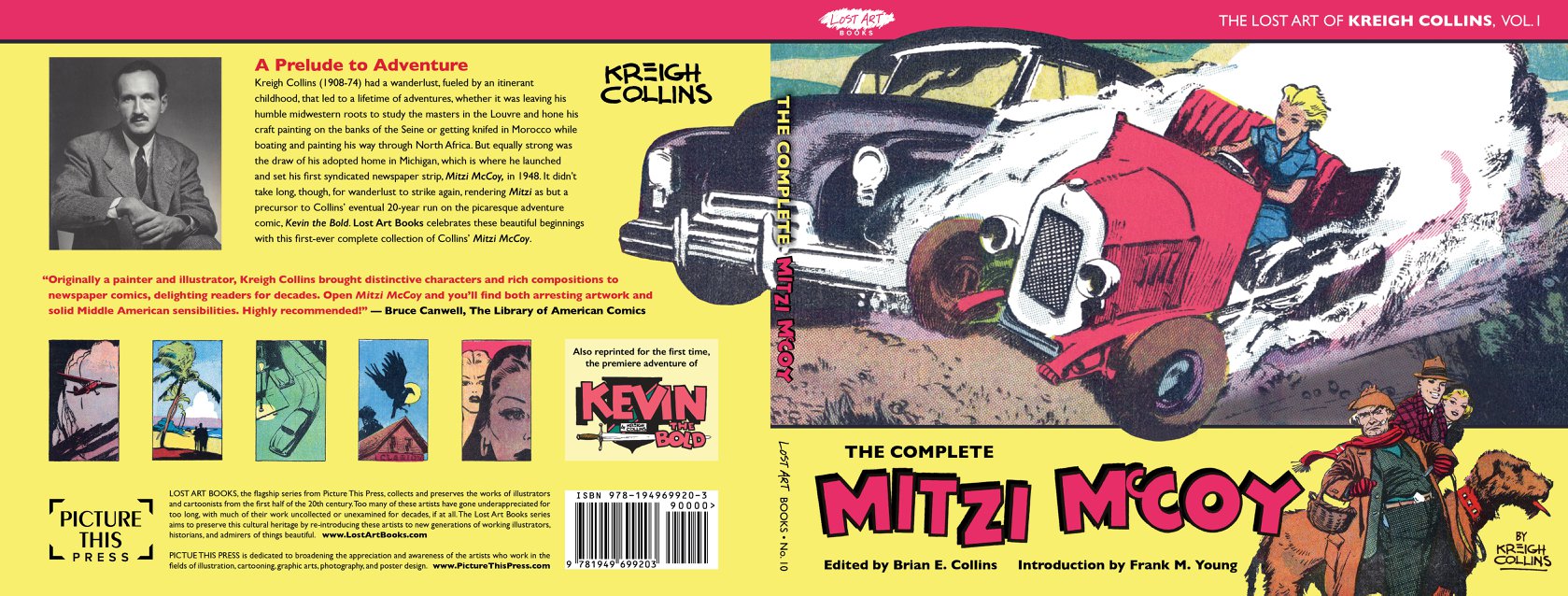
“The Lost Art of Kreigh Collins, the Complete Mitzi McCoy” features the entire run of Kreigh Collins’ first NEA feature.
MITZI McCOY ran from 1948 to 1950 and showcased Kreigh Collins’ skill as an illustrator and storyteller. His picturesque landscapes, lovely character designs, and thrilling action sequences brimmed with detail and charm, and the strip’s ensemble cast rotated in and out of the spotlight taking turns as protagonists in the dozen story arcs collected in this volume. The last story collected in “The Complete Mitzi McCoy” is the narrative bridge that set Collins and his characters off on a new journey, beautifully told for the next couple of decades in the much-lauded adventure strip Kevin the Bold.
The collection includes an introduction by Eisner Award-winning author Frank M. Young, an Afterward by Ithaca College’s Ed Catto, and previously unpublished artwork and photos. Longtime comics artist Butch Guice also provides a new pin-up of the character Mitzi McCoy.
The book is available for $30. For domestic shipping, add $4; for international orders, please add $25 to cover first class shipping. To place an order, leave a comment below or email me at BrianEdwardCollins1[at]gmail.com, and I will give you PayPal or Venmo information. Thank you!
For more information on the career of Kreigh Collins, visit his page on Facebook.
While journeying past the Alps, and on their way to certain adventure — finding a lost treasure! — Kevin and Brett pause for an archery lesson. Who better to have as a teacher than Kevin? Surely he’s the finest archer in the land…
An impromptu contest between Kevin and a local hotshot ends with the expected result. Speaking of expected results, what did Kreigh Collins have against raptors? (In an October 1949 “Mitzi McCoy” sequence, Tim Graham had made a pin cushion of an osprey. Although it’s a similar stunt, it’s nice to see the differences in perspectives between the two illustrations.)
Their land journey over, Kevin and Brett set sail for the exotic East — to Byzantium (which is sometimes referred to as Istanbul or Constantinople).
Note the cute advertisement for the (second) re-release of Walt Disney’s 1937 feature Snow White at the bottom of the page—but the highlight for me is the wonderful throwaway panel illustration of Moab’s niece. Speaking of treasure, it turns out that our heroes aren’t the only ones digging around for it.
Moab demonstrated that he had honorable principles as a youth, when he first saw the jewels being hidden; what about now, when he seeks them as an adult?
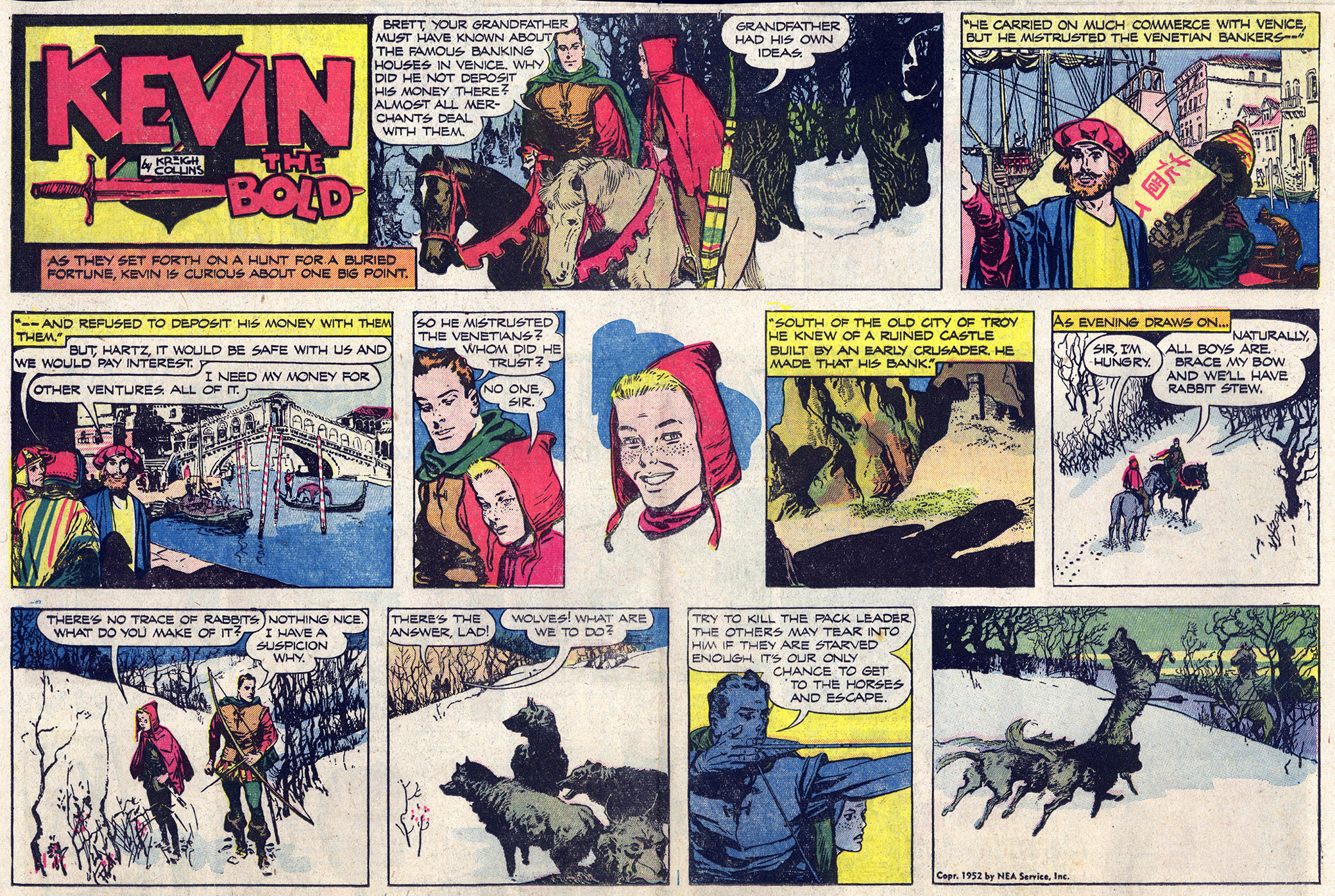
In KEVIN THE BOLD’s seventh chapter, Kevin has decided to take Brett as his ward, and they set off together. Brett’s tragic backstory is revealed in these handsomely-printed and concisely-scripted comics. The impressive variety of settings, exotic locales, archery and wildlife were all hallmarks of Collins’ style.
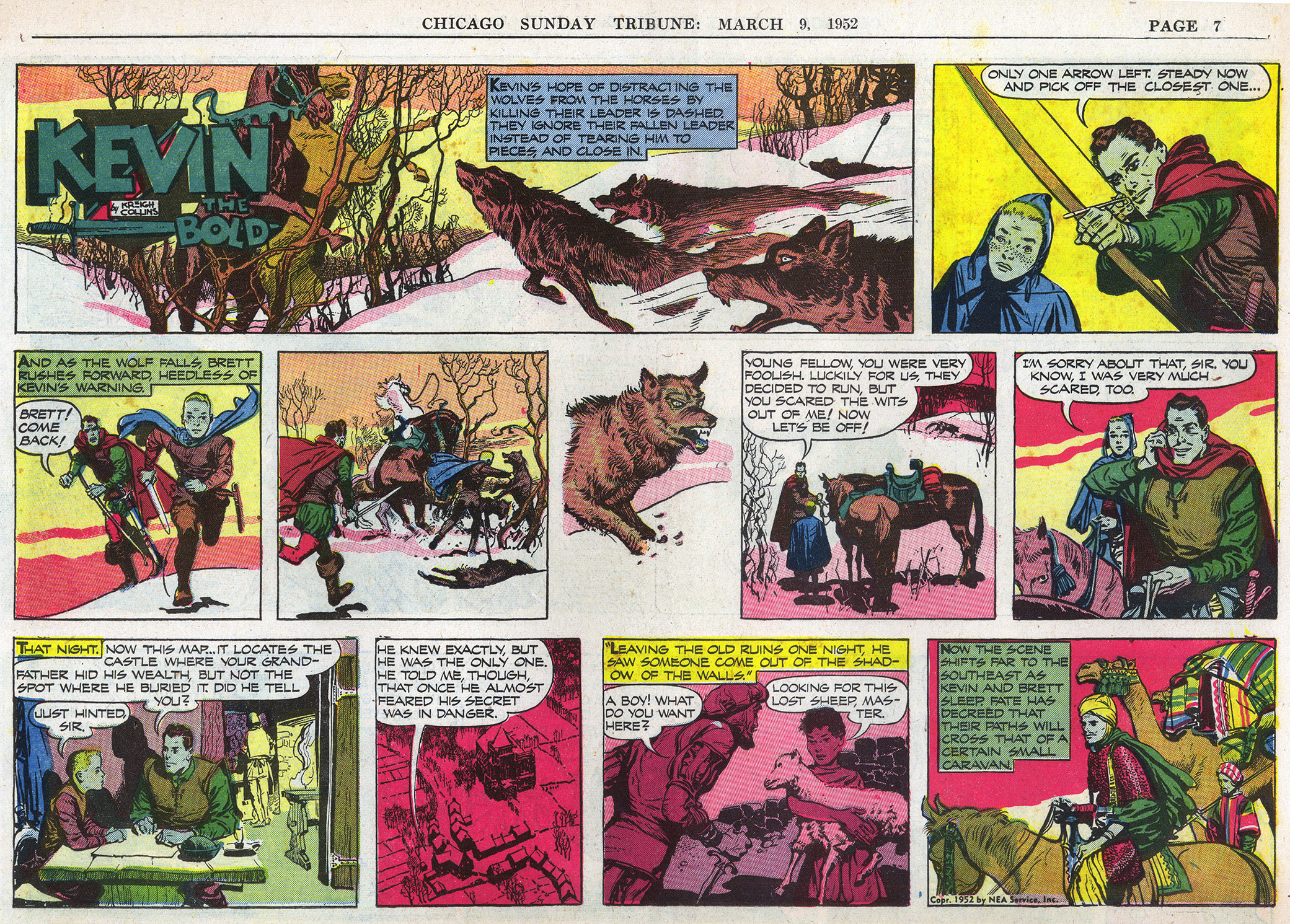
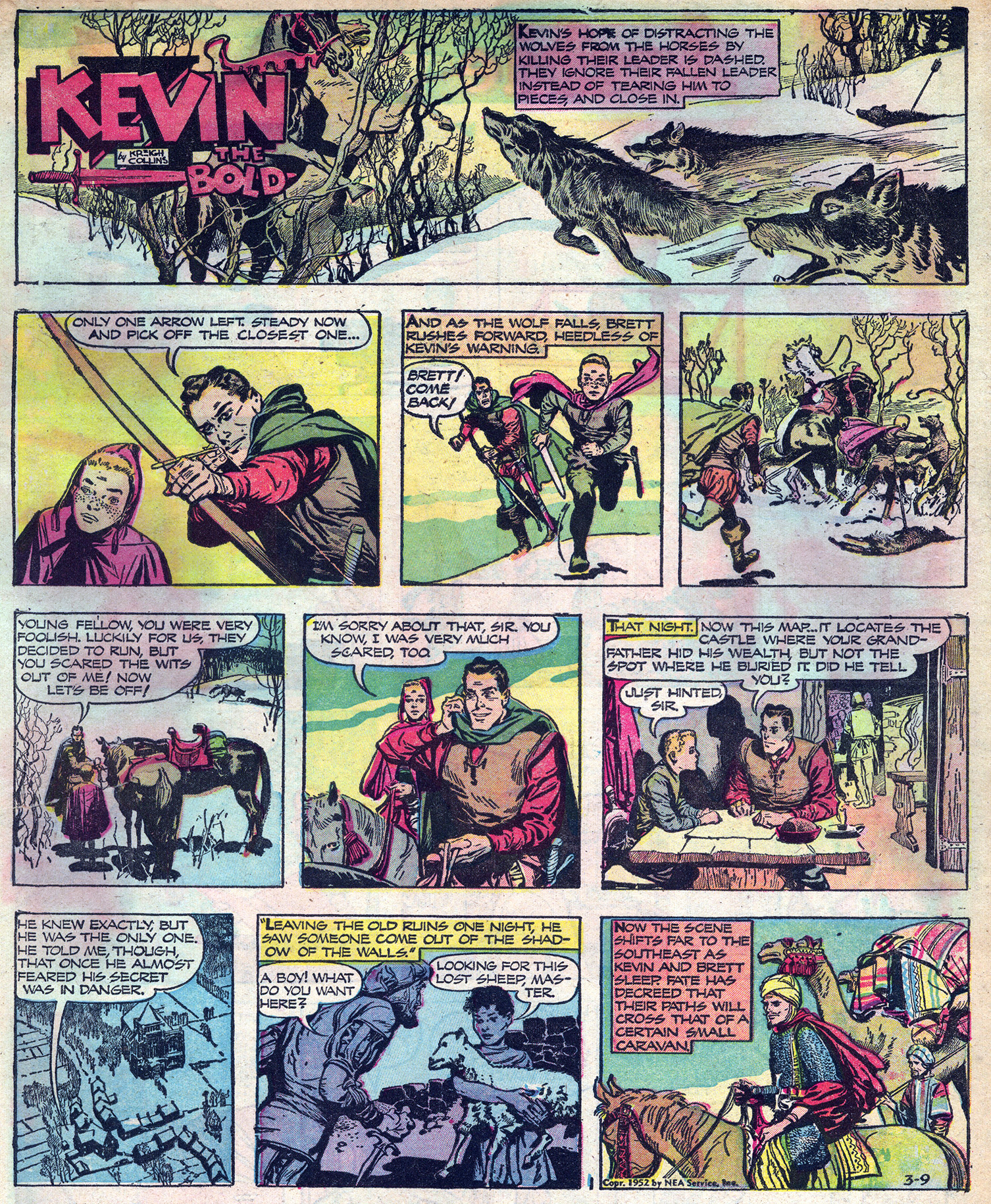
In what must have been a rare case of transposed films, the Chicago Tribune’s March 9, 1952 comic printed badly. (It seems the magenta and cyan plates were switched — similar to a different instance, involving yellow and magenta). A tabloid version from the same day had its own reproduction issues, but gave an indication of how the colors were probably supposed to appear.

















 Kreigh’s Comics
#/media/File:USCG_Seneca.jpg)