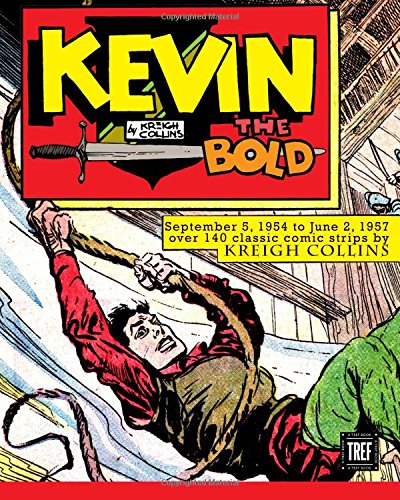
Compiled by Eisner Award-winning comics historian Frank M. Young, the collection is available online from Amazon (a bargain at $14.99).
As Described on the back cover: Unjustly neglected in newspaper comics histories, Kreigh Collins’ Kevin the Bold is one of the 1950s’ best, with outstanding artwork and witty scripting. Here are close to three years of Kevin (and Collins) at the top of their game, sourced from rare syndicate proofs.
For more information on the career of Kreigh Collins, visit his page on Facebook.
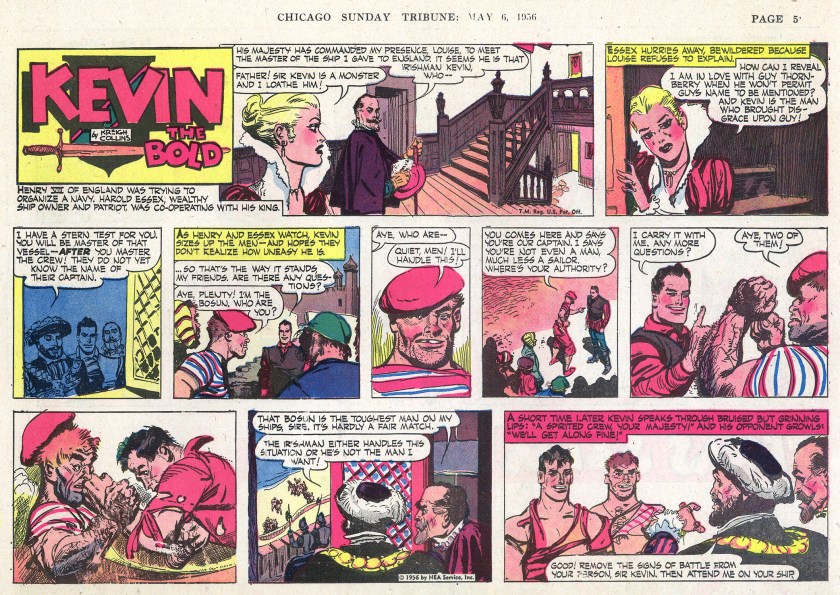
The pirates picked a fight with the wrong crew—even the “gentle” artist Stephen gets into the act. (It’s always interesting to note how Kreigh Collins portrayed artists in his comics).
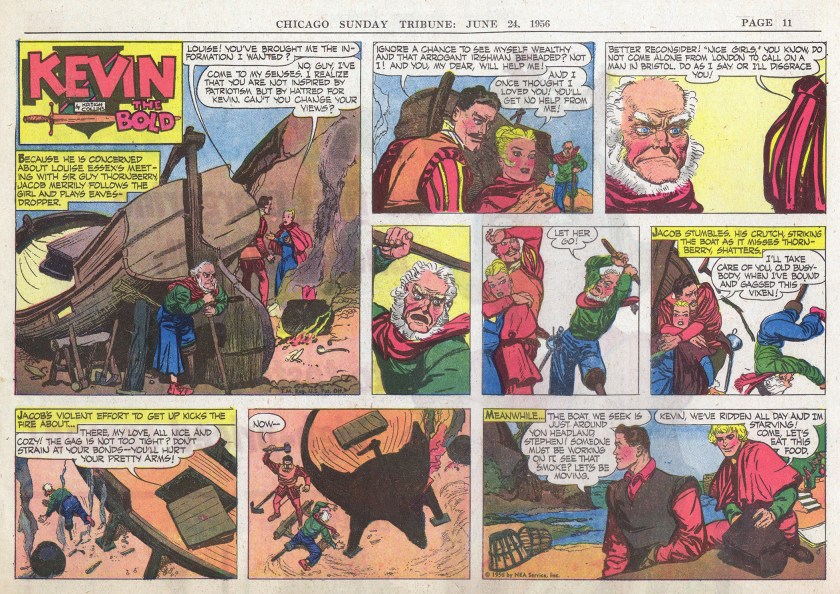
Louise Essex is slowly coming to her senses; unfortunately, she’s still a bit naive.
Kind of a funny thing, lovely Louise is running around and can’t seem to make an impression on the men—meanwhile they’re both headed to the shore, to scrutinize the same boat.
Jacob Merrily, an acquaintance of Stephen’s, was introduced during the previous sequence—in the March 4 episode. When Stephen went into hiding, the kindly old sailor gave him shelter; following a chance encounter with Louise, his protective instincts kick in again.
Sadly, things didn’t work out the way Jacob had intended.
Next, will Stephen stop for lunch? Or will Kevin persuade him to investigate the smoke first? Check back next week for this story’s conclusion!
For more information on the career of Kreigh Collins, visit his page on Facebook.
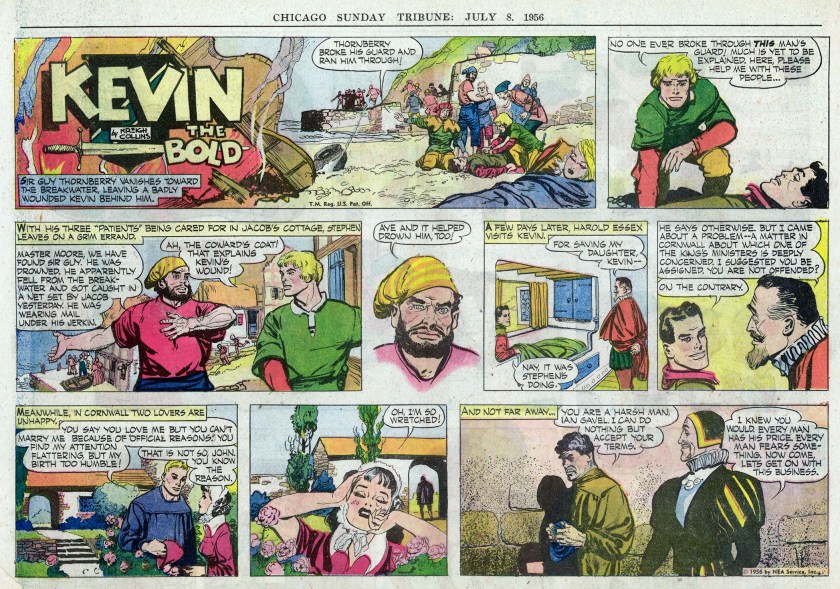
A surprise visit by Louise catches Sir Guy unawares. (It’s hard to imagine what they see in him, but Sir Guy certainly attracts lovely young ladies. Oh—it’s money).
Shoving Jacob Merrily to the ground, Thornberry shows his true colors, and Merrily’s comment proves to be prophetic.
The May 27 episode is a beauty, with especially arresting opening and closing panels. The events are equally portentous with Louise naively sharing sensitive information and Kevin discussing the merits of different sailing rigs. It also includes an interesting sailing term of the day, shouted by the watch. These days, left is referred to as “port” side of a ship, as is “starboard” for the right, but in the 16th century, the left was known as the “larboard” side.
As Stephen Moore sketches, the battle draws nigh.
For more information on the career of Kreigh Collins, visit his page on Facebook.
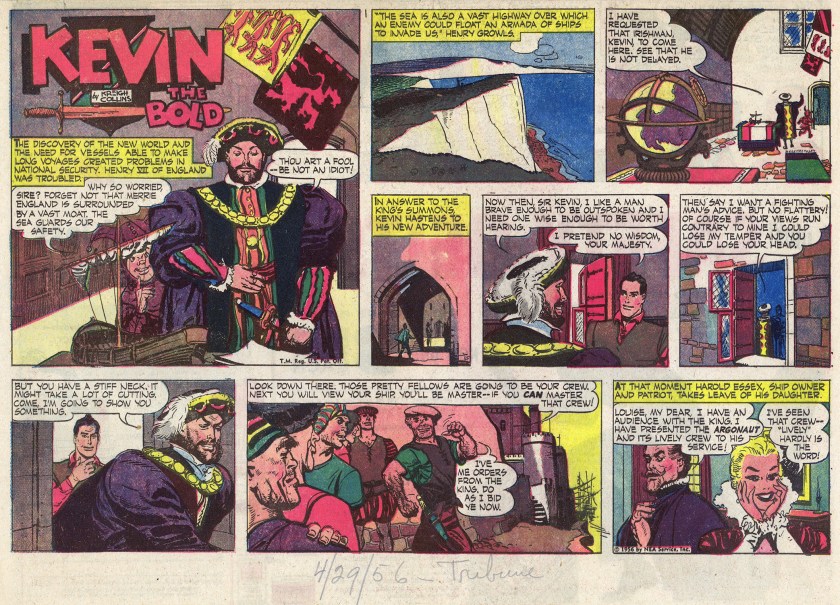
The action from the preceding story arc continues, and with many of the same characters. Sir Guy Thornberry has skulked offstage, but for how long? For reasons unknown, Louise Essex is smitten with the scoundrel. Meanwhile, King Henry has an important job for Kevin—once he overcomes a certain obstacle.
The second panel has a nice rendering of the Cliffs of Dover.
By this point, there wasn’t much difference in the print quality of the comics in the Chicago Sunday Tribune and the Detroit News (as shown below). One detail the Tribune versions lacked was the comic’s date inked into one of the panels (shown in the final panel of the News version). For Trib comics that didn’t appear at the top of a page, with the date typeset directly above, a nice personal detail for me is the date written on them, recognizable to me as done by my grandmother, Theresa. (“Teddy” also frequently modeled poses for her husband and basically served as his secretary).
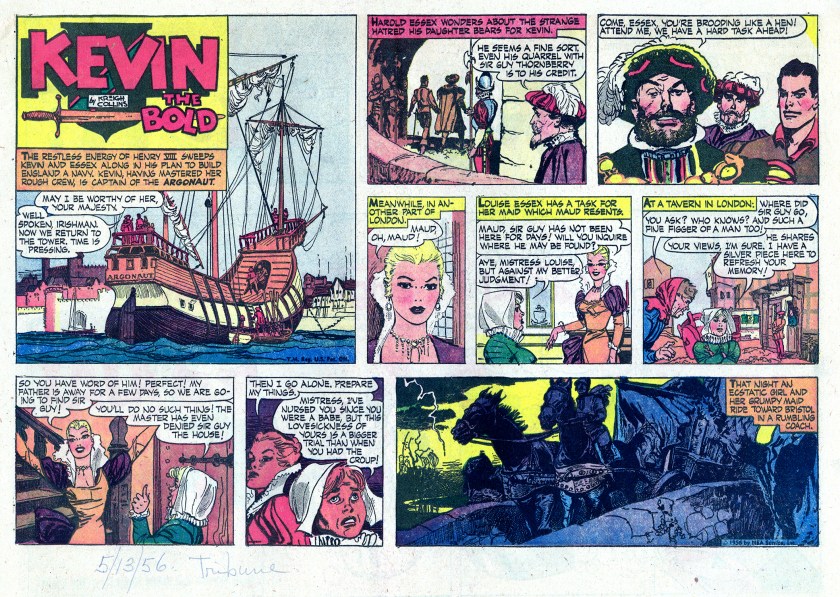
The colors are a bit richer in the “Tribune” version, but in the third panel there seems to have been some indecision whether to include a yellow background or not.
I think the second and third panels look better with a white background.
Another nice family detail is found in the name of the ship Kevin captains. Argonaut was the name of Kreigh Collins’ own sailboat, a yawl—somewhat smaller than her namesake (I think she was only 25′ long). And while Collins purchased his schooner Heather later this same summer, she too was dwarfed by Kevin’s ship.
Collins and his family sailed aboard “Argonaut” (shown at left in Racine, WI) from 1952–1956, and aboard “Heather” (shown in Annapolis, MD) from 1956–1972.
For more information on the career of Kreigh Collins, visit his page on Facebook.
This story arc concludes with three episodes taken from three different newspapers: the Chicago Sunday Tribune, the Florida Times-Union, and the Detroit News. The reproduction quality varies noticeably. Despite being years past its early 1950s prime, the Tribune is superior, the News is decent, and the Times-Union… not so much.
Kevin finds himself in the King’s good graces and is soon made an offer that he cannot refuse. Kevin agrees, under one condition.
Where Kevin has brought Marion Drake and Stephen Moore untold happiness, he has served an equal amount of misery to Sir Guy Thornberry.
What’s the deal with all of that magenta?
As Thornberry crawls off, tail between his legs, Kevin receives an assignment from his new champion, King Henry. In fact, the King becomes an oft-recurring character in KEVIN THE BOLD, appearing in at least 14 more story arcs over the next 6-plus years of the comic strip’s run.
Next week: Sir Guy Thornberry seeks revenge!
For more information on the career of Kreigh Collins, visit his page on Facebook.
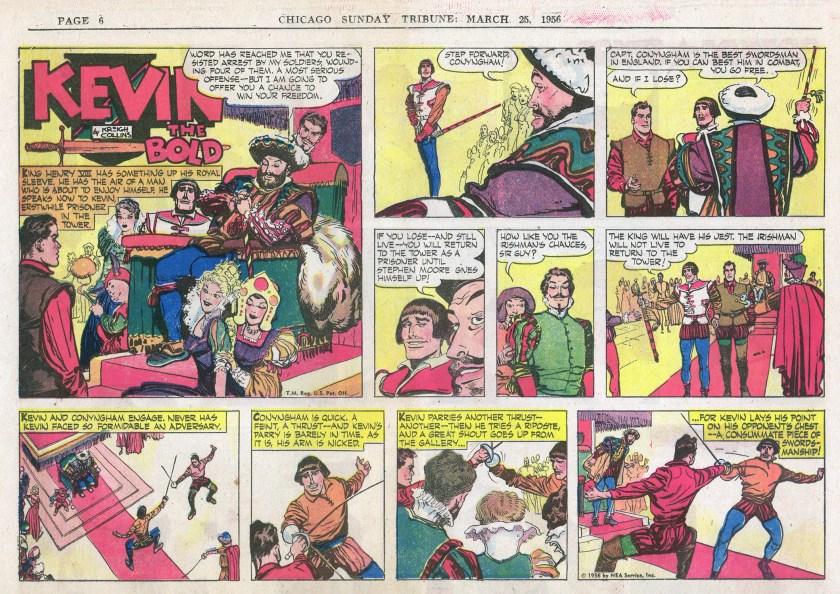
Heralded by a beautifully-rendered splash panel, Kevin gets a temporary reprieve, but Sir Thornberry still schemes against him.
Instead of listening to Thornberry and having Kevin killed, King Henry would rather have some entertainment.
Kevin quickly takes the measure of his opponent, and impresses the audience with his showmanship.
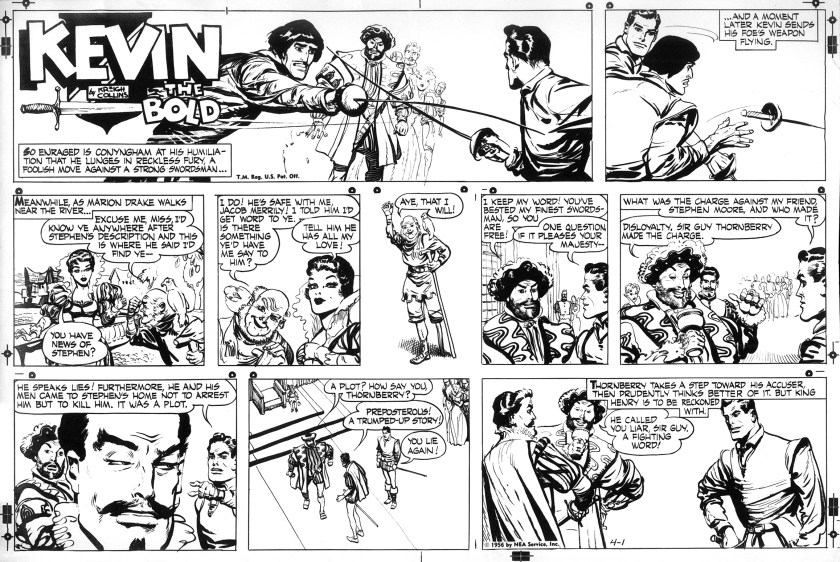
After baiting Conyngham and scoring a decisive win, Kevin takes aim at Thornberry. In an interesting choice of words, Sir Guy accuses Kevin of telling a Trumped-up story. A Trumped-up story is, of course, something that is is faked or fabricated. As any KEVIN THE BOLD reader knows, Kevin lives by a moral code that would not allow such behavior. Reacting to the slanderous comment, Sir Guy backs down, lest he also face Kevin’s sword.
For more information on the career of Kreigh Collins, visit his page on Facebook.
In a case of mistaken identity, Kevin suddenly realizes the danger he is in. As with my torn copy of the March 6 episode, it’s always good to have backup.
While Stephen finds safe harbor, Kevin lands in the Tower. In the notorious prison, Kevin faces questioning from an equally imposing brute, illustrated marvelously by Collins. It seems that only a fool would save Kevin now.
For more information on the career of Kreigh Collins, visit his page on Facebook.
Generally set in the fifteenth and sixteenth centuries, Kevin the Bold can be labelled as historical fiction, with its early story arcs and characters being Kreigh Collins’ brainchildren.
After a couple of years, famous historical figures started appearing—sometimes as ancillary characters, and at other times being more integral to the action. The first of these was Leonardo da Vinci, who made a couple of brief appearances in 1952. (Da Vinci would make another memorable cameo in 1967, in one of Kevin’s final adventures).
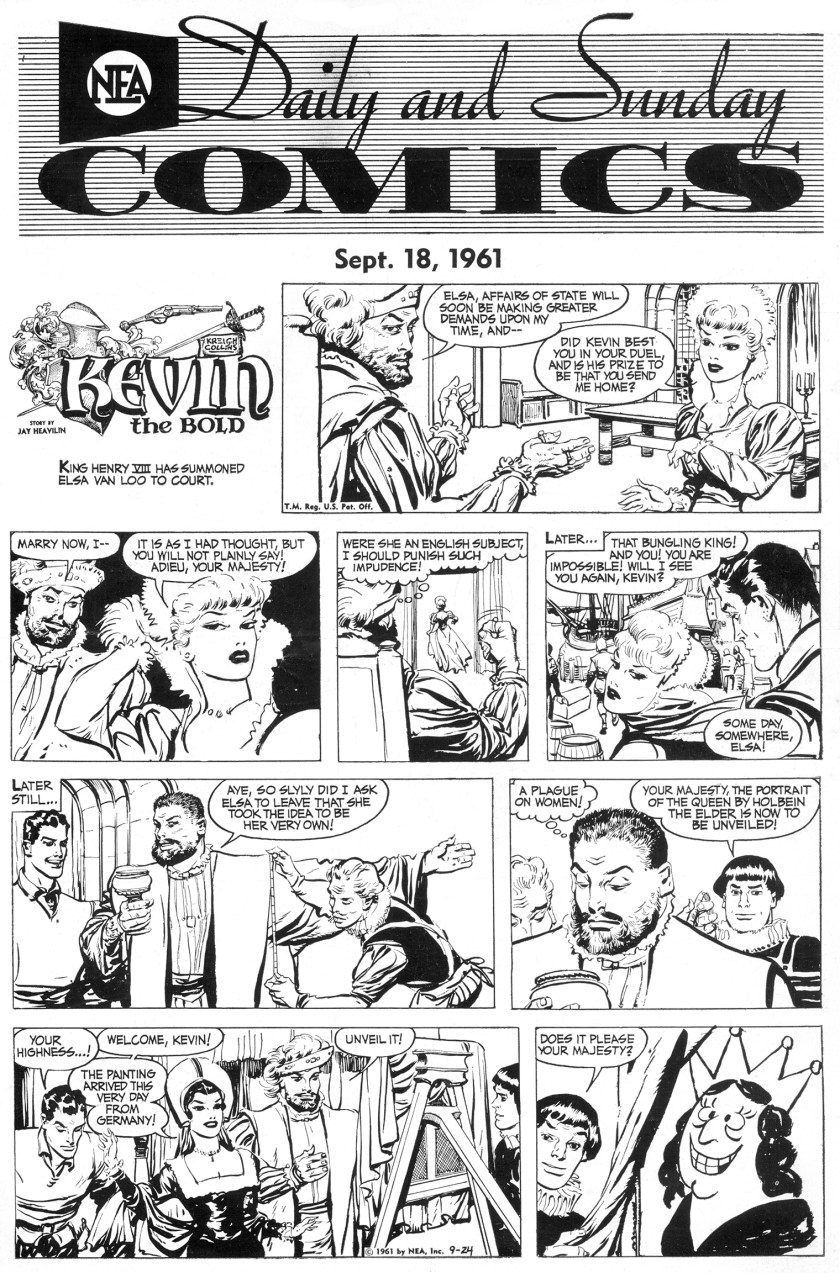
The historical figure appearing most frequently was King Henry VIII; in the September 24, 1961 episode he appears along with a mention of a noted portraitist of the era, (Hans) Holbein the Elder.
King Henry first appeared in 1956, and that entire sequence will run over the next few Sundays. The tone of this story arc is different than most of what had preceded it, and it is likely that Kreigh Collins was extensively using other’s scripts for the first time. In between the more historical storylines (with King Henry, Shakespeare, etc.), Collins’ own chapters become easier to spot. This change in direction was caused in part by burn out. According to an oral history done by Kreigh’s wife Theresa , “Kreigh was always trying to think up the next story. It was the equivalent of writing a full novel every ten weeks.” Giving up the writing likely meant a cut in pay but with the overall ascendance of “Kevin the Bold” and the income it generated, it was a good tradeoff for Collins.
As Henry’s first chapter got off the ground, any time Collins saved by not writing looks like it may have been spent on the illustration. The Florida Times-Union‘s reproduction is mediocre, but the artwork is quite nice, with many compelling scenes and characters.
To be continued…
For more information on the career of Kreigh Collins, visit his page on Facebook.
At each others’ throats just moments before, Kevin and Karl are now completely aligned.
The short chapter’s quick pace continues, and with Brett’s lion cub/baby switcheroo, the story begins to transition to Kevin’s next adventure.
Before Kevin’s lady friend gets a chance to share it, her story comes alive!
This story line would continue in the pages of the Monomonee Falls Gazette. KEVIN THE BOLD debuted in issue No. 109 (January 14, 1974), which featured Kreigh Collins’ artwork on the cover. For the next six months, KEVIN ran on the gazette’s back cover, and continued inside until the demise of the publication four years later.
In case you can’t get your hands on MFG issues 109–232, the next dozen or so KEVIN THE BOLD chapters are collected in the book Kevin the Bold: Sunday Adventures. The 154-page collection, about 97% of which was compiled from BW syndicate proofs, is available on Amazon.com.
This past week, Thanksgiving was celebrated here in the USA. It is traditional for the professional football team I grew up rooting for, the Detroit Lions, to play on Thanksgiving Day. One thing I am especially thankful for is my close relationship with my brother Brett, Kreigh Collins’ eldest grandchild. Growing up in Ann Arbor, Michigan, Brett was originally a Lions fan, too. Here, Kevin the Bold’s ward, Brett, stars in the short story arc that follows.
I originally posted this sequence a few years back. This “encore presentation” is due to the unfortunate circumstances my brother finds himself, battling a very nasty form of cancer—I’m currently helping his wife while he is hospitalized.
The five episodes that will appear were all taken from the Chicago Sunday Tribune, and although they are a bit past that newspaper’s prime years (as far as reproduction and printing of Sunday comics is concerned), they are beautiful examples nonetheless. This early chapter—KEVIN THE BOLD’s 17th—immediately precedes the episodes that ran in the Menomonee Falls Gazette.
As noted in the opening caption, the action is set in 1491. The year is somewhat arbitrary—my feeling is that it just serves to peg the action as occurring just before Christopher Columbus’ first voyage to the New World. It was a busy year for Kevin—the strip’s three previous chapters also took place in 1491. These were the first times a specific date was referenced for KEVIN THE BOLD’s action.
This sequence also kept Kevin busy—quite a bit of action was packed into its five episodes, which lacked the longer exposition normally found at the beginning of a chapter.
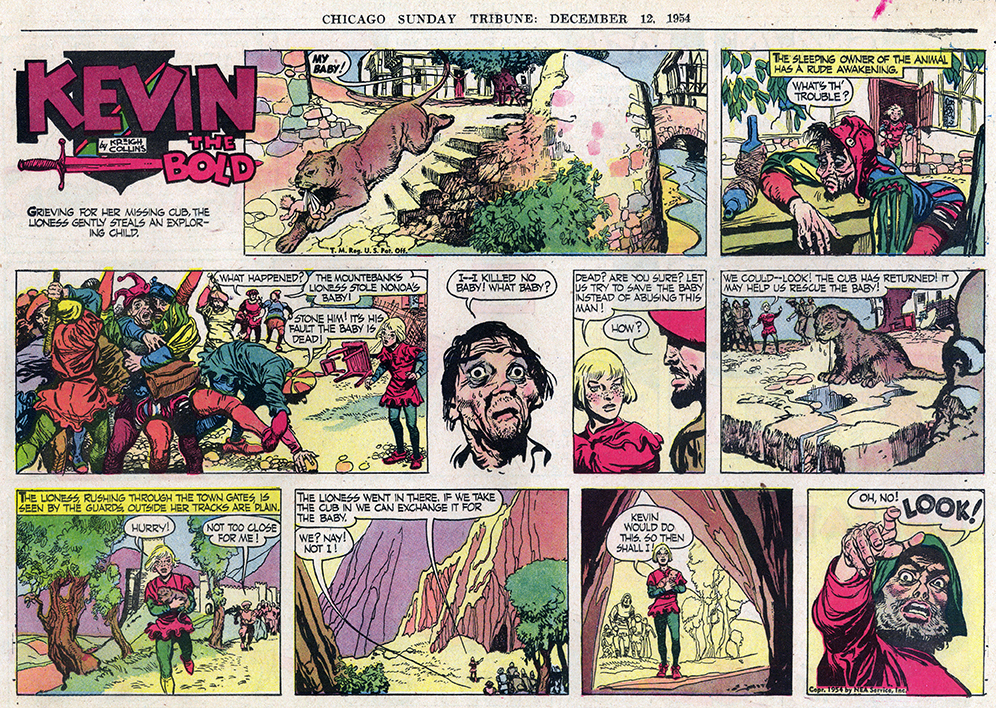
Having just arrived, Kevin makes immediate impressions on both the town’s law and order man and his pretty female friend. The jealous Swiss guardsman insults Kevin and moments later they square off to fight. Oh, and there are lions!
As quickly as it started, the fight ends, and the two combatants join forces in a common goal, finding the lioness’s cub. It’s all happened so quickly that I barely had time to look up the definition of mountebank—if he’s a charlatan, the townsfolk don’t seem to mind. Now back to the action!
In an odd form of payback, the lioness kidnaps a baby. Brett emerges as the voice of reason, the lion cub returns and… has Brett lost his mind?












 Kreigh’s Comics