Boom RIde

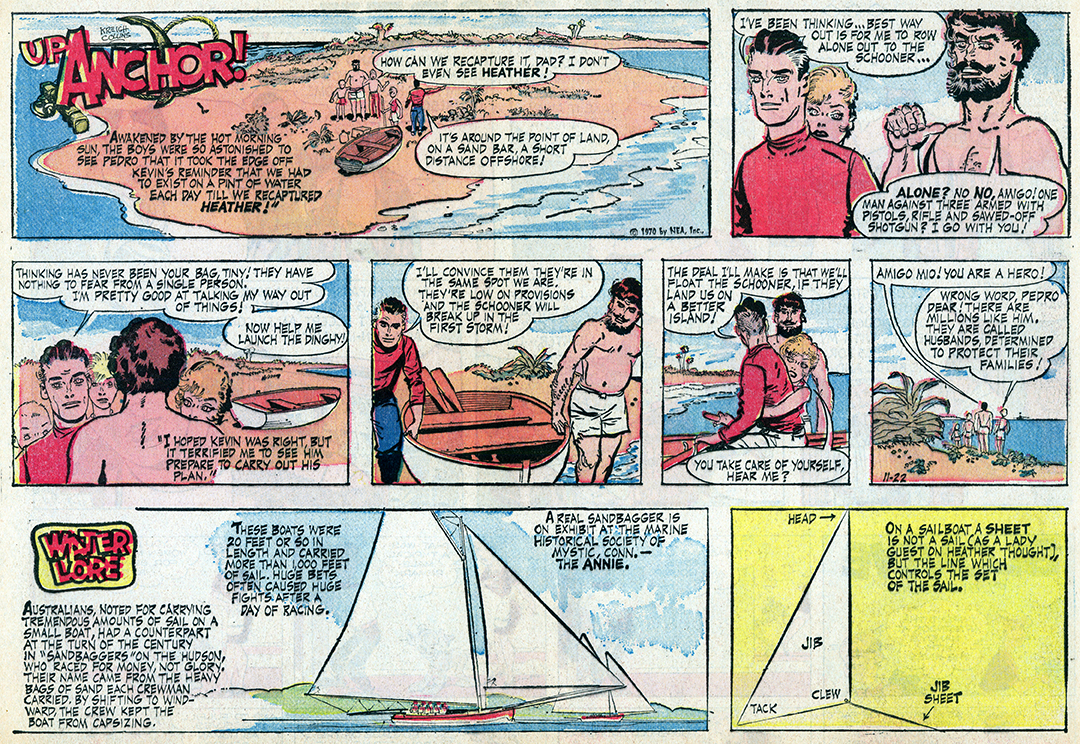
Due to their short supply of water and food, Kevin Marlin sets off, without even a fully-formed plan.

The pirates trust Kevin—some more than others!

Those filthy hippies probably needed a bath, anyway!

The story arc ends, but unfortunately, Kevin Marlin and his family haven’t seen the last of the pirate trio.

_______________________________________________________________

For more information on the career of Kreigh Collins, visit his page on Facebook.

Marooned!

While Kreigh Collins never managed to sail Heather to the Bahamas, his Sunday comics counterpart Kevin Marlin did. While heading back to Florida, an unusual boat was spotted.

Many pieces of original artwork for UP ANCHOR! are found in a collection at the Grand Rapids Public Library, including those for two of the episodes in this installment.

In a case of “no good deed goes unpunished,” the Marlin family are ambushed.

The ersatz Manson Family members decide to maroon Heather‘s crew on a desert island, but not before the Marlins lay eyes on the hippies’ prisoner, Pedro.

While the reunion is nice, a plan to save themselves would be nicer!

_______________________________________________________________

For more information on the career of Kreigh Collins, visit his page on Facebook.

It Was Murder!

Among some recently-acquired UP ANCHOR! half pages were most of the episodes of a story arc with an unusual plot element—murder. The choice of portraying hippies as villains was likely inspired by the tragic and ugly Manson family murders, which had occurred in the summer of 1969. In fact, the Tate-LaBIanca trial was under way when these episodes were published in late 1970.

The Marlin family, whose journey aboard Heather had led to a temporarily relocation in Florida, had just returned from Maine. Kevin Marlin had been hired to sail a cutter from Connecticut Down East. To return “home” and hear such terrible news would be very unsettling.

A couple things from the October 11, 1970 episode that caught me eye were the Manson Family lookalikes in the center panel and the second panel of WATER LORE. Occasionally, Kreigh Collins would directly reference his personal life, but I had never seen him mention his father. He was much closer to his mother.

As Heather is being provisioned, some Easter Eggs are revealed on the labels of the packages being brought aboard. In the first panel, Kevin caries a case of “Jesiek’s Oil.” Back home in Michigan on Lake Macatawa, Heather spent her winters “on the hard” at Jesiek Brothers Shipyard. Based on the box carried by his friend, I’d wager that “Schottenburg’s” was a nearby grocer the Collins family patronized. The second tier’s second panel shows Dave and Erik pestering their mother about dinner—here a box is simply labelled “Boy Food.”

The provisions were needed for an upcoming trip to the Bahamas. While many of the adventured that take place in UP ANCHOR! were based on real events, alas, a trip to the Bahamas was a dream that was never realized for Kreigh’s family. The Marlin family’s adventures in Florida were inspired by the journey the Collinses took in 1959–1960, but the Chicago Tribune’s sudden cancellation of KEVIN THE BOLD in December, 1959 necessitated a reappraisal of the family’s financial situation and resulted in the cancellation of the Bahamas leg of the trip.

_______________________________________________________________

For more information on the career of Kreigh Collins, visit his page on Facebook.

Pela Cruz e Pela Espada

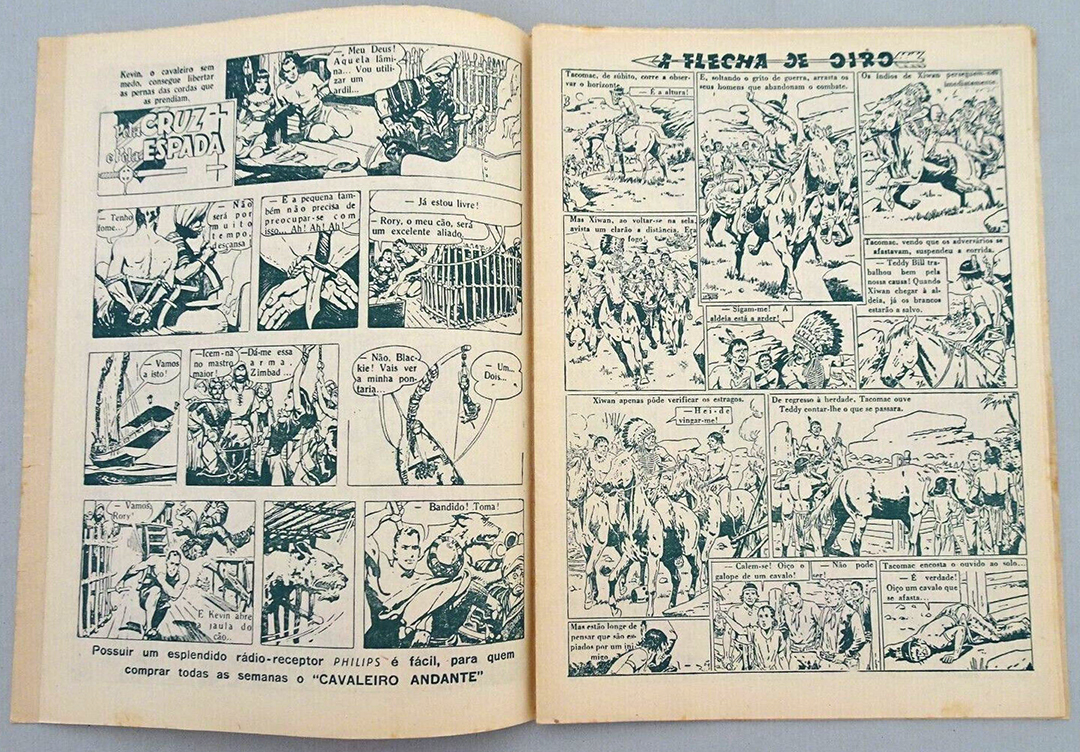
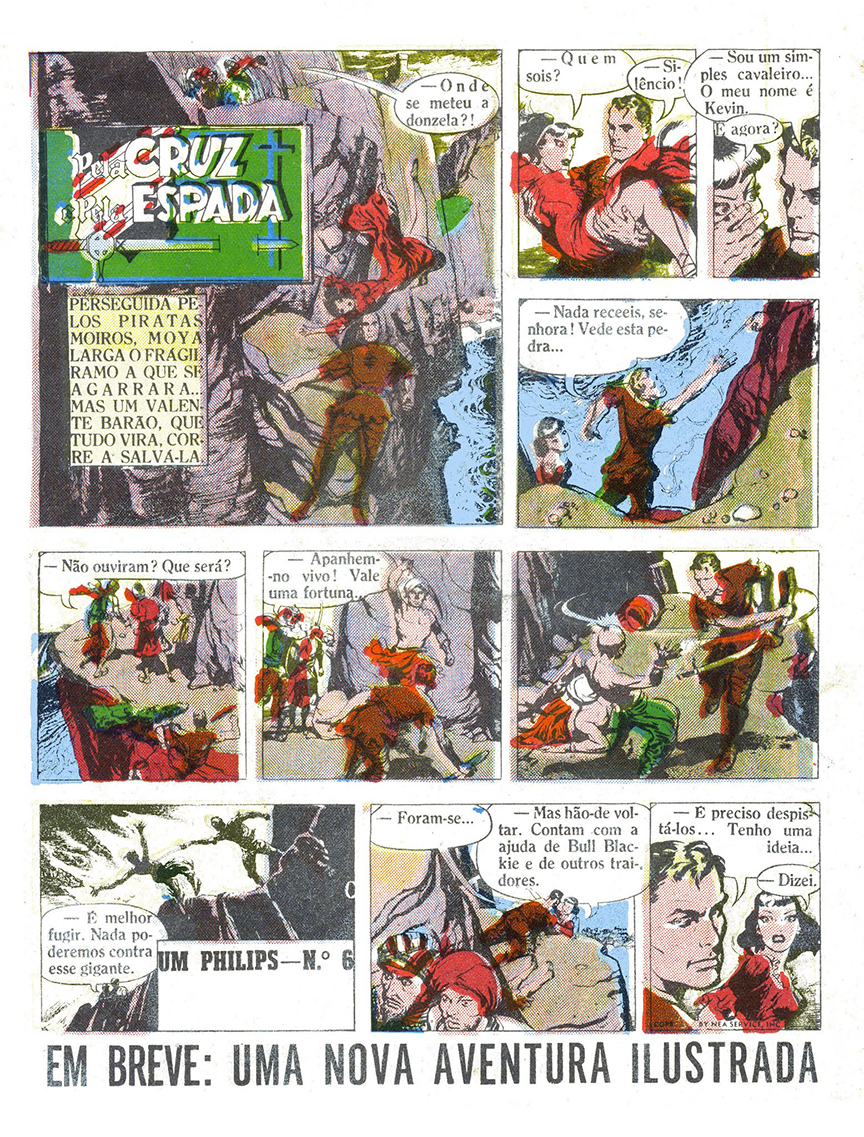
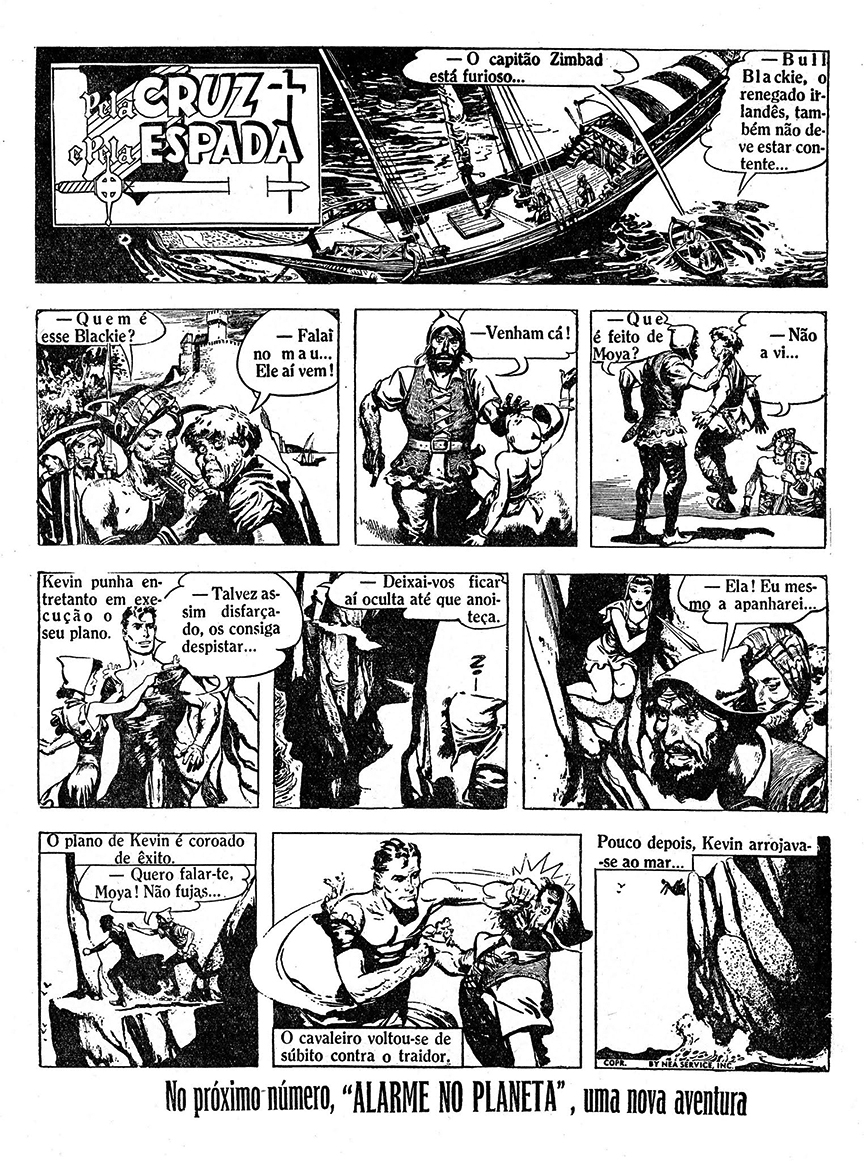
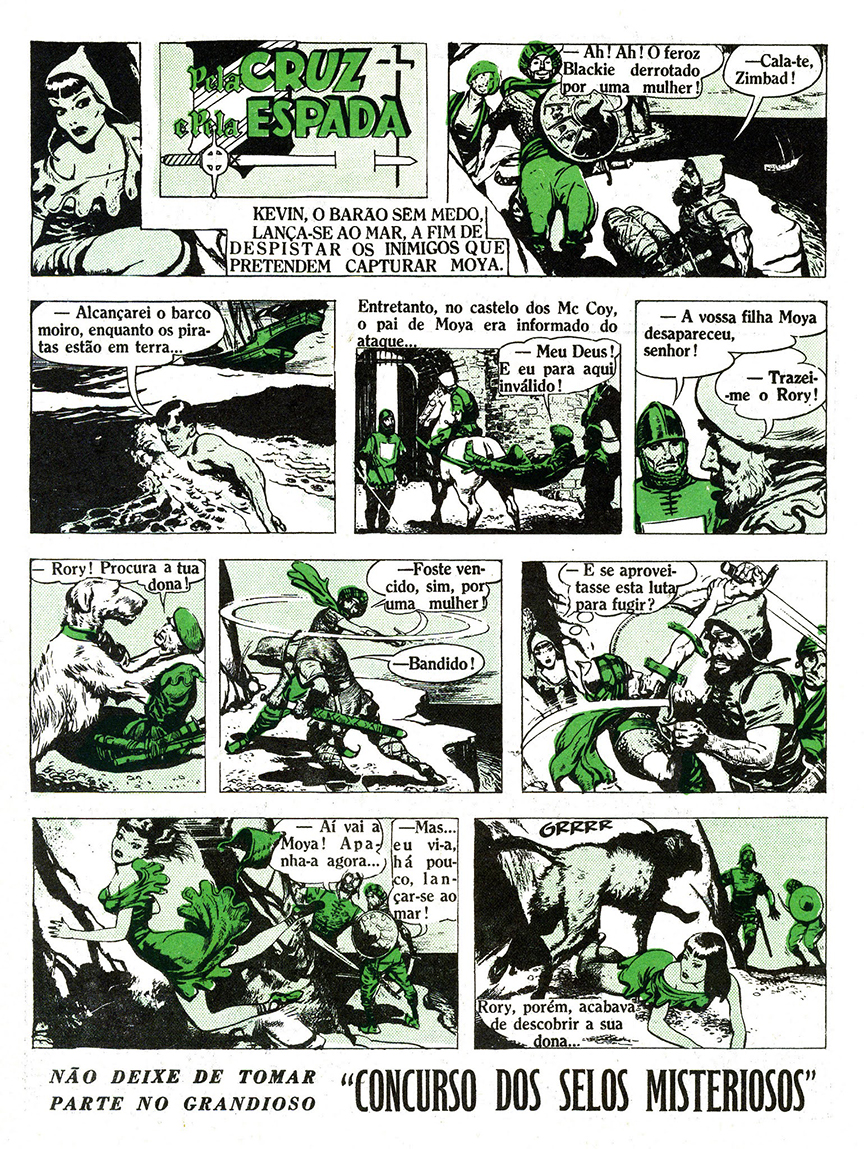
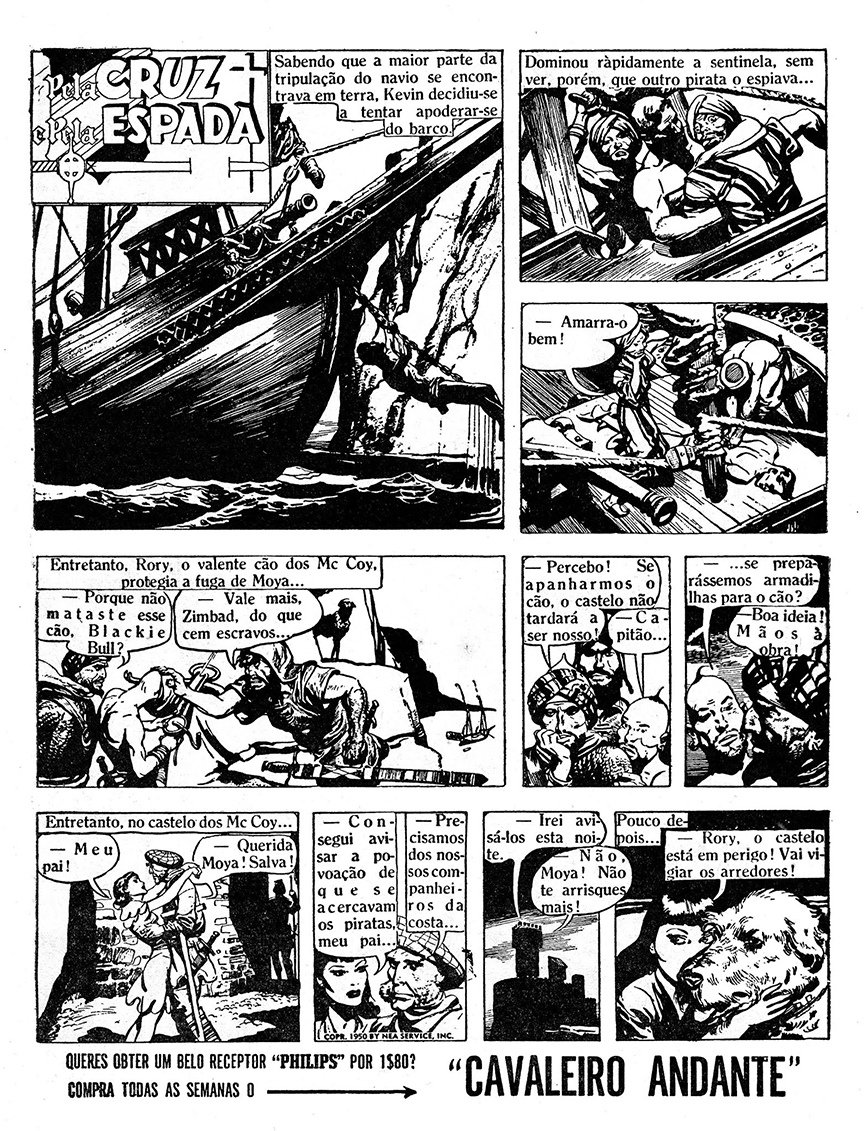
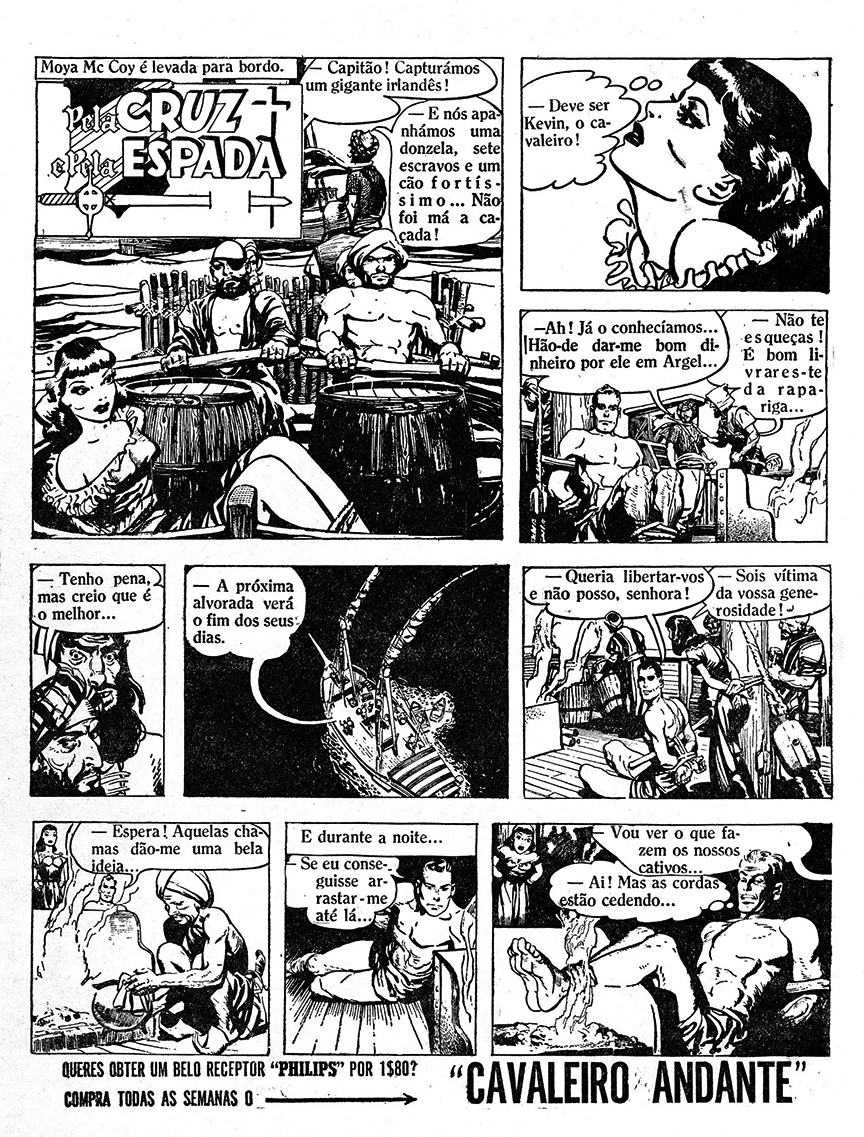
My Christmas wish was answered when I received an email from a new friend, Santiago. He sent me a link to a blog that featured a Portuguese version of KEVIN THE BOLD published in a magazine titled Cavaleir Andante. The magazine’s title translates to Knight Errant—“a medieval knight wandering in search of chivalrous adventures“—a perfect description of Kevin. The comic strip itself was retitled Pela Cruz e Pela Espada (By the Cross and by the Sword).

I don’t own a physical copy of the magazine, but it seems to have been primarily a collection of comic strips, with color covers and some color pages inside. My assumption is that the magazine was a weekly.

Pela Cruz e Pela Espada ran in 41 issues of the magazine (issues No. 5 through No. 46), and started on February 2, 1952. It began with Kevin’s debut adventure about the Moorish pirate raiders.

The first couple of episodes ran in full-color versions, with the magazine providing its own color scheme. These were followed by episodes in black and white or in two colors.

The two-color approach brings to mind the religious comics Collins created for the Methodist Publishing House in the mid-1940s.

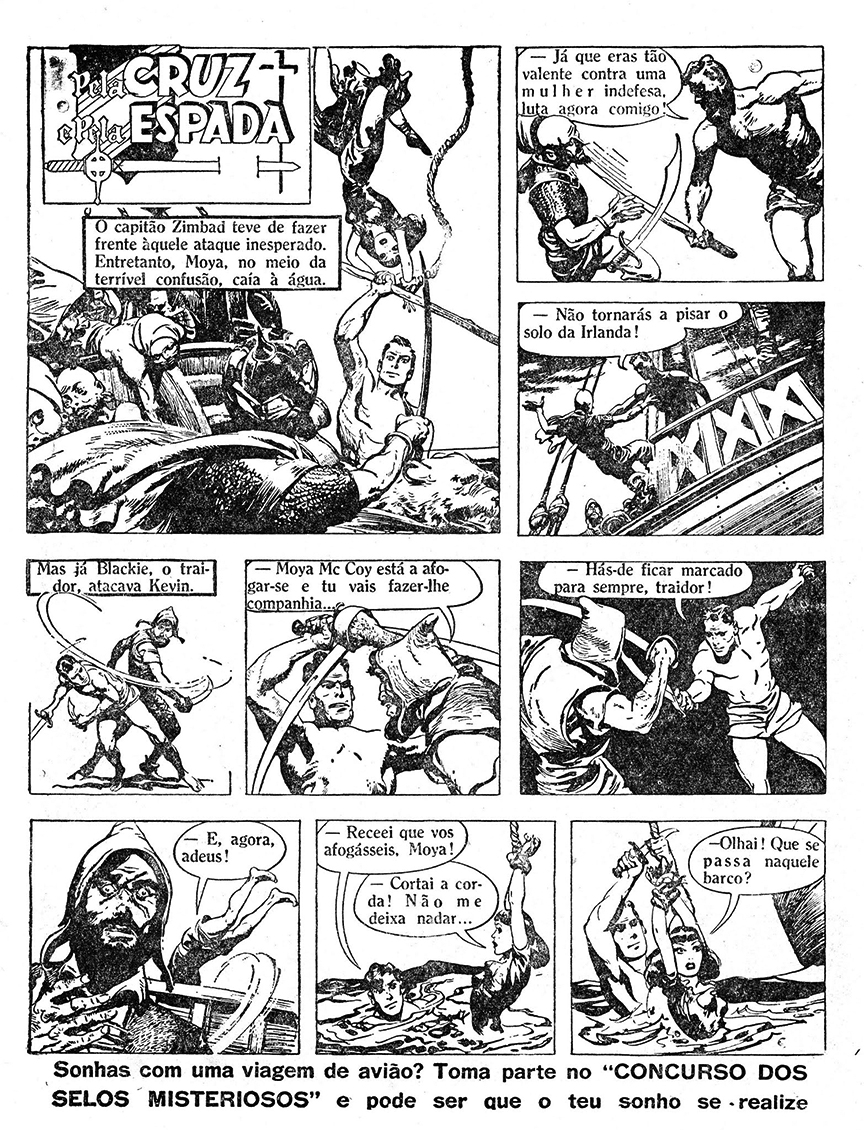
The penultimate episode in the introductory story arc contains one of Kevin’s classic lines, as he uses his sword to mark a “T” into the face of the treacherous Bull Blackie (“T is for traitor!”)

In this Portuguese version, the dialog changes slightly: “You will be marked forever, traitor. And now, goodbye!” Not quite as punchy as the original, but still very dramatic.

In the original version, the story arc ends with Kevin receiving his title (“…the Irishman who wields this sword shall be known as Kevin the Bold!”), but here it becomes “Kevin, with this sword we will perform valuable feats! God bless you!” The change makes sense because the strip is titled not after its lead character, but for his actions (By the Cross and By the Sword).

The 41 episodes represent the first three of Kevin’s adventures. In addition to the chapter with the Moorish Pirates, the others feature his battle against the Count de Falcon and Kevin’s quest to rescue the Count’s sister, Sadea.

I hope your Christmas wish came true too. Happy New Year, and Happy Birthday (tomorrow) to Kreigh Taylor Collins.

_____________________________________________________

For more information on the career of Kreigh Collins, visit his page on Facebook.

Kevin o Ousado?

My Christmas wish is to find a version of KEVIN THE BOLD in Portuguese. The comic strip has been translated into so many different languages (French, Spanish, Swedish, Danish, Norwegian, Finnish, Serbian, Afrikaans, etc.), that I’m surprised that I haven’t come across one published in Portugal or Brazil. (If any readers know of any leads, please let me know!)

With about 17% of my visitors coming from Portugal and Brazil, it seems likely that a Portuguese version must exist.

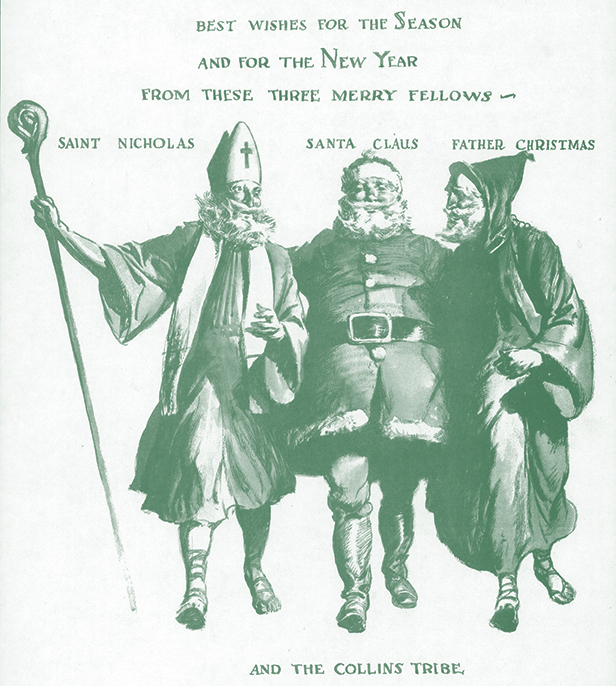
…Maybe one of these guys can help me out. Until then, make a joyful noise. 

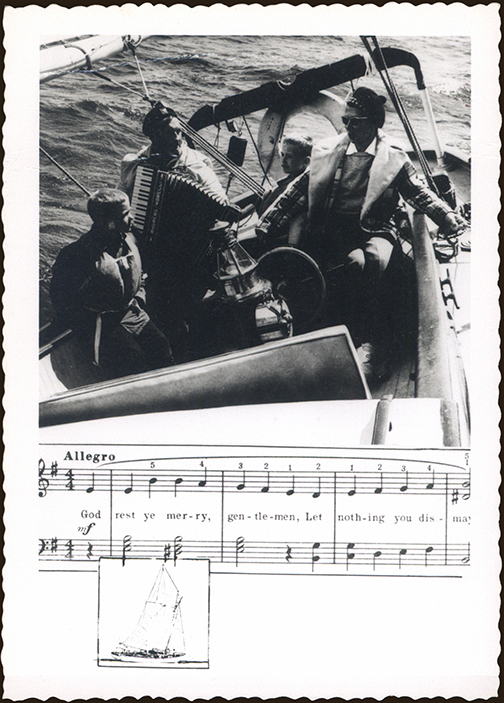
Merry Christmas, Happy Holidays, and Best WIshes for 2024!

_____________________________________________________

For more information on the career of Kreigh Collins, visit his page on Facebook.

The Fool

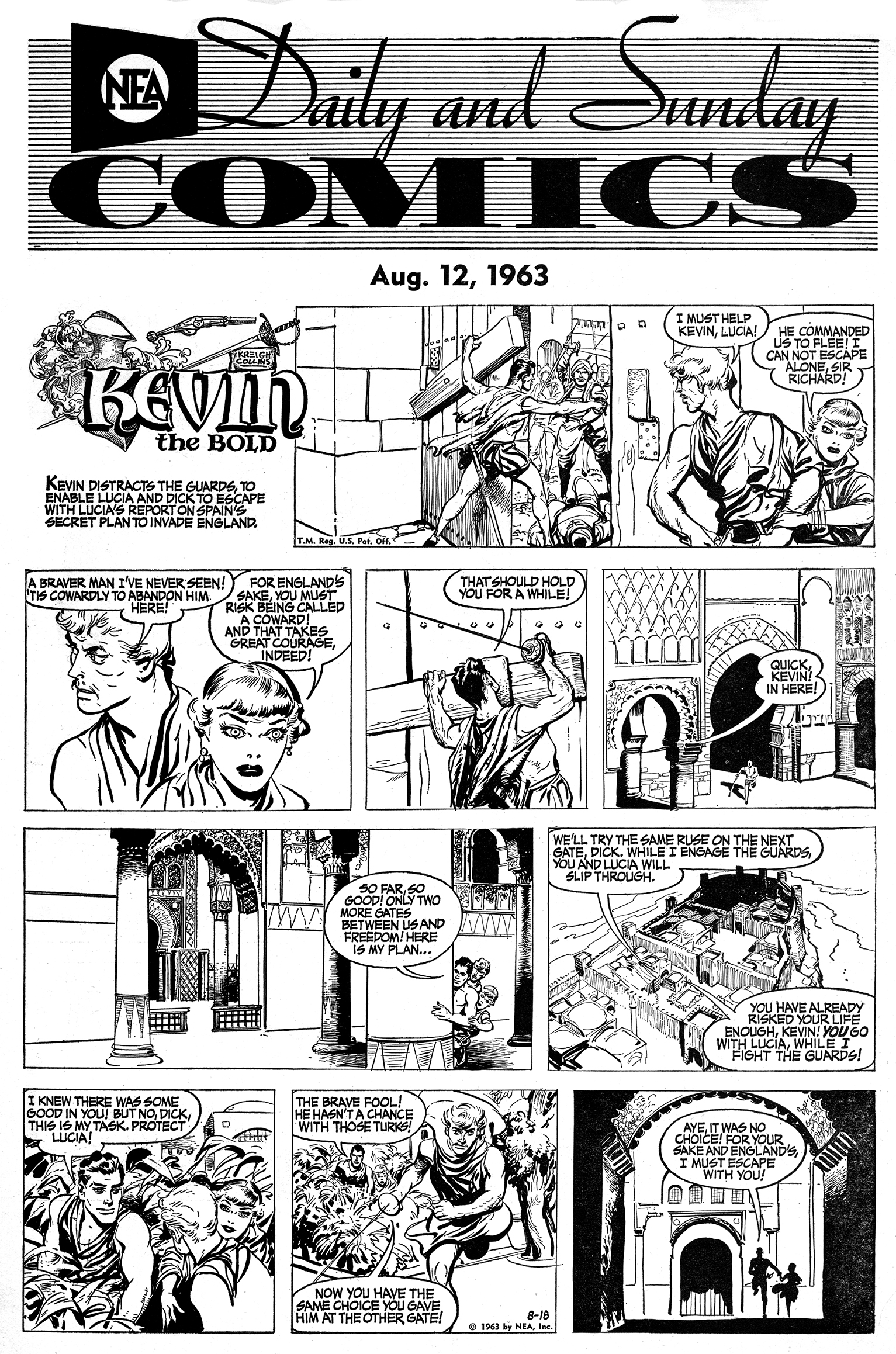
KTB 081863 BWT 150 qcc

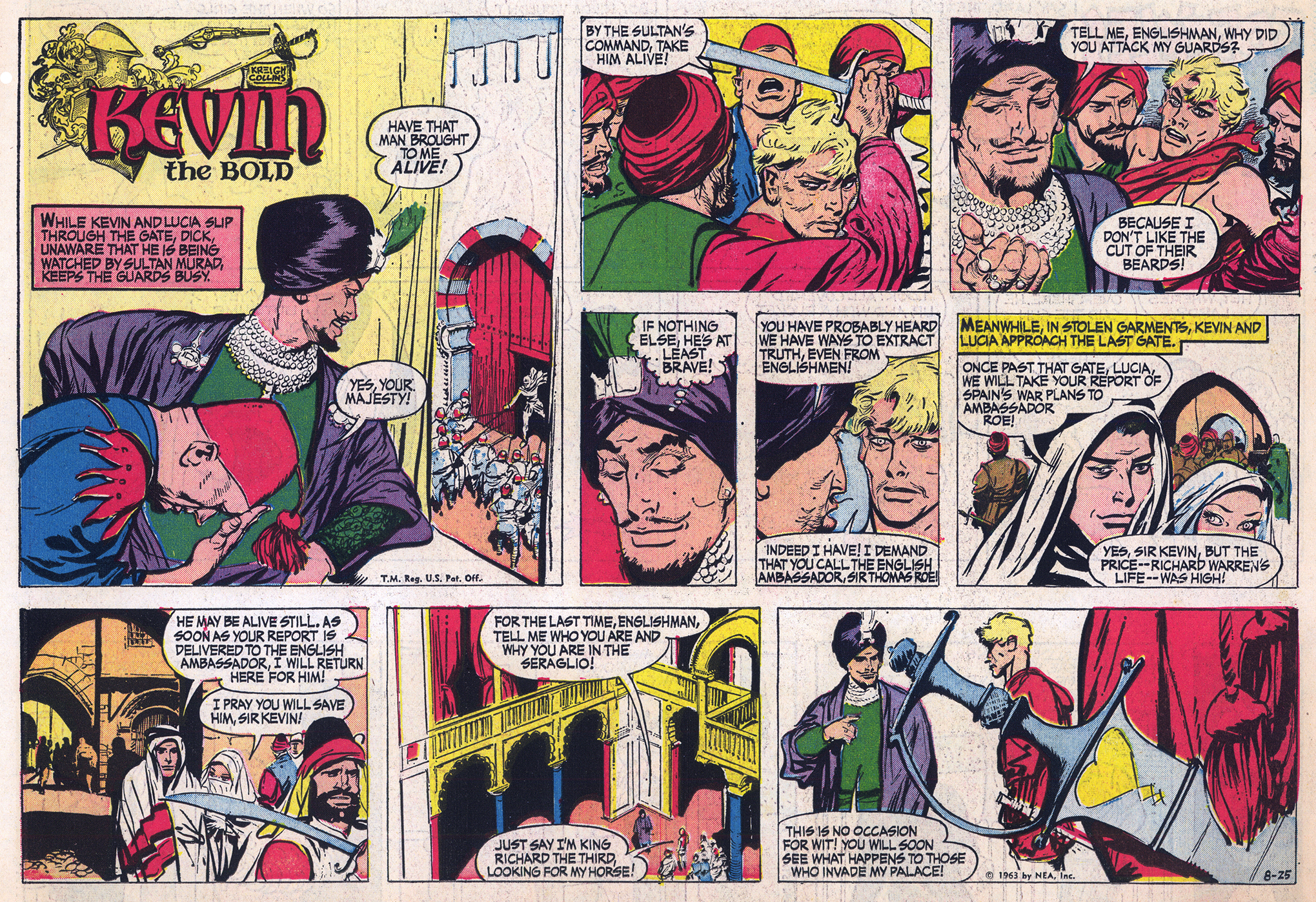
After experiencing Sir Richard’s foolhardiness first hand, Kevin witnesses it again. This time it seem certain that it will cost Sir Richard his life.

KTB 082563 HA 150 qcc.jpg

KTB 090163 BWT 150 qcc

In a shocking turn of events, Sultan Murad releases Richard. And sure enough, the foolish Englishman puts them all in harm’s way again. How many times can Kevin overcome Richard’s ineptitude?


For more information on the career of Kreigh Collins, visit his page on Facebook.

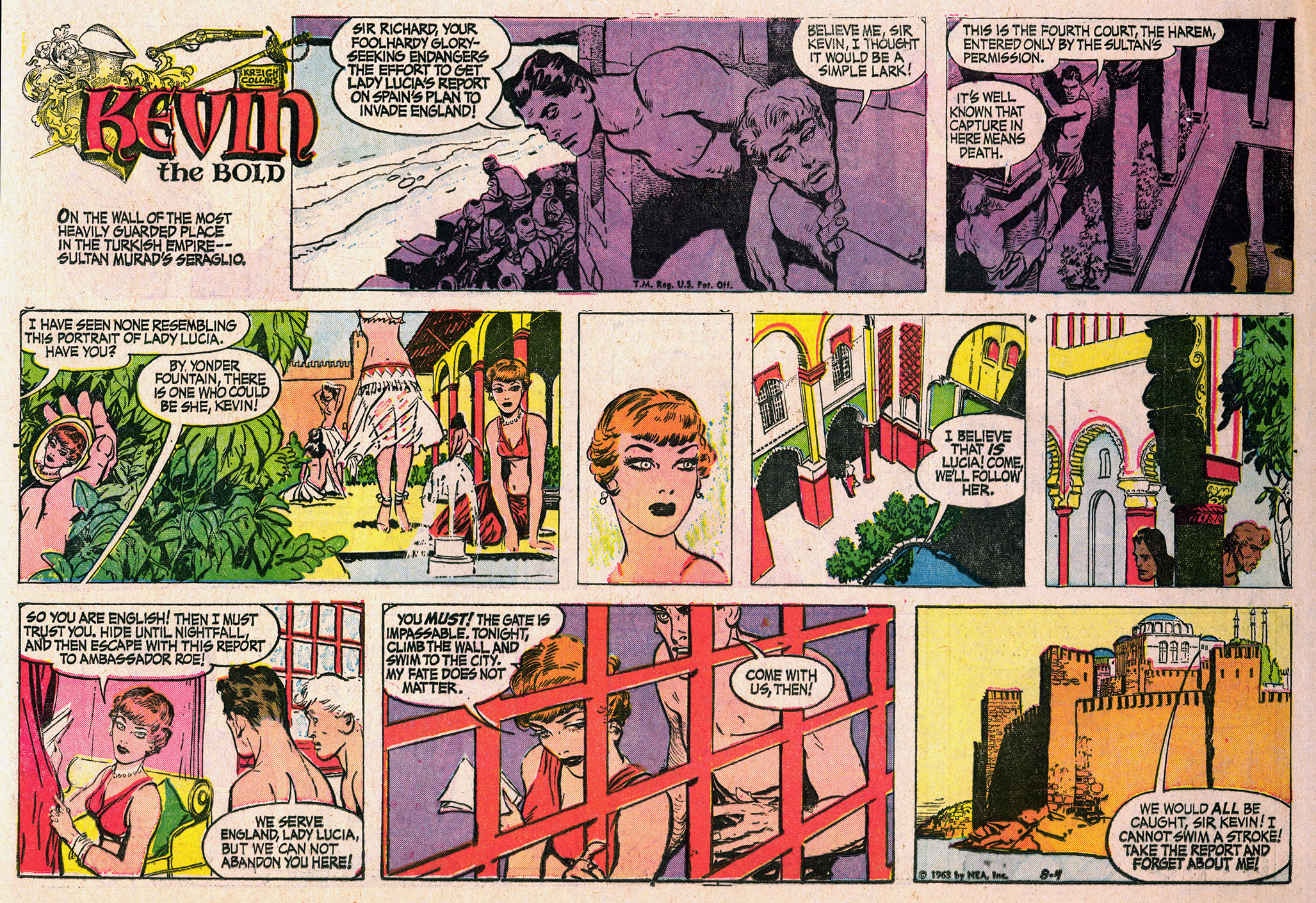
Escaping the Harem

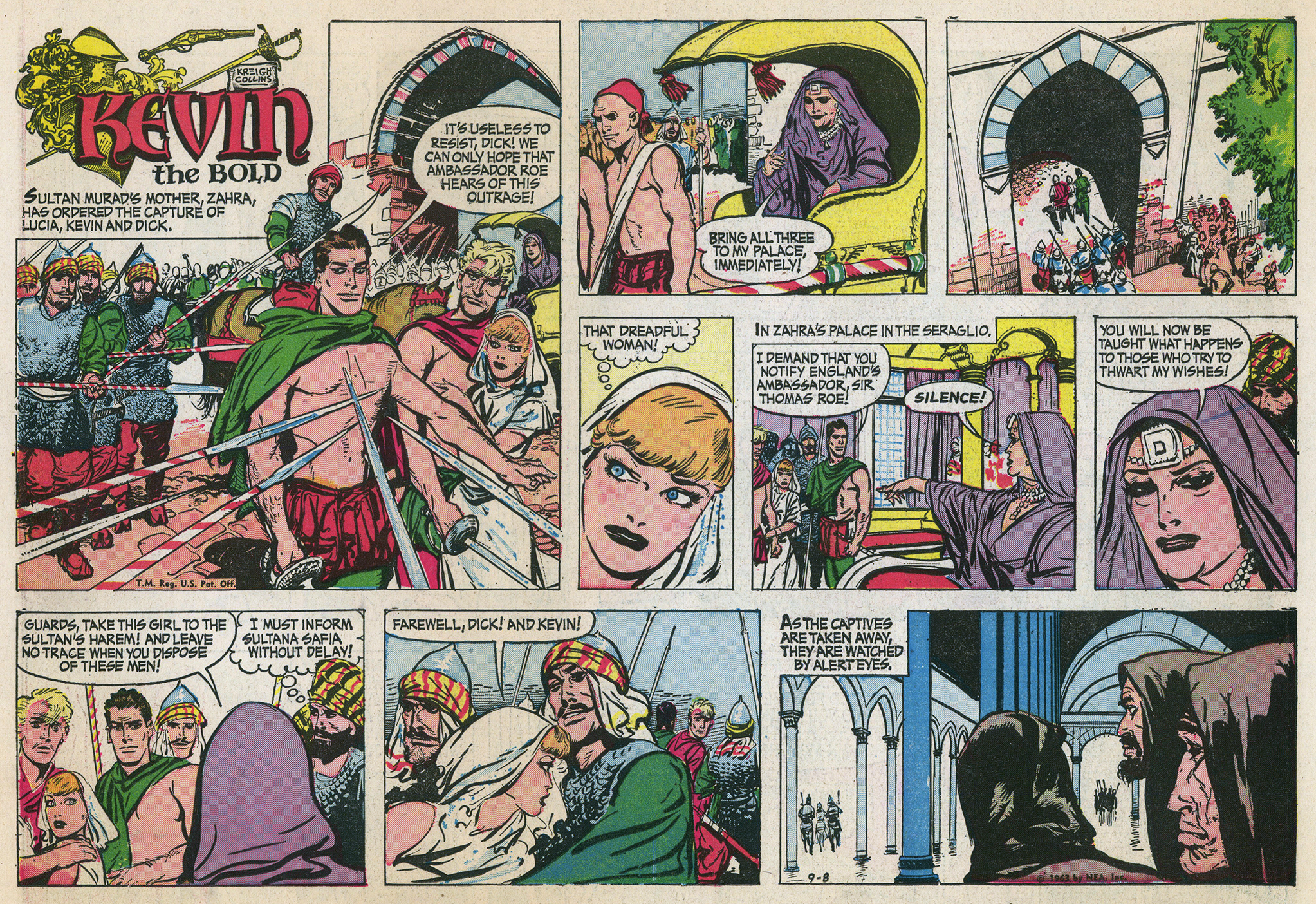
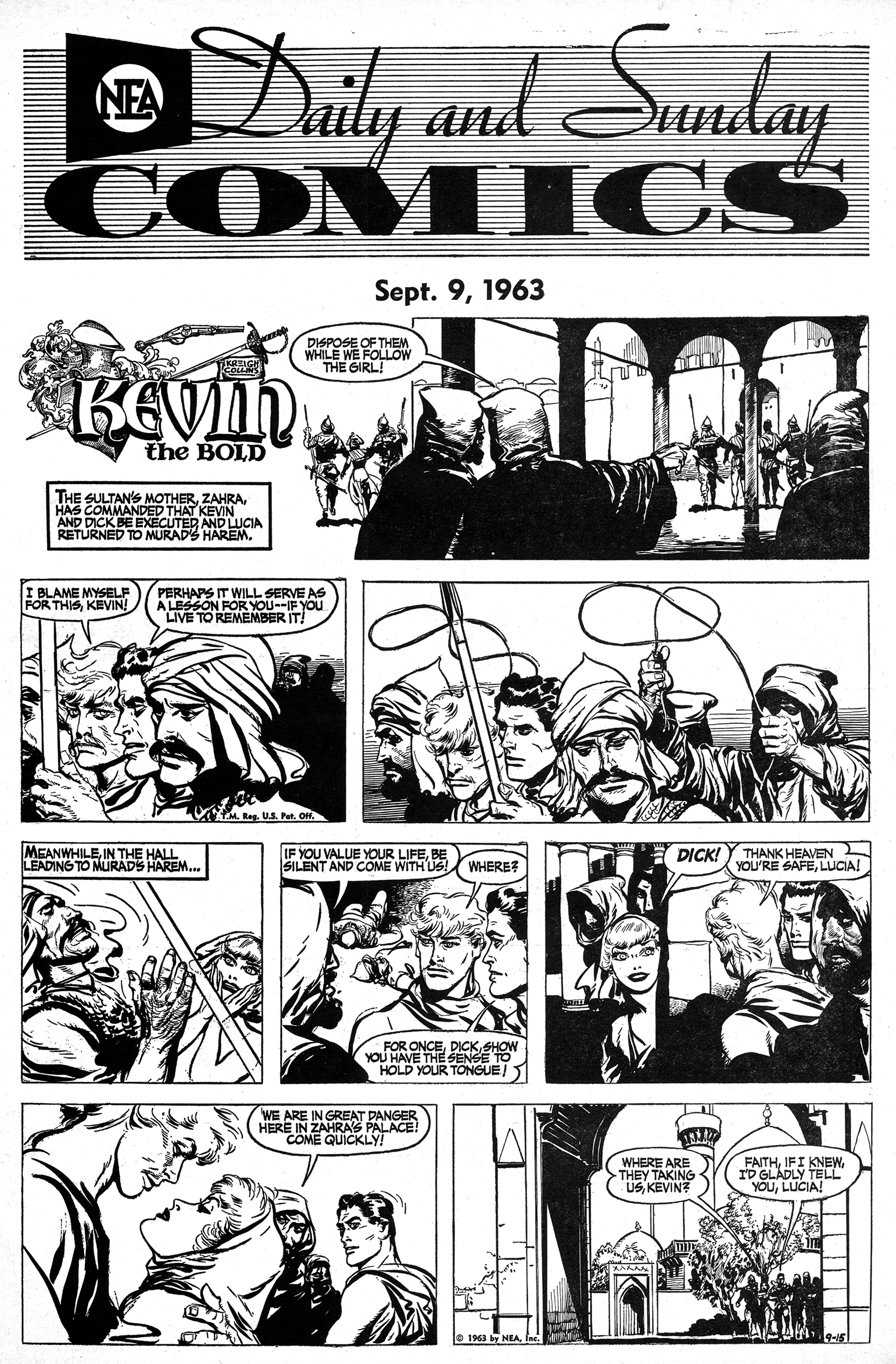
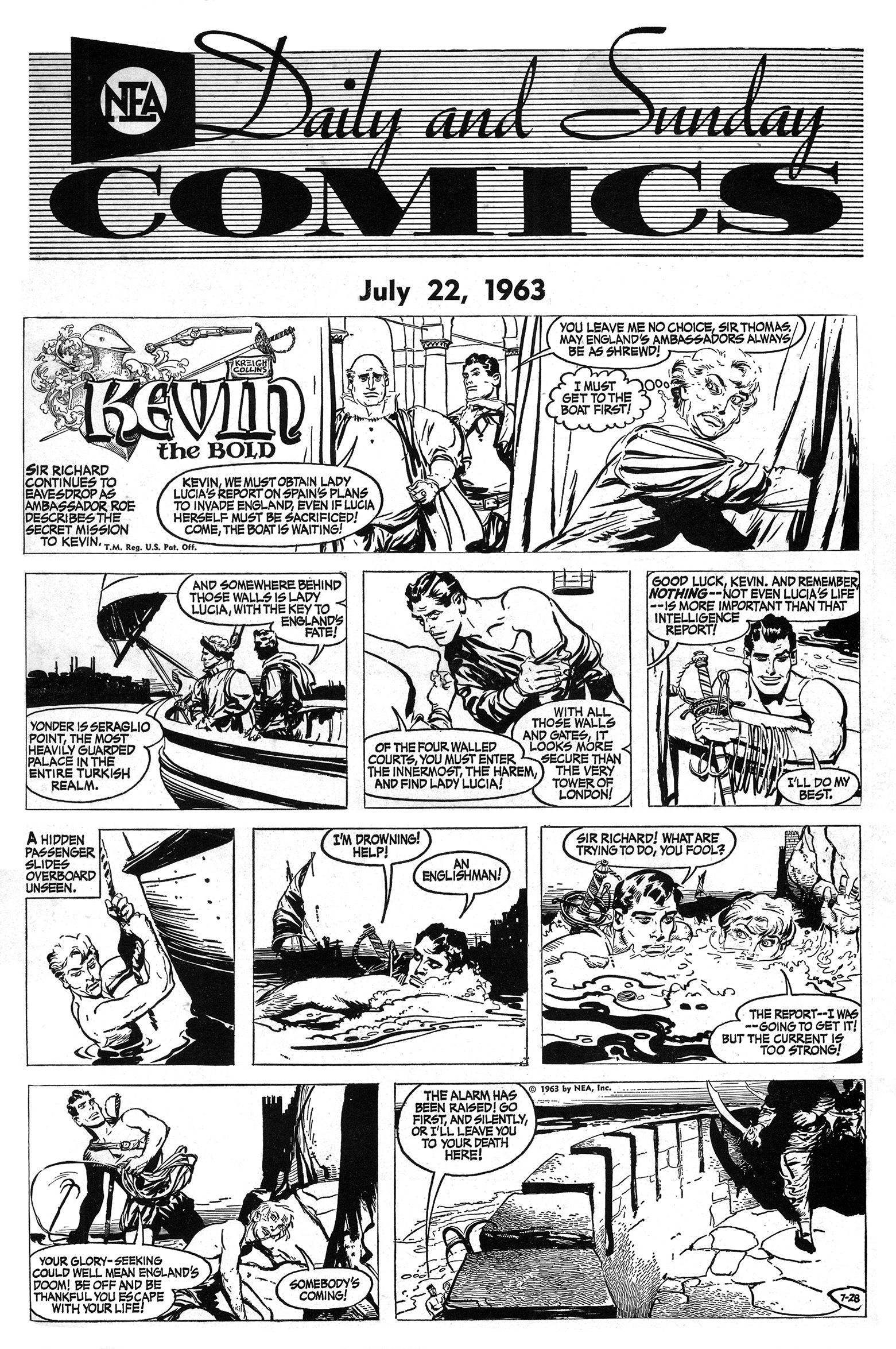
As this new adventure begins, Kevin is aboard a sailboat near Istanbul, a seemingly unusual place to secure intel on Spain’s plans to invade England.

KTB 072863 BWT 150 qcc.jpg

KTB 080463 HA 150 qcc.jpg

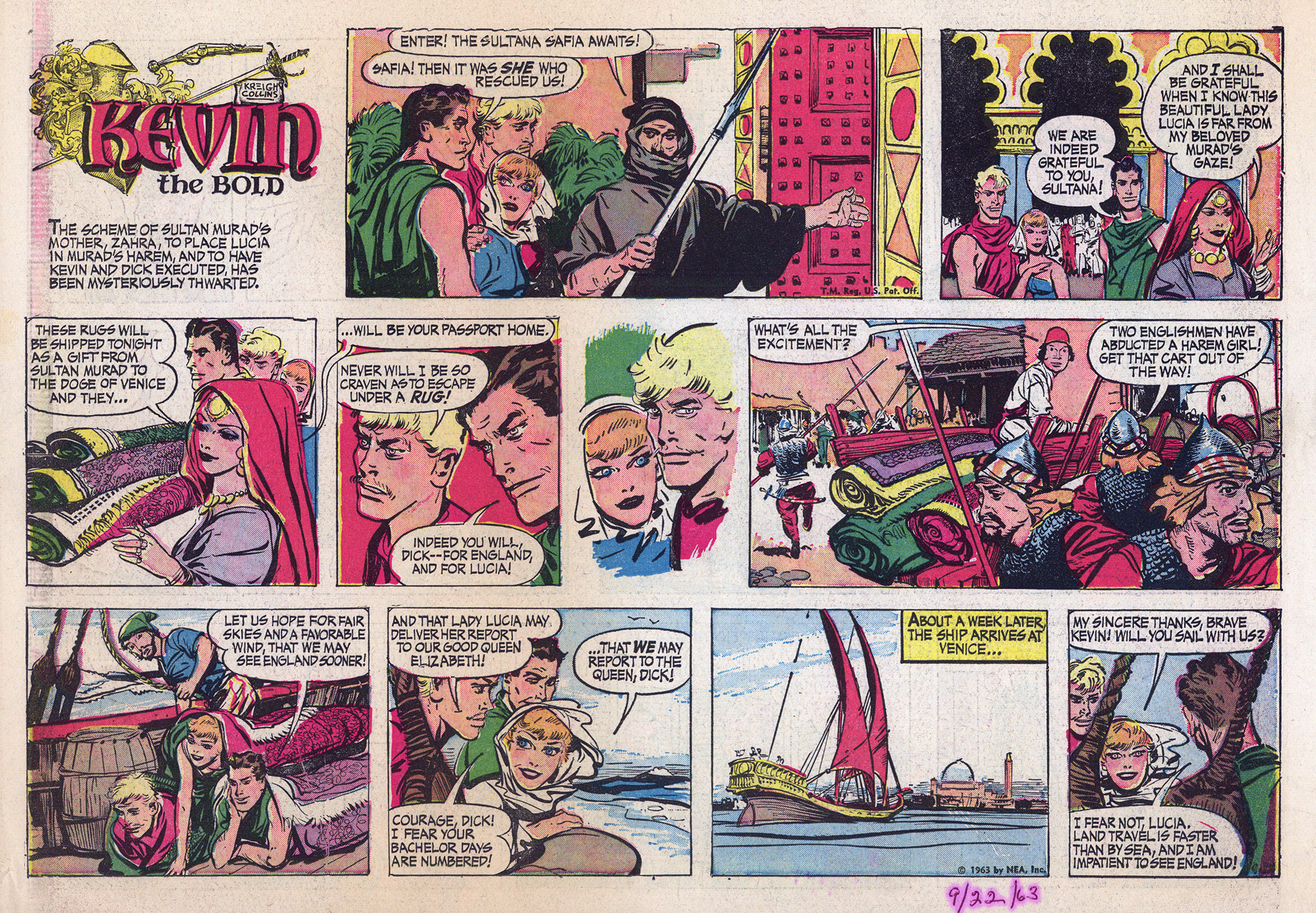
Due to the reference to Sultan Murad (III), the events depicted would be occurring c. 1580, the height of the Ottoman Empire. Kevin and tagalong Sir Richard are set to rescue the fetching English spy, Lucia.

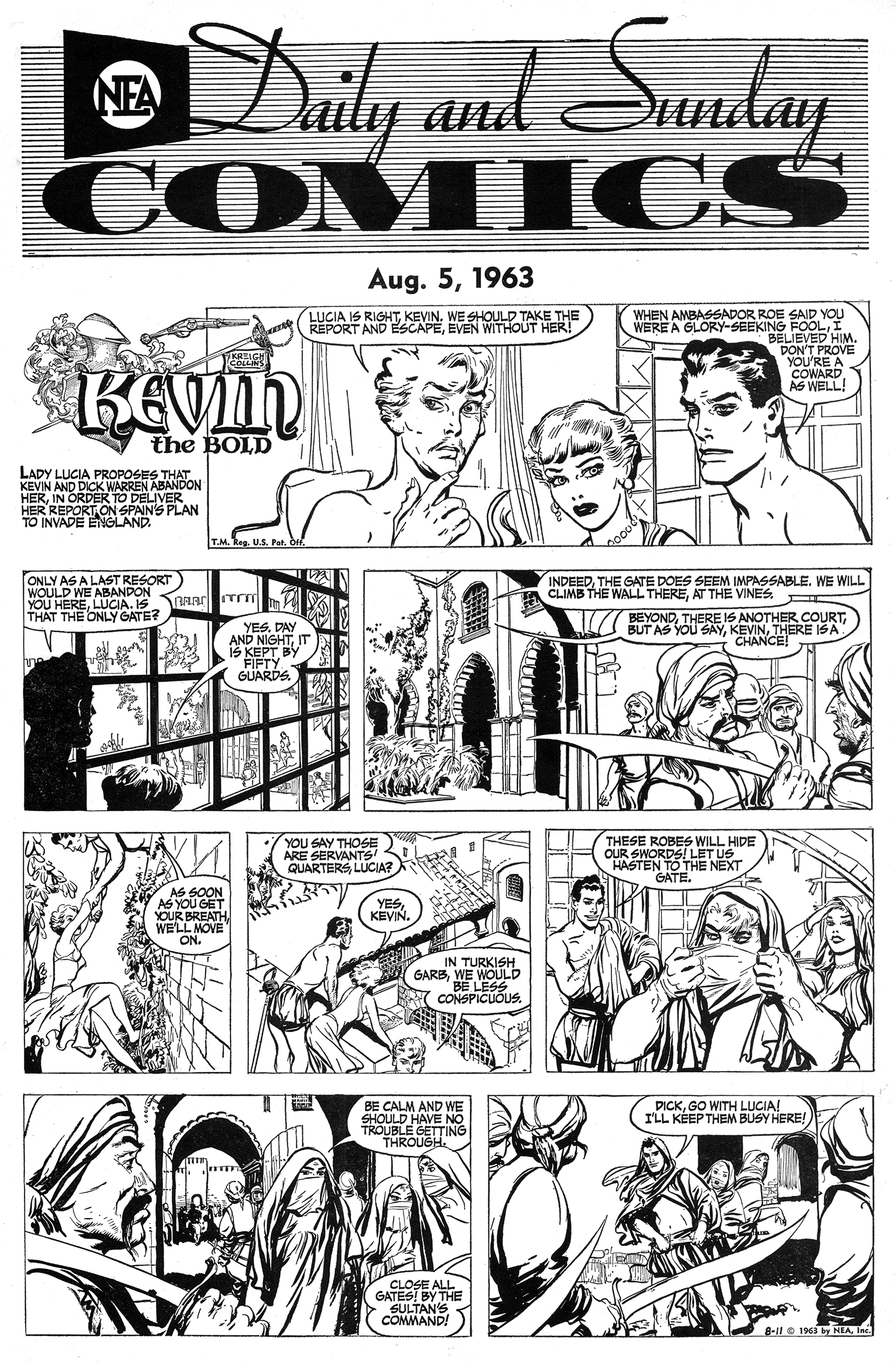
KTB 081163 BWT 150 qcc

The August 11 episode is a marvel, and Collins’ beautiful line work is fully on display in the NEA Daily. Despite Sir Richard’s timely suggestion to change into less conspicuous clothing, their daring escape is noticed.


For more information on the career of Kreigh Collins, visit his page on Facebook.

Fan Mail

Over the course of his 24-year career illustrating comics for NEA, Kreigh Collins received quite a bit of fan mail. No doubt it was flattering for Collins to read, but the real benefit was more tangible. Fan mail indicated engaged readers, and led to better treatment from the newspapers running the comics—more desirable placement in the comics section, and less chance of running in the unflattering one-third page version. When letters arrived at the NEA offices, staffers wrote back, thanking them, but suggesting they send praise directly to their local paper.

During the “Mitzi McCoy” era, Stub Goodman’s dog Tiny was the inspiration for much of the positive reader response. Tiny was an enormous Irish Wolfhound, and became the favorite of many, especially members of the Irish Wolfhound Club of America. Initially, these letters were encouraged—Lynn thought he could mobilize an enthusiastic base in a letter-writing campaign to help boost “Mitzi” ’s profile. Soon, however, it was decided the amount of energy spent catering to the wolfhound aficionados outweighed any benefit they provided.

After the successful debut of “Kevin the Bold,” one letter writer wondered (correctly) if the the comic strip was created by the same Kreigh Collins he had known who did illustration work for Chicago ad agencies in the early 1930s. (After all, my grandfather wasn’t the only one with that unusual name).

What other letters often had in common, besides praise, was a request. Would Mr. Collins please sent an autographed photo? Could he please send a drawing of Tiny/Mitzi/Kevin? Or would he be able to send a piece of original artwork?

Collins was happy to oblige. In his era, original comic art didn’t hold the cachet it does today. By the time his original illustrations were returned to him, those episodes were ancient history, and Collins would be busy refining layouts for upcoming comics and developing scripts for future ones. Besides mailing art to far flung fans, Kreigh also gave them to friends closer to home. Though it isn’t in fantastic condition, my favorite “Kevin the Bold” original is the one my Grandpa Collins gave to my Grandpa Palmer (my mother grew up in Grand Rapids, about ten miles from my father, who hailed from Ada, Michigan).

KTB 012162 OA 72

Personalized by the artist, top left.

Many letters complimenting Collins’ fine illustrations came due to his dogged research efforts, whether of 16th-century Austrian armorer Konrad Seusenhofer (“my family were armorers for generations going back as far as 1250… would you be so kind to give me the source of the information…”), 16th century sailing ships (“Above all I have enjoyed the lavish details that you put into your caravels…”), or period-appropriate clothing (“the thing I am so very fond of are the gorgeous clothes”).

Features Director Ernest Lynn used the fan mail as a sales tool. A letter sent to Miami Herald brass collected several glowing quotes and a referenced the Chicago Tribune’s use of “Kevin the Bold” in an attempt to persuade them to feature the comic.

1952 0109 Fan IMG_4823

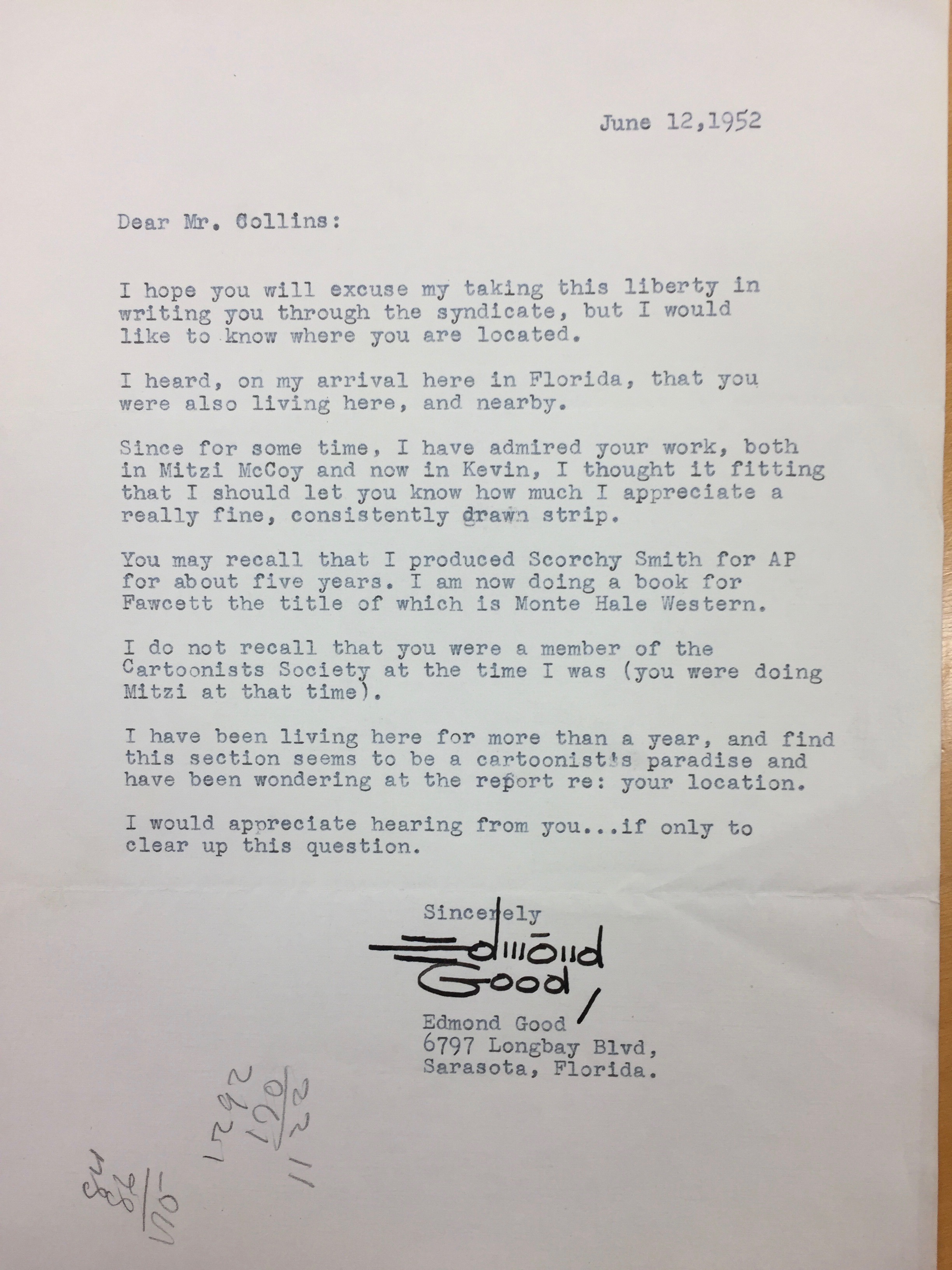
Letters from hobbyists and art students are one thing, but recognition from peers is something else. Another 1952 letter came from comic book artist Edmond Good. I was unfamiliar with his name, but after seeing his telltale signature, I looked him up.
1952 0612 Fan IMG_4828


For more information on the career of Kreigh Collins, visit his page on Facebook.

Murphy’s Law

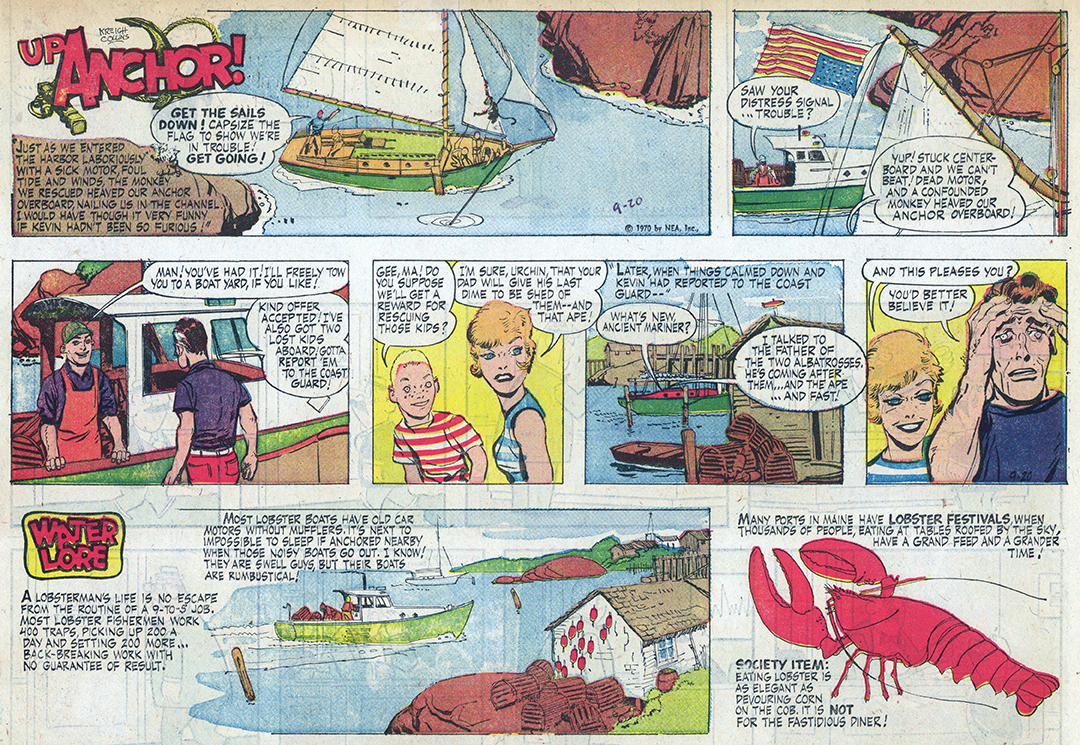
Since rescuing two kids and their monkey from a drifting rubber raft, everything that could go wrong did go wrong. However, Heather’s crew is pretty good at problem solving.

A leeboard was improvised, and worked pretty well until the monkey dropped anchor.

Luckily, tying up the loose ends wasn’t too challenging.

Unfortunately, the chapter concludes with an episode I don’t have. And Murphy’s Law dictates that the original artwork isn’t among the 75 examples found in Collection 56 at the Grand Rapids Public Library, either. (All told, there are 174 episodes of UP ANCHOR!).

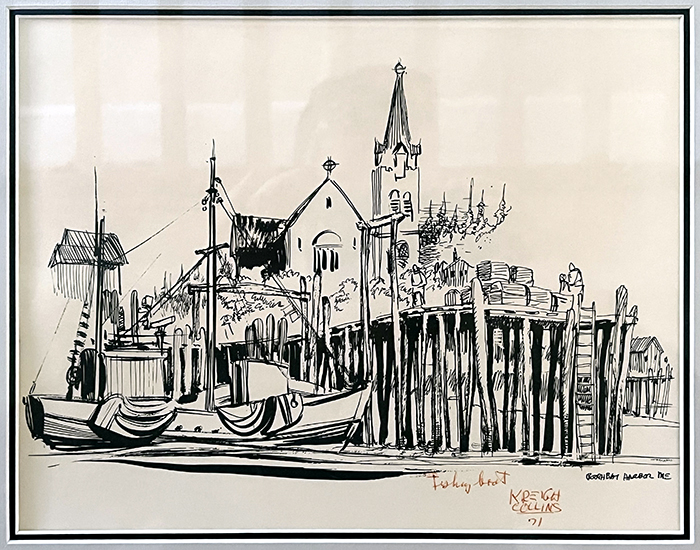
Nonetheless, it shows the family sailing into Boothbay Harbor, Maine, aboard the cutter they were delivering.

This ending was inspired by Collins and his family reaching Boothbay Harbor, Maine, aboard their schooner Heather in the summer of 1965. After a year of sailing, Boothbay Harbor was the furthest point east that they reached—over 1,000 miles from Lake Macatawa.

After wintering in Maine, Heather would start her return trip to west Michigan in the spring. By August she would be home.

_______________________________________________________________

For more information on the career of Kreigh Collins, visit his page on Facebook.